
How to Build a Blackwater Aquascape That Stays Stable
A blackwater aquascape uses wood, dried leaves and other botanicals to stain aquarium water the colour of tea, like the forest rivers of the Amazon basin. Before any leaf goes in, test the KH and pH of your tap water, because soft water takes the tint and a falling pH easily while hard water holds its pH against the leaves.
What is a blackwater aquascape, and what do you decide first?
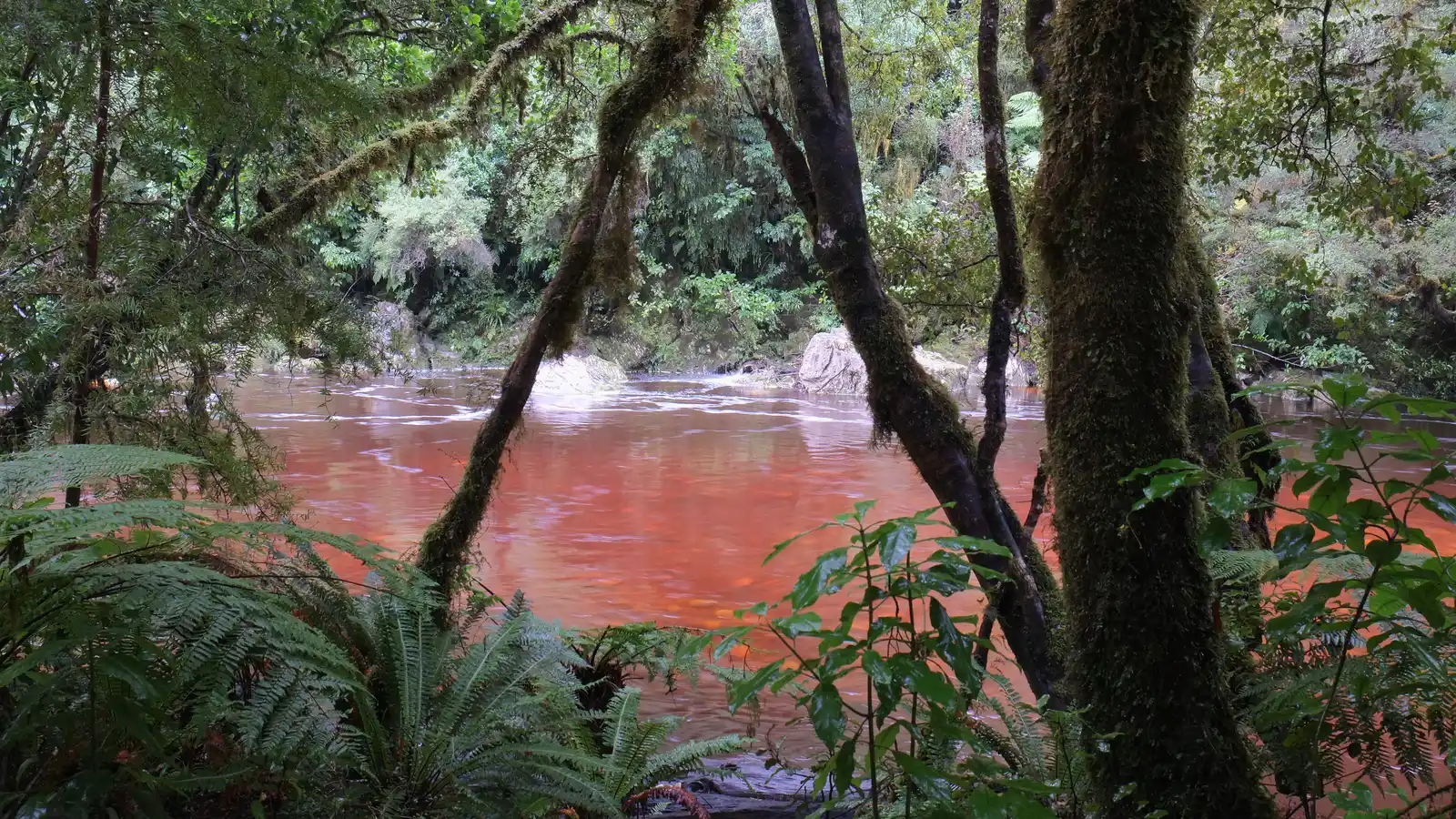
A blackwater aquascape is a layout of wood, dried leaves and other plant material that stains the water the colour of tea, modelled on forest rivers such as the Rio Negro in the Amazon basin.
The first decision is whether you want a tea-coloured display or a specialist low-mineral habitat. Test source-water GH, KH and pH and check the intended fish's requirements before choosing materials; tint alone does not tell you whether the water suits them.
GH describes calcium and magnesium hardness, while a carbonate hardness (KH) test estimates acid-neutralising capacity. Low KH leaves less resistance to a pH change, so a leaf addition cannot be assumed to cause only a gentle drop.
Water with substantial alkalinity may become tinted with little pH change. Leaves are not a dependable way to turn mineral-rich tap water into soft water, and a dark colour does not establish a safe chemistry for any species.
In the wild the colour comes from chemistry, not dirt. Soils in the Rio Negro basin are mostly silicate sand that holds few nutrients, so the river carries very few dissolved minerals, bacteria break fallen plant matter down slowly, and the humic and fulvic acids left behind stain the water and make it acidic.
Very little sediment travels with it, so blackwater is dark but still clear, because light passes through the stain instead of being blocked by suspended mud.
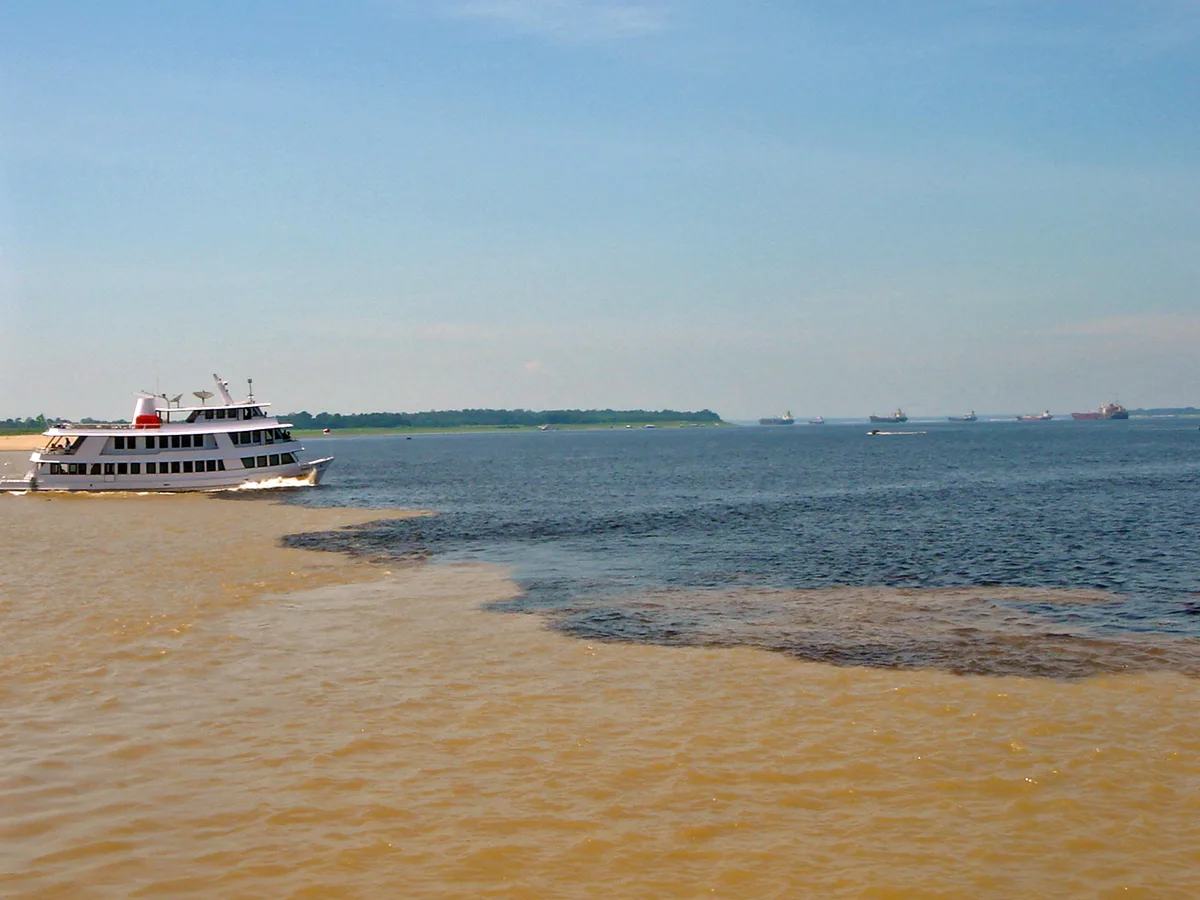
These river measurements explain where the look comes from and are not targets a home aquarium has to reach.
- pH in the Rio Negro
- Roughly 4.0 to 5.5 near Manaus; one survey at Novo Airão measured pH 4.67
- Dissolved organic carbon
- 5 to 30 mg C/L across Amazonian blackwater rivers; one Rio Negro dataset recorded 8.75 mg/L in the wet season and 5.84 mg/L in the dry season
- Calcium
- 0.16 to 0.17 mg/L in that Rio Negro dataset, far below most tap water
- Alkalinity
- 7.7 to 12.4 mg/L as CaCO3, which is under 1 dKH
- Conductivity
- About 12 µS/cm at Novo Airão, a sign of almost no dissolved minerals
Few aquarium fish need those extremes. Cardinal tetras come from this water, yet Seriously Fish records the same species in clearer Orinoco habitats at around pH 5.5 to 6.5, which makes dark water a choice of look rather than a requirement.
What does each material do in a blackwater tank?
Each material stains the water, builds structure, or gives cover, and knowing which does what lets you build the look without adding more decaying matter than the filter and your maintenance can carry.
Driftwood
The main structure. Dense hardwoods release tannins for weeks or months, strongest at first and fading with time, so soaking removes the heaviest early flush.
Dried leaves
Indian almond (catappa), oak and beech leaves collected brown and dry sink, stain the water and form a litter layer. They soften and break down over weeks, so they are topped up rather than placed once.
Alder cones
Small, dense and slow to break down. They add tint in soft water with little debris, which makes them useful for small adjustments.
Seed pods and bark
Tougher botanicals that keep their shape for months. They add texture and hiding places for small fish more than colour.
Fine sand
Lets litter rest on top and lets bottom fish sift. Coarse gravel traps leaf fragments where they rot out of sight.
Floating plants
Shade the surface the way a forest canopy does and take up some of the nitrate that decay releases.
Use correctly identified aquarium-suitable botanicals with a known, uncontaminated origin. Being brown, dry or collected away from a road does not by itself establish safety; rinsing or boiling cannot certify unknown material as pesticide-free.
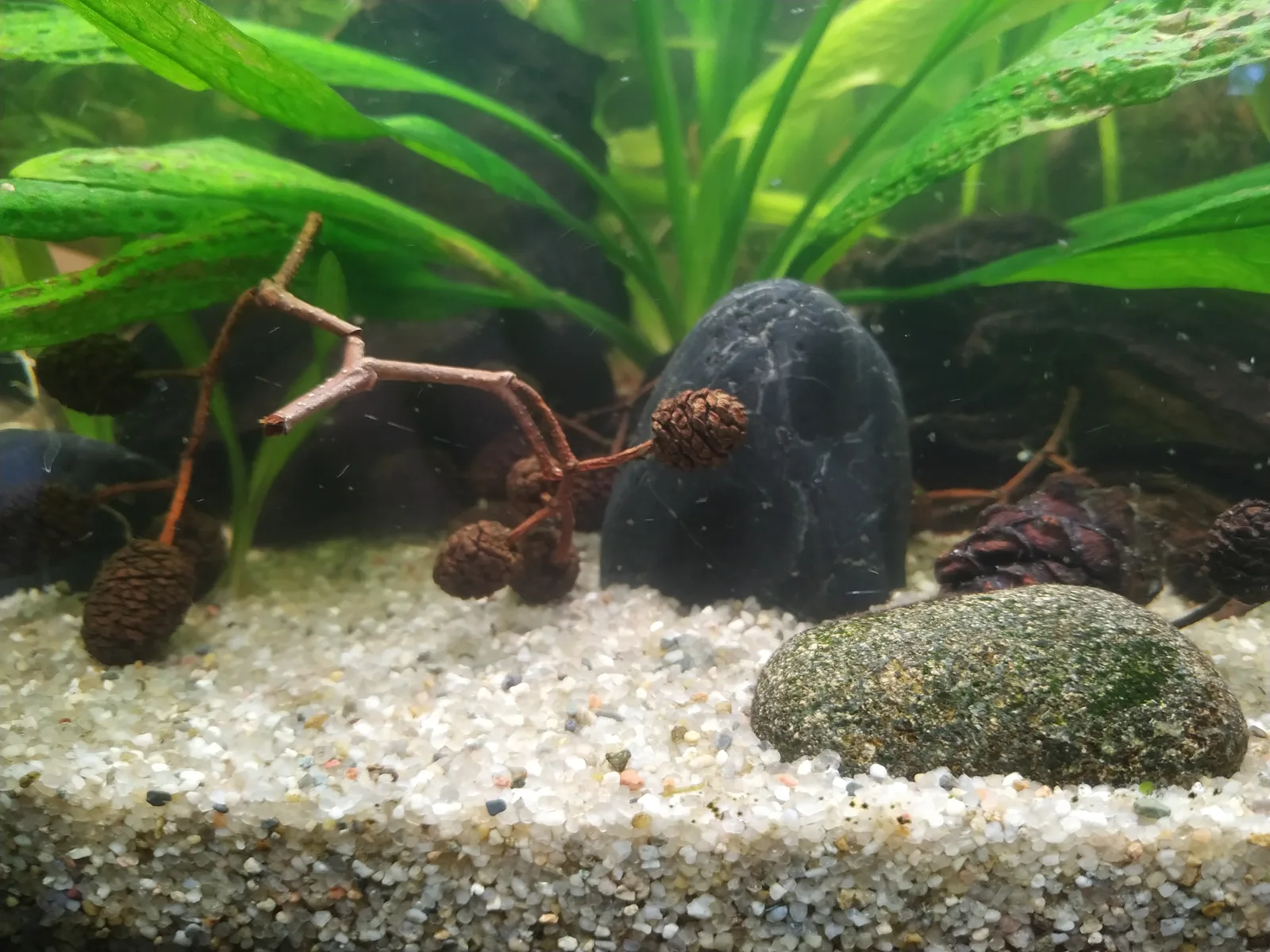
Peat was once the usual way to stain and soften water through the filter. It is no longer needed, since Seriously Fish describes collecting natural peat as unsustainable and environmentally destructive, and wood, leaves and cones supply the tint without it.
Indian almond leaves also carry a reputation as a natural remedy, but the evidence stops at the laboratory.
Concentrated leaf extracts slowed the growth of fish disease bacteria such as Aeromonas in dishes, and the researchers state the result still has to be tested in live fish.
A leaf in a display tank is tint and cover, so a sick fish still needs its cause found, usually starting with the water and a quarantine tank.
How do you build a blackwater aquascape step by step?
Build order matters because leaves and botanicals are the part that decays. Hard structure goes in first, the filter matures next, and litter arrives last, so each stage can be checked before the next one adds load.
- Record the source water Test tap KH, GH and pH and write the readings down, so every later change has a baseline.
- Lay the substrate Spread fine sand in a thin layer that slopes gently toward the back, leaving the front shallow enough to siphon.
- Place soaked wood Build the structure from driftwood that has already been soaked, and keep a clear lane along the front glass for maintenance.
- Attach the plants Tie or glue epiphytes such as anubias and ferns to the wood before the tank is filled, while every surface is still easy to reach.
- Fill and cycle Use dechlorinated water and complete fishless cycling before stocking. Follow the cycling guide to verify processing of a known ammonia input to undetectable ammonia and nitrite; never add cycling ammonia when animals are present.
- Add leaves in stages Trial the material without fish and check pH, KH, ammonia and nitrite before further additions. Stop adding botanicals if readings deteriorate; neither a leaf count nor a colour is a safe dose.
- Assess readiness before stocking Add fish only after fishless cycling is demonstrated under the intended water conditions and the botanical additions have not destabilised them. Stable pH through two water changes alone does not prove readiness; do not use hardy fish to test the filter.
Why the filter should cycle before the leaves go in
A new filter has not yet grown the bacteria that turn ammonia into nitrite and then nitrate through the aquarium nitrogen cycle, and leaves add organic waste during exactly the weeks when the filter is least able to handle it.
The SRAC start-up guidance describes conditions for conventional recirculating aquaculture biofilters, not a validated protocol for every acidic aquarium. A filter established under different water conditions must not be assumed to retain the same capacity after acidification.
Where leaves should sit in the layout
Leaves drift until the current stops them, so they collect wherever the flow is weakest. Placing wood so those dead spots sit near the front, within reach of a siphon, keeps litter visible instead of rotting behind rocks.
A thin layer ages better than a deep one, because water reaches the whole layer when sand still shows through the gaps, and the bottom of the pile is less likely to run out of oxygen.
Why tint is added gradually
Colour and pH respond over several days, and a large batch of fresh botanicals added at once can push the pH of soft water down faster than the fish or the filter can adjust, which is why the tint is built up in small additions with a test between each one.
How dark should the water be, and what does the tint change?
There is no correct shade. Pale amber and strong tea are both valid blackwater looks, and the right depth depends on the plants, the fish and how closely you can watch them.
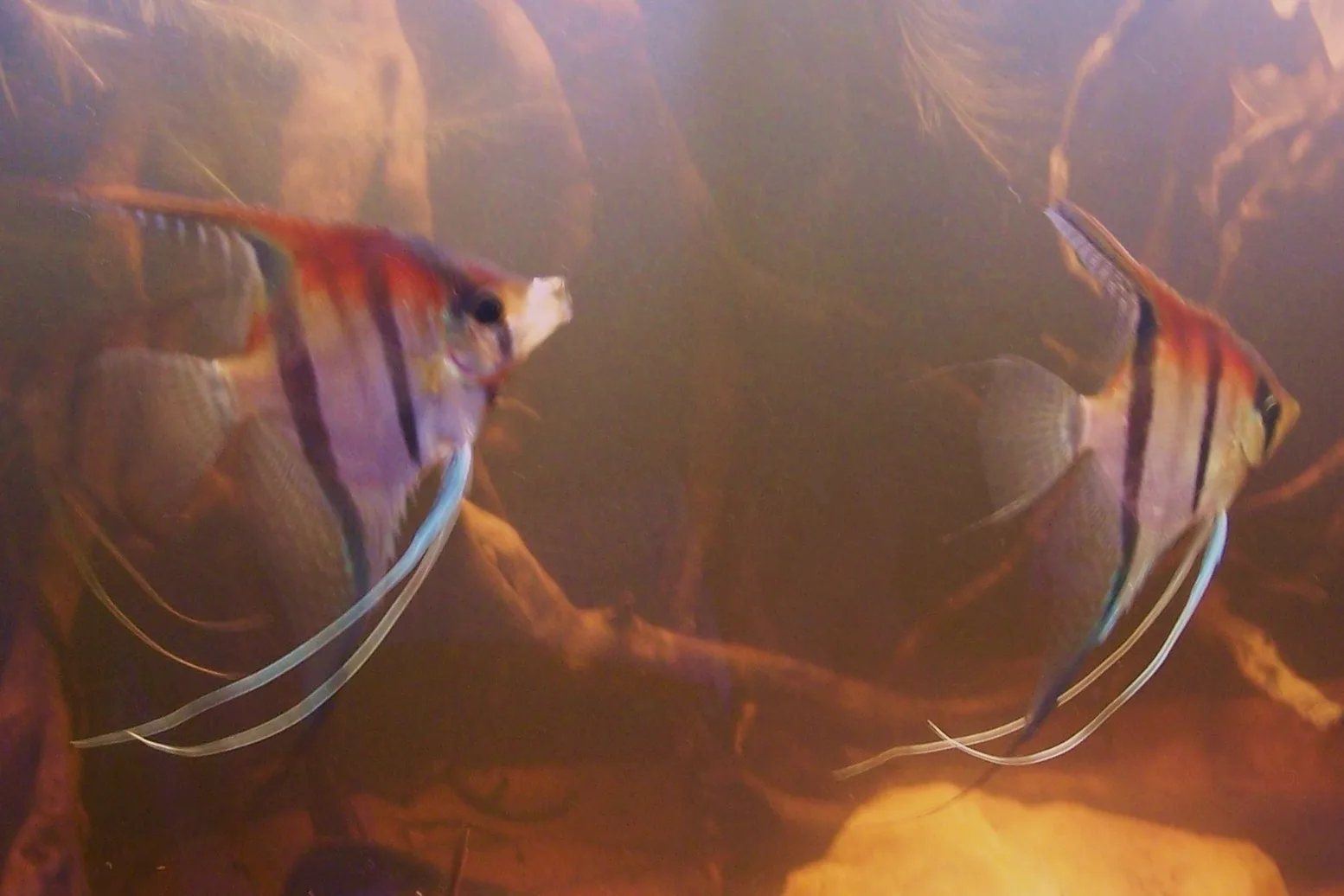
The tint works as a filter on light. Humic substances absorb ultraviolet and blue light strongly, which is where the tea colour comes from, so less light reaches the lower half of the tank and the light that does arrive is warmer.
| Decision factor | Clear or lightly tinted | Strongly stained |
|---|---|---|
| Light at the substrate | Most of the light reaches the bottom | Much less reaches low plants, blue light especially |
| Plant choice | Most low and medium light plants | Slow epiphytes placed high, plus floating plants |
| Seeing problems | Uneaten food and waste are easy to spot | Needs closer inspection, sometimes a torch |
| How fish look | Neutral, cooler colours | Warmer, with an amber cast over everything |
| pH and hardness | Cannot be inferred from appearance | Cannot be inferred from appearance; measure both rather than judging the tint |
| Activated carbon in the filter | Keeps the water clear | Removes the tint as it adsorbs organic matter |
| Water changes | No visible change | Each change dilutes the colour until the botanicals restore it |
Darker water hides problems as well as fish, so a deep tint needs a routine that still catches uneaten food, a fish hanging back from the group, or a leaf turning to mush.
Holding a steady colour comes from balance between what stains and what dilutes. Wood provides a base colour for months, leaves top it up, and every water change removes part of it, so replacing a few leaves as old ones break down keeps the shade far steadier than one large addition.
Activated carbon clears tint from the water, which helps when a shade has gone too dark and explains why a tank that stays stubbornly clear often has a carbon pad hidden in the filter.
Heavy tint changes the light available to submerged plants. Plant choice and placement should suit the light that actually reaches their leaves; stronger lighting cannot be assumed to solve poor growth, and a pale tint alone does not establish that light is adequate.
How do you manage decomposing leaves and botanicals?
Leaves change in a predictable order. They soften, grow a white or grey coating of fungi and bacteria, then thin out until only the veins remain, and that coating is normal: Seriously Fish notes that the microbe colonies growing on decaying leaves become a secondary food source for fry.
Decay also uses oxygen: leaf litter decomposing in flooded Amazon forest is a recognised cause of low oxygen at high water, and a tank with deep litter and weak flow can repeat that at night, when plants stop producing oxygen.
Working through the warning signs in order separates an ordinary stage of breakdown from a load the filter and oxygen supply cannot carry.
When decay goes wrong, check these first
- Detectable ammonia or nitrite Check filtration, decay, feeding and source water. Pause botanical additions and assess the readings with pH and temperature; a low-pH tank with accumulated ammonia needs the correction precautions below.
- Fish gasping or breathing fast Improve aeration immediately and test ammonia, nitrite, pH and temperature. Breathing distress has several causes; severe distress, loss of balance or deaths require urgent aquatic-veterinary help.
- Rotten egg smell Suspect hazardous hydrogen sulfide, not routine leaf decay. Stop disturbing the substrate, maintain aeration and seek urgent help; do not wait until the next scheduled cleaning or transfer fish into untested water.
- Oily or dusty film on the surface Decay and food leave oils that settle at the surface. More surface agitation clears it, and a film that keeps returning means the organic load is too high.
- Milky water after new botanicals A microbial bloom is possible, but appearance does not confirm the cause or safety. Pause additions, check aeration and water tests, and respond urgently if fish show distress.
- White fuzz on new wood or leaves Usually a harmless fungal and bacterial growth that fades within a few weeks. Fuzz on a fish is a different matter and needs isolation and a closer look.
- pH lower at every test Check alkalinity and the wider water-quality picture; the trend alone does not identify its cause.
Routine care keeps most of these away. Siphoning lightly beneath the litter at each water change and replacing a portion of the leaves at a time means the tank never loses all its litter, or all its colour, at once.
Some signs point past the layout. Continuing losses, ulcers, frayed or bloody fins, or fish that keep gasping after oxygen and water quality have been corrected mean an aquatic veterinarian should examine them rather than another round of layout changes.
Why can pH crash in a blackwater tank, and how do you stop it?
Acid production can consume the water's alkalinity, leaving less resistance to a pH drop. Bicarbonate and carbonate commonly contribute to alkalinity, but GH, KH and pH describe different properties and should not be treated as interchangeable readings.
The Merck Veterinary Manual describes the result as a pH drop that can be gradual or sudden once bicarbonate is depleted. Soft water starts with little KH to lose, which is why the aquarium KH reading matters more in a blackwater tank than the tint.
Guidance on how low KH can go differs, and Merck states that total alkalinity at or below 50 mg/L as CaCO3, about 2.8 dKH, inhibits normal biofilter function.
Measurements from a flowing river cannot establish a safe operating limit for a closed aquarium. Low-mineral habitat replication requires a species-specific water and filtration plan; a tinted display need not reproduce the river's extremes.
Merck describes small daily water changes for old tank syndrome, with precautions against both pH shock and ammonia toxicity. That is not a fixed-volume recipe for every blackwater tank; suspected ammonia accumulation calls for prompt qualified advice rather than chasing pH.
A liquid test kit must cover the range being measured and be used according to its instructions. Keep dated readings, test after material or maintenance changes, and test immediately when behaviour changes; a stable run does not justify abandoning monitoring.
The separate blackwater aquarium chemistry guide explains the water measurements behind this style. This layout guide does not prescribe acid dosing, a mineral-removal recipe or a universal low-pH target.
A pH that keeps dropping in spite of regular water changes has causes beyond the leaves.
Which fish and plants suit a blackwater aquascape?
Fish from soft, stained, slow water suit the style best, especially small South American tetras and Southeast Asian rasboras from peat swamp forest. Soft water matters more to them than the tint, so a stable soft tank with light colour serves them better than dark water with a drifting pH.
Fish from soft, tannin-stained habitats
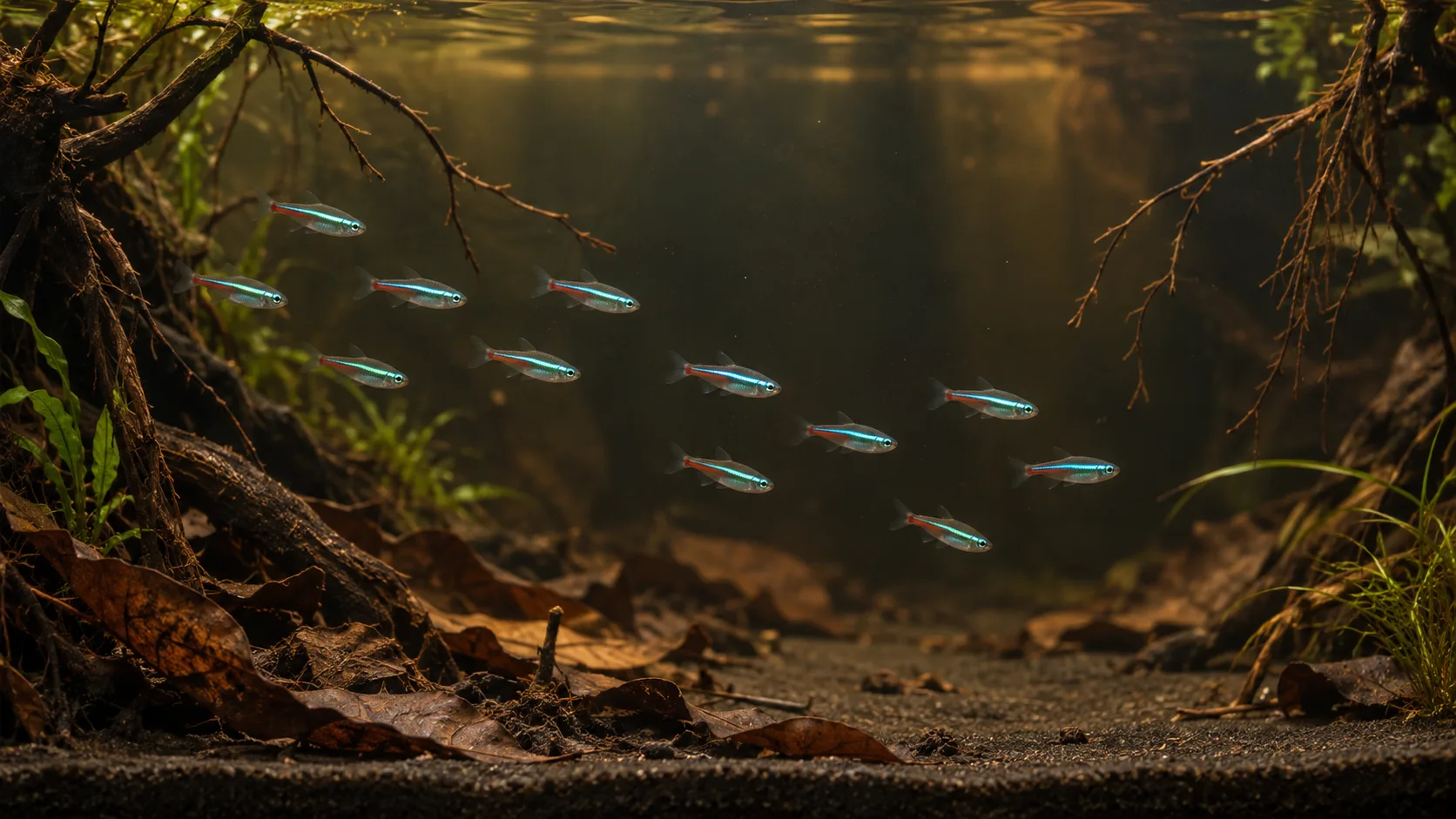
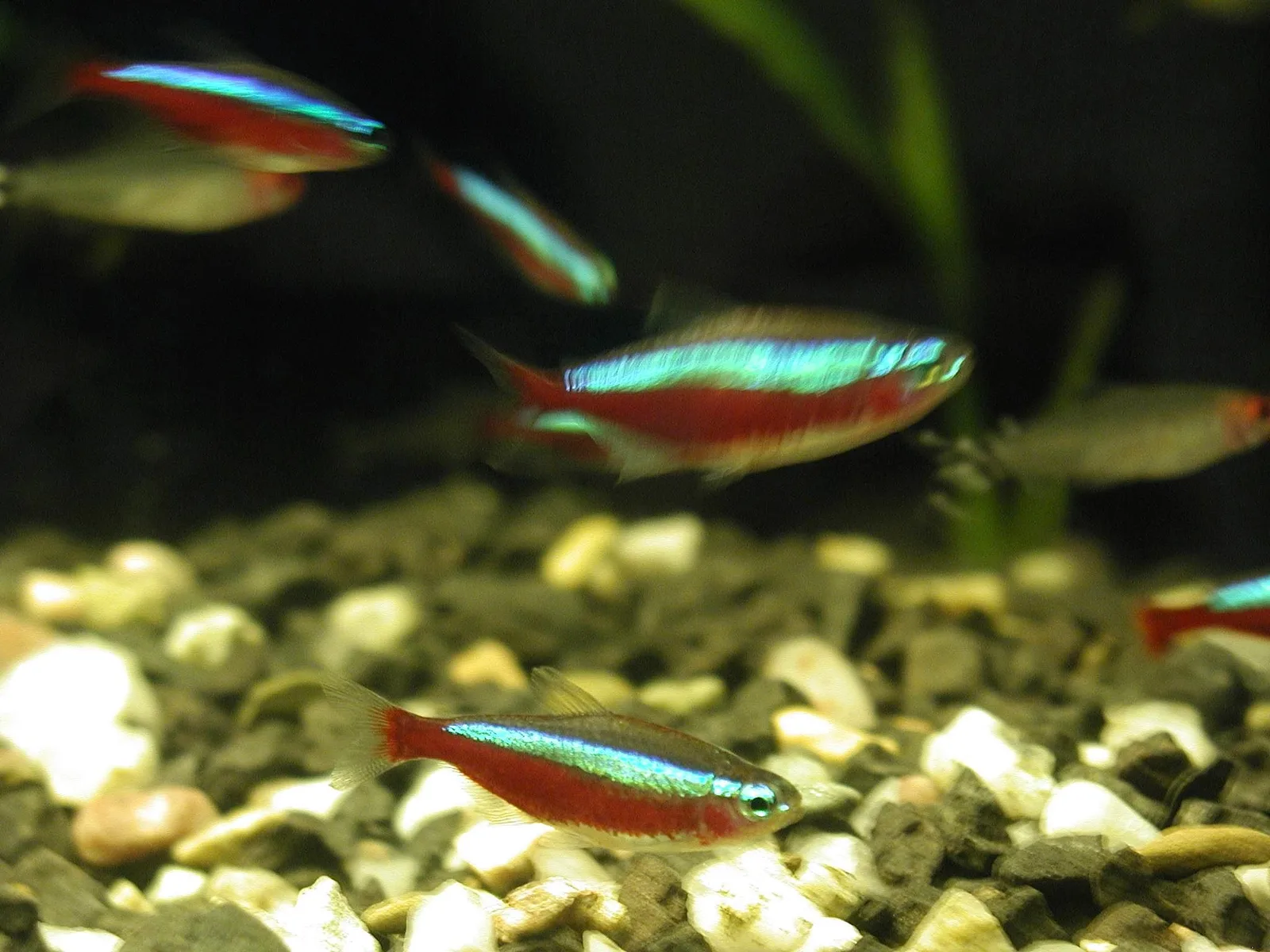
 Cardinal tetra
Blackwater streams of the upper Orinoco and Rio Negro; kept as a group in a planted, dimly lit tank.
 Green neon tetra
Upper Negro and Orinoco basins; tiny and better with fine foods and very calm companions.
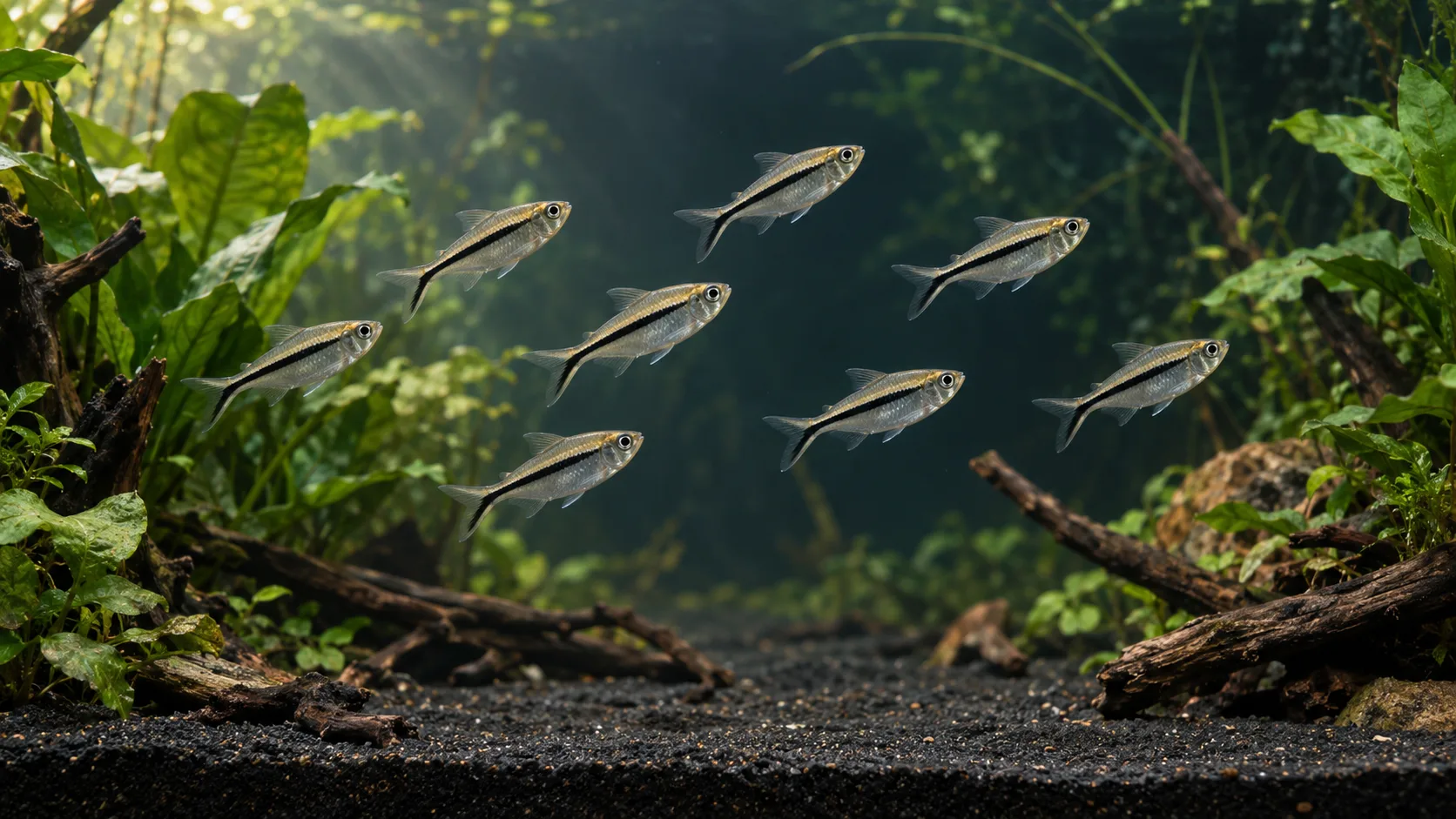 Penguin tetra
Adaptable across a wide pH range, so it suits a lightly tinted tank on harder tap water.
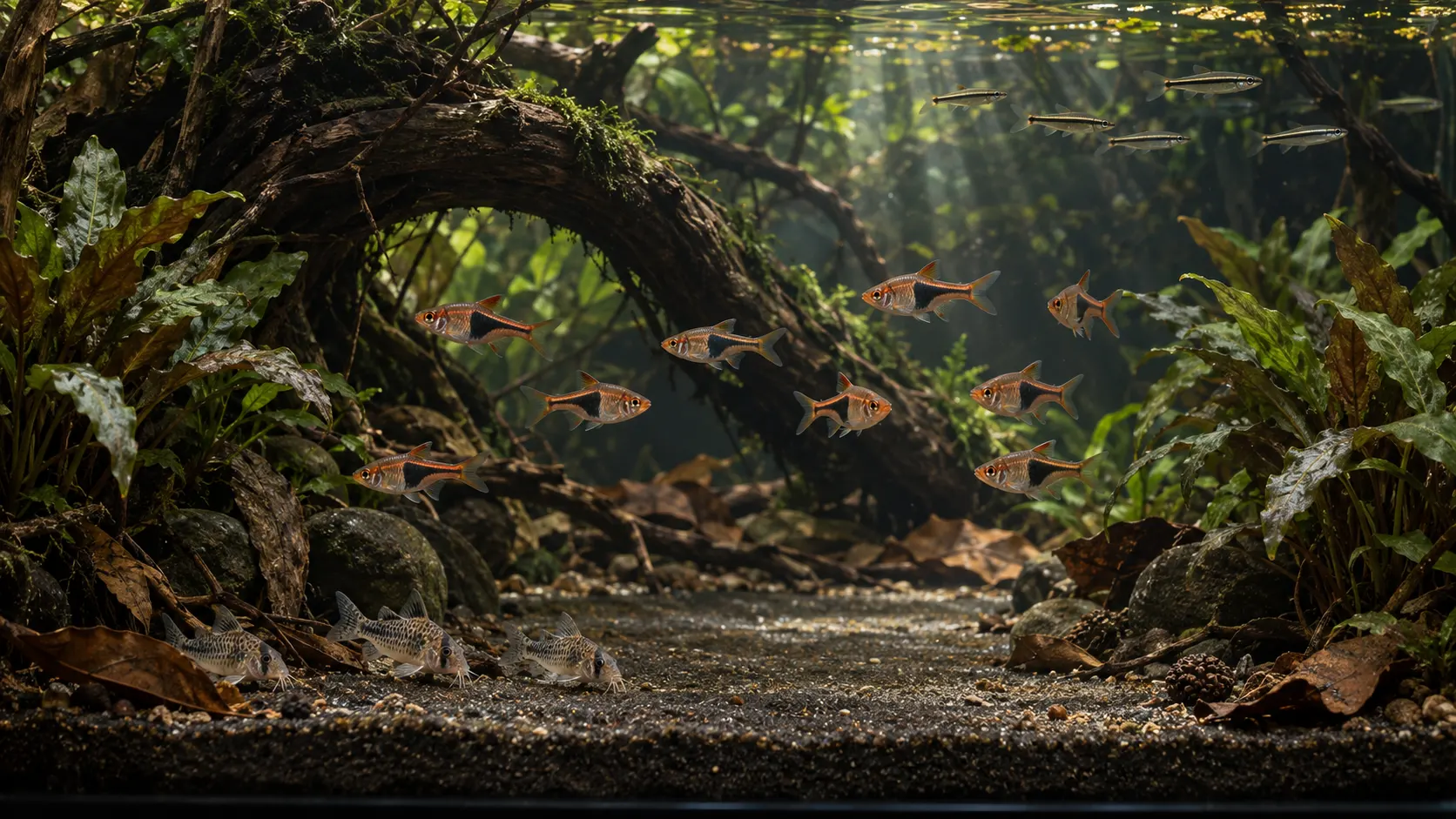 Harlequin rasbora
Forest streams and peat swamps of Malaysia and Indonesia; a midwater school.
 Chili rasbora
A minute fish from peat swamp country in southern Borneo, suited to small, quiet layouts.
 Clown rasbora
Blackwater peat swamp streams; reaches about 10 cm, so it needs a far larger tank than the others.
Other documented species fit too: the neon tetra comes from both blackwater and clearwater tributaries, the brilliant rasbora and emerald eye rasbora come from Southeast Asian peat swamp systems, and pencilfish and hatchetfish use the calm upper water that floating plants shade.
A blackwater look can mix fish from two continents, which is fine for a display but is not a habitat reconstruction. Matching one river's species, water and materials is the job of a biotope aquarium, and a group that shares one blackwater stream makes a stronger layout than a mix chosen for colour.
Hard water livebearers are the poor fit, because the guppy, platy and molly come from harder, more alkaline water, and a soft, acidic blackwater tank works against them even when it looks right.
Plants have to cope with dim, soft water, and the reliable ones grow on wood rather than in the substrate. Anubias barteri takes low light tied to a branch, java fern and java moss do the same, and Seriously Fish lists Cryptocoryne as a rooted choice that tolerates the dim light cardinals prefer.
African water fern needs more light than anubias, so it grows better near the surface or under a lighter tint. Floating plants such as Amazon frogbit and Salvinia minima supply the canopy shade, and thinning them regularly keeps enough light and gas exchange at the surface.