
What Is a Neon Tetra, and What Does Its School Need?
Paracheirodon innesi
The neon tetra is a 2.5 cm South American schooling fish identified by a blue-green stripe and red colour on the rear half of the body. A healthy group needs a mature aquarium at least 60 cm long, shaded cover, open midwater, fine distributed food, and stable water close to the conditions in which the stock was raised.
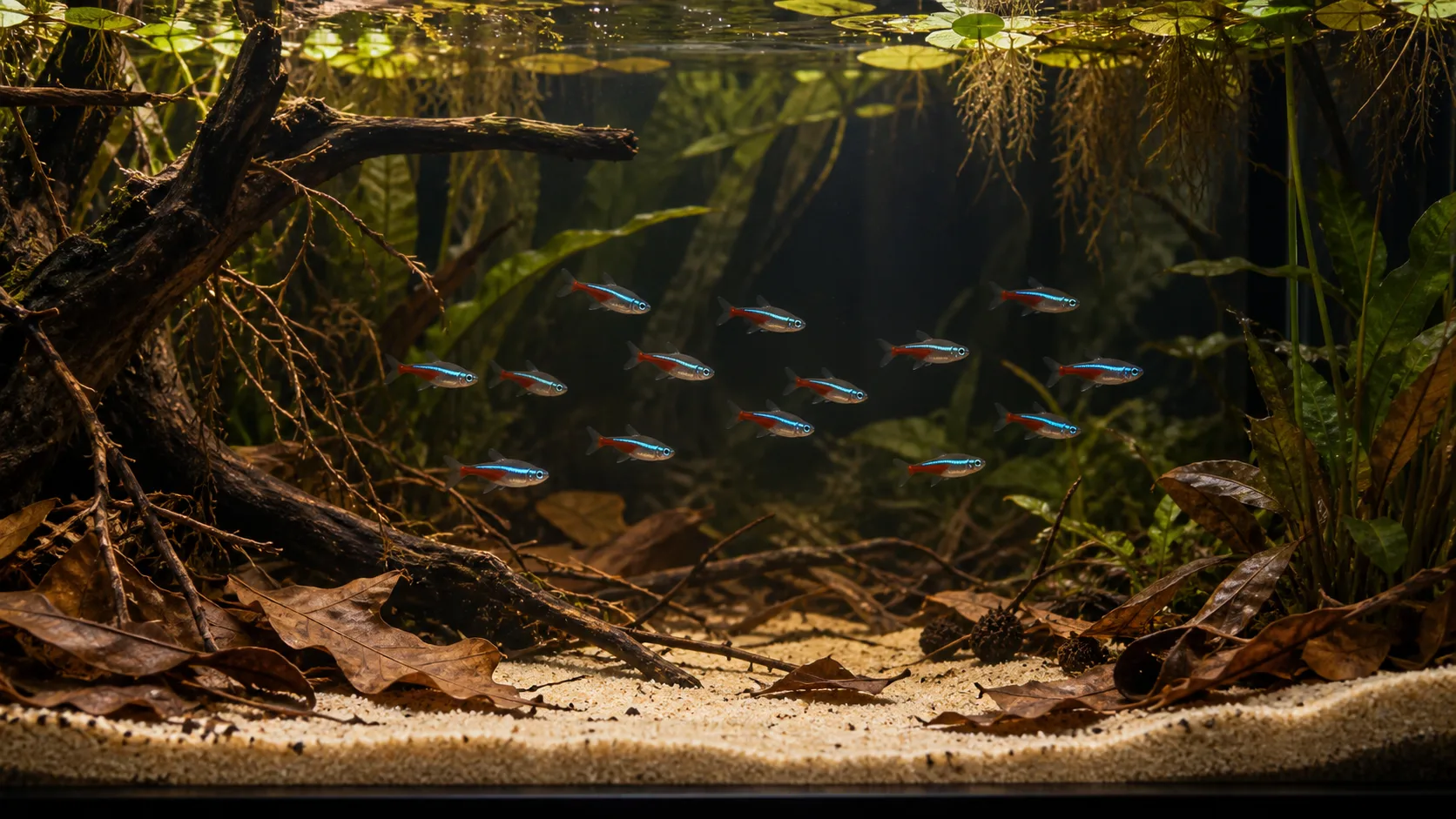
At a glance

- Adult size
- 2 to 2.5 cm
- Minimum footprint
- 60 x 30 cm or larger
- Minimum volume
- 54 litres
- Social structure
- Schooling midwater fish; keep a complete group
- Minimum group
- 10
- Diet
- Omnivore
- Feeding
- Use shaded cover and open midwater; compare supplier and receiving water before acclimation.
- Waste load
- low per fish; moderate for a full school
- Family
- Acestrorhamphidae
- Native range
- Blackwater and clearwater tributaries of the Solimões system in northern South America
- Conservation status
- Least Concern, assessed 4 March 2021 Source
Adult body size, social structure, swimming behaviour, open routes, and filtration are considered together.
What is a neon tetra?
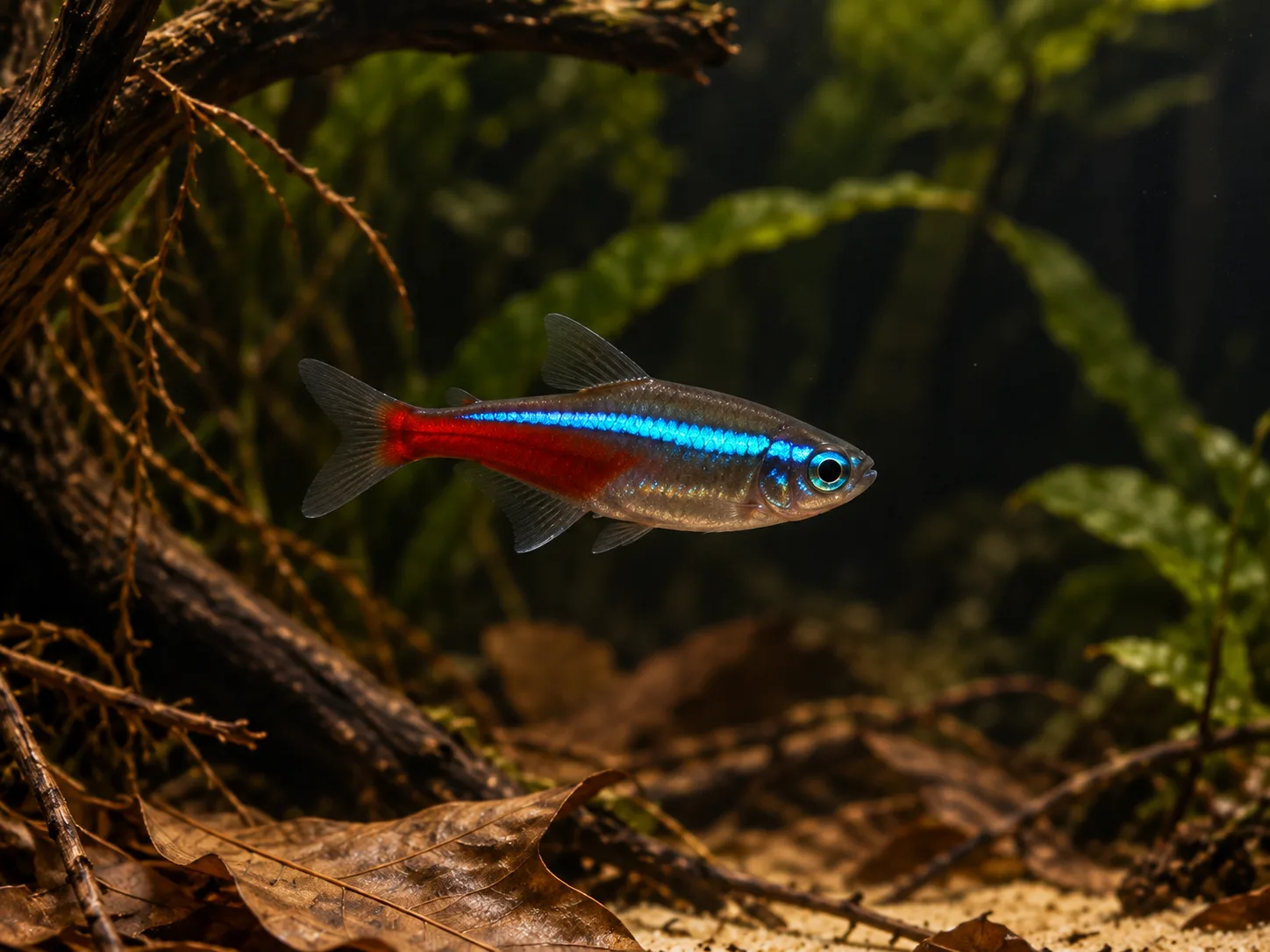
A neon tetra is Paracheirodon innesi, a small South American schooling fish with an iridescent blue-green stripe and a red stripe limited mainly to the rear half of the body. That red pattern separates it from the cardinal tetra, whose red extends much farther forward.
The green neon tetra is smaller and carries a different body pattern, while the black neon tetra belongs to another genus. Trade names containing “neon” therefore do not describe one interchangeable care group.
- Accepted identity
- Paracheirodon innesi (Myers, 1936)
- Family
- Acestrorhamphidae
- Native setting
- Blackwater and clearwater tributaries of the Solimões system
- Published maximum size
- 2.5 cm standard length
- Social structure
- Schooling fish kept in a complete group
- Published aquarium length
- At least 60 cm
- Compiled water context
- 20 to 26 °C, pH 5.0 to 7.0, 1 to 2 dH
- Recorded diet
- Worms, small insects, crustaceans, and plant material
- Conservation
- Least Concern, assessed 4 March 2021
FishBase accepts the name and records the size, habitat, diet, and environmental values. The U.S. Fish and Wildlife Service identifies it as a widely traded tropical species and documents failed or uncertain introductions, reinforcing the rule that aquarium fish and water stay out of natural waterways.
How do neon tetras differ from similar blue-striped tetras?
The neon tetra's red colour is concentrated on the rear half of the body beneath a bright blue-green lateral stripe. A cardinal tetra carries much more red along the lower body, while a green neon is smaller and shows a different balance of blue-green and red; the unrelated black neon uses a dark horizontal pattern rather than the same red-and-blue combination.
| Fish | Useful visual clue | Care consequence |
|---|---|---|
| Neon tetra | Red mainly on the rear half below the blue-green stripe | Match group and water requirements to Paracheirodon innesi |
| Cardinal tetra | Red extends along most of the lower body | Do not assume its preferred temperature matches a neon group |
| Green neon tetra | Smaller body with a strong blue-green line and reduced red | Its scale changes tank-mate and feeding decisions |
| Black neon tetra | Dark lateral stripe with pale reflective line above | Shared common name does not make it the same species |
Colour alone becomes unreliable in stressed shop fish, poor light, or a blurred photograph. Body proportions, stripe placement, seller records, and a clear side view should agree before a fish is treated as a particular species.
Do not mix look-alike fish to create one apparent school. Closely related tetras may swim near each other, but each species still needs enough conspecifics for its own social behaviour and must share a genuinely suitable temperature and water context.
How many neon tetras should live together?
FishBase and OATA give five as a minimum group, with OATA noting that more is better. In a mature aquarium at least 60 cm long, ten to fifteen creates more social choice and a more stable visual school without turning the minimum into a stocking target.
Neons do not hold a parade formation all day. A relaxed group spreads among plants and open water, then tightens after a sudden movement or when a larger fish passes.
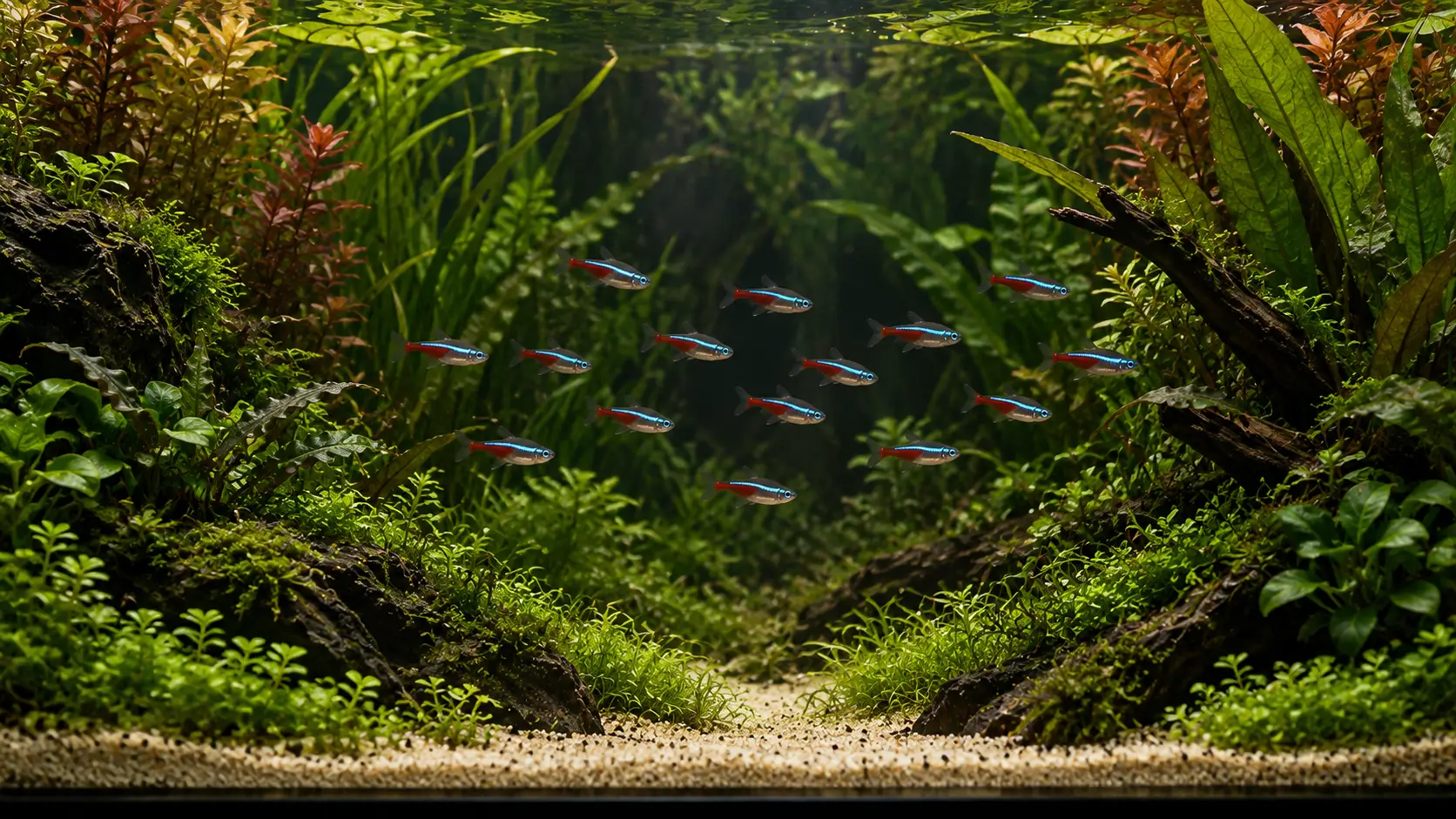
- Fit the complete neon group before counting tank mates.
- Preserve at least 60 cm of horizontal swimming length.
- Give the school shaded edges and an open middle route.
- Avoid large fish that keep the school permanently compressed.
- Use a secure lid around filter and cable gaps.
- Confirm that every fish reaches fine food at more than one feeding point.
Adding more neons cannot fix an immature filter, bright exposed tank, or threatening tank mate. Measure the shared conditions first when a group hides continuously.
What water conditions suit neon tetras?
FishBase compiles 20 to 26 °C, pH 5.0 to 7.0, and 1 to 2 dH. These soft-water habitat records are informative, but moving a captive-bred group abruptly from harder supplier water into very soft acidic water can cause more harm than keeping an appropriate stable overlap.
Published neon tetra water context
- Temperature20 to 26 °CSeparate aquarium thermometer away from heater and return.
- pH5.0 to 7.0 pHCalibrated meter or liquid test spanning source-water value.
- General hardness1 to 2 dHDrop-count GH titration test in degrees of hardness.
Every range above applies to Compiled species range in a freshwater system. Source: FishBase, checked 2026-09-15.
OATA's general captive-tetra guidance is broader, which reflects mixed species and captive histories. Do not average the two records; ask what water the fish currently live in, measure your own, and plan acclimation from the actual difference.
Ammonia and nitrite should remain unmeasurable. Neon tetras have little body mass to buffer transport and water-quality mistakes, so a mature filter and stable receiving tank matter more than chasing a wild pH with additives.
What aquarium layout makes neons visible and secure?
Neons need a contrast between shaded refuge and open midwater. A Brazilian stream-inspired aquarium can use pale sand, leaf litter, fine branches, dark rear planting, and floating cover while keeping a clear front-to-back viewing lane.
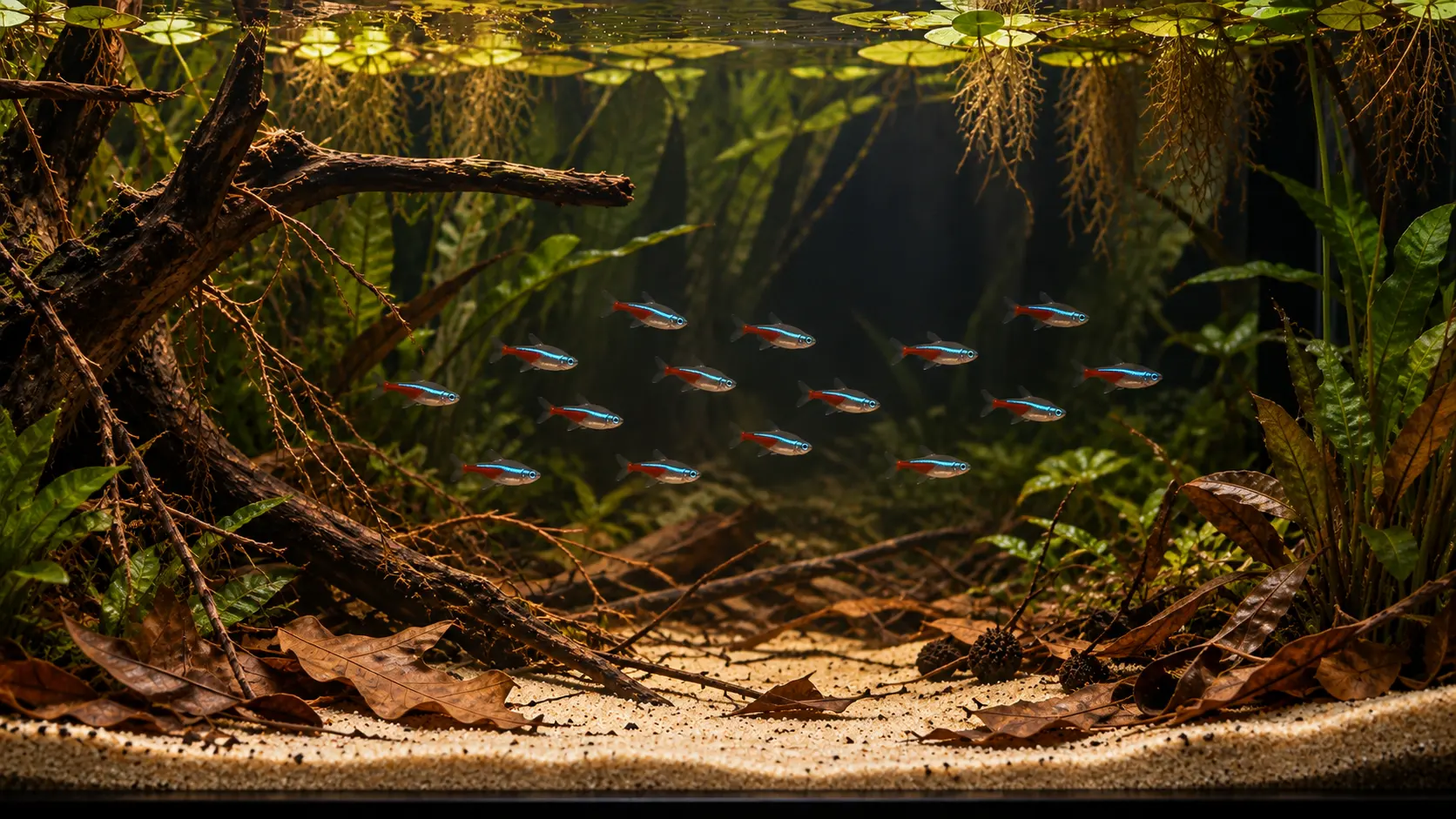
Shaded upper edge
Floating leaves reduce glare and give the school a retreat.
Open middle lane
Fish can spread, feed, and regroup across the aquarium length.
Fine branches
Narrow hardscape creates boundaries without occupying the whole footprint.
Restrained leaf litter
Natural texture remains thin enough to inspect and siphon.
Dark rear planting
Background contrast makes body condition and colour changes easier to see.
Gentle surface ripple
Oxygen exchange stays visible without turning the tank into a fast-flow raceway.
Bright light alone does not make a fish healthier or more colourful. If the animals remain washed out and hidden, reduce exposure, add real cover, and inspect water and tank mates before changing food supplements.
What should you inspect before buying a neon tetra school?
Commercial neons are often sold soon after transport, when colour and feeding response have not fully recovered. Visit before feeding if possible, then watch the group after a small meal rather than selecting fish only from a still photograph or the brightest display light.
- Most fish hold level and use open water between disturbances.
- Breathing is steady rather than rapid across the whole tank.
- Bellies are gently rounded after food, without severe wasting or one-sided swelling.
- Fins open normally and bodies show no obvious sores or cotton-like growth.
- The shop can state when the shipment arrived and whether losses occurred.
- The chosen school can come from one system instead of several recent shipments.
- Quarantine is cycled, heated, covered, and ready before purchase.
A single pale fish may be newly stressed, but several fish gasping, spinning, or resting on the bottom indicates a shared problem that should not be brought home. Buying the remaining apparently normal fish does not remove their exposure history.
Choose the group, not individual colours. Leaving the smallest or plainest fish behind can split an established shipment while producing a school assembled around appearance rather than health and social stability.
How should new neon tetras be acclimated?
Transport combines darkness, crowding, temperature drift, and declining bag water. Prepare a dim, mature quarantine tank first, compare temperatures and source-water chemistry, and keep the transfer controlled rather than extending bag time indefinitely.
- Inspect before purchase Avoid a system with unexplained deaths, sores, severe wasting, or several fish breathing hard.
- Prepare quarantine Match stable temperature and provide mature filtration and cover.
- Compare water Measure temperature and, where chemistry differs, conductivity or GH and pH.
- Transfer calmly Dim the lights and keep the bag closed only as long as temperature equalization requires.
- Discard shop water Move fish with a net or container without adding bag water to quarantine.
- Observe the whole group Record feeding, breathing, waste, body shape, and any losses before sharing tools.
Quarantine protects the established aquarium and gives small fish a quiet place to regain feeding condition. A fixed number of days cannot replace observation when the group has not yet eaten consistently or unexplained signs remain.
What should happen during the first week after introduction?
The first week is an observation period, not a race to make the fish display at full colour. Keep lighting subdued, offer small familiar foods, and record whether the same individuals eat, breathe normally, and rejoin the school after routine disturbances.
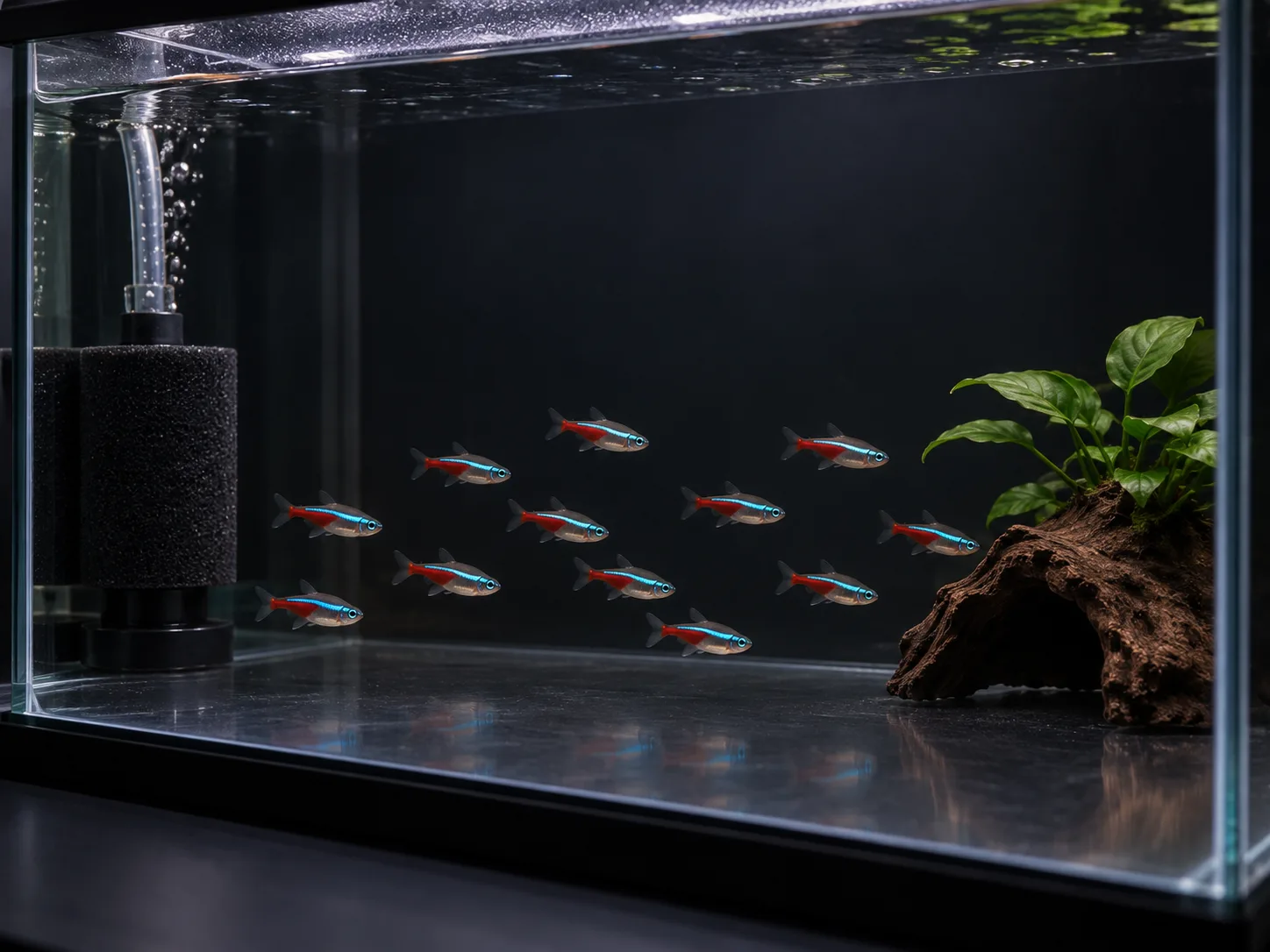
- Settle the room first Avoid tapping, netting, or rearranging the tank after release.
- Use a predictable light transition Let room light soften the change before aquarium lights switch on or off.
- Offer a very small meal Confirm swallowing and distribution before adding more.
- Check morning and evening Compare breathing, colour, position, waste, and group shape at consistent times.
- Keep equipment separate Do not share nets, siphons, or wet hands with established aquariums during quarantine.
- Escalate measured problems Correct oxygen, temperature, ammonia, or nitrite issues before considering disease treatments.
A school that remains tight on the first day may simply be cautious. Concern rises when the pattern does not loosen and fish also refuse food, breathe rapidly, isolate, clamp their fins, or lose balance.
Avoid repeated large changes made to chase appearance. Stable appropriate conditions and consistent observation reveal the direction of recovery more clearly than daily changes to temperature, pH, decor, and food at the same time.
What do neon tetras eat?
FishBase records worms, small insects, crustaceans, and plant material. A complete fine flake or micro-pellet can be the staple, with small frozen or cultured foods used for variety.
Neons have small mouths and can miss sinking particles once food falls into dense plants. Crush oversized flakes and feed tiny portions across two or more points so quieter fish remain visible.
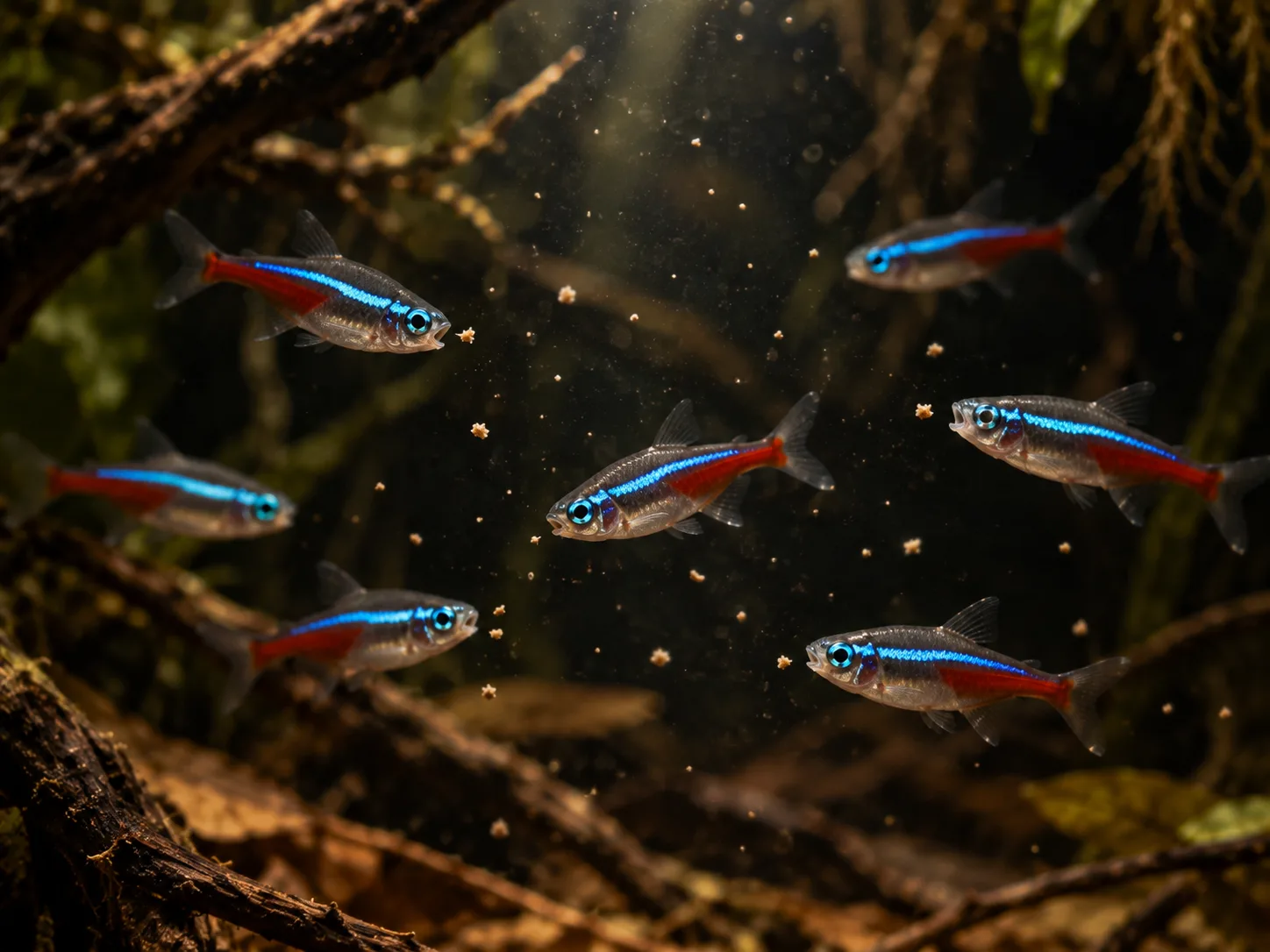
| Observation | Useful response | Avoid |
|---|---|---|
| Fish spit pieces out | Reduce particle size | Adding a larger portion of the same food |
| One side eats first | Split feeding points | Pouring the meal into one ring |
| Food reaches substrate | Reduce the next portion | Adding cleanup animals as a solution |
| One fish stays thin | Watch access and isolate for assessment | Assuming the whole school needs more food |
| Nitrate rises faster | Reduce waste and review stocking | Treating water changes as permission to overfeed |
Which tank mates work with neon tetras?
Good companions are peaceful, too small-mouthed to swallow a neon, comfortable within the same stable temperature and chemistry, and unlikely to win every feeding race. The smallest fish should not become the default prey item in a community assembled around larger animals.
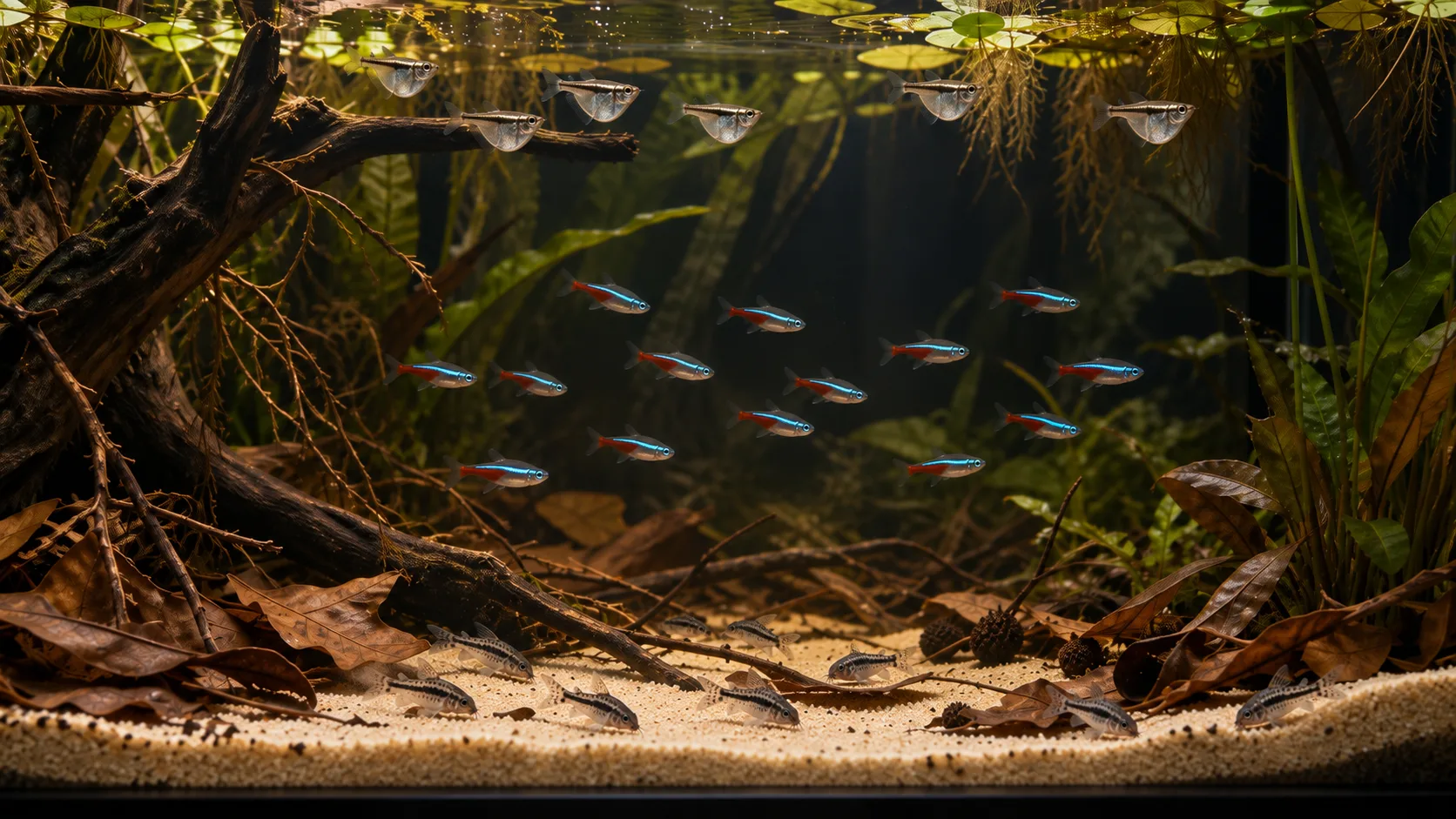
| Decision | Better match | Poor match |
|---|---|---|
| Adult mouth size | Cannot swallow a 2.5 cm fish | Predatory or opportunistic large mouth |
| Temperament | Calm and able to disengage | Persistent chasing or ambush pressure |
| Water | Stable overlap for every species | One species held at a tolerance edge |
| Feeding | Food reaches separate zones | Fast fish clear all small particles |
| Space | Each full group keeps an open route | Several schools share one narrow strip |
Cardinal tetras are a close visual comparison but prefer a warmer profile in many records. Glowlight and ember tetras can overlap in planted systems, though adding another school increases food and oxygen demand; mollies pull the aquarium toward harder, more alkaline water and are usually a poor chemistry match.
Small corydoras may use the lower zone where temperature and sand area suit them. Bettas vary individually and need a ready separation plan because slow fins, territorial behaviour, and feeding competition cannot be settled by a species list.
When does colour loss or unusual swimming matter?
Brief colour loss after lights-on or transport can resolve as the school settles. Persistent fading paired with isolation, clamped fins, rapid breathing, wasting, a curved posture, sores, swelling, or loss of balance needs investigation.
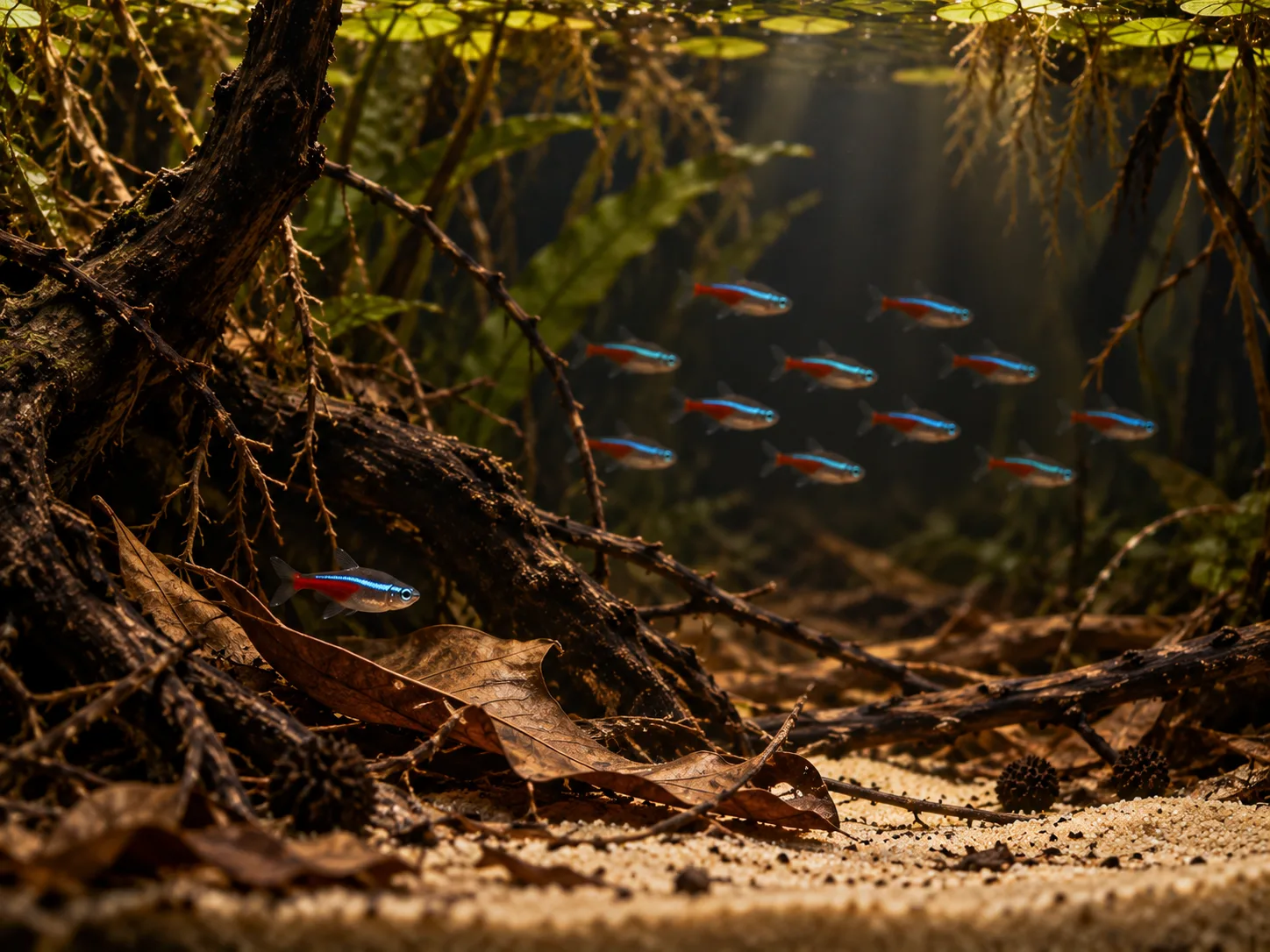
Start with conditions shared by the school
- Temperature and oxygen Verify the thermometer, surface movement, filter return, and recent warm weather.
- Ammonia and nitrite Test after new stocking, filter cleaning, medication, or a power interruption.
- Acclimation difference Compare supplier and tank water rather than assuming they matched.
- Feeding access Watch the same individual through a complete meal.
- Contamination Review sprays, soap, metals, untreated water, and shared equipment.
Several fish changing together strongly suggests a shared exposure or system failure. Increase safe aeration, correct only measured water problems, and seek aquatic-veterinary help for severe breathing distress, open sores, major swelling, neurological signs, or continuing losses.
How long do neons live and can they breed in a community?
Accessible institutional guidance supports multi-year care but does not establish one dependable lifespan for every commercial stock. Record the acquisition date and plan for several years rather than treating an advertised maximum as a promise.
Neons scatter eggs and provide no parental care. Adults and tank mates eat eggs and tiny fry, so spawning can occur unnoticed without turning a display tank into a successful breeding setup.
Is a neon tetra right for your aquarium?
Neons suit a mature, covered aquarium with at least 60 cm of length, a group of ten or more, shaded cover, open midwater, and stable water close to the stock's existing conditions. They are a poor first addition to a new cycle or a community containing large, fast, or hard-water fish.
- The filter is mature and ammonia and nitrite remain unmeasurable.
- The tank fits a complete school before tank mates are counted.
- The aquarium combines shaded cover with an open horizontal lane.
- Supplier water and receiving water have been compared.
- Food is fine enough and distributed at several points.
- Quarantine is ready before the group arrives.
- No aquarium fish, plants, or water will be released outdoors.