
What Is an Ember Tetra, and Is It Suitable for a Small Tank?
Hyphessobrycon amandae
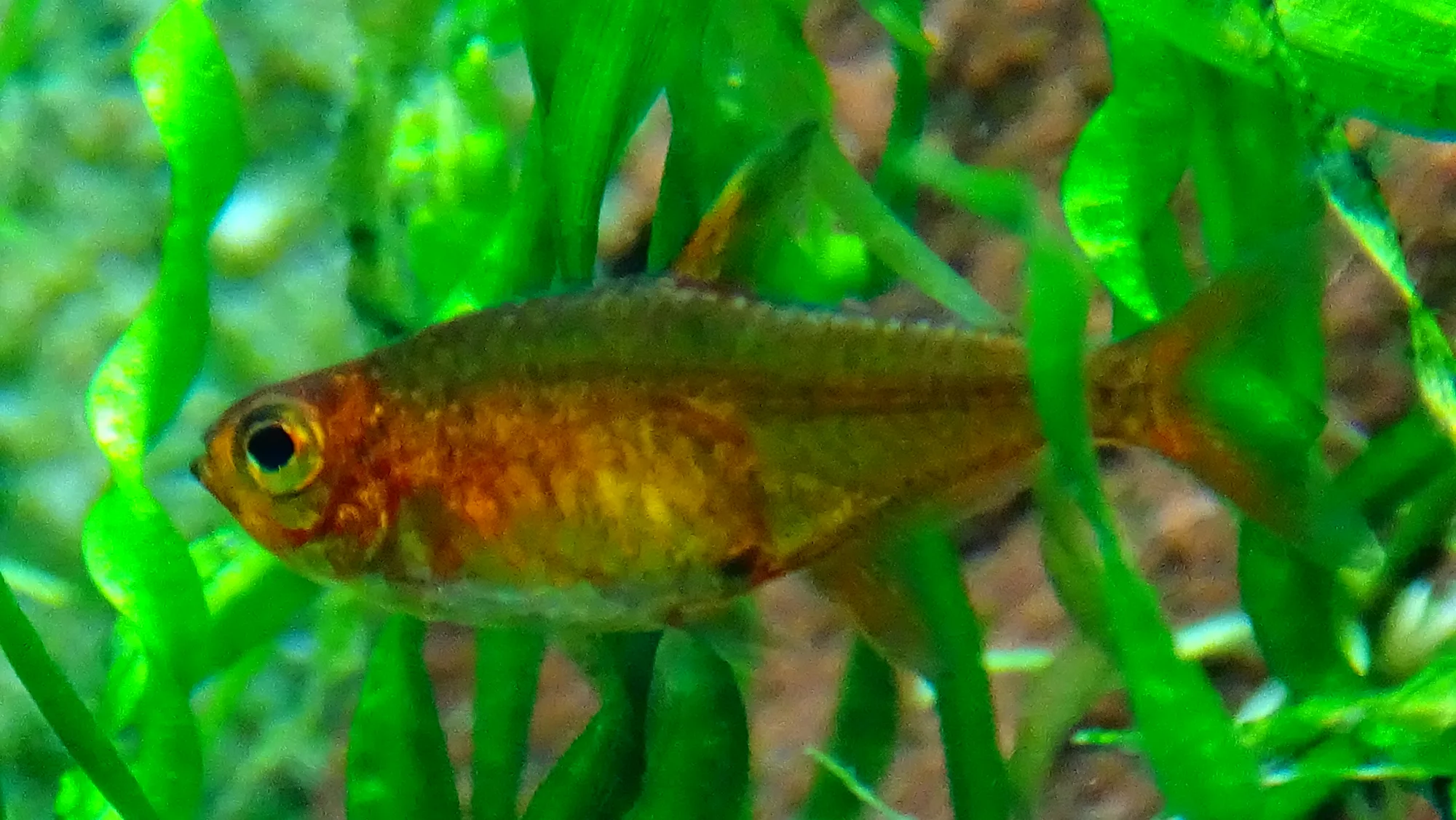
The ember tetra is Hyphessobrycon amandae, a 2 cm orange shoaling fish from Brazil's Araguaia basin. It can thrive in a compact planted aquarium, but only when that small system is mature, temperature-stable, safe at the filter intake and free from larger fish that outcompete or swallow it.

At a glance

- Adult size
- 2 cm
- Minimum footprint
- A mature 45 to 60 cm planted aquarium, with 60 cm offering the stronger stability and swimming margin
- Social structure
- A true shoal, commonly eight or more when filtration, oxygen and footprint support the group.
- Sex ratio
- No evidence-based household sex ratio is established; body fullness and color are unreliable on juveniles.
- Diet
- Omnivore
- Feeding
- Very fine complete food distributed across the shoal, with appropriately small frozen or live variety.
- Waste load
- low per fish; meaningful as a full shoal
- Family
- Acestrorhamphidae
- Native range
- Araguaia River basin, Brazil
- Also sold as
- amber tetra. Trade and hobby names, not accepted species names.
- Conservation status
- Least Concern, assessed 7 November 2018 Source
The footprint is expressed as usable horizontal room because adult movement and social escape cannot be inferred from litres alone.
What is an ember tetra?
The ember tetra is Hyphessobrycon amandae, a tiny orange characin from Brazil's Araguaia River basin. FishBase records a maximum of 2 cm standard length, which explains both its appeal and most of its husbandry risks.
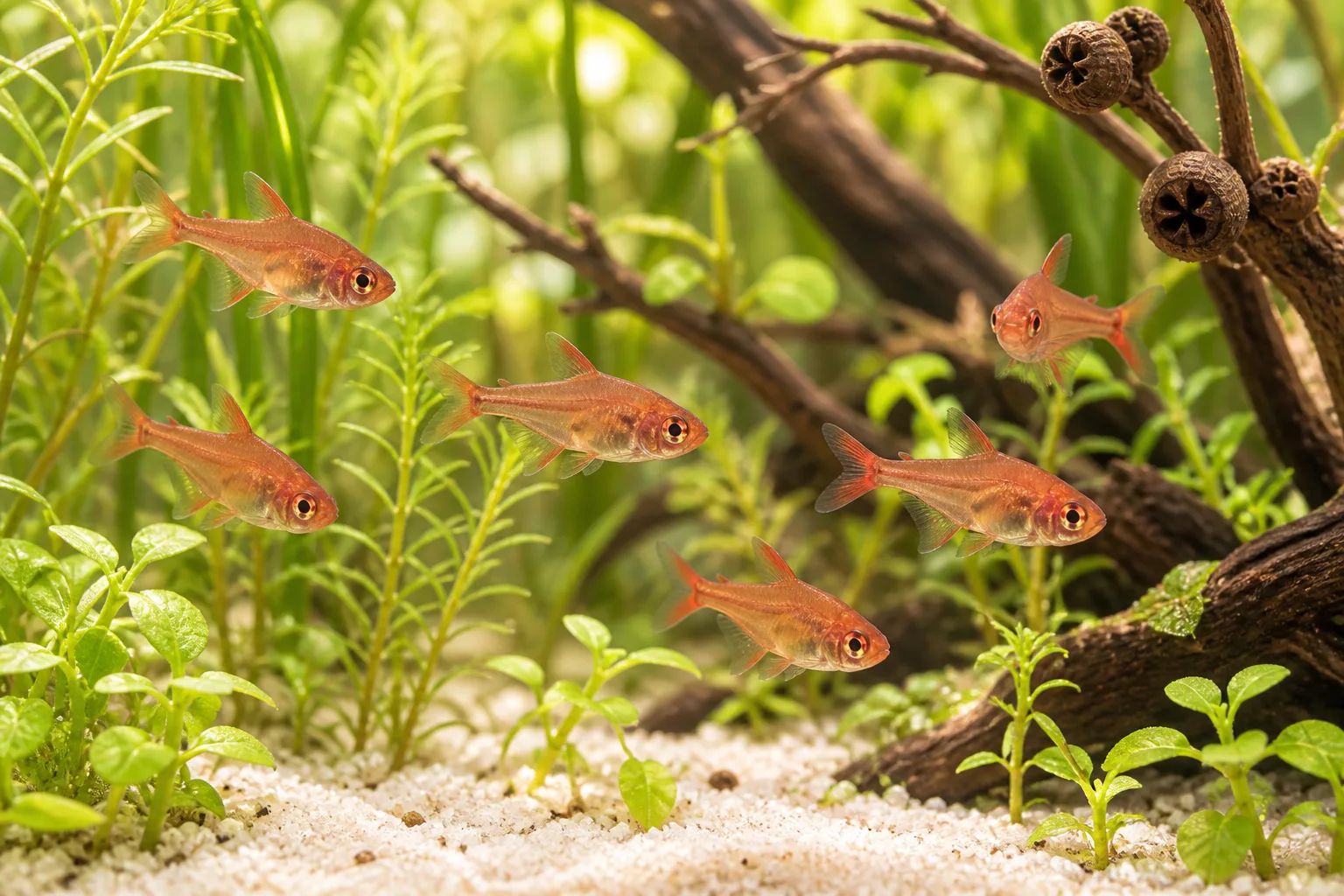
- Accepted identity
- Hyphessobrycon amandae Géry & Uj, 1987
- Family
- Acestrorhamphidae
- Native range
- Araguaia River basin, Brazil
- Maximum published size
- 2 cm standard length
- Temperature
- 24 to 28 °C in FishBase
- Social pattern
- Small shoaling characin
- Main practical constraint
- Tiny mouth and low competitive weight
- IUCN assessment
- Least Concern, assessed 7 November 2018
The accepted name has remained stable since the species was described in 1987. “Amber tetra” appears as a trade variation, but it does not identify a second species.
How can you identify an ember tetra?
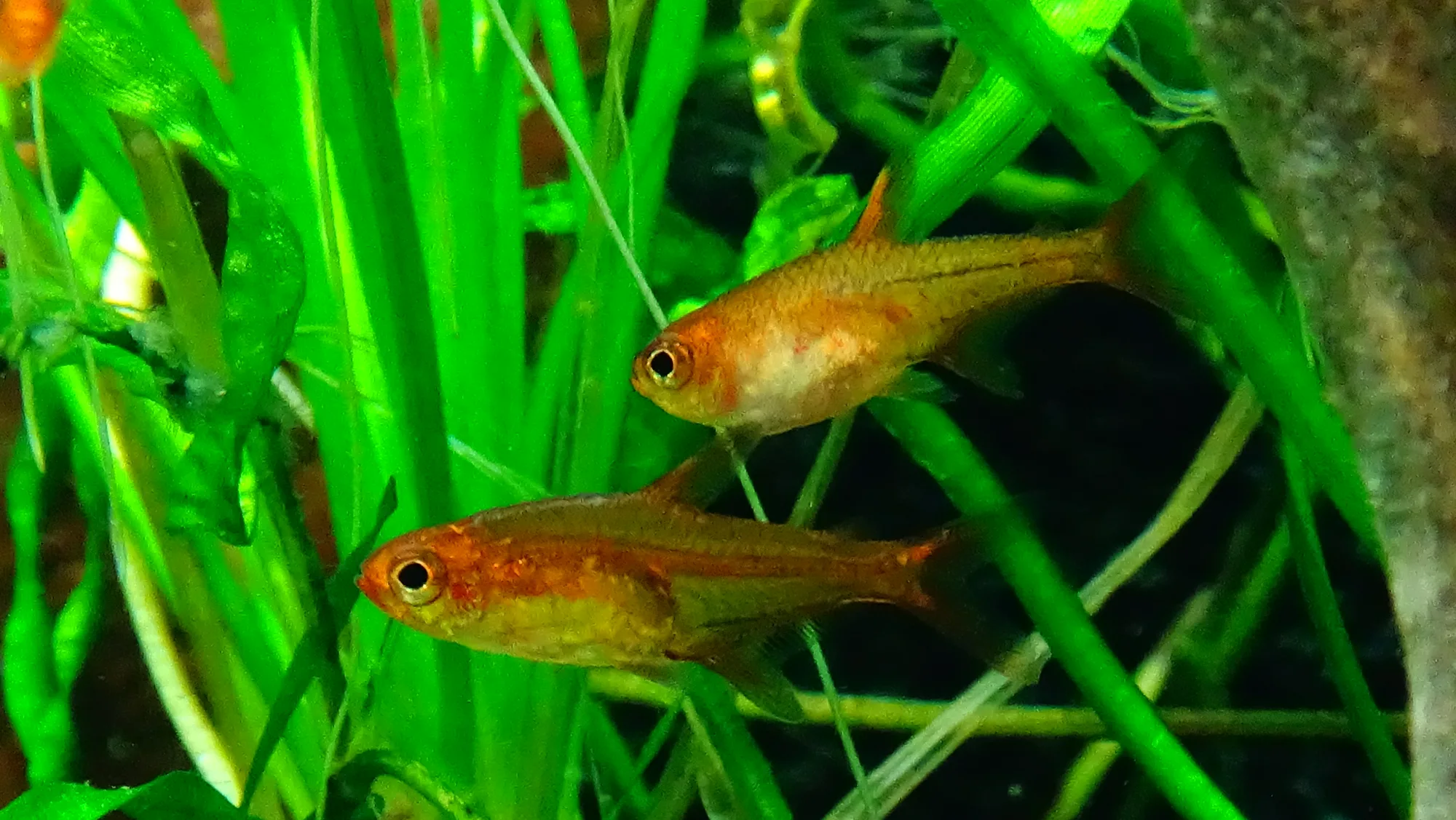
An ember tetra has a translucent orange to copper body, clear fins with warm pigment and a compact, laterally compressed outline. Adults remain small enough that scale must be judged against a known object, not against a close photograph.
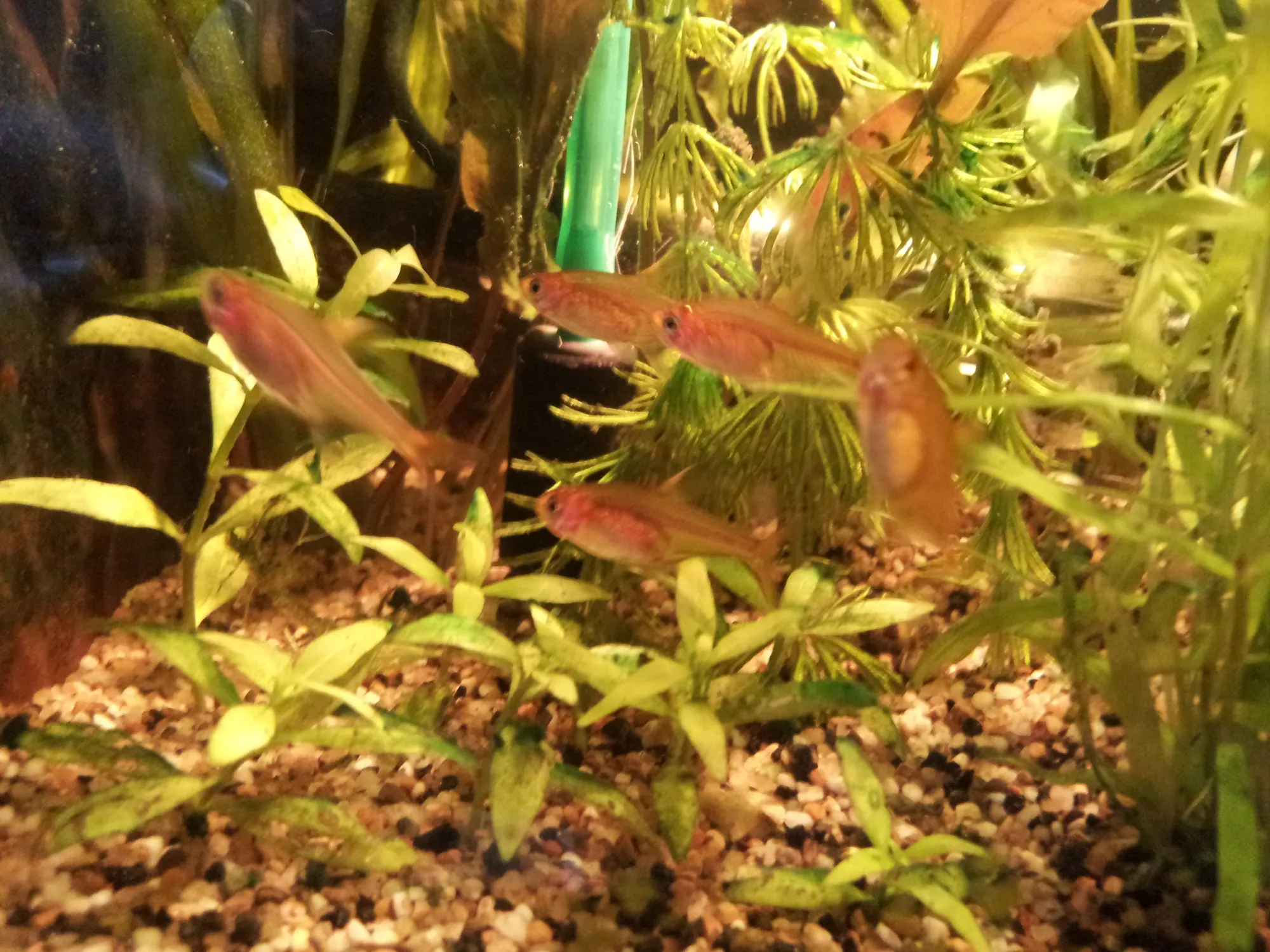
Pale color is common after transport or when the fish stays behind cover. The diagnostic outline and pigment distribution remain more useful than asking whether the orange matches a product photograph.
Is an ember tetra suitable for a small tank?
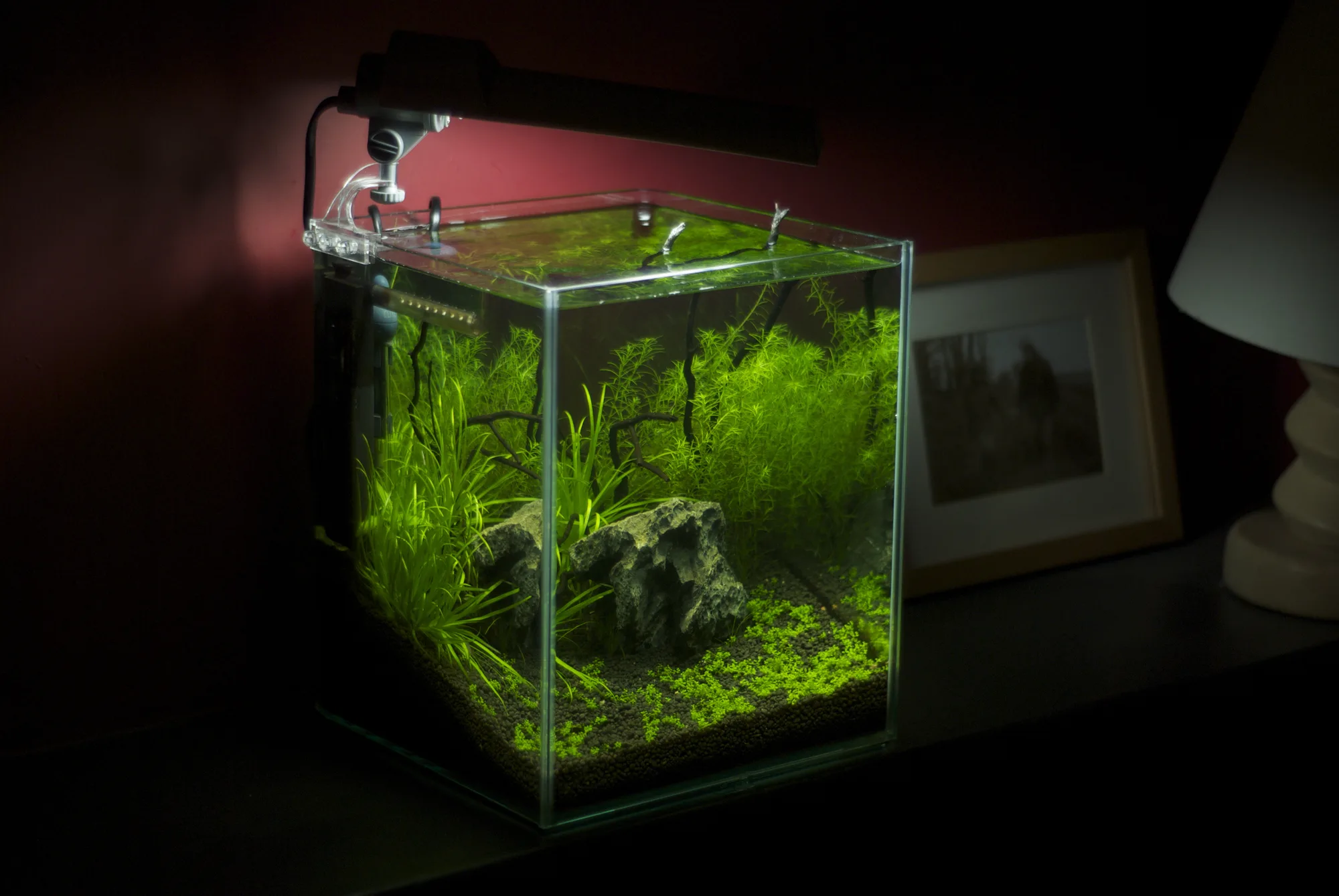
It can suit a compact aquarium, but small fish do not make unstable water safe. A tiny volume changes temperature, dissolved waste and oxygen faster than a larger body of water, especially when it is newly set up.
The tank must hold a social group, a mature biofilter, open midwater and cover while leaving maintenance access. A 45 to 60 cm footprint is a practical starting range for a dedicated group, with the longer end offering a much better stability and swimming margin.
| Need | Why the fish notices it | Practical check |
|---|---|---|
| Stable temperature | Small water volumes follow room changes quickly | Compare morning and evening thermometer readings |
| Mature filtration | A full group still produces ammonia | Confirm the cycle before livestock, then test after additions |
| Safe intake | The fish is light and narrow | Cover slots and suction points with suitable foam or mesh |
| Open water | Shoaling occurs away from the glass and plants | Preserve one continuous middle route |
| Retreat cover | New or startled fish need somewhere to settle | Plant both ends rather than creating one crowded corner |
Do not use a newly filled desktop tank as the place where the filter matures around the fish. Ember tetras are poor tools for absorbing the mistakes of a small uncycled system.
How many ember tetras should live together?
They should live as a shoal, not as a pair. No authoritative species record reviewed here establishes one universal minimum number, so the honest recommendation connects group size to observed behavior and available footprint.
Start with a group large enough to spread attention and produce coordinated movement, commonly eight or more when the mature tank supports them. A larger group is useful only if filtration, oxygen and feeding access remain strong.
Group behavior should improve after settlement. Fish that remain pinned in one corner, scatter at every approach or allow one individual to disappear behind equipment are reporting a problem that a head count alone cannot resolve.
Confident group
Uses open water, reforms after feeding and explores several depths.
Newly introduced group
May stay low or behind plants, but should begin feeding and widen its range over days.
Socially pressured group
Clusters tightly whenever another species approaches and loses access to food.
Environmentally stressed group
Breathes rapidly, hangs near the surface or becomes uniformly inactive.
What water conditions are supported by evidence?
FishBase supplies a temperature range of 24 to 28 °C but does not publish a pH or hardness range on the current species summary. That absence should remain visible instead of being filled with a confident number copied from retailers.
Verified ember tetra water record
- Temperature24 to 28 °C
Every range above applies to Hyphessobrycon amandae in a freshwater system. Source: FishBase, checked 2026-09-13.
Separate aquarium thermometer positioned away from the heater.
The Araguaia origin supports a freshwater tropical context, but a river basin does not have one pH at every site and season. Ask what water the actual batch was raised and held in, then compare it with the home aquarium before acclimation.
Stability has the highest practical value. Avoid fast pH correction, keep ammonia and nitrite at zero, and use regular small maintenance rather than allowing a compact tank to accumulate waste between large rescues.
Because the supported temperature range is warm, gas exchange deserves deliberate attention. Warm water carries less dissolved oxygen, and a dense planted tank can also consume oxygen after the lights go out.
- Keep enough surface movement for a visible ripple without blasting the shoal.
- Do not shut the filter off overnight; biological media and fish both depend on continuing flow.
- Remove dying leaves and trapped food before they decompose in a small water volume.
- Compare breathing shortly before lights-on with breathing during the day.
- Investigate a whole group at the surface immediately rather than assuming they are waiting for food.
What should ember tetras eat?
The feeding problem is not appetite; it is particle size and delivery. Food that looks small beside a finger can still be too large for a 2 cm fish.
- Crush before feeding Reduce flakes or pellets to particles each fish can swallow immediately.
- Distribute across the shoal Release food in two or three small areas so one quick fish cannot own the meal.
- Use the current gently Let particles drift through midwater without pulling them straight into the filter.
- Watch the smallest fish Confirm that it takes and keeps food rather than repeatedly spitting pieces out.
- Stop before food settles A compact tank has little dilution margin for particles trapped under hardscape.
Small frozen and live foods can add variety when their size is appropriate and their source is safe. They should support a complete staple rather than turning every meal into a high-protein feeding event.
A keeper can use body condition to refine the portion. The abdomen should look gently filled after a meal and return toward normal before the next one; persistent hollowness suggests missed food, while repeated swelling or trailing waste needs closer assessment.
Which fish can live with ember tetras?
The best companions are peaceful animals that share the water conditions, do not fit an ember tetra in their mouth and do not dominate every feeding. Adult size matters more than the label “community fish.”
Even a non-predatory fish can be a poor match if its speed keeps the ember group behind plants. A calm bottom fish may create less competition than another fast midwater shoal, provided its temperature and substrate needs align.
| Decision factor | Likely workable | Poor fit |
|---|---|---|
| Mouth and body scale | Cannot swallow or injure a 2 cm tetra | Ember tetra can enter the mouth or be struck during feeding |
| Feeding pace | Leaves fine suspended food available | Clears all food before the shoal approaches |
| Swimming zone | Uses another zone or shares midwater calmly | Drives the group into one corner |
| Water overlap | Thrives within the same stable temperature and chemistry | Needs a cooler, harder or rapidly adjusted system |
| Temperament | Brief curiosity without pursuit | Repeated chase, stalking or fin contact |
Shrimp compatibility depends on what is being protected. Adult shrimp may coexist, while newly hatched shrimplets are small live food and cannot be promised safety.
Why might ember tetras turn pale or hide?
Paleness is a clue, not a diagnosis. It often accompanies transport, bright bare surroundings, social pressure or poor water, and the correct response begins with observation and measurement.
Check these before changing the tank
- Recent arrival Give a feeding, breathing and movement baseline over the first days without repeatedly rearranging the aquarium.
- Light and background Confirm that direct glare is not eliminating shaded retreat space.
- Tank mates Watch whether the group opens out only after another species moves away.
- Water quality Test ammonia and nitrite, verify temperature, and review the maintenance interval.
- Food size Look for fish taking food and spitting it out, which can resemble poor appetite from a distance.
- Disease or injury White patches, ulcers, swelling, loss of balance or persistent rapid breathing needs qualified help.
Do not add medication or make a large chemical adjustment for color alone. If the whole group changes at once, the shared environment deserves attention before an individual disease theory.
Quarantine is especially easy to get wrong with fish this small. The holding tank still needs a mature filter, guarded intake, stable heat and visual cover; a bare uncycled cup can cause the rapid breathing and color loss it was supposed to help investigate.
When one fish alone loses weight despite verified food access, separate observation can be useful, but diagnosis and treatment should come from a qualified aquatic professional. Tiny body size leaves little margin for guessed medication concentrations.
What does its wild status tell a keeper?
FishBase records the ember tetra as Least Concern, assessed in 2018, and lists commercial aquarium use. CITES is recorded as not evaluated.
Least Concern is a population category, not a husbandry certificate. It does not make release safe, erase local habitat pressures or prove that every fish in trade was produced the same way.
Ask the seller whether the batch is captive-bred when origin matters to the purchase. Never release an unwanted group or aquarium water into drains or natural waterways that can reach wildlife.
Is an ember tetra the right nano fish for you?
It is a strong choice for a mature planted aquarium where a full shoal can receive fine food without larger fish taking it first. Its warm temperature range and tiny adult size suit many compact systems when those systems are stable.
It is the wrong choice for an uncycled jar, an exposed high-flow intake, a community with predators or a tank whose owner expects small fish to need little maintenance. The fish is tiny; the complete system it depends on is not.
Which tetras make useful comparison points?
Chili rasbora
A minute blackwater group fish whose mouth size, water and refuge needs set a much smaller scale.
Cardinal tetra
A small blackwater shoaler whose soft-water context and quiet group behaviour narrow the comparison.
Celestial pearl danio
A tiny planted-tank danio with cooler documented habitat water and a different style of group behaviour.
Cherry barb
A small planted-stream barb that contrasts sex-linked colour, social structure and habitat cover.
Black neon tetra
A smaller midwater shoaler that offers a useful contrast in body size, group movement and water tolerance.
Diamond tetra
A medium deep-bodied characin that offers a closer comparison in warm water, adult mass and display behaviour.
Emperor tetra
A medium tetra whose males hold display positions, adding territory and sight lines to the group decision.
Colombian tetra
A robust medium tetra whose feeding pace and fin-nipping risk change an otherwise similar community plan.
Black skirt tetra
A deeper-bodied group fish whose speed and fin behaviour deserve a separate stocking check.
Bleeding heart tetra
A deep-bodied characin with longer fins, making group confidence and fin condition useful comparison points.