
What Is a Black Skirt Tetra, and Why Does It Need a Group?
Gymnocorymbus ternetzi
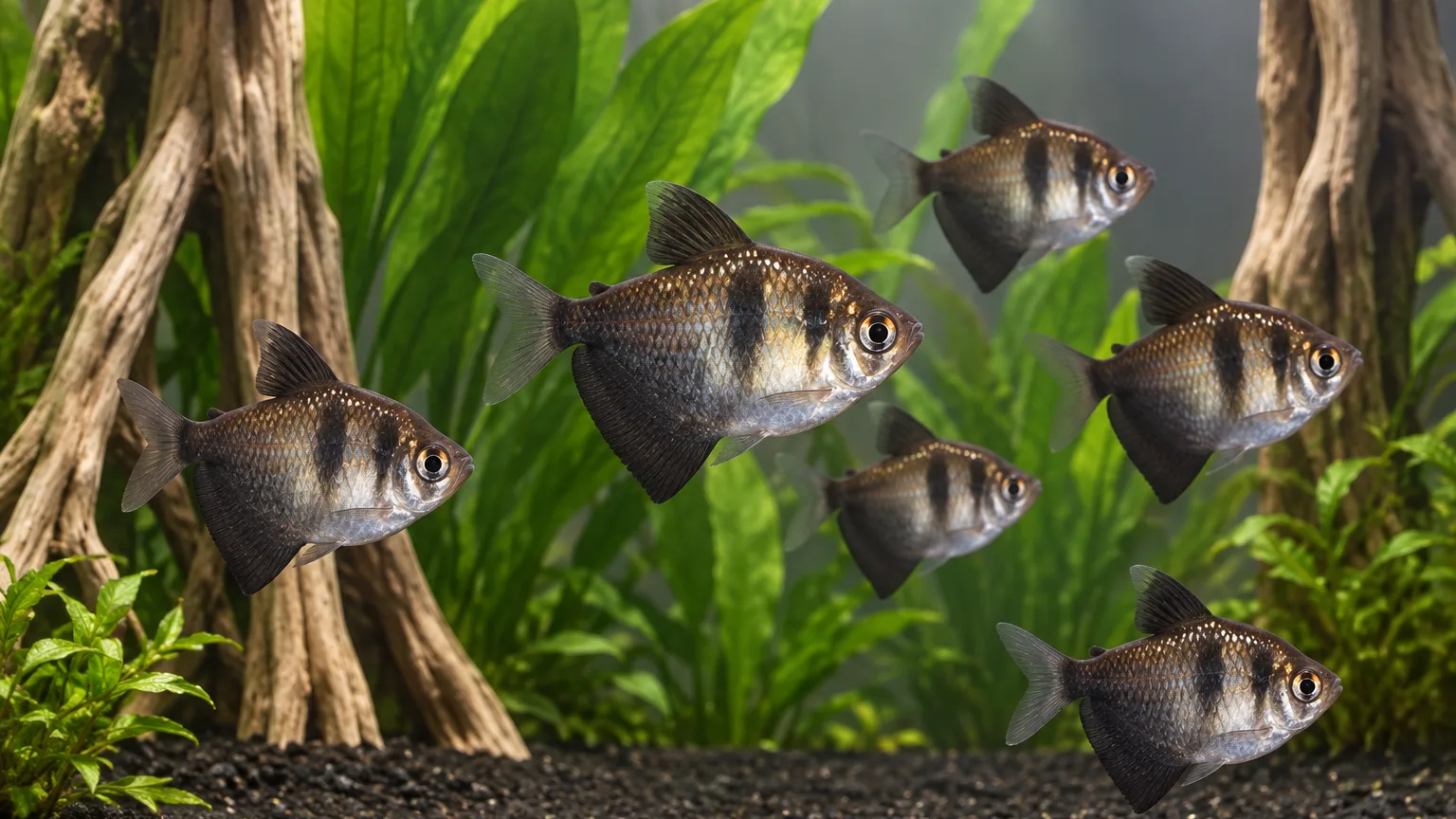
Black skirt tetras are deep-bodied Rio Paraguay basin fish whose small individual size can hide the space needed by an active same-species shoal. Natural dark, white, long-fin and fluorescent domestic forms remain Gymnocorymbus ternetzi, and aquarium fit depends on horizontal room, stable water, group structure and monitored fin interactions.
At a glance

- Adult size
- 7.5 cm
- Minimum footprint
- About 60 cm horizontal aquarium length as a starting benchmark, with clear middle and upper swimming room
- Social structure
- At least six conspecifics; increase the group only when footprint, filtration, oxygen and feeding access support it.
- Minimum group
- 6
- Sex ratio
- No fixed routine sex ratio established.
- Diet
- Carnivore
- Feeding
- Use a complete small tropical-fish staple with suitable invertebrate variety; distribute small portions so every shoal member feeds.
- Waste load
- moderate
- Family
- Acestrorhamphidae
- Native range
- Confirmed Rio Paraguay basin; type locality Descalvados, Mato Grosso, Brazil, on the Rio Paraguay. Broader Guapore and Peru summaries remain unresolved against the 2015 revision.
- Also sold as
- black tetra, black widow tetra, petticoat tetra, white skirt tetra, white tetra. Trade and hobby names, not accepted species names.
- Former scientific names
- Tetragonopterus ternetzi. Superseded names for this same species.
- Conservation status
- Least Concern, assessed 4 March 2021 Source
The source benchmark is length; group size, usable route, decor, filtration and the full community determine fit.
What is a black skirt tetra?
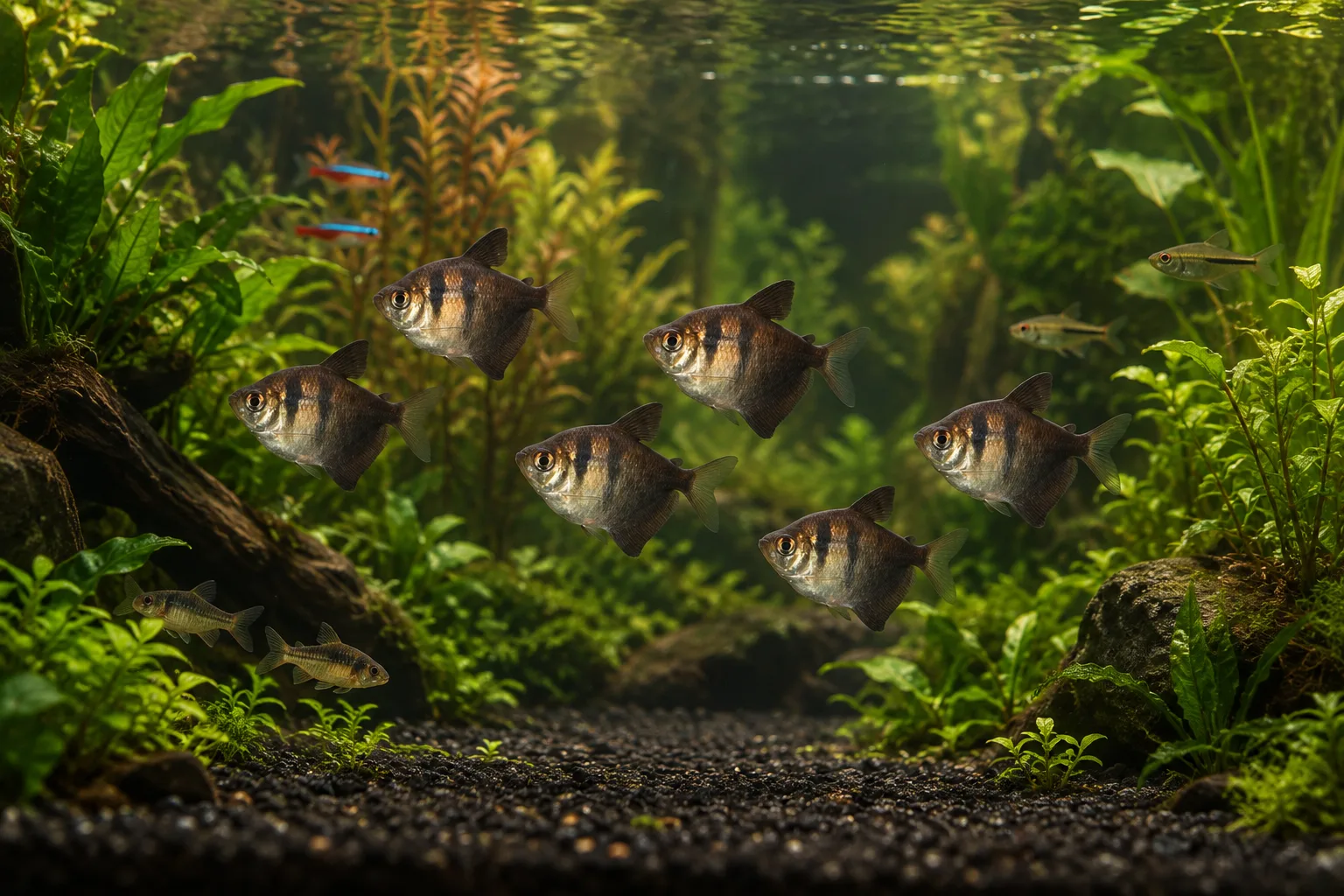
The black skirt tetra is Gymnocorymbus ternetzi, a deep-bodied South American tetra. The dark lower body and broad anal fin create the skirt outline, but the larger care decision is whether the aquarium can support an active same-species shoal with uninterrupted horizontal swimming room.
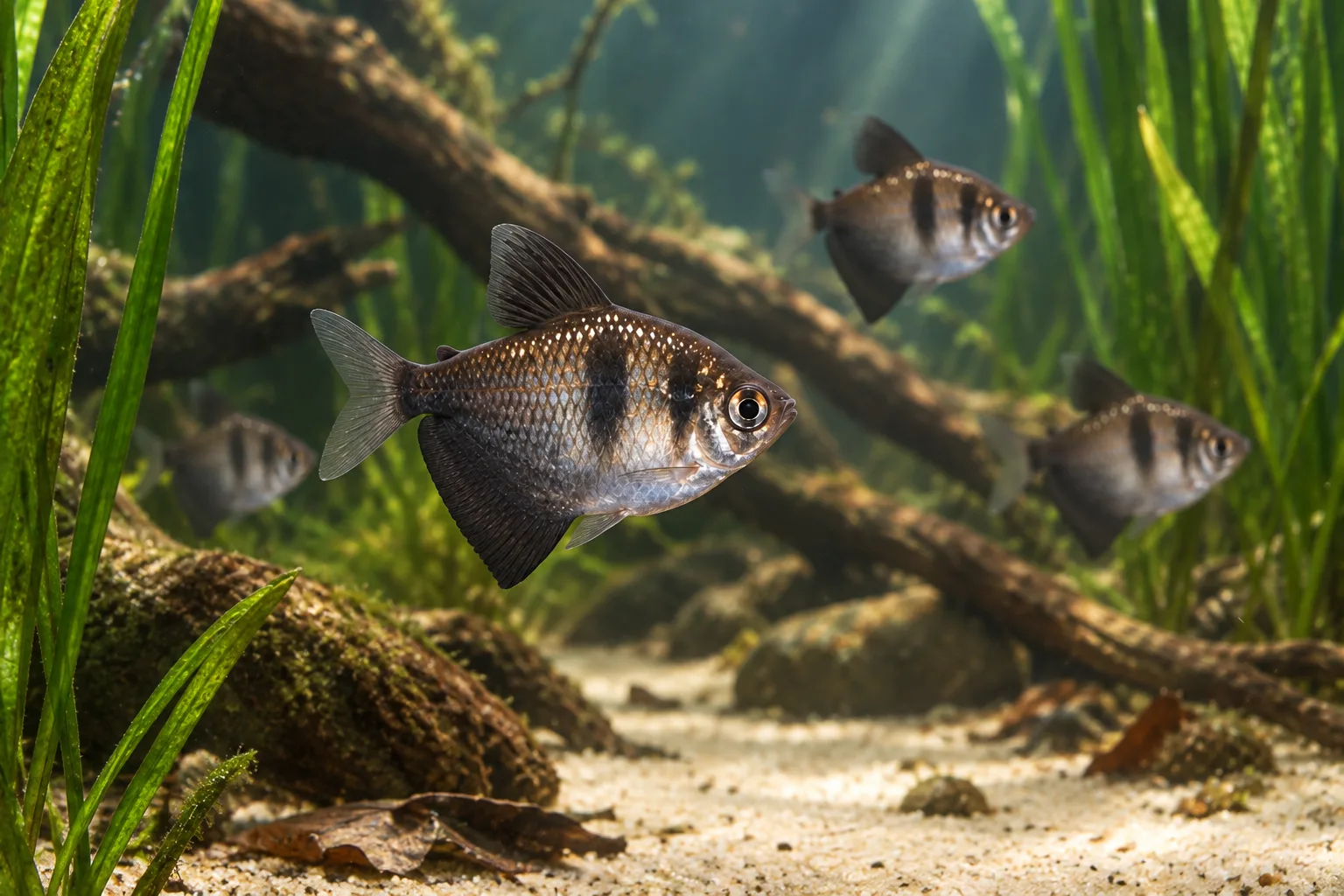
Catalog of Fishes accepts G. ternetzi (Boulenger, 1895) in Acestrorhamphidae. The original combination was Tetragonopterus ternetzi, and black tetra, black widow tetra, petticoat tetra and black skirt tetra are common names for the same species rather than separate fish.
White skirt or white tetra is a pale domestic form of G. ternetzi.
Long-fin fish have selectively extended fins, while fluorescent lines are genetically engineered domestic forms; color, fin length or a commercial brand does not create another species.
FishBase reports a maximum of 7.5 cm standard length. Standard length ends at the base of the tail fin, so it must not be compared directly with a total-length figure that includes the tail.
How can you identify a black skirt tetra?
The natural dark form has a tall, laterally compressed body, two strong vertical bars behind the gill cover, a fainter bar through the eye area, and a long anal fin that deepens the rear silhouette. The dark pigment often becomes less intense as a fish matures, so a grey adult can still show the same structural pattern.
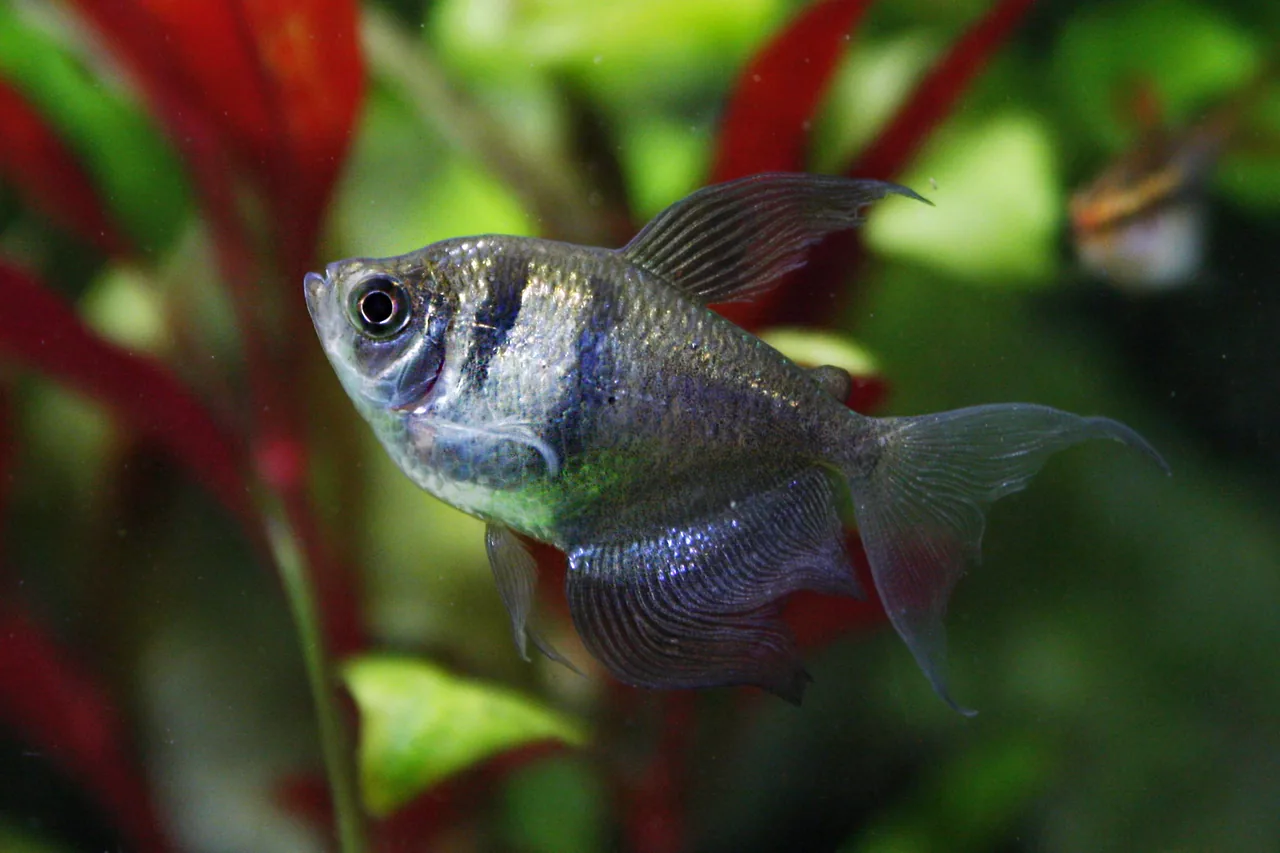
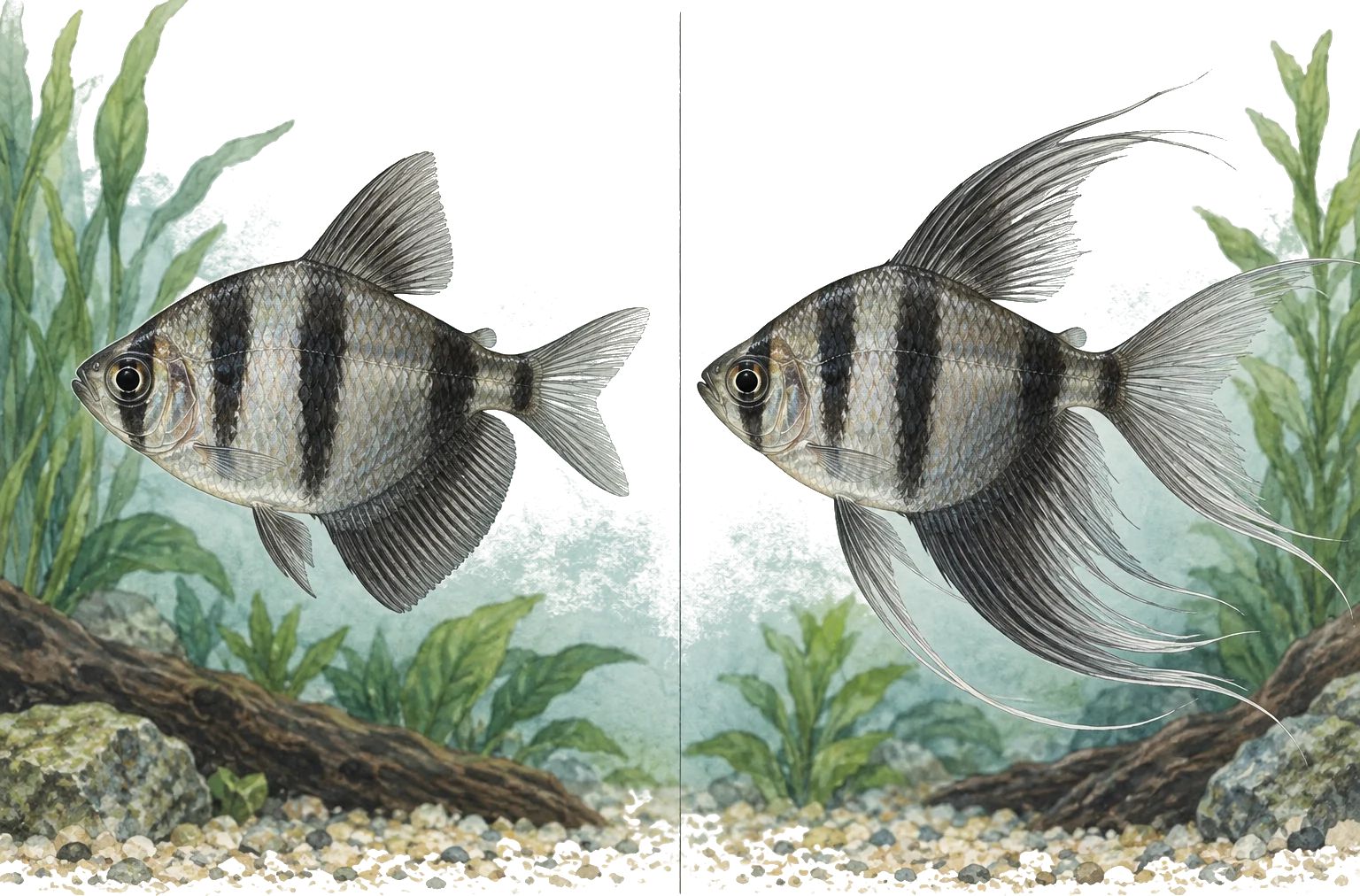
White skirt fish retain the deep body and fin outline while lacking much of the dark pigment. Fluorescent color can obscure the familiar black skirt appearance, so use body depth, bar position, fin structure and a documented stock identity together.
A black neon tetra is slimmer and carries a bright horizontal line over a black side stripe. That direction of pattern is a quick distinction: black skirt tetras are defined visually by a deep profile and vertical shoulder bars, not a pale-over-black horizontal band.
A clear side photograph can support identification, but it cannot prove age, sex, health, genetic line, captive origin or water conditions.
Body fullness is also unreliable on its own because mature females may look deeper, while feeding, eggs or illness can change the same outline.
Where does a black skirt tetra come from?
The 2015 specimen-based revision of Gymnocorymbus confirms G. ternetzi from the Rio Paraguay basin and gives the type locality as Descalvados, Mato Grosso, Brazil, on the Rio Paraguay. Current Catalog and FishBase summaries also mention the Guaporé basin and Peru, which conflicts with that revision; those broader places are not treated here as confirmed native range.
The revision examined non-type specimens from 21.2 to 53.1 mm SL. Its largest examined fish is a sample limit, not a species maximum, so it remains separate from the 7.5 cm SL maximum reported by FishBase.
FishBase places adults in middle and upper water and describes a diet of worms, small crustaceans and insects. In an aquarium, preserve an open lane through those levels, border it with plants or wood for retreat, and avoid filling the entire footprint with dense decor.
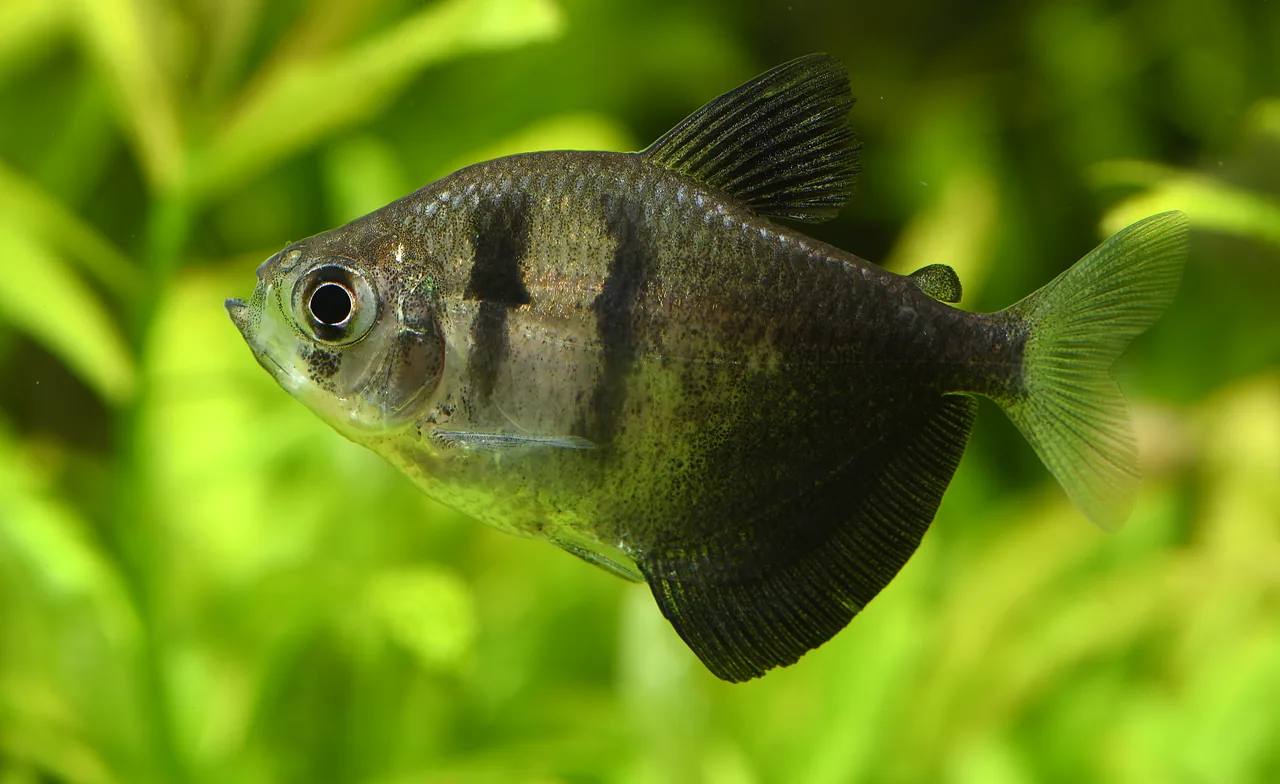
Moderate circulation should keep oxygen moving without pinning the shoal behind hardscape. Judge the layout by whether fish can cross the tank, turn as a group, leave a chase, and rest near cover without fighting the outlet.
How many black skirt tetras should live together?
Black skirt tetras are shoaling fish and should not be planned as single display animals. FishBase cites groups of five or more, while a controlled growth study housed them singly and in groups of 4, 8 and 16 and found group size affected growth performance, giving direct evidence that social conditions can change welfare outcomes.
You should plan at least six together, then choose a larger shoal only when the footprint, filtration, oxygen and feeding access can support it. Six is a practical welfare floor that avoids solitary or paired housing; it does not make a cramped aquarium suitable.
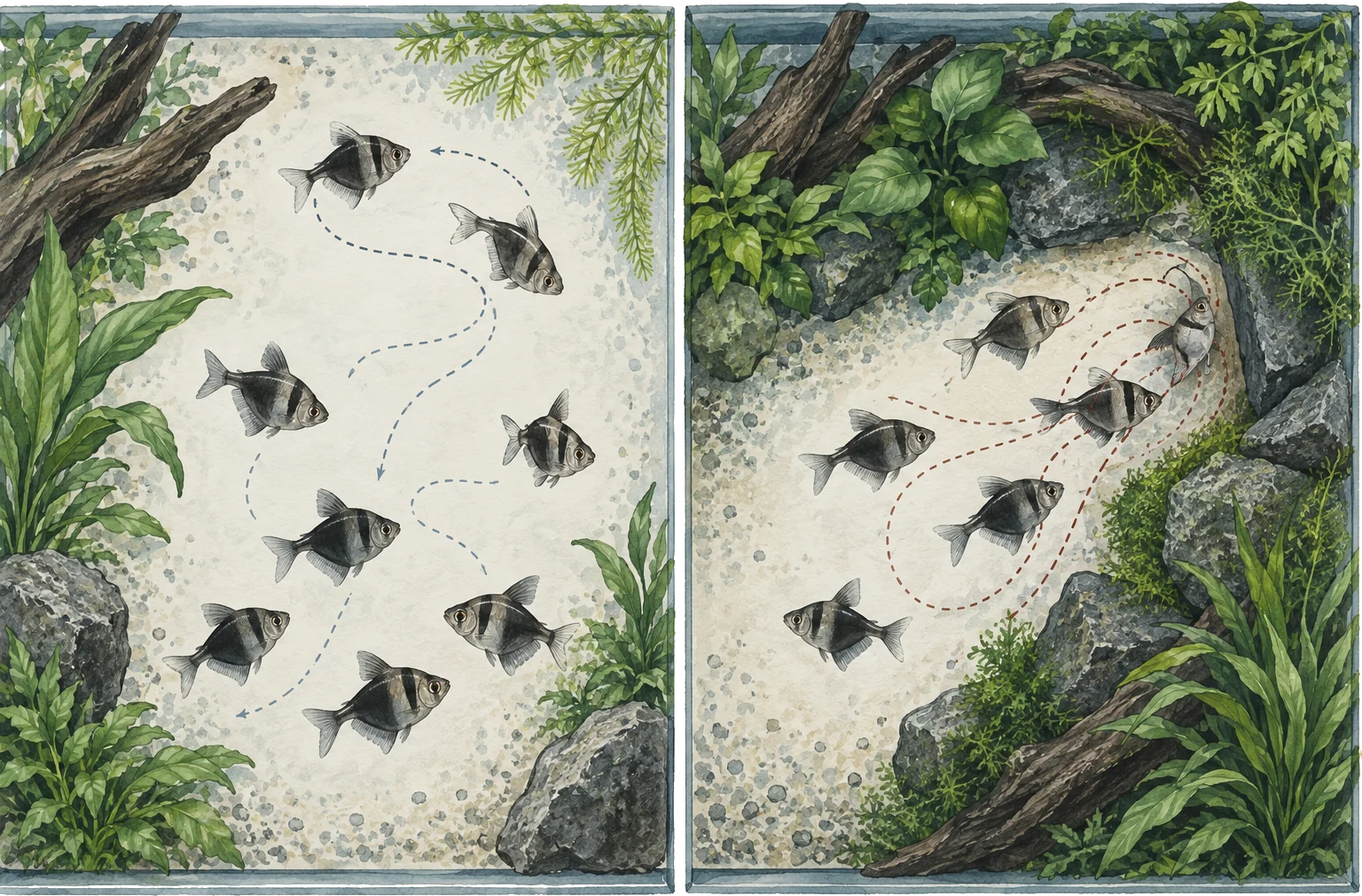
Chasing within a group can be brief social interaction.
Persistent targeting, torn fins, one fish held away from food, or a shoal compressed into one corner means the result is harmful regardless of whether a care label calls the species peaceful.
Fin interest becomes more consequential around slow, long-finned tank mates. A complete group, visual breaks and adequate room may reduce pressure, but they do not guarantee that an individual shoal will ignore exposed fins.
How much swimming space does the group need?
A 7.5 cm SL upper planning figure describes one fish without its tail, while the aquarium must hold repeated acceleration, turning and spacing among at least six fish. FishBase cites a 60 cm aquarium length reference; use that as a starting benchmark, not as proof that every tank of that length has enough usable room.
- Accepted species
- Gymnocorymbus ternetzi (Boulenger, 1895)
- Conservative size record
- Up to 7.5 cm standard length reported by FishBase
- Revision sample
- 21.2 to 53.1 mm SL; sample result, not a maximum
- Social plan
- At least six conspecifics, with more only when the system supports them
- Footprint reference
- About 60 cm horizontal length as a starting point
- Swimming zone
- Middle and upper water
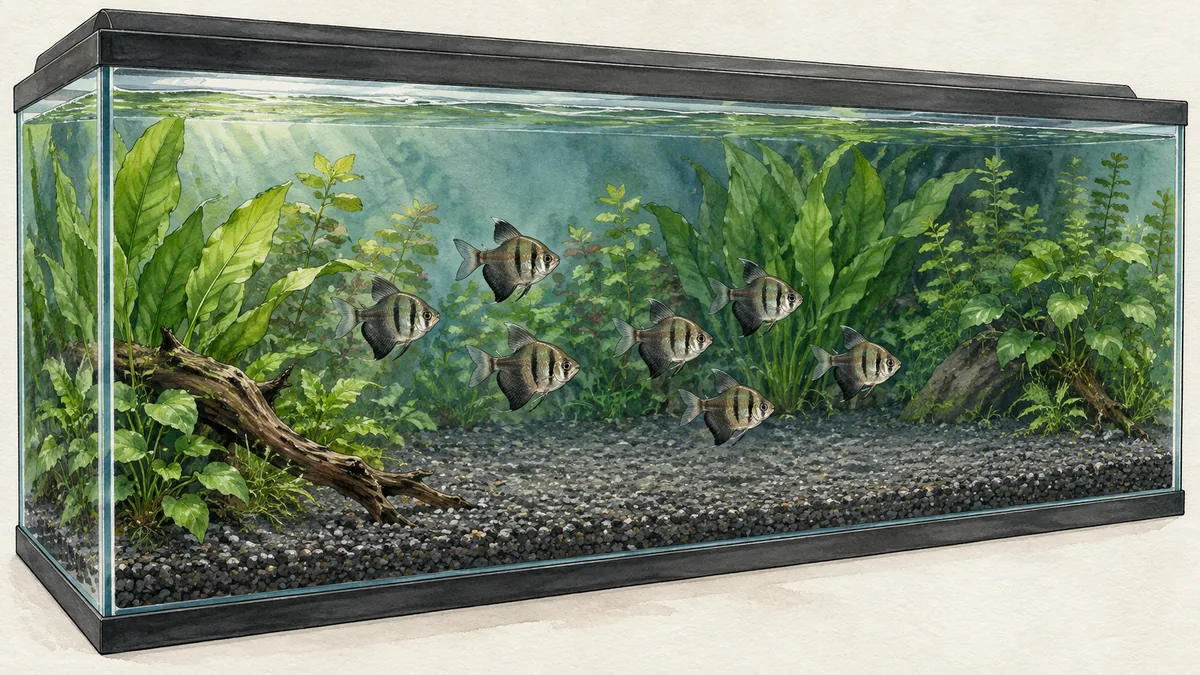
Width, decor and equipment determine how much of that length remains usable.
A taller tank does not replace a clear horizontal route, and a larger shoal or busy community should move the plan beyond the starting footprint.
The aquarium needs mature filtration sized for the whole community and a lid that closes gaps around cables and filter pipes. Sudden pursuit, netting or maintenance can trigger a jump even when the fish normally remain in midwater.
Which water conditions support black skirt tetras?
FishBase compiles an aquarium range of 20 to 26 °C, pH 6.0 to 8.0, and 5 to 19 dGH for G. ternetzi. These are broad reference boundaries from aquarium literature, not one universal target or measurements from every Rio Paraguay locality.
Recorded freshwater aquarium context
- Temperature20 to 26 CSeparate aquarium thermometer; FishBase compiled range.
- pH6.0 to 8.0Calibrated pH meter or suitable aquarium test; FishBase compiled range.
- General hardness5 to 19 dGHGH titration test; FishBase compiled range.
Every range above applies to Black skirt tetra husbandry in a freshwater aquarium system. Source: FishBase species summary, checked 2026-09-11.
A stable established aquarium within the supported band is usually safer than repeated attempts to hit a midpoint. Check temperature with a separate thermometer, record pH with the method used, and read GH from a titration test in degrees of general hardness.
Ammonia and nitrite are not species preference numbers. In a stocked mature aquarium, any detectable result should be confirmed and traced to cycling, filtration, feeding, dead material or a recent stocking change rather than accepted as normal for a robust tetra.
Before transfer, compare the seller's temperature and, where possible, pH and hardness with the prepared tank before transfer. Avoid an abrupt correction; stop an acclimation or chemistry change if fish lose balance, gasp, or deteriorate, and get qualified help when severe signs persist.
What do black skirt tetras eat?
The recorded natural diet includes worms, small crustaceans and insects. Aquarium feeding can use a nutritionally complete small tropical-fish staple with appropriately sized frozen or live invertebrate foods as variety.
- Choose a complete staple whose particles fit the tetra's small mouth.
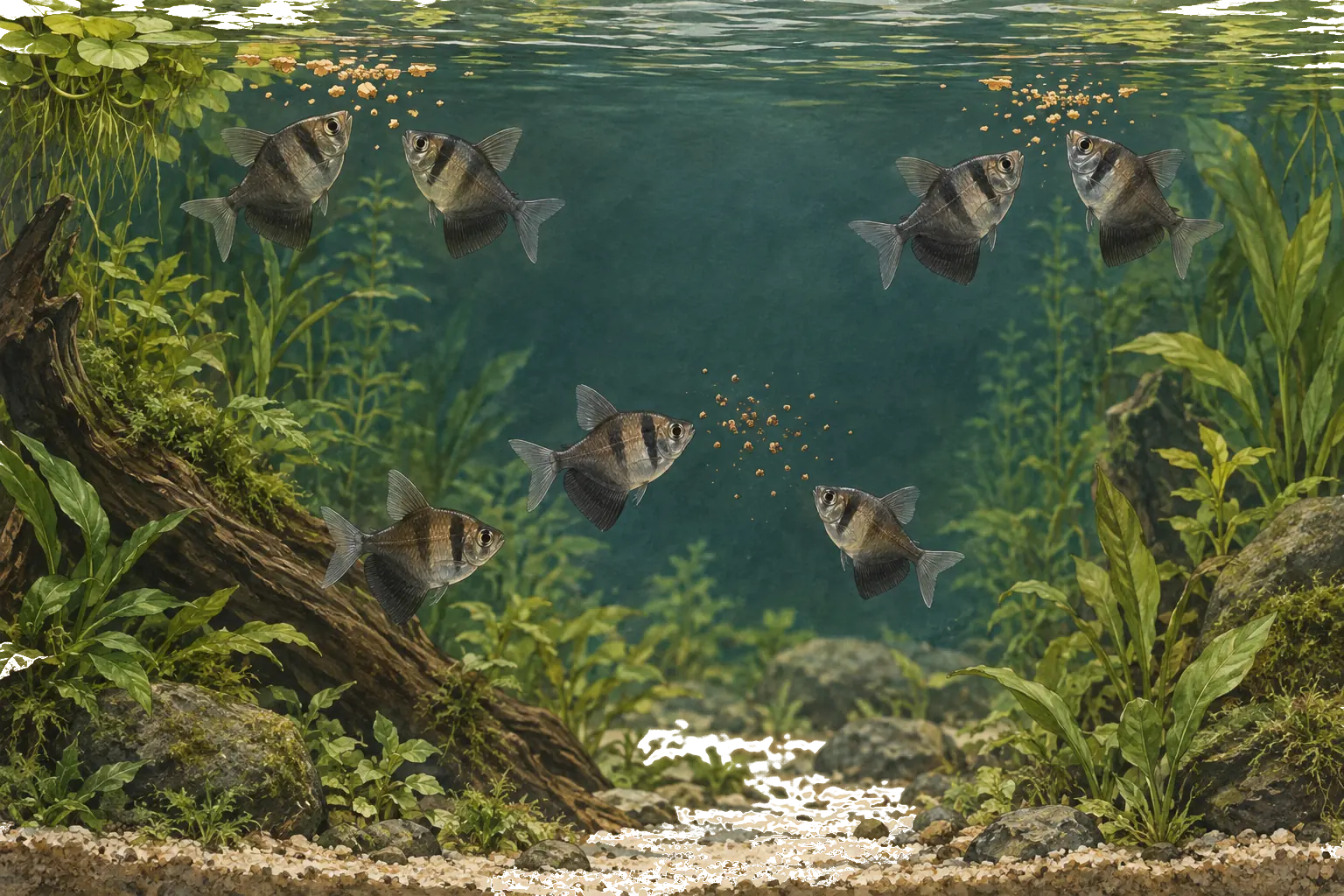
- Release small portions across several points instead of creating one feeding contest.
- Watch the quieter fish long enough to confirm that each one swallows food.
- Stop when the active response fades and remove food that continues to settle.
- Adjust the next ration from individual body condition, leftovers, and measured water trends.
Live food can introduce pathogens or contaminants when its source is uncertain. Use reputable cultured food and dedicated tools, and do not let diet variety become an excuse for uncontrolled feeding.
Can black skirt tetras live in a community tank?
They can live in a community when every species overlaps in water, scale, pace and space, and when the complete skirt-tetra shoal can feed and withdraw from contact. A general peaceful label is weaker evidence than the behavior of the actual animals in the actual footprint.
| Decision | Workable condition | Reject or separate when |
|---|---|---|
| Predation | Tank mates cannot swallow or seriously injure an adult tetra | Stalking, lunging or disappearance occurs |
| Fins | Tank mates can leave and rest without repeated fin attention | Fraying, cornering or repeated nipping appears |
| Feeding | Food reaches fast and cautious residents | One species consistently blocks another |
| Water | Temperature, pH and hardness overlap without constant adjustment | A resident must live at the edge of its supported range |
| Space | Open midwater remains after decor and territories | The shoal is trapped in one lane or corner |
A long-finned Betta fish is a conditional risk because exposed fins, different flow preferences and unequal feeding speed can turn apparent parameter overlap into poor daily welfare. A black neon tetra has a slimmer body and different visual identity, but mixing tetra species does not replace the same-species group each one needs.
You should observe at feeding, after lights change and when fish try to rest.
Keep a ready heated separation option because compatibility can change as fish mature, group structure shifts or a new animal begins targeting fins.
Persistent isolation, clamped fins, rapid breathing, surface gasping, loss of balance, swelling, sores or progressive fin damage require immediate investigation. These signs do not diagnose a disease from appearance; confirm water and equipment first and involve an aquatic veterinarian or experienced fish-health professional when severe decline continues.
Is a black skirt tetra shoal right for your tank?
This species fits your aquarium when you can keep at least six, provide roughly 60 cm or more of useful horizontal length as a starting point, maintain stable measured water, and monitor fin interactions. Postpone the purchase when the plan depends on one fish, a short crowded tank, an immature filter, or a slow long-finned resident having nowhere to withdraw.
Available authoritative sources do not establish a controlled captive lifespan range, so a precise number would be false certainty. Treat the shoal as a multi-year commitment and record acquisition dates, health changes and major husbandry events without presenting one household's outcome as the species limit.
FishBase lists the species as Least Concern from a 4 March 2021 IUCN assessment. That global category does not prove the origin of shop stock, and the official CITES checklist did not return a direct species listing when checked on 11 September 2026; local possession, import and genetically engineered animal rules can still differ.
- The seller confirms Gymnocorymbus ternetzi and identifies any domestic form.
- The aquarium can support the whole same-species group from the first purchase.
- A clear midwater route remains after plants, wood and equipment are placed.
- The lid closes escape gaps and the mature filter supports the total community.
- Current temperature, pH and GH fall in a shared supported range without abrupt correction.
- No resident can swallow, corner or repeatedly target the shoal's fins.
- A heated separation option is ready if social contact becomes harmful.
Never release aquarium fish, plants, water or live food into a drain, pond, stream or wetland. The U.S. Geological Survey records non-native black tetra occurrences linked to aquarium or fish-farm escape, so rehome unwanted fish through a responsible keeper, retailer, rescue or local authority.
Use the freshwater fish guide to compare adult size, social needs, swimming space, and water requirements. At the shop, compare the fish's current food and water with the prepared aquarium, inspect the group for controlled swimming and intact fins, and leave without buying if identity or condition cannot be established.
Which tetras make useful comparison points?
Colombian tetra
A robust medium tetra whose feeding pace and fin-nipping risk change an otherwise similar community plan.
Diamond tetra
A medium deep-bodied characin that offers a closer comparison in warm water, adult mass and display behaviour.
Congo tetra
A larger African shoaler with long male fins and a metre-plus swimming-space question.
Emperor tetra
A medium tetra whose males hold display positions, adding territory and sight lines to the group decision.
Ember tetra
A tiny warm-water tetra whose low competitive weight and small mouth change feeding and tankmate choices.
Cardinal tetra
A small blackwater shoaler whose soft-water context and quiet group behaviour narrow the comparison.
Chili rasbora
A minute blackwater group fish whose mouth size, water and refuge needs set a much smaller scale.