
What Is a Diamond Tetra, and When Does Its Color Develop?
Makunaima pittieri
The diamond tetra is Makunaima pittieri, a 6 cm Venezuelan characin whose famous blue-violet sparkle belongs mainly to mature, settled fish. A suitable 80 cm or longer aquarium, a real social group, stable warm water and time matter more than color-enhancing food.

At a glance

- Adult size
- 6 cm
- Minimum footprint
- At least 80 cm aquarium length, following the FishBase aquarium benchmark
- Social structure
- A social group of five or more, with open display water and planted retreat edges.
- Minimum group
- 5
- Sex ratio
- Mature males tend to have longer fins; juveniles cannot be sexed reliably, so no fixed ratio is promised.
- Diet
- Omnivore
- Feeding
- A complete small-particle staple with appropriately sized frozen or live animal foods for variety.
- Waste load
- medium
- Family
- Acestrorhamphidae
- Native range
- Lake Valencia basin, northern Venezuela
- Former scientific names
- Moenkhausia pittieri. Superseded names for this same species.
- Conservation status
- Endangered, assessed 29 November 2022 Source
The footprint is expressed as usable horizontal room because adult movement and social escape cannot be inferred from litres alone.
What is a diamond tetra?
The diamond tetra is Makunaima pittieri, a deep-bodied characin from the Lake Valencia basin of northern Venezuela. The reflective scales that created its common name become much more obvious as the fish matures and settles.
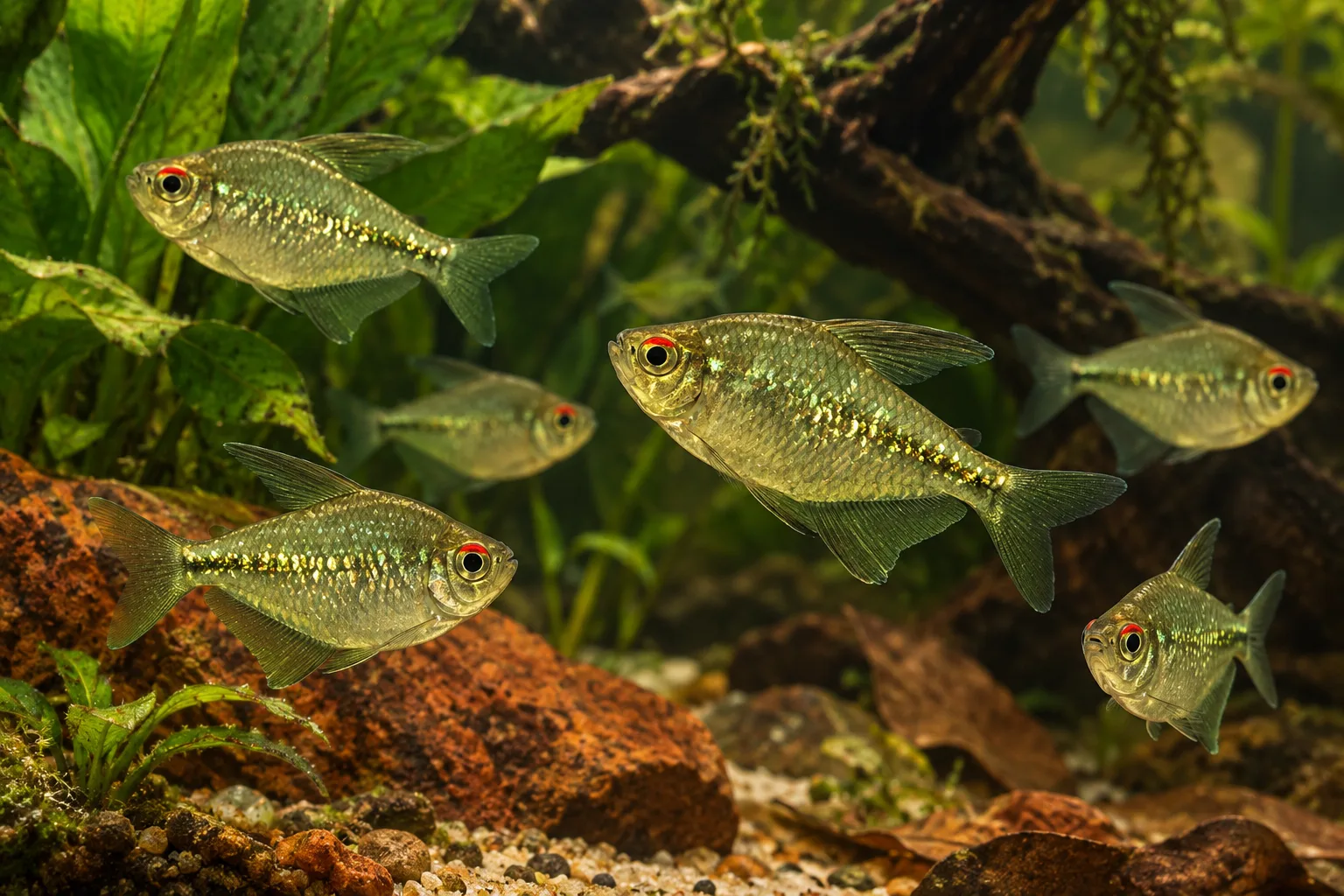
Older references usually call it Moenkhausia pittieri. The Catalog of Fishes now accepts Makunaima pittieri, so the familiar older name remains useful for finding historical aquarium information but is no longer the current combination.
- Accepted identity
- Makunaima pittieri (Eigenmann, 1920)
- Former combination
- Moenkhausia pittieri
- Family
- Acestrorhamphidae
- Native range
- Lake Valencia basin, northern Venezuela
- Maximum published size
- 6 cm standard length
- Temperature
- 24 to 28 °C
- Social requirement
- Group of five or more in the FishBase aquarium record
- IUCN assessment
- Endangered, assessed 29 November 2022
Its body is silver-grey until light catches the large scales, then blue, green and violet flashes move across the flank. That shifting reflection is normal; a fish does not need to look like a studio photograph from every angle to be healthy.
When does diamond tetra color develop?
Juveniles are slimmer, paler and much less reflective than mature fish. The visible change comes from growth, larger exposed scale surfaces, fin development and a fish becoming confident enough to hold position in open water.
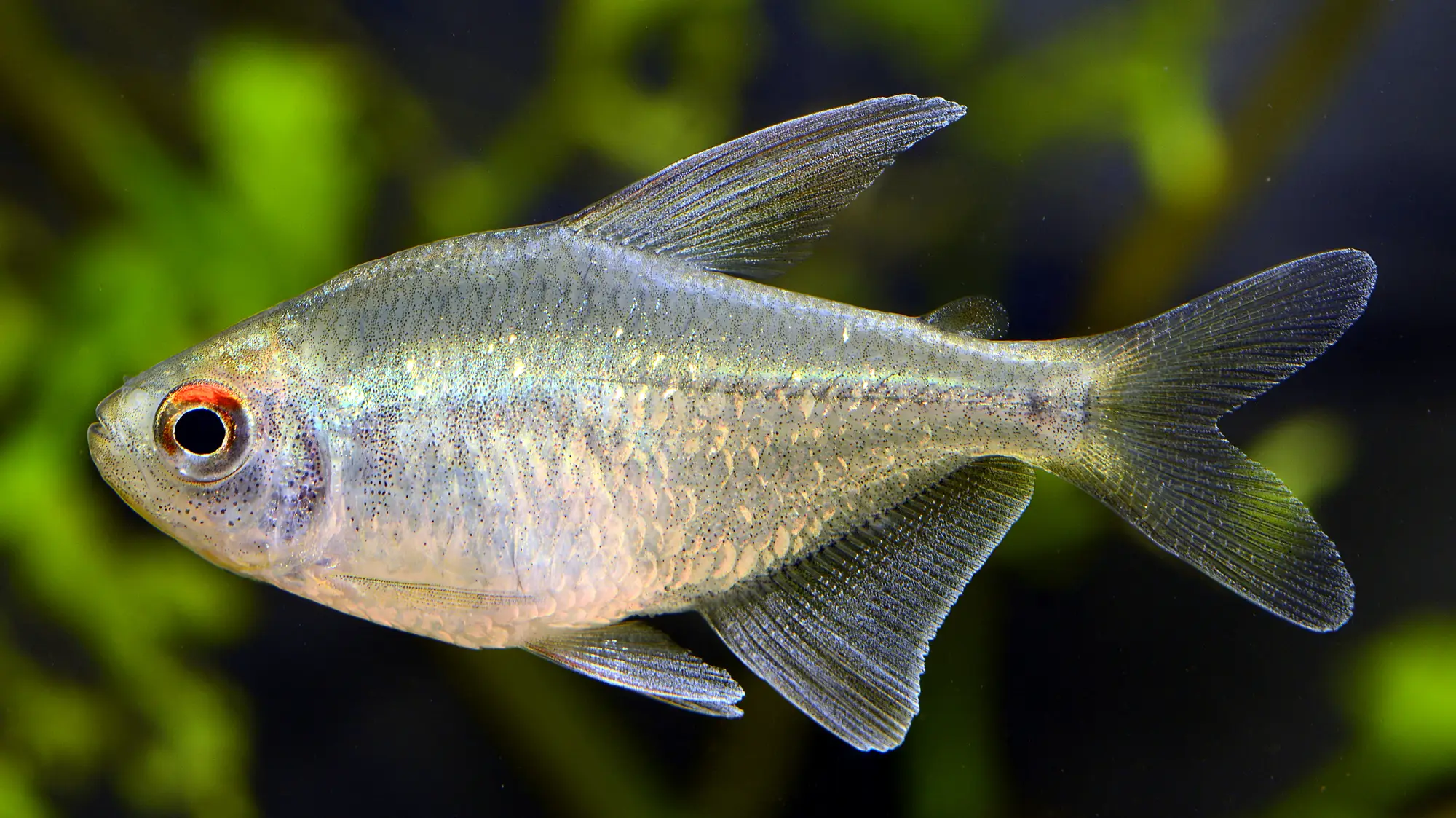
Color therefore cannot be separated from time. A recently imported or newly moved juvenile may need weeks to feed normally and months to become the deeper-bodied adult shown in mature photographs.
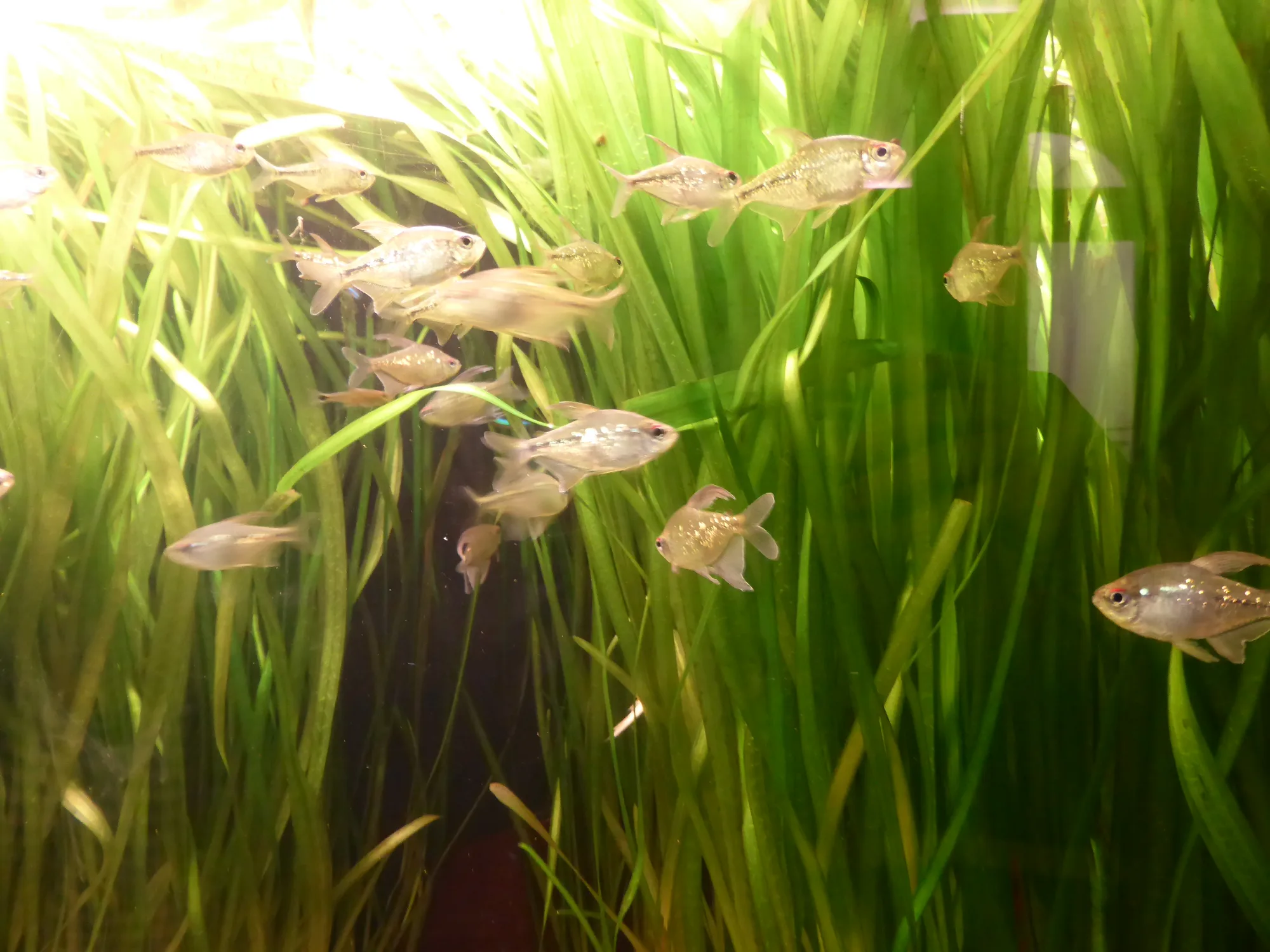
Light still matters. Side lighting reveals the reflective scales, while flat light from directly above can make a healthy fish look plain.
How can you tell males from females?
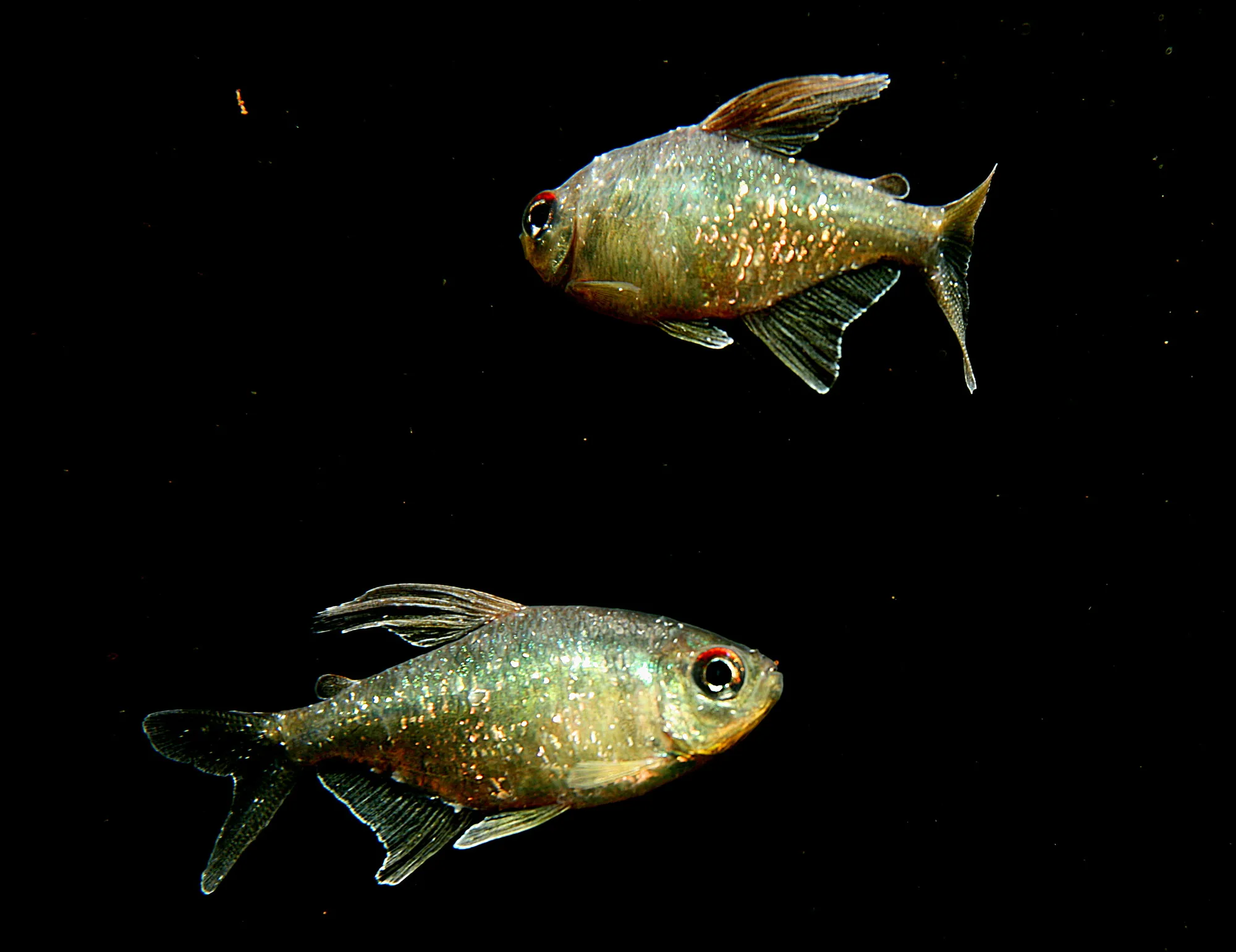
Mature males generally develop longer dorsal, anal and pelvic fins, and their body reflection can look more intense. Mature females are usually fuller through the abdomen and retain shorter fins.
| Character | Mature male | Mature female | Main limitation |
|---|---|---|---|
| Dorsal fin | Usually longer and more pointed | Usually shorter | Damaged or immature fins hide the difference |
| Anal and pelvic fins | More extended | More compact | Individual variation overlaps |
| Body depth | Deep, especially in established adults | Often fuller through the abdomen | Feeding and reproductive condition alter shape |
| Reflection | Often stronger | Still clearly iridescent | Lighting can overwhelm the biological difference |
No single trait reliably sexes a juvenile. When the sex balance matters, choose a mature group or accept that the balance will only become clear later.
Why does a group need an 80 cm aquarium?
FishBase gives an 80 cm minimum aquarium length and a group of five or more. The length serves social movement and escape, not just exercise.
Diamond tetras display side-on, turn sharply and establish short-lived positions within the group. In a cramped tank, the same display can become repeated pursuit because the receiving fish has nowhere to leave the line of sight.
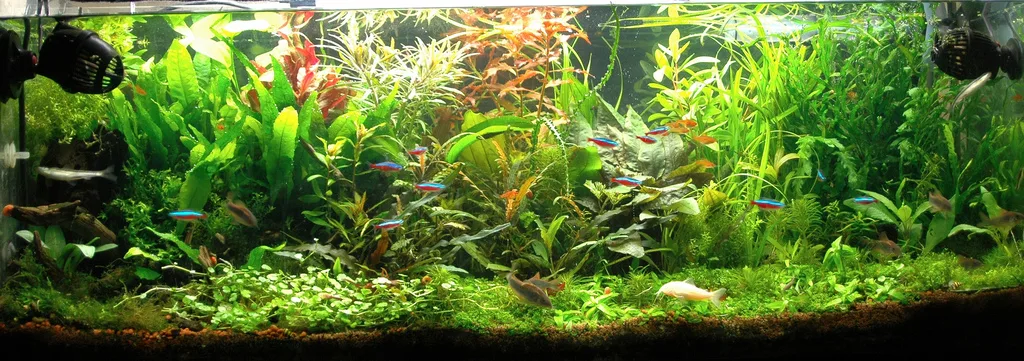
An 80 cm tank is a starting benchmark for the species group, not a complete stocking calculation. Other midwater fish, a large male-heavy group or bulky hardscape can make a longer footprint the better choice.
- Measure the clear internal length after background chambers and end filters take their share.
- Reserve the middle water for the tetra group rather than filling it with vertical hardscape.
- Count every adult midwater fish that will compete for the same lane.
- Provide at least two planted or wooded retreat edges, not one dead-end thicket.
- Confirm that the filter can maintain clean water without turning the lane into a narrow jet.
What water does a diamond tetra need?
FishBase compiles 24 to 28 °C, pH 6.0 to 7.0 and 5 to 12 dH. The relatively narrow pH record makes source water and acclimation worth checking before purchase.
Published diamond tetra water ranges
- Temperature24 to 28 °CSeparate thermometer placed away from the heater.
- pH6.0 to 7.0Calibrated meter or aquarium test spanning acid to neutral.
- General hardness5 to 12 dHGH titration test in degrees of hardness.
Every range above applies to Makunaima pittieri in a freshwater system. Source: FishBase, checked 2026-09-13.
Do not lower pH rapidly to copy the native basin. First compare the dealer water with the home aquarium, acclimate to the measured difference and keep the eventual value stable.
Warm water holds less oxygen than cool water, while a deep-bodied active group consumes more than its length suggests. Surface movement and unclogged biological filtration therefore matter even though this species is not sold as a river fish.
Routine maintenance should preserve the conditions under which the fish is developing rather than repeatedly resetting them. Match replacement-water temperature, avoid exposing filter media to untreated tap water and remove fine waste from the planted margins without stripping every surface clean.
- Test the trend Record temperature, pH and nitrogen waste at a consistent point in the maintenance cycle so a change can be distinguished from normal test variation.
- Prepare replacement water Match temperature and treat disinfectants before the new water reaches fish or biological media.
- Clean for flow Rinse clogged mechanical media in removed aquarium water while leaving established biological surfaces intact.
- Refill without a swing Add water at a rate that does not abruptly change temperature or overturn the layout.
- Observe the group Normal open-water use after maintenance is a better closure check than a single clear-water photograph.
What should diamond tetras eat?
FishBase records worms, crustaceans and insects. In an aquarium, the useful translation is a complete small-particle staple supported by varied frozen or live foods that the whole group can swallow.
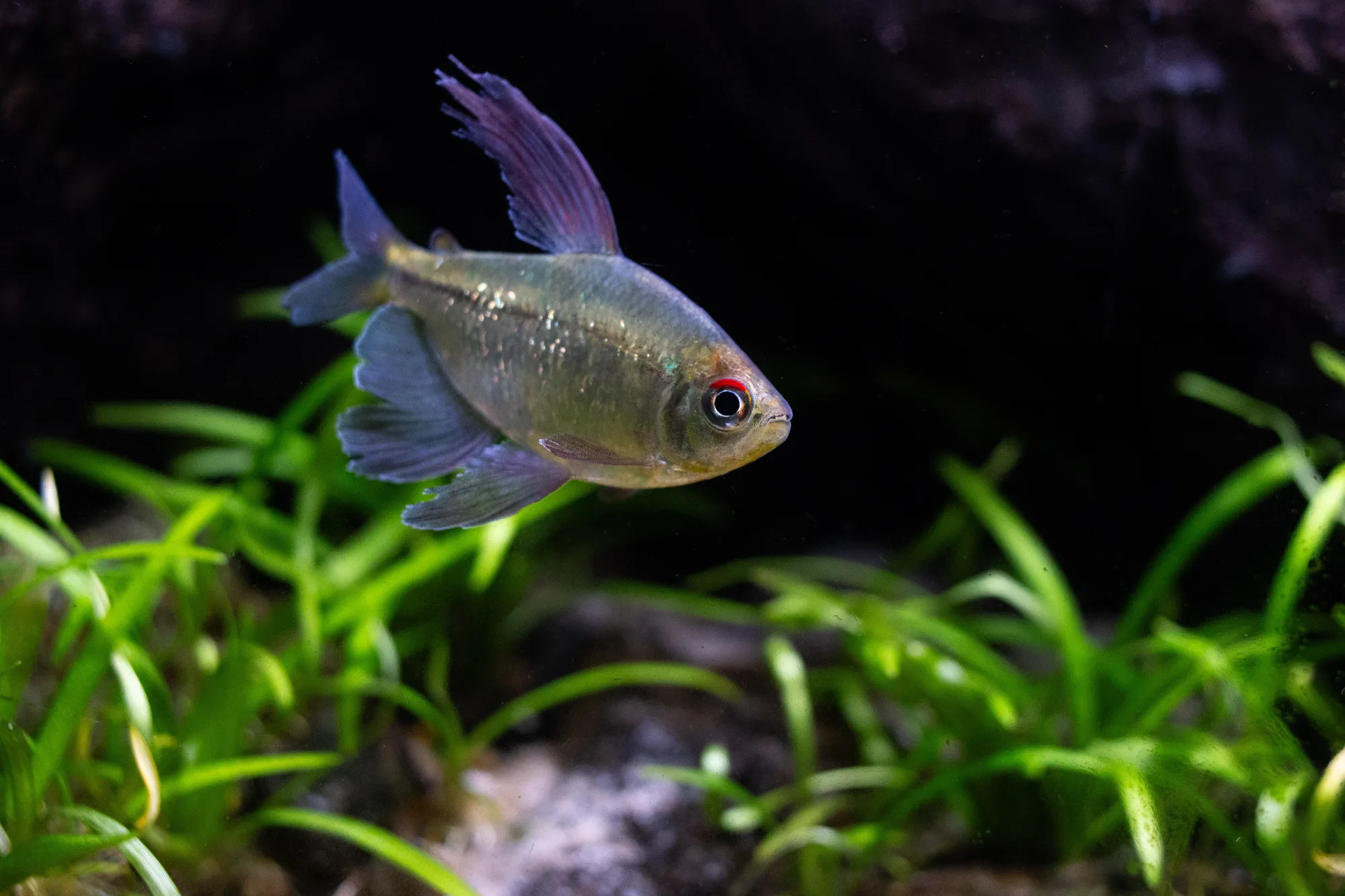
The body is deep but the mouth is not large. Oversized food creates competition around fragments and sends more waste into the substrate.
Daily staple
A complete micro pellet or flake crushed to an easy swallow, offered in portions the group clears.
Animal variety
Small frozen or live foods such as suitable crustaceans or insect larvae, matched to mouth size.
Plant contribution
A varied prepared diet rather than an all-meat routine, because complete nutrition is broader than the recorded prey list.
Feeding test
Every fish reaches food, no one repeatedly spits particles out, and little food reaches the bottom untouched.
More food will not force faster color development. Excess food raises waste and can dull the very appearance it was intended to improve.
Are diamond tetras peaceful?
They are community fish, but peaceful does not mean motionless or socially simple. Males display, the group rearranges itself and an individual may chase briefly before returning to open water.
The distinction is whether the other fish can disengage. A short pursuit that ends at cover is normal social behavior; repeated cornering, fin damage or a fish excluded from food is a welfare problem.
| Decision factor | Normal group display | Intervention needed |
|---|---|---|
| Duration | Short approach, flare or turn, then separation | The same fish is pursued repeatedly without a pause |
| Space | Fish use the open zone and retreat edges | One fish is confined behind equipment or at the surface |
| Fins | Open and undamaged | Split, clamped or progressively shortened |
| Feeding | All fish join within the meal | One fish waits until food is gone |
| Breathing | Returns to normal after activity | Rapid breathing persists while resting |
Suitable companions are peaceful fish of comparable scale that tolerate the same warm, moderately soft water. Avoid predators, persistent fin nippers and very slow long-finned fish that cannot leave a busy feeding group.
The deepest-bodied adults also compete more strongly than juveniles suggest. When adding a second midwater species, allocate space and food for both adult groups instead of assuming their peaceful labels allow them to share one lane without consequence.
Small peaceful bottom fish
Can reduce direct competition when substrate and temperature needs overlap.
Similar calm tetras
Work when the aquarium provides enough midwater for both full groups.
Long-finned fish
Risk persistent attention and cannot always escape a quick feeding rush.
Tiny fish or fry
May be intimidated, outcompeted or treated as prey by larger adults.
Territorial cichlids
Can convert the retreat edges into defended space and trap the tetra group in the middle.
Why does the Lake Valencia origin matter?
The accepted distribution is the Lake Valencia basin in northern Venezuela. That limited basin is not decorative biography; it is the context for the species' Endangered assessment.
FishBase records the IUCN category as Endangered from a 2022 assessment. It also records commercial aquarium use and no CITES evaluation.
Captive availability does not make a wild population secure, and an Endangered wild status does not mean a responsibly produced aquarium fish must be avoided. The decision turns on traceable origin and suitable lifetime care.
Why might a diamond tetra stay dull?
Start with age and lighting, then check the factors that affect the whole animal. Dullness alone is nonspecific and should not be treated as a disease diagnosis.
Work from the tank outward
- Age Juveniles are naturally slimmer and less reflective; compare growth over months, not days.
- Lighting angle View from the side under steady neutral light before judging the scales.
- Social security A small or pressured group spends more time behind cover and shows less flank.
- Water quality Test ammonia and nitrite, verify temperature, and review recent maintenance rather than adding color products.
- Diet access Watch one full meal to confirm that every fish swallows suitable particles.
- Health Weight loss, swelling, sores, rapid breathing or persistent isolation needs qualified assessment.
A healthy fish can be visually quiet. The stronger evidence is normal breathing, steady appetite, intact fins, gradual growth and regular use of the tank.
How long do diamond tetras live?
Institutional records reviewed here do not provide a verified aquarium lifespan. Popular figures are repeated widely, but they are not strong enough to install as a guaranteed range.
Plan for a multi-year commitment because the fish is sold young, develops slowly and must remain in a social group. Replacement planning also matters: an aging group should not be allowed to shrink to one or two fish while a keeper waits for a convenient restock.
Is a diamond tetra right for your aquarium?
Choose it for a mature warm-water aquarium with at least the published 80 cm length, a proper group and enough open water to display. It suits a keeper willing to wait for adult color rather than buying a finished-looking fish.
Skip it when the only available space is a short nano tank, when the water is persistently hard and alkaline outside the published record, or when existing fish are slow, long-finned or likely to swallow a 6 cm tetra.
Which tetras make useful comparison points?
Bleeding heart tetra
A deep-bodied characin with longer fins, making group confidence and fin condition useful comparison points.
Colombian tetra
A robust medium tetra whose feeding pace and fin-nipping risk change an otherwise similar community plan.
Cardinal tetra
A small blackwater shoaler whose soft-water context and quiet group behaviour narrow the comparison.
Black skirt tetra
A deeper-bodied group fish whose speed and fin behaviour deserve a separate stocking check.
Ember tetra
A tiny warm-water tetra whose low competitive weight and small mouth change feeding and tankmate choices.
Black neon tetra
A smaller midwater shoaler that offers a useful contrast in body size, group movement and water tolerance.
Chili rasbora
A minute blackwater group fish whose mouth size, water and refuge needs set a much smaller scale.
Celestial pearl danio
A tiny planted-tank danio with cooler documented habitat water and a different style of group behaviour.
Cherry barb
A small planted-stream barb that contrasts sex-linked colour, social structure and habitat cover.
Emperor tetra
A medium tetra whose males hold display positions, adding territory and sight lines to the group decision.