
What Is a Black Neon Tetra, and Why Does Its Shoal Matter?
Hyphessobrycon herbertaxelrodi
Black neon tetras are small Paraguay-basin fish that need a same-species shoal, open horizontal swimming room, and stable warm freshwater. Their pale-over-black side stripes make identification straightforward when the complete flank pattern is visible, but a single fish or photograph cannot establish welfare, sex, or health.
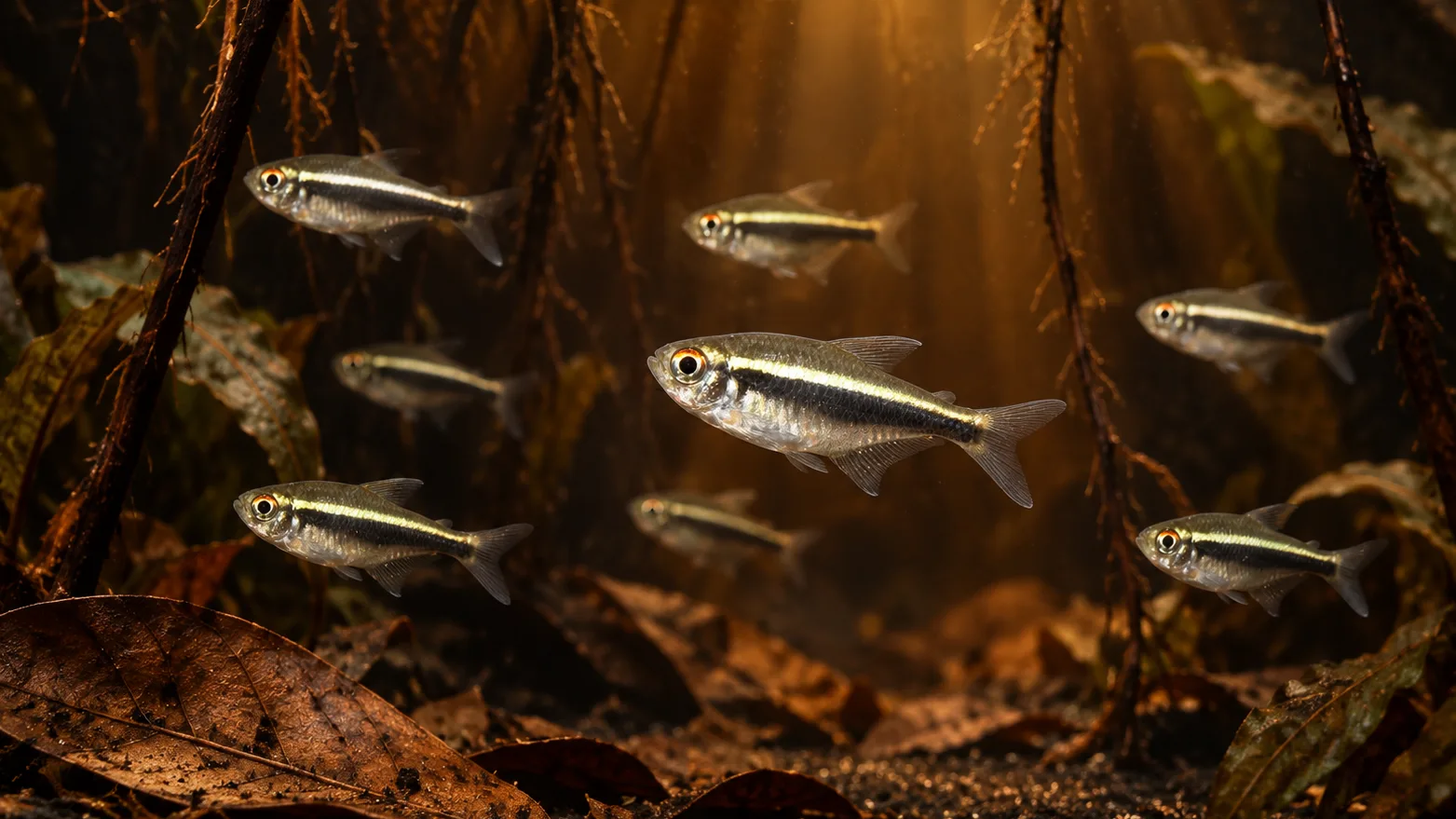
At a glance

- Adult size
- 3.2 cm
- Minimum footprint
- About 60 cm horizontal aquarium length as a starting benchmark, with an open midwater lane
- Social structure
- At least six conspecifics; a larger shoal is preferable when footprint, filtration and feeding access support it.
- Minimum group
- 6
- Sex ratio
- No fixed sex ratio is established for routine community keeping.
- Diet
- Omnivore
- Feeding
- Use a small complete staple with appropriate invertebrate variety, distribute tiny portions across the shoal, and adjust from body condition, leftovers and water trends.
- Waste load
- low
- Family
- Acestrorhamphidae
- Native range
- Paraguay River basin in Brazil and Bolivia
- Also sold as
- Black neon. Trade and hobby names, not accepted species names.
- Conservation status
- Least Concern, assessed 7 November 2018 Source
The source benchmark is aquarium length, not volume; usable horizontal room, group size, decor and total bioload determine fit.
What is a black neon tetra?
The black neon tetra is Hyphessobrycon herbertaxelrodi, a small freshwater fish native to the Paraguay River basin. Its decisive care requirement is social: one fish may be short, but a suitable aquarium must support a moving same-species shoal.
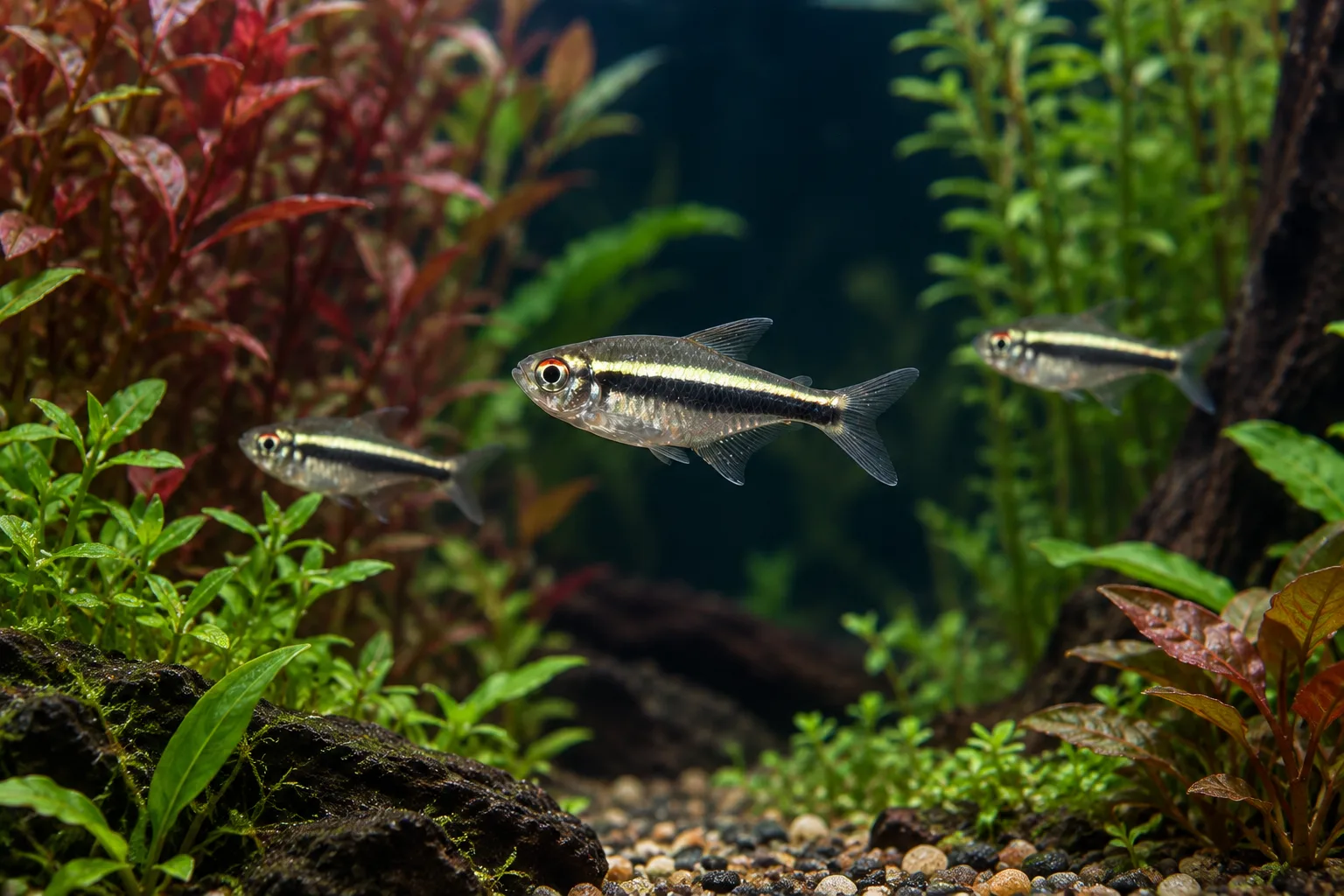
The current Catalog of Fishes record accepts H. herbertaxelrodi Géry, 1961 and places it in Acestrorhamphidae, subfamily Hyphessobryconinae. Older books and databases may still list Characidae because the family-level classification has changed, not because those sources describe another black neon tetra.
The species name honors Herbert Axelrod, while the genus name separates it from the familiar neon tetra, Paracheirodon innesi. A shared trade word does not make the two species close substitutes in identification, water history, or stocking plans.
FishBase reports a maximum length of 3.2 cm SL. SL means standard length, measured from the snout to the base of the tail fin, so the living fish looks slightly longer when its tail is included.
That measurement convention matters when comparing care sheets. A source giving total length and one giving standard length may appear to disagree even when both measured the same kind of adult fish.
The lead photograph is by Brian Gratwicke, CC BY 2.0, and was resized and converted to WebP from the Wikimedia Commons source file.
How can you recognize one without confusing it with another tetra?
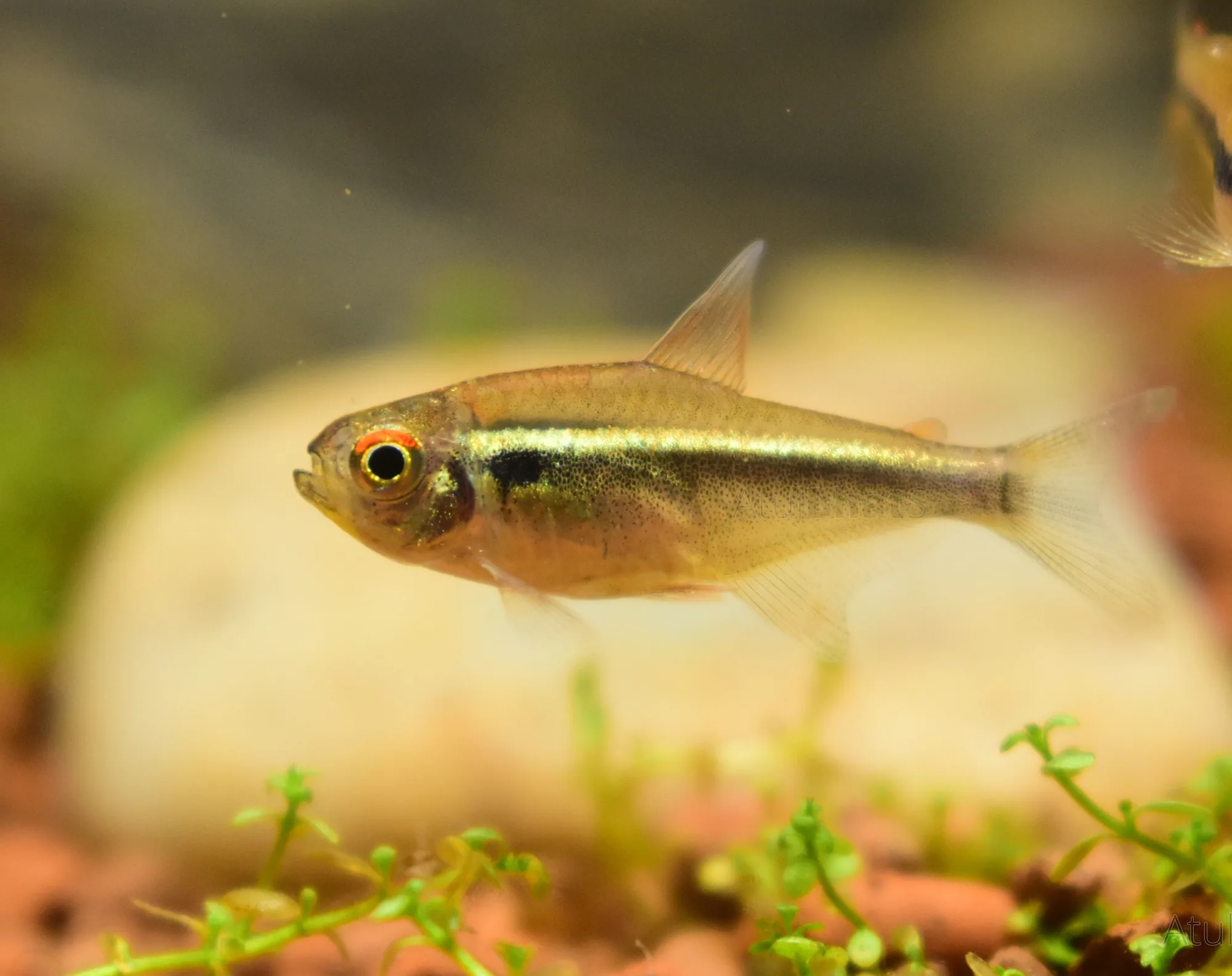
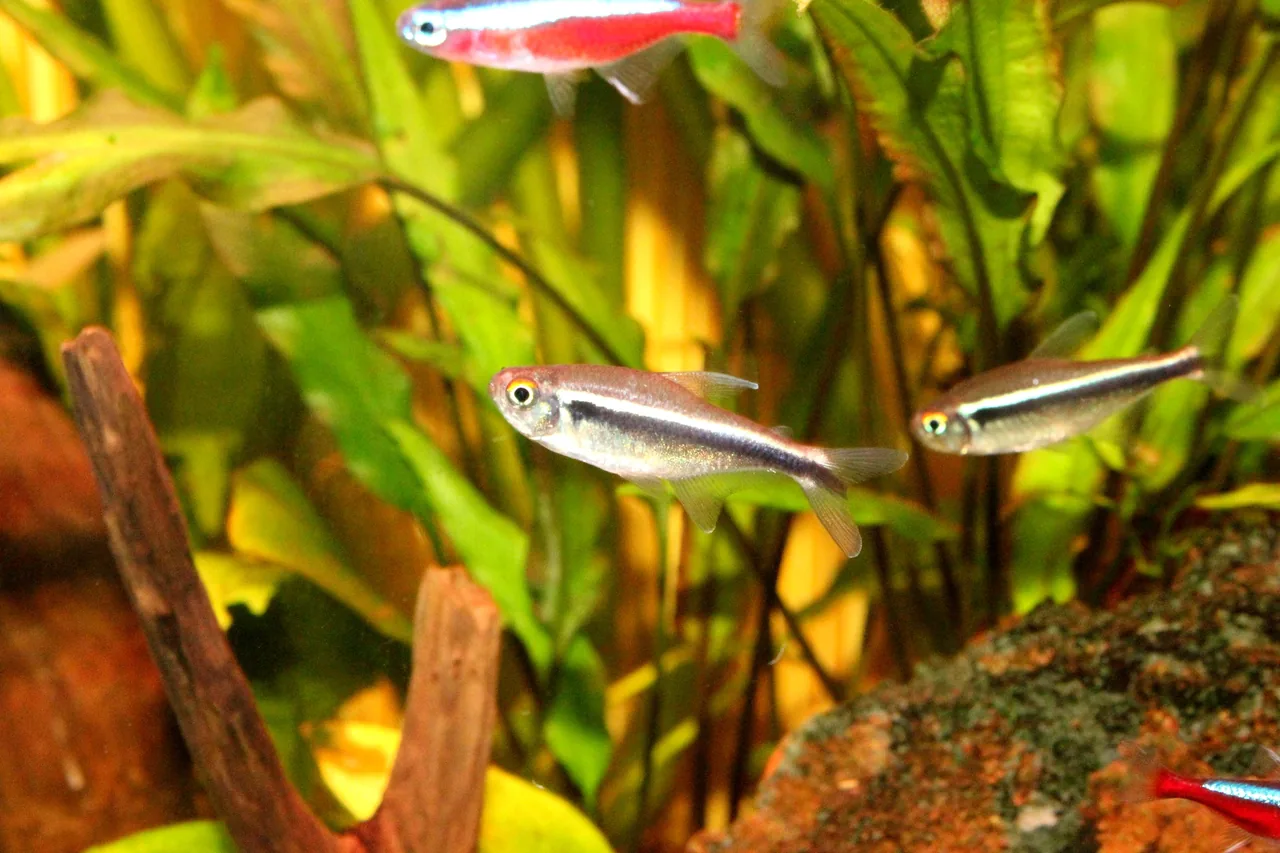
A typical black neon tetra has a narrow bright stripe along the upper side and a much broader dark stripe directly below it. The upper portion of the eye often shows red, while the body below the dark band is silvery to translucent rather than deep-bodied and skirt-shaped.
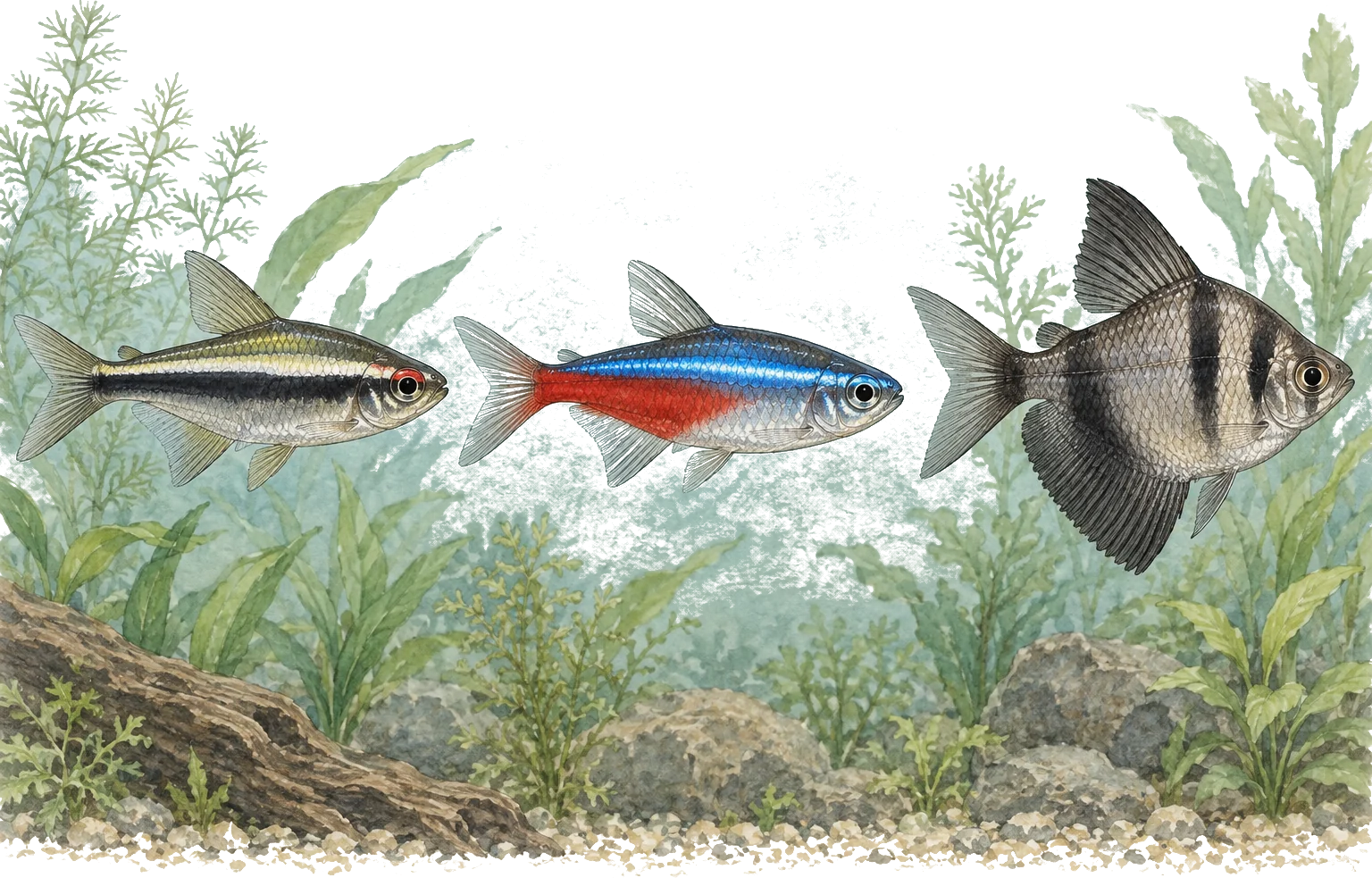
Its name invites two common mistakes. A neon tetra carries an electric blue stripe and red color on the rear half, while a black skirt tetra has a deeper, taller body with vertical dark bars and a broad anal fin that creates the skirt outline.
| Decision factor | Visible pattern | Name boundary |
|---|---|---|
| Black neon tetra | Slender body; pale reflective line above a broad black band; red on the upper iris | It is Hyphessobrycon herbertaxelrodi, not a dark color form of the neon tetra |
| Neon tetra | Slender body; blue lateral stripe with red on the rear half | Its accepted name is Paracheirodon innesi |
| Black skirt tetra | Deeper body; dark vertical bars; expanded dark anal fin | Its shape and swimming profile differ even though the trade name also starts with black |
Color changes with angle, lighting, background, stress, age, and camera exposure. In a bright photograph the pale stripe may look white, green, or gold, so identify the arrangement of features rather than matching one exact color sample.
A picture can support a label when the whole side profile is visible.
It cannot confirm age, sex, health, wild origin, water quality, or a claimed morph, and it should never be used alone to diagnose a fish that has changed color.
Sexual dimorphism is subtle compared with the bold lateral pattern. Mature females are often described as fuller-bodied, but body fullness also changes with feeding, reproductive state, swelling, and camera angle; do not buy or pair fish on that sign alone.
Where does the species live, and what should the aquarium copy?
Catalog of Fishes records the species from the Paraguay River basin in Brazil and Bolivia, including the type locality at Coxim on the Taquari system in Mato Grosso. FishBase describes it as a tropical, freshwater, benthopelagic fish, meaning it uses the water above the bottom rather than living as a surface specialist.
The U.S. Fish and Wildlife Service risk summary found reliable native records in the basin but very little detailed ecological information. Pet-shop observations outside South America were sometimes entered as geographic records, which is a useful warning against treating every map point as a wild population.
For aquarium design, copy functions rather than staging a supposed biotope from guesses. Provide planted or wooded margins for shade and retreat, then leave a broad open lane where the group can cross the tank without weaving through dense stems.
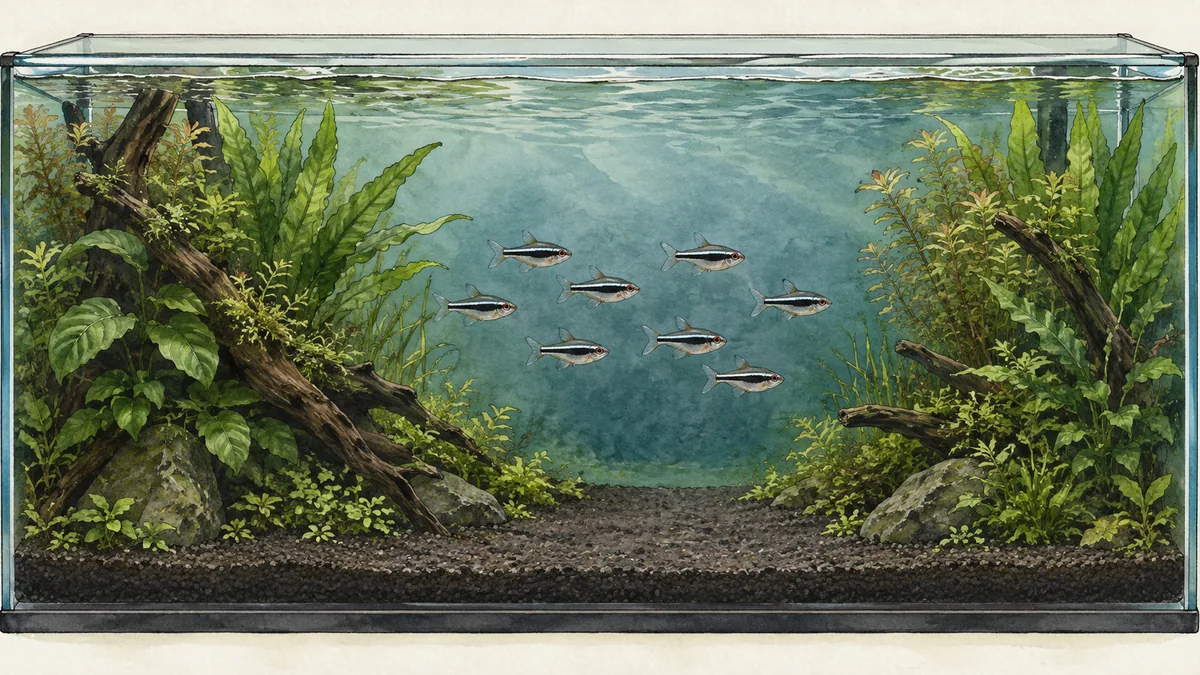
A dark backing, subdued zones, leaf litter or wood can make the stripes easier to see, but these are layout choices rather than proof of one exact collection habitat. Keep every material aquarium-safe, and preserve access for cleaning so organic debris does not accumulate unseen.
Moderate water movement can support gas exchange and carry food through the swimming zone. The useful test is behavior: the group should be able to hold position, spread out, and cross the open lane without being pinned behind decor or forced to fight a strong outlet all day.
No verified wild-habitat photograph was used here. An aquarium scene may help with layout, but presenting it as documentary evidence of the Paraguay basin would overstate what the image proves.
Why does the group size matter more than one fish's length?
Black neon tetras are social fish. FishBase cites aquarium keeping in groups of five or more, while a broad review of fish welfare in managed aquariums says keeping only one or two members of a naturally shoaling species does not provide a positive social situation.
Plan at least six black neon tetras as one group, and consider a larger group when the tank footprint, filtration, oxygen, and maintenance routine can carry the added bioload. Six is a defensible floor from the available evidence, not proof that every six-fish setup is spacious or stable.
A study of the related neon tetra found that increasing groups from five to ten had a calming effect and improved shoaling tendencies, as discussed in an open-access ornamental-fish feeding study. That result supports the direction of the welfare decision, but it does not establish ten as a tested optimum for black neon tetras.
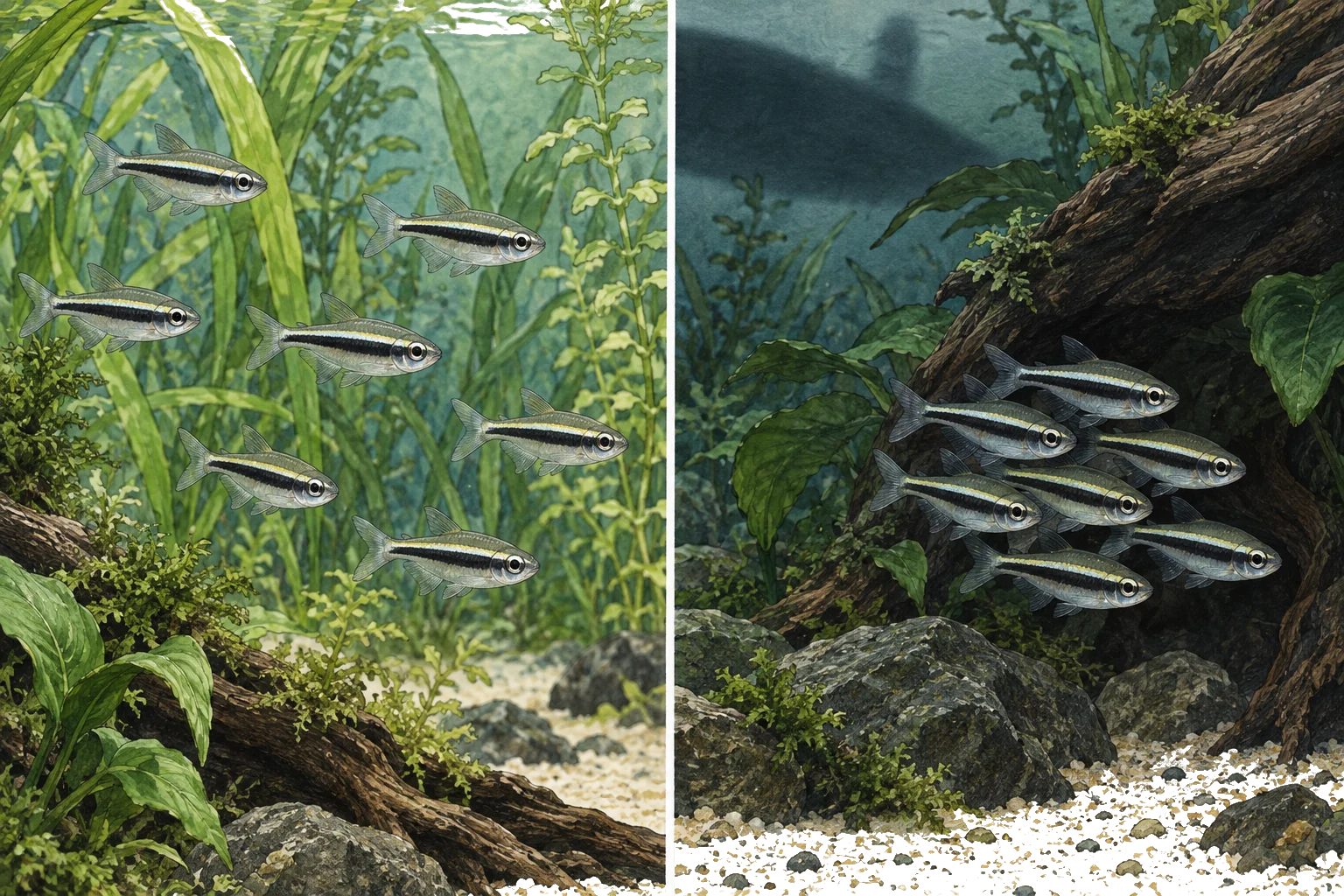
Shoaling and schooling are related but different. A shoal stays socially associated, while a school shows coordinated alignment and direction; a comfortable group may spread out when undisturbed and pull tightly together after a disturbance.
Constantly tight formation is therefore not an automatic sign of excellent care.
It can reflect perceived threat, a new environment, harsh lighting, exposed space, or an aggressive tank mate, so compare the pattern with normal feeding, breathing, exploration, and use of cover.
More fish do not repair an undersized aquarium.
Adding companions without increasing usable swimming room, filtration capacity, oxygen, and feeding access can exchange social isolation for crowding and declining water quality.
Plan the footprint around a moving shoal
The 3.2 cm standard-length record describes one body, not the space needed by six or more bodies that accelerate, turn, separate, and regroup. A tall column may hold many litres while offering a short route across the middle of the aquarium.
FishBase cites a 60 cm aquarium-length benchmark from a German husbandry reference. Treat about 60 cm of horizontal length as a practical starting point, then increase the footprint for a larger shoal, active tank mates, heavy planting, or decor that breaks the route into narrow corridors.
- Recorded adult size
- 3.2 cm standard length, excluding the tail fin
- Social plan
- At least six of the same species; more only when space and filtration support them
- Footprint reference
- About 60 cm of horizontal tank length as a starting benchmark
- Swimming zone
- Mid and upper water in aquarium observations
- Layout priority
- Open crossing space bordered by cover, not a fully packed plant thicket
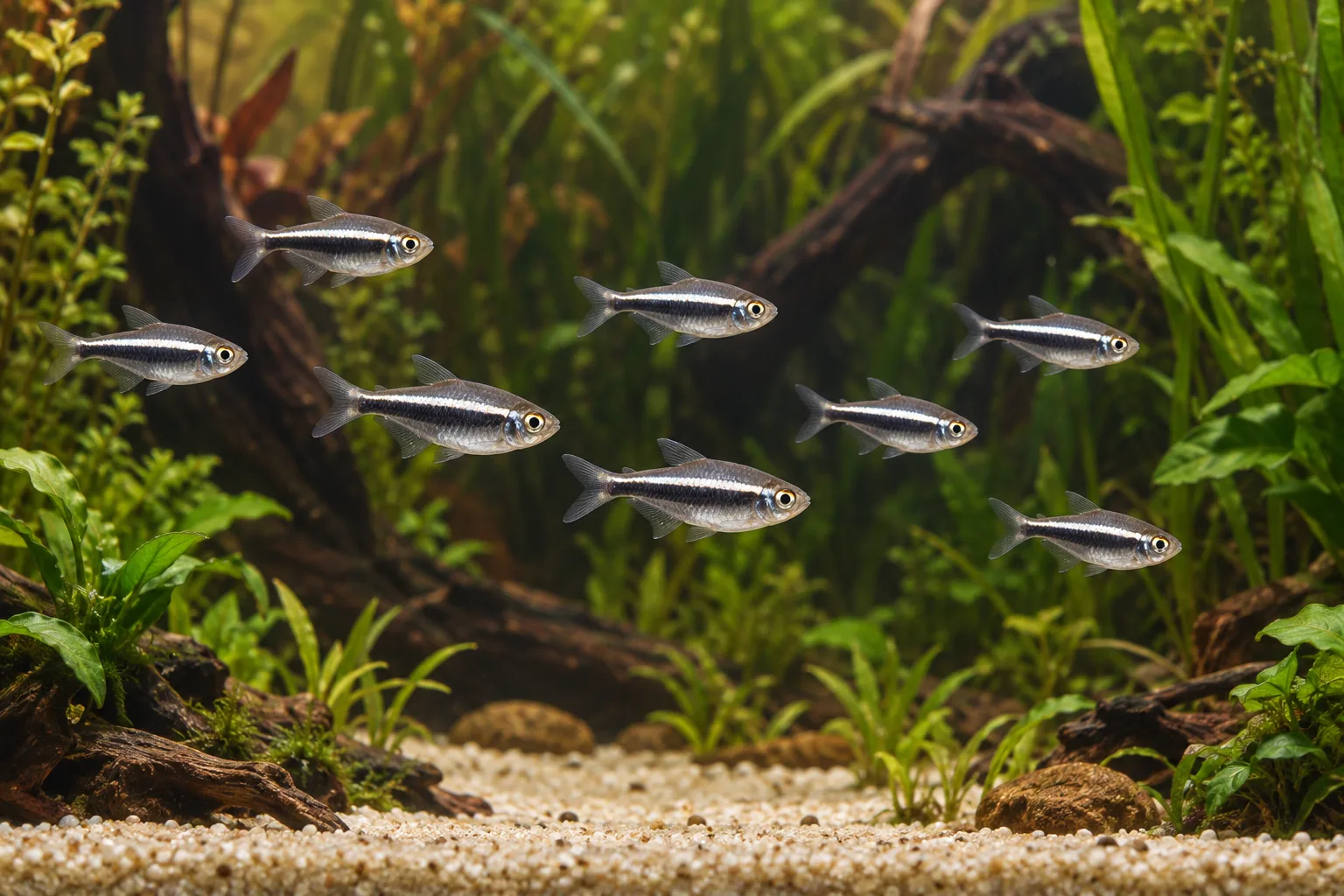
A common 60 cm rectangular aquarium often holds roughly 54 to 75 L depending on width and height, but dimensions matter more than a label on the carton. Measure the inside route after hardscape, large equipment, and dense plants occupy part of it.
Cover the tank because small tetras can leave the water during chasing, netting, maintenance, or a sudden fright. Close cable and filter gaps while preserving normal gas exchange, and never fill so high that a jump clears the rim before the lid stops it.
A mature filter must handle the entire community, not only the new shoal.
If adding six fish causes detectable ammonia or nitrite, the problem is the life-support capacity or introduction pace, not a reason to accept chronic exposure.
Which water conditions support a stable shoal?
FishBase reports 23 to 27 °C, pH 5.5 to 7.5, and general hardness up to 15 dGH for black neon tetras. These figures come from aquarium references compiled into a species record, so they are useful boundaries with moderate uncertainty, not measurements from every wild locality or a command to chase the midpoint.
Recorded aquarium water context
- Temperature23 to 27 C
- pH5.5 to 7.5
- General hardnessUp to 15 dGH; lower bound not specified
Every range above applies to Black neon tetra husbandry in a freshwater aquarium system. Source: FishBase species summary, checked 2026-09-11.
Aquarium range compiled by FishBase.
Compare those values with the water the fish currently occupy and with your established aquarium. A stable mature tank within the supported band usually creates less risk than repeated chemical corrections that make pH or hardness swing.
Temperature should be checked with a separate aquarium thermometer rather than trusting the heater dial. Test pH with a calibrated meter or an aquarium test whose range includes the expected value, and measure hardness with a GH titration test reported in degrees of general hardness.
Ammonia, nitrite, and nitrate answer different questions from species-range records. FishBase does not provide a black-neon-specific safe waste range; any detectable ammonia or nitrite in a stocked established aquarium warrants confirmation and investigation of cycling, filter function, feeding, dead material, or recent stocking.
Do not make a large water change with water that differs sharply in temperature or chemistry just because one reading is undesirable. Confirm the test, identify the cause, match replacement water safely, make a controlled correction appropriate to the actual emergency, and stop changing chemistry if the fish deteriorate or the readings become unstable.
A pH result also needs context from KH because low carbonate buffering can allow rapid movement between tests. If your source water lies outside the recorded band, choose livestock that suits it or get qualified advice before redesigning the chemistry around fish that have not yet been bought.
Acclimation is a comparison, not a timer
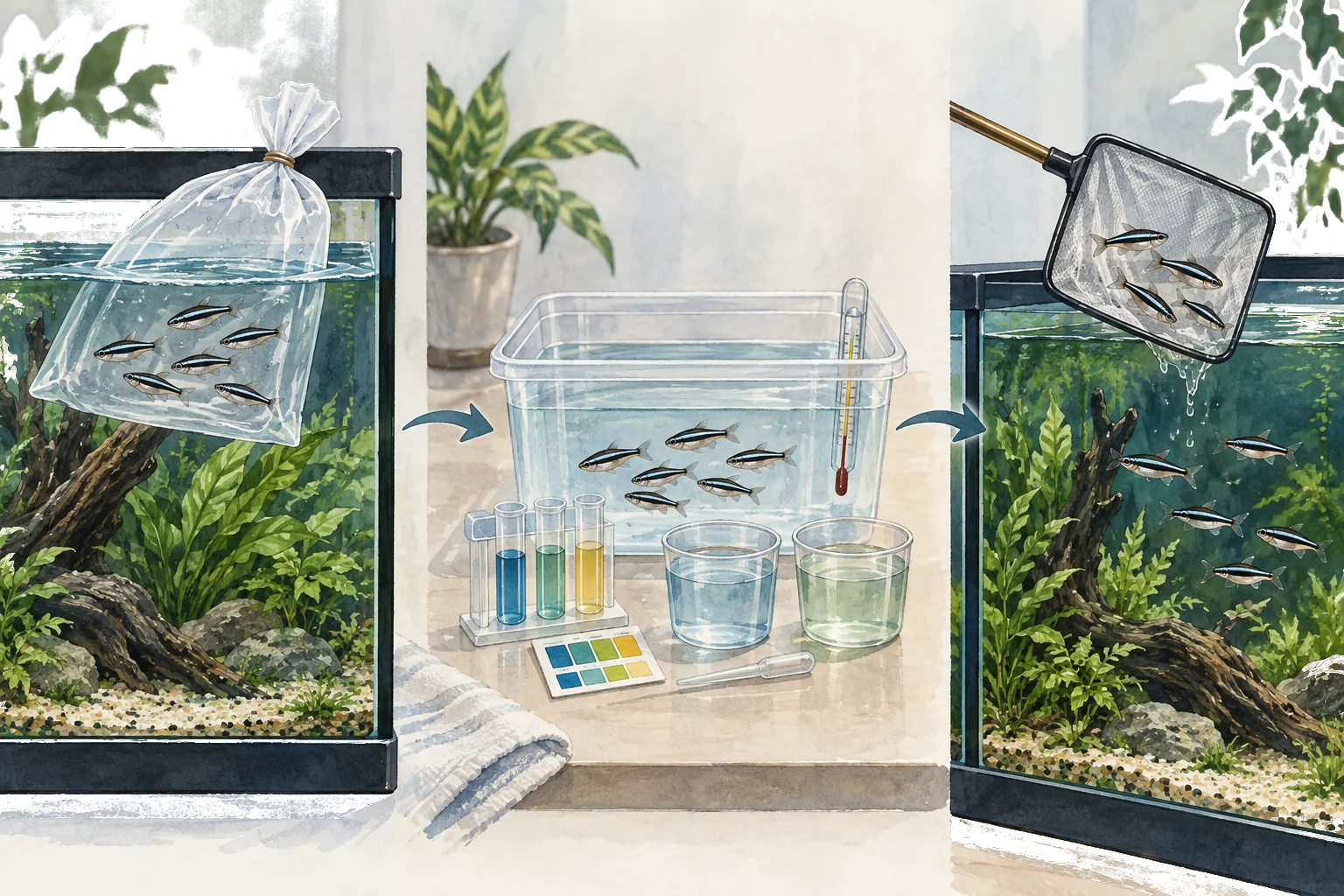
Ask the seller for temperature and, where possible, pH and conductivity or hardness. The larger the difference from the prepared aquarium, the more important it is to avoid a sudden transfer and to follow a method that also limits prolonged exposure to transport water.
There is no universal number of minutes that makes every transfer safe.
Observe swimming control and breathing during the process, use clean dedicated equipment, and stop if the fish lose balance or show severe respiratory distress.
How should food reach every fish in the group?
FishBase records worms, small crustaceans, and plant matter in the diet. In a home aquarium, that supports an omnivorous feeding plan built around a nutritionally complete small tropical-fish food, with appropriately sized frozen or live invertebrate foods used as variety rather than as the only ration.
Particle size matters because a food can be nutritionally suitable yet too large for a small mouth.
Crush flakes consistently or choose micro-pellets that the fish can swallow without repeated spitting, and discard foods that remain too hard or large after soaking according to their instructions.
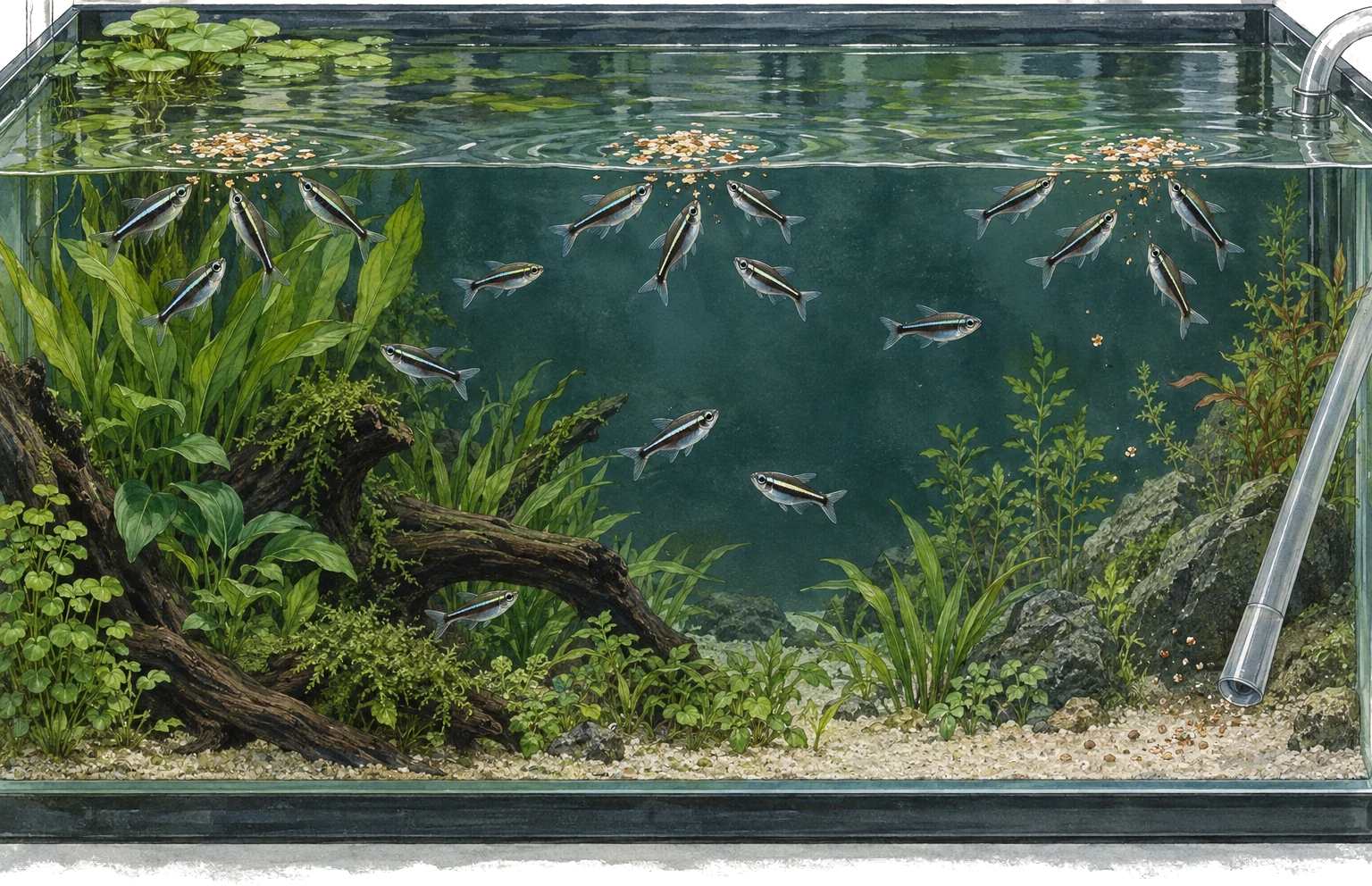
- Choose a complete staple whose particles fit a 3 cm tetra.
- Release small portions across more than one point so dominant fish cannot intercept everything.
- Watch long enough to see whether the smallest or quietest individual actually swallows food.
- Stop when the active feeding response fades, then remove persistent leftovers.
- Use weekly body shape and water-test trends to adjust the next ration.
A rounded female may be carrying eggs, well fed, or unwell; one glance cannot distinguish those states. Look for symmetrical body condition, normal balance, continued appetite, and stable waste production over time.
Feeding several tiny releases is useful only when the total remains controlled. Food entering the filter, coating the substrate, or raising nitrogen waste is evidence that distribution or quantity needs changing.
Which community fish are compatible in principle?
Black neon tetras suit a community only when water conditions overlap and every animal can feed, rest, and move without predation or repeated harassment. The word peaceful cannot settle a pairing by itself because size, speed, mouth gape, territory, and group composition all change the result.
| Compatibility filter | A workable condition | Reject or separate when |
|---|---|---|
| Predation and scale | Tank mates cannot swallow or seriously injure an adult tetra | A fish stalks the shoal, lunges repeatedly, or a tetra disappears |
| Social behavior | The full black neon group has open midwater and retreat cover | One fish is isolated, chased continuously, or blocked from the group |
| Feeding pace | Food reaches both fast and cautious animals | The shoal monopolizes food or repeatedly loses every feeding contest |
| Fins and contact | No species persistently nips, rams, or corners another | Torn fins, compressed schooling, hiding, or weight loss appears |
| Water and flow | Temperature, pH, hardness, oxygen, and current overlap | One species must live at the edge of its supported range to accommodate another |
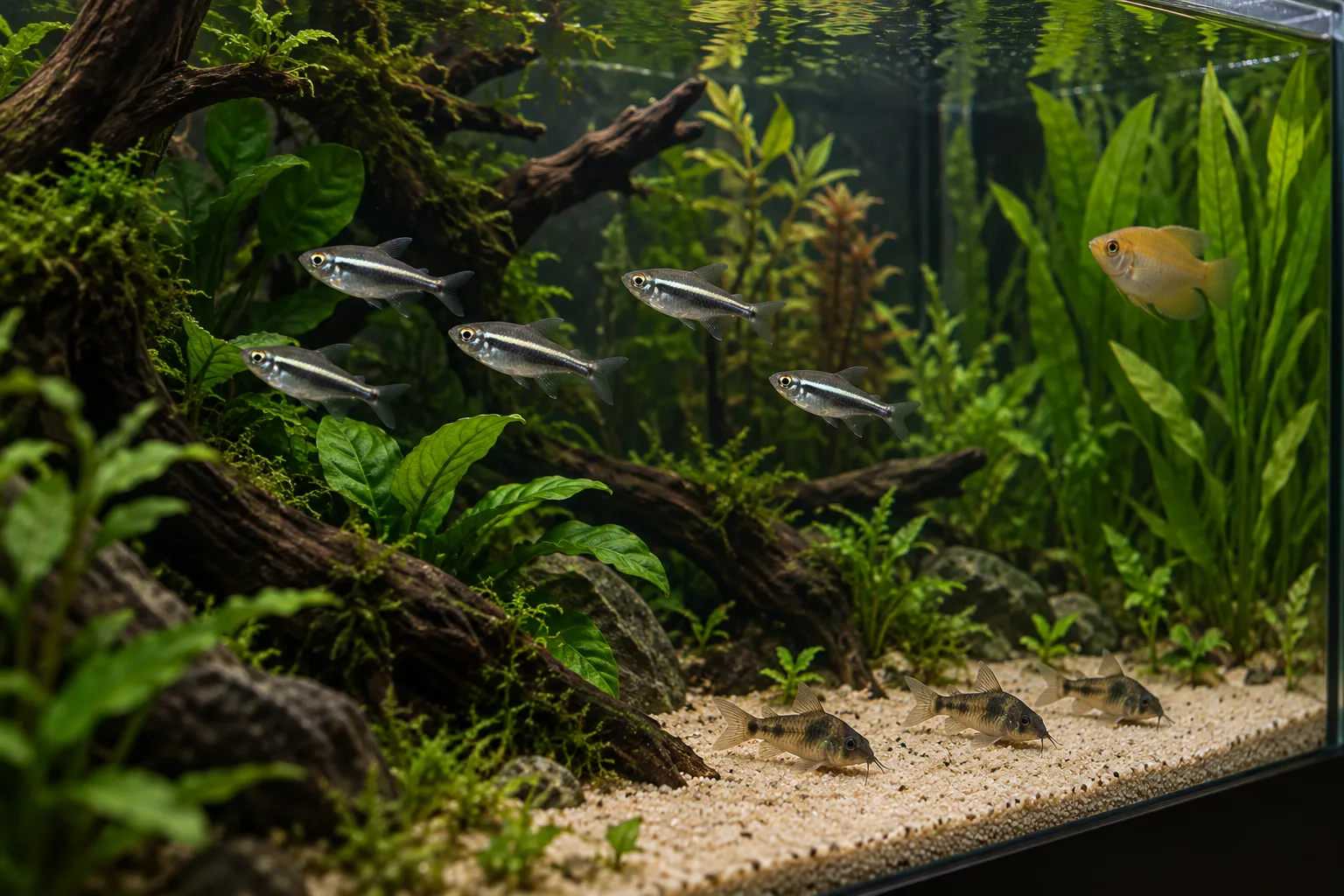
A single male Betta fish creates a useful example of why labels are insufficient.
Bettas often need gentle flow and may defend space or be stressed by fast feeding, while an active tetra shoal needs open movement; an individual temperament and the aquarium footprint can make the combination fail even if a chart says both are community fish.
Long-finned fish deserve extra caution because any repeated fin interest can become injury. Slow bottom fish also need protected feeding access, while shrimp fry or very small invertebrates may be treated as food.
Introduce the black neon shoal only after the aquarium is cycled and stable, then observe the whole community during feeding and at lights-out. Keep a ready, heated separation option because compatibility can change as fish mature or territories shift.
What changes in the shoal deserve attention?
A settled group may alternate between loose social spacing, coordinated bursts, foraging, and rest near cover. Temporary tightening after maintenance or a sudden movement can be normal; the concern is a persistent change from that group's baseline.
- Check the thermometer and confirm the filter is moving water normally.
- Test ammonia and nitrite separately, then record pH and nitrate with the date.
- Look for one fish excluded from the group or repeatedly targeted by another animal.
- Compare breathing rate, balance, fin position, color, appetite, and body condition with recent observations.
- Inspect for trapped fish, jump gaps, sharp decor, and blocked swimming routes.
- Use separate wet equipment if an infectious problem is possible.
Persistent isolation, clamped fins, loss of balance, rapid breathing, surface gasping, progressive weight loss, swelling, sores, or worsening fin damage need attention without delay.
These signs do not identify one disease, and a photograph cannot replace water tests, history, and examination.
Correct a confirmed heater, oxygen, ammonia, nitrite, or aggression emergency without creating a second abrupt temperature or chemistry shock. Seek an aquatic veterinarian or experienced fish-health professional when severe breathing, balance, tissue damage, swelling, or rapid decline continues.
Do not combine medications because several symptoms look similar online. Treatment without a confirmed condition can expose the fish and biofilter to unnecessary risk while delaying the real cause.
What can we honestly say about lifespan?
Available authoritative species sources do not provide a verified maximum age or a controlled captive lifespan range for H. herbertaxelrodi. FishBase leaves maximum age unreported, and the U.S. Fish and Wildlife Service summary likewise supplies size and ecology but no lifespan evidence.
Popular care pages often repeat precise ranges, yet a repeated number is not stronger evidence.
Importing the lifespan of neon tetra or another small characin would hide a species gap behind a familiar estimate.
Plan for a multi-year commitment because a stable aquarium, same-species group, and future medical or equipment needs persist well beyond purchase. Record acquisition date and major health events so your own husbandry history is useful without turning one household's outcome into a species claim.
Age at purchase is usually unknown, and genetics, early rearing, chronic water stress, nutrition, injury, infection, and access to qualified care can all affect survival. The honest endpoint is sustained normal behavior and body condition, not a promise that good care guarantees a particular birthday.
Conservation, trade and release are separate questions
FishBase displays the species as Least Concern, assessed for the IUCN Red List on 7 November 2018. Least Concern is a global extinction-risk category for the wild species; it does not certify that every local population is secure or that every fish in commerce has a documented origin.
The U.S. Fish and Wildlife Service confirms that black neon tetras occur in the aquarium trade. Its 2020 screening summary found no established wild population in the United States and rated the overall invasion-risk conclusion uncertain because available biological information was limited.
No direct species listing was returned when the official CITES Checklist was searched on 11 September 2026. That result does not prove that collection, possession, import, transport, or sale is unrestricted, because national and local rules apply independently and trade labels can be wrong.
Prefer a seller who can identify the species and explain whether the stock is captive bred. Avoid vendors who cannot separate H. herbertaxelrodi from similarly named tetras or who present wild collection as an unqualified selling point.
Is a black neon tetra shoal right for your aquarium?
This species fits when the prepared aquarium can hold at least six black neon tetras, offers roughly 60 cm or more of usable horizontal length, preserves an open midwater lane, and has mature filtration. The measured temperature, pH, and hardness should already fall within a defensible shared range for every resident.
- The seller confirms Hyphessobrycon herbertaxelrodi rather than a similar trade name.
- The budget and bioload plan include the whole same-species group, not one trial fish.
- The lid closes every escape gap and equipment leaves a clear horizontal route.
- Current ammonia and nitrite are undetectable with a suitable test in the established aquarium.
- Existing fish cannot swallow, corner, outcompete, or continually chase the tetras.
- A separate heated holding option is ready if compatibility fails.
Postpone the purchase when the plan depends on adding one or two fish, when the only available tank is short and crowded with decor, or when the filter is still cycling. A small body does not reduce the need for social choice, swimming distance, oxygen, and stable water.
At the shop, look for a group that maintains controlled swimming and responds to its surroundings. Ask what it is eating and what temperature and water chemistry it currently occupies, then compare those answers with the prepared aquarium before transport.
Before transport, compare the shop water, available swimming length, group size, and prepared aquarium. Use the freshwater fish guide to compare species, then treat tank footprint, water adjustment, feeding, breeding, and treatment as separate decisions.
Which tetras make useful comparison points?
Cardinal tetra
A small blackwater shoaler whose soft-water context and quiet group behaviour narrow the comparison.
Ember tetra
A tiny warm-water tetra whose low competitive weight and small mouth change feeding and tankmate choices.
Diamond tetra
A medium deep-bodied characin that offers a closer comparison in warm water, adult mass and display behaviour.
Emperor tetra
A medium tetra whose males hold display positions, adding territory and sight lines to the group decision.
Chili rasbora
A minute blackwater group fish whose mouth size, water and refuge needs set a much smaller scale.
Celestial pearl danio
A tiny planted-tank danio with cooler documented habitat water and a different style of group behaviour.
Cherry barb
A small planted-stream barb that contrasts sex-linked colour, social structure and habitat cover.