
What Is a Cardinal Tetra, and How Does It Differ From a Neon?
Paracheirodon axelrodi
The cardinal tetra is Paracheirodon axelrodi, a 3 cm shoaling characin recorded from water at pH 4.0 to 6.0 in the upper Orinoco and Rio Negro. Most of the ones in shops were caught in a river rather than bred, and the red running the full length of the body is what separates it from a neon.

At a glance

- Adult size
- 3 cm
- Minimum footprint
- An aquarium at least 60 cm long, planted and shaded, with an open middle water layer
- Social structure
- Five or more as a published floor, and visibly better in larger numbers.
- Minimum group
- 5
- Sex ratio
- No routine sex ratio is established.
- Diet
- Carnivore
- Feeding
- A quality dried staple sized for a 3 cm fish, with small frozen or live foods; feed small amounts more than once a day.
- Waste load
- low
- Family
- Acestrorhamphidae
- Native range
- Upper Orinoco and Negro River basins, in Brazil, Colombia and Venezuela
- Also sold as
- red neon. Trade and hobby names, not accepted species names.
- Former scientific names
- Cheirodon axelrodi. Superseded names for this same species.
- Conservation status
- Least Concern, assessed 4 March 2021 Source
The German federal minimum standards for keeping ornamental fish give five or more fish in an aquarium of at least 60 cm; that is a floor rather than a target.
What is a cardinal tetra?
The cardinal tetra is Paracheirodon axelrodi, a 3 cm shoaling characin from the blackwater tributaries of the upper Orinoco and Rio Negro.
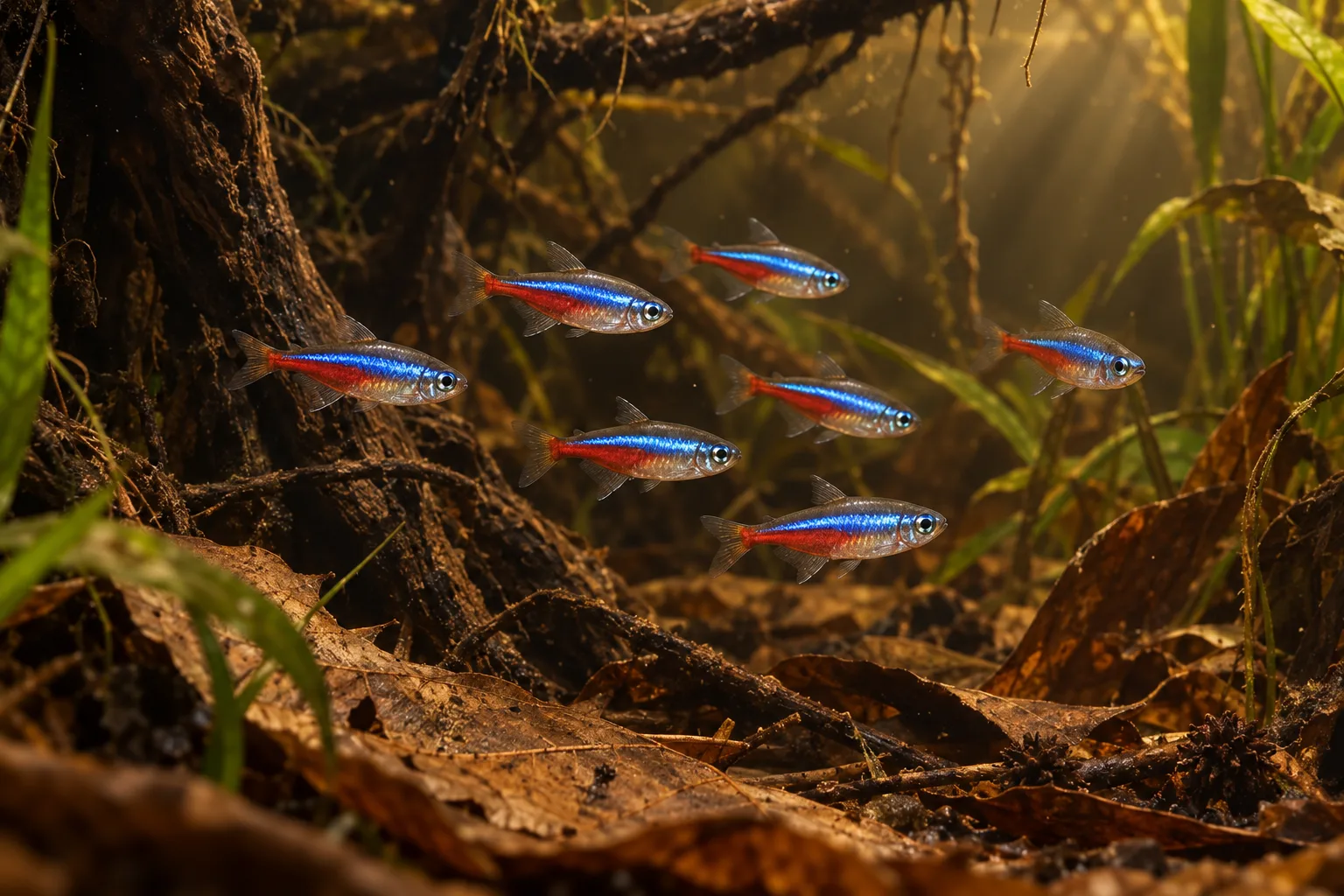
It is one of the most traded aquarium fish in the world, and most of the ones in shops were caught in a river rather than bred in a hatchery.
Leonard Schultz described it in 1956, and where he published is worth a moment: Tropical Fish Hobbyist, a magazine for aquarists.
The type specimen came from a stream near Tomar on the Rio Negro. It sits in the Smithsonian collection as USNM 164483.
- Accepted identity
- Paracheirodon axelrodi (Schultz, 1956)
- Family
- Acestrorhamphidae, subfamily Megalamphodinae
- Type locality
- Stream near Tomar, Rio Negro, Brazil
- Native range
- Upper Orinoco and Negro basins, in Brazil, Colombia and Venezuela
- Recorded maximum
- 3.0 cm standard length
- Recorded water
- pH 4.0 to 6.0
- Swimming zone
- Middle water layers, in a shoal
- Group reference
- Five or more, in an aquarium at least 60 cm long
- IUCN assessment
- Least Concern, assessed 4 March 2021
The family line will surprise anyone who last checked a few years ago. Catalog of Fishes now places the species in Acestrorhamphidae, not Characidae, which is where almost every older book and shop label still puts it.
Nothing about the animal changed. The classification did, and a search result that still says Characidae is out of date rather than wrong about the fish.
How do you tell a cardinal from a neon tetra?
This is the question the species generates most often, and it has a clean answer: look at how far the red runs.
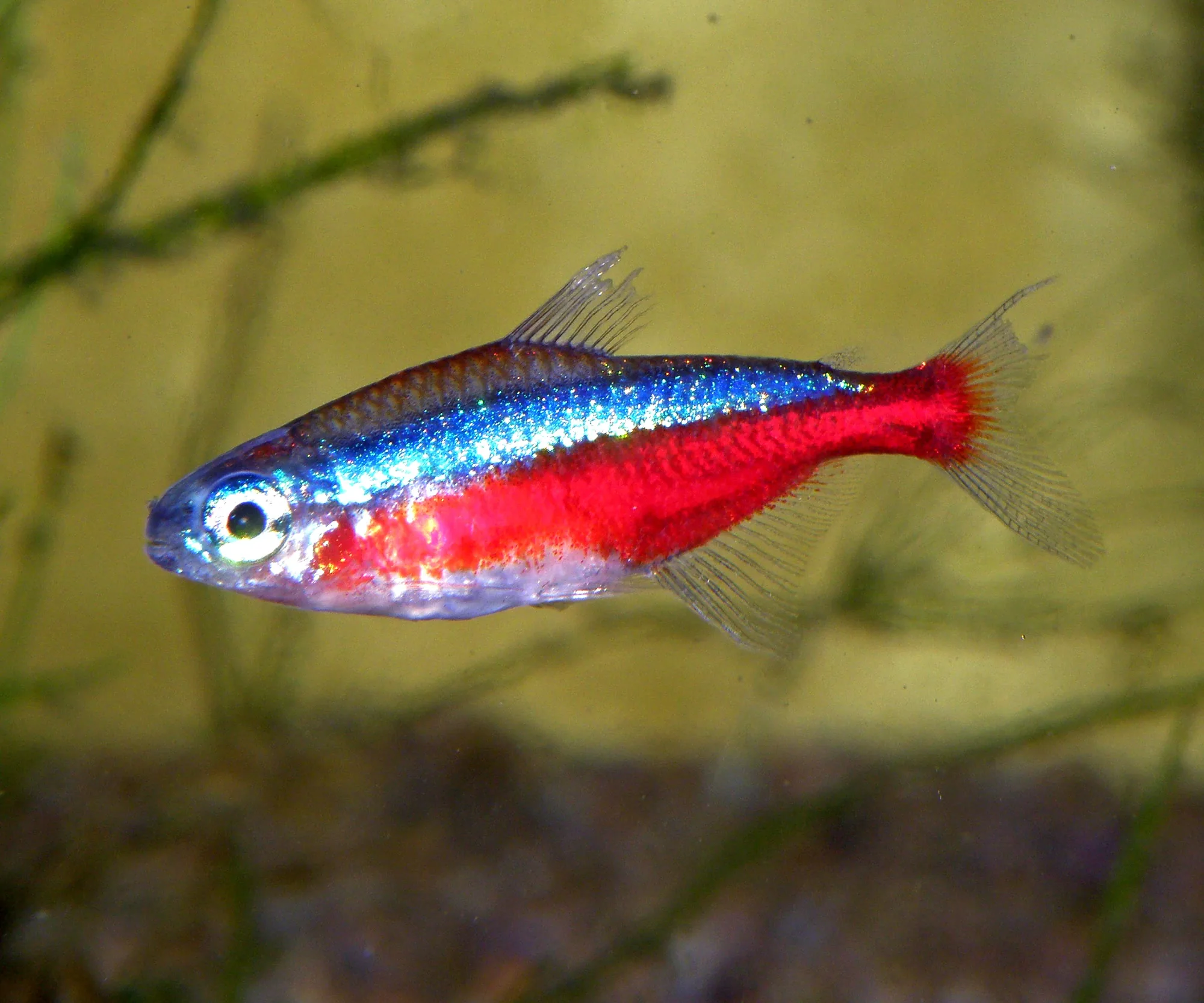
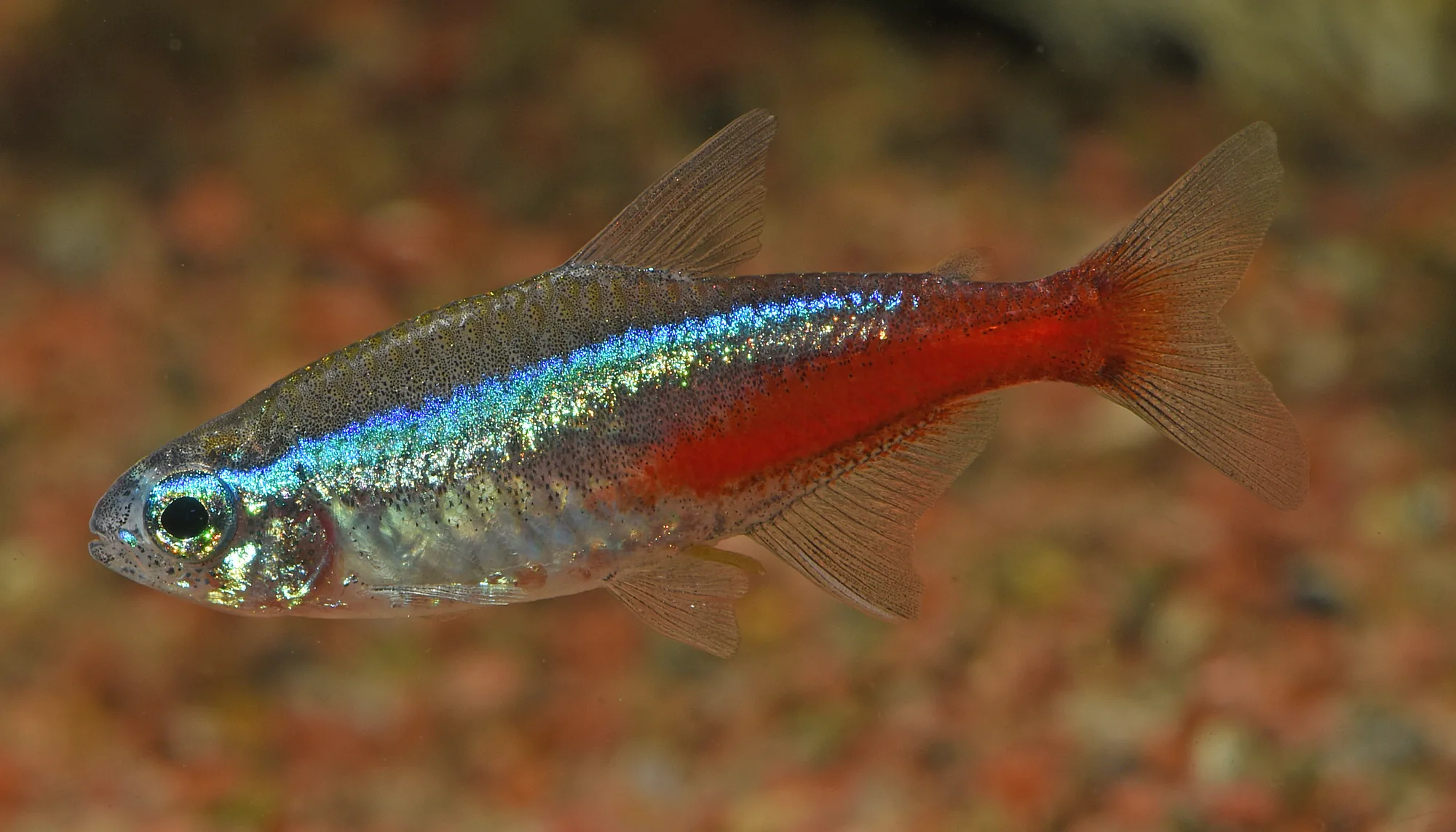
That is the whole test, and it survives poor lighting better than most identification characters because it is about extent rather than shade.
Two practical notes come with it.
A stressed or newly arrived cardinal fades, and a faded cardinal can briefly look like a neon until it settles.
The other is price.
Cardinals usually cost more than neons, so a tank labelled cardinal at a neon price is worth a second look before you buy the bag.
Why are most cardinal tetras still wild-caught?
Breeding cardinals is possible and it is genuinely difficult, which is a rare combination in a fish this common. FishBase records that captive breeding works but that most trade specimens are caught in the tributaries of the Rio Negro and Orinoco.
This is not a fish the trade quietly farms while telling a river story.
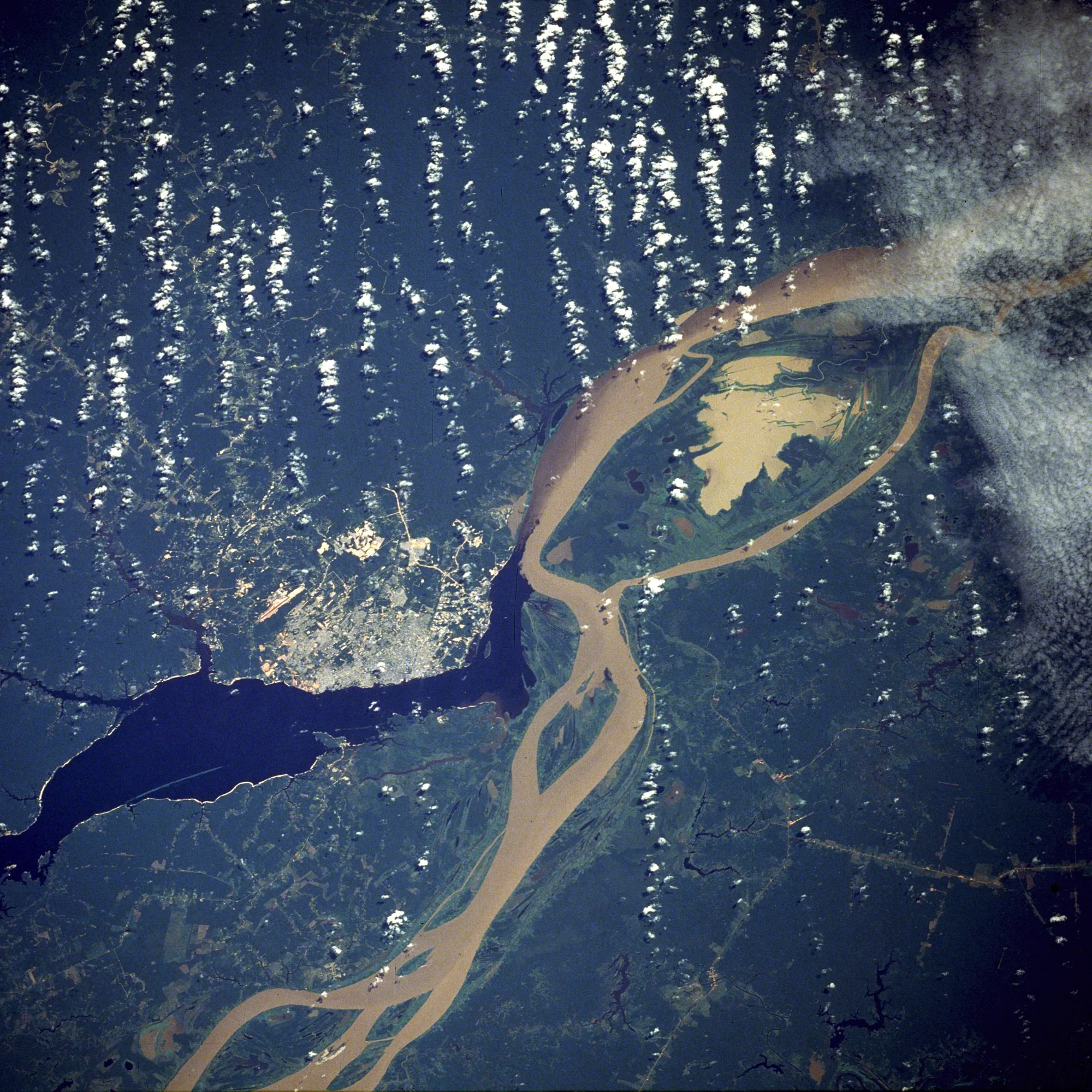
Project Piaba, the research programme that has worked on this fishery since the early 1990s, states that approximately 80 percent of the trade from artisanal fisheries in the Rio Negro is this single species. FishBase lists the species as highly commercial in both food and ornamental fisheries.
The argument made for the fishery is that a river which earns a living as a river is a river less likely to be cleared, and that the people catching the fish are the ones with most to lose if the habitat goes.
That argument deserves to be weighed rather than repeated.
What it does change, concretely, is the first fortnight after the fish get home.
| Decision factor | Wild-caught | Captive-bred |
|---|---|---|
| Route to the shop | Long, with several abrupt water changes | Short, often within one country |
| Water it grew up in | Soft and acidic, far from most tap water | Close to whatever the hatchery runs, usually harder |
| Acclimation it needs | Slow, over an hour or more, on a big chemistry gap | Ordinary temperature and water matching |
| Quarantine | Longer, and genuinely worth doing | Still sensible, usually less eventful |
| What buying it supports | A river fishery that pays people to keep the forest standing | A hatchery, and no pressure on wild stock |
Neither column is the right answer on its own. The point is that they are different purchases, and the label is the only place you will find out which one you are making.
What does pH 4.0 to 6.0 mean for your tap water?
FishBase records this species from water at pH 4.0 to 6.0, which is a long way below almost anything that comes out of a domestic tap.
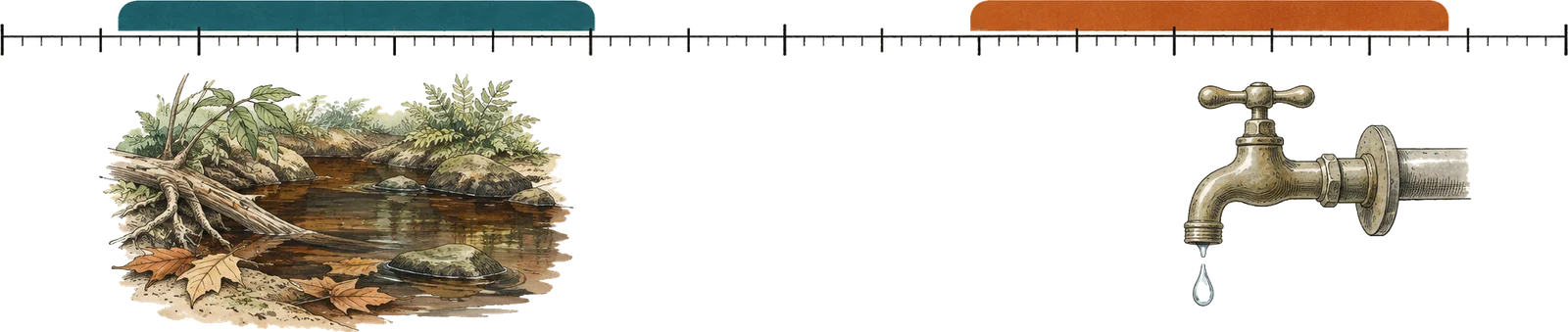
Here is the part that matters more than the number. Cardinals are kept successfully, in very large numbers, in water considerably harder and more alkaline than their recorded range.
Recorded freshwater context
- Temperature23 to 27 °CSeparate aquarium thermometer.
- pH4.0 to 6.0Calibrated pH meter or an aquarium test covering the range.
- General hardness5 to 12 dGHGH titration test in degrees of general hardness.
Every range above applies to Paracheirodon axelrodi in a freshwater system. Source: FishBase species summary, checked 2026-09-12.
The compiled range above comes from an aquarium reference of 1991 rather than from field measurement, and it describes the low end of what the species is recorded from.
So the practical rule is not chase the number. A stable pH of 7.0 that never moves is better for these fish than a pH of 5.5 that you are fighting to hold, because the thing that kills soft-water fish in hard-water tanks is usually the correcting rather than the water.
If your tap water is very hard and you want to soften it, do it with a mixing barrel and reverse osmosis water prepared in advance, rather than with chemicals added to a stocked tank.
How should you acclimate a fish that comes from water this soft?
Wild-caught cardinals arrive having crossed a very large chemistry gap already, usually more than once on the way.
- Match temperature first Float the closed bag until the two are level. Everything after this is chemistry, and chemistry is easier on a fish that is not also cold.
- Add your water slowly Small amounts of tank water into the bag over an hour or more. A large pH and hardness jump is what you are spreading out.
- Never pour the bag in Net the fish out at the end and leave the shop water behind.
- Lights off afterwards Give the group the rest of the day undisturbed, and do not feed heavily on the first evening.
An hour is a reasonable floor for a fish making a jump this large. Longer does no harm.
Keep the lights off for the rest of the day and leave the group alone. A shoal that spends its first evening hiding and colourless is behaving normally, and a shoal still doing it after three days is telling you something about the water or the tank.
What does a shoal and its tank actually need?
The German federal ministry's published minimum standards for keeping ornamental fish give this species groups of five or more in an aquarium of at least 60 cm length. That is an official welfare floor rather than a shop recommendation, and floors are not targets.
Five will shoal.
More than five will shoal better, and the difference is visible within a day.
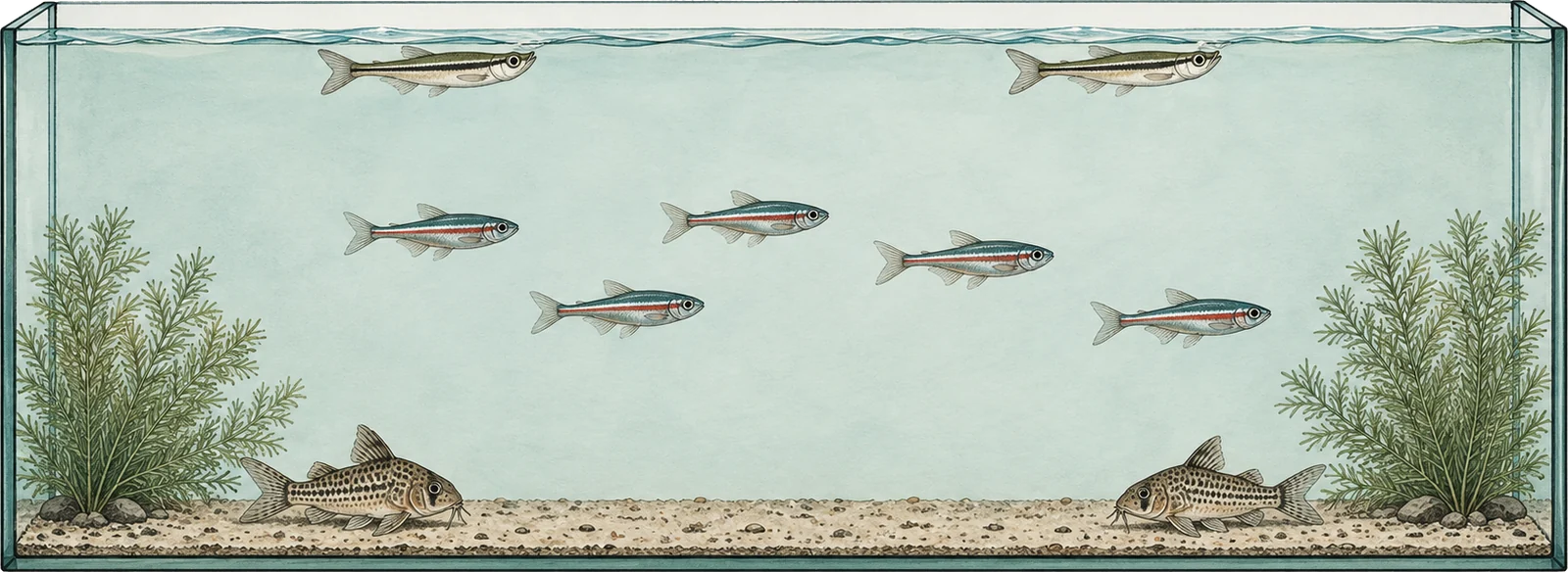
Planting at the ends and along the back, shade at the surface, and a dark substrate all do the same job. A cardinal on pale gravel under bright light is a fish that will spend its time being hard to see rather than being seen.
Keep the flow gentle. These are not fish that fight a current for a living, and a group pinned at one end of the tank is a group that is not using it.
What should cardinal tetras eat?
FishBase records worms and small crustaceans, crediting an aquarium encyclopaedia rather than a gut-content study.
In practice this is a micropredator with a very small mouth.
A quality dried staple sized for a 3 cm fish covers the routine. Small frozen or live foods bring out the colour that made the species famous.
Feed small amounts more than once a day rather than one large ration. Watch that food is still reaching the fish at the back of the shoal, which is where a slow individual quietly stops keeping up.
Which tank mates suit them?
Almost anything peaceful that shares the temperature range and cannot fit a 3 cm fish in its mouth, which is a genuinely long list.
The constraint most often missed is the last one.
The other tetras documented here work on the same terms and want the same water. A black neon tetra or a bloodfin tetra occupies the same middle layer, which means the swimming route has to be long enough for both shoals rather than for one.
A cherry barb group works from the other direction, foraging low over the bed and leaving the open middle water to the cardinals.
A brilliant rasbora is a size mismatch worth checking rather than an outright refusal, since it reaches three times the cardinal's length and feeds faster. A long-finned Betta fish is the more common problem in the other direction: cardinals are quick enough to strip trailing fins if the tank is short on space or the group is bored.
Can cardinal tetras be bred at home?
The mode is documented. The conditions are demanding.
FishBase records the timings, and they are short enough that a keeper who is not watching for them misses the whole event.
| Stage | Recorded interval | What it means in a community tank |
|---|---|---|
| Eggs laid to hatching | 24 to 30 hours | Eggs are eaten long before this in a stocked aquarium |
| Hatching to free-swimming | 3 to 4 days | Fry spend this period hidden and are easily siphoned out |
| Overall difficulty | Possible but difficult | Needs very soft, very acidic water prepared separately and dim light |
The difficulty is water and light rather than technique. Successful spawning generally needs very soft, very acidic water prepared separately, dim conditions, and a separate tank, because eggs and fry in a community aquarium do not survive.
Nothing about a community tank of cardinals is a breeding project, and a shoal that has never spawned is not a shoal doing badly.
Which health signs matter, and where does the boundary sit?
Rapid breathing, surface gasping, loss of balance, or a group suddenly clustering at the filter outflow are water questions until measurement says otherwise.
Rule these out before naming a disease
- Temperature Read it off a separate thermometer. Cardinals are kept warm, and a failed heater shows as behaviour within hours.
- Ammonia and nitrite Zero on both. A recently cleaned filter or a new batch of fish is the usual cause of anything else.
- pH movement Not the value, the change. A pH that has shifted since the last reading matters more than a pH that is simply higher than the species record.
- Oxygen and surface movement Warm water holds less. Gasping with normal test results usually means the surface is too still.
Colour loss is this species' general-purpose distress signal and is not specific. New arrivals, cold water, a pH swing, bright bare tanks and bullying all produce the same pale fish, so it tells you to look rather than what to look for.
There is a specific condition often named in connection with this genus, and it cannot be diagnosed from a photograph or a description. Progressive loss of colour in one area, a fish that stops shoaling, spinal curvature and wasting are signs to isolate the animal and get qualified advice, not signs to self-diagnose and dose a tank.
Contact an aquatic veterinarian or an experienced fish-health professional when several fish decline together, when a fish is wasting despite eating, or when measured water is normal and the animals are not.
What do conservation and trade records show?
The IUCN Red List carries Paracheirodon axelrodi as Least Concern, assessed on 4 March 2021. FishBase records the CITES state as Not Evaluated, checked on 12 September 2026.
A Least Concern listing on a species caught in these numbers is worth reading carefully rather than as reassurance.
It reflects a wide range and a fast life cycle, not an audit of any particular stretch of river.
The pressure on this fish is not primarily collection. It is what happens to blackwater forest when the rivers stop being worth more intact than cleared, which is the argument the fishery rests on.
Never release aquarium fish, plants, water or live food outdoors, and do not tip shop water into a drain that reaches a watercourse.
Should you buy cardinal tetras now or wait?
Wait if the tank is new.
This is a poor first occupant for an immature filter, and a wild-caught fish making a large chemistry jump into an uncycled tank is the worst version of it.
Wait if the group would be three or four, or if the aquarium is shorter than the 60 cm the published standard names.
- The filter is mature and ammonia and nitrite have measured zero for a fortnight.
- At least five fish are going home together, and preferably more.
- The tank offers a planted, shaded middle water layer rather than bright bare gravel.
- Your own water has been measured, and the plan is to keep it stable rather than to chase pH 5.
- You have asked whether the stock is wild-caught, and planned the acclimation and quarantine around the answer.
None of that is difficult. It is just the part that happens before the fish are in the bag, which is the only point at which most of it is still possible.
Which tetras make useful comparison points?
Ember tetra
A tiny warm-water tetra whose low competitive weight and small mouth change feeding and tankmate choices.
Chili rasbora
A minute blackwater group fish whose mouth size, water and refuge needs set a much smaller scale.
Diamond tetra
A medium deep-bodied characin that offers a closer comparison in warm water, adult mass and display behaviour.
Emperor tetra
A medium tetra whose males hold display positions, adding territory and sight lines to the group decision.
Celestial pearl danio
A tiny planted-tank danio with cooler documented habitat water and a different style of group behaviour.