
What Is a Cherry Barb, and Why Is Mine Not Red?
Rohanella titteya
The cherry barb is Rohanella titteya, long known as Puntius titteya, a small barb endemic to Sri Lanka and assessed as Vulnerable in the wild. The deep red that sells it belongs to males in condition, and shade, a dark substrate and company do more for it than anything sold in a bottle.

At a glance

- Adult size
- 5 cm
- Minimum footprint
- An aquarium at least 60 cm long, planted and shaded, with a dark substrate
- Social structure
- Five or more as a published floor. Two or three males to a larger number of females produces display without one fish taking all of it.
- Minimum group
- 5
- Sex ratio
- Two or three males to a larger number of females.
- Diet
- Omnivore
- Feeding
- A quality dried staple with small frozen or live foods. The recorded wild gut contents are detritus, green algae, diatoms, dipterans and animal matter.
- Waste load
- low
- Family
- Cyprinidae
- Native range
- Western and south-western river basins of Sri Lanka, from the Kelani to the Nilwala, endemic
- Former scientific names
- Barbus titteya, Puntius titteya. Superseded names for this same species.
- Conservation status
- Vulnerable, assessed 2020 as Puntius titteya Source
The German federal minimum standards for keeping ornamental fish give five or more fish in an aquarium of at least 60 cm; shade and planting matter as much as length here.
What is a cherry barb?
The cherry barb is a small, deep-bodied Sri Lankan barb, sold in almost every aquarium shop in the world and assessed as Vulnerable in the wild.
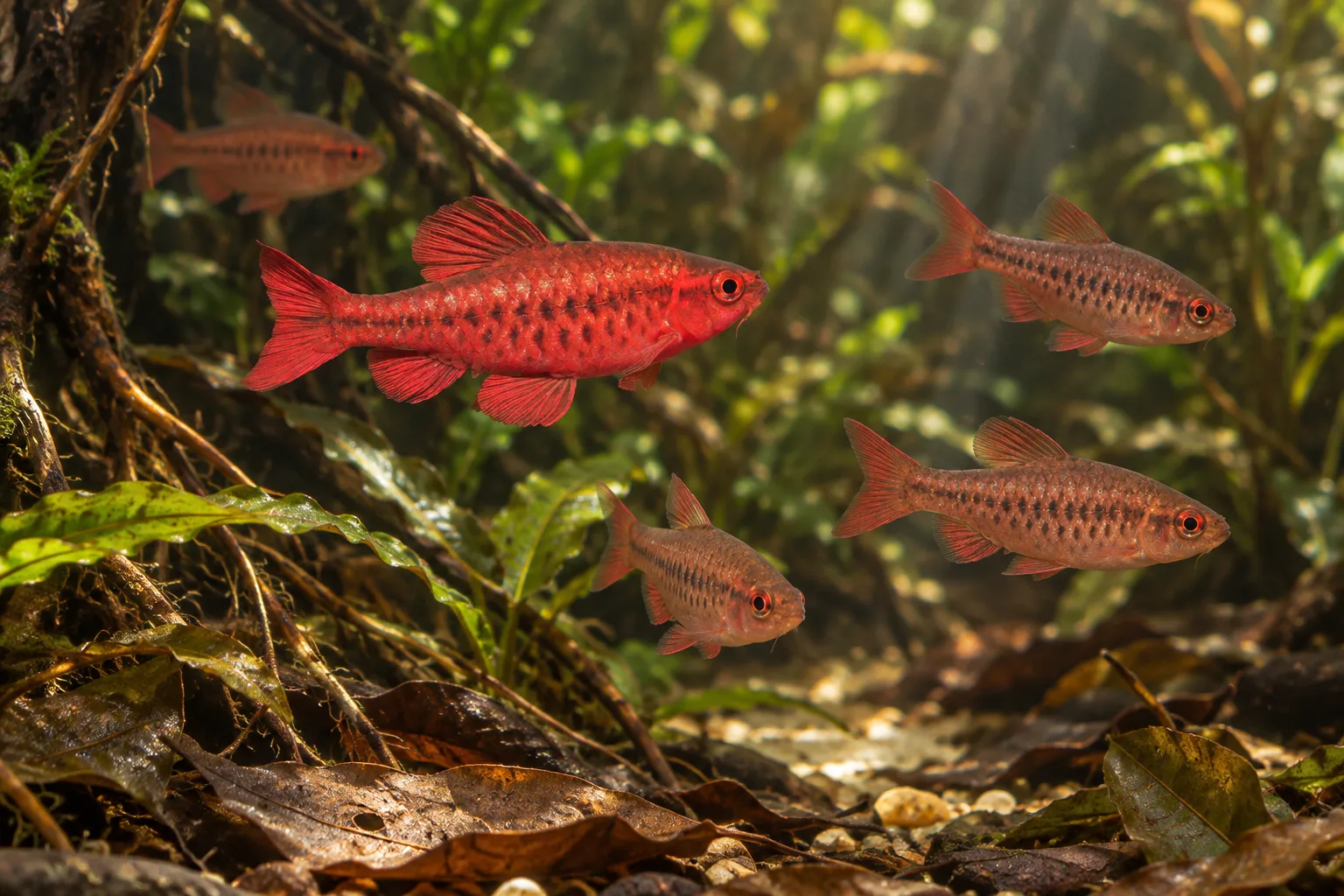
Both of those things are true at once, and the reason is that the fish in the shop and the fish in the river are usually not the same animal.
Deraniyagala described it in 1929 from Ambagaspitiya in Sri Lanka. The holotype is a 26 mm specimen in the Natural History Museum in London.
- Accepted identity
- Rohanella titteya (Deraniyagala, 1929)
- Long-standing name
- Puntius titteya, still used almost everywhere
- Family
- Cyprinidae, subfamily Smiliogastrinae
- Native range
- Western and south-western river basins of Sri Lanka, endemic
- Recorded maximum
- 5.0 cm total length
- Common length
- 2.5 cm total length
- Habitat
- Heavily shaded streams and rivulets, shallow and slow, over silt and leaf debris
- Group reference
- Five or more, in an aquarium at least 60 cm long
- IUCN assessment
- Vulnerable, as Puntius titteya, 2020
The species is endemic to Sri Lanka. It occurs naturally nowhere else, across a set of river basins from the Kelani south to the Nilwala, and it has been introduced to Hong Kong and Mexico.
Did the cherry barb just change its name?
Yes, and recently enough that nothing in a shop reflects it.
For most of a century this was Puntius titteya. In 2023 Sudasinghe and colleagues placed it in a new genus, and Eschmeyer's Catalog of Fishes now gives the current status as Rohanella titteya.
Almost every label, book, database entry and care sheet still says Puntius. That is not an error to correct in a shop; it is a change that has not finished moving through the literature.
Why is the red so variable?
This is the question that brings most people to the species, usually after buying six pale fish that looked scarlet in the photograph.
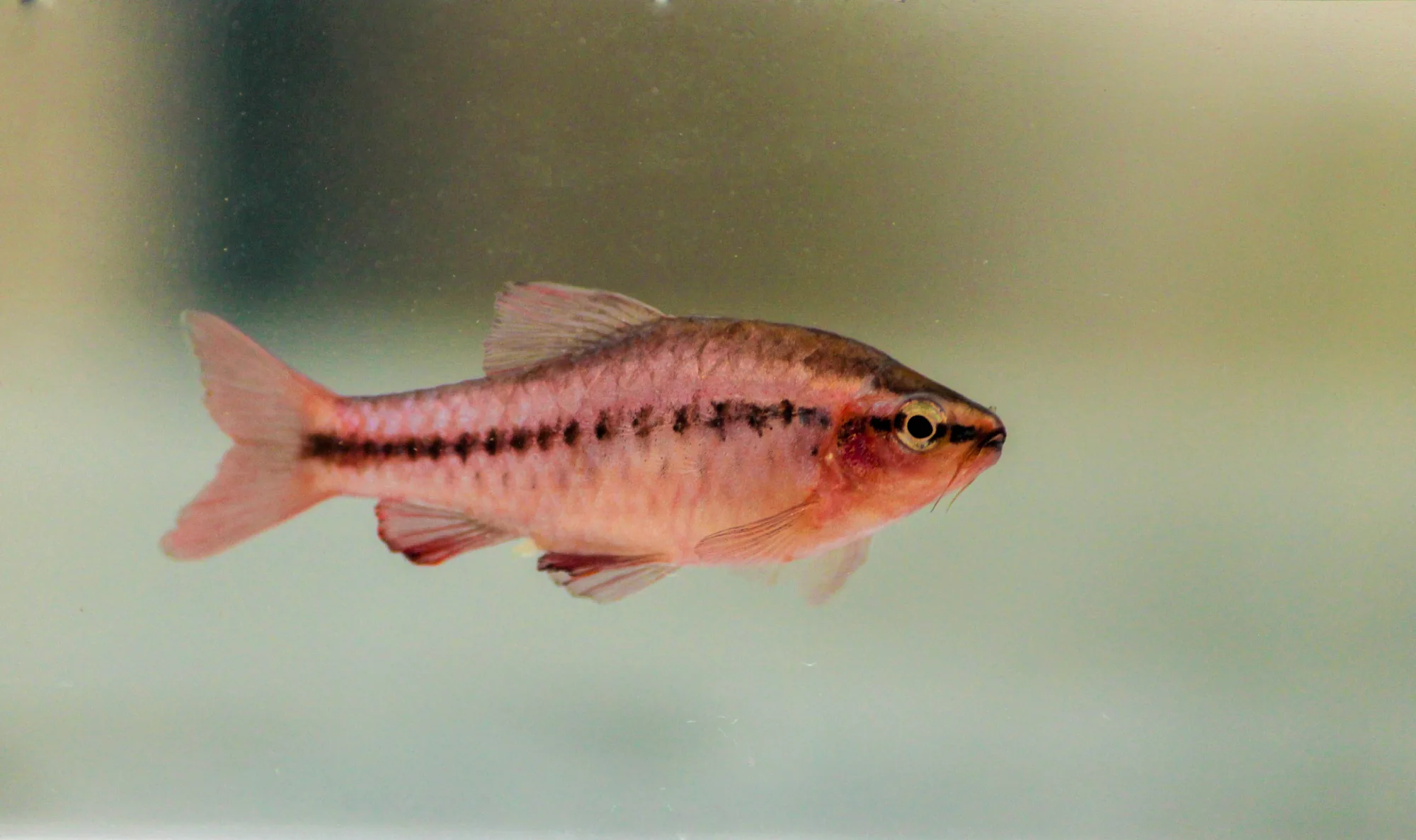
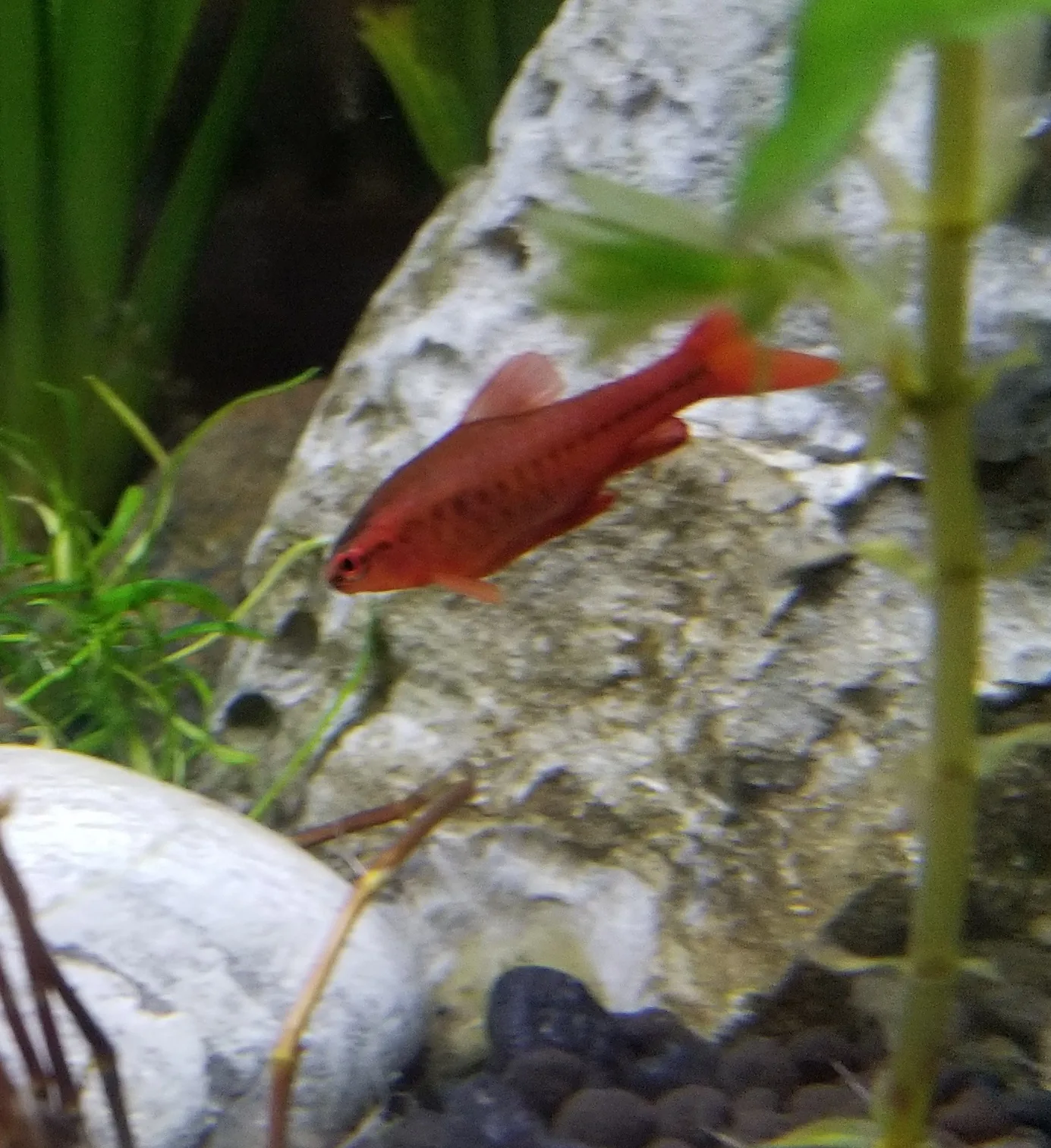
Three things drive it, and only one of them is genetics.
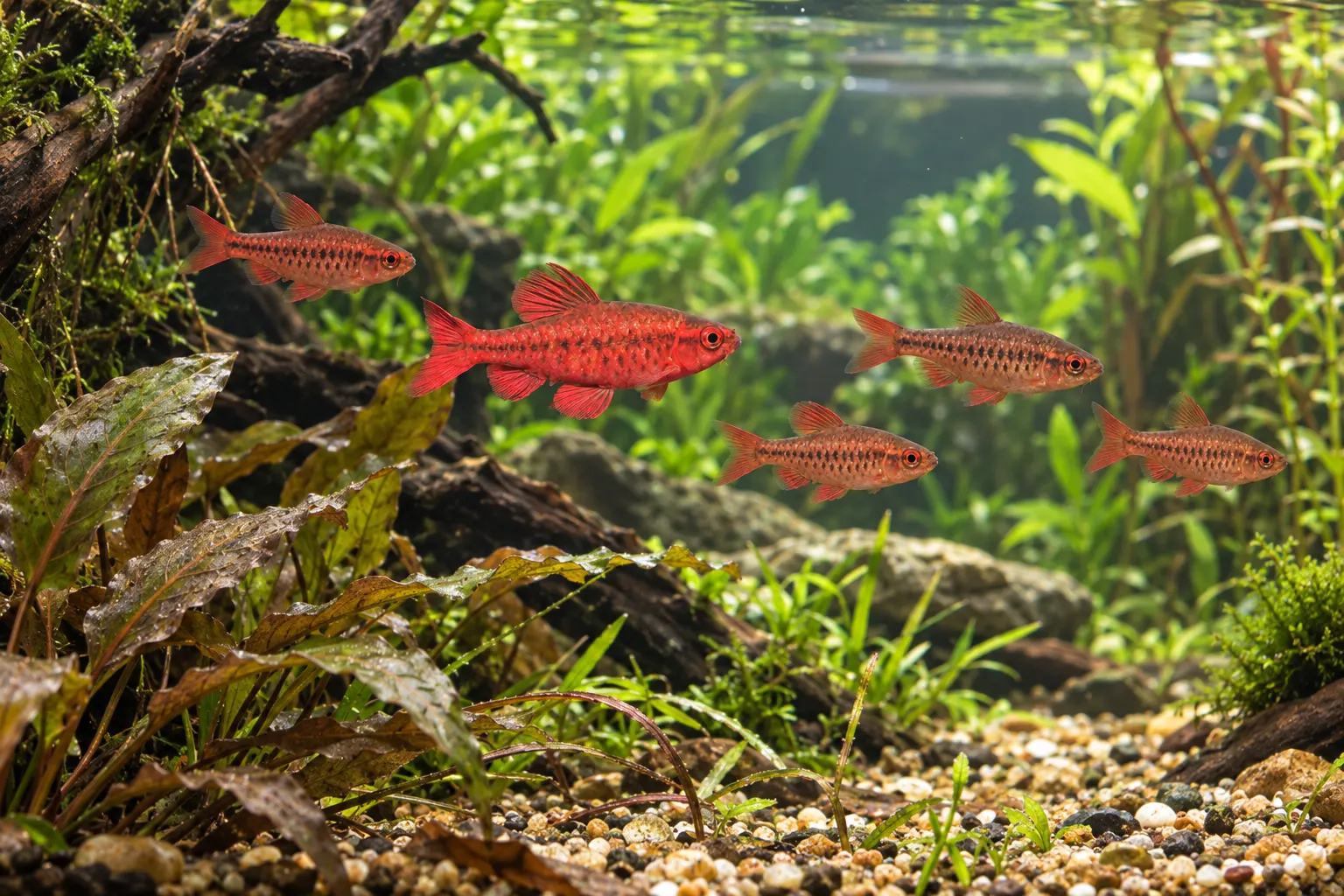
The first is sex. Males carry the deep red; females are a quieter brown-gold with the same dark stripe, and a tank of mostly females will never look like the photograph.
The second is state. A frightened, newly moved, or brightly lit fish drops colour within minutes and takes days to get it back.
The third is condition, which is the slow one. A well-fed male in a shaded, planted tank with rivals to display to intensifies over weeks.
Buying for colour in a shop tank is buying the least informative version of this fish. A pale barb in a bare dealer tank may be a better animal than a red one that has simply been there longer.
What does the wild habitat ask of the tank?
FishBase records the species from heavily shaded streams and rivulets, in shallow, slow-flowing water over silt and leaf debris.
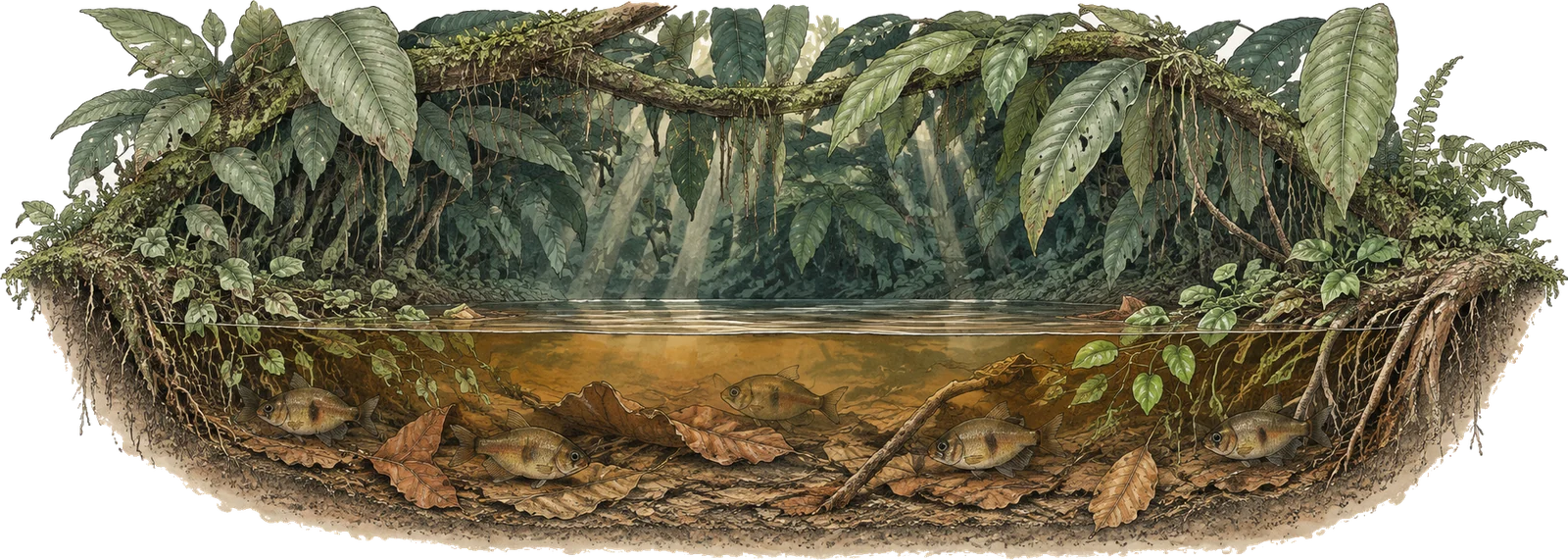
That converts into a short list of decisions, and none of them is expensive.
- Shade the surface: floating plants, or planting tall enough to break the light before it reaches the fish.
- Use a dark substrate. Pale gravel is the single most common reason a cherry barb tank looks washed out.
- Add leaf litter or botanicals if you want the fish at their best; they are foraging over exactly that in the wild.
- Keep the flow gentle. This is a slow-water fish, not a stream-riffle fish.
- Plant the ends and margins and leave the middle open.
Get the shade and the substrate right and most of the colour problem solves itself.
How big does a cherry barb get?
The two figures in the literature answer different questions, and mixing them up is where the confusion starts.
| Figure | Source | What it means | What to plan around |
|---|---|---|---|
| 5.0 cm total length | Talwar and Jhingran, Inland Fishes of India and Adjacent Countries, 1991 | The largest recorded, tail tip included | The upper bound, rarely reached in a tank |
| 2.5 cm total length | Pethiyagoda, Freshwater Fishes of Sri Lanka, 1991 | The length typically encountered | What most of your fish will actually be |
Both are total length, measured to the tip of the tail rather than to its base, which is why they read smaller than the standard-length figures used for many tetras.
For planning purposes this is a fish of a few centimetres that needs a group and a planted tank, not a fish that needs a big one.
What does the group need?
The German federal ministry's published minimum standards for keeping ornamental fish give this species groups of five or more in an aquarium of at least 60 cm long.
That is a floor set by a regulator rather than a shop, and more fish is better than five.
Get the sex ratio right, because it changes what you see. Several males together display and colour up against one another; a single male with five females is a quiet fish in a quiet tank.
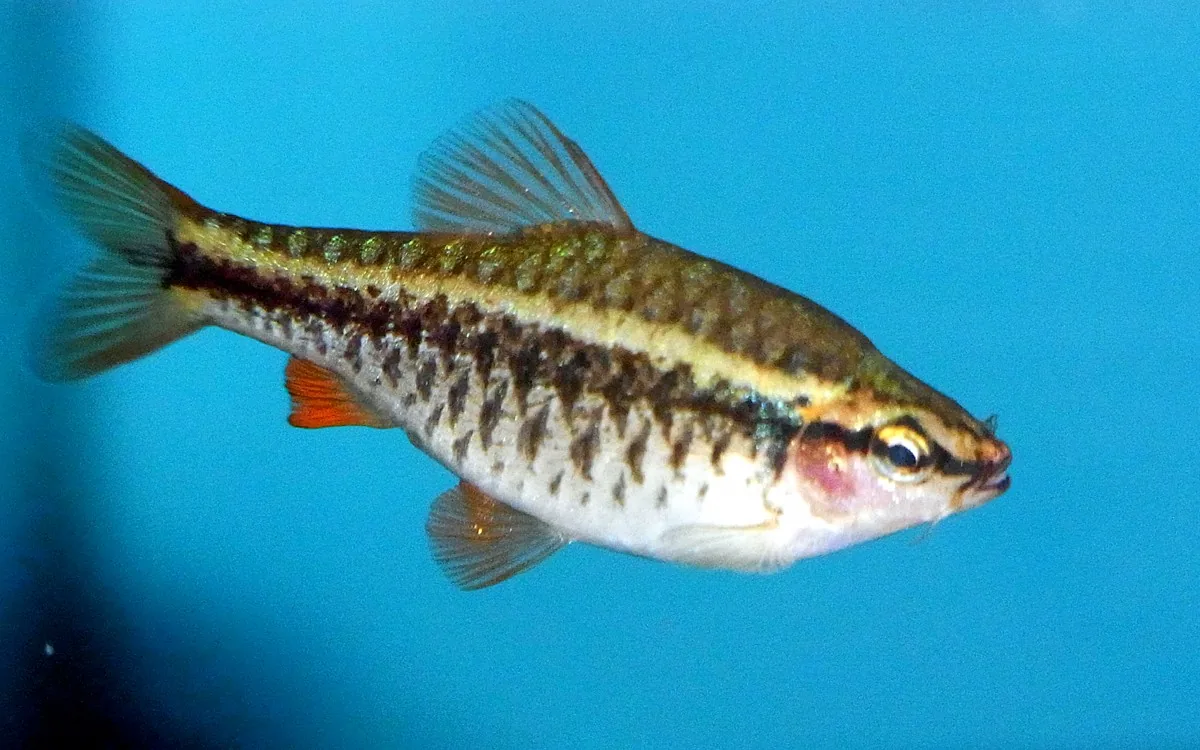
Two or three males to a rather larger number of females is the arrangement that produces display without one fish taking all of it.
What water does the record support?
Recorded freshwater context
- Temperature23 to 27 °CSeparate aquarium thermometer.
- pH6.0 to 8.0Calibrated pH meter or an aquarium test covering the range.
- General hardness5 to 19 dGHGH titration test in degrees of general hardness.
Every range above applies to Puntius titteya aquarium reference range in a freshwater system. Source: FishBase species summary, checked 2026-09-12.
That is a wide range, and it is compiled from an aquarium book of 1992 rather than from field measurement.
Wide is the useful part. A pH range spanning 6.0 to 8.0 and hardness from 5 to 19 dGH covers most treated tap water in most places, which is a large part of why this species became a standard beginner fish.
Stability still matters more than position. Measure with the same test each time, acclimate against the difference you actually find, and stop a transfer if fish gasp or lose balance.
What should cherry barbs eat?
The gut-content record is more specific than most, and it is worth reading because it tells you how the fish feeds rather than only what it eats.
FishBase records the species as omnivorous, with guts containing detritus, green algae, diatoms, dipterans and animal matter.
That is a forager working over a leaf-littered bed, not a mid-water fish waiting for flake to fall past.
Feed a quality dried staple as the routine, with small frozen or live foods a few times a week.
- Recorded gut contents
- Detritus, green algae, diatoms, dipterans and animal matter
- What that describes
- A forager working over a leaf-littered bed, not a mid-water flake feeder
- Routine food
- A quality dried staple, small enough for a fish of a few centimetres
- Variety
- Small frozen or live invertebrate foods several times a week
- Between meals
- Leaf litter and a mature tank surface, which is where the detritus and algae come from
Which tank mates suit them?
Cherry barbs are peaceful and small, which makes this one of the easier sections on this site.
They want the same water as most standard community fish and they occupy the lower and middle water rather than the surface, which reduces competition rather than creating it.
A black neon tetra or a bloodfin tetra shoal shares the temperature range and stays higher in the tank. A cardinal tetra group is a good match on temperament and a reasonable one on water, though cardinals want the warmer and softer end of what cherry barbs tolerate.
The exclusions sort into three groups rather than one list.
| Type of tank mate | Verdict | The reason |
|---|---|---|
| Small peaceful shoaling fish sharing the range | Works | Different water layer, same conditions, no competition for the bed |
| Anything with a mouth wide enough for a 3 cm barb | No | Size, not temperament, and the mouth widens as that fish grows |
| Fast surface feeders | Usually no | They strip the food before a bottom forager reaches it |
| Cool-water or strong-current species | No | The habitat record is shaded, shallow and slow |
| Long-finned slow fish | Depends on the tank | Cherry barbs are not habitual nippers, but a bare tank with nothing to forage over changes that |
Can cherry barbs be bred at home?
Yes, and this is one of the more accessible egg-scattering barbs to breed.
FishBase records the whole sequence, and it moves quickly.
- Scattering About 200 eggs are released among marginal plants rather than placed on a chosen surface.
- Hatching One to two days later, which is fast enough that a keeper checking weekly misses it entirely.
- Free-swimming After a further 48 hours, at which point the fry need food small enough to be almost invisible.
- Removing the adults At any point before hatching, because the spawners eat both eggs and fry.
Marginal plants are the operative detail. Fine-leaved planting or a spawning mop gives the eggs somewhere to fall out of reach.
The adults will eat both eggs and fry, so anything past the occasional survivor means removing the spawners or moving the eggs. Fry are small enough to need infusoria-grade food before they can take newly hatched brine shrimp.
Which signs mean act now, and which are just colour?
This species has a signal most fish do not: it goes pale when something is wrong, and it goes pale for a dozen unrelated reasons.
That makes colour loss a reason to start checking rather than an answer in itself.
Fast breathing, gasping, loss of balance, or several fish clustering at the outflow come before any thought about disease.
Test before you treat
- Temperature Off a separate thermometer. A barb from shaded lowland streams does not want a tank run at the top of the tropical range.
- Ammonia and nitrite Zero on both, every time. A pale, hiding group with a nitrite reading is not a pale, hiding group with a pathogen.
- Light and cover A tank that was recently opened up, thinned out or moved into brighter light produces exactly the same washed-out fish.
- Group composition One pale hiding fish with the rest coloured up is a social result, not a water result.
Slower signs deserve a slower response. Clamped fins, a fish that stops foraging, weight loss despite eating, sores, or fin edges that are getting shorter rather than staying ragged all need attention over days.
One cherry-barb-specific check is worth adding. If a single fish is pale and hiding while the rest of the group is coloured up and feeding, look at behaviour between the males before looking for a pathogen.
Appearance does not diagnose a disease and a photograph diagnoses nothing at all. Contact an aquatic veterinarian or an experienced fish-health professional when several fish decline together, when a fish is wasting despite eating, or when measured water is normal and the animals are not.
How long do cherry barbs live?
No species-specific captive lifespan appears in the FishBase summary, the Catalog of Fishes entry or the IUCN assessment for this fish.
Figures circulate in the hobby, and they may well be about right, but they are not traceable to an authoritative source.
What the record does support is that this is a small barb with a fast life cycle, breeding readily and early. Plan around a group that turns over rather than around individual animals lasting a long time, and treat a quoted number as a claim that needs its own evidence.
What do conservation and trade records show?
This is the section that matters most on this species, and it is the one most care sheets skip.
The IUCN Red List assessed Puntius titteya as Vulnerable in 2020. FishBase notes separately that the more colourful varieties are possibly being overfished for the aquarium trade.
Read those two together. The trait being selected for by collectors is the same trait the species is bought for, and it is carried by one sex.
The species is endemic to one island, which is what makes a Vulnerable listing bite. There is no other population somewhere else to fall back on, and the pressures on its streams include habitat change as well as collection.
It has also been introduced to Hong Kong and Mexico, which is the other half of the argument for never releasing aquarium fish, plants, water or live food outdoors.
Should you buy cherry barbs?
For most people setting up a first planted community tank, this is a genuinely good answer: small, peaceful, undemanding about water, and striking once settled.
The mistakes are predictable and all avoidable.
- Buy a group of at least five, with more females than males if you want display rather than one dominant fish.
- Judge stock on condition and behaviour rather than on colour in the dealer tank.
- Have the tank planted and shaded, with a dark substrate, before the fish arrive.
- Ask whether the stock is captive-bred, and prefer it.
- Expect the colour to arrive over weeks, not on the day you get home.
The fish that disappoints people is almost always a pale female in a bare bright tank, bought as a red male and given nothing to settle into.
Which schooling fish are useful comparisons?
Ember tetra
A tiny warm-water tetra whose low competitive weight and small mouth change feeding and tankmate choices.
Celestial pearl danio
A tiny planted-tank danio with cooler documented habitat water and a different style of group behaviour.
Diamond tetra
A medium deep-bodied characin that offers a closer comparison in warm water, adult mass and display behaviour.
Emperor tetra
A medium tetra whose males hold display positions, adding territory and sight lines to the group decision.
Chili rasbora
A minute blackwater group fish whose mouth size, water and refuge needs set a much smaller scale.
Colombian tetra
A robust medium tetra whose feeding pace and fin-nipping risk change an otherwise similar community plan.
Black skirt tetra
A deeper-bodied group fish whose speed and fin behaviour deserve a separate stocking check.