
What Is a Clown Rasbora, and Why Is It Sold So Small?
Rasbora kalochroma
The clown rasbora is Rasbora kalochroma, a pinkish-red cyprinid from the peat swamp forests of Malaysia, Borneo and Sumatra that reaches 10 cm. It is almost always sold at around half that length, which is where most of the trouble with this fish begins.

At a glance

- Adult size
- 10 cm
- Minimum footprint
- A base of 120 cm by 45 cm, in a tank 45 cm deep, with the central run left open
- Social structure
- Keep eight to ten as a starting group. Seriously Fish states that this is a schooling fish despite reports to the contrary, and records problems in insufficient numbers.
- Minimum group
- 8
- Sex ratio
- No routine sex ratio is established; mature females are rounder-bellied and often a little larger than males.
- Diet
- Carnivore
- Feeding
- A good quality dried staple as the routine, with daily live or frozen foods such as bloodworm, Daphnia and Artemia, which the source ties directly to best colour and condition.
- Waste load
- low
- Family
- Danionidae
- Native range
- Peninsular Malaysia, Borneo and Sumatra
- Conservation status
- Least Concern, assessed 9 August 2019 Source
The published benchmark is a base footprint rather than a volume, because an active mid-water shoal spends length; the same litres in a tall tank with a 60 cm base give the group almost nothing to swim along.
What is a clown rasbora?
The clown rasbora is Rasbora kalochroma, a pinkish-red cyprinid from the peat swamp forests of Malaysia, Borneo and Sumatra.
Bleeker described it in 1851. The name refers to the two dark blotches on its flank, one sitting just behind the gill cover and a larger one at mid-body.
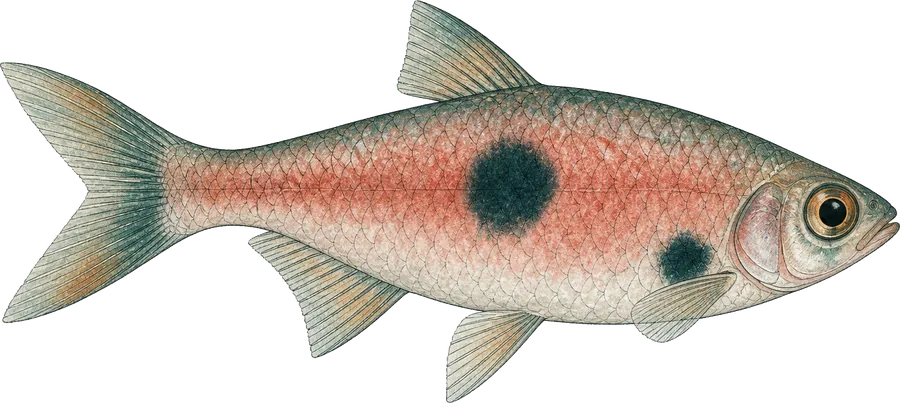
It reaches 10 cm, which is the figure every decision about tank, tank mates and group size follows from.
- Accepted identity
- Rasbora kalochroma (Bleeker, 1851)
- Family
- Danionidae
- Native range
- Peninsular Malaysia, Borneo and Sumatra
- Habitat
- Blackwater streams in ancient forest peat swamps
- Maximum length
- 100 mm standard length
- Flank markings
- Two dark blotches, variable in size and shape across the range
- Social requirement
- A group, with 8 to 10 given as a starting number
- IUCN assessment
- Least Concern, assessed 9 August 2019
Very few people meet this fish at 10 cm, which is where the trouble starts.
How big does a clown rasbora actually get?
Two institutional records give a maximum, and side by side they read like a range.
| Figure | Source | What is being measured |
|---|---|---|
| 100 mm SL | Seriously Fish | Standard length, snout to the base of the tail |
| 10.0 cm TL | FishBase | Total length, snout to the tip of the tail fin |
They are not a range. Standard length stops where the body ends, total length carries on to the end of the tail fin, so the same animal produces two figures depending on where the ruler stops.
Read together, they describe a fish whose body alone is about ten centimetres long.
That is a substantial animal by the standards of the word rasbora, which most people attach to fish a third of that length or less.
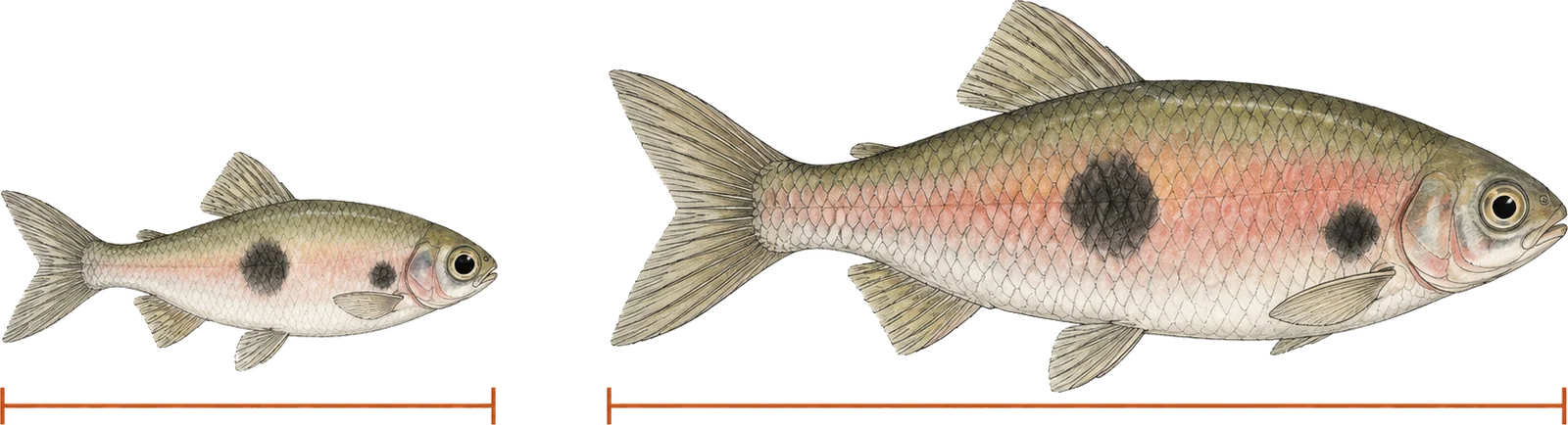
Why does the shop fish look like a nano species?
Because it usually is a juvenile. Retail stock is commonly offered at 4 to 5 cm, which is roughly half the adult standard length.
At that size the fish is doing a convincing impression of something else entirely. Seriously Fish records that juveniles are confused with Boraras maculatus, the dwarf rasbora, and that is not a careless mistake to make.
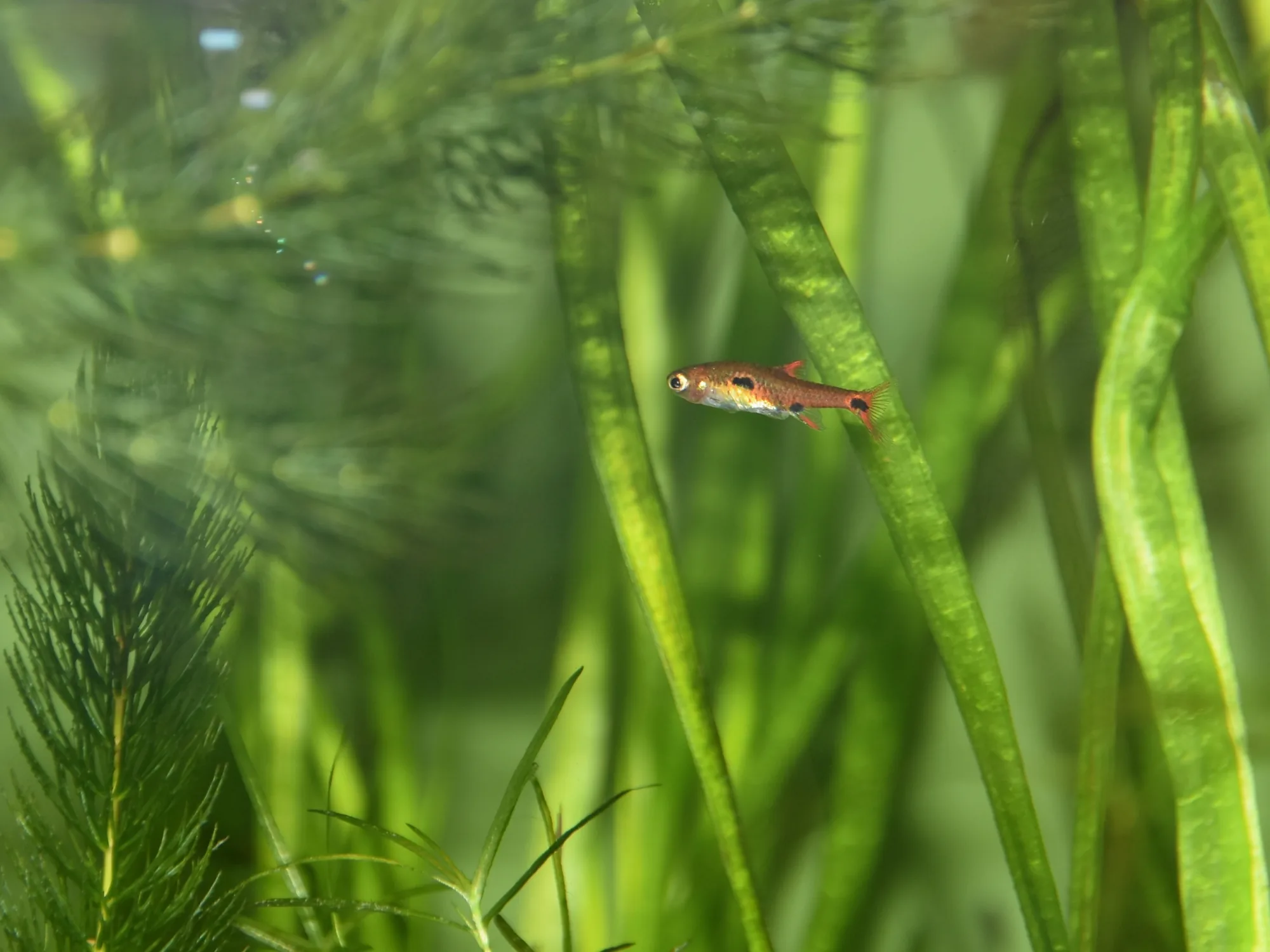
The chili rasbora documented on this site belongs to that genuinely tiny genus, and the gap between the two animals is the whole issue.
Which fish is an adult clown rasbora mistaken for?
Once it is grown, the confusion moves to a different species. Rasbora elegans carries a similar arrangement of dark flank markings and overlaps in size.
The separating character is not the pattern but the colour.
| Decision factor | Clown rasbora | Rasbora elegans |
|---|---|---|
| Body colour | Pinkish red through the flank, deepening with condition | Overall silver and olive, with no red or pink wash |
| Flank markings | Two dark blotches, sometimes joined by a line of smaller spots | A squarish mid-flank blotch and a second blotch at the tail base |
| Reliability | Colour holds even when the pattern varies | The same, which is why Seriously Fish calls it the easy character |
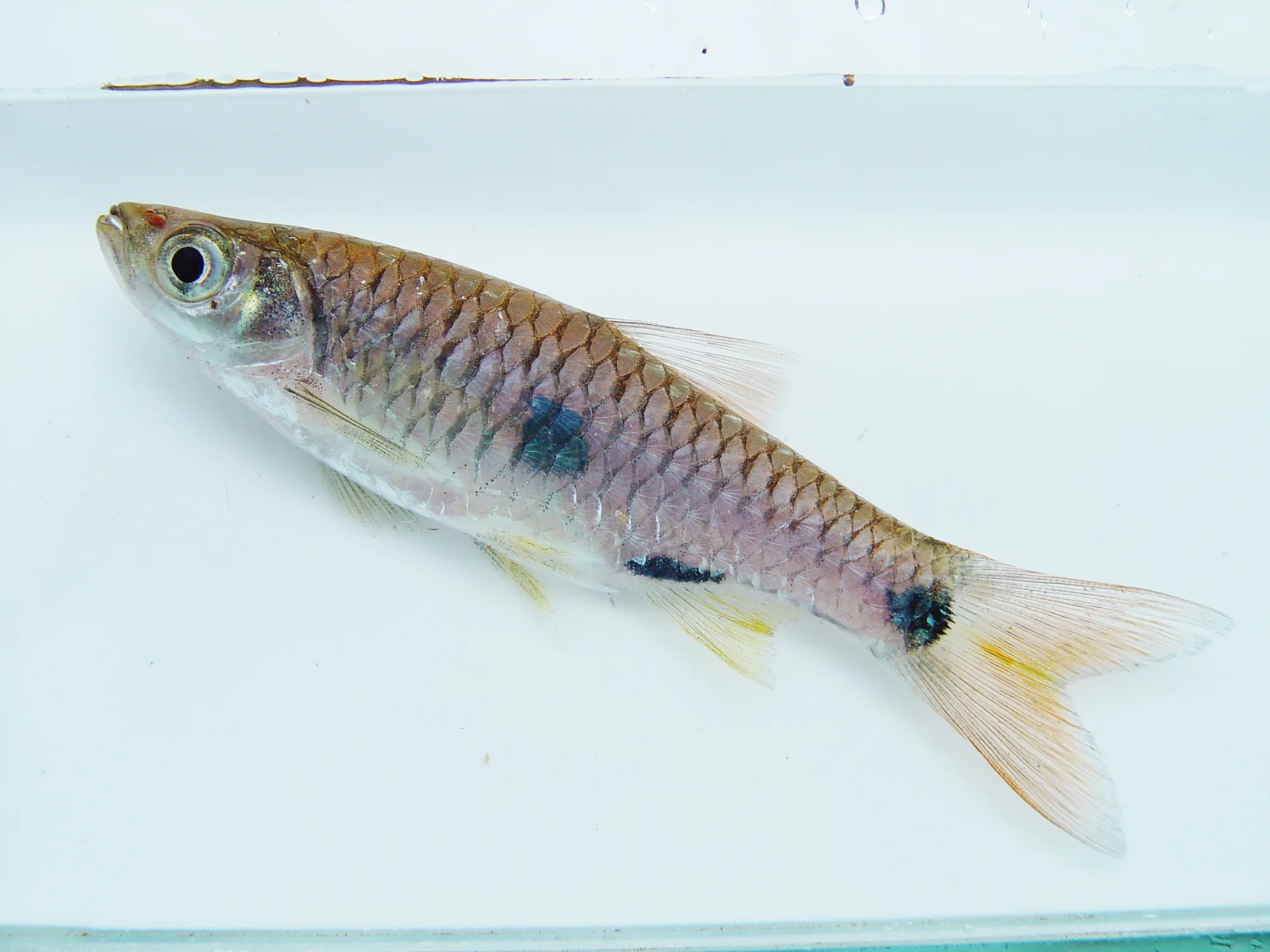
Pattern alone is unreliable here for a specific reason. The markings vary across the species range, and some populations carry a line of spot-like marks running between the two blotches while others do not.
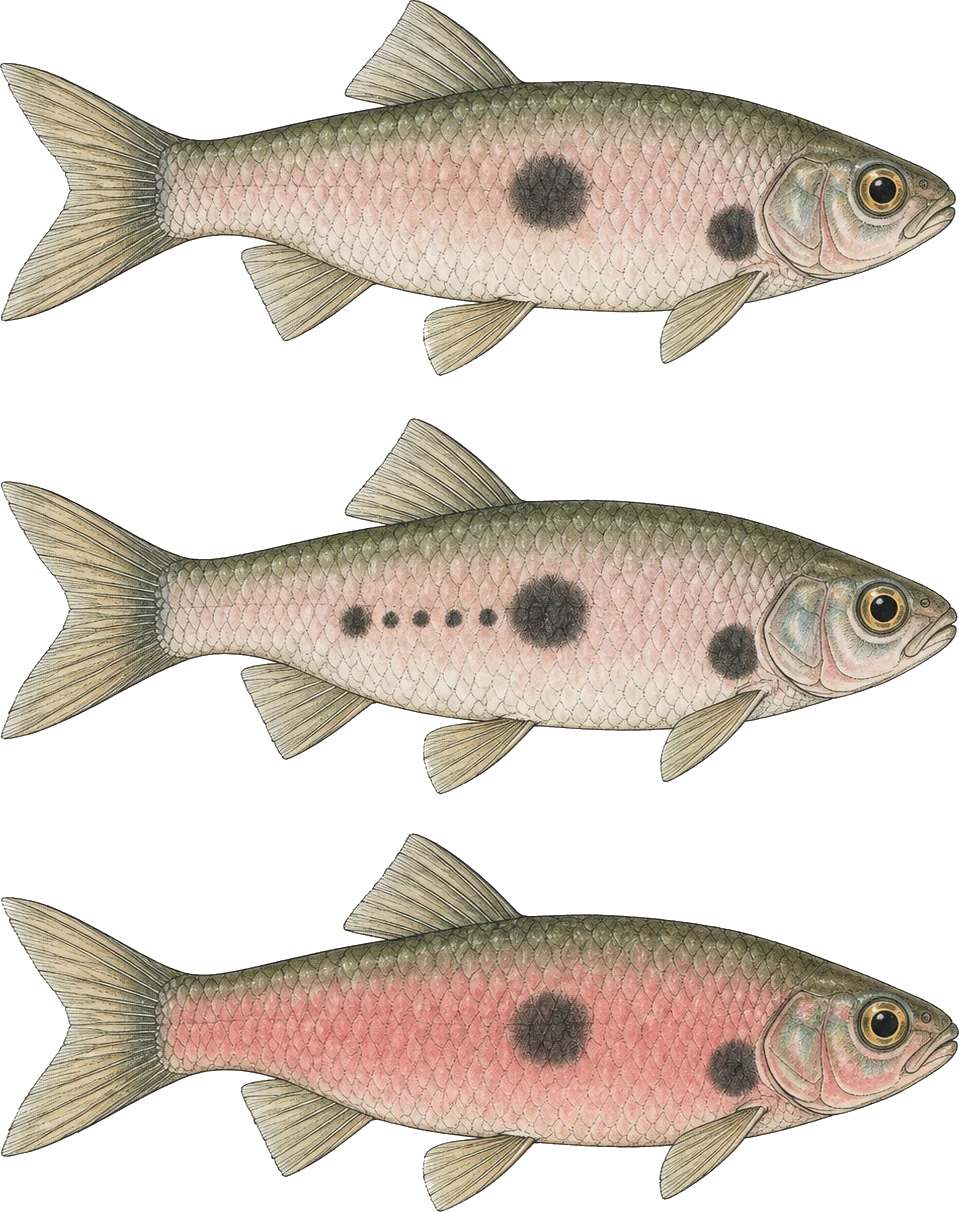
Any single photograph of this species is therefore a reference rather than a key.
What tank does a group of clown rasboras need?
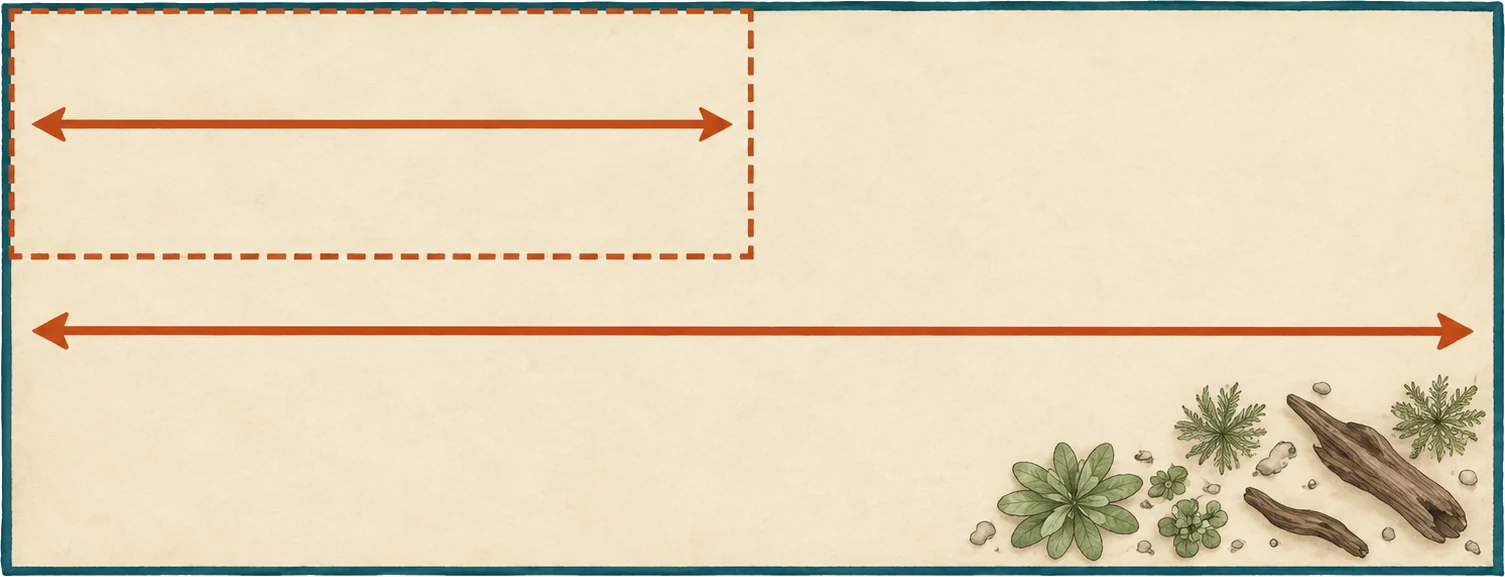
Seriously Fish benchmarks a group at a base of 120 by 45 cm, in a tank 45 cm deep, which works out at roughly 243 litres.
That figure is published as a footprint rather than as a volume, and the distinction matters.
- Published base footprint
- 120 by 45 cm
- Tank depth used in that benchmark
- 45 cm
- Approximate volume
- 243 litres
- What governs the choice
- Length, because the fish is described as active and spends its day crossing open water
An active mid-water shoal spends length. A tall 200-litre tank with a 60 cm base holds plenty of water and gives the group almost nothing to swim along, which is why a volume figure on its own is a poor way to decide this.
What water does a clown rasbora need?
Here the two sources that agree on almost everything else stop agreeing.
Published ranges, and where they come from
- Temperature23 to 28 °CRead from a separate thermometer rather than the heater dial.
- pH5.0 to 7.5Calibrated meter or a test covering the acidic end of the range.
- General hardness2 to 10 dGHGH titration test in degrees of general hardness.
Every range above applies to Rasbora kalochroma in a freshwater system. Source: Seriously Fish, checked 2026-09-12.
FishBase gives a narrower temperature band of 25 to 28 °C, publishes no pH range at all, and records hardness as a dH range starting at 10 and running upward.
That last entry points in the opposite direction to the one above it. One record describes a soft-water fish with an upper bound of 10; the other treats 10 as the floor.
We have not averaged them, because the average would be a number neither institution published.
The habitat evidence is what breaks the tie in practice. A fish collected from water with negligible hardness is not being well served by planning for the hard end of a contradictory record, and the softer range is the one supported by where the animal actually lives.
What both records agree on is narrower than either range suggests: this fish wants warm, stable water, and it is recorded as susceptible to swings in chemistry rather than to any particular value.
Where does a clown rasbora live in the wild?
In blackwater streams and rivers running through ancient forest peat swamps.
The water is stained brown by tannins released as organic matter breaks down, the bed is scattered with fallen leaves, twigs and branches, and the canopy overhead keeps the whole system dim.
Those swamps are acidic in a way that surprises people used to community-tank numbers. Seriously Fish records pH as low as 4.0 with negligible hardness.
The species has been collected from Selangor, Terengganu, Pahang and Johor in Peninsular Malaysia, and on Borneo from Kuching south through the Kapuas basin as far as the Barito drainage.

Read as instructions rather than as background, that description sets out most of the tank.
- Dim the lighting and break up the surface with floating plants, because the wild habitat sits under a closed canopy.
- Use a fine, dark substrate, which is where the source says the species shows to best effect.
- Add leaf litter and driftwood, matching the fallen leaves and branches recorded on the bed.
- Let the wood and leaves stain the water rather than filtering the colour out; the fish is recorded as better coloured in tannin-stained water.
Is the clown rasbora really a schooling fish?
This one is genuinely disputed, and the current source says so in as many words.
Despite reports to the contrary this is a schooling fish and at least 8-10 specimens should be purchased.
Seriously Fish, Rasbora kalochroma
That sentence is doing two things. It gives a number, and it records that the number argues with earlier accounts of the species.
Those earlier reports are not itemised, so we cannot tell you which is right on the evidence available. What we can say is which way the error runs.
Buying eight fish that turn out not to need company costs money. Buying three fish that do need company produces nervous, poorly coloured animals that spend their lives in cover, and the source is explicit that problems appear when the fish are kept in insufficient numbers.
There is a second reason the group size matters, and it has nothing to do with stress. Males show their strongest colour competing with one another for female attention, so a group of three never produces the animal in the photograph.
Why do clown rasboras lose their colour?
Pale fish are a symptom with several independent causes, and they sort into an order worth following.
Work through these before assuming illness
- Ammonia and nitrite Both should read zero. A husbandry result is being read as a colour problem until these two numbers are known.
- Temperature Take it from a separate thermometer. The two published records disagree on the lower bound, which makes the actual reading more useful than the dial setting.
- Group size Male colour is tied directly to competition inside the group. A pale male in a group of three is behaving normally for a group of three.
- Light, substrate and tannins Bright light over a pale substrate in clear water is the combination that produces the least colour in this species.
- Time since arrival A fish that has been in the tank for three days is not yet showing what it will look like in three months.
None of that is a diagnosis. If the fish are also breathing hard, hanging at the surface or losing balance, the water is the question and an aquatic vet is the next step, not a colour adjustment.
What should be ready before the fish arrive?
Two of the risks this species carries are named in the literature, and both are closed before anything is bought.
- Mature the filter first The species is recorded as poorly suited to a biologically immature tank, where it is susceptible to swings in water chemistry. This is the step that takes weeks rather than minutes.
- Fit a tight-fitting cover Like most rasboras it is an accomplished jumper, and an open-topped tank is the commonest way a healthy fish is lost in the first month.
- Dim the light and add cover Floating plants, wood and leaf litter are far easier to arrange in an empty tank than around a nervous new shoal.
- Buy the group in one visit The recommended 8 to 10 is a starting group, not a target to build toward over several months while the first few fish sit alone.
What do clown rasboras eat?
In nature, mostly invertebrates. Seriously Fish describes the diet as aquatic and terrestrial invertebrates, inferred from similar members of the genus rather than from stomach contents for this species specifically.
- Recorded wild diet
- Aquatic and terrestrial invertebrates
- Trophic level
- 3.2, from FishBase
- Aquarium staple
- Good quality dried flakes and granules
- What condition depends on
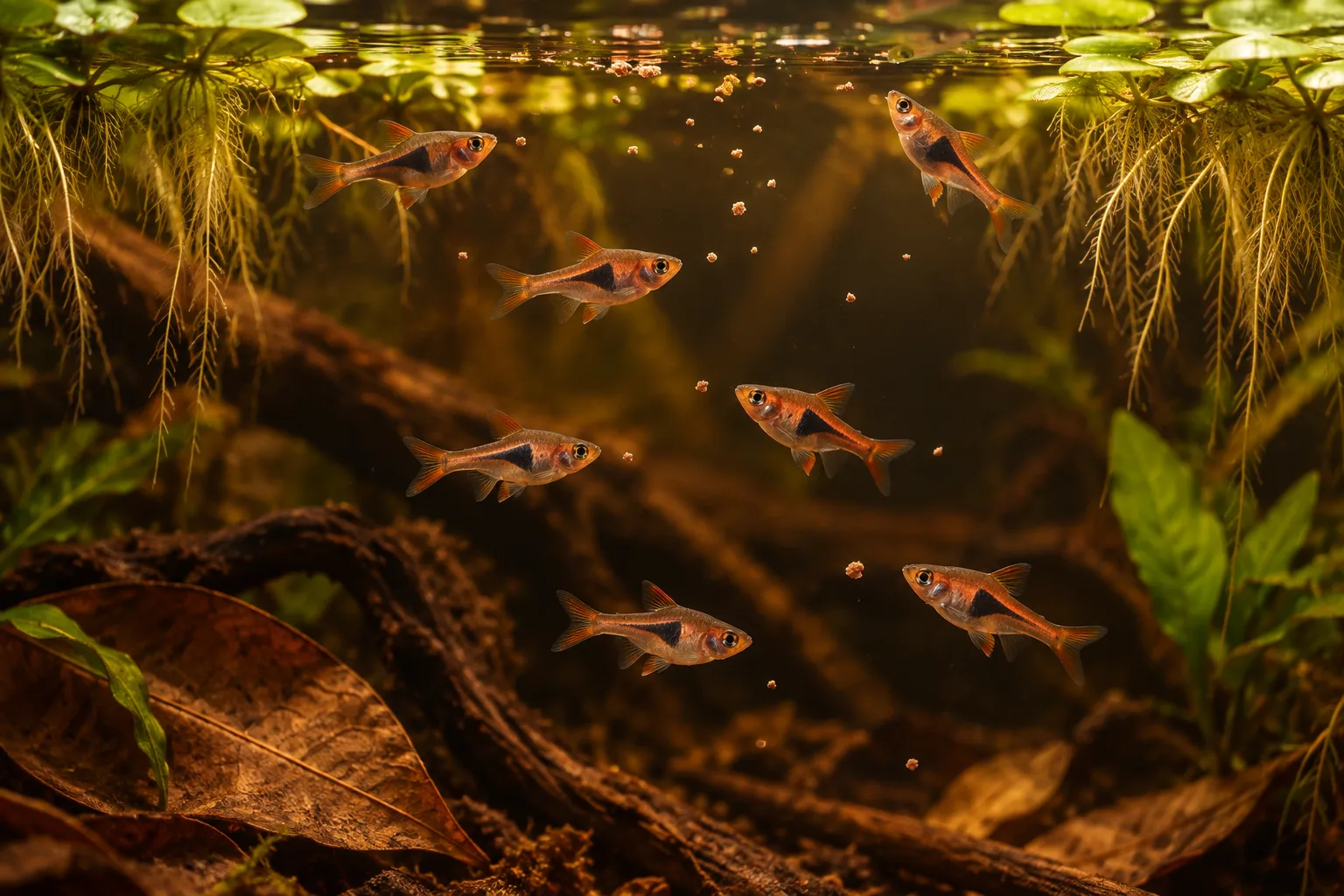
- Daily live and frozen foods such as bloodworm, Daphnia and Artemia
- Basis of the wild diet
- Inferred in the source from similar members of the genus
The fish is easy to feed and that is not the same as saying diet does not matter. The source ties its best colour and condition specifically to the live and frozen part of the menu, which puts those foods closer to the middle of the diet than to the edge of it.
What can share a tank with a clown rasbora?
Seriously Fish calls this species very peaceful indeed, which makes it the vulnerable party in most pairings rather than the threat.
The real constraints are not about temperament.
| Constraint | Why it bites here |
|---|---|
| Adult size of the other fish | A 10 cm rasbora is large enough that the usual worry runs both ways, and anything with a mouth to match is a problem |
| Water overlap | A soft, acidic, warm blackwater species narrows the field considerably more than a shared temperature does |
| Tank length | The published footprint is already spoken for by one shoal of eight to ten |
| Light tolerance | A community that wants bright light will not get one, because this tank is deliberately dim |
The most useful answer to this question is not a generic list of peaceful community fish, because one already exists in the literature.
Seriously Fish records the species that share its blackwaters in the Endau drainage of Peninsular Malaysia, among them Rasbora cephalotaenia, Betta pugnax and Sphaerichthys osphromenoides.
One name on that list is already documented here. Rasbora einthovenii is the brilliant rasbora, which comes out of the same peat swamps and wants the same water.
Co-occurrence in the wild is a strong starting point and not a guarantee. A biotope tank still has to satisfy the constraints above, and a shared river is no help if the tank is 60 cm long.
Among the other fish documented on this site, the cardinal tetra is the closest honest match on water chemistry, wanting the same soft acidic conditions from a different continent.
The mismatch to avoid runs the other way. A true nano species such as the celestial pearl danio shares none of the requirements that matter here, and would be outpaced at every feed by a shoal of fish five times its length.
How long do clown rasboras live?
Three to five years is the figure repeated across aquarium sites, and it does not trace back to an institutional record.
FishBase carries no longevity entry for Rasbora kalochroma at all.
Treat the number as a planning estimate that nobody has verified, rather than as a measurement. A well-kept small cyprinid of this size living several years is unremarkable; the absence of a record is not evidence that it is short-lived.
Can clown rasboras be bred at home?
Up to a point, and mostly without being asked.
- Continuous scattering This is an egg-scattering, continuous spawner rather than a species that has to be triggered. Fish in good condition spawn often.
- No parental care The adults do not guard eggs or fry, and they will eat both, which is why fry rarely survive in a stocked tank.
- Hatching in 18 to 48 hours Short enough that a keeper checking the tank weekly misses the entire event.
- In a densely planted mature tank Small numbers of fry may appear unaided, which is how most people discover their group has been breeding.
Raising fry deliberately needs more control than that, and the published account does not give a conditioning or water recipe we would be willing to invent one from.
What is the clown rasbora trade and conservation status?
The register entries are short, and the dates are worth reading alongside them.
| Record | Status | Dated | What it does not cover |
|---|---|---|---|
| IUCN Red List | Least Concern | 9 August 2019 | Abundance in any particular stream or state |
| CITES | Not Evaluated | Checked 12 September 2026 | National and local rules, which apply separately |
| Recorded use | Commercial fisheries and commercial aquarium trade | FishBase, checked 12 September 2026 | Whether a given shipment was wild-caught or bred |
Two things in that table tend to surprise people. The species is recorded as a commercial food fish as well as an aquarium one, and Least Concern is a judgement about the species across its whole range rather than a statement about the water any individual fish came out of.
That distinction matters here more than it does for most aquarium species. The peat swamp systems this fish lives in are under sustained pressure from rubber and palm oil plantations, drainage and development across Southeast Asia.
A species can hold a Least Concern listing while the specific habitat that defines it continues to shrink, and both of those things are true of the clown rasbora at once.
Which schooling fish are useful comparisons?
Emerald eye rasbora
A tiny rasbora whose cooler range, small body and quiet shoaling pattern create a different constraint set.
Giant danio
A large, fast danio that makes horizontal room, group speed and oxygen demand the central comparison.
Betta fish
A solitary, surface-oriented fish whose long fins change the pace and fin-contact risk in a community.
Black neon tetra
A smaller midwater shoaler that offers a useful contrast in body size, group movement and water tolerance.
Ember tetra
A tiny warm-water tetra whose low competitive weight and small mouth change feeding and tankmate choices.
Cherry barb
A small planted-stream barb that contrasts sex-linked colour, social structure and habitat cover.