
What Is a Congo Tetra, and Why Is the Shop Fish So Plain?
Phenacogrammus interruptus
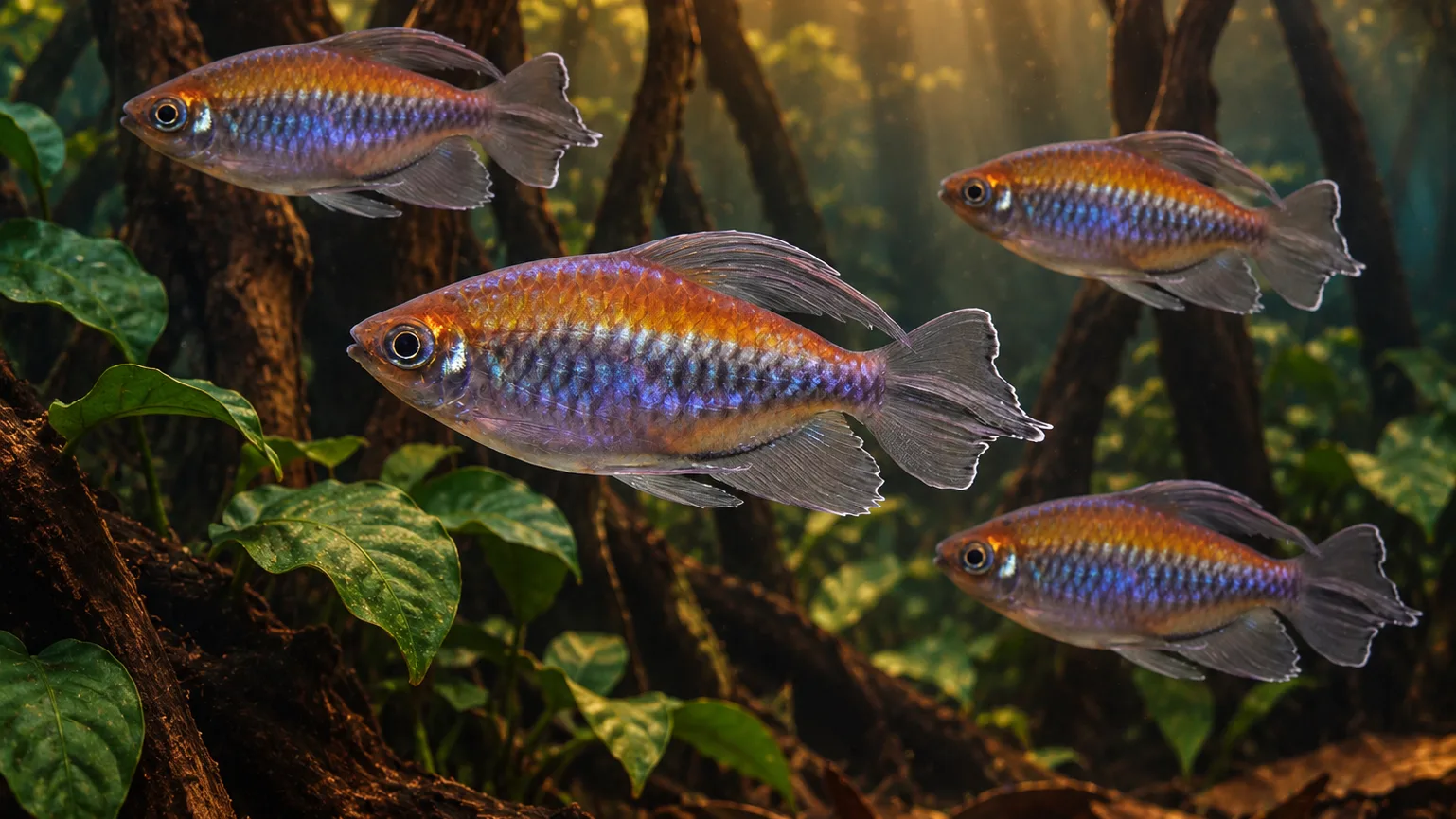
The congo tetra is Phenacogrammus interruptus, an African characin from the Congo basin whose mature males carry an iridescent orange and violet flank and long trailing fins. None of that is present on the juveniles shops sell, and whether it ever arrives depends on water quality and on what else is in the tank.
At a glance

- Adult size
- 8 cm
- Minimum footprint
- A base of 120 cm by 30 cm for adults, with a clear central run left open
- Social structure
- A mixed-sex shoal. Seriously Fish asks for a mixed-sex group for the best effect and FishBase records a requirement for five or more; confidence and display both depend on the number.
- Minimum group
- 5
- Sex ratio
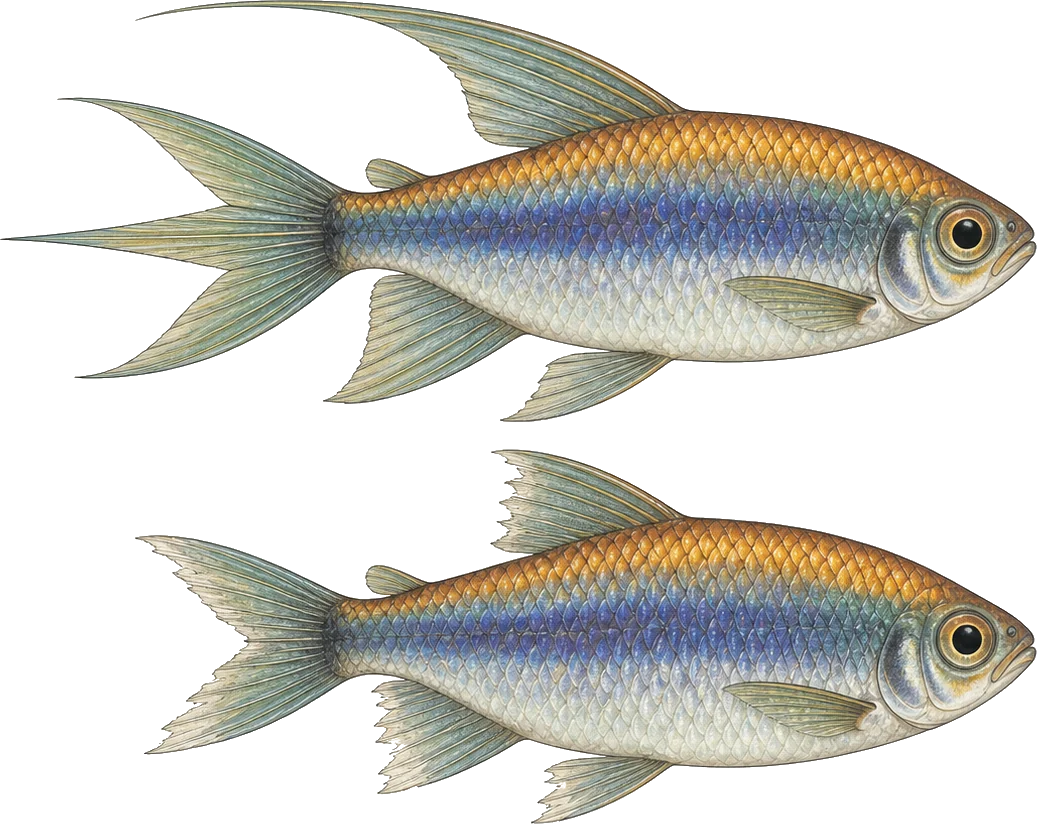
- Males reach 8.0 cm total length against 6.0 cm for females, and develop a greatly extended dorsal fin and drawn-out middle caudal rays. Neither character is present on juveniles.
- Diet
- Omnivore
- Feeding
- A quality dried staple as the base, with live and frozen foods as a significant part rather than an occasional extra, which the source ties directly to colour.
- Waste load
- medium
- Family
- Alestidae
- Native range
- Lower and middle Congo River basin, in both the Democratic Republic of the Congo and the Republic of the Congo
- Conservation status
- Least Concern, assessed 16 February 2009 Source
Two published benchmarks agree on length rather than volume: Seriously Fish gives a 120 by 30 cm base and FishBase a minimum 100 cm aquarium. Length serves twice here, as swimming space for an active shoal and as room for a startled fish to stop before it hits something.
What is a congo tetra?
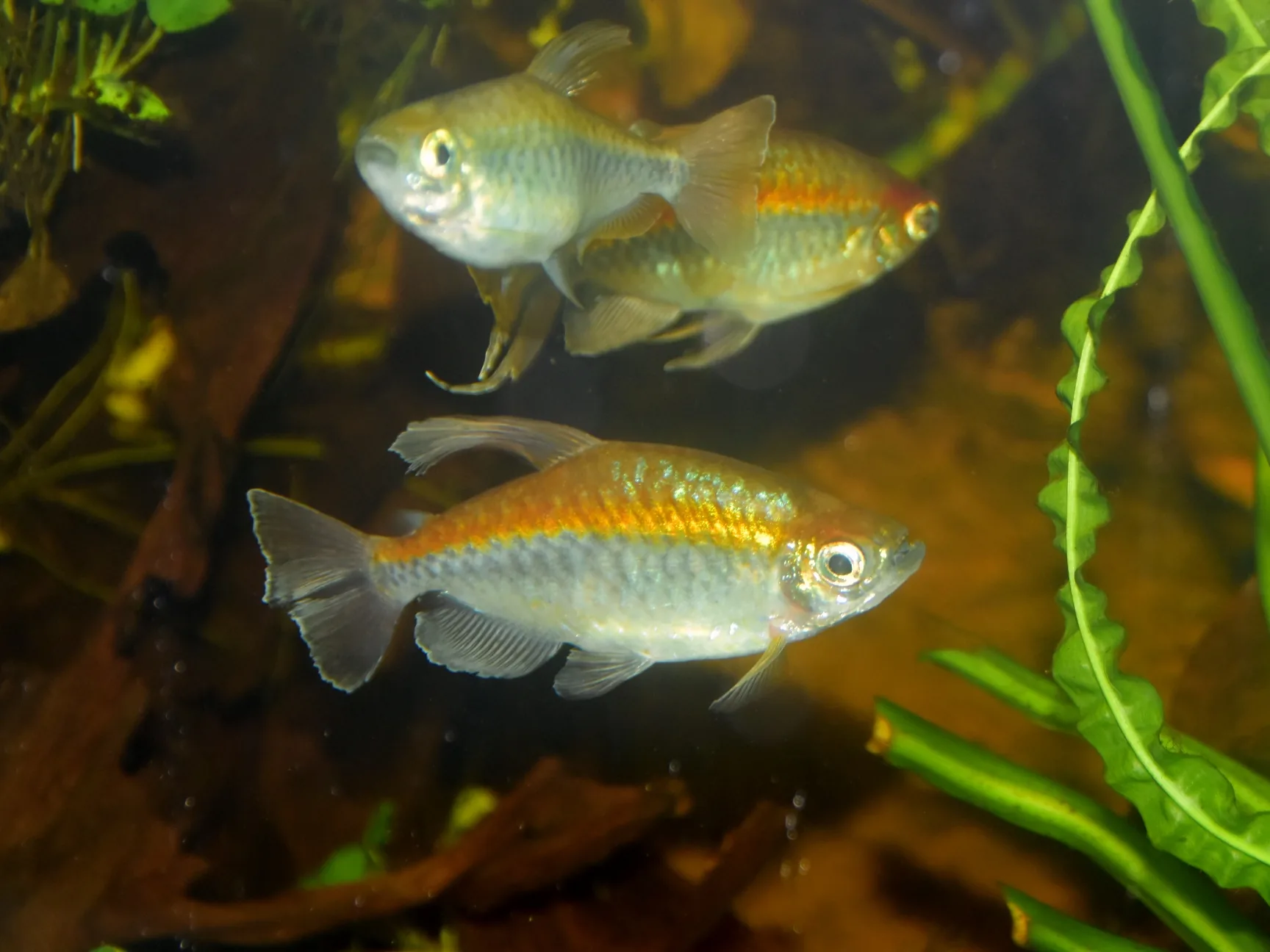
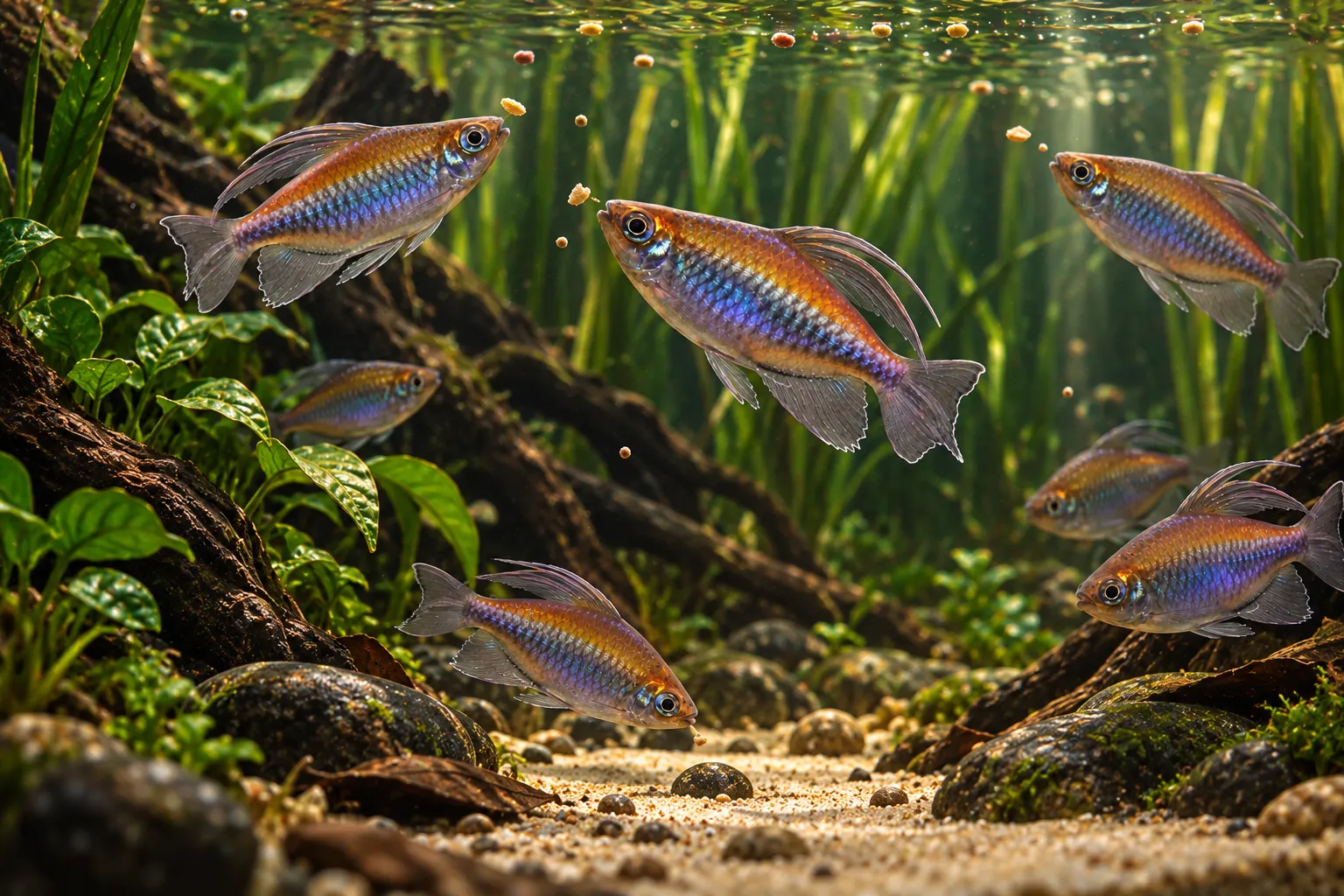
The congo tetra is Phenacogrammus interruptus, a deep-bodied fish from the Congo River basin whose mature males carry an iridescent orange and violet flank and long trailing fins.
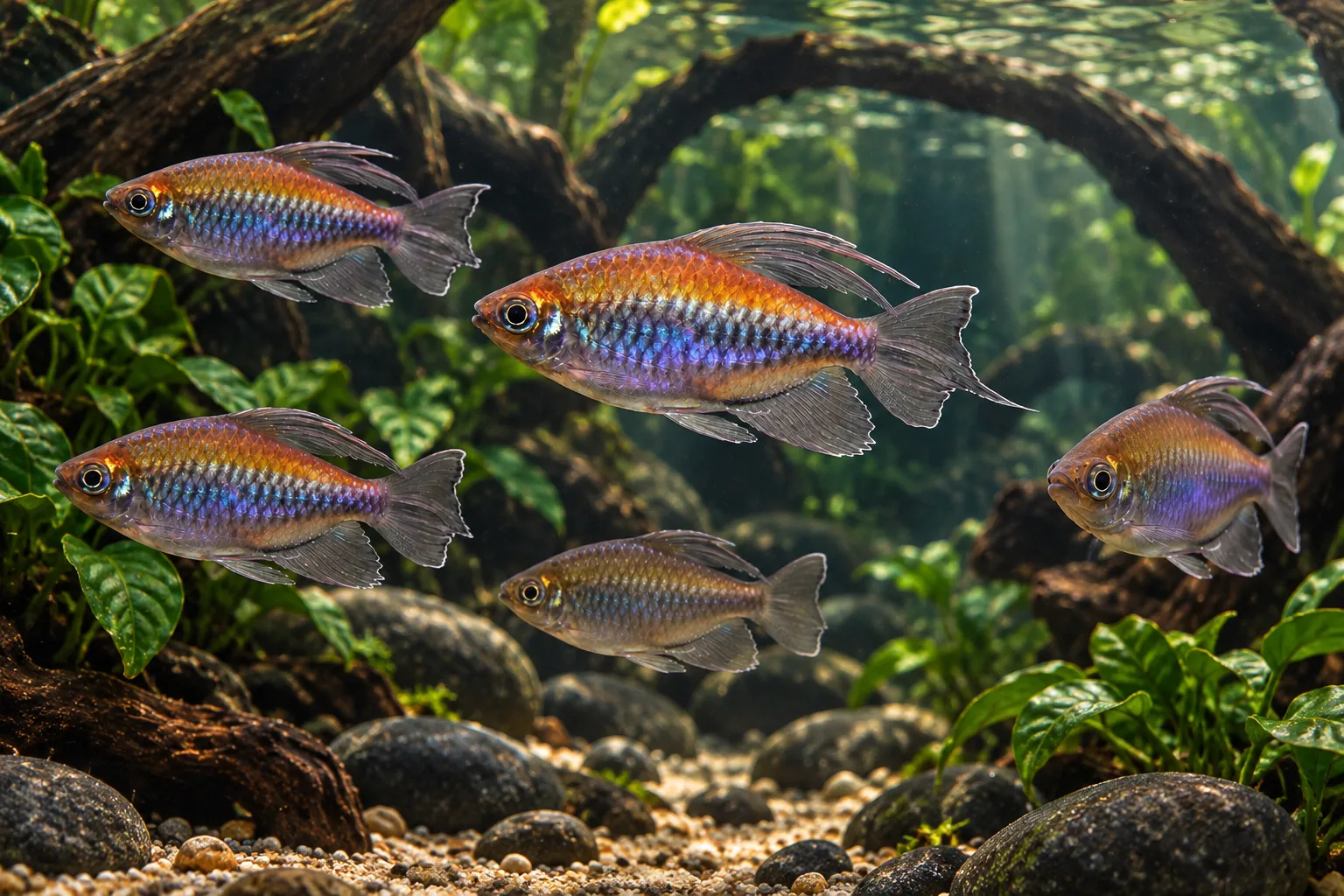
Boulenger described it in 1899. It belongs to Alestidae, the African tetras, and not to Characidae, which is where almost every other fish sold as a tetra sits.
That is more than a filing detail. The word tetra spans two families on two continents, and this one is the African branch.
- Accepted identity
- Phenacogrammus interruptus (Boulenger, 1899)
- Family
- Alestidae, the African tetras
- Native range
- Lower and middle Congo basin, in both Congos
- Male length
- 8.0 cm total length
- Female length
- 6.0 cm total length
- Defining male character
- Greatly extended dorsal fin and drawn-out middle caudal rays
- Temperament
- Peaceful and timid
- IUCN assessment
- Least Concern, assessed 16 February 2009
Almost everything a buyer needs to know about this fish follows from one awkward fact, which is that none of the appearance above is present when it is sold.
Why does the shop fish look nothing like the photographs?
Because the fish in the shop is usually a juvenile, and a juvenile congo tetra is a plain silver fish with short fins.
Seriously Fish puts it plainly: young specimens are drab, and they develop their spectacular colouration as they mature and settle in.
The photographs are not exaggerated. They are photographs of a later stage of the same animal.
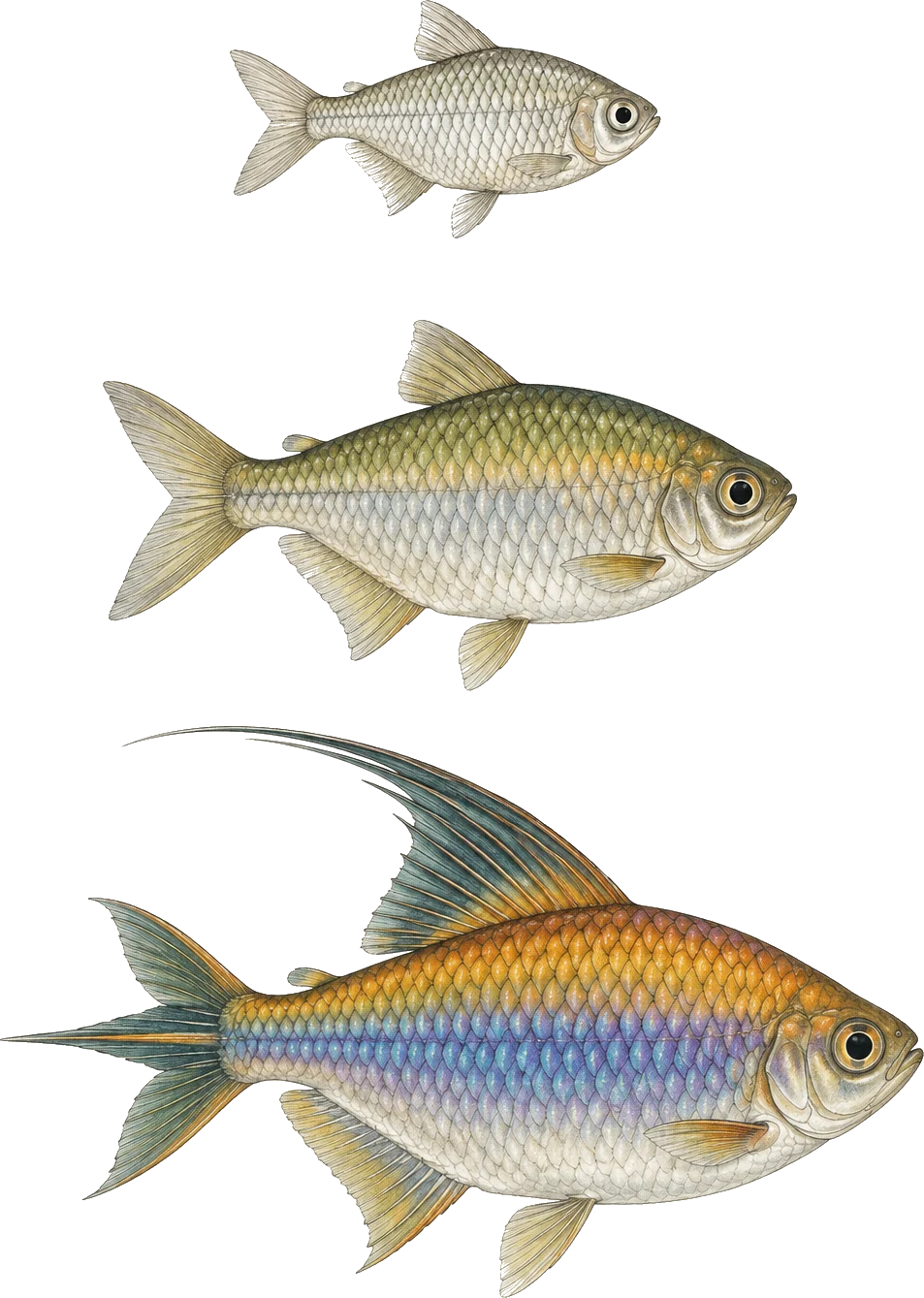
The second half of the fact is the part that catches people. Development is not automatic.
The same source records that where water quality is not maintained, male fin development is impaired and the fish lose colour. So the finnage is not simply a matter of waiting.
What do the male's fins actually look like?
Two fins are involved, and both are worth being able to recognise in a shop tank.
The dorsal fin is greatly extended, with its rear rays drawn out into a trailing point that sweeps back over the body. The tail is the more distinctive of the two: the middle caudal rays extend well past the upper and lower lobes, so the fin reads as three lobes rather than a fork.
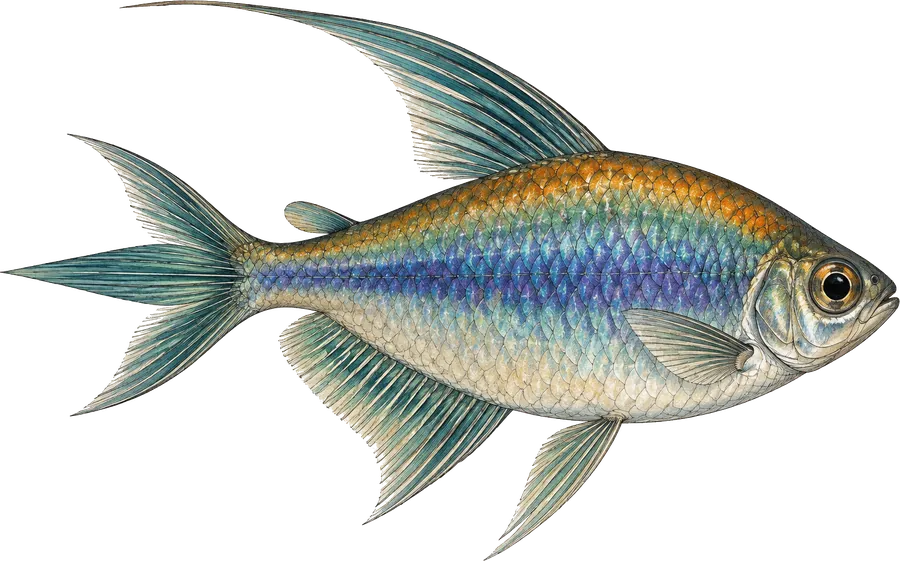
The sexes also differ in size, which is a more reliable guide than colour on a fish that has not finished developing.
| Character | Male | Female | Usable on a juvenile? |
|---|---|---|---|
| Caudal fin | Middle rays drawn out into a separate central lobe | An even fork | No |
| Dorsal fin | Greatly extended into a trailing point | Short and plain | No |
| Published length | 8.0 cm total length | 6.0 cm total length | Not reliably |
| Colour | Stronger, but only once mature | Weaker in the same arrangement | No |
A tank of young congo tetras will show none of this, which is why shop stock of this species all looks alike.
What ruins a male congo tetra's fins?
Three things, and they divide cleanly into what stops the fins growing and what removes them once grown.
Poor water quality belongs to the first group. Seriously Fish describes the species as quite sensitive in this respect and ties poor conditions directly to impaired fin development and lost colour.
The other two belong to the second group, and both are stocking decisions.
The source states without qualification that congo tetras should not be kept with fin-nipping species, because the males' fins will be destroyed. It also advises against boisterous tank mates, on the grounds of the fish's timidity.
There is a third route to the same outcome that has nothing to do with other fish.
A startled congo tetra bolts, and a bolting fish in an open tank meets hardscape and glass. Trailing fins are the first thing to catch.
Work through these before assuming illness
- Water quality Ammonia and nitrite at zero, nitrate controlled, and changes done regularly. This is the cause the source names for fins that never develop in the first place.
- Fin-nipping tank mates Named explicitly by the source as incompatible. A single persistent nipper is enough.
- Boisterous tank mates Fast, pushy species exploit the timidity and keep the fish in cover, where it neither displays nor feeds well.
- Layout and startle room Hard, sharp or crowded hardscape in the swimming zone is what a panicking fish collides with.
- Group size A group below the recommended number stays nervous, and a nervous fish bolts more often.
None of that is a diagnosis. Fins that are reddened, fraying without contact, or worsening in clean water with no aggressor present are a question for an aquatic vet rather than for a stocking change.
What tank does a group of congo tetras need?
Two institutional benchmarks exist, and they are close enough to act on.
- Seriously Fish benchmark
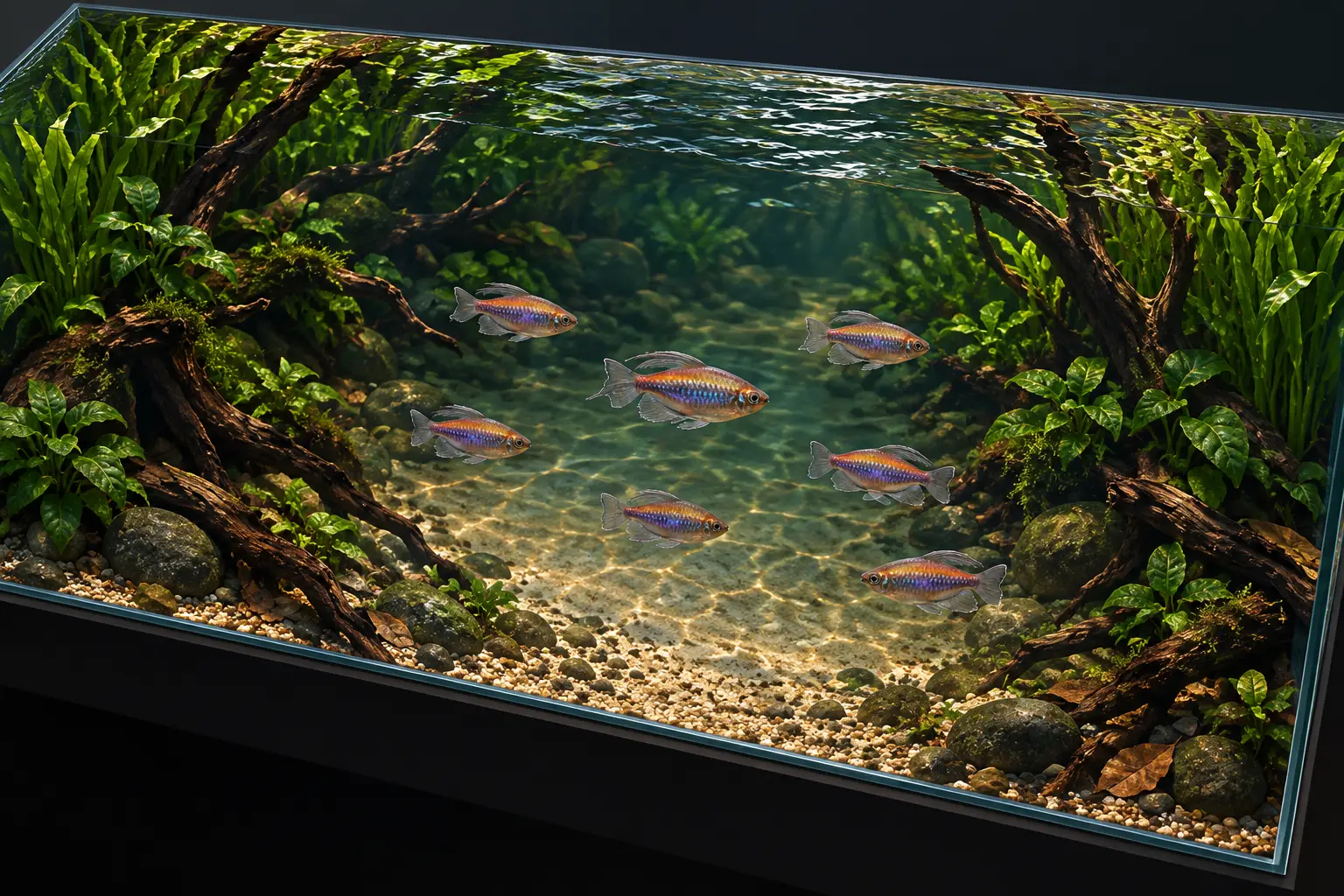
- A base of 120 by 30 cm for adults
- FishBase benchmark
- A minimum aquarium length of 100 cm, with groups of five or more
- Where they agree
- Both are length figures above a metre
- Why length
- An active shoaling fish that needs an open run, and a startled one that needs room to turn
Neither figure is averaged here, because averaging two published benchmarks produces a number nobody published. Taken together they say a tank of a metre or more, and a group rather than a pair.
The length matters twice over for this species. It is the swimming space an active shoal uses, and it is also the margin that lets a bolting fish stop before it hits something.
What water does a congo tetra need?
Forgiving ranges, and an unforgiving attitude to quality within them.
Published ranges and how they were taken
- Temperature23 to 28 °CSeparate aquarium thermometer rather than the heater dial.
- pH6.0 to 7.5Calibrated meter or an aquarium test spanning acidic to neutral.
- General hardness3 to 18 dGHGH titration test in degrees of general hardness.
Every range above applies to Phenacogrammus interruptus in a freshwater system. Source: Seriously Fish, checked 2026-09-12.
FishBase compiles the same three parameters slightly differently, at 23 to 26 °C, pH 6.0 to 8.0 and 5 to 19 dH. The two records overlap comfortably and disagree at their edges, which is normal for compiled aquarium ranges and is not a reason to pick a midpoint.
What both leave out is the thing this species is actually sensitive to. Seriously Fish is explicit that quality rather than value is what shows on the fish, and the visible consequence of getting it wrong is the fins and the colour.
That makes this the rare profile where water maintenance is not a background obligation. It is the mechanism that produces the animal in the photograph.
Where does a congo tetra come from?
From the River Congo drainage. Seriously Fish records it as endemic to parts of that system in the Democratic Republic of the Congo, and FishBase gives the lower and middle Congo basin across both the DRC and the Republic of the Congo.
Very few of the fish in shops have been anywhere near it. Seriously Fish records that most specimens sold commercially originate from the Far East and Eastern Europe, providing direct context for the wild-caught question.
Neither source puts a figure on the farmed share against the wild-collected one, so the honest position is that commercial supply is largely farmed and that a specific batch is a question for the supplier.
How shy is a congo tetra?
Shy enough that it changes how the tank has to be set up and how the first fortnight has to be handled.
Seriously Fish describes the species as timid and gives that as the reason to keep it away from boisterous tank mates. It also asks for a mixed-sex shoal for the best effect, and FishBase records a requirement for groups of five or more.
Aquarium reporting is consistent on what timidity looks like in practice. Newly added fish are jumpy, they bolt at movement near the tank, and they are reported to dash into the glass.
- Buy the full shoal at once Both sources tie confidence to group size, and a group assembled over months spends most of that time below the number it needs.
- Fit a tight cover before the fish arrive A bolting fish leaves the water. This is the first weeks' real risk and it is entirely preventable.
- Plant the margins and leave the middle open Cover to retreat into, and a clear run to display in. A fish with neither hides in a corner.
- Keep approach and lighting gentle Sudden room lights and movement at the glass are what trigger the bolt that costs the fins.
A settled group behaves completely differently from a new one, and the difference is weeks rather than days. A congo tetra that hides for a fortnight has not been mis-sold.
What can share a tank with a congo tetra?
Seriously Fish names categories rather than species, which is the more useful form because it lets you judge a fish the list never mentions.
Similarly sized peaceful tetras and characins
Match on size, water and speed, and add to the shoaling mass that makes a timid fish confident. This is the category with the most overlap on this site.
Rainbowfish
Named directly by the source. Active without being aggressive, and large enough that they are not at risk from the congos either.
Non-predatory cichlids
Also named, with the qualifier doing the work. Medium-sized and not predatory means a fish that ignores an 8 cm tetra rather than one that fits it in its mouth.
Fin-nipping species
The first exclusion, and the firmest. The source says the males' fins will be destroyed, and that is the whole investment gone.
Boisterous or much smaller fish
Boisterous species exploit the timidity and keep the group in cover. Much smaller fish run a risk in the other direction, since aquarium reporting has congo tetras nipping fish well below their own size.
Set against the species documented here, those categories sort into three that fit and two that do not.
Species documented here, and where each one lands
 Black skirt tetra
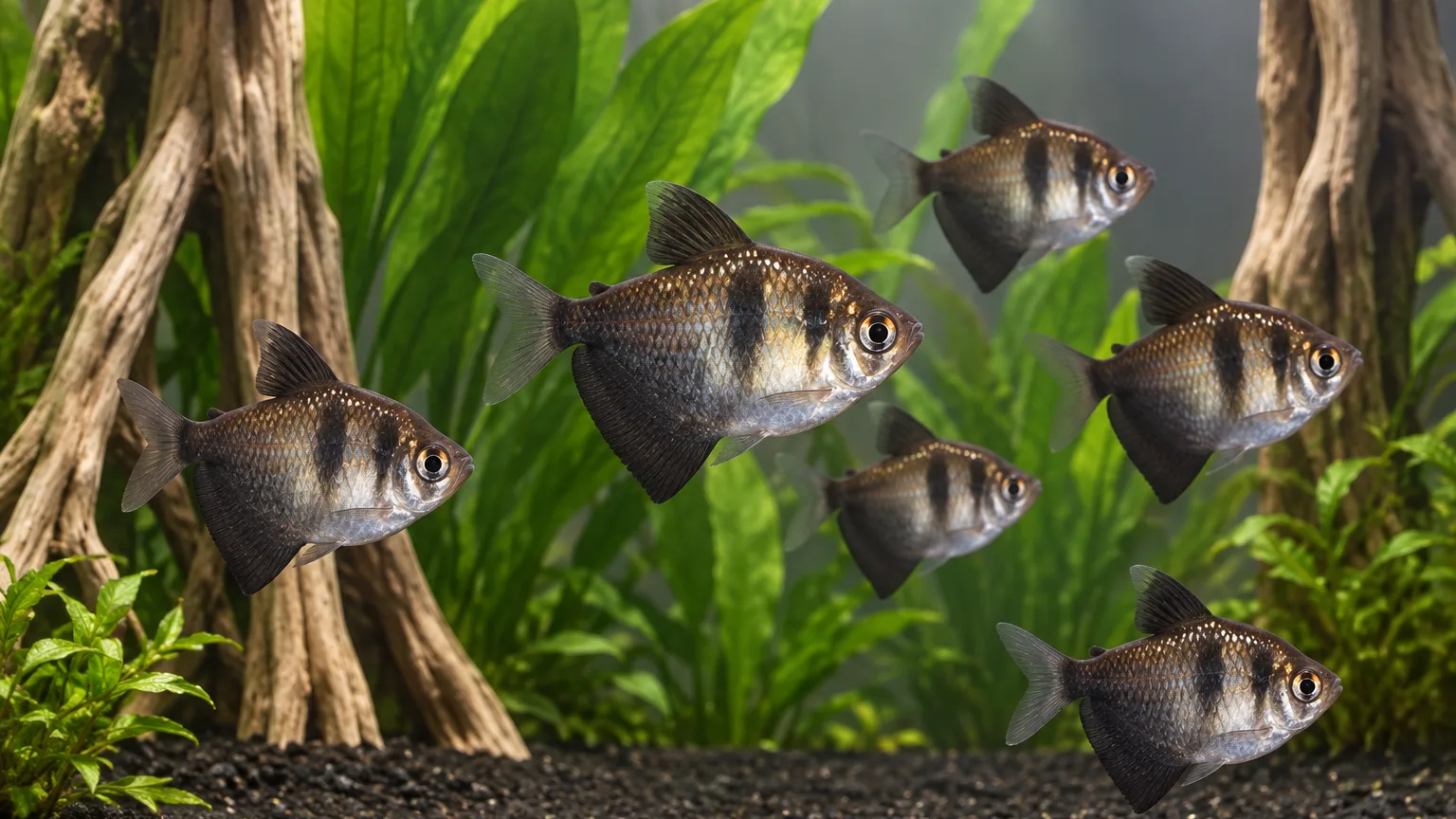
A deep-bodied characin of comparable size and speed. Sits squarely in the first category and adds to the shoaling mass.
 Bleeding heart tetra
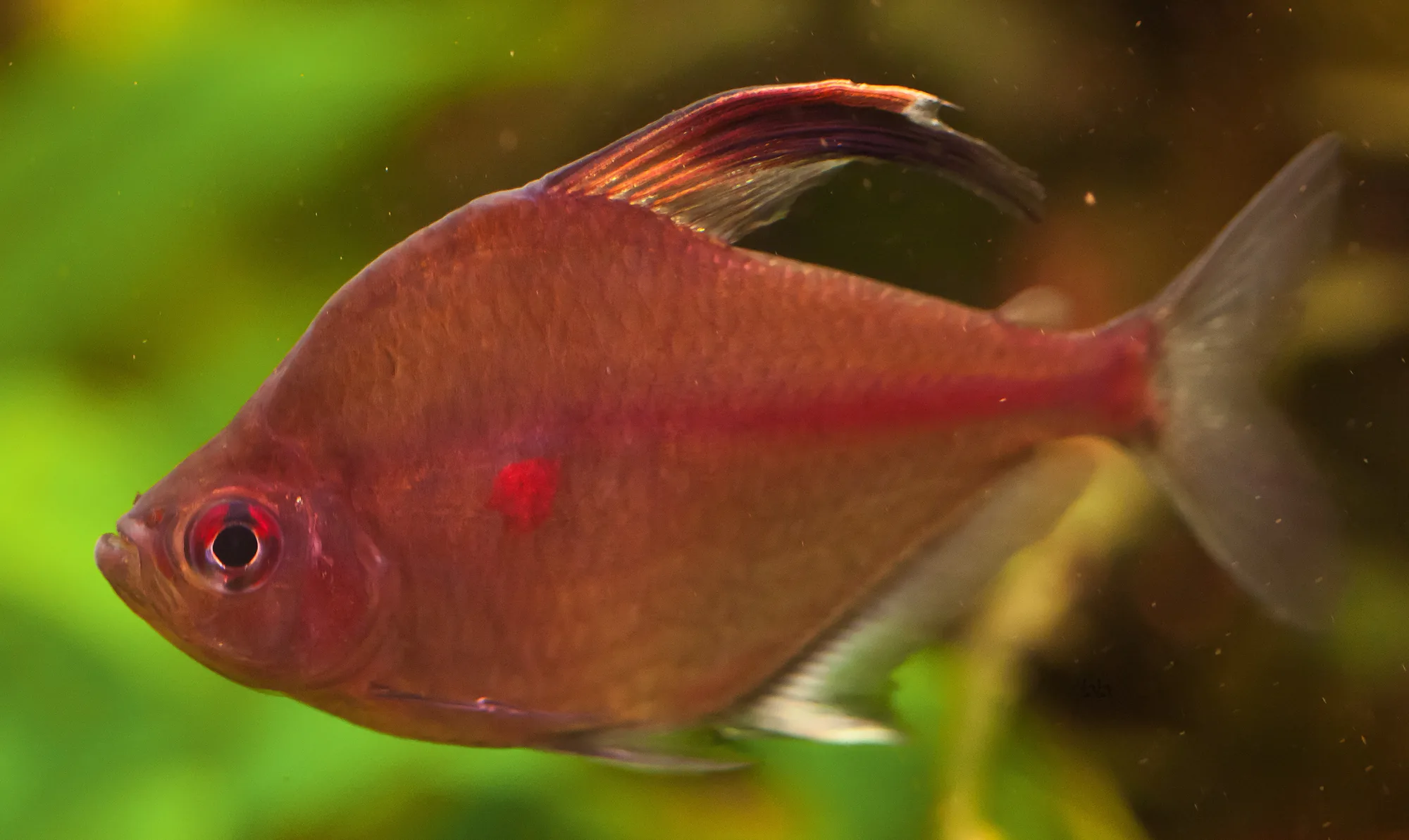
Another deep-bodied characin at a similar length, wanting similar water. The same category, and a longer-finned fish itself, so both benefit from the same exclusions.
 Colombian tetra
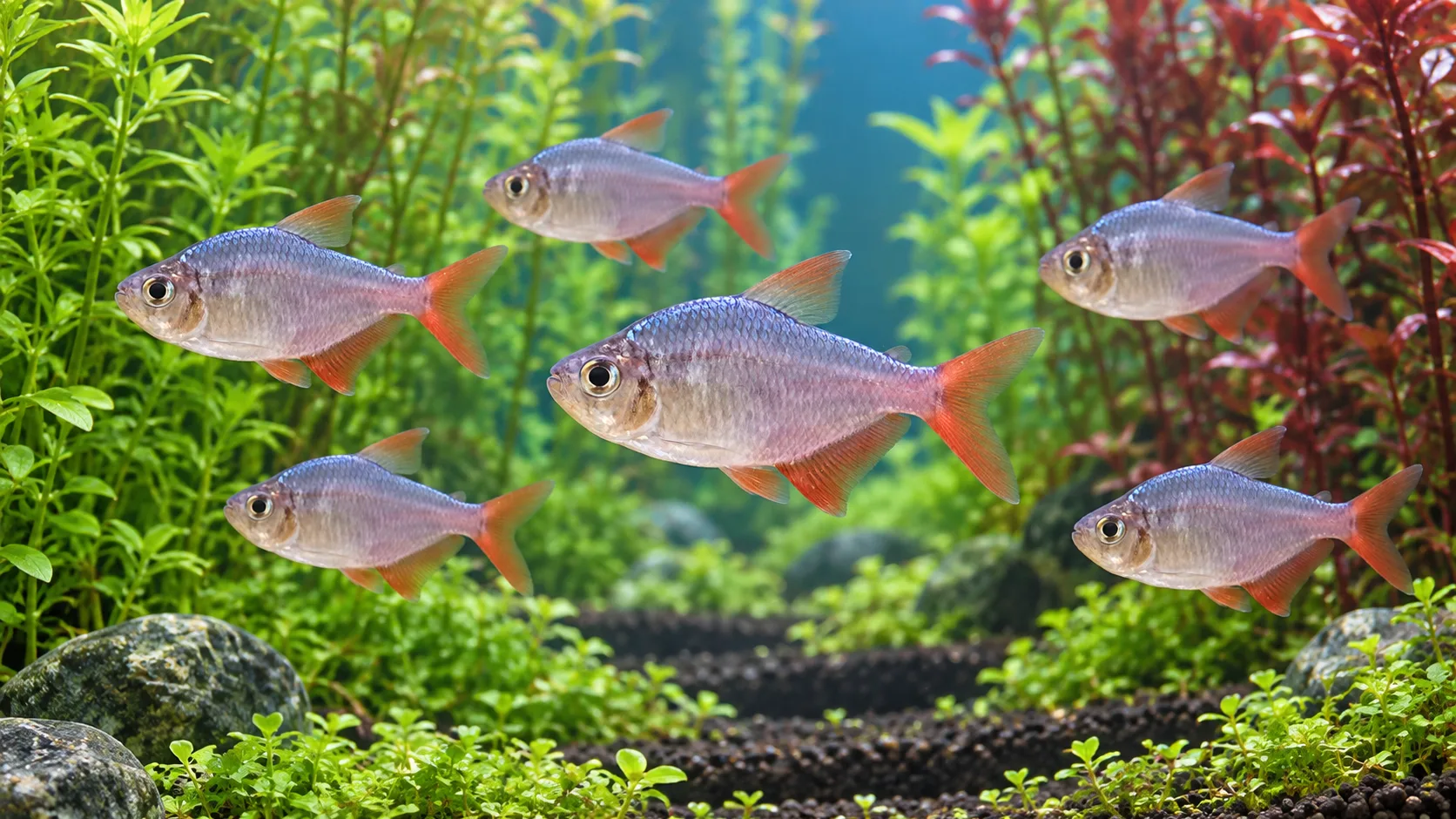
Carries exactly the nipping reputation this species cannot afford. A single persistent nipper is enough to take the finnage.
 Bucktooth tetra
Feeds on the fins and scales of other fish as a matter of course. The clearest possible case of the first exclusion.
 Cardinal tetra
Less than half the length of an adult male congo, which puts it in the category aquarium reporting describes as at risk from the congos rather than the other way round.
The two exclusions are worth more attention than the three that fit. Losing a male's finnage takes months to happen and cannot be undone by removing the culprit afterwards.
What do congo tetras eat?
Most things, which is what an omnivore of this size usually amounts to.
- Recorded wild diet
- Small worms, insects, crustaceans, algae and other zooplankton, with plant matter
- Trophic level
- 3.0, from FishBase
- Routine food
- A quality dried staple sized for the mouth
- What colour depends on
- Live and frozen foods as a significant part of the diet, not an occasional extra
- Basis of the wild diet
- A compiled description rather than a stomach content study
The feeding note matters more here than on most profiles for the same reason the water note does. Seriously Fish ties optimal colouration to the live and frozen portion of the diet, so food is another input to the appearance being bought.
A congo tetra fed only on flake will live. Whether it colours up is a separate question, and the source connects the two.
Can congo tetras be bred at home?
It is possible and the published verdict is that it is difficult, so the honest answer leads with that rather than with a method.
Seriously Fish describes the species as relatively challenging to breed. The numbers explain part of why.
| Figure | Record | What it implies for a keeper |
|---|---|---|
| Egg number | Up to 300 large eggs, 100 to 200 more common | A useful batch is possible from one female |
| Laying pattern | Spread over several days | There is no single moment to catch and remove the adults |
| Hatching interval | Around six days | Six days of eggs sitting in a tank, which is a long exposure |
| First food | Infusoria, then brine shrimp nauplii once large enough | Fry are too small for brine shrimp at hatching |
Six days is the figure worth pausing on. A Colombian tetra of comparable size hatches in 24 to 36 hours, so congo tetra eggs sit exposed for roughly four times as long.
That interval, combined with laying spread over several days, is most of the reason fry do not simply appear in a stocked community tank.
How long do congo tetras live?
Three to five years is the figure in general circulation, and it comes from aquarium sources rather than from an institutional record. FishBase carries no longevity entry for the species.
What FishBase does record is high resilience, with a minimum population doubling time under 15 months, which describes how a population recovers rather than how long one fish lives.
Set the circulating figure against the way this fish develops and it becomes more useful than a bare number. A drab juvenile that needs to mature before it shows anything is spending a real fraction of a three-to-five-year life becoming what the photographs show.
That is the argument for getting the water and the tank mates right early rather than intending to improve them later.
What is the conservation and trade status?
Brief entries, and one of them is getting old.
| Record | Status | Dated | What it does not cover |
|---|---|---|---|
| IUCN Red List | Least Concern | 16 February 2009 | Anything that has changed in the basin since |
| CITES | Not Evaluated | Checked 12 September 2026 | National and local rules, which apply separately |
| Recorded use | Commercial fisheries and aquarium trade | FishBase, checked 12 September 2026 | Whether a given fish was farmed or collected |
Two things there are worth reading twice. The species is recorded as a commercial food fish as well as an ornamental one, which surprises most aquarists, and the Red List assessment is more than fifteen years old.
Least Concern across a basin the size of the Congo is a reasonable judgement and a coarse one. It says nothing about any particular tributary.
For a buyer, the practical position is more comfortable than it is for many species on this site, because the trade is largely supplied by farms rather than by collection. What the record will not tell you is which of the two produced the fish in front of you.
Which tetras make useful comparison points?
Emperor tetra
A medium tetra whose males hold display positions, adding territory and sight lines to the group decision.
Diamond tetra
A medium deep-bodied characin that offers a closer comparison in warm water, adult mass and display behaviour.
Giant danio
A large, fast danio that makes horizontal room, group speed and oxygen demand the central comparison.
Brilliant rasbora
A slender but substantially larger rasbora whose adult footprint can rule out tanks suited to nano species.
Ember tetra
A tiny warm-water tetra whose low competitive weight and small mouth change feeding and tankmate choices.