
What Is a Bucktooth Tetra, and Why Does It Eat Scales?
Exodon paradoxus
The bucktooth tetra is Exodon paradoxus, and it feeds by rasping the scales off other fish. Scales make up 88 percent of the stomach contents of wild-caught specimens, which is why almost everything about keeping it is a question about group size and tank mates rather than water.

At a glance

- Adult size
- 7.5 cm
- Minimum footprint
- A long aquarium with an open central run and broken sightlines at both ends
- Social structure
- Keep a large group. Small groups concentrate scale-eating on one individual rather than reducing it.
- Minimum group
- 12
- Sex ratio
- No routine sex ratio is established.
- Diet
- Carnivore
- Feeding
- A varied carnivore diet in generous amounts, fed frequently. Underfeeding reliably increases attacks on tank mates.
- Waste load
- moderate
- Family
- Characidae
- Native range
- Amazon and Tocantins basins and Guyana, in Brazil, Colombia and Guyana
- Former scientific names
- Epicyrtus exodon, Epicyrtus paradoxus. Superseded names for this same species.
- Conservation status
- Least Concern, assessed 4 March 2021 Source
The constraint is group size rather than volume: the shoal has to be large enough to spread aggression, and the layout has to let a pursued fish break the line of sight.
What is a bucktooth tetra?
The bucktooth tetra is Exodon paradoxus, a golden-green South American characin with two dark flank spots and a diet almost nothing else in the aquarium trade shares.
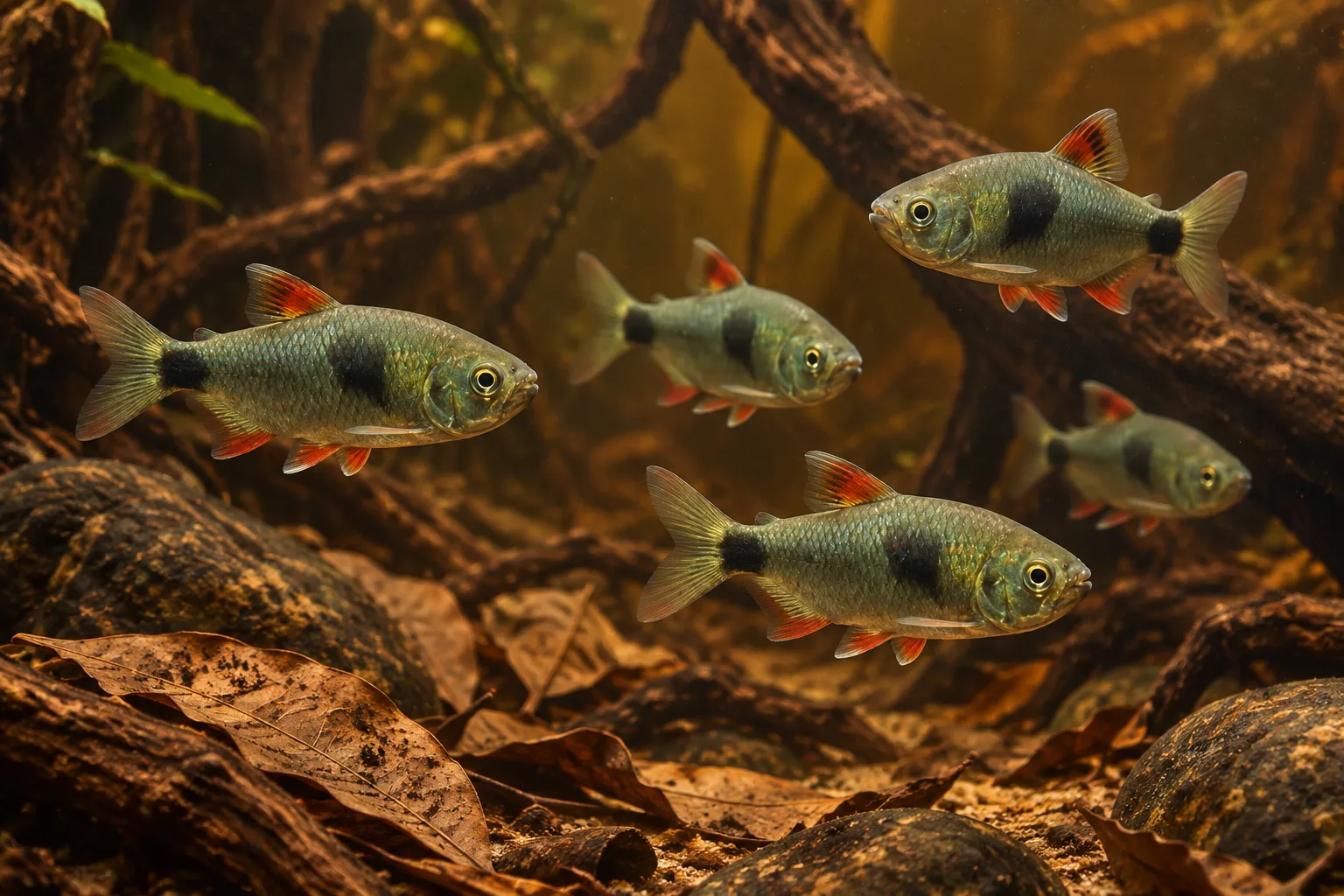
It eats the scales off other fish.
Müller and Troschel described the species in 1844 from the Essequibo River in Guyana, and Eschmeyer's Catalog of Fishes still treats that name as current, placing it in Characidae, subfamily Exodontinae. Epicyrtus exodon, named from the Amazon six years later, is a synonym rather than a second fish.
- Accepted identity
- Exodon paradoxus Müller & Troschel, 1844
- Family
- Characidae, subfamily Exodontinae
- Type locality
- Essequibo River, Guyana
- Native range
- Amazon and Tocantins basins, and Guyana
- Recorded maximum
- 7.5 cm standard length
- Diet in the wild
- Scales of other fish, 88 percent of stomach contents
- Group reference
- Large, and larger than most shoaling fish
- Swimming zone
- Open water, across the whole tank
- IUCN assessment
- Least Concern, assessed 4 March 2021
Everything difficult about this fish follows from that one line about its diet.
A shop will sell it as a tetra, and it is a tetra. The word simply carries none of the meaning a buyer brings to it.
What does a scale-eater actually do?
Scale-eating has a name in the literature, lepidophagy, and Exodon paradoxus is one of its better studied practitioners. A 2011 paper in PLoS ONE filmed the behaviour in aquaria and reported that scales fill 88 percent of the stomach contents of wild-caught fish.
The attack has a shape, and it is worth knowing because it explains the damage.

The fish in that study averaged 52 mm standard length. Their prey, goldfish used because the scale size suited, averaged 63 mm.
The predator was smaller than the animal it was feeding on.
That is the ordinary condition for this species rather than an experimental artefact, and it is why size offers a tank mate no protection at all.
Attack frequency was recorded over one-hour observations and ranged from 5 to 96 strikes an hour, averaging about 34. A tank mate does not experience this as an occasional nip.
There is one more finding worth carrying, because it sounds like trivia and is not. Individuals are either right-jawed or left-jawed, with a matching preference for which flank they attack, so a group contains specialists working both sides of the same victim.
Why does the group have to be large?
The usual reason for keeping a shoaling fish in numbers is that the animals are calmer in company. Here the reason is arithmetic.
Aggression inside the group does not stop when the group is small. It concentrates.
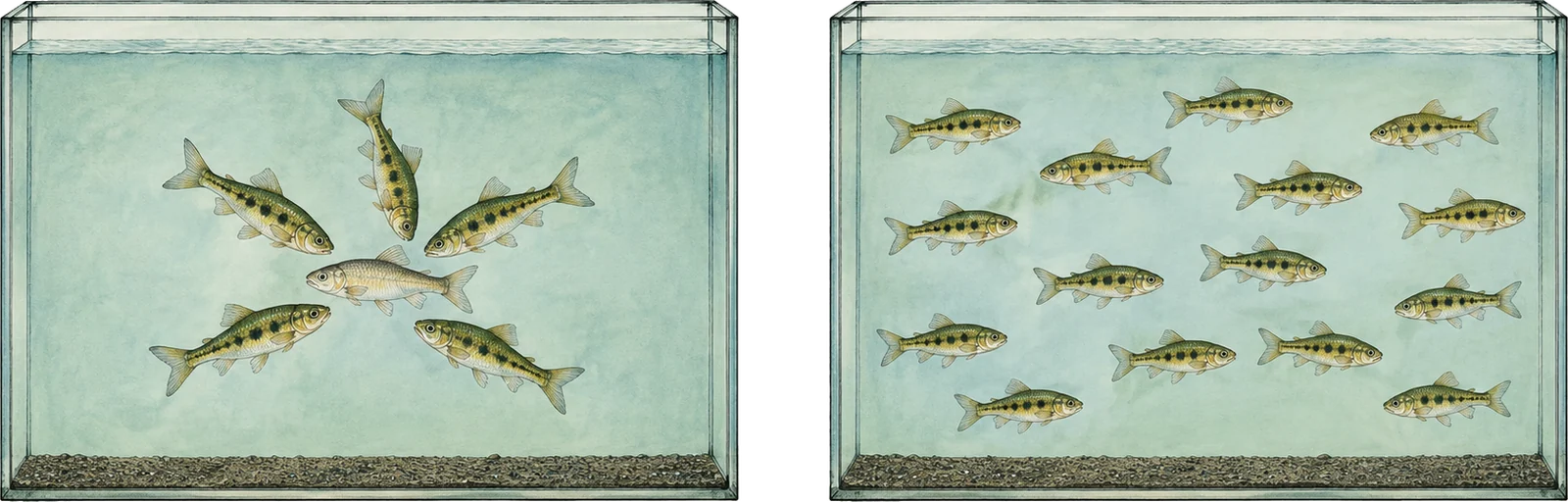
Keepers who run this species successfully run it in large numbers, and the figures quoted in the hobby start around a dozen and rise from there.
A trio or a pair is the arrangement that reliably ends with one fish left.
Numbers alone do not finish the job. A group that has run out of food, or that has been moved into a bare tank with nowhere to break up sightlines, will find a target regardless of how many fish are present.
How do you add fish to a group that already exists?
Adding to an established group is the moment most bucktooth tanks go wrong, and it goes wrong in both directions.
A single new fish dropped into a settled group arrives as the obvious target, with no established position and usually less size and condition than the residents.
Add several at once instead of one, so the attention has somewhere to go other than a single newcomer.
Rearranging the wood and planting before they go in is the other half of it. A settled group with disrupted territory spends its first hours re-establishing rather than concentrating on the arrivals.
Feed the tank heavily on the day, keep the lights low, and watch the group properly for the first few hours rather than checking back the next morning.
What does a tank for a shoal of scale-eaters need?
Start from the adult length. 7.5 cm standard length, recorded in the South American freshwater fish checklist that FishBase draws on, is a substantial fish once a dozen or more of them are swimming at once.
Then multiply by the group the species actually needs.
- Length before volume: an active open-water shoal of this size spends the front glass, not the depth.
- Broken sightlines: wood and planting at the margins, so a pursued fish can leave the line of sight rather than only outswim it.
- A clear central run, because a group with nowhere to go turns inward.
- A secure lid; startled fish of this build leave the water.
- Mature filtration sized for a heavy, protein-fed group rather than for the nominal volume.
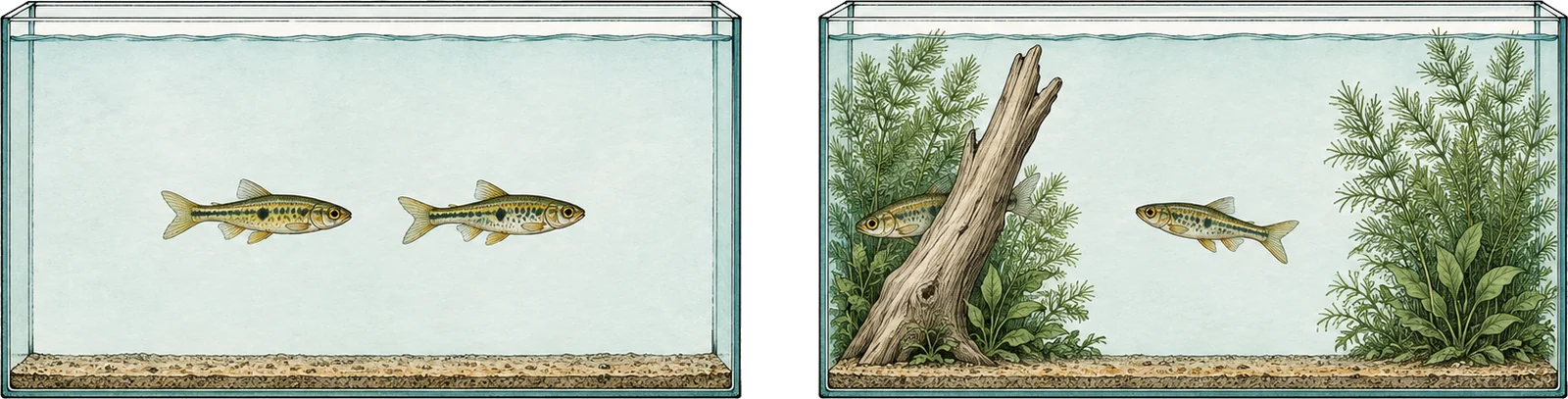
The middle stays open on purpose. Filling the whole tank would remove the swimming route this species spends its day in, and a group with nowhere to go turns inward.
Which fish can share the tank?
The honest answer is almost nothing, and the reason is not temperament.
Any fish with scales is food.
A fish without scales removes the obvious problem and leaves the general one. A characin striking 34 times an hour is a poor neighbour for anything slow, long-finned or resting on the bottom.
- Scales are the food source, so scale size and body surface are what a tank mate is being judged on.
- Body size offers no protection; the studied fish fed on prey a fifth longer than themselves.
- Long or trailing fins are the easiest target on any animal in the tank.
- Slow fish and bottom-resting fish cannot leave a strike, which is the only defence that works.
- Nothing above is solved by feeding more, though feeding less makes all of it worse.
The tetras documented elsewhere on this site are worth naming as examples of what fails rather than as candidates. A black skirt tetra or a bleeding heart tetra is deep-bodied with broad, exposed fins, which is a larger target surface rather than a defence.
A Betta fish is the clearest case against. Long unsupported finnage in front of a specialist that feeds by rasping at flanks and fins is not a compatibility question; it is a feeding opportunity.
Fast open-water fish of similar size fare no better. A bloodfin tetra or a brilliant rasbora can match the speed for a while and still loses scales in the meantime, because outrunning an attack is not the same as avoiding it.
A single-species tank is the arrangement this fish is actually suited to, and treating that as the default rather than as a fallback is what separates a working bucktooth tank from a failing community one.
How should a bucktooth shoal be fed?
Feeding does not switch the behaviour off, but underfeeding reliably turns it up.
Give a varied carnivore diet in genuinely generous amounts, and feed it more often than a community tetra tank.
A hungry group looks for the food it is built to find, and the nearest source of that food is each other.
- Split the ration Two or three smaller feeds beat one large one, because the gap between meals is when a group turns on itself.
- Lead with substance Frozen or live invertebrate foods are the body of the diet here, not a weekly treat.
- Spread the delivery Release at several points so the quickest fish are not standing over the only source.
- Watch the quarter hour after The minutes following a meal are when a fish that missed out starts working on its neighbours.
Watch the group during and after feeding, not only while the food is going in. The minutes after a meal are when a fish that missed out starts working on its neighbours.
What does damage look like, and what should you do?
Scale loss is the first sign.
On a silver-flanked fish it reads as dull or matte patches where the surface no longer catches the light.
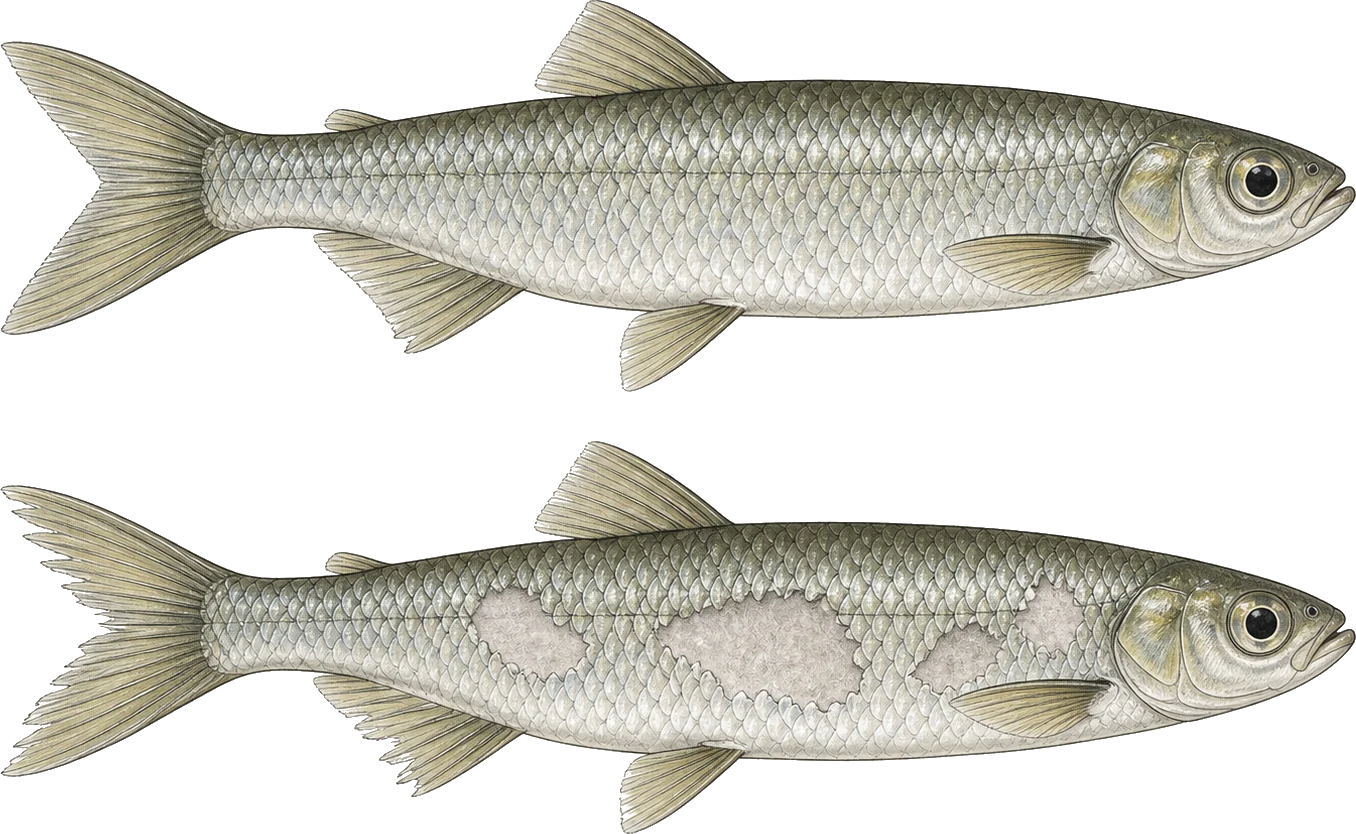
A fish holding away from the group and losing condition quickly is the next stage. Open lesions where scales have gone are wounds and entry points for infection, not cosmetic damage.
The response is a husbandry response before it is anything else. Check group size, feeding volume and frequency, available cover, and whether one animal has become the group's focus, and correct whichever of those is wrong.
A fish that is being targeted needs to be out of that tank rather than watched for improvement. Move it to a mature, heated, filtered aquarium of its own, and do not return it while the conditions that produced the damage are unchanged.
Appearance does not diagnose an infection and a photograph diagnoses nothing. Contact an aquatic veterinarian or an experienced fish-health professional when wounds are extensive, when they do not close, or when several fish decline at once.
Where does the species live, and what water does the record support?
Catalog of Fishes gives the distribution as Brazil, Colombia and Guyana. FishBase describes it from the Amazon and Tocantins basins and separately from Guyana, which is the same picture at a different resolution.
Recorded freshwater context
- Temperature23 to 28 °CSeparate aquarium thermometer.
- pH5.5 to 7.5Calibrated pH meter or an aquarium test covering the range.
- General hardness0 to 20 dGHGH titration test in degrees of general hardness.
Every range above applies to Exodon paradoxus in a freshwater system. Source: FishBase species summary, checked 2026-09-12.
That range is compiled from the Aquarien Atlas, a German aquarium reference of 1991, rather than from field measurements. It describes water the species has been kept in successfully and is wide enough to cover most treated tap water once it is stable.
Which is the useful conclusion here: water chemistry is not the hard part of keeping this fish. Almost everything difficult about it is behavioural, and no parameter adjustment addresses any of it.
Can bucktooth tetras be bred at home?
Spawning in aquaria is reported by keepers rather than documented in available authoritative sources, and the accounts describe a conventional egg-scattering characin rather than anything exotic.
The difficulty is the same difficulty as everything else about the species.
Conditioned adults in a group that is working are adults with a strong feeding drive and a taste for the surfaces of other fish, and eggs and fry in that tank have no protection at all. Anyone pursuing this seriously is separating spawners and removing them afterwards.
No controlled breeding study for Exodon paradoxus turned up in the sources used here, so anything more specific would be invention.
What do conservation and trade records show?
The IUCN Red List carries Exodon paradoxus as Least Concern, assessed on 4 March 2021. FishBase records the CITES state as Not Evaluated, checked on 12 September 2026.
The species appears in commercial fisheries as well as the aquarium trade, which is unusual for a fish this size and worth knowing when a shipment is described as tank-bred.
Ask where stock came from. Wild-caught fish arriving with scale damage from transport are not automatically damaged by their tank mates, and knowing which you are looking at changes what you do about it.
Never release aquarium fish, plants, water or live food outdoors. A specialised predator with no local equivalent is exactly the kind of animal that should not be finding out whether it can survive a new watershed.
Should you buy a shoal of scale-eaters?
This is a species for a keeper who wants this species, in a tank set up for nothing else, with the group size and the food budget planned before the fish are ordered.
It is a genuinely fascinating animal. Watching a group work is watching a feeding strategy almost no other aquarium fish uses, and the literature on it is more interesting than most.
- The tank is for this species alone, and that was the plan from the start rather than the result of losing tank mates.
- The group is large enough to spread aggression, not the three the shop had left.
- The aquarium is long, with broken sightlines at the margins and a clear run through the middle.
- The feeding routine is generous, varied and frequent, and the budget for it is real.
- A heated, filtered, mature tank is available to move an injured fish into at short notice.
Wait when any of those is missing. The fish will not adapt to a plan built for a different animal, and the ones that pay for the gap are the ones sharing the tank with it.
Which fish expose the biggest stocking differences?
Colombian tetra
A robust medium tetra whose feeding pace and fin-nipping risk change an otherwise similar community plan.
Congo tetra
A larger African shoaler with long male fins and a metre-plus swimming-space question.
Emperor tetra
A medium tetra whose males hold display positions, adding territory and sight lines to the group decision.
Denison barb
A large high-flow cyprinid that pushes oxygen, current and uninterrupted tank length much further.
Ember tetra
A tiny warm-water tetra whose low competitive weight and small mouth change feeding and tankmate choices.