
About this guide
How KnownAquarium Researches and Verifies Every Guide
Reliable aquarium advice depends on matching each claim to the right evidence, preserving its context, and stopping where the evidence can no longer support a safe conclusion.
Which sources carry the most weight?
Authority depends on the claim. A taxonomic catalogue can establish an accepted scientific name, while a manufacturer's manual is suitable for the operating limits of that manufacturer's own equipment.
- Accepted taxonomy, conservation, and trade authorities for identity and legal status.
- Aquatic-veterinary and peer-reviewed sources for health, physiology, and biological risk.
- Official environmental and fisheries bodies for distribution, regulation, and recorded conditions.
- Recognised institutional husbandry references for practical captive care.
- Manufacturer instructions for that company's own product and installation limits.
Community discussions can surface an overlooked question or common failure. They do not establish a scientific or safety claim by themselves.
What makes an aquarium number meaningful?
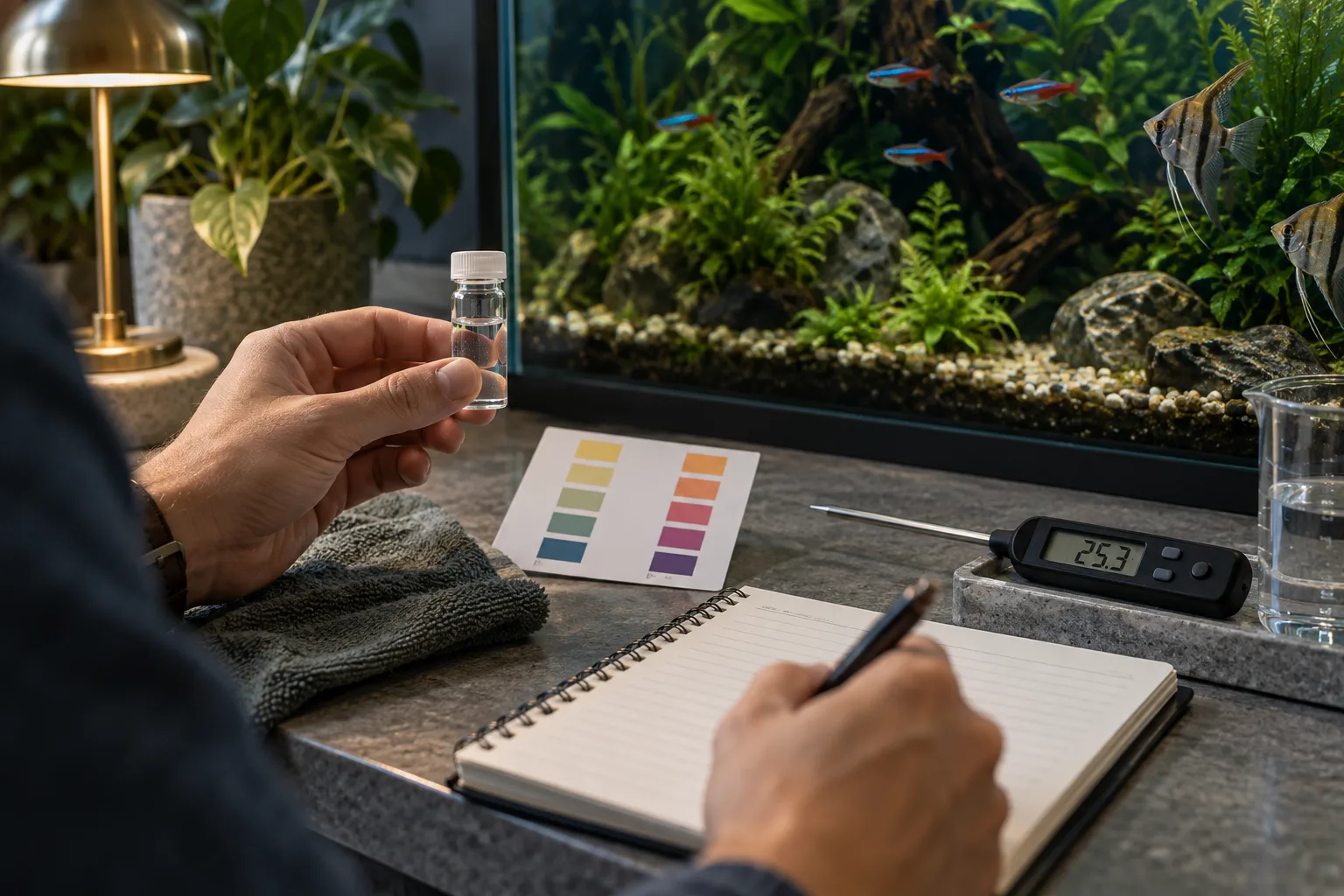
A temperature, pH, hardness, salinity, or nutrient value has little meaning without its unit, subject, system, measurement method, and source. A field record, a captive breeding condition, and a long-term housing recommendation may all be valid while answering different questions.
| Context | Question to ask | Why it matters |
|---|---|---|
| Species and life stage | Which animal and stage does the value describe? | Eggs, juveniles, adults, and related species may have different limits. |
| System | Was it measured in the wild, captivity, aquaculture, or a breeding tank? | A recorded condition is not automatically a housing target. |
| Method | How was the value measured and in which unit? | Different methods and scales can make similar-looking numbers incomparable. |
| Time | Was it a stable condition, a short exposure, or a seasonal observation? | Duration and rate of change affect animal stress. |
| Uncertainty | Does the source state limits or leave the value unresolved? | A precise recommendation should not be built from uncertain evidence. |
Why is compatibility always conditional?
Compatibility is conditional rather than a permanent yes or no. The same pairing can change with adult size, group structure, sex ratio, territory, aquarium footprint, food competition, water overlap, and the order of introduction.
Why do footprint and group size matter?
Volume alone cannot describe swimming length, turning room, surface area, or territory. A tall cube and a long rectangular aquarium can hold the same litres while offering very different space to an active school.
- Start with verified adult size and normal movement.
- Include the full social group rather than one specimen.
- Measure the usable footprint after hardscape and plants are in place.
- Account for oxygen demand, filtration, waste, and feeding competition.
- Leave room for fish to turn, pass, rest, and escape pressure.
When trade identity or mature size remains uncertain, a more conservative footprint reduces the chance of an urgent later upgrade. The tank setup section covers the wider relationship between layout, equipment, and livestock.
Why can one symptom have several causes?
Several animals showing the same sign at once often points first to a shared problem such as oxygen loss, temperature error, toxic nitrogen, contamination, or equipment failure. An individual fish may instead be injured, excluded, or ill, but those possibilities still need evidence.
| Observation | Immediate boundary |
|---|---|
| Several fish gasp or lose balance | Check temperature, oxygen, ammonia, nitrite, recent changes, and equipment immediately. |
| One fish hides or misses food | Check injury, social exclusion, body condition, and access to a safe observation space. |
| Sores, major swelling, bleeding, or rapid decline | Seek prompt aquatic-veterinary help. |
| A photograph appears to match a disease | Do not treat the resemblance as a diagnosis or dosing instruction. |
Medication choices depend on the confirmed condition, species, actual water volume, other livestock, formulation, and professional oversight. KnownAquarium does not calculate or prescribe doses.
Why do names and trade status need separate evidence?
Common names can cover several species, while an old scientific name may remain common in shops long after a revision. Accepted names, synonyms, distribution, conservation status, and trade restrictions therefore need separate verification.
A missing CITES listing does not prove that wild collection is sustainable or legal in every jurisdiction. Current local rules and traceable captive breeding still matter.
What happens when sources conflict?
The first check is whether the sources describe the same species, population, life stage, environment, and method. Differences that come from distinct contexts remain separate rather than being forced into one range.
When the conflict is genuine, the stronger authority receives greater weight and the remaining uncertainty stays visible. A precise answer is withheld when available evidence cannot support it safely.
When does aquarium evidence need rechecking?
Taxonomy, trade rules, product instructions, and safety information can change. Evidence is rechecked according to how quickly it can become outdated and how much harm an old claim could cause.
Older guidance should yield to stronger current evidence, especially when animal welfare, legal status, or a safety decision may change. Factual concerns can be sent through the contact details.
More about KnownAquarium
Our scope, evidence standards, safety boundaries, privacy practices, and legal terms.
- About this guide About KnownAquarium and the Standards Behind Our Guides KnownAquarium connects animal welfare, stable water, usable space, and responsible aquarium care.
- About this guide KnownAquarium Editorial Policy for Accurate Fish Care The evidence, welfare, safety, independence, and correction standards followed by KnownAquarium.
- About this guide Contact KnownAquarium About Corrections and Reviews Email KnownAquarium about a correction, accessibility problem, permission request, or qualified review.
- Legal KnownAquarium Privacy Policy and Data Practices What this site collects, what it does not, and what happens to it.
- Legal KnownAquarium Terms of Use for Readers and Visitors The terms under which this site is offered.
- Legal KnownAquarium Disclaimer for Aquarium Care Information What this site is, what it is not, and why it is never a substitute for an aquatic veterinarian.