
What Is a Bleeding Heart Tetra, and How Big Does It Get?
Megalamphodus erythrostigma
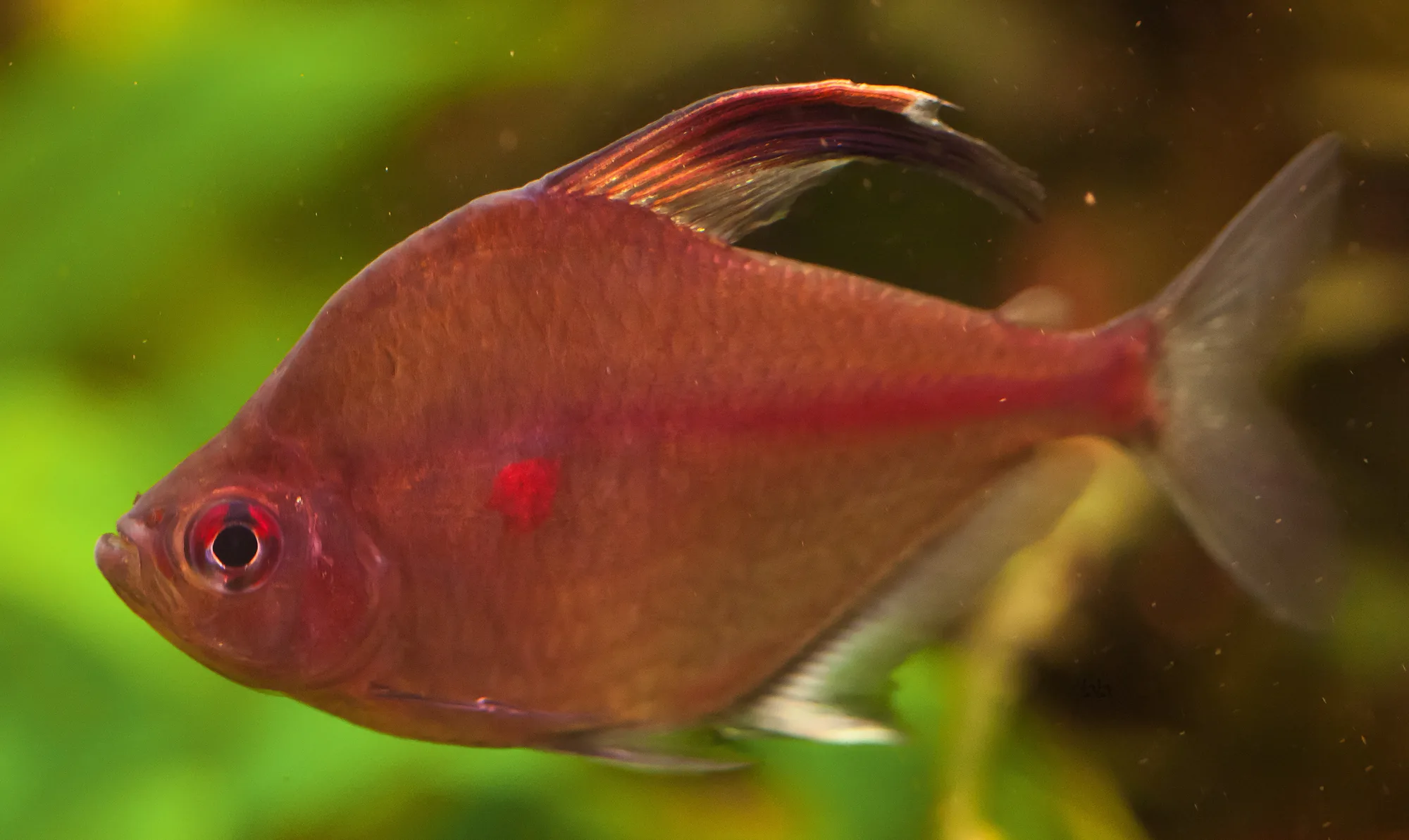
A bleeding heart tetra is a medium-sized upper Amazon tetra recognized by a red humeral mark behind the gill cover. Its current scientific name is Megalamphodus erythrostigma, and its aquarium fit depends on an 80 cm or longer swimming footprint, a proper same-species group, stable warm water and fair access to food.
At a glance

- Adult size
- 6.1 cm
- Minimum footprint
- At least 80 cm horizontal aquarium length with an open midwater route
- Social structure
- Plan at least six conspecifics; increase the group only when footprint, filtration, oxygen and feeding access support every fish.
- Minimum group
- 6
- Sex ratio
- No fixed routine sex ratio established.
- Diet
- Omnivore
- Feeding
- Use a complete small tropical-fish staple with suitable invertebrate variety; distribute small portions across multiple points so every group member feeds.
- Waste load
- moderate
- Lifespan
- 3 to 5 years
- Family
- Acestrorhamphidae
- Native range
- Upper Amazon River basin in Brazil, Ecuador, Colombia and Peru; the type locality is only recorded as probably the Peru-Brazil border area.
- Also sold as
- tetra perez. Trade and hobby names, not accepted species names.
- Former scientific names
- Hemigrammus erythrostigma, Hyphessobrycon erythrostigma, Hyphessobrycon rubrostigma. Superseded names for this same species.
- Conservation status
- Least Concern, assessed 4 March 2021 Source
The source benchmark is aquarium length; decor, filtration, total stocking and group behavior determine whether the usable footprint is sufficient.
What is a bleeding heart tetra?
The bleeding heart tetra is Megalamphodus erythrostigma, a laterally compressed South American tetra with a conspicuous red mark behind each gill cover. That mark explains the common name, but it does not by itself separate this fish from every related rosy tetra.
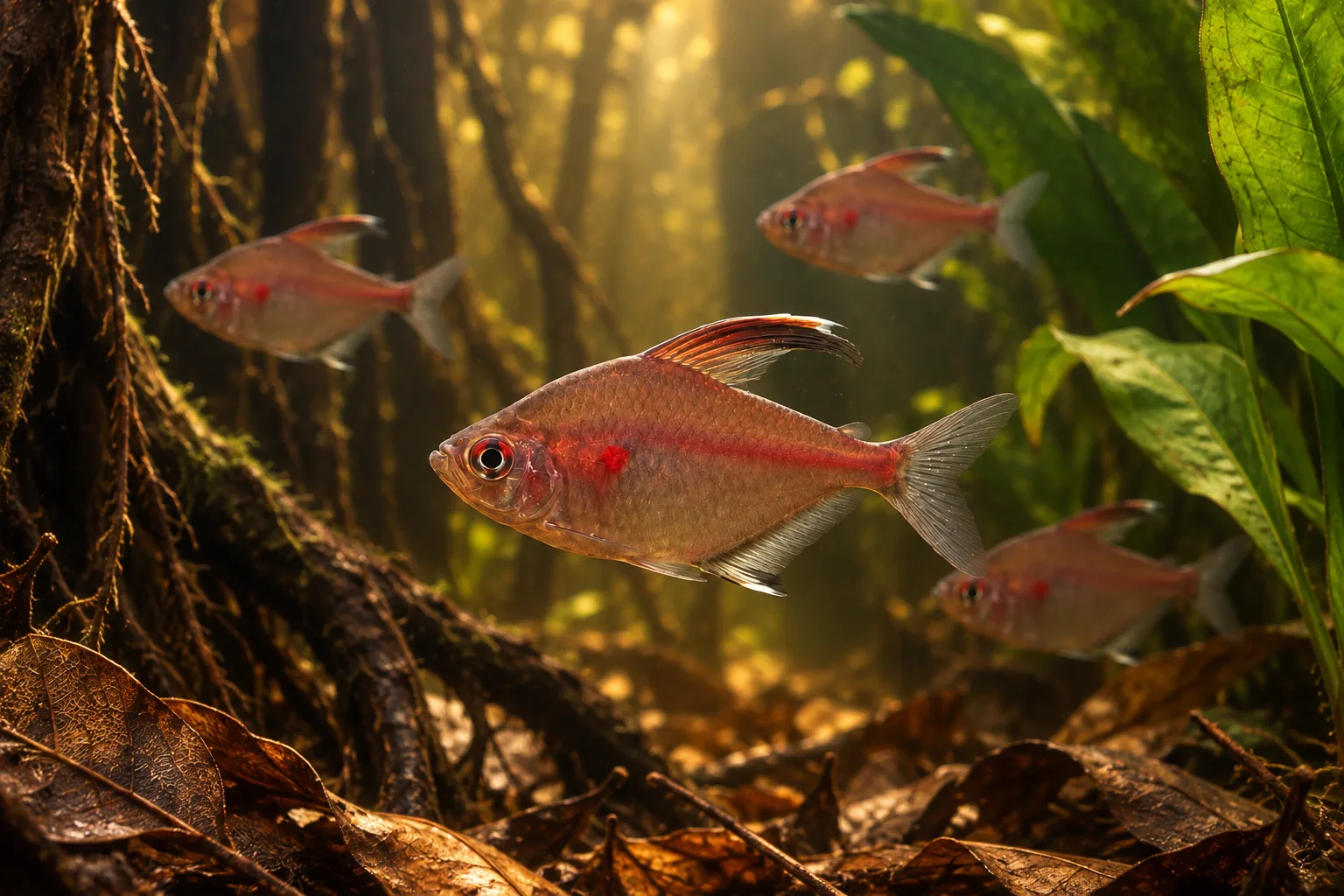
The bleeding heart tetra is currently accepted as Megalamphodus erythrostigma.
Many aquarium references and older scientific records use Hyphessobrycon erythrostigma, an earlier generic placement for the same species.
Melo and colleagues revalidated Megalamphodus in their 2024 phylogenomic classification and explicitly transferred this species. Catalog of Fishes records the valid combination as M. erythrostigma (Fowler, 1943), places it in Acestrorhamphidae, and traces the original description to Hemigrammus erythrostigma Fowler, 1943.
Catalog of Fishes also treats Hyphessobrycon rubrostigma as a synonym. Common trade names include bleeding-heart tetra and tetra perez, but a common name should be checked against the scientific identity before purchase.
Which features identify the species?
A genuine bleeding heart tetra has a deep, silvery to pinkish body and a round to vertically extended crimson humeral patch behind the gill cover. The dorsal fin carries dark pigment, and mature males commonly develop a taller, more extended dorsal fin and longer anal-fin rays than females.
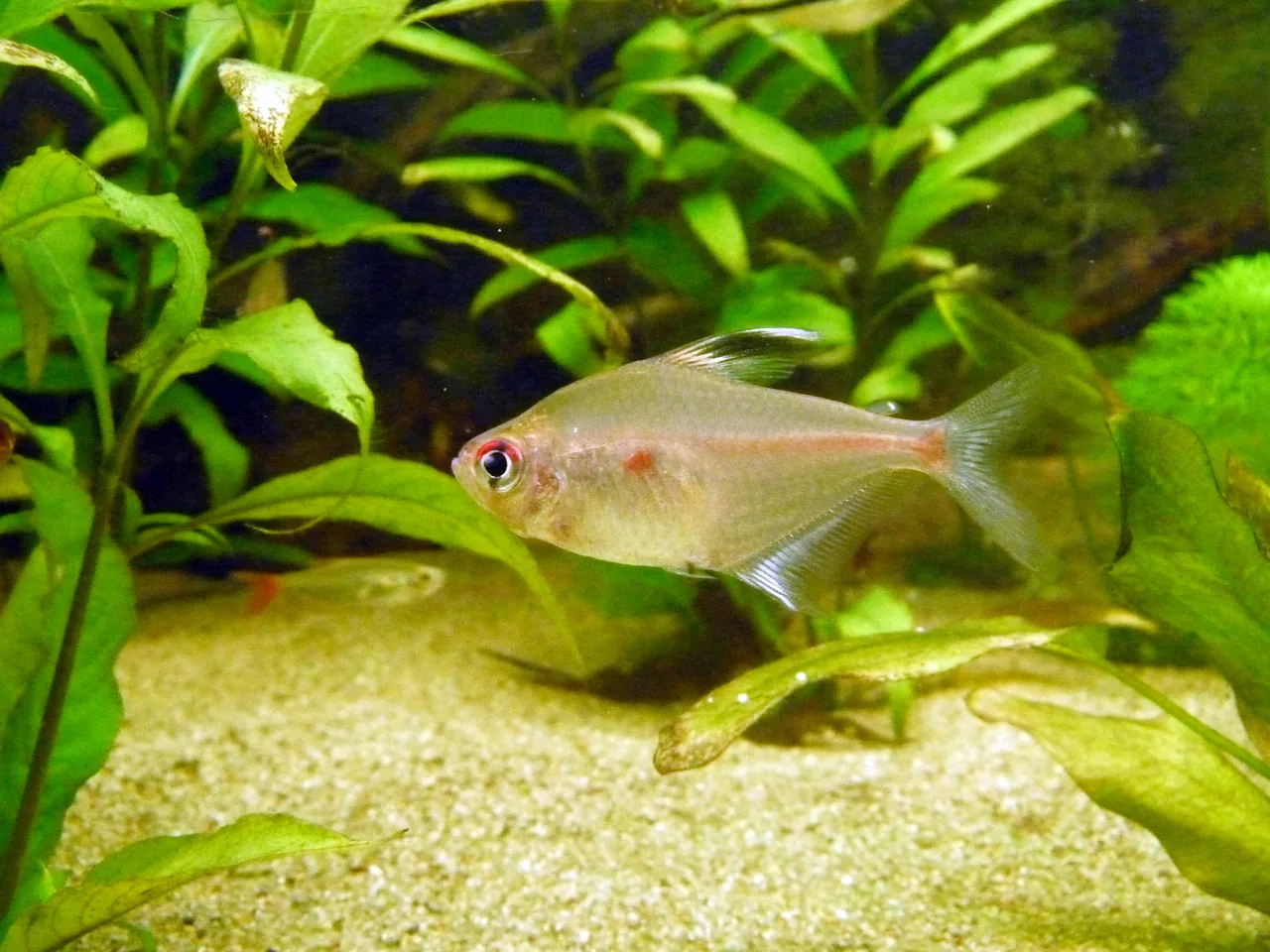
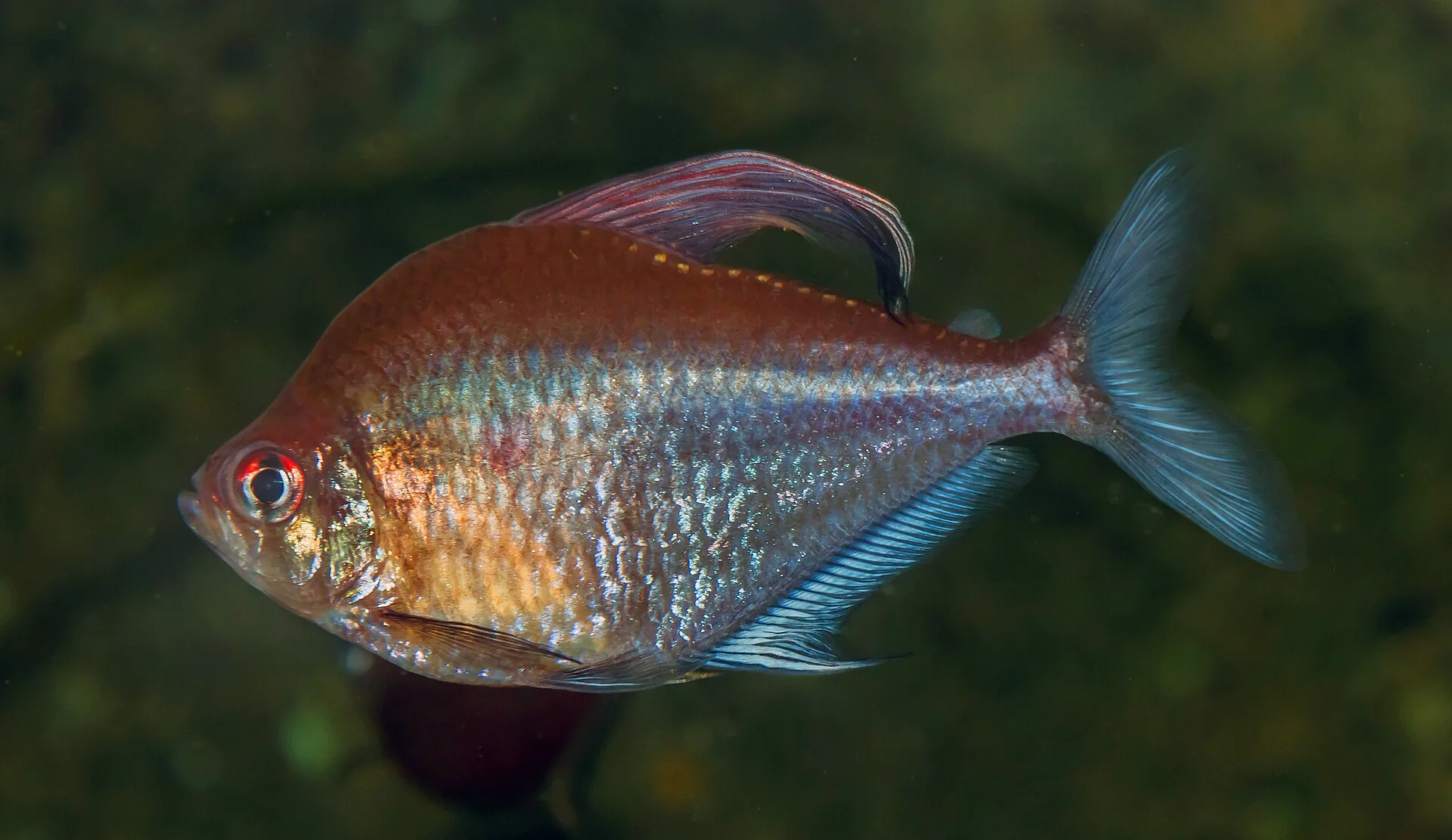
Age, sex, lighting, stress and body angle change how bright the red patch and pink body appear.
Juveniles may show shorter fins, while a mature female may look fuller through the abdomen; neither body depth nor fin length alone proves sex or reproductive condition.
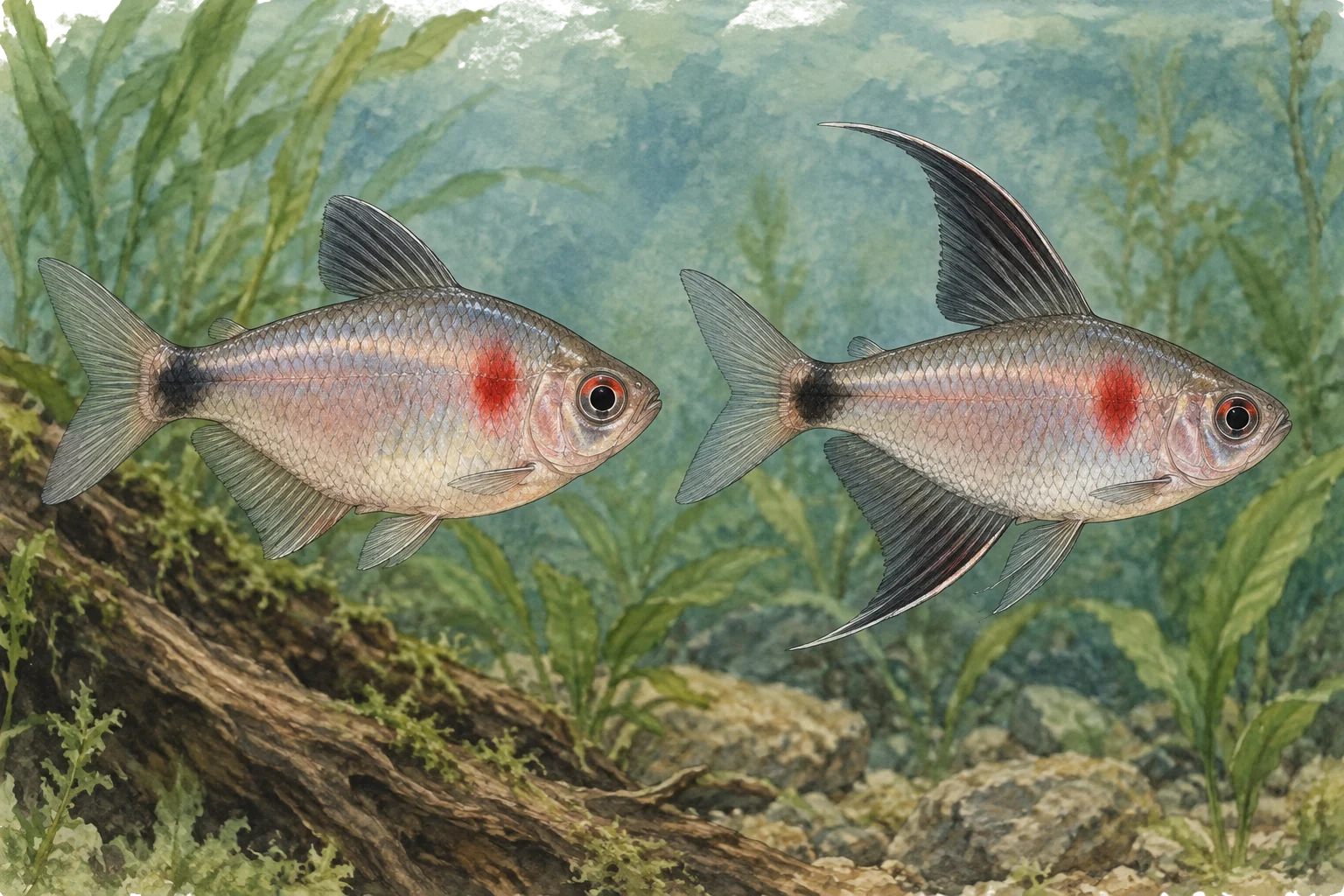
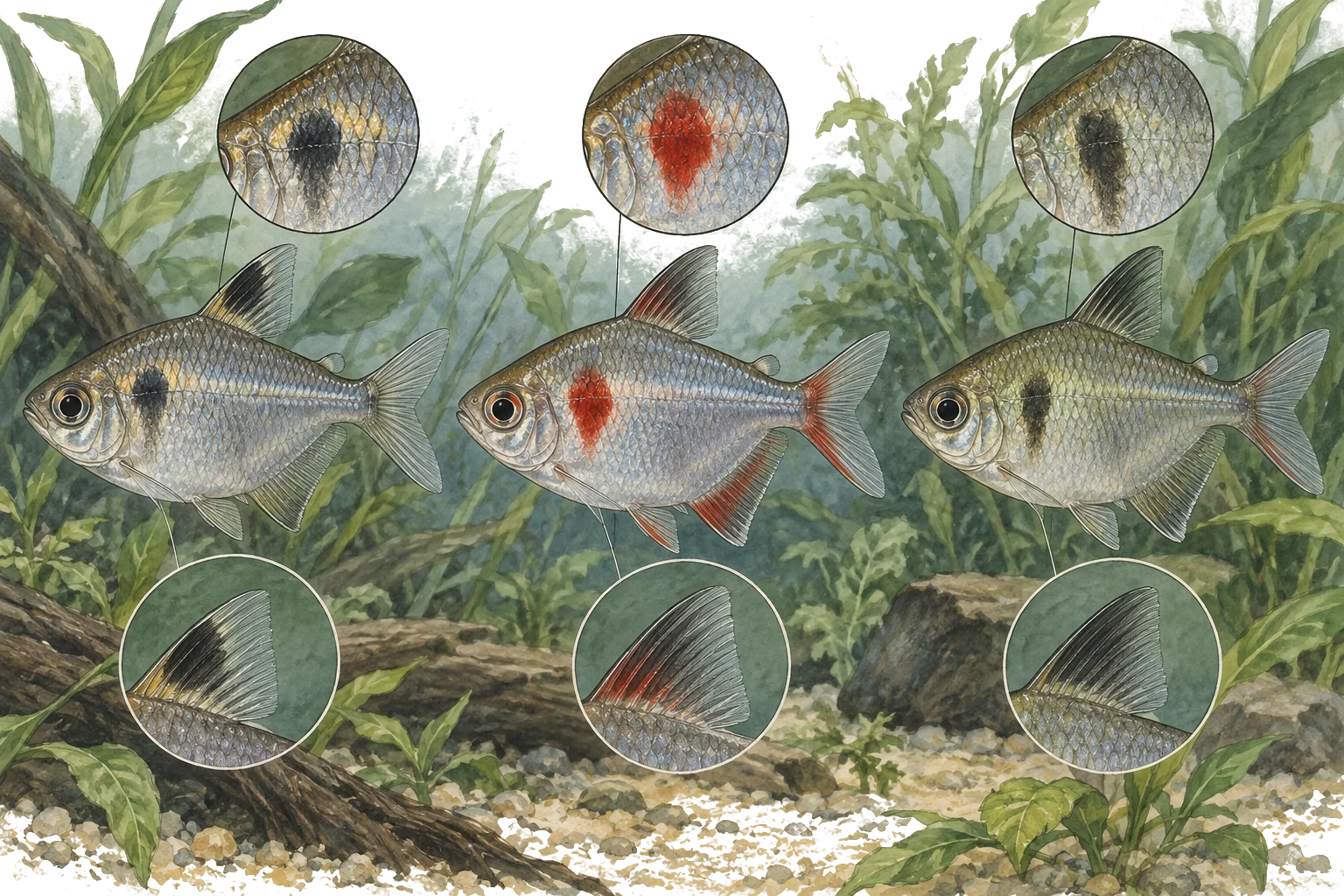
A black neon tetra is much slimmer and shows a pale horizontal line above a dark stripe. A black skirt tetra has a deeper profile and long anal fin, but its prominent markings are dark vertical bars rather than one red shoulder patch.
Other bleeding-heart relatives, including Megalamphodus socolofi and Hyphessobrycon pyrrhonotus, can share a red humeral mark. Species-level separation may require fin markings, meristic characters, locality and an expert examination, so one photograph cannot prove identity, sex, health or origin.
Where does it come from?
Catalog of Fishes places M. erythrostigma in the upper Amazon basin of Brazil, Ecuador, Colombia and Peru. The original type locality was recorded only as probably near the Peru-Brazil border, so it should not be rewritten as one precise river or collecting site.
FishBase describes a freshwater, benthopelagic species from the upper Amazon basin. The broad basin statement is secure, while local habitat claims often repeated in aquarium care summaries are less precisely tied to specimens and should not be treated as a single habitat used everywhere.
You can use this origin as design context without chasing a blackwater number. Give the group open midwater, subdued refuge near plants or wood, and enough depth around cover to turn and disperse.

How large does a bleeding heart tetra grow?
FishBase reports a maximum of 6.1 cm standard length. Standard length ends at the base of the tail fin, so it must remain labeled SL and should not be silently converted into total length.
- Accepted identity
- Megalamphodus erythrostigma (Fowler, 1943)
- Former combination
- Hyphessobrycon erythrostigma
- Family
- Acestrorhamphidae
- Maximum reported size
- 6.1 cm standard length
- Group reference
- Five or more in FishBase; plan at least six for routine aquarium keeping
- Footprint reference
- Aquarium at least 80 cm long
- Recorded zone
- Benthopelagic freshwater fish; commonly uses open middle levels in aquaria
- Global assessment
- Least Concern, assessed 4 March 2021
This size can look modest on a shop label, yet a group needs much more room than one 6.1 cm body occupies.
Your plan has to accommodate the fish turning, feeding and moving together, rather than merely fitting one adult into a volume.
What group and tank footprint does it need?
FishBase cites aquarium keeping in groups of five or more and an aquarium length of at least 80 cm. For a routine home plan, keep at least six conspecifics and treat 80 cm of clear horizontal length as a starting footprint rather than a guarantee of enough capacity.
The tank must still support the full group after plants, wood, equipment and other residents take space.
A taller aquarium cannot replace a continuous swimming route, and adding fish to a crowded tank does not repair insecure behavior.
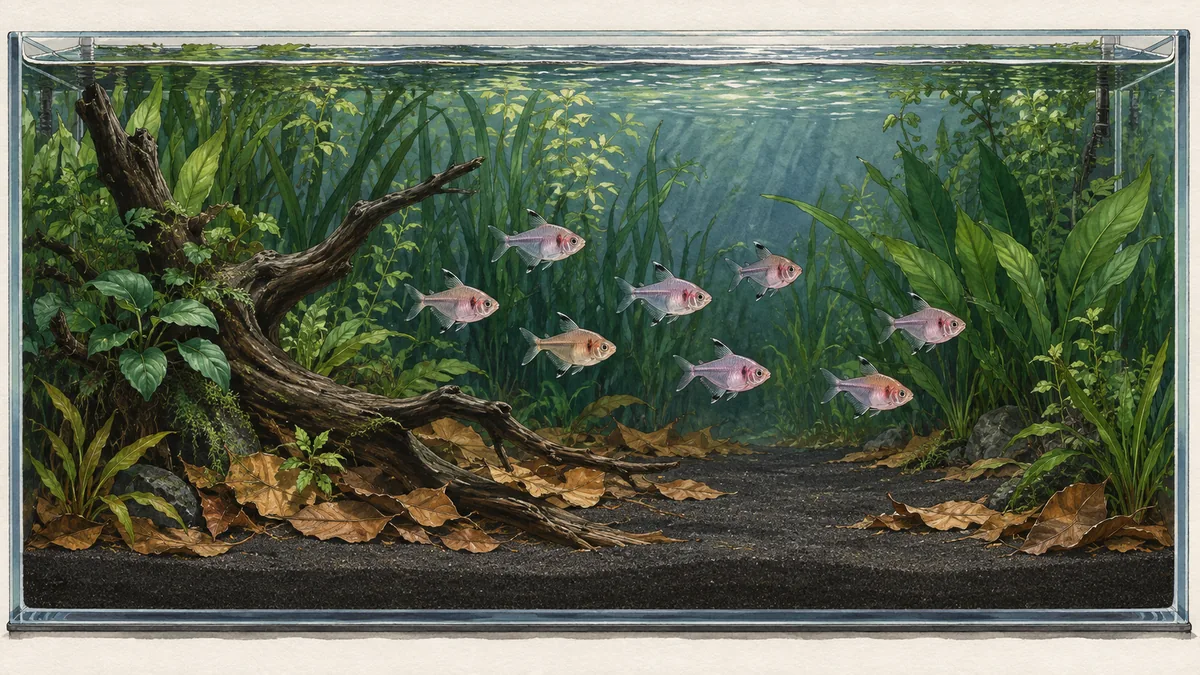
Bleeding heart tetras may spread out when relaxed and draw together when disturbed. Brief display or chasing can occur within the group, but repeated pursuit, torn fins, a fish held behind equipment or one animal excluded from food means the social result is failing.
Your aquarium needs a mature filter sized for the whole community, gentle to moderate circulation, and a secure lid around cables and pipework. Leave shaded cover at the margins without closing the central route, and verify that flow does not force the whole shoal into one quiet corner.
Which water conditions are supported?
FishBase compiles 23 to 28 °C, pH 5.6 to 7.2, and hardness up to 12 dGH for M. erythrostigma. These are broad aquarium reference boundaries, not one target and not proof that every wild locality shares the same chemistry.
Recorded freshwater aquarium context
- Temperature23 to 28 CSeparate aquarium thermometer; FishBase compiled range.
- pH5.6 to 7.2Calibrated pH meter or aquarium test covering the expected range; FishBase compiled range.
- General hardnessUp to 12 dGHGH titration test; FishBase compiled upper boundary.
Every range above applies to Bleeding heart tetra husbandry in a freshwater aquarium system. Source: FishBase species summary, checked 2026-09-12.
You should choose a stable point inside the overlap shared by every resident. Check temperature with a separate thermometer, keep the same pH method from test to test, and measure GH with a titration kit instead of guessing hardness from pH.
Ammonia and nitrite are not preferences for this species. Confirm any detectable result and investigate cycling, filtration, feeding, dead material or recent stocking before exposing a new group.
Compare the seller's measured temperature and, where available, pH and hardness with the prepared tank. Avoid abrupt correction, stop a transfer or chemistry adjustment if fish lose balance or gasp, and seek experienced help when severe deterioration continues.
What and how should the group eat?
FishBase records worms, crustaceans and plant material in the diet. In an aquarium, use a nutritionally complete small tropical-fish staple, then add appropriately sized frozen or cultured invertebrate foods as variety rather than as the entire diet.
- Choose a complete staple with particles the fish can swallow without prolonged spitting.
- Release small portions at several points and depths so one fast cluster cannot intercept everything.
- Watch the edge of the group and confirm that the quieter fish actually swallow food.
- Stop when active feeding falls away, then remove persistent leftovers.
- Adjust the next portion from individual body condition and measured water trends.
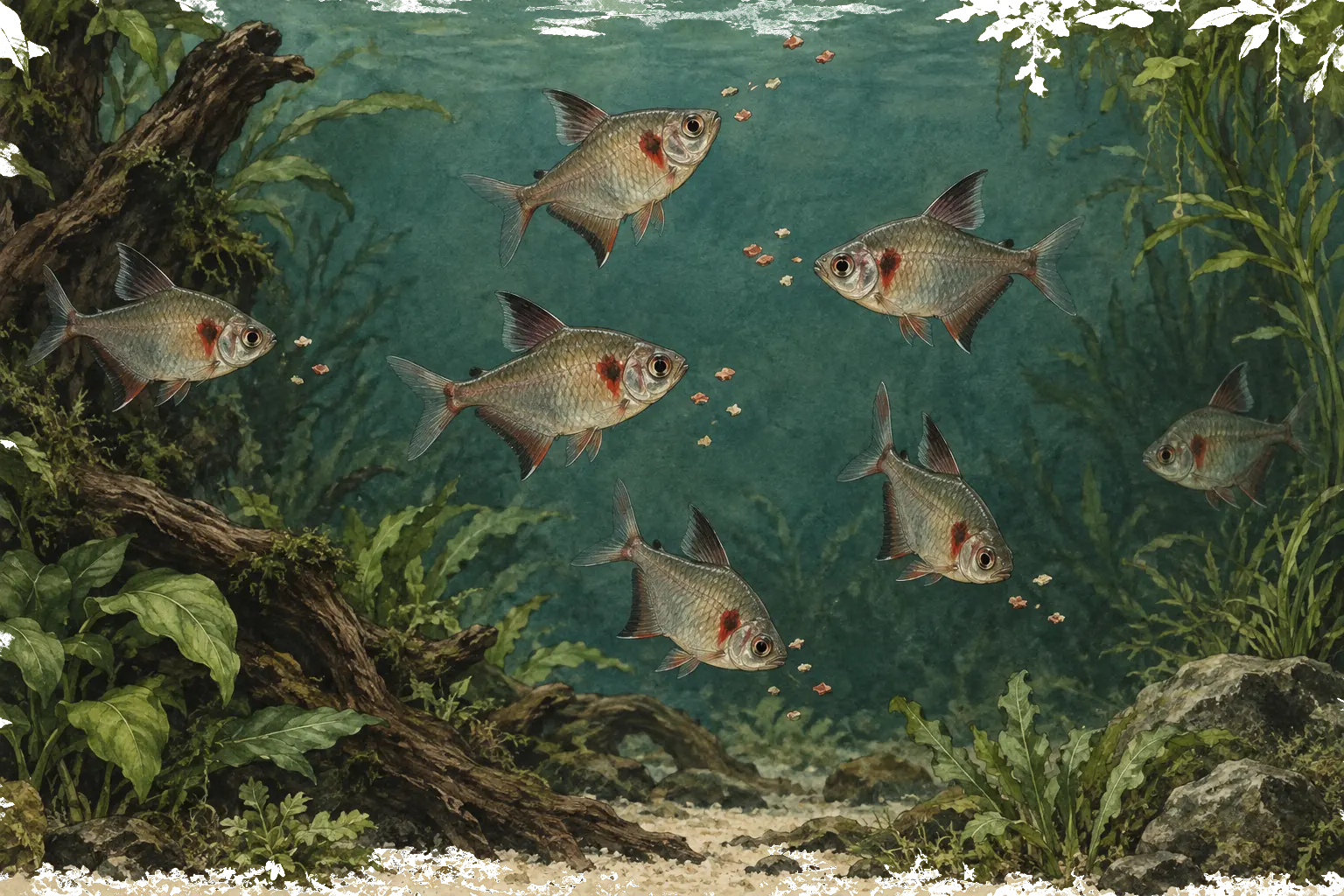
Live food from an uncertain source can carry contaminants or pathogens. Use reputable cultured food and dedicated tools, and do not increase feeding simply to make the red body color look stronger.
Can it share a community aquarium?
Bleeding heart tetras can suit a community when tank mates share the supported water range, cannot swallow them, do not monopolize food and leave enough open room for the complete tetra group. The behavior of the actual residents is stronger evidence than a peaceful label.
| Decision | Workable condition | Warning sign |
|---|---|---|
| Scale | No resident can swallow or seriously injure an adult tetra | Stalking, lunging or unexplained disappearance |
| Fins | Display and chasing stop without one fish being trapped | Fraying, cornering or repeated targeting |
| Food | Several feeding points reach every resident | One fish repeatedly misses food |
| Water | All species overlap without constant chemical adjustment | A resident stays at the edge of its supported range |
| Space | Open midwater and retreat cover remain after stocking | The group is compressed behind decor or equipment |
A long-finned Betta fish is a conditional rather than automatic match. Different flow preferences, exposed fins, feeding speed and individual aggression can make a tank fail even when temperature and pH overlap.
You should check behavior at feeding, after lights change and when fish settle.
Keep a heated separation option ready because compatibility can change as fins develop, social rank shifts or another resident matures.
What should make you postpone the purchase?
Postpone the purchase when the fish cannot be identified beyond a vague bleeding-heart label, the tank is shorter than the 80 cm reference, the filter is immature, or the plan depends on keeping one or two. Also wait when current water differs sharply from the seller's water or an existing resident already targets midwater fish.
- The seller confirms Megalamphodus erythrostigma or its former combination Hyphessobrycon erythrostigma.
- The red humeral mark and overall body form match, while lookalike uncertainty is acknowledged.
- The aquarium provides at least 80 cm of useful horizontal length for six or more.
- Open midwater remains after plants, wood, equipment and territories are placed.
- Temperature, pH and GH are measured and overlap without abrupt correction.
- Food can reach every member of the group.
- No resident can swallow, corner or repeatedly damage these tetras.
- A mature filter, closed lid and heated separation option are ready.
Animal Diversity Web reports about three years as typical in captivity and records up to five, while noting that wild lifespan information is unavailable.
Treat that as a secondary captive summary with uncertainty, not a guaranteed span for every fish.
FishBase reports a Least Concern IUCN assessment dated 4 March 2021. No direct species result appeared in the official CITES Checklist when checked on 12 September 2026, which is a dated search limitation rather than proof that no local trade or possession rule exists.
Rapid breathing, surface gasping, loss of balance, persistent isolation, clamped fins, sores, swelling or progressive fin damage require immediate water and equipment checks. Appearance alone does not diagnose a disease; involve an aquatic veterinarian or experienced fish-health professional when severe signs persist or several fish decline.
Never release aquarium fish, plants, water or live food into drains or natural waters. Rehome unwanted fish through a responsible keeper, retailer, rescue or local authority.
You can browse the freshwater fish directory when comparing species. Before bringing this fish home, record the shop water, inspect the entire group for controlled swimming and intact fins, and leave without buying when identity or condition remains unclear.
Which tetras make useful comparison points?
Diamond tetra
A medium deep-bodied characin that offers a closer comparison in warm water, adult mass and display behaviour.
Emperor tetra
A medium tetra whose males hold display positions, adding territory and sight lines to the group decision.
Congo tetra
A larger African shoaler with long male fins and a metre-plus swimming-space question.
Colombian tetra
A robust medium tetra whose feeding pace and fin-nipping risk change an otherwise similar community plan.
Ember tetra
A tiny warm-water tetra whose low competitive weight and small mouth change feeding and tankmate choices.
Cardinal tetra
A small blackwater shoaler whose soft-water context and quiet group behaviour narrow the comparison.