
What Is a Brilliant Rasbora, and How Big Does It Get?
Rasbora einthovenii
Published maximum lengths for Rasbora einthovenii run from 5 cm to 10.6 cm standard length, and the small-tank minimum printed on most care cards rests on the smaller one. Getting that single number right decides the tank length, the group size and most of what follows from them.
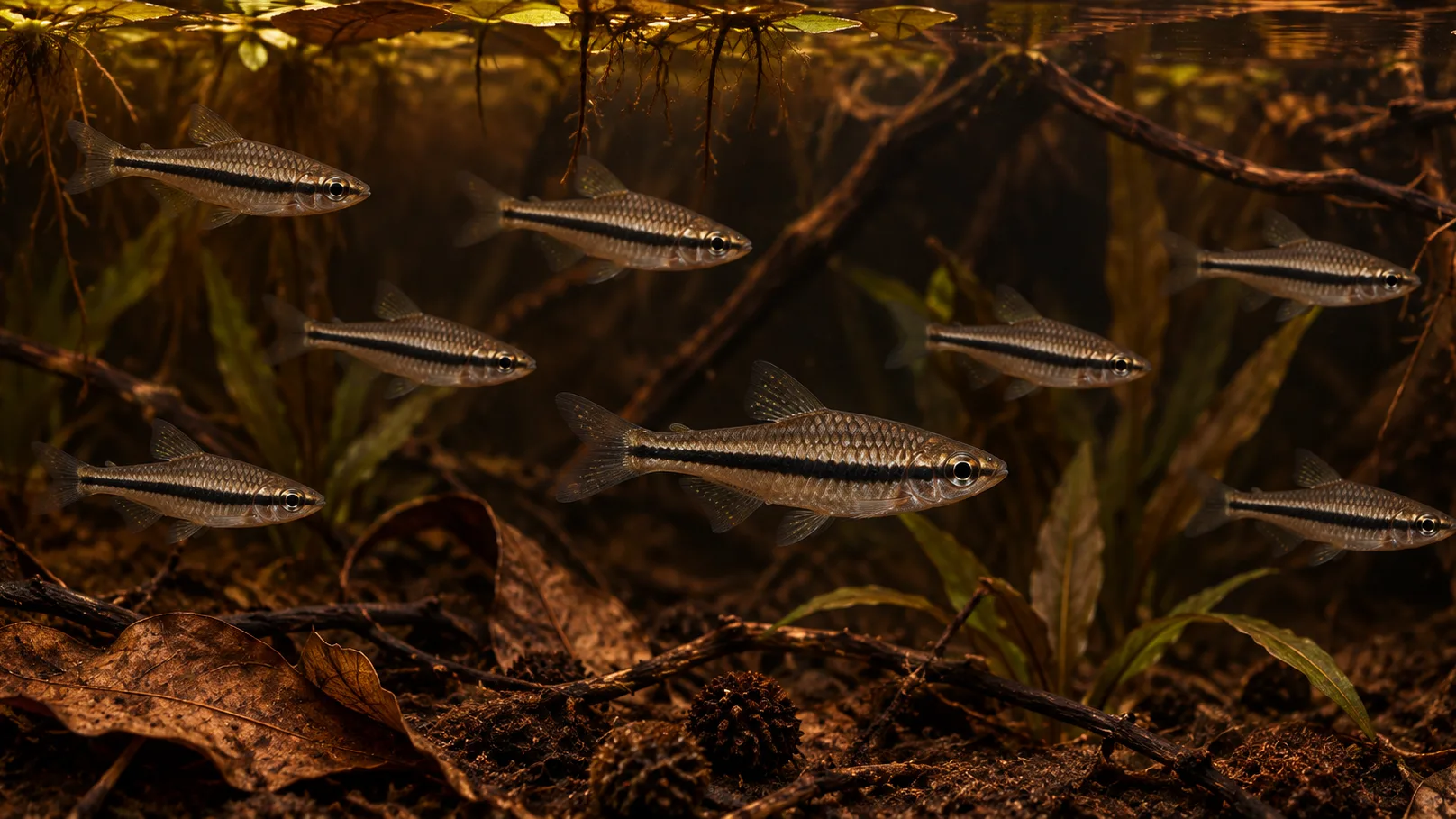
At a glance

- Adult size
- 10.6 cm
- Minimum footprint
- About 120 cm of aquarium length by 30 cm front to back, with the central run left open
- Social structure
- Keep six as a floor and more where the footprint allows; larger groups are reported as better coloured and more active than minimum ones.
- Minimum group
- 6
- Sex ratio
- No routine sex ratio is established; mature females are rounder-bellied and often only slightly larger.
- Diet
- Carnivore
- Feeding
- A complete dried staple sized for the mouth, with small frozen or cultured invertebrates as variety; release food at several points so the fastest fish do not take it all.
- Waste load
- low
- Family
- Danionidae
- Native range
- Malay Peninsula including southern Thailand, Sumatra, Bangka and Borneo
- Also sold as
- long-band rasbora. Trade and hobby names, not accepted species names.
- Former scientific names
- Leuciscus einthovenii, Rasbora labuana, Rasbora vegae. Superseded names for this same species.
- Conservation status
- Least Concern, assessment published 2020 Source
The published benchmark is a base footprint rather than a volume, because an open mid-water shoaler spends length; nominal litres say nothing about the clear route left after planting and hardscape.
What is a brilliant rasbora?
The brilliant rasbora is Rasbora einthovenii, a slim, striped shoaling fish from the Malay Peninsula, Sumatra and Borneo.
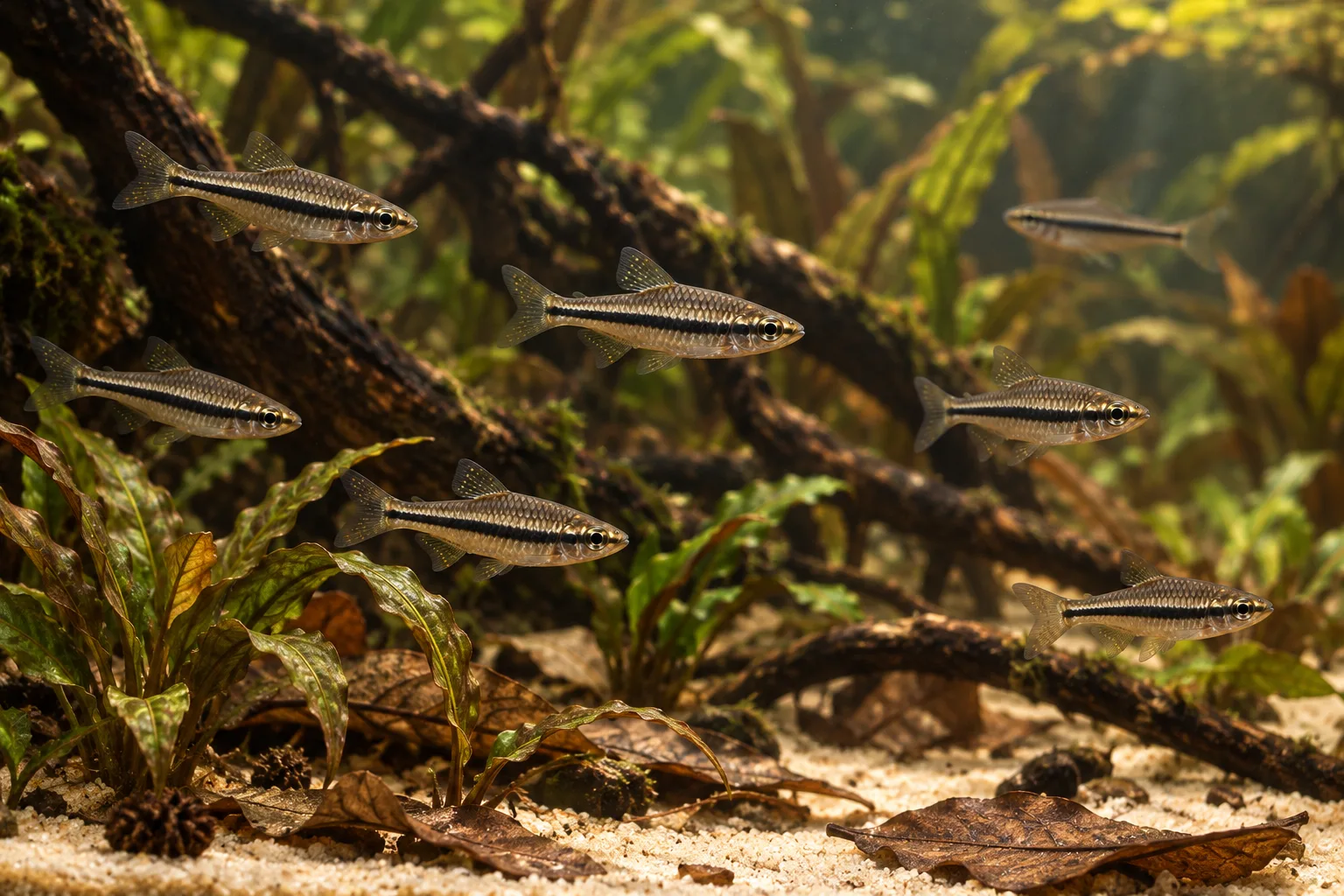
One measurement separates it from the small rasboras it sits beside on a stock list, and that measurement is its adult length.
Bleeker described the species in 1851 as Leuciscus einthovenii, from a specimen taken at Sambas in western Borneo. Eschmeyer's Catalog of Fishes still treats that as the accepted name, and it lists Rasbora vegae Rendahl 1926 and Rasbora labuana Whitley 1958 as synonyms rather than as separate aquarium fish.
- Accepted identity
- Rasbora einthovenii (Bleeker, 1851)
- Family
- Danionidae, subfamily Rasborinae
- Type locality
- Sambas, western Borneo, Indonesia
- Native range
- Malay Peninsula, Sumatra, Bangka and Borneo
- Recorded maximum
- 10.6 cm standard length
- Swimming zone
- Open mid-water, in a group
- Group reference
- Six as a floor; larger groups behave better
- Footprint reference
- Aquarium base of about 120 by 30 cm
- IUCN assessment
- Least Concern, published 2020
Two reference databases file this fish differently, which is worth knowing before a search result confuses anyone. Catalog of Fishes places it in Danionidae, the family that now holds the rasboras and danios, while the GBIF taxonomic backbone still returns it under the older and broader Cyprinidae.
Neither placement changes the animal.
What changes a purchase is that brilliant rasbora is a trade name with no authority behind it, and several closely related fish are near enough in appearance to reach a shop under it.
How big does a brilliant rasbora get?
Published maxima for this species disagree by a factor of two, and the gap is not a rounding difference. It decides whether the fish belongs in a small planted tank or in a long one.
FishBase records 10.6 cm standard length and credits that figure to the FishShapes dataset published by Price and colleagues in 2022, which measured museum specimens rather than compiling aquarium reports.
Seriously Fish publishes 90 mm standard length. The English Wikipedia article gives 5 cm.
| Source | Published maximum | Measurement basis | What the figure can support |
|---|---|---|---|
| FishBase species summary | 10.6 cm | Standard length, from a morphometric dataset of measured specimens | The largest length a tank should be planned around |
| Seriously Fish | 9.0 cm | Standard length, from aquarium reference literature | A realistic adult in a well kept aquarium |
| English Wikipedia | 5.0 cm | Unstated, citing a 2013 FishBase snapshot | Nothing a stocking decision should rest on |
Standard length stops at the base of the tail fin.
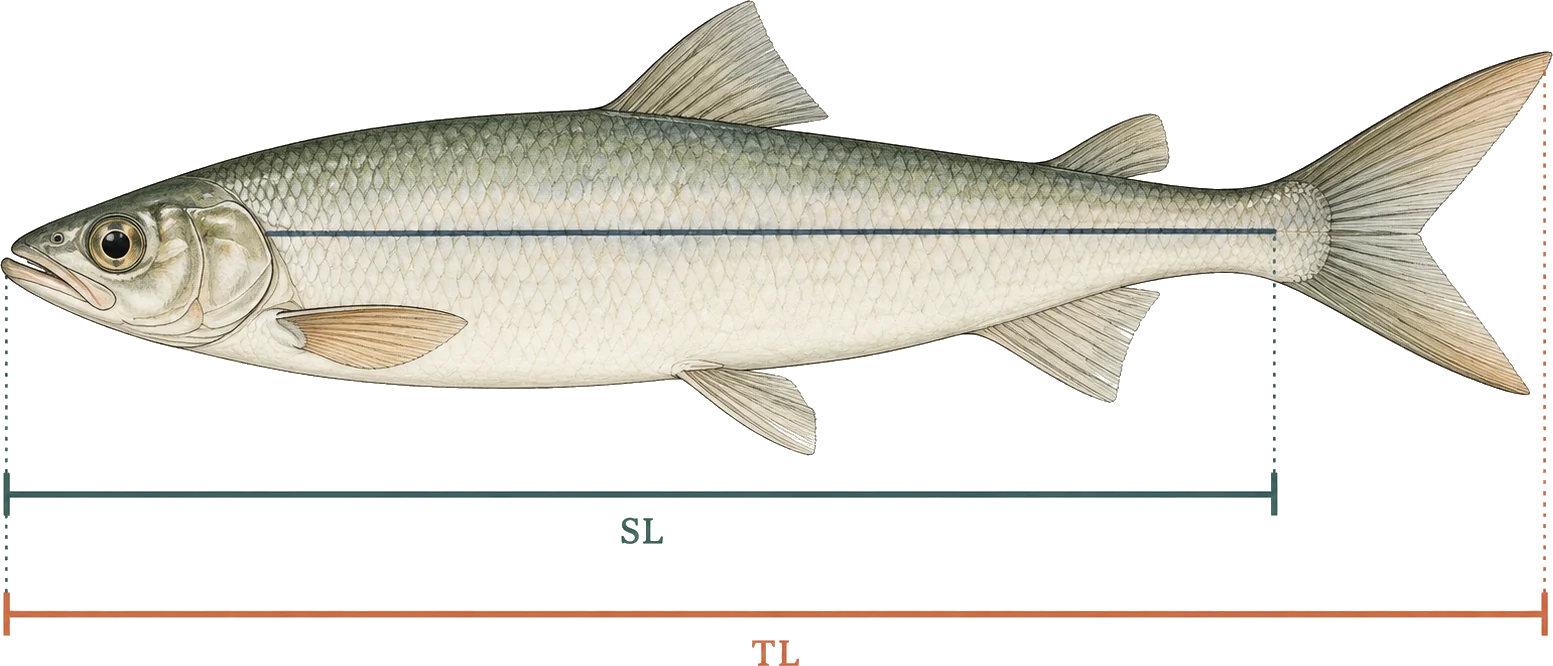
A fish measured at 10.6 cm standard length therefore occupies noticeably more than 10.6 cm of glass once the caudal fin is included, so even the largest published figure understates the space the animal actually sweeps.
A recorded maximum is not an average adult, and aquarium-raised stock often finishes short of the largest measured specimen.
But planning to the smallest published figure is the decision that most often forces an upgrade a year later, because the fish that arrives at 3 cm has no obligation to stop at 5.
Why does the 15 gallon figure keep appearing?
Retail and hobby care pages circulate 15 gallons, about 57 litres, as the minimum for a group of six brilliant rasboras. Another widely read hobby source puts the same six fish at a 30 gallon minimum, so the trade does not agree with itself even before the taxonomic literature is opened.
The smaller number is an inference rather than a measurement.
It works if the fish reaches about 5 cm, which is the figure the Wikipedia article carries and the one a quick search surfaces first.
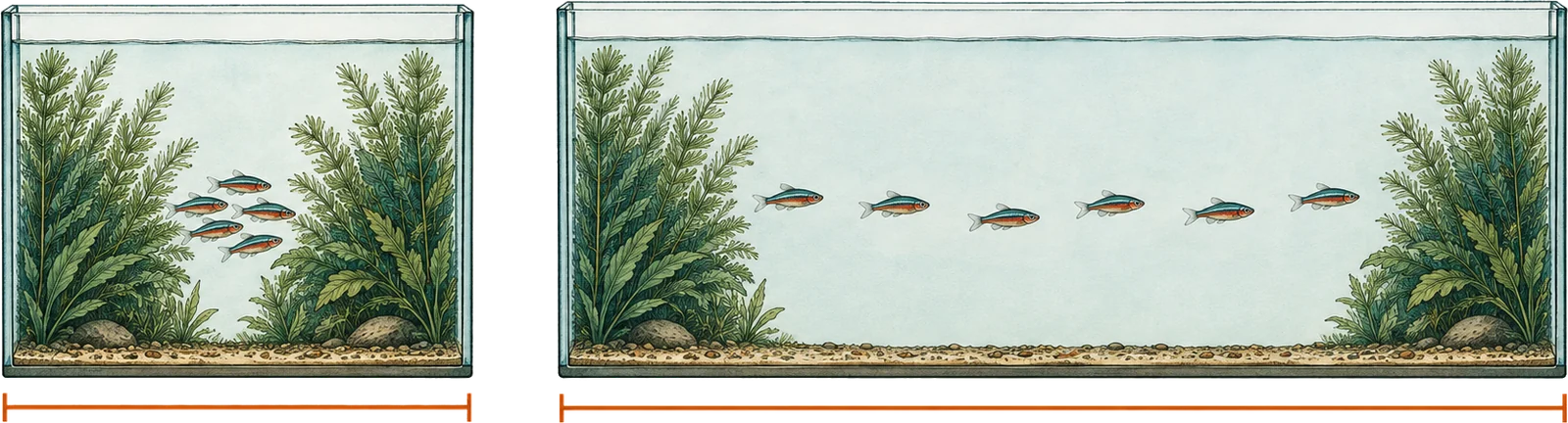
A 15 gallon aquarium is usually sold on a base around 60 cm long. That is half the length the aquarium reference literature gives for a group of this species, and length is the dimension an open-water shoaler actually spends.
None of this makes the retail figure dishonest. It makes it a number inherited from a smaller fish and repeated until it looked like a standard.
How much swimming room does a group need?
Published aquarium guidance gives a base of about 120 by 30 cm for a group, with six fish as the floor rather than the target.
Hobby accounts consistently report that groups well above six colour up better and stay more active, which is the same observation arriving from the other direction.
Length is what the fish uses. A tall aquarium of the same nominal volume gives a mid-water shoaler more water and less room, because the animal travels horizontally and turns at the ends.
Decor subtracts from that run.
Dense hardscape across the middle of a 120 cm tank leaves two short pockets rather than one long route, and the fish will treat it exactly that way.
| Decision factor | The circulating retail minimum | A plan built on the footprint |
|---|---|---|
| Base length and clear route | About 60 cm, usually broken by planting | About 120 cm, with the central run kept open |
| Group size it supports | Six, held at the floor by the space | Six upwards, with room to add rather than replace |
| What the layout gives up | Hardscape competes directly with the swimming route | Planting sits at the ends and margins, route intact |
| Where it ends up | An upgrade, or a crowded group that never settles | The tank the fish finishes growing into |
The threshold is easier to check than to argue about. If the group cannot cross the tank in an unbroken run, or if adults consistently hold at one end, the footprint has stopped being adequate whatever the volume label says.
Which rasboras get sold under this name?
Several fish look like this one, and the closest of them are not separated by colour. They are separated by what the dark side stripe does along its length.
In 2018 Britz and Tan described Rasbora simonbirchi from Central Kalimantan as a member of the Einthovenii species group, the assemblage that contains this species. They distinguished it from R. einthovenii and R. patrickyapi partly by an interrupted mid-lateral stripe overlaid with crescentic black marks along the rear edges of the mid-body scales, and by a faint dark blotch above the anal fin.
So the character to look for is continuity.
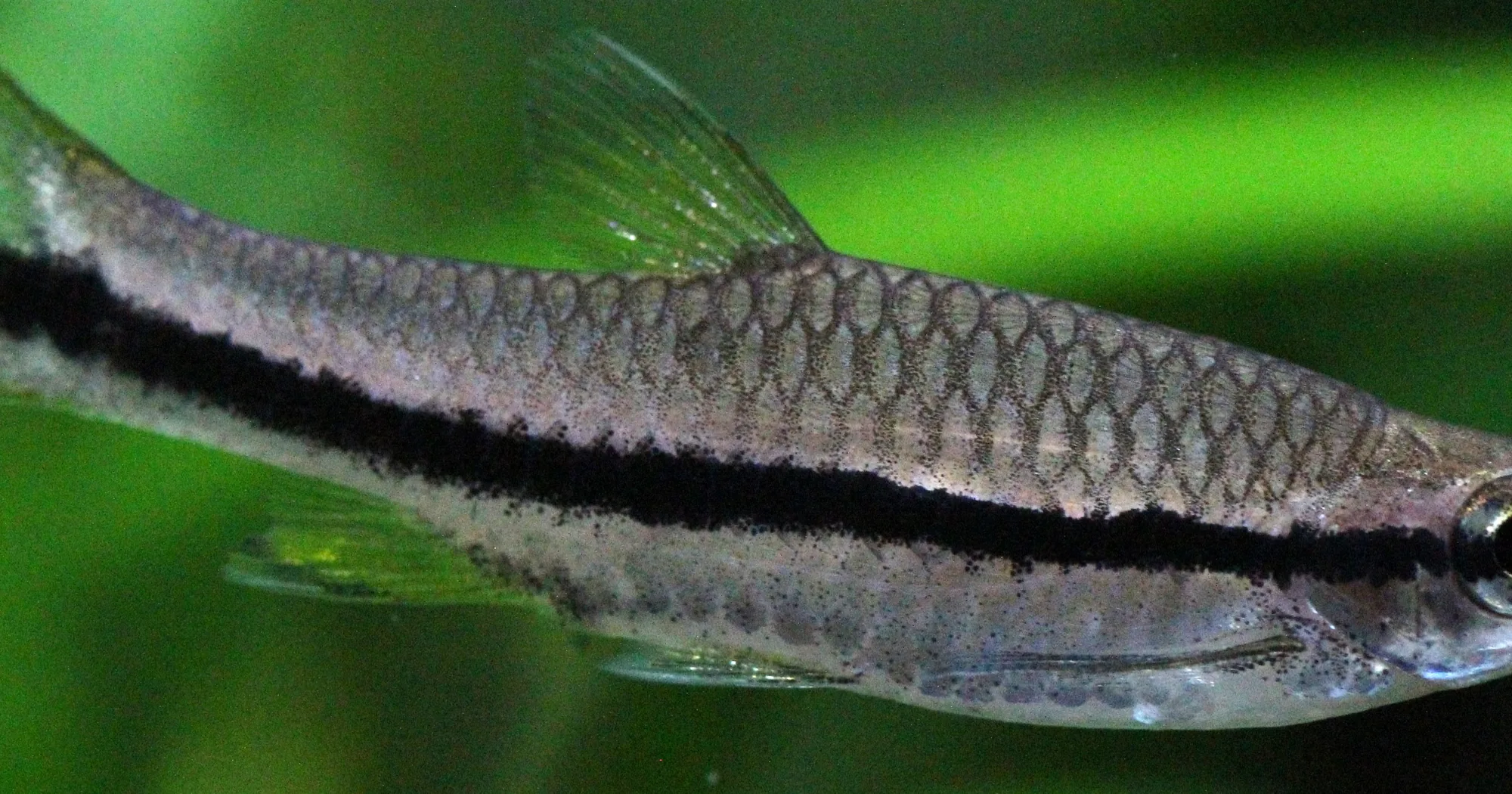
On Rasbora einthovenii the stripe runs unbroken from behind the eye to the caudal base, its lower margin is visibly uneven rather than ruled, and no reticulated dark scales sit above it.
What that looks like from the other side is a fish whose line is not continuous at all.
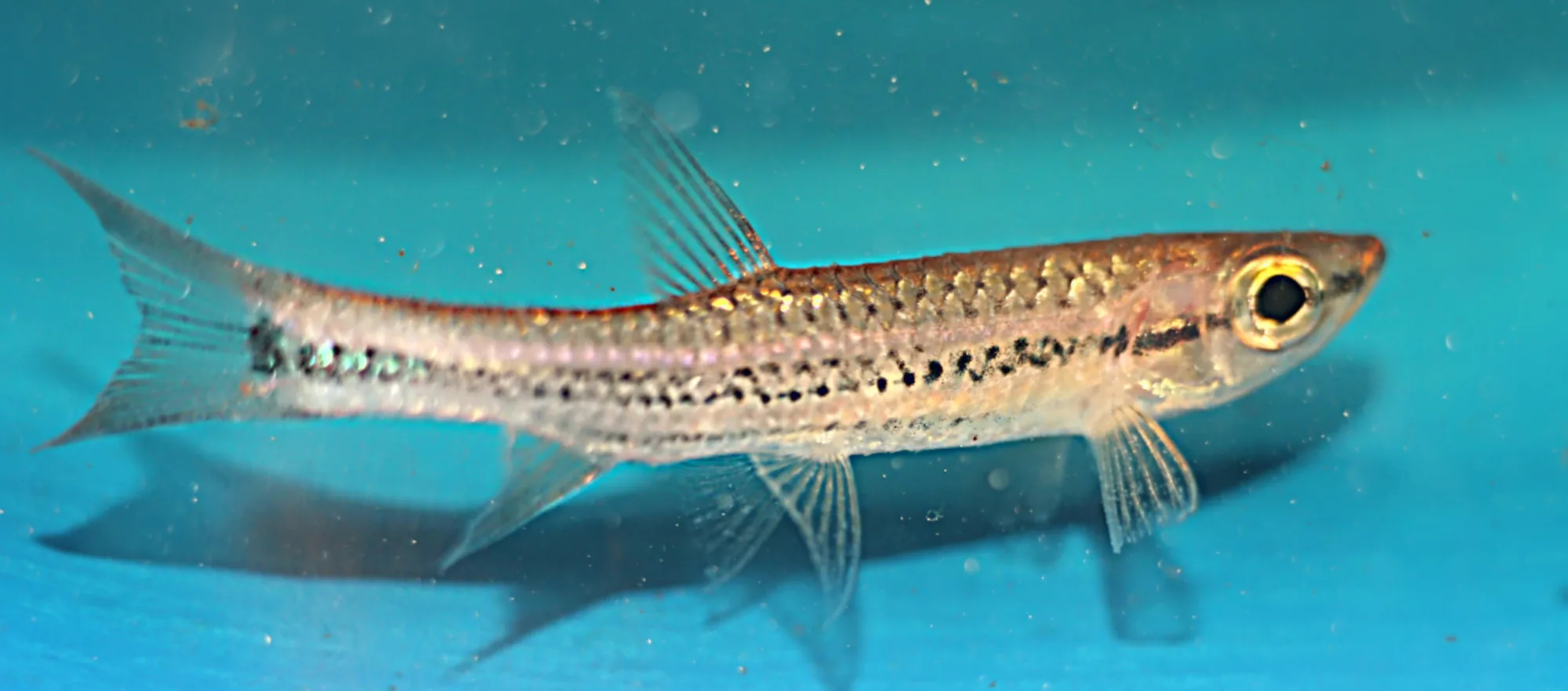
The character needs a settled, well lit fish seen from the side. It is readable on a healthy animal in a planted tank and frequently not readable on a newly arrived one under shop lighting.
Colour is the least reliable thing to remember the fish by.
The same species reads as muted silver and bronze in planted water, and as gold and copper with a turquoise band over the stripe when it is lifted into a pale tray.
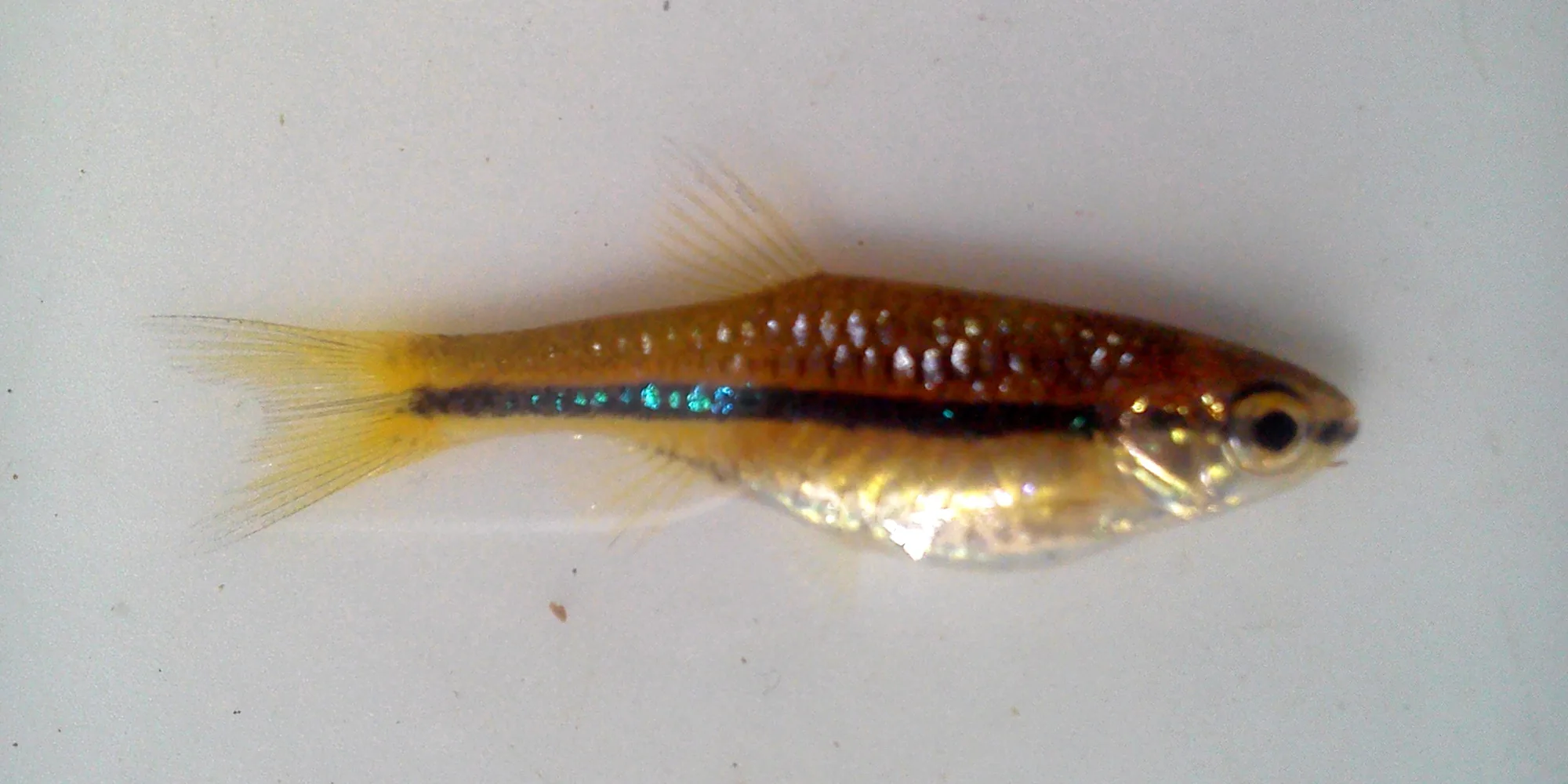
One further separation is worth carrying into a shop. Rasbora jacobsoni has dark reticulated scales above the lateral stripe and this species does not, so a pattern of dark scale edges above the line is a reason to ask more questions rather than to buy.
What does the peat swamp origin ask of the tank?
Catalog of Fishes gives the range as Malaya, Sumatra and western Kalimantan, and the IUCN account extends it to Bangka and southern Thailand.
FishBase records the species in forest streams, citing the 1990 survey of Singapore's freshwater fishes by Lim and Ng.
Those are not generic tropical streams. Aquarium reference literature places the fish in blackwater running through ancient forest peat swamp, where fallen leaves and branches structure the bed, tannins stain the water brown, and the canopy keeps the light low.
Field work supports the idea that these waters differ from each other in ways the fish respond to. Beamish, Beamish and Lim sorted the fish of the North Selangor blackwater peat swamp into assemblages that tracked oxygen, pH, water colour, conductivity and the organic content of the substrate, which is a finer picture than any single biotope recipe can hold.
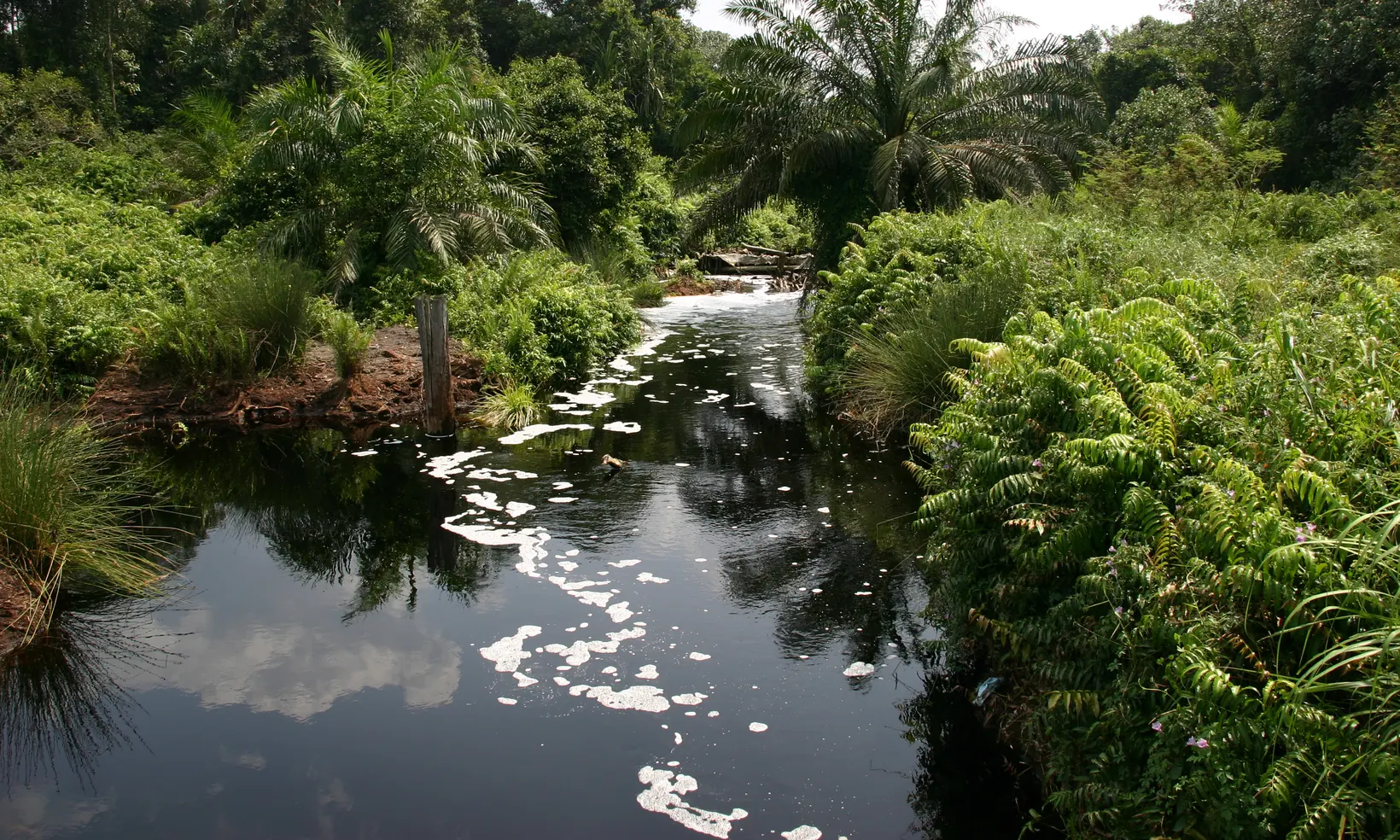
- Keep the light low, with floating or emergent cover over part of the surface.
- Put leaf litter and submerged wood on the bed, where the fish expect structure.
- Move water gently along the length rather than across it, so the group is not pinned into a corner.
- Use a dark substrate, which changes how the fish colour up and how readily they settle.
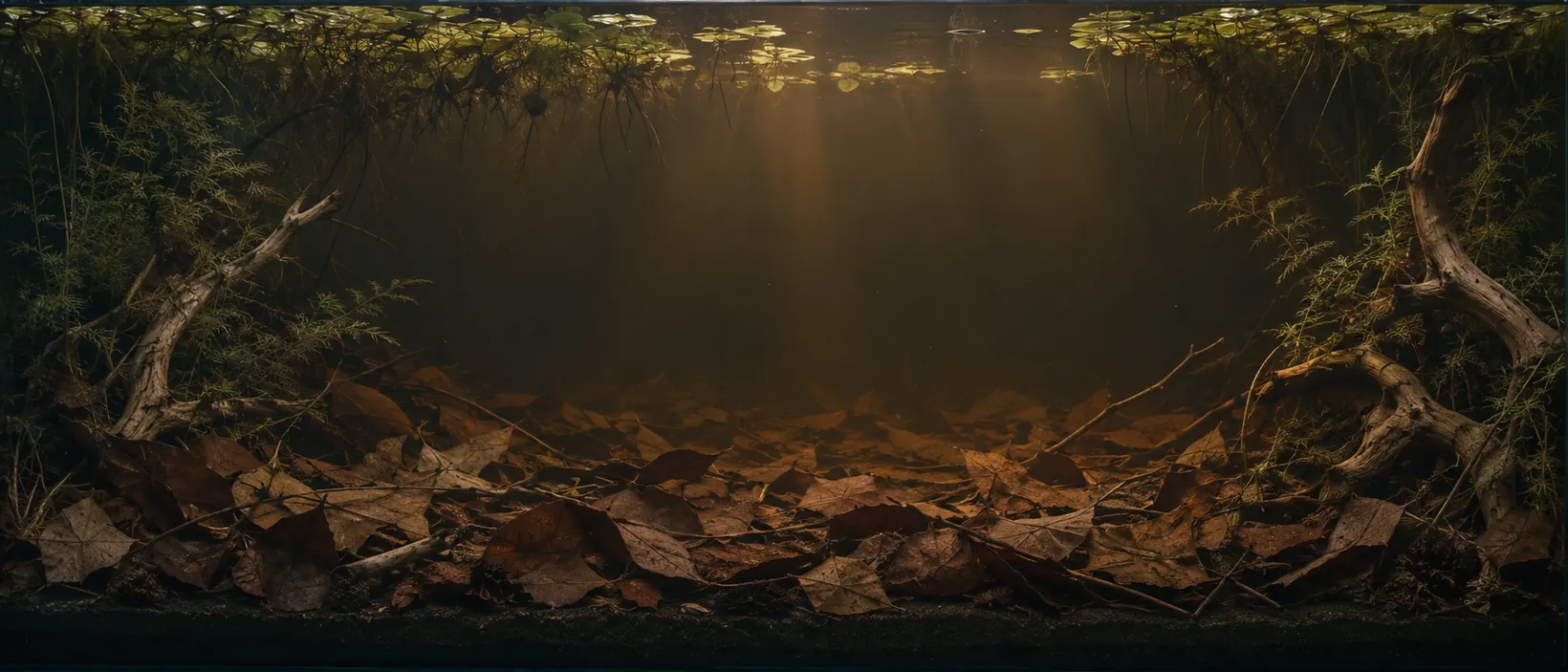
None of that makes tannin-stained water compulsory.
A brilliant rasbora kept in clear, stable, moderately soft water is not being deprived. The habitat record earns its place because it explains how the animal reacts to light, cover and flow, and those reactions are the decisions worth taking from it.
Where do the published water numbers come from?
FishBase publishes 22 to 26 °C, pH 6.0 to 6.5, and hardness up to 5 dH for this species.
Those three values share a single reference, and it is not a field study. The reference resolves to Baensch and Riehl's Aquarien Atlas, Band 2, published in 1985.
An aquarium atlas describes how a fish has been kept. It does not measure the water the fish was taken from, and the distinction matters as soon as somebody starts adjusting a tank to reach the numbers.

Recorded freshwater context
- Temperature22 to 26 °CSeparate aquarium thermometer.
- pH6.0 to 6.5Calibrated pH meter or an aquarium test covering the range.
- General hardnessUp to 5 dGH, upper boundary onlyGH titration test in degrees of general hardness.
Every range above applies to Rasbora einthovenii in a freshwater system. Source: FishBase species summary, checked 2026-09-11.
Seriously Fish publishes a considerably wider aquarium range for the same fish, pH 5.0 to 7.5 and 2 to 10 degrees hardness. The two are not averaged here, because an average would invent a precision that neither source claims.
Read together they still say something useful. The narrow range describes water this species has been kept well in, the wider one describes water it has tolerated, and a keeper whose tap water sits outside both has a decision to make before buying rather than a number to chase afterwards.
The hardness figure carries an upper boundary and no published lower value.
A blank lower bound is not a target of zero. A keeper who reads it that way will strip the buffering out of a tank in pursuit of a number nobody stated.
Stability outranks position within the range. Measure the seller's water and your own with the same method, acclimate slowly against the difference you actually find, and stop the transfer if fish gasp, lose balance or cannot hold position.
How should a shoal be fed?
The recorded diet is worms, crustaceans and insects, a line FishBase credits to a 1989 aquarium encyclopaedia rather than to a gut-content study. Aquarium literature describes the same animal as a micropredator taking small insects, worms, crustaceans and zooplankton.
A complete dried staple sized for the mouth does the daily work, with small frozen or cultured invertebrates alongside it as variety rather than as the diet.
Release food at several points rather than one.
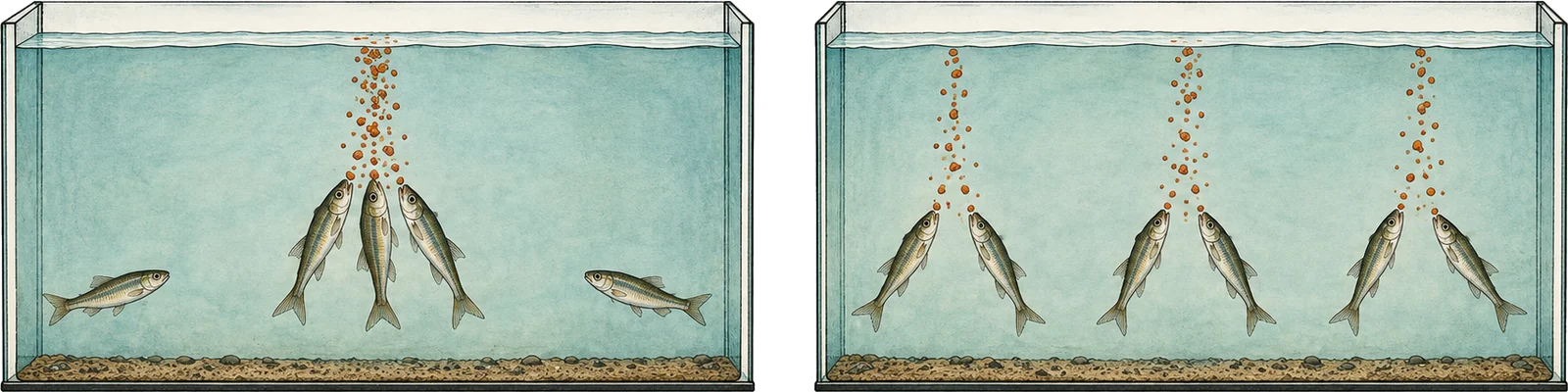
A fast group feeding at a single spot lets the three quickest fish collect most of it, and the shortfall surfaces weeks later as one thin animal rather than as anything visible at feeding time.
Watch individual fish swallow. Body condition across the group, leftover food on the substrate and the trend in measured nitrate are better portion guides than any count of pinches or flakes.
What does a settled group look like?
A group that is working spreads out. The fish occupy open mid-water along the length of the tank, drift apart while feeding or investigating, and tighten into a formation only when something startles them.
Shoaling is not a permanent parade.
A group that holds one tight cluster all day is usually reporting something about the space or about a tank mate, not demonstrating good social structure.
The failures are specific and visible. One fish cut off every time it tries to cross, an animal that never rests anywhere, torn fins, or the same individual missing every feeding are each enough to say the arrangement is not working.
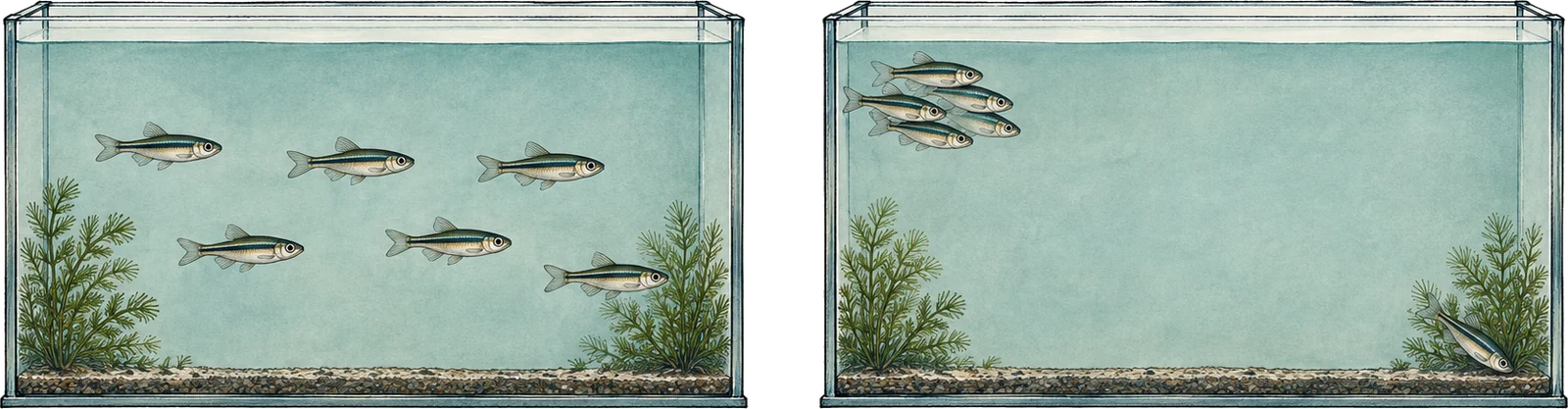
Adding fish to a short tank usually makes it worse. More animals in the same run means more competition for the same food and the same space, and the fish already losing goes on losing.
Which tank mates suit a fish this size?
A companion has four conditions to meet, and the last one is the one a stock list never mentions.
- It overlaps on measured water rather than on a general description like tropical.
- It is too large for a 9 cm rasbora to swallow and too small to swallow one.
- It can feed without being outpaced by a fast mid-water shoal.
- It leaves the middle of the tank free, because that is where this species lives.
That last condition is the one a stock list never mentions.
The word peaceful does real work here and it has limits. A fish reaching 9 cm that feeds at speed is peaceful in the sense that it attacks nothing, and disruptive in the sense that it reaches the food first and uses the whole tank doing it.
The species named here are worked examples rather than a list to copy.
A bloodfin tetra shares the fast open-water habit and competes for exactly the same feeding window, so the two together need more length than either would alone. A black neon tetra is smaller and slower to the food, which makes feeding distribution the thing to watch rather than aggression.
A bleeding heart tetra and a black skirt tetra both bring body depth and exposed fins into the decision, and both want the warm end of the temperature overlap rather than the cool end this rasbora tolerates.
A long-finned Betta fish is a conditional match at best. Temperature overlaps, while feeding speed, flow preference, exposed fins and individual temperament can all conflict, so the pairing is judged on the actual animals after a feeding and after a light change, with a heated separation option already set up.
Nothing here is settled by the species pair alone.
Adult size, group size, footprint and the individual fish decide it, and a tank that is short for the rasboras is short for everything sharing it.
Can brilliant rasboras be bred at home?
Spawning is recorded in thick aquatic vegetation, and aquarium literature describes a continuous egg scatterer with no parental care whose fry first take very small live food.
In a stocked community tank that combination has one outcome. Eggs fall among the plants and are eaten, usually by the parents, so a keeper waiting for fry will wait a long time.
Dense fine-leaved planting is the one change that gives eggs any chance at all, and it is a small chance.
No controlled breeding study for this species appears in the available authoritative sources, so anything more specific would be a guess dressed as a method.
What do the sources still not tell you?
A figure missing from the literature is not a small figure or an easy one. It is a gap, and three of them matter for this fish.
No species-specific captive lifespan appears in the FishBase summary, the Catalog of Fishes entry or the IUCN account. Publishing a confident number would turn repeated aquarium claims into false precision, so a seller who quotes one should be asked where it came from.
Sexing is the second gap.
Mature females are described as rounder-bellied and often a little larger, which is a real difference on settled adults and close to useless on thin, stressed fish in a shop tank.
The third is the water itself. No field-measured chemistry tied to this species was located, so the ranges on record come from an aquarium atlas rather than from a river survey.
None of this means nothing is known.
It means the boundary between what has been measured and what has been repeated is worth keeping visible, particularly when a number is about to decide a purchase.
Which signs mean act now?
Rapid breathing, surface gasping, loss of balance, or several fish suddenly clustering at the filter outflow all point at the water before they point at anything else.
Measure these before you change anything
- Temperature Against a separate thermometer, not the heater dial. A heater stuck on or off produces most of the sudden behaviour changes in a settled tank.
- Dissolved oxygen and surface movement Gasping at the surface in a warm tank is usually oxygen, and the fastest fix is more surface agitation rather than colder water.
- Ammonia and nitrite Both should read zero. Anything above that in a stocked tank is a filter problem, not a fish problem.
- Recent changes New fish, a cleaned filter, a new decoration, or a large water change in the last few days.
Confirm an abnormal reading before changing anything, because a correction made on a guess becomes the second problem.
A fish from soft, acidic, tannin-stained water moved into hard alkaline tap water usually shows it as behaviour first. Hiding, refusing food, hanging at the surface and losing colour arrive well before anything looks like disease, and they deserve to be read as information rather than as a settling-in period.
Persistent isolation, clamped fins, sores, swelling, progressive fin damage or repeated refusal of food need attention on a slower clock. Appearance does not diagnose a disease, and a photograph diagnoses nothing at all.
Contact an aquatic veterinarian or an experienced fish-health professional when severe signs persist, when several fish decline together, or when measured water is normal and the animals are not.
What do conservation and trade records show?
The records themselves are short, and worth putting side by side.
| Record | Status | Dated | What it does not cover |
|---|---|---|---|
| IUCN Red List | Least Concern | Published 2020, assessment dated 14 January 2019 | Abundance at any particular stream |
| CITES | Not Evaluated | Checked 12 September 2026 | National and local rules, which apply separately |
| Trade | Recorded in commercial aquarium trade | FishBase, checked 12 September 2026 | Whether a given shipment was wild-caught |
A global assessment is not a statement about one stream.
The peat swamps this species is recorded from are among the most heavily drained and cleared freshwater habitats in Sundaland, and a Least Concern listing across a wide range does not report what has happened at a particular collection site.
FishBase records the species in commercial aquarium trade. That makes sourcing a real question: ask whether stock is wild-caught or captive-bred, and treat the answer as part of the purchase rather than as trivia.
Never release aquarium fish, plants, water or live food outdoors. Ornamental species reach new waters through exactly that route, and GBIF already holds a handful of occurrence records for this fish from countries outside its accepted native range.
When should you wait before buying?
Wait when the seller cannot confirm the species by name, when the tank's clear route is closer to 60 cm than 120 cm, when the filter is young, or when the plan is for two or three fish rather than a group.
Wait as well when the tap water sits well outside both published ranges and nothing has been done about it yet.
- The supplier record or label confirms Rasbora einthovenii, not just a trade name.
- The stripe on the fish in front of you runs unbroken to the tail base.
- The tank offers an unbroken run of about 120 cm once planting and hardscape are in place.
- At least six fish are going home together, with room to add more later.
- The filter is mature, and both the seller's water and yours have been measured with the same method.
- The tank plan works for a fish approaching 10 cm, not for the 5 cm figure a search result offered first.
None of those conditions is about whether this is a good fish. They are about whether the tank is ready for the one the evidence actually describes.
Which schooling fish are useful comparisons?
Clown rasbora
A larger blackwater rasbora that tests whether length, group size and swimming room have been underestimated.
Emerald eye rasbora
A tiny rasbora whose cooler range, small body and quiet shoaling pattern create a different constraint set.
Giant danio
A large, fast danio that makes horizontal room, group speed and oxygen demand the central comparison.
Denison barb
A large high-flow cyprinid that pushes oxygen, current and uninterrupted tank length much further.
Ember tetra
A tiny warm-water tetra whose low competitive weight and small mouth change feeding and tankmate choices.