
What Is a Denison Barb, and How Much Swimming Room Does It Need?
Dawkinsia denisonii
The Denison barb is Dawkinsia denisonii, a 15 cm stream fish whose torpedo shape and social speed make a long aquarium essential. Its care turns on usable swimming length, oxygen-rich stable water, a full group and a traceable source, not on fitting one juvenile into a shop-sized tank.
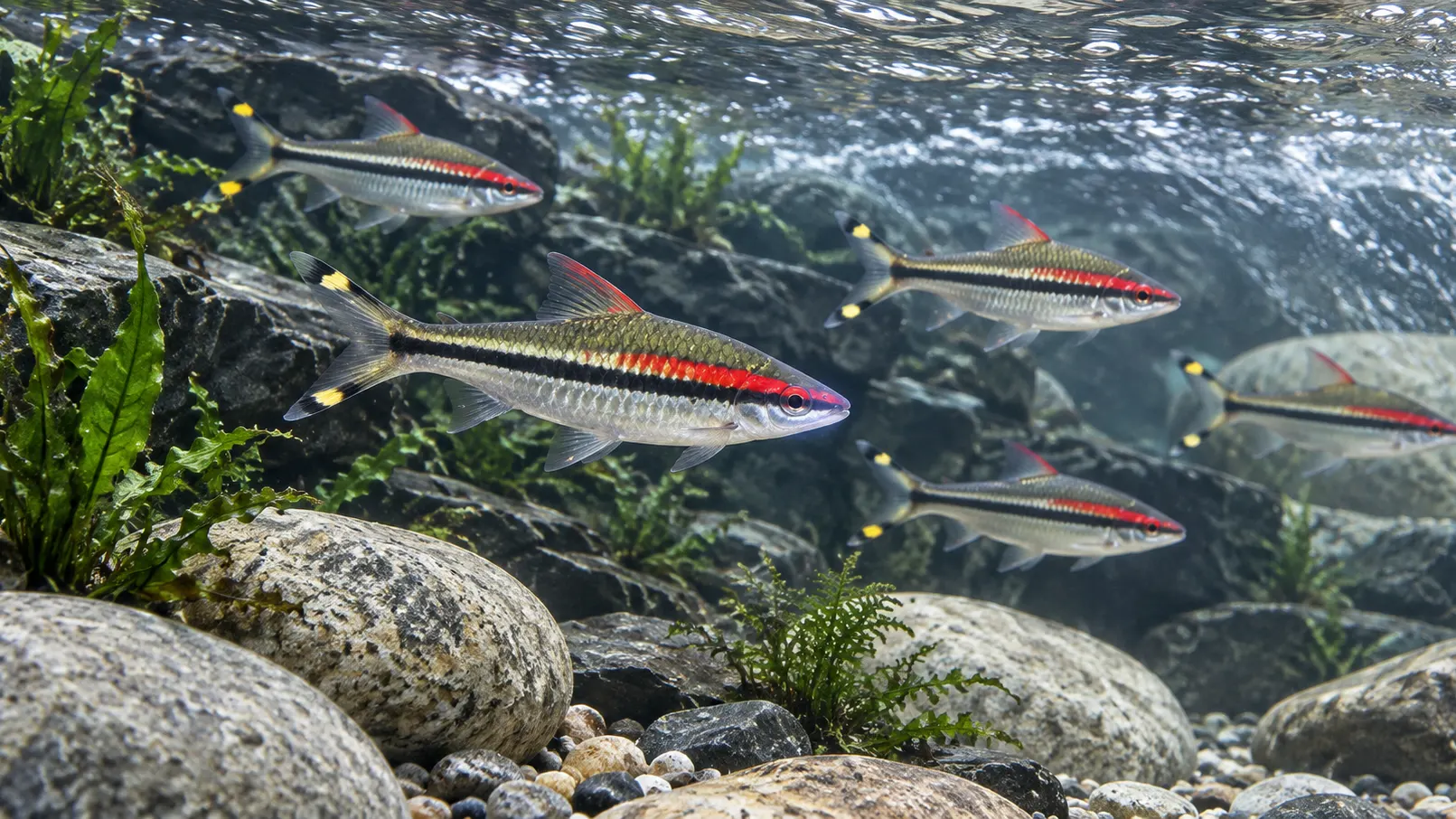
At a glance

- Adult size
- 15 cm
- Minimum footprint
- At least 120 cm of usable swimming length as a welfare starting point
- Social structure
- A gregarious active shoal; plan a full group, commonly six or more when the tank supports it, rather than a pair or trio.
- Sex ratio
- No universal sex ratio is supported by the reviewed sources; prioritize a stable group and enough retreat distance.
- Diet
- Herbivore
- Feeding
- A complete staple with a meaningful plant component, plus appropriately sized varied foods distributed across the shoal.
- Waste load
- medium-high
- Family
- Cyprinidae
- Native range
- Hill streams of Kerala and Karnataka in southwestern India
- Also sold as
- red-line torpedo barb. Trade and hobby names, not accepted species names.
- Former scientific names
- Puntius denisonii, Sahyadria denisonii. Superseded names for this same species.
- Conservation status
- Endangered, assessed 6 July 2010 Source
The footprint is expressed as usable horizontal room because adult movement and social escape cannot be inferred from litres alone.
What is a Denison barb?
The Denison barb is Dawkinsia denisonii, a long, fast cyprinid from streams of southwestern India. Its black lateral stripe, scarlet line and yellow-black tail pattern make it easy to recognize, but its shape matters more to husbandry than its color does.
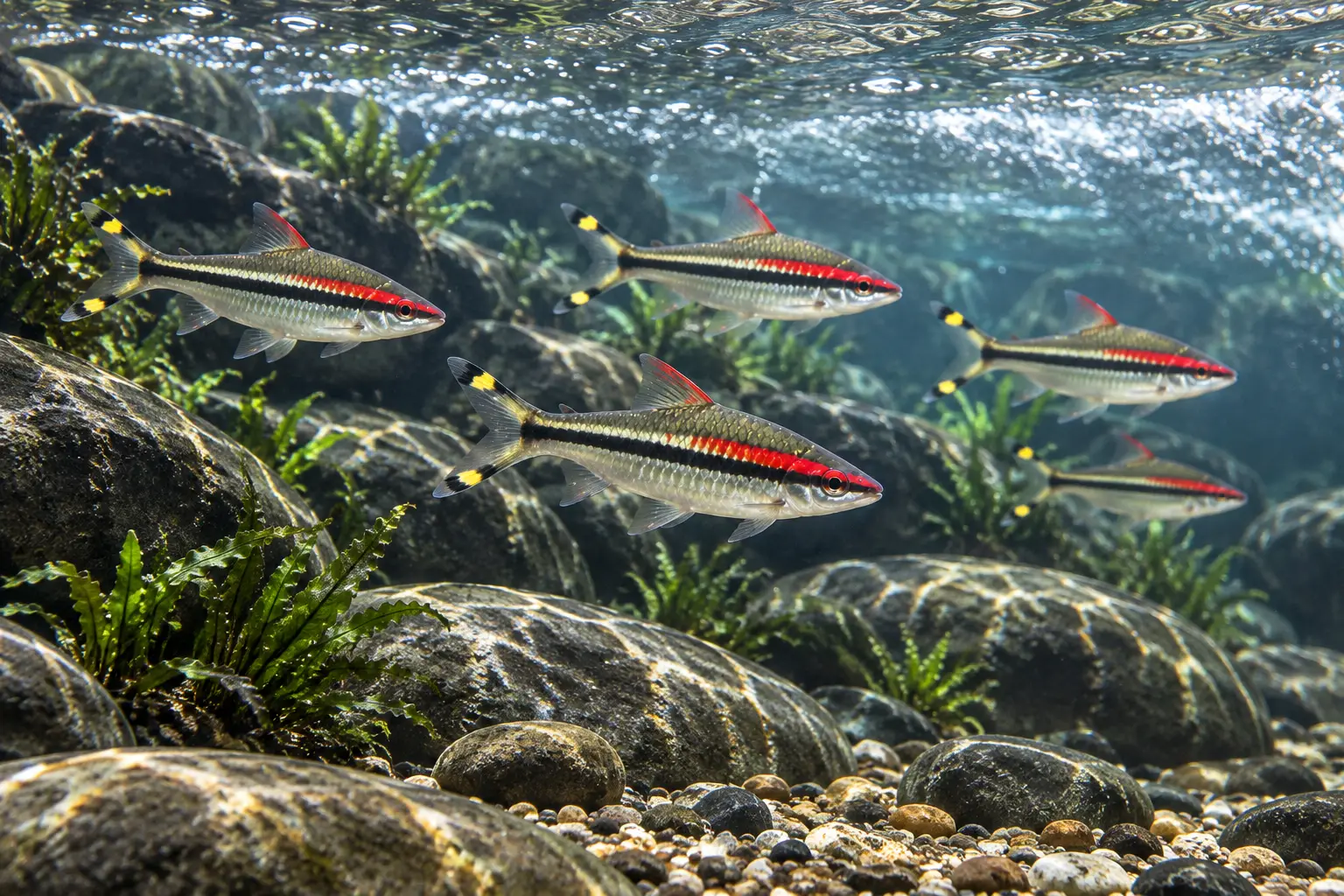
FishBase records a maximum total length of 15 cm. A fish that size, built like a torpedo and kept socially, needs sustained swimming room rather than a nominal volume squeezed into a short aquarium.
- Accepted identity
- Dawkinsia denisonii (Day, 1865)
- Family
- Cyprinidae
- Native range
- Hill streams of Kerala and Karnataka in southwestern India
- Published maximum
- 15 cm total length
- Social pattern
- Gregarious, active midwater swimmer
- Recorded diet
- Predominantly plant material, with other foods taken
- Temperature
- 15 to 25 °C in the FishBase record
- IUCN assessment
- Endangered, assessed 6 July 2010
Older books may place this fish in Puntius or Sahyadria. The Catalog of Fishes accepts Dawkinsia denisonii, so those older combinations are name history, not separate fish.
How can you recognize the correct fish?
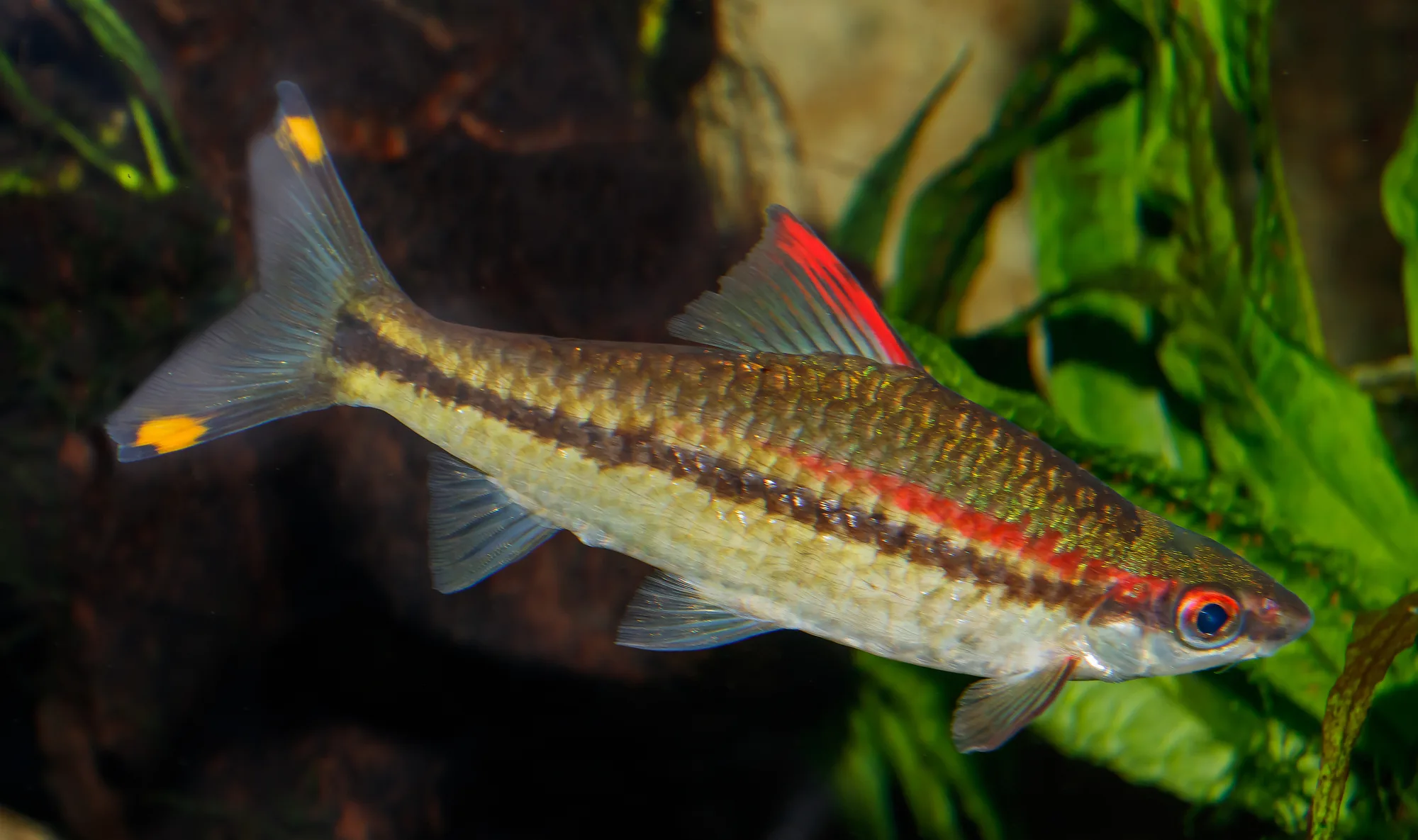
The most useful mark is the black stripe from the snout through the eye and along the flank. A scarlet stripe runs above it from the snout to around the middle of the body, while the forked tail carries black and yellow markings.
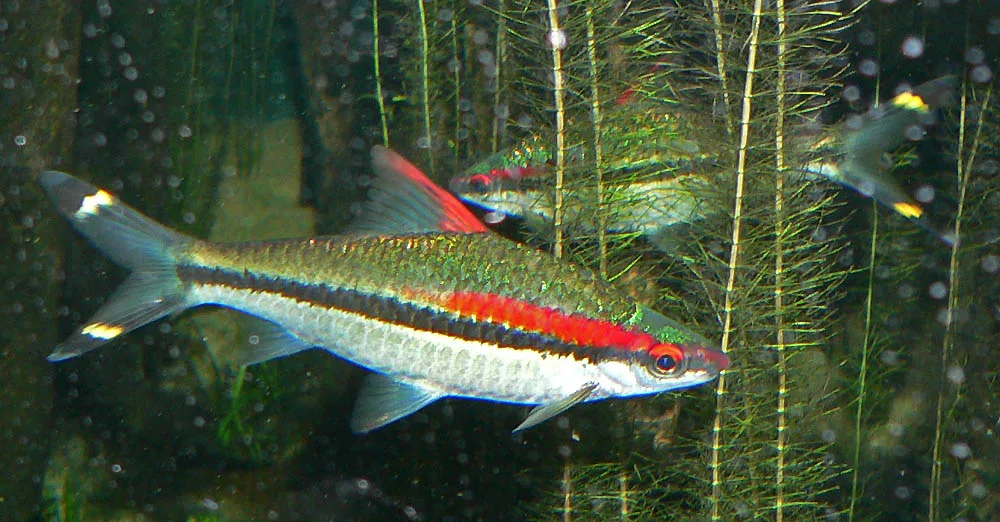
Body condition changes the outline without changing those marks. A well-fed adult looks deeper than a juvenile, while a frightened fish may wash out its red quickly; neither change creates a different species.
The fish sold as the similar Dawkinsia chalakkudiensis has been confused with it in the trade. A photograph can flag that a label deserves checking, but a reliable separation depends on verified locality and diagnostic characters rather than red intensity alone.
Why does this barb need a long aquarium?
The reason is a combination of adult length, acceleration and group movement. A Denison barb does not hover around one cave; it crosses open water, turns with companions and uses current.
A 120 cm usable swimming length is a conservative starting point, not a universal law or a promise that every tank with that front glass is suitable. A larger group, dense hardscape or strong territorial tank mates can push the real requirement upward.
| Decision factor | Long footprint | Short footprint |
|---|---|---|
| Group movement | Fish can accelerate, turn and regroup without folding back immediately | Every burst ends at glass or hardscape |
| Flow | Current can run along a clear lane with quieter margins | One strong outlet can turn the whole tank into a jet |
| Social escape | A chased fish can leave a display without leaving the group | The same fish meets the pursuer again after one turn |
| Maintenance margin | Waste is spread through a larger working area | Heavy feeding and a large shoal concentrate quickly |
Volume still matters for dilution and oxygen, but volume alone does not describe this fish's job. A tall cube can contain many litres and still give a 15 cm barb nowhere to run.
What does a useful group look like?
FishBase calls the species gregarious, and the government risk assessment also treats it as a shoaling fish. Neither source establishes one universal household group number for every aquarium.
The practical decision is to keep a real group rather than a pair or trio, then size the aquarium and filtration around the full adult group. Six is a sensible planning floor when space permits, while a larger stable group usually distributes attention and produces more coherent movement.
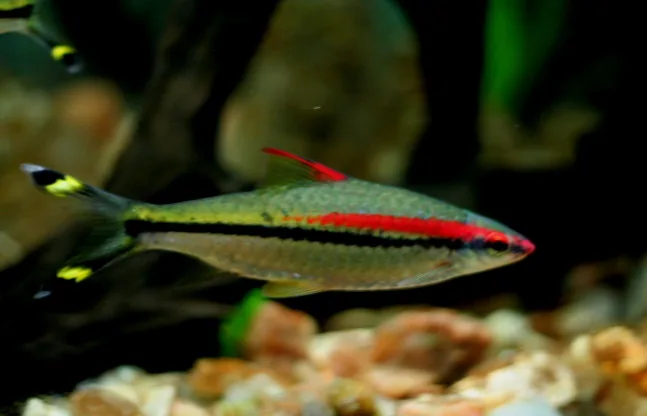
Watch the distribution rather than merely counting fish. A healthy group uses the same broad zone, feeds across it and repeatedly reforms after short separations.
When the group no longer moves as one
- Water quality Test ammonia and nitrite first, then confirm temperature and oxygen. A whole group becoming still is an environmental warning.
- Flow pattern Check whether one outlet is pinning fish into a corner instead of creating a broad river-like route.
- Social pressure Look for one fish repeatedly driven behind equipment or into the surface corners.
- External disturbance Sudden room lights, tapping and fast movement near the glass can keep an otherwise suitable group on edge.
- Illness or injury A single fish with rapid breathing, loss of balance, sores or persistent isolation needs an aquatic veterinarian without delay rather than a layout experiment.
What water conditions suit Denison barbs?
FishBase compiles 15 to 25 °C, pH 6.8 to 7.8 and 5 to 25 dH. Those are broad field and aquarium ranges, not instructions to chase a midpoint.
Published Denison barb water ranges
- Temperature15 to 25 °CSeparate aquarium thermometer, checked at both ends of the tank.
- pH6.8 to 7.8Calibrated pH meter or a test whose scale covers the expected value.
- General hardness5 to 25 dHGH titration test, recorded in degrees of hardness.
Every range above applies to Dawkinsia denisonii in a freshwater system. Source: FishBase, checked 2026-09-13.
The habitat description explains why oxygen and cleanliness deserve equal attention. FishBase places the species in fast-flowing hill streams and rocky pools with thick riparian vegetation.
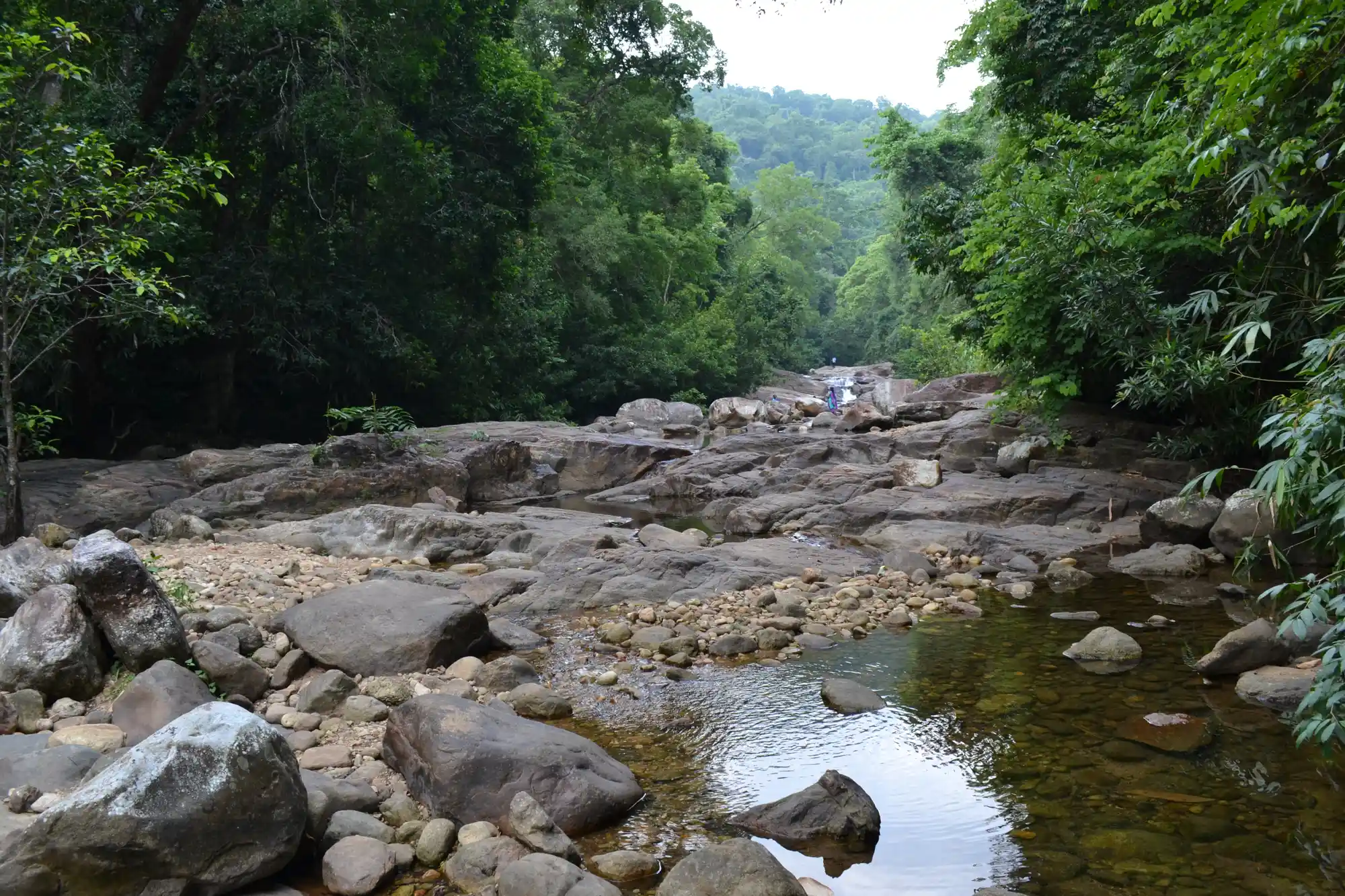
High flow is not the same as pointing a narrow pump at the fish. Aim for broad circulation, visible surface movement and clean oxygen-rich water, with calmer pockets behind planting or rounded wood.
If a fish came from warmer dealer water, do not drop it abruptly toward the cool edge of the range. Match the arrival water first, verify with a thermometer, and change slowly only when there is a clear reason.
The filter must solve two different jobs. Biological media processes dissolved waste, while mechanical media catches the fine debris that would otherwise collect in rock gaps and reduce local water movement.
A spray bar, broad return or carefully aimed outlet can move the length of the tank without creating one punishing jet. Observe whether the shoal can choose between faster and slower water; fish permanently braced behind one object are avoiding flow, not enjoying it.
Surface movement
Keeps gas exchange visible and helps oxygen enter warm, stocked water.
Broad return
Moves a large cross-section of water instead of striking one fish with a narrow stream.
Quiet margin
Gives resting fish relief without becoming a stagnant debris pocket.
Open intake
Prevents falling flow and oxygen when plant leaves or waste cover the guard.
Clean mechanical media
Restores circulation before trapped debris decomposes inside the filter.
What should Denison barbs eat?
FishBase describes the species as herbivorous, which separates it from the idea that every active barb needs a heavily animal-based diet. A varied aquarium diet should include a dependable plant component as well as appropriately sized prepared and frozen foods.
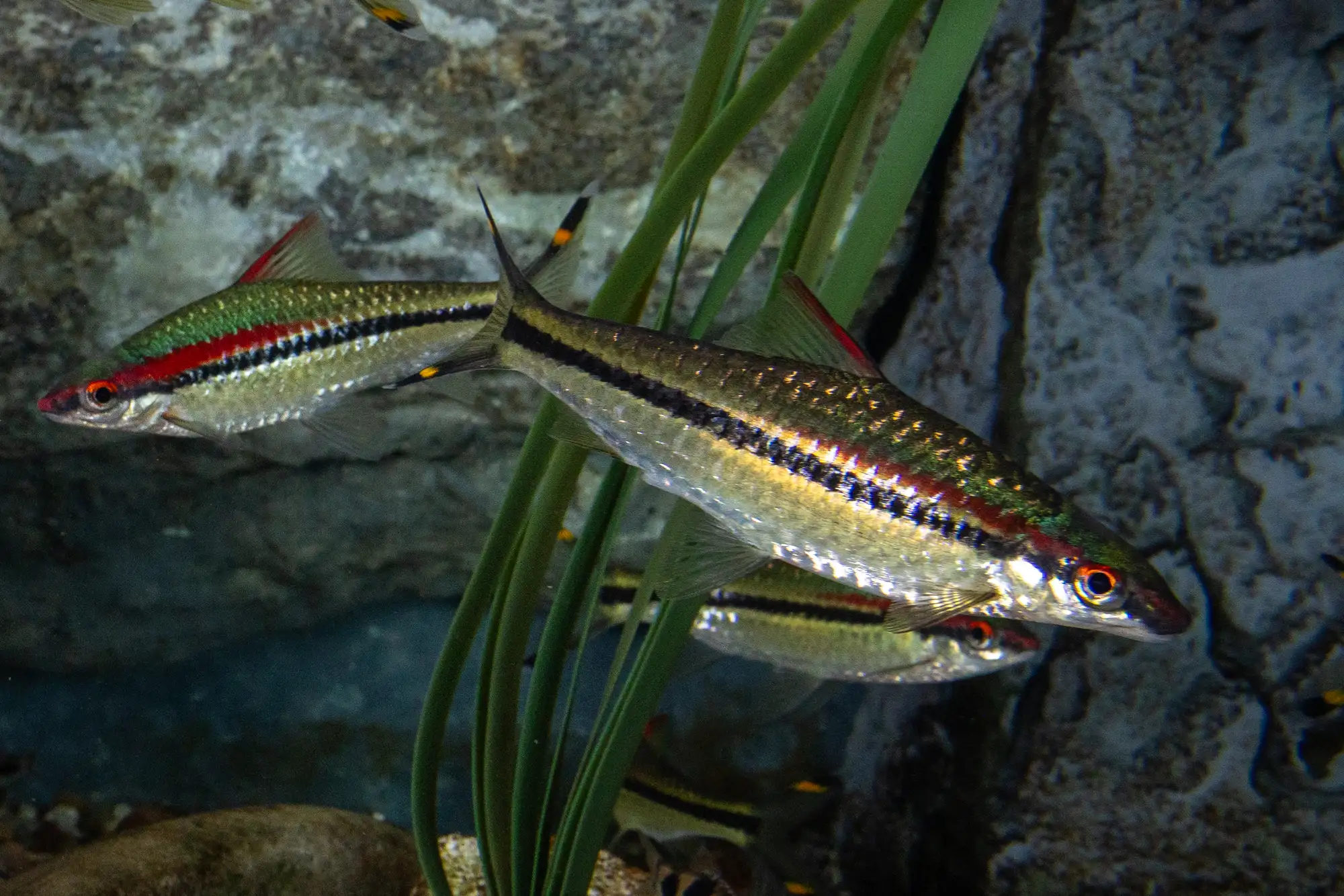
- Use a complete staple with recognizable plant ingredients rather than color marketing alone.
- Offer small portions that remain suspended long enough for the whole moving group to intercept them.
- Rotate in suitable frozen or live foods for variety without allowing them to displace the staple.
- Watch the slowest fish, not the first fish to reach the surface.
- Adjust the next meal when food reaches the bottom untouched or the group loses its streamlined body condition.
A red stripe does not prove that the diet is balanced. Color can respond to lighting and pigments while growth, body condition and waste output tell a different story.
Which tank mates are a good match?
Choose companions that overlap in temperature, tolerate moving oxygen-rich water and cannot swallow or harass a Denison barb. Calm, robust midwater fish and peaceful bottom fish usually fit better than slow long-finned species.
Very small fish can become intimidated by the speed and mass of an adult group even when no predation occurs. Conversely, large cichlids or persistent fin nippers can turn an active shoal into fish that hide, collide and arrive late to food.
Similar active cyprinids
Match swimming speed and water movement, but add their full adult size and group needs before deciding the tank is large enough.
Peaceful medium tetras
Often workable when temperature overlaps and no species depends on long trailing fins.
Bottom-dwelling catfish
Can use a different zone if oxygen, temperature and footprint suit both animals.
Tiny nano fish
Usually a poor scale match because the Denison group dominates space and feeding even without direct attack.
Slow long-finned fish
Vulnerable to constant disturbance and accidental fin contact in fast communal feeding.
Large predatory fish
Excluded because a streamlined barb can still be swallowed or injured.
Compatibility is a tank-level decision. Add the adult body lengths, social groups, oxygen needs and feeding styles of both species before treating a temperament label as permission.
Introduce the complete Denison group only after the aquarium has cycled and the temperature has been verified across several days. Adding a few fish to “test” the tank leaves a social animal below its intended group and exposes it to any instability that the test was meant to discover.
Quarantine protects both directions: the new barbs from established pathogens and the existing aquarium from problems carried through the supply chain. Use an appropriately sized covered system with active filtration and oxygen rather than a small uncycled container that creates a new hazard.
How can you tell stress from normal speed?
Normal Denison barb activity has pauses, coordinated turns and purposeful feeding. Distress looks less organized: repeated glass running, surface crowding, clamped fins, rapid gill movement or one fish failing to rejoin.
Check the environment in a fixed order so that several variables are not changed at once.
- Measure before intervening Test ammonia and nitrite, verify temperature and observe breathing. Do not assume speed means aggression.
- Restore gas exchange If the whole group breathes rapidly, increase surface movement and check for a failed filter or blocked intake while the tests run.
- Map the current Use floating food or fine debris to see whether circulation forms a broad loop or a narrow blast.
- Observe one complete feeding Confirm that every fish can approach food and retreat without repeated pursuit.
- Escalate visible illness Loss of balance, bleeding, ulcers, swelling or breathing that stays abnormal in verified water needs qualified aquatic-veterinary help.
Avoid rapid pH or temperature correction unless an immediate hazard has been measured. Stable water inside the tolerated range is safer than a fast swing toward a number that looks ideal on paper.
What does Endangered status mean for a buyer?
FishBase records the species as Endangered, based on an IUCN assessment from 2010, and also records commercial aquarium use. CITES is listed as not evaluated, which does not erase national or local trade rules.
The aquarium trade has a complicated history with this endemic fish. Captive production can reduce collection pressure, but a generic shop label does not prove origin.
The responsible purchase is therefore two decisions at once: verify the supply chain as far as the seller can, and confirm that the full adult group already has a suitable long aquarium.
Is a Denison barb the right fish for your tank?
It fits when the aquarium is long, mature, oxygen-rich and large enough for a full social group plus compatible companions. It is a poor choice for a warm compact community, a new tank, a short cube or a keeper who wants one colorful specimen.
The decisive question is not whether the shop fish fits today. It is whether several 15 cm active adults can turn, feed and retreat in the aquarium after the hardscape and other animals take their share of the space.
Which schooling fish are useful comparisons?
Brilliant rasbora
A slender but substantially larger rasbora whose adult footprint can rule out tanks suited to nano species.
Congo tetra
A larger African shoaler with long male fins and a metre-plus swimming-space question.
Bloodfin tetra
A small, active school that changes the temperature, swimming-speed and feeding-access questions.
Bucktooth tetra
A scale-feeding specialist that shows why similar body size can hide a completely different housing decision.
Ember tetra
A tiny warm-water tetra whose low competitive weight and small mouth change feeding and tankmate choices.
Cardinal tetra
A small blackwater shoaler whose soft-water context and quiet group behaviour narrow the comparison.
Black neon tetra
A smaller midwater shoaler that offers a useful contrast in body size, group movement and water tolerance.
Chili rasbora
A minute blackwater group fish whose mouth size, water and refuge needs set a much smaller scale.
Celestial pearl danio
A tiny planted-tank danio with cooler documented habitat water and a different style of group behaviour.
Cherry barb
A small planted-stream barb that contrasts sex-linked colour, social structure and habitat cover.