
What Is an Endler's Livebearer, and Is Yours a Hybrid?
Poecilia wingei
The Endler's livebearer is Poecilia wingei, a tiny Venezuelan poeciliid whose colorful males remain much smaller than the plain females. A shop label cannot prove pure ancestry, and a mixed-sex group can turn a modest colony into a crowded tank quickly, so lineage and population capacity matter before color.
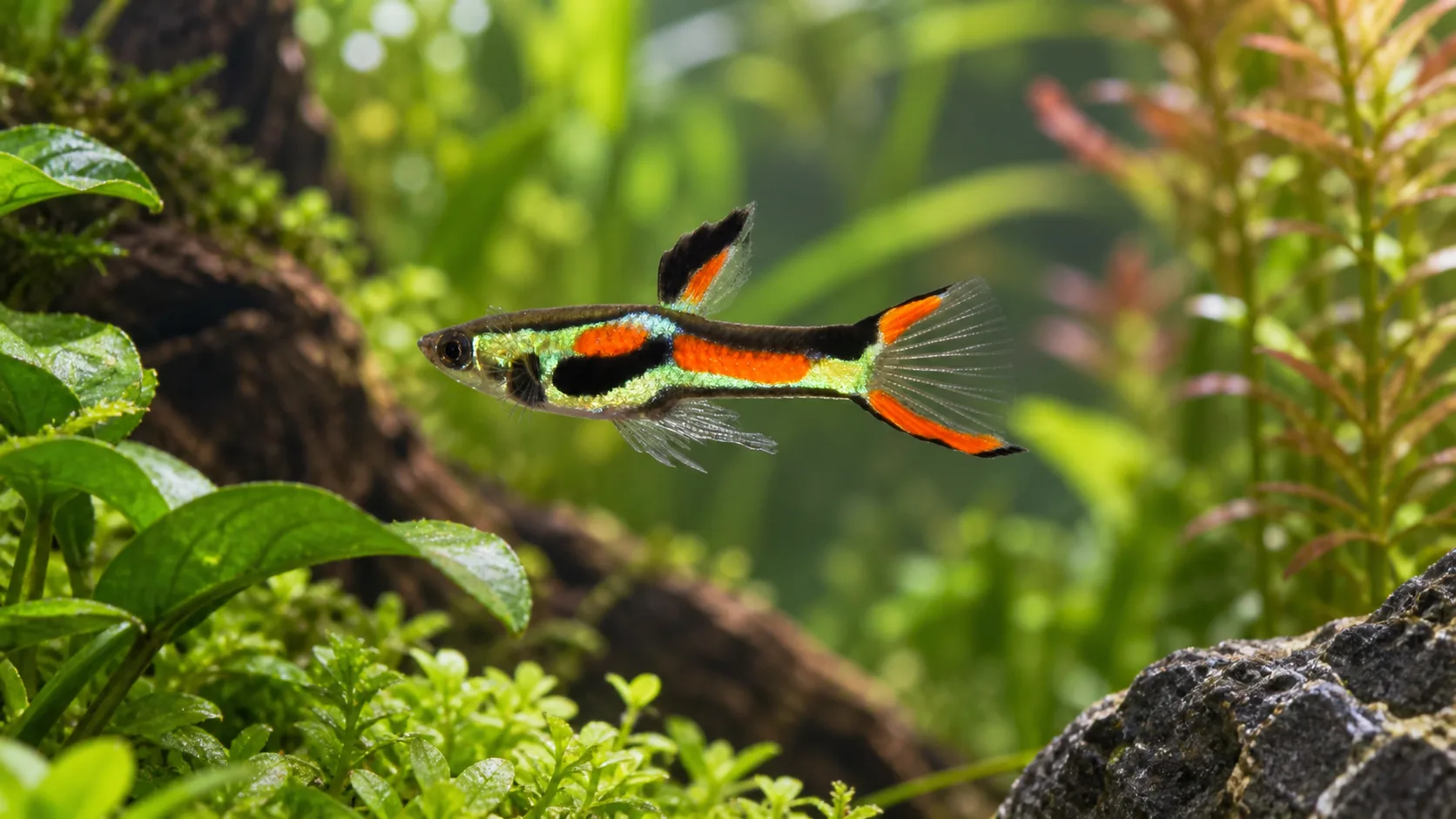
At a glance

- Adult size
- 1.9 to 3 cm
- Minimum footprint
- At least a 45 by 30 cm aquarium base
- Minimum volume
- 41 litres
- Social structure
- Active colony fish; choose a male-only display or a managed mixed group with planted refuge and offspring capacity.
- Sex ratio
- A mixed group needs several females per male and enough refuge that every female can feed and rest; no rigid universal ratio is promised.
- Diet
- Omnivore
- Feeding
- Use a complete fine staple with plant material and small animal-food variety, distributed so females and juveniles feed.
- Waste load
- Low per adult but potentially high as retained fry mature
- Family
- Poeciliidae
- Native range
- Campoma and Buena Vista lagoon systems in northern Venezuela
- Conservation status
- Endangered B1ab(iii,v), assessed 8 March 2021 Source
The usable footprint must support active horizontal movement, courtship escape and retained offspring; litres alone do not set colony capacity.
Know which Endler you are buying
The Endler's livebearer is Poecilia wingei, a small Venezuelan freshwater fish in the family Poeciliidae. The current Catalog of Fishes accepts it as a valid species, while FishBase records it from the Campoma and Buena Vista lagoon systems in northern Venezuela.
That name tells you what the species is. It does not prove that every brightly patterned shop fish has documented P. wingei ancestry, because Endlers and common guppies can hybridize and captive lines can lose their history as they change hands.
- Accepted identity
- Poecilia wingei Poeser, Kempkes and Isbrücker, 2005
- Family
- Poeciliidae
- Recorded range
- Campoma and Buena Vista lagoon systems, northern Venezuela
- Type-series male length
- 18.8 to 21.3 mm standard length
- Type-series female length
- 26.9 to 30.4 mm standard length
- Published aquarium footprint
- 45 by 30 cm base, about 41 litres
- Published maintenance range
- 24 to 30 °C, pH 7.0 to 8.5, 15 to 35 dGH
- Wild status
- Endangered B1ab(iii,v), assessed 8 March 2021
The common guppy is Poecilia reticulata. The original P. wingei description compared body color, male courtship and anatomical characters with guppies, and current taxonomy continues to recognize the two names.
A controlled hybrid study produced reciprocal first-generation hybrids and then second-generation hybrids. The species boundary is real, but it does not prevent fertile crosses.
| Decision factor | Option A | Option B |
|---|---|---|
| Accepted name | Poecilia wingei | Poecilia reticulata |
| Typical adult male | Very small body with compact fins and bold black, orange or metallic patches | Usually larger, with many domestic lines selected for broad tails and extensive color |
| Typical adult female | Larger than the male, deeper-bodied and comparatively plain | Larger than the male, often plain unless selected domestic color is present |
| What appearance can establish | A likely visual match to a described form | A likely visual match to a guppy form |
| What appearance cannot establish | Pure ancestry or an unbroken locality line | Absence of historical Endler ancestry |
| Breeding consequence | Can produce fertile experimental hybrids with guppies | Can produce fertile experimental hybrids with Endlers |
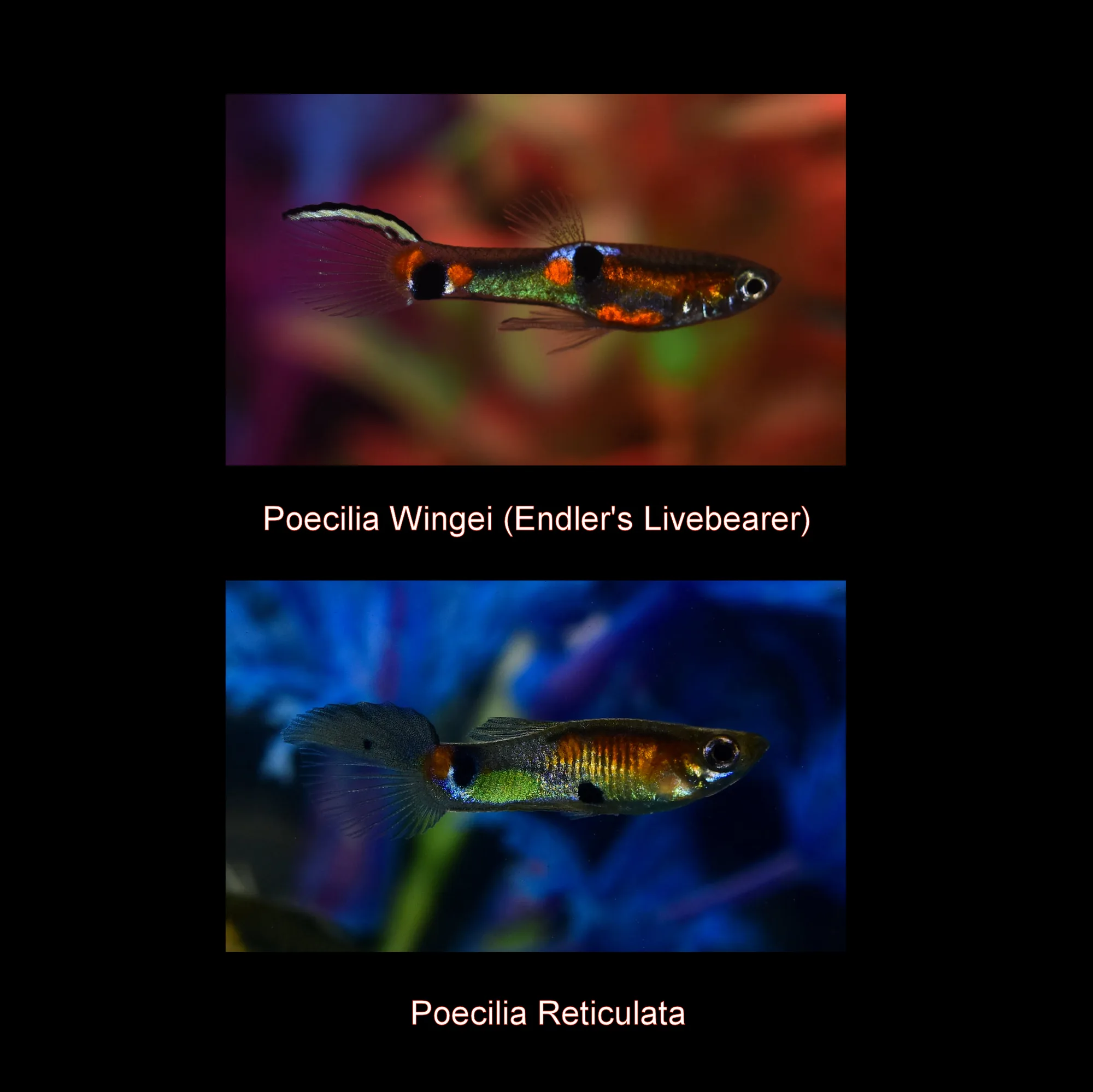
Ask the seller for the scientific name, the source of the line and whether guppies have shared any breeding tank. If the answer is unknown, the honest description is unknown lineage, even when the fish makes a perfectly suitable aquarium animal.
Breeder classes such as N, P or K can organize records within a breeding community, but a letter is only as reliable as the history behind it. Keep guppies out of a line maintained as P. wingei, and never sell uncertain descendants as pure stock.
Male and female Endlers change the whole plan
Mature males are smaller, slimmer and much more colorful. Mature females are longer and deeper through the abdomen, usually gray or olive-silver, and often carry far less of the black and orange pattern associated with the males.
The anal fin is the more functional distinction. A mature male has a narrow modified gonopodium, while a female retains a broad fan-shaped anal fin.
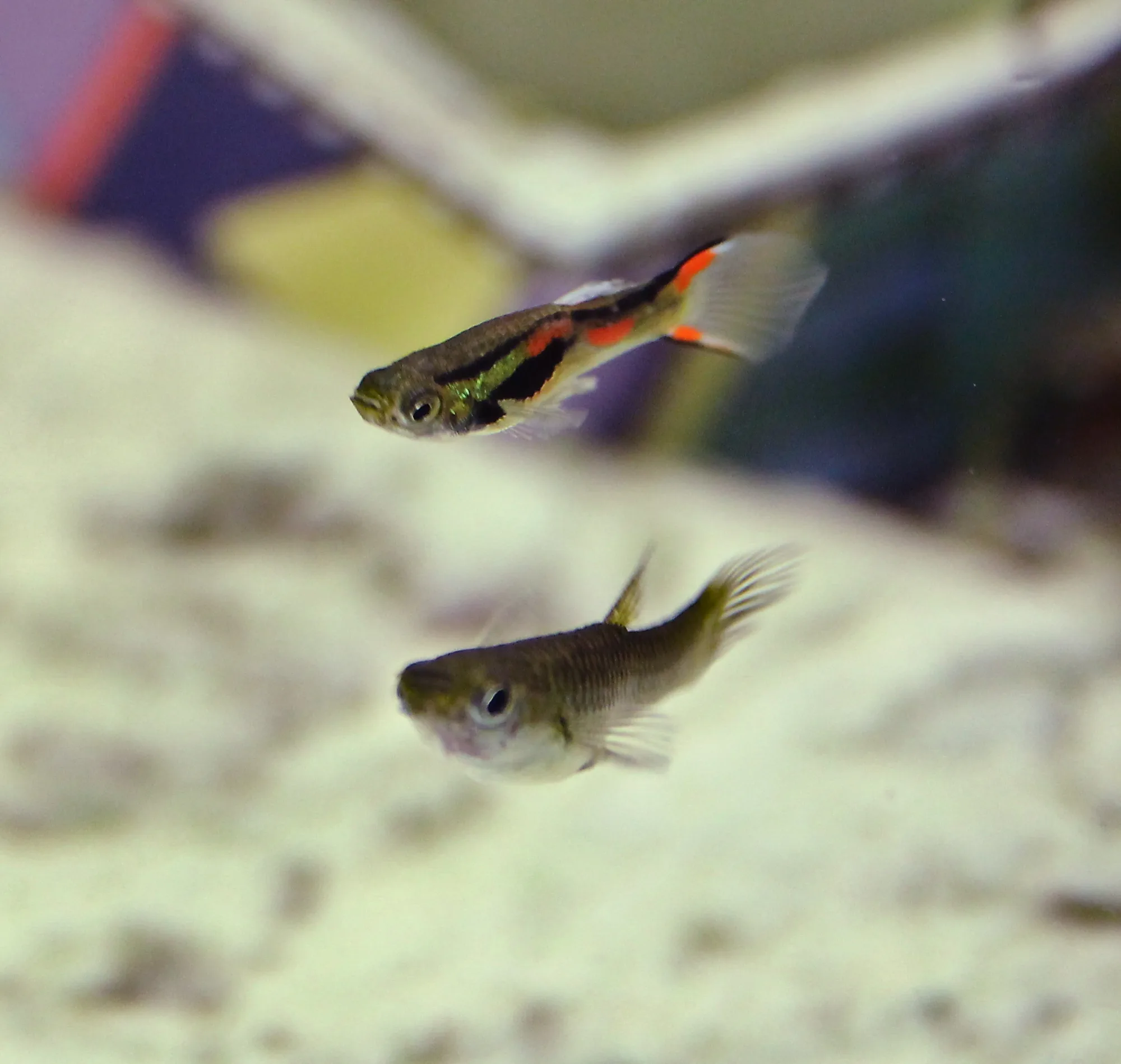
| Character | Mature male | Mature female | Limit |
|---|---|---|---|
| Type-series standard length | 18.8 to 21.3 mm | 26.9 to 30.4 mm | Five fish of each sex were measured, so this is a sample rather than a universal size range |
| Color | Strong black, orange and metallic patches are typical | Usually gray or olive-silver with subdued markings | Captive selection and hybrid ancestry can alter color |
| Body depth | Slimmer | Deeper, especially through the abdomen | Feeding and reproductive condition change body shape |
| Anal fin | Narrow gonopodium | Broad fan-shaped fin | The difference is less obvious in immature fish |
| Population consequence | Male-only groups do not produce fry | A female acquired from mixed stock may already have mated | A shop cannot infer reproductive history from one photograph |
Juveniles create most sexing mistakes. A pale small fish may be an undeveloped male, and an immature anal fin should not be forced into a confident answer from one quick photograph.
Observe the fish from the side in neutral light and combine anal-fin shape, adult proportions and color. Buy a male-only group only when the sex is mature and clear, because one misidentified female changes a display tank into a breeding colony.
Plan the tank around the next brood
Seriously Fish recommends a base of at least 45 by 30 cm, approximately 41 litres, for a substantial colony. The footprint matters more than volume alone because Endlers use horizontal routes, and females need room to leave persistent male attention.
Treat that footprint as a starting benchmark for a deliberately stocked group. Plants, wood, substrate and filters reduce usable space, while each surviving brood adds feeding competition, oxygen demand and waste.
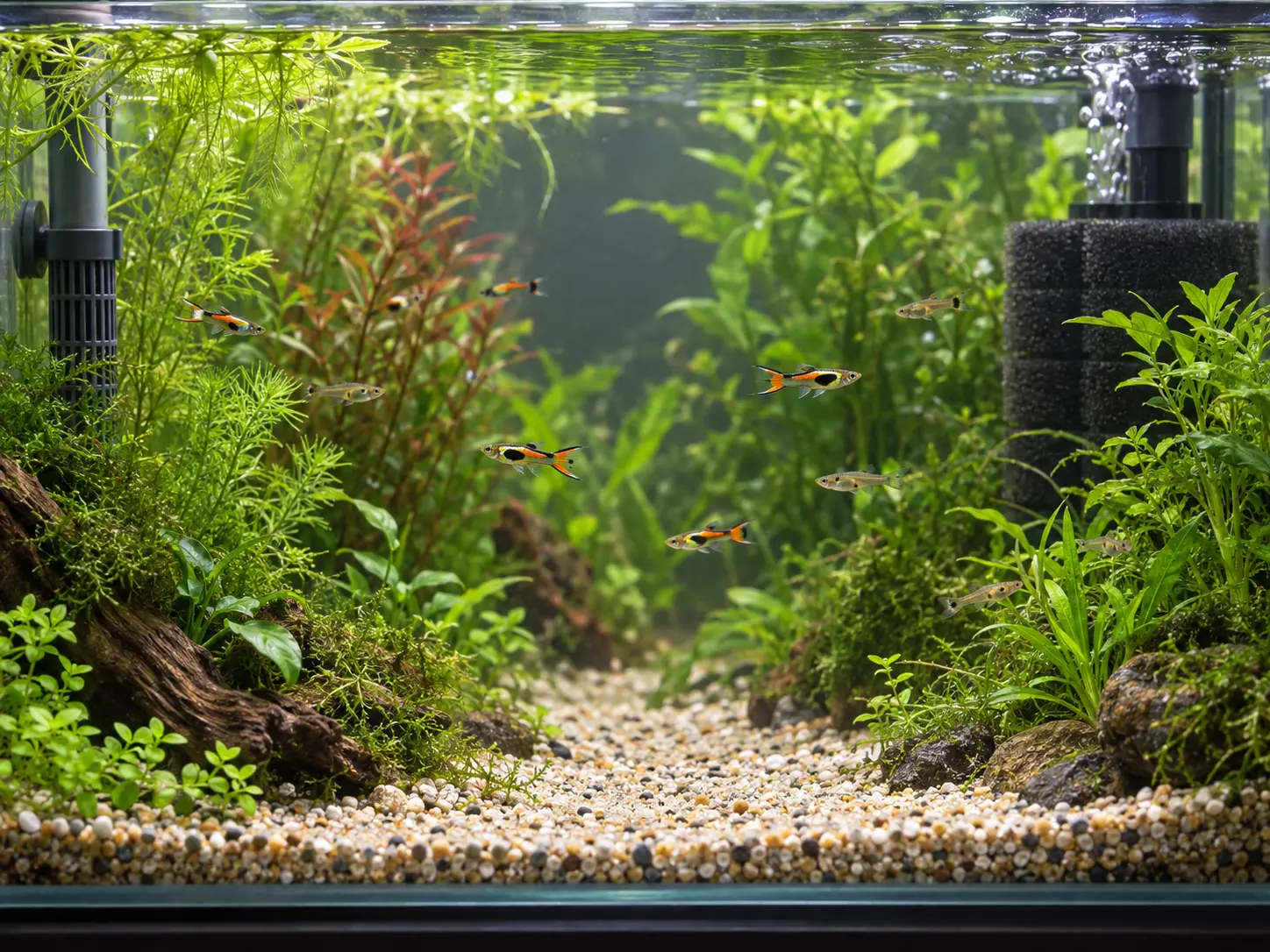
Open swimming lane
Preserve a clear horizontal route instead of filling the entire footprint with hardscape.
More than one refuge
Use fine-leaved or floating plants in separate areas so one fish cannot control all cover.
Protected filtration
Fit a sponge filter or intake guard where newborn fry cannot be pulled into the filter.
Steady gas exchange
Move the surface without turning the whole aquarium into a fast current.
Secure cover
Close gaps around cables and pipes because a startled small fish can find a narrow opening.
Countable sightlines
Leave enough open water to see whether every adult and juvenile can feed and breathe normally.
A male-only display and a mixed breeding group do different jobs. In a mixed group, several females per male usually spread courtship pressure, but the result still matters more than the ratio: every female must be able to feed, rest and cross the tank without immediate interception.
Adding fish can spread one male's attention, yet it can also turn social pressure into crowding. Increase the group only when the footprint, filtration and plan for offspring can support the higher count.
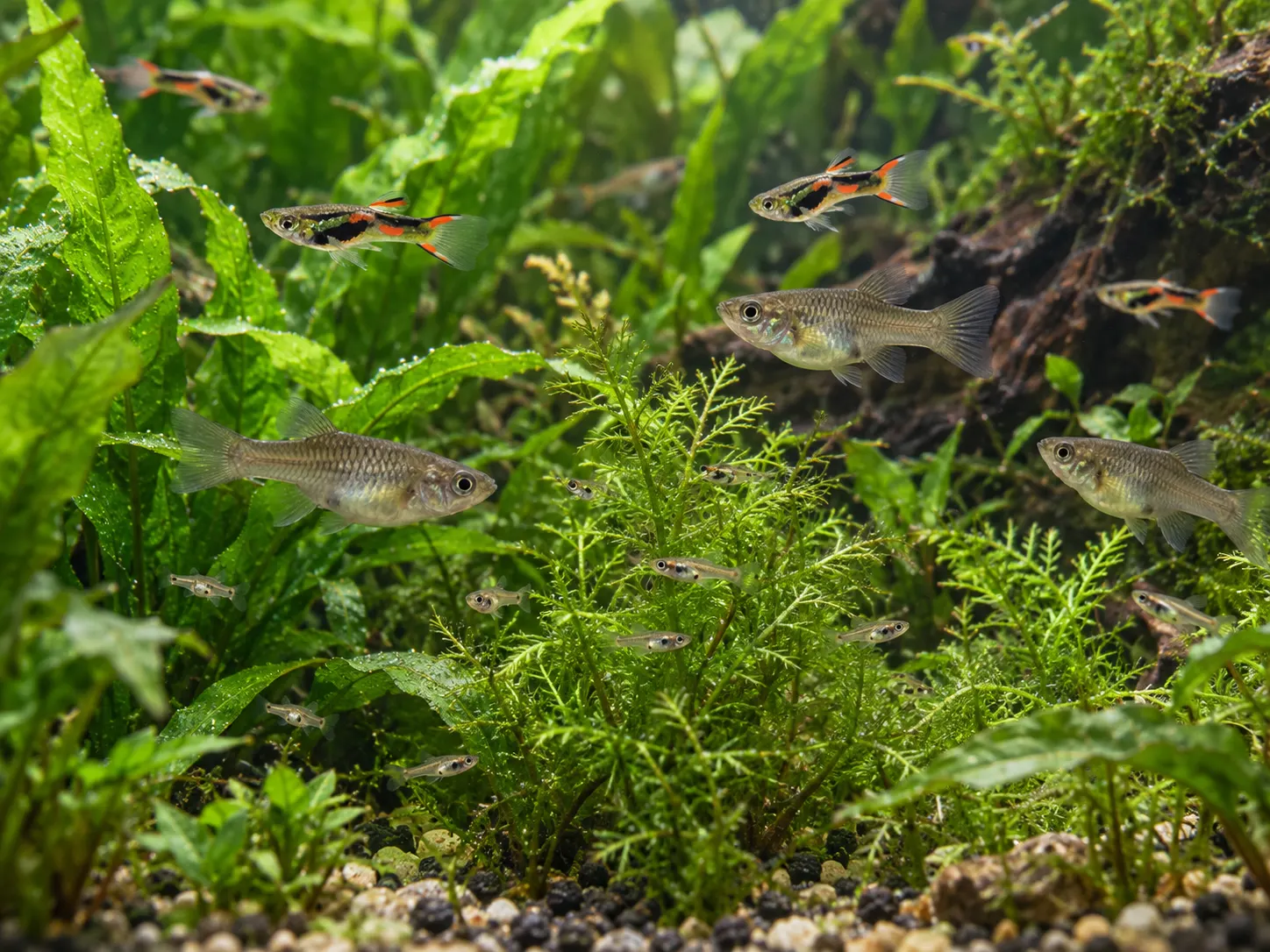
A 2021 laboratory life-history study followed 12 females and 3 males and recorded 10 litters containing 122 fry. It reported a mean of 17.33 fry per litter, newborn total length of 7.75 mm and a mean male maturity endpoint at 37.33 days.
Those figures describe one Blue Japan captive variety under warm controlled conditions. They do not predict the next litter in your aquarium, but they show why population growth can outrun a small tank quickly.
Dense plants and fry-safe filtration allow more young to survive, while adults or tank mates may consume some fry in a more open tank. Neither outcome replaces a decision about grow-out space, responsible rehoming or a male-only group.
What water does an Endler's livebearer need?
Published aquarium guidance places P. wingei in warm, neutral-to-alkaline and moderately hard to hard freshwater. Seriously Fish gives 24 to 30 °C, pH 7.0 to 8.5 and 15 to 35 dGH, which is a maintenance context rather than permission to move fish abruptly across the whole range.
Published Endler's livebearer maintenance ranges
- Temperature24 to 30 °CSeparate aquarium thermometer away from the heater.
- pH7.0 to 8.5Calibrated meter or a liquid test covering the source-water value.
- General hardness15 to 35 dGHGH titration test reported in degrees of general hardness.
Every range above applies to Captive Poecilia wingei maintenance in a freshwater system. Source: Seriously Fish, checked 2026-09-13.
The 2021 laboratory study maintained its fish at 27 to 28 °C, pH 7.0 to 7.5, general hardness 110 to 120 mg/L, carbonate hardness 90 to 95 mg/L and dissolved oxygen 5.6 to 6 mg/L. Ammonia and nitrite were reported at 0 mg/L.
That successful laboratory setting does not cancel the broader aquarium range. The figures also cannot be averaged directly with degrees of hardness because the study and husbandry source report different units and contexts.
Start with the water used by the breeder or retailer. Compare temperature and pH before transfer, add conductivity or GH when the two waters may differ substantially, and slow acclimation when the measured gap is large.
Once the fish are established, stable water matters more than chasing a fashionable pH. Keep ammonia and nitrite at zero, control nitrate through measured feeding and water changes, and match replacement water closely enough that routine maintenance does not create a chemistry shock.
Warm water carries less dissolved oxygen than cool water, and a growing colony consumes more oxygen than the original adults. Surface movement and a clean, mature filter become more important as both temperature and fish count rise.
Do not add salt as routine compensation for soft source water or poor maintenance. If measured GH is unsuitable, use a freshwater remineralization method, verify the result with a test and make changes gradually.
What should Endler's livebearers eat?
Endlers are omnivores with very small mouths. Seriously Fish describes wild feeding that includes zoobenthos and detritus and notes that vegetable matter should be present in the captive diet.
Use a complete micro-pellet, fine granule or quality flake as the regular base. Small daphnia, Artemia nauplii, microworms or finely prepared frozen foods can add variety, but rich animal foods should not displace the complete staple.
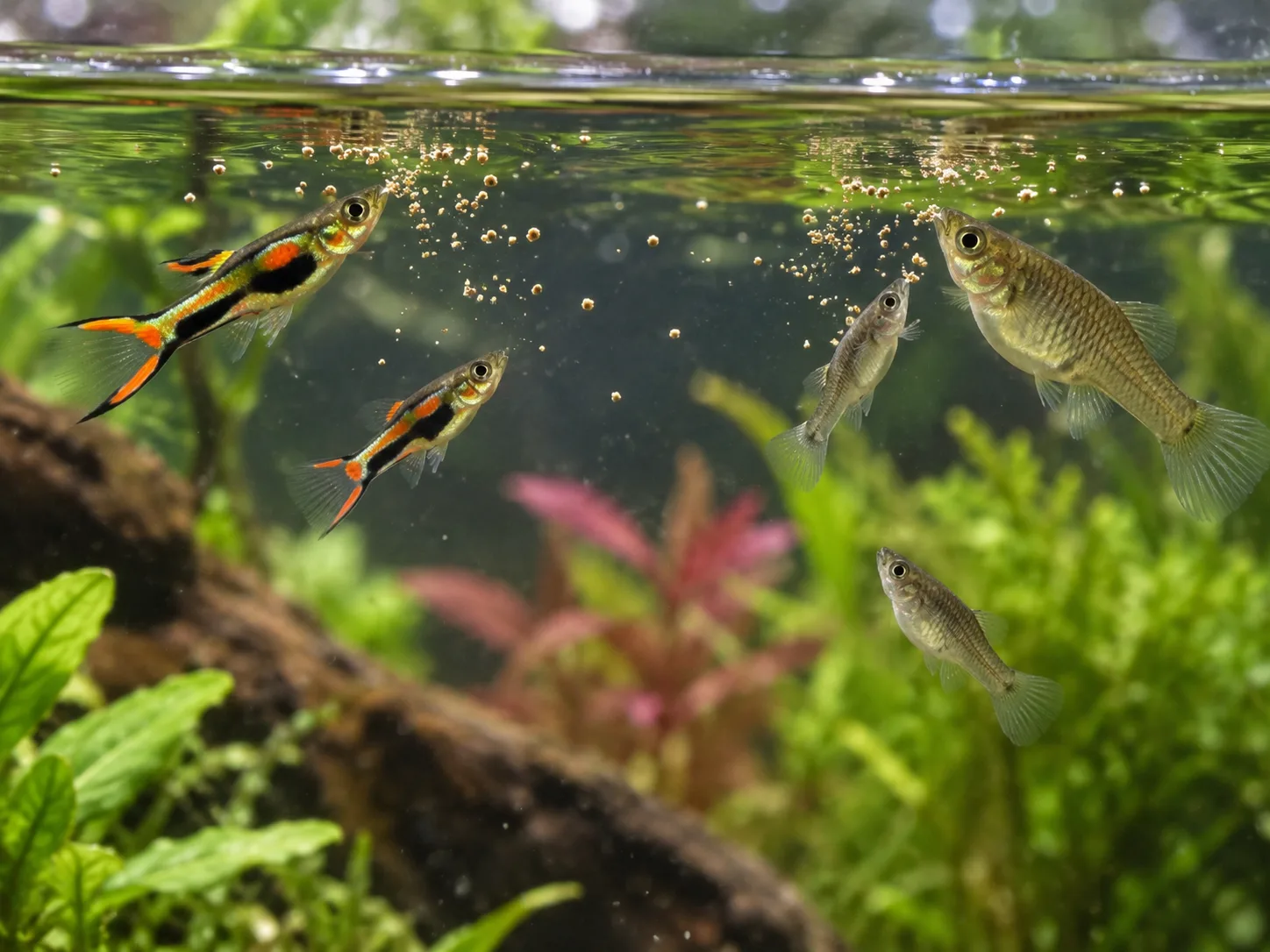
- Match the smallest mouth Each fish should swallow the particle promptly rather than repeatedly spit out an oversized piece.
- Use two feeding points Spread a small portion across separate surface areas so one quick fish cannot collect every particle.
- Watch one complete meal Confirm that females, juveniles and subordinate fish actually swallow food.
- Keep a complete base Rotate suitable small foods without turning one treat into the entire ration.
- Stop before food settles End the meal while the fish are clearing suspended particles, then reduce the next portion if food reached the floor.
Small bodies make excess food look harmless, but uneaten dust raises microbial demand and nitrogen waste quickly in a compact aquarium. A bright dominant male is not evidence that the whole group is eating well.
Judge the ration by body condition, growth and access across the group. A harassed female or late-feeding juvenile can lose condition behind the plants while the fastest fish remain full.
Fry need smaller particles and more frequent access, which also creates more waste. A mature sponge filter, plant refuge and measured portions work together; powdered food cannot make an immature or overloaded aquarium safe.
Tank mates must pass three tests
A proposed tank mate must overlap the Endlers' water, leave them enough space and allow every fish to feed without injury. The label peaceful covers only behavior and says nothing about mineral range, temperature, mouth size or feeding speed.
Guppies require a separate rule. They may share suitable water and social behavior, but keep them apart whenever known P. wingei lineage matters because fertile hybridization defeats that purpose.
Body size alone cannot decide compatibility.
Small fish with very different constraints
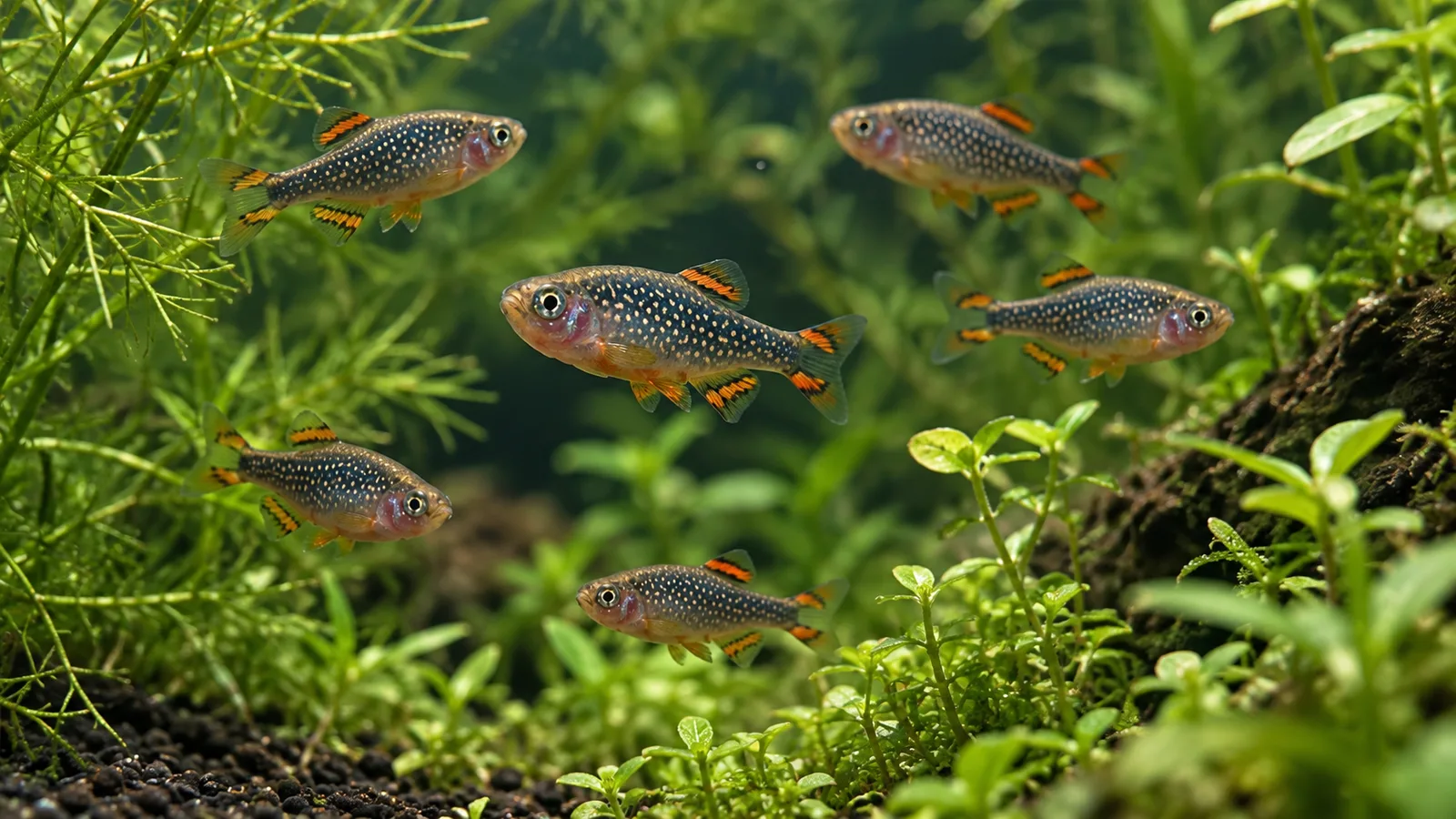 Celestial pearl danio
Similar adult size, but its documented 22 to 24 °C type-locality water sits below much of the Endler maintenance range.
 Chili rasbora
Tiny and planted-tank friendly, but its published hardness ceiling of 10 dGH conflicts with the Endler range of 15 to 35 dGH.
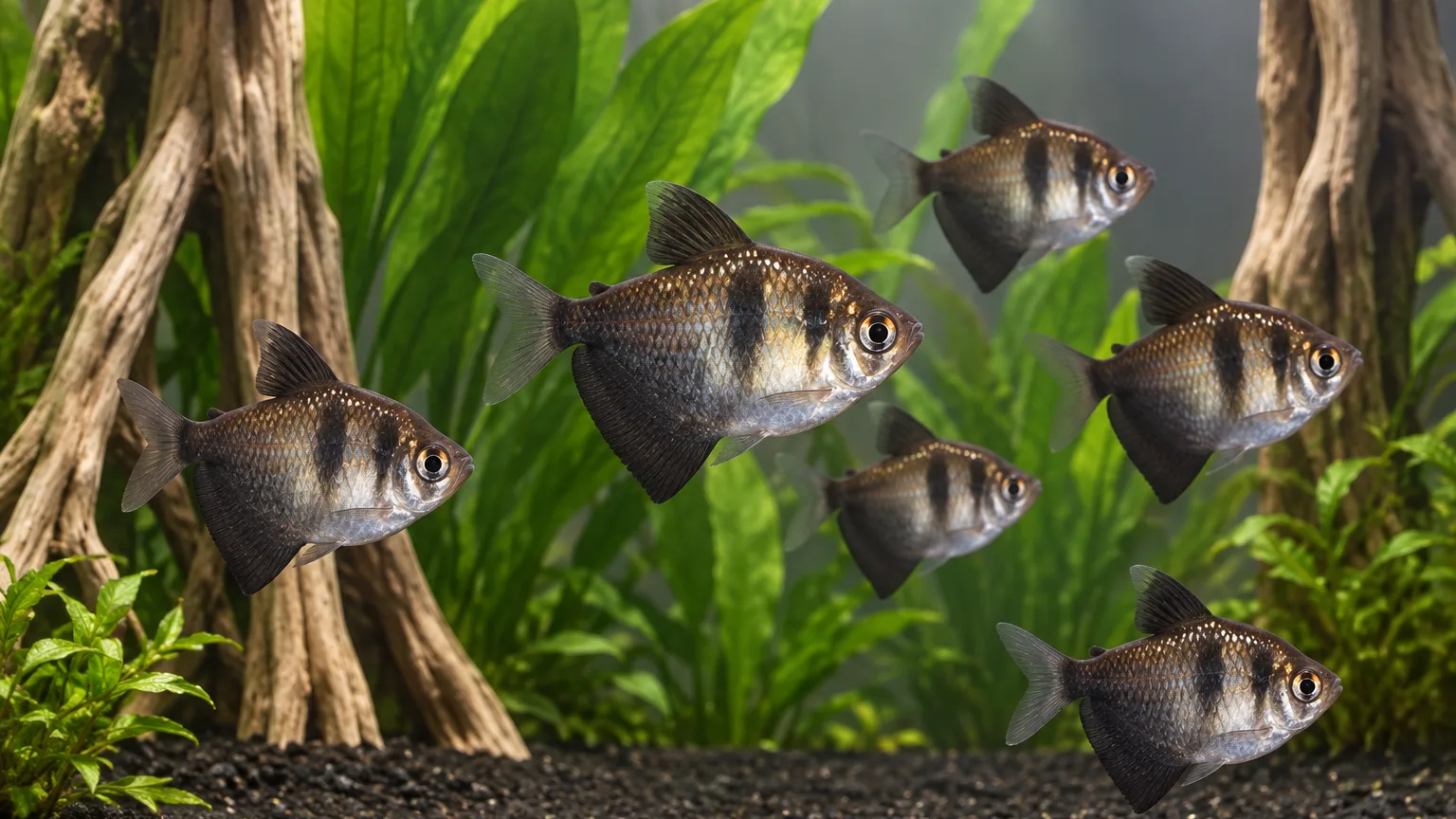 Black skirt tetra
A larger deep-bodied shoaling fish that needs its own horizontal room and monitoring for harmful pursuit or fin damage.
 Bucktooth tetra
A scale-feeding species that belongs in a large single-species group, not with small livebearers.
A single-species Endler aquarium is often the clearest use of a 45 by 30 cm footprint. It makes courtship, feeding access, pregnancy and population growth easier to read without a second species claiming the same water and swimming room.
For a community, compare adult size, group size, temperature, pH, hardness, swimming level, mouth size and feeding speed before purchase. Add the space and bioload needed by both groups instead of treating Endlers as free capacity because they are small.
Small shrimp may coexist with adults, but newborn shrimp and fish fry can be eaten. Snails avoid the hybrid issue, yet their feeding and reproduction still count toward total waste.
Quarantine new fish separately with stable heat and mature filtration before mixing groups. An active shop fish can still carry a health problem, and direct introduction makes later observation and separation harder.
Read the colony before you treat it
Brief pursuit can be normal courtship, but constant attention that prevents a female from feeding or resting is a welfare problem. Repeated hiding, clamped fins, torn fins, weight loss, rapid breathing or whole-group surface crowding call for measurements before medication.
Check a struggling Endler colony in this order
- Temperature and toxic nitrogen Verify temperature, ammonia and nitrite with working tests before changing food or medication.
- Oxygen and circulation Look for whole-group rapid breathing, surface crowding or improvement near the filter return.
- Population and waste Count adults and juveniles, compare the count with the last maintenance record, and inspect the filter for reduced flow.
- Courtship pressure Observe whether the same female can leave a chase, reach food and rest behind more than one sight break.
- Food access Watch one complete meal and confirm that small juveniles and subordinate adults swallow food.
- Individual health Isolate an injured fish safely and seek an aquatic veterinarian for persistent breathing trouble, wasting, swelling, sores, balance loss or unexplained deaths.
When the whole group changes
When several fish change behavior together, test the shared environment first. Check temperature, ammonia, nitrite, surface movement and filter flow before assuming every fish acquired the same disease.
Crowding can appear gradually because the tank once supported its original adults. More juveniles, heavier feeding and reduced filter flow can push the same water volume past its previous oxygen and waste capacity.
When one fish changes
When one female hides or loses condition while the rest remain active, watch where each chase begins and ends. Rearrange cover only if you can preserve open swimming room, and separate the fish when injury or complete feeding exclusion continues.
Make one controlled correction at a time unless toxic nitrogen, oxygen failure or severe injury creates an emergency. Simultaneous changes to temperature, chemistry, filtration and group structure can add another shock and hide the original cause.
Endangered status changes sourcing decisions
FishBase displays Poecilia wingei as Endangered under criterion B1ab(iii,v), assessed on 8 March 2021. The assessment concerns a restricted wild range together with continuing decline in habitat quality and mature individuals.
That status describes wild populations. It does not certify the lineage of a shop fish, and keeping an undocumented captive group does not automatically contribute to conservation.
FishBase also records the species as not evaluated by CITES. A missing CITES listing does not mean wild collection is harmless, legal in every place or useful to the species.
Choose traceable captive-bred fish when available and retain the breeder name, locality claim and known crosses. If those details are absent, record the fish as unknown lineage rather than improving its history when it changes hands.
The original species account described a clear Campoma stream with dense vegetation along the banks but no submerged vegetation at the observation point. That is useful natural-history context, not a collection invitation or one mandatory aquarium layout.
Is an Endler's livebearer right for your tank?
An Endler group fits when you have a mature aquarium with at least a 45 by 30 cm base, stable warm mineral-rich water, protected filtration, open swimming room and planted refuge. You must also know the sex composition and decide what happens if a mixed group produces young.
Choose mature males only when you want color without births. Choose a mixed colony only when you have grow-out or confirmed rehoming capacity and can prevent guppy crosses if the line is being kept as P. wingei.
Delay the purchase when the water is very soft and unstable, the available tank is tall but narrow, a predator shares the space or surplus fry have no destination. The fish's small adult size does not solve any of those conflicts.
No strong species-specific lifespan figure appeared in the reviewed taxonomic, institutional and life-history sources, so a precise two-year or three-year promise would overstate the evidence. Plan beyond the purchased adults because the practical commitment may include several later generations.
The best fit is a keeper willing to count fish, measure water and separate lineage records from appearance. When you can provide that routine, an Endler colony offers constant activity and color without asking you to ignore the females, fry or filter that make the aquarium work.
Which small fish are useful comparisons?
Black neon tetra
A small midwater shoaler whose group movement and softer water options contrast with a livebearer colony.
Ember tetra
A tiny warm-water tetra with lower competitive weight and a much smaller mouth at feeding time.
Emerald eye rasbora
A tiny rasbora whose cooler range and quiet shoaling pattern create a different constraint set.
Cherry barb
A planted-stream group fish that changes the social structure, breeding pattern and habitat-cover question.
Cardinal tetra
A blackwater shoaler whose soft acidic context sits far from the hard-water range documented for Endlers.