
What Is a Celestial Pearl Danio, and How Small Is It?
Danio margaritatus
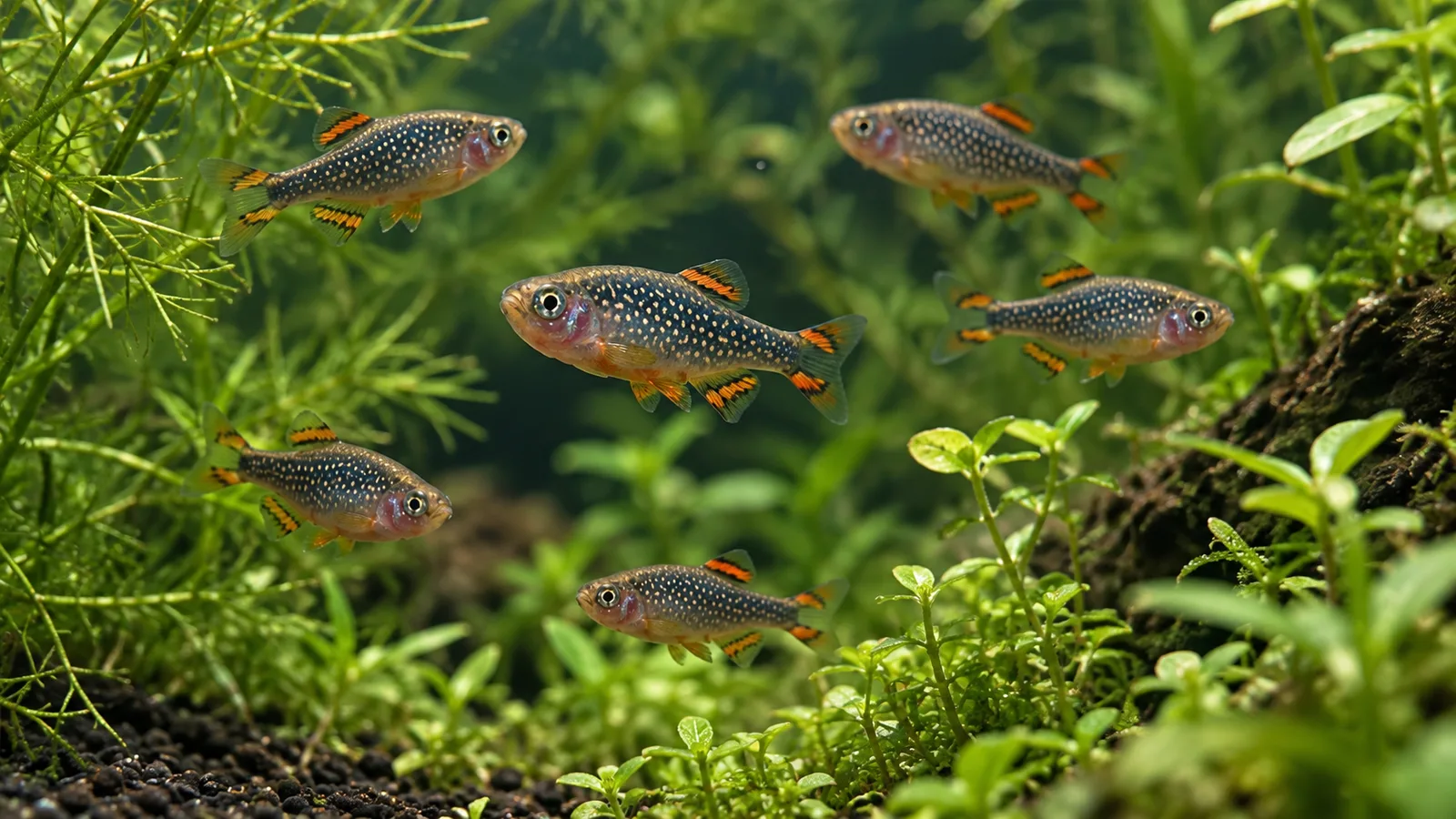
The celestial pearl danio is Danio margaritatus, a two-centimetre spotted minnow described from Myanmar in 2007 and already in the aquarium trade before it was named. Its shyness, its group size and its filter risk all follow from how small it is and what it was found living in.
At a glance

- Adult size
- 2.1 cm
- Minimum footprint
- A planted aquarium long enough to hold several male territories rather than a small cube
- Social structure
- A dozen or more, with more females than males, so no single fish absorbs a dominant male's attention.
- Minimum group
- 12
- Sex ratio
- More females than males. Males are deeper through the caudal peduncle and posture at one another.
- Diet
- Carnivore
- Feeding
- Micro-sized dried food with small live and frozen items; mouth size is the constraint rather than nutrition.
- Waste load
- low
- Family
- Danionidae
- Native range
- Shallow spring-fed ponds near Hopong, east of Taunggyi, Myanmar, at about 1,040 m
- Also sold as
- galaxy Microrasbora, galaxy rasbora. Trade and hobby names, not accepted species names.
- Former scientific names
- Celestichthys margaritatus. Superseded names for this same species.
- Conservation status
- Data Deficient, assessed 22 January 2010 Source
The original description records fin nipping of smaller males by dominant males as common in small aquaria, so floor space and group size are one decision.
What is a celestial pearl danio?
The celestial pearl danio is Danio margaritatus, a spotted minnow from Myanmar that reaches about 2.1 cm and was unknown to science until 2007.
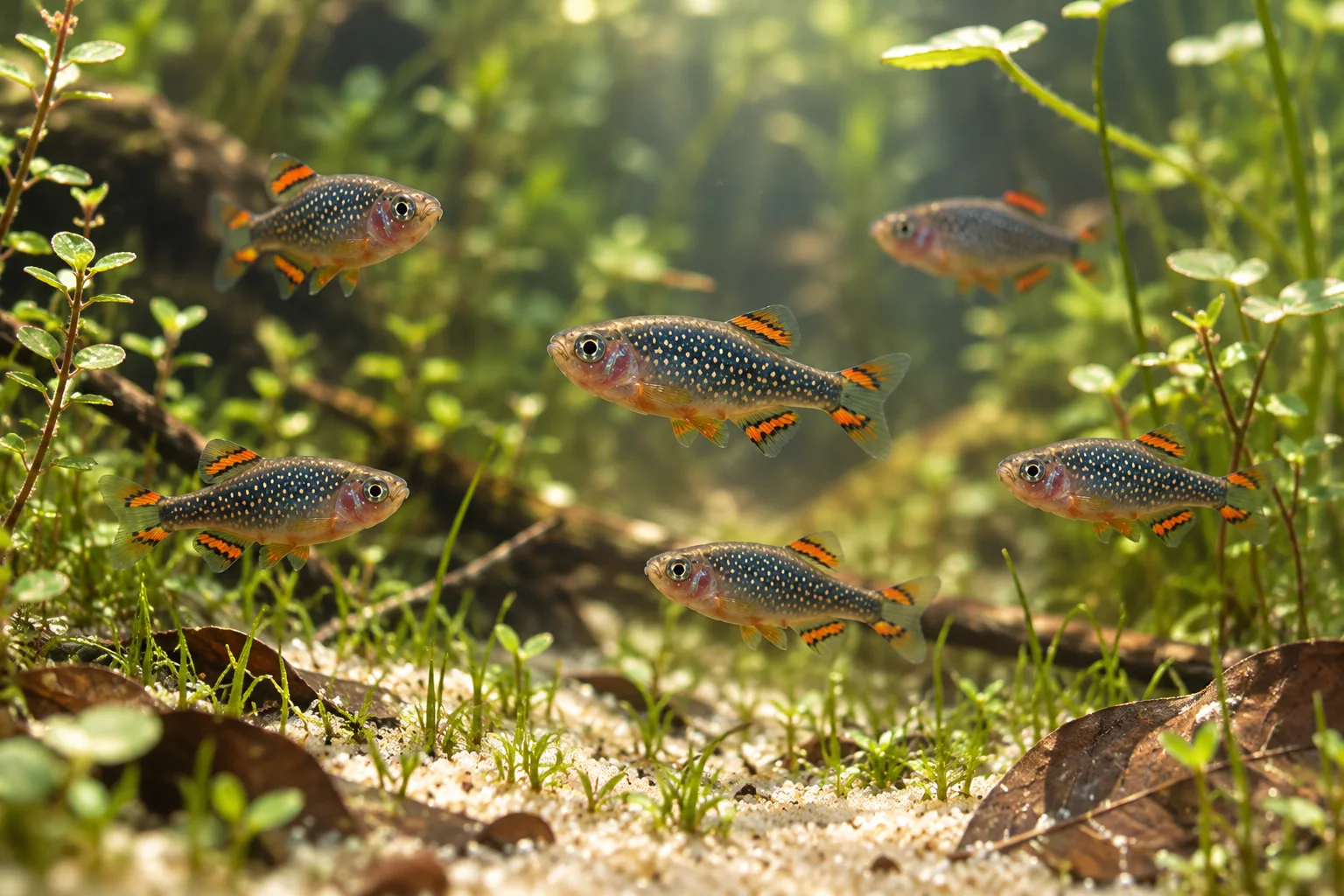
It is still widely sold as galaxy rasbora, which is a good description and the wrong fish. It is not a rasbora.
Tyson Roberts described it in the Raffles Bulletin of Zoology in 2007, from pools at the foot of a mountain near Hopong, roughly 30 km east of Taunggyi, at an elevation of 1,040 metres.
His description opens by noting that the fish was discovered in August 2006 and was already being exported as an aquarium fish. It reached the hobby before it reached science.
- Accepted identity
- Danio margaritatus (Roberts, 2007)
- Described as
- Celestichthys margaritatus, a new genus and species
- Family
- Danionidae, subfamily Danioninae
- Type locality
- Pools near Hopong, east of Taunggyi, Myanmar, at 1,040 m
- Recorded maximum
- 2.1 cm standard length
- Recorded habitat depth
- Ponds at most 30 cm deep
- Field water temperature
- 22 to 24 °C, measured January 2007
- Trade names in use
- Celestial pearl danio, galaxy rasbora
- IUCN assessment
- Data Deficient, assessed 22 January 2010
Almost everything that makes this fish difficult to keep well follows from two of those lines: how small it is, and what it was found living in.
Why does the name keep changing?
Roberts put the species in a genus of its own, Celestichthys, which is where the word celestial in the common name comes from.
A year later, Conway and colleagues moved it into Danio. Eschmeyer's Catalog of Fishes follows that placement today, while noting that Kottelat's 2013 catalogue kept the original genus.
So three names circulate for one animal, and all three have been correct at some point.
How big is it, really?
The holotype, a male, measured 21.2 mm standard length. The 303 paratypes collected with it ranged from 14.0 to 19.6 mm.
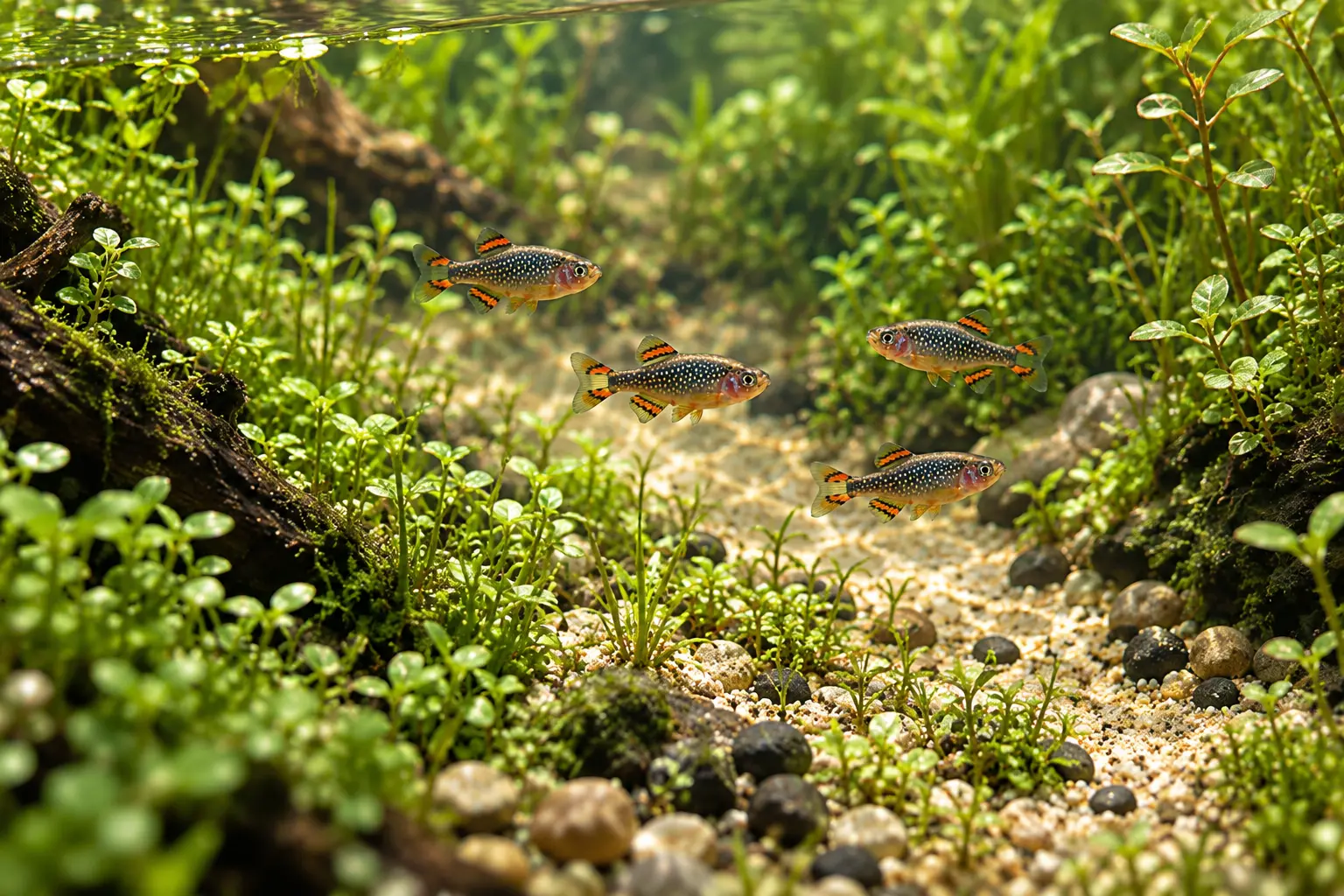
So the working figure is a fish of about two centimetres, and standard length stops at the base of the tail.
That is small enough to change equipment decisions rather than just stocking ones.
A conventional filter intake will draw in a fish this size, and a hang-on-back or internal filter needs a sponge guard fitted before the fish go in rather than after the first one disappears. Any gap a 2 cm fish can enter, it eventually will.
Food has to be small enough too, which is a separate problem from food being nutritious.
What was it actually found living in?
This is the part that explains the animal, and the original description is unusually specific about it.
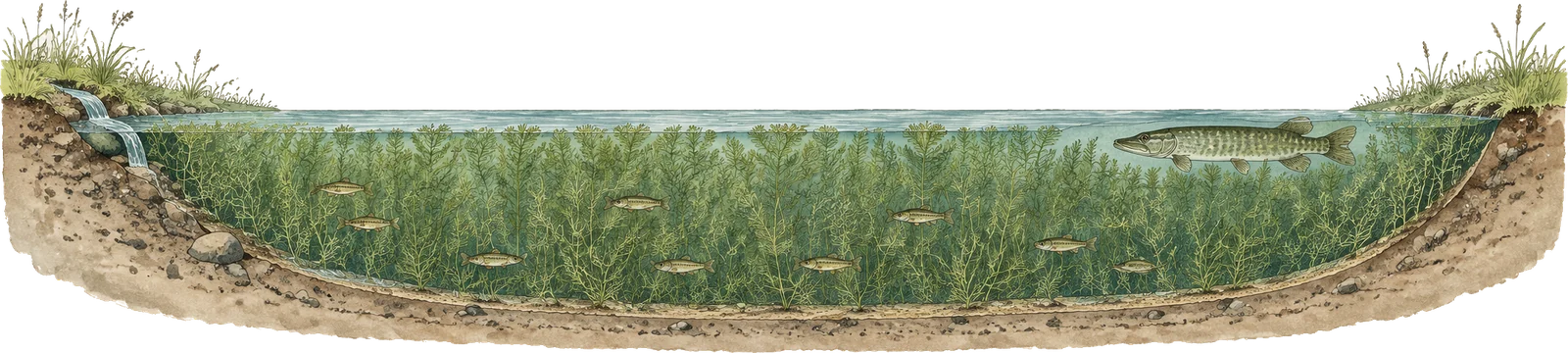
Roberts recorded the ponds as clear unless roiled, with luxuriant submerged plants of one or two species similar to Elodea, and water at 22 to 24 °C in January 2007.
He recorded something else that gets repeated far less often. The type locality sat in an area he described as rapidly developing, with the natural vegetation largely cleared away, extensive road construction and housing estates.
That temperature is a field measurement rather than a compiled aquarium range, which makes it more useful than most numbers attached to a small fish.
The surrounding vegetation was open grassland. This is not a forest fish and it is not a blackwater fish, which matters because a great deal of advice aimed at small Asian minnows assumes both.
Only three other fish species came out of those ponds: a small Microrasbora, a small Yunnanilus loach, and Channa harcourtbutleri, a snakehead that eats fish.
A very short species list is what a small, isolated, spring-fed pond tends to produce. It is also what makes a habitat like that easy to lose.
Why is it shy, and what actually fixes that?
A 2 cm fish that lives in 30 cm of water alongside a predator does not spend its day in the open because it feels like it.
The instinct most keepers have is to open the tank up so they can see the fish. It produces the opposite result.
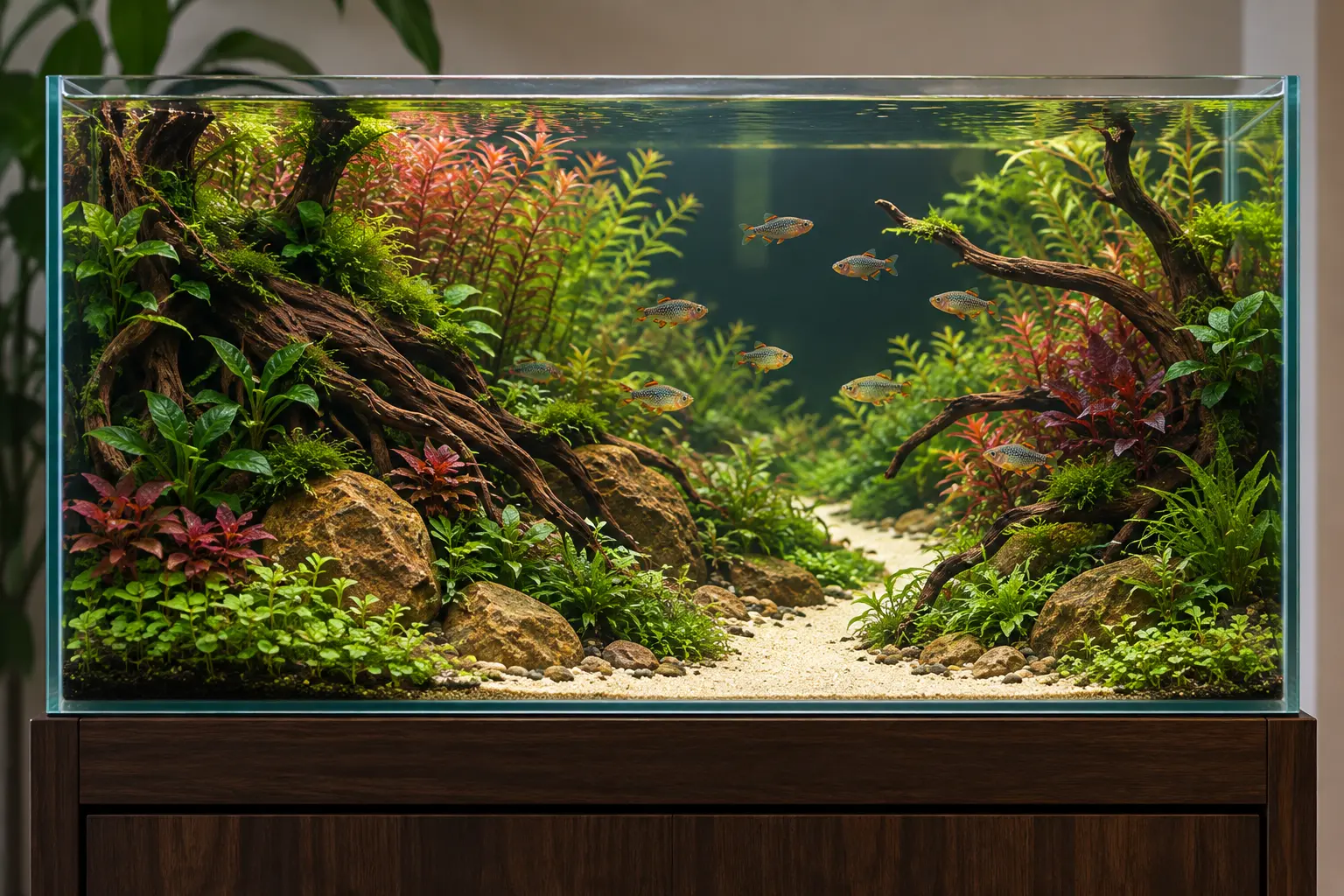
Plant heavily, especially at the ends and the back, and leave a clearing rather than a desert.
Keep the light moderate and break it at the surface with floating plants. Bright, even, top-down lighting over an open tank is the lighting this species has the least use for.
Give it time. A group moved into a new tank may take a fortnight to start using the open water, and moving the decor around resets that clock.
What does the group need, and how much tank?
Buy a proper group rather than a handful.
Roberts described the behaviour directly. The fish hover obliquely in shelter, dart when they move, and flare all their fins at rivals competing for territory or food.
He also recorded that fin nipping of smaller males by larger or dominant males is commonly observed in small aquaria.
That line is the argument for both the numbers and the floor space, and it comes from the person who described the species rather than from a forum thread.
A dozen or more, in a tank long enough to hold several male territories, spreads the pressure out. A trio in a small cube concentrates all of it on one fish.
More females than males is the arrangement most keepers settle on, for the same reason.
How do you tell males from females?
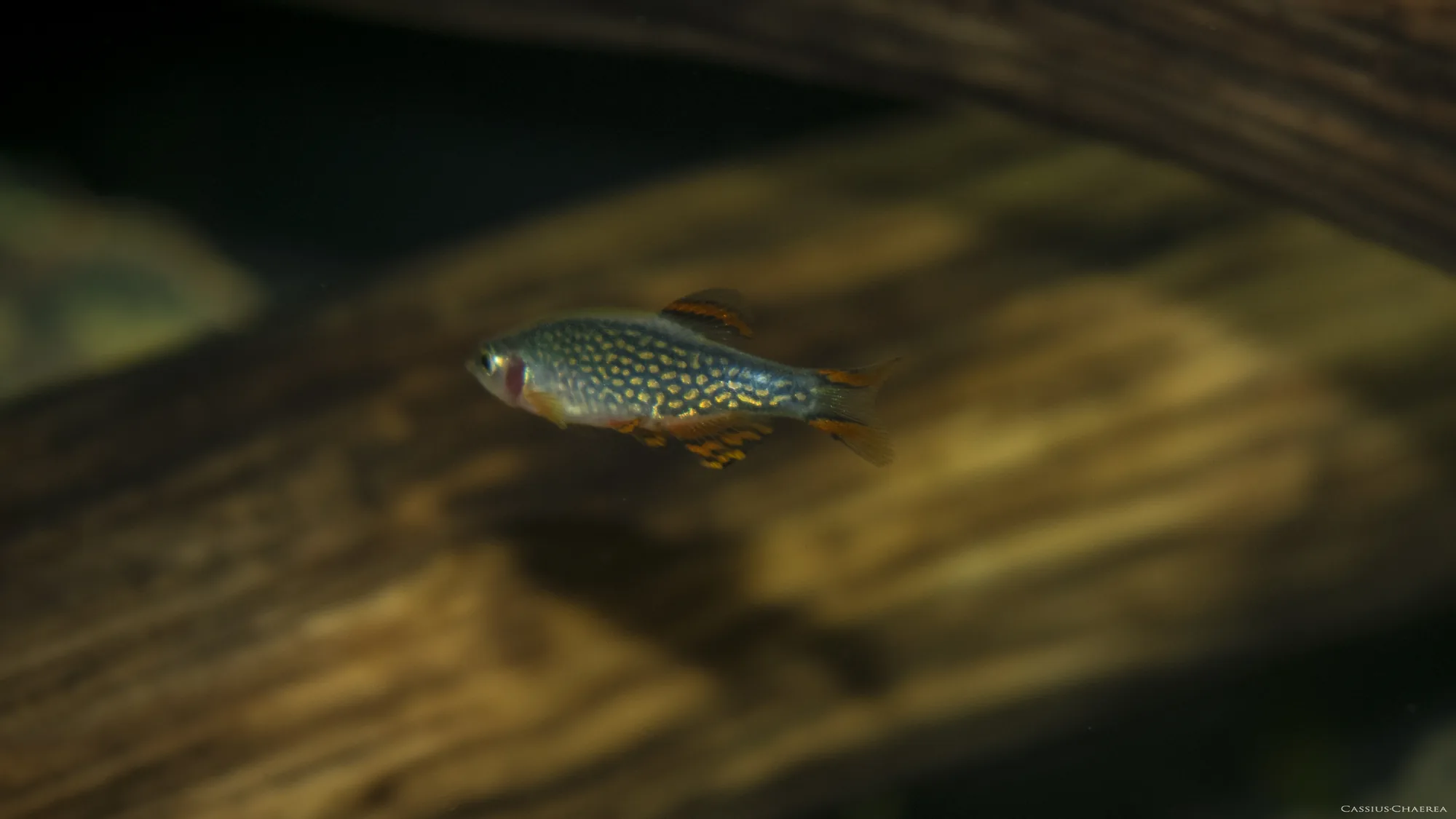
Both sexes are strikingly coloured, which is unusual in a small danionin and is why a shop tank looks uniform at first glance.
The structural difference recorded in the description is the depth of the caudal peduncle, the narrow section just in front of the tail. It goes 6.5 times into standard length in males and 7.3 times in females, so males are deeper through that part of the body.
On live fish in a planted tank, most keepers go by behaviour and belly shape instead.
Males posture and flare at one another; ripe females are rounder-bellied and usually less intensely marked in the fins.
What water does the record support?
The honest position on this species is that the aquarium literature has less to say than usual, and the field record has more.
Recorded freshwater context
- Temperature22 to 24 °CApplies to Danio margaritatus, measured at the type locality in January 2007. Field measurement reported in the original species description.
- Habitat depth0 to 1 m, ponds at most 30 cm deepApplies to Danio margaritatus recorded habitat. Depth recorded at the collection sites.
Every range above is for a freshwater system. Source: FishBase species summary, checked 2026-09-12.
Notice what is not there. FishBase publishes no compiled pH or hardness range for this species, so assigning one would create false precision.
What the record does support is a cooler tank than most tropical community fish get. A January measurement of 22 to 24 °C at 1,040 metres is not a fish that wants to be held at 27 °C all year.
Moderately hard, neutral water kept stable suits them in practice, and stability matters more than position. Measure your own water with the same test each time, acclimate slowly against whatever difference you find, and stop a transfer if fish gasp or lose balance.
What should a 2 cm fish be fed?
Mouth size is the constraint, not appetite.
A high-quality crushed or micro-sized dried food works as the routine. Small live and frozen foods, the sort sold for fry and nano fish, are what visibly improve condition and colour.
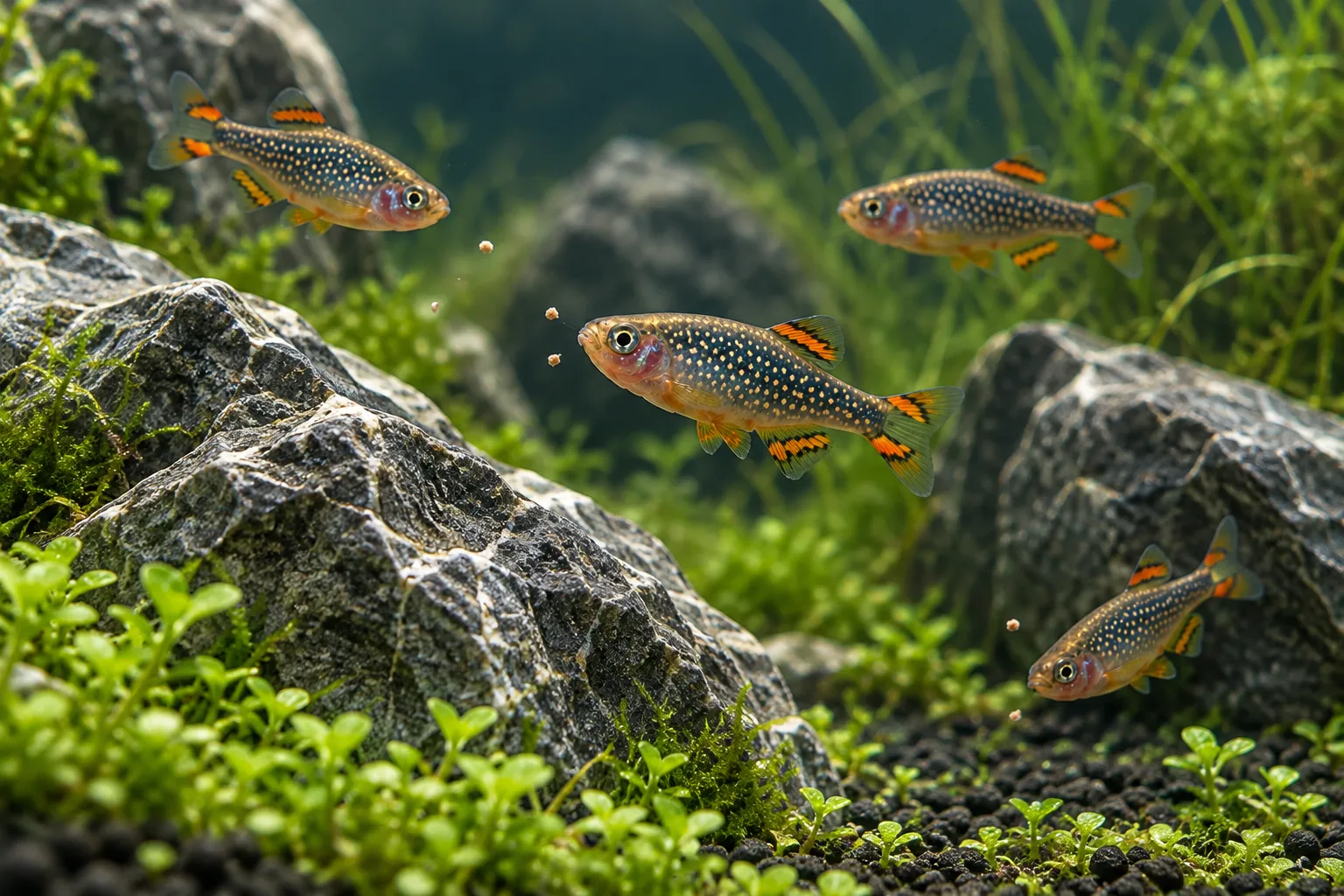
Feed small amounts often rather than one large portion, and watch that food actually reaches the fish rather than the plants. A heavily planted tank hides uneaten food as effectively as it hides fish.
Which tank mates suit them?
Very few, and the reason is the size rather than the temperament.
Most standard community fish are large enough to eat a 2 cm danio or fast enough to take every piece of food before it does. The snakehead in the type habitat is a useful reminder of which end of the food chain this animal occupies.
The species documented elsewhere on this site are mostly too big to be honest suggestions. A cardinal tetra is the closest of the tetras in size and still outcompetes them at feeding time in a small tank.
A chili rasbora is the one genuine match here: similar length, similar mouth, and the same preference for a densely planted tank.
A Betta fish is a poor idea for the obvious reason, and a brilliant rasbora at three or four times the length is simply a different fish for a different tank.
A species tank, or a tank shared only with small invertebrates and similarly tiny fish, is where this animal actually does well.
Can celestial pearl danios be bred at home?
They had been bred in captivity before the species was formally described. Roberts credits aquarists associated with the Bolton Aquarium in Lancashire and quotes their account of the behaviour.
That account is precise about what the fish does not do. They are not true broadcast scatterers, and they are not depositors that place eggs on a chosen surface the way a Trigonostigma does.
What follows from the record is straightforward enough. Eggs scattered into fine dense vegetation in a pond full of fine dense vegetation have somewhere to go, and eggs scattered into an open tank do not.
Adults will eat eggs and fry, so anything beyond occasional survivors means separating spawners or growing fry elsewhere.
Beyond that evidence, any detailed prescription would be a guess about a species described only recently.
What do conservation and trade records show?
The register entries are thin, and the dates are the part worth reading.
| Record | Status | Dated | Why the date matters |
|---|---|---|---|
| IUCN Red List | Data Deficient | 22 January 2010 | Three years after description, and not revisited since |
| CITES | Not Evaluated | Checked 12 September 2026 | No trade controls attach to the species |
| Habitat at the type locality | Recorded as being cleared | January 2007, in the original description | The pressure was already present when the fish was named |
Data Deficient does not mean safe. It means the assessors did not have enough information to place the species in a category, and that assessment is now fifteen years old.
The context makes that gap worth stating plainly.
Roberts wrote in the description itself that the extraordinary worldwide demand for the fish and its intensive exploitation were cause for concern. He was describing a species whose type locality he had just recorded as being cleared for roads and housing.
Collection is only half of that. A shallow pond fed by a spring does not survive a housing estate regardless of how many fish were netted out of it first.
One more detail is worth knowing, because it says something about how fast this happened. Most of the material Roberts examined came directly or indirectly from the aquarium trade rather than from his own collecting, and so arrived with no locality data attached.
Captive-bred stock is now widely available and is the straightforward answer. Ask a seller where the fish came from, and prefer bred fish where the choice exists.
Never release aquarium fish, plants, water or live food outdoors.
Which signs mean act now?
Rapid breathing, gasping at the surface, loss of balance, or the whole group pressed into one corner and staying there are water questions first.
Check these before anything else
- Temperature This species wants the cool end of tropical. A heater running at community-tank settings is a common and easily missed cause of stress here.
- Ammonia and nitrite Zero on both. Small tanks reach a measurable reading faster than large ones, which is the real risk of a nano setup.
- Filter intake Count the fish. A missing animal in a tank with an unguarded intake is usually not a health problem.
- Recent disturbance Rearranged decor, a water change larger than usual, or new tank mates in the last few days.
On this species there is a second thing to look at, and it is not water. Check the smallest fish and the trailing edges of the fins, because fin damage from a dominant male is the failure a too-small tank produces most reliably here.
Persistent hiding in a group that had already settled, a fish that stops feeding, clamped fins, or wasting despite eating all deserve attention on a slower clock.
Appearance does not diagnose a disease, and a photograph diagnoses nothing. Contact an aquatic veterinarian or an experienced fish-health professional when several fish decline together, or when measured water is normal and the animals are not.
Should you buy celestial pearl danios?
This is an excellent fish for a small, heavily planted, moderately cool tank that is not trying to be anything else.
It is a poor fish for a general community aquarium, a bright open tank, or an unguarded filter.
- The filter intake is guarded with a sponge or a fine mesh, fitted before the fish arrive.
- The tank is densely planted at the ends and back, with a clear middle and broken surface light.
- The group is a real group rather than a pair or a trio, with more females than males.
- The temperature sits nearer 23 °C than 27 °C, and does not swing.
- Tank mates, if any, are too small to eat a 2 cm fish and too slow to take all its food.
- The stock is captive-bred, or you have asked and know that it is not.
Get those right and the fish is not demanding. Get the filter and the planting wrong and it will be a fish you paid for and rarely see.
Which schooling fish are useful comparisons?
Ember tetra
A tiny warm-water tetra whose low competitive weight and small mouth change feeding and tankmate choices.
Emerald eye rasbora
A tiny rasbora whose cooler range, small body and quiet shoaling pattern create a different constraint set.
Endler's livebearer
A small livebearer whose hard-water range and constant reproduction create a different maintenance problem.
Black neon tetra
A smaller midwater shoaler that offers a useful contrast in body size, group movement and water tolerance.
Cherry barb
A small planted-stream barb that contrasts sex-linked colour, social structure and habitat cover.
Diamond tetra
A medium deep-bodied characin that offers a closer comparison in warm water, adult mass and display behaviour.