
What Is a Betta Fish, and What Does It Need to Thrive?
Betta splendens
Betta fish are domesticated forms of Betta splendens, a small tropical labyrinth fish with strong territorial behavior and a need for warm, stable water. A suitable home is a heated, filtered, lidded aquarium with gentle flow, surface access, cover, and enough furnished space for normal swimming.
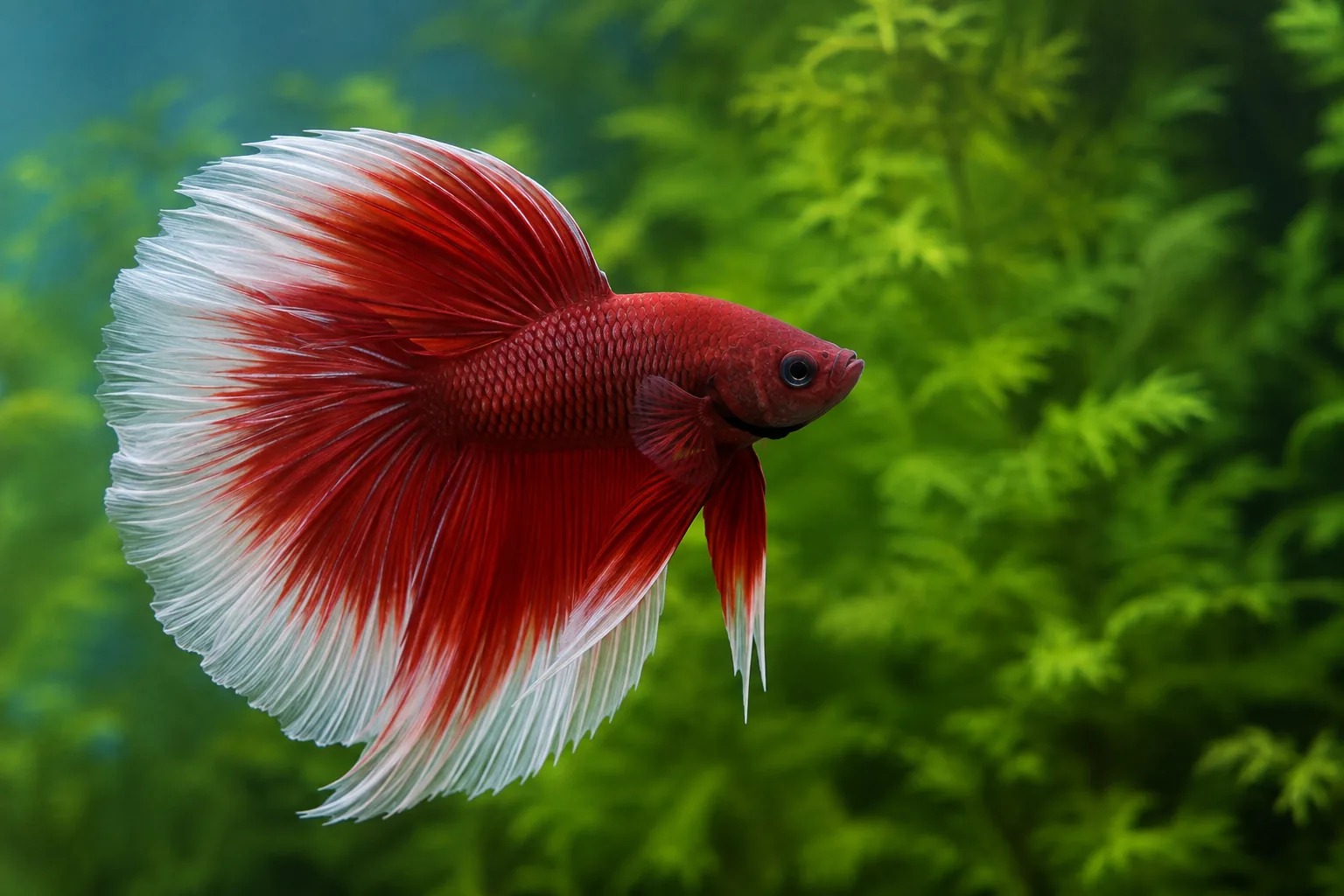
At a glance

- Adult size
- 5 to 6.5 cm
- Minimum footprint
- Broad horizontal footprint with unobstructed surface access
- Minimum volume
- 20 litres
- Social structure
- One adult male per aquarium; any community or female group requires individual assessment and immediate separation capacity.
- Minimum group
- 1
- Sex ratio
- Do not house adult males together; sex ratio is not a substitute for a compatibility assessment.
- Diet
- Carnivore
- Feeding
- Use a complete betta pellet as the staple and appropriately sized invertebrate foods for variety; adjust portions to body condition and uneaten food.
- Waste load
- low
- Lifespan
- 3 to 5 years
- Family
- Osphronemidae
- Native range
- Central Thailand and adjacent Southeast Asian lowland freshwater habitats
- Also sold as
- Siamese fighter, Siamese fighting fish. Trade and hobby names, not accepted species names.
- Conservation status
- Vulnerable (A2ace), wild assessment dated 2011 Source
About 20 L is a defensible home starting point: controlled studies found severe swimming restriction at 0.5 L and better activity in larger furnished tanks, with the largest recent treatment at 19.3 L.
What is a betta fish?
A betta fish in the aquarium trade usually means a domesticated form of Betta splendens, also called the Siamese fighting fish. It is one species in a much larger genus, so the word betta does not identify every wild Betta species or every hybrid sold under that label.
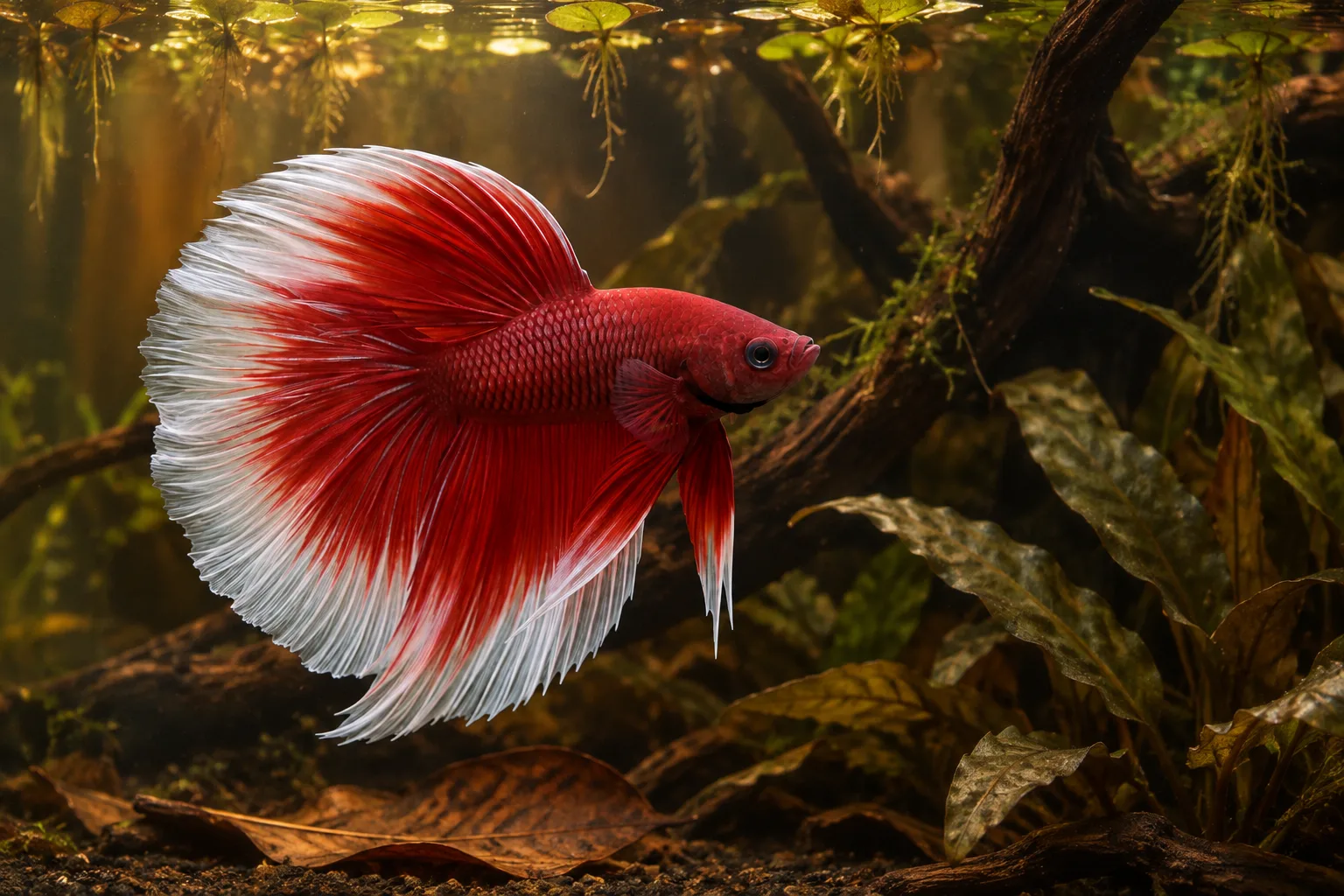
That distinction changes how you read care advice. The common domestic aquarium fish carries the accepted name Betta splendens, and an unknown wild-type betta is not interchangeable with it.
FishBase places the species in the gourami family Osphronemidae and reports a maximum total length of 6.5 cm. Long fins can make an ornamental male look much larger, but the body size, fin shape, activity, and ability to swim against current all matter when you choose the aquarium.
How do domestic bettas differ from wild fish?
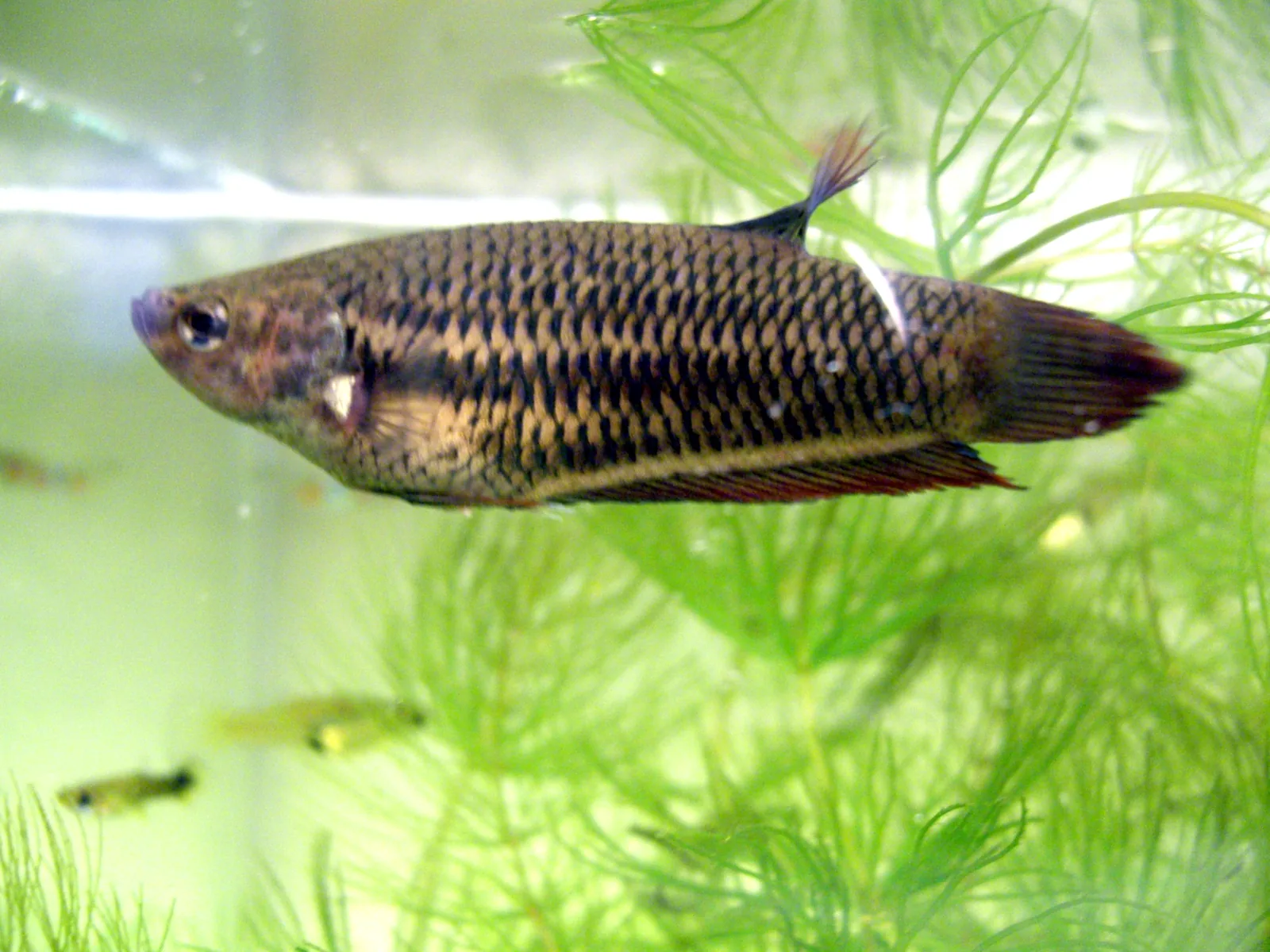
Selective breeding has produced domestic bettas with colors and fin shapes that do not represent the usual wild animal. The University of Florida IFAS overview describes a long history of selection for fighting and ornamental traits, while a U.S. Fish and Wildlife Service summary describes wild fish as much less conspicuous in color.
A veiltail, crowntail, halfmoon, plakat, and short-finned female can therefore look very different while still being sold as B. splendens. Color alone is a poor way to decide sex, health, lineage, or species identity, especially in juveniles and heavily selected strains.
What fin shape changes in daily care
Very long fins add drag. A long-finned fish may need especially gentle flow, clear routes to the surface, broad resting leaves, and decor without sharp edges, while a short-finned fish may be a stronger swimmer and jumper.
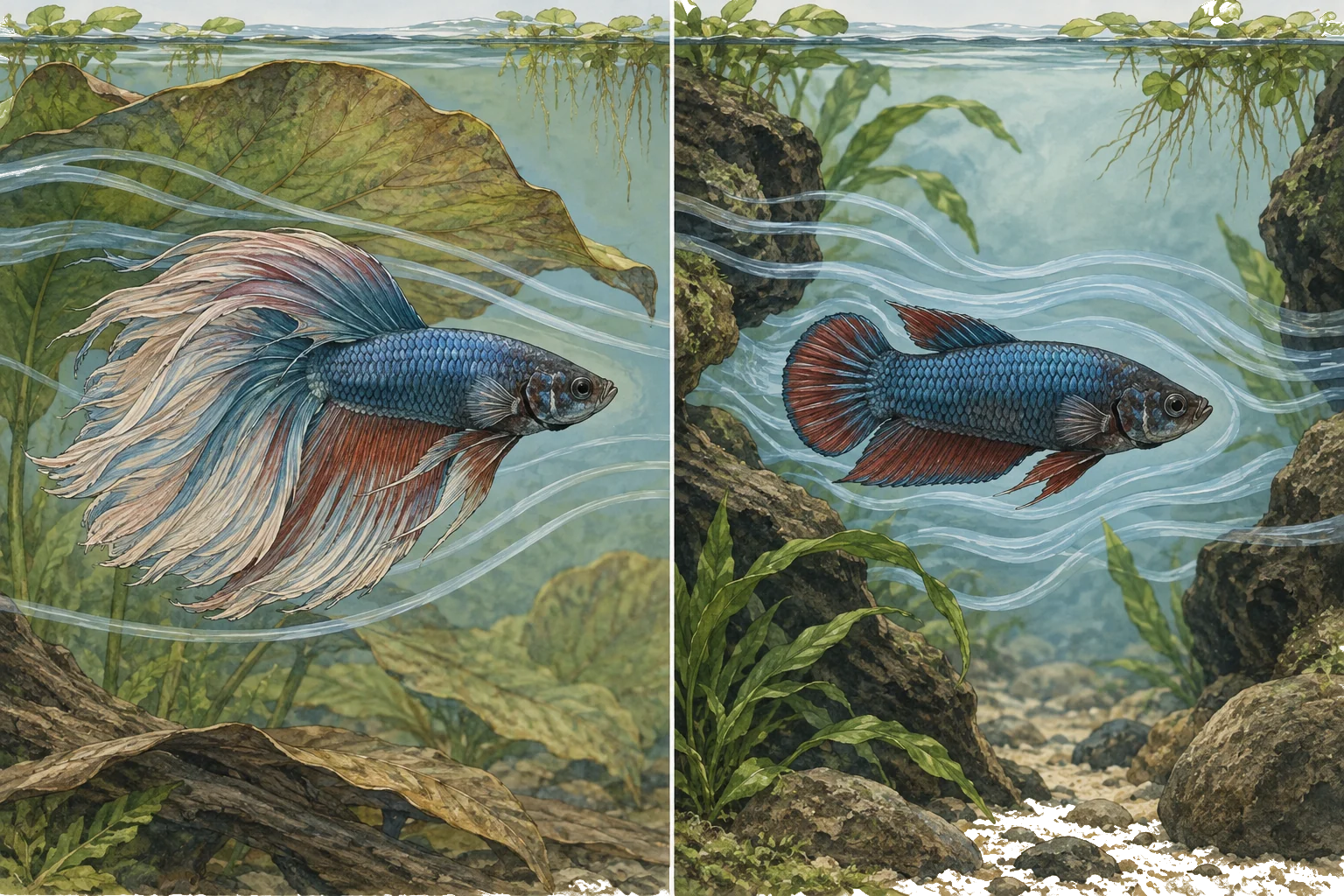
Fin form does not excuse a cramped tank. It changes how the fish moves through the same basic requirements: usable horizontal space, warm stable water, shelter, surface access, and a secure lid.
What a photograph cannot establish
A photograph can show color, fin outline, obvious damage, and body condition at one moment.
It cannot confirm water quality, internal disease, age, genetic background, or whether a fish that looks still is resting or becoming unwell.
Use appearance as one observation alongside appetite, breathing, swimming control, response to the environment, waste, and measured water conditions. A worsening change deserves investigation even when no single photograph provides a diagnosis.
Where do betta fish come from, and why does habitat matter?
Wild B. splendens is associated with shallow, slow or standing freshwater in Southeast Asia, including floodplains, canals, marshes, and rice-growing landscapes. FishBase records a 24 to 30 °C occurrence range and describes the species as a facultative air breather.
The labyrinth organ lets a betta take air at the surface, which helps in warm, oxygen-poor habitats. It does not make dissolved oxygen, clean water, or filtration optional, and it does not mean the fish can live without reliable access to the surface.
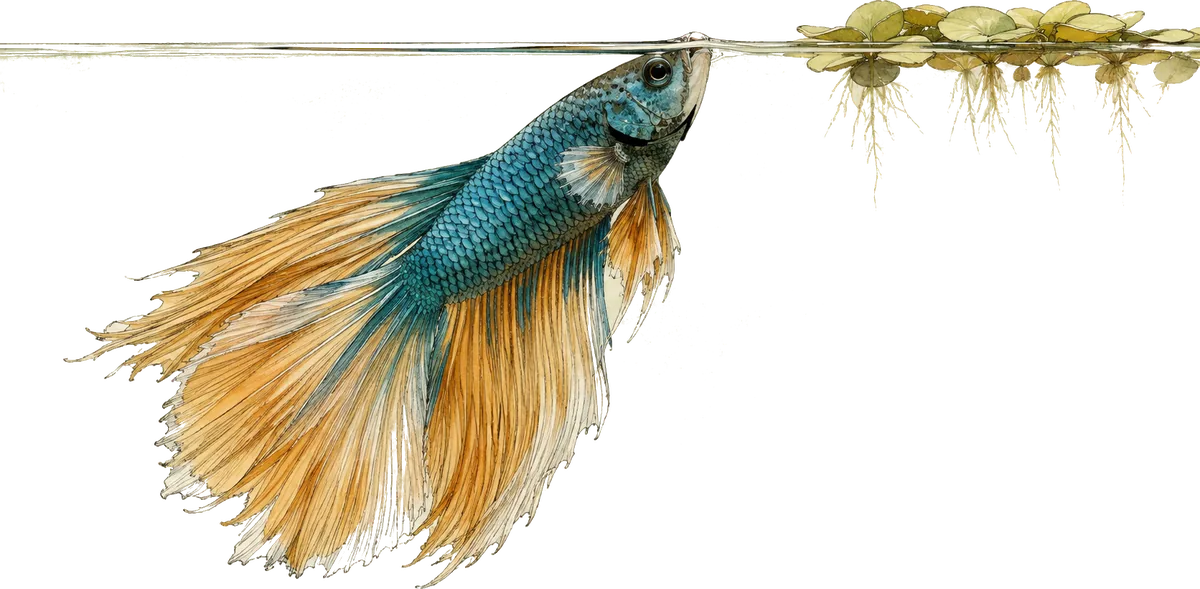
Shallow natural water is also not the same as a tiny glass container. A floodplain or paddy can offer broad area, vegetation, temperature gradients, prey, and routes away from conflict even where the water is not deep.
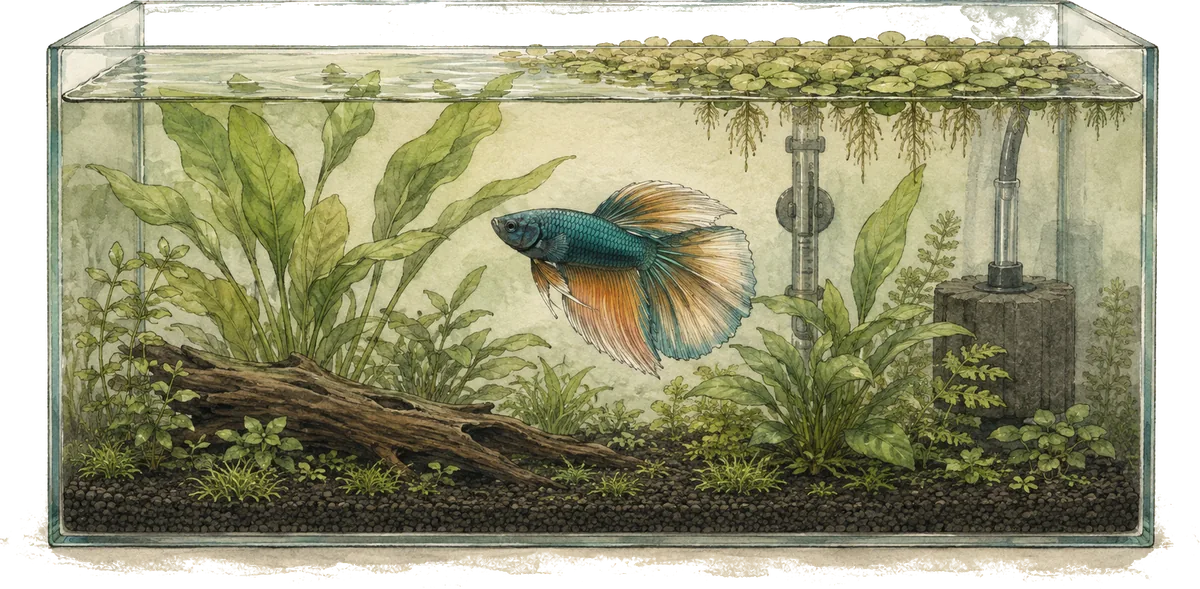
In an aquarium, the useful translation is gentle movement with open surface access, not stagnant water. Plants, wood, and smooth shelters should create cover without sealing the fish away from the surface or trapping it behind decor.
What does a suitable betta aquarium need?
A practical home starts with a tank large enough to hold stable heat and water quality while allowing normal movement. Two controlled welfare studies found clear behavioral costs in very small containers: the 2023 fishbowl study found that 0.5 L bowls constrained swimming, and the 2024 tank study found more active swimming and fewer abnormal behaviors in larger, furnished tanks.
The 2024 study tested containers from 1.5 to 19.3 L and recommended more than 5.6 L plus furnishings. For a home aquarium, about 20 L is a defensible starting point, because it matches the largest condition in that work closely and gives more room for a heater, filter, plants, and stable maintenance than the smaller experimental containers.
Volume is only part of the decision.
Prefer a broad usable footprint, enough depth to cover equipment safely, and an unobstructed route to the surface; a tall narrow vessel can hold the same litres while offering less useful swimming room.
- A thermostat-controlled heater and a separate thermometer.
- A mature biological filter with gentle or baffled flow.
- A secure lid with safe ventilation and no escape gaps.
- Open surface access for air breathing.
- Live or soft artificial plants, smooth shelter, and shaded resting places.
- Enough open water for the fish to turn and swim without dragging fins across decor.
- A liquid test method appropriate for ammonia, nitrite, nitrate, and pH.
- A siphon and bucket reserved for aquarium maintenance.
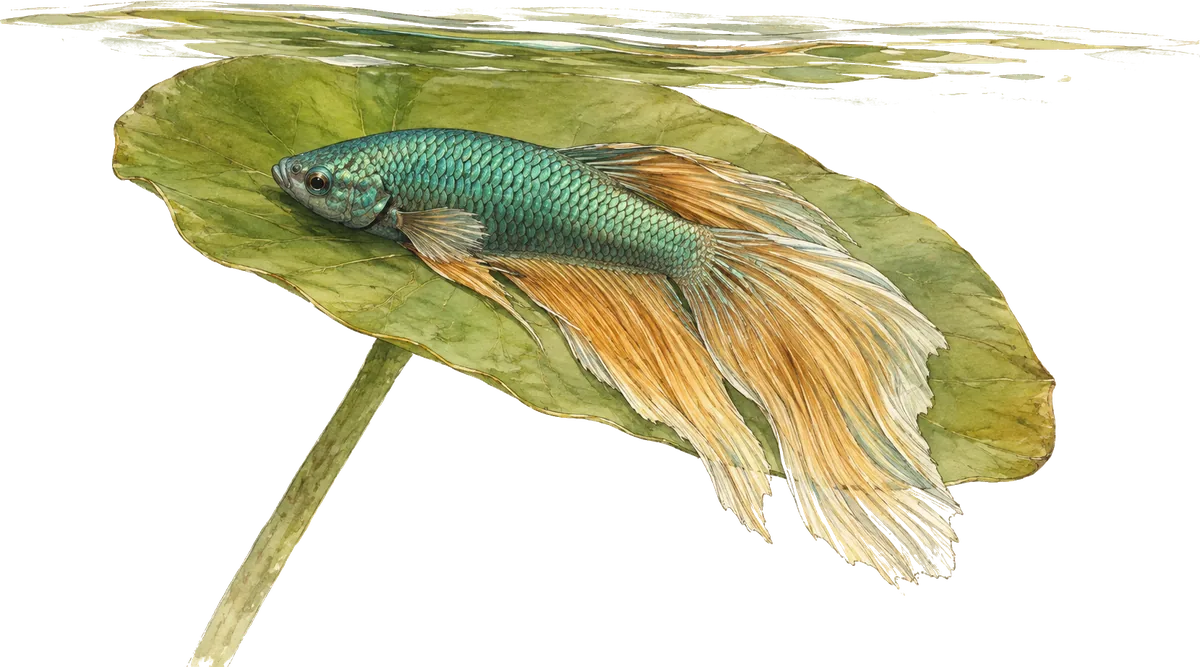
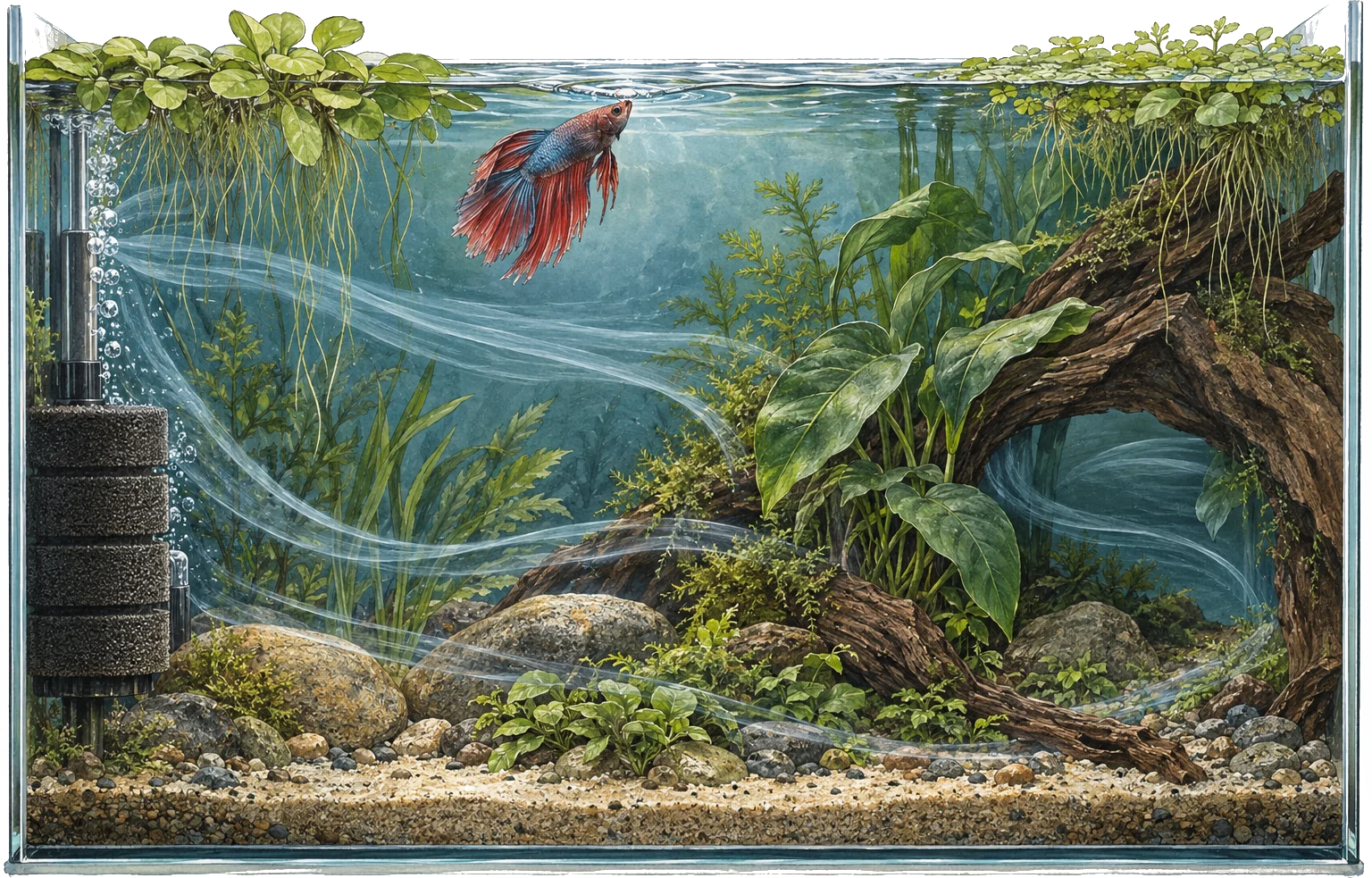
A filter outlet should move water without pushing the fish continuously across the tank.
Watch the animal rather than judging flow by the filter label: struggling to hold position, avoiding an entire side, or being pinned against intake guards means the layout or flow needs correction.
Which water conditions keep a betta stable?
FishBase reports 24 to 30 °C, pH 6.0 to 8.0, and hardness of 5 to 19 dGH for B. splendens. Those are broad species occurrence records, not instructions to move a long-acclimated pet toward the middle of each range.
Recorded freshwater aquarium context
- Temperature24 to 30 CSeparate aquarium thermometer; FishBase compiled range.
- pH6.0 to 8.0Calibrated pH meter or aquarium test covering the expected range; FishBase compiled range.
- General hardness5 to 19 dGHGH titration test; FishBase compiled range.
Every range above applies to Betta splendens husbandry in a freshwater aquarium system. Source: FishBase species summary, checked 2026-09-11.
For a home tank, use the recorded range as a boundary and choose a stable point that also suits the animal's acclimation history. Measure temperature with a thermometer; measure pH and hardness with tests that state their units and usable range.
Ammonia and nitrite carry no species range at all, because a geographic occurrence record cannot supply safe aquarium values for nitrogen waste. In an established aquarium, any detectable rise should trigger confirmation of the result and a search for the cause, such as an immature filter, dead material, overfeeding, or a sudden increase in bioload.
Do not chase pH with repeated chemical corrections. A stable value inside the supported range is usually easier on the fish than a value that swings as products are added, and source water must be understood before any deliberate adjustment.
What to monitor between scheduled tests
Check the thermometer and the fish every day. A heater failure, stuck thermostat, blocked filter, or closed surface can become urgent before the next routine water test.
Track results rather than relying on memory. A number moving over several tests often reveals a maintenance or filtration problem earlier than one isolated reading.
Can bettas live together or with other fish?
Two adult male B. splendens should not share an open aquarium. Their territorial aggression can escalate quickly, and visual contact through a clear divider may keep both fish in repeated display rather than creating safe companionship.
Keeping females together is not automatically safe. Individual temperament, maturity, group composition, space, cover, and an immediate separation plan all affect the outcome; a general profile cannot approve a particular sorority or pair.
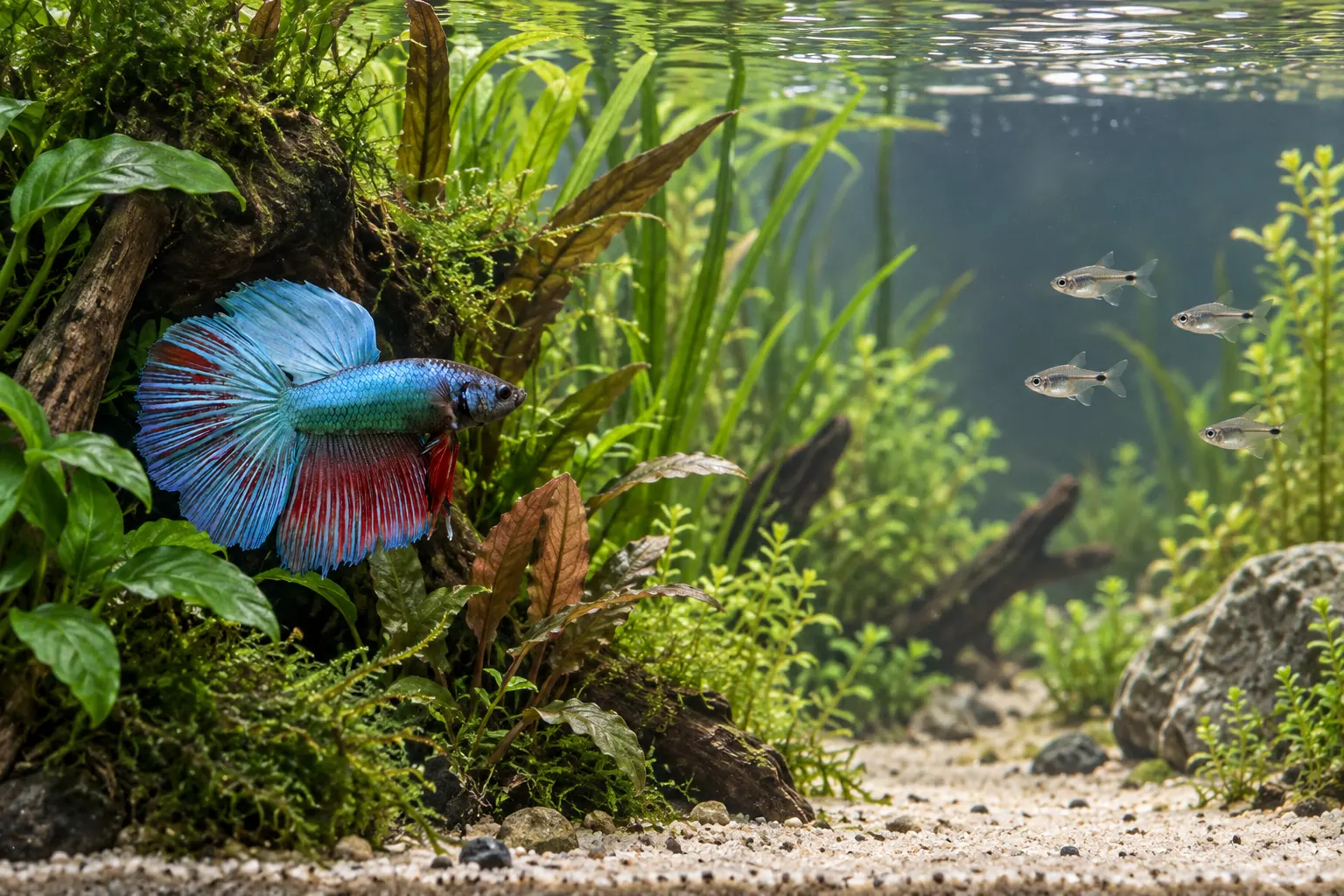
A single betta may live in a community aquarium when the other animals share its water and do not nip fins, outcompete it at the surface, crowd its territory, or become prey. The betta must also leave slower animals alone, which cannot be assumed from the word peaceful.
| Pairing question | What must be true | Reasons to stop |
|---|---|---|
| Another male betta | Do not attempt open cohabitation | Flaring that does not stop, pursuit, biting, torn fins, or blocked access to food and surface |
| Female bettas | Large furnished system, experienced observation, and ready separation space | One fish hides continuously, loses condition, is cornered, or shows injury |
| Small community fish | Compatible water, calm behavior, enough room, and separate feeding access | Fin nipping, persistent display, food loss, pursuit, or a fish unable to rest |
| Shrimp or very small animals | Accept that individual bettas may hunt them | Stalking, repeated attacks, injury, or disappearing animals |
The safe default is one betta with no same-species companion. Any named pairing still needs its own evidence, and an untested combination remains uncertain.
What do betta fish eat?
Wild bettas take small aquatic and surface-associated animals, and FishBase describes insect larvae among their foods. Domestic fish do well on a nutritionally complete betta pellet as the staple, with appropriately sized frozen or live invertebrate foods used for variety when they can be handled safely.
Pellet sizes and energy density vary, so one fixed pellet count can overfeed one product and underfeed another.
- Choose a nutritionally complete betta food with particles the fish can swallow cleanly.
- Offer a small portion and watch the fish eat instead of feeding from its reaction at the glass.
- Stop before food begins collecting on the substrate or entering the filter.
- Check body condition, waste, appetite, and water-test trends before changing the next portion.
- Use frozen or cultured invertebrate foods as controlled variety, not as an unlimited ration.
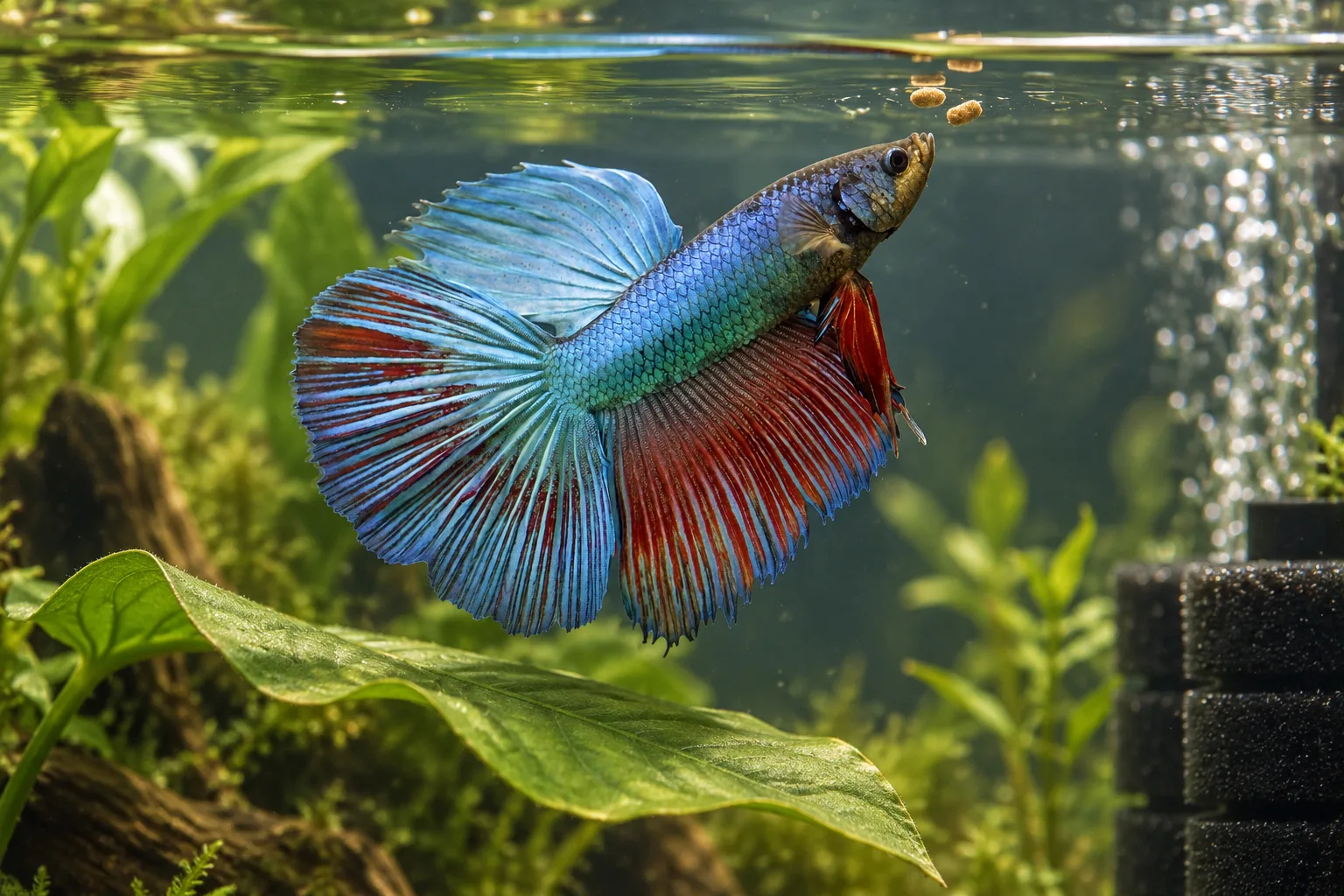
Repeated overfeeding adds waste, can distort body condition, and makes it harder to distinguish normal appetite from a genuine change.
The laboratory husbandry review reports successful use of formulated pellets and live brine shrimp in managed colonies. Its exact feeding schedule was designed for research and breeding fish, so it supports diet type and variety rather than a universal home portion.
Which behaviors are normal, and which are warning signs?
Regular trips to the surface are normal for a labyrinth fish. Short bouts of flaring, exploring, resting on a leaf, and building a bubble nest can also occur in a healthy animal, though none of those behaviors alone proves that every care condition is correct.
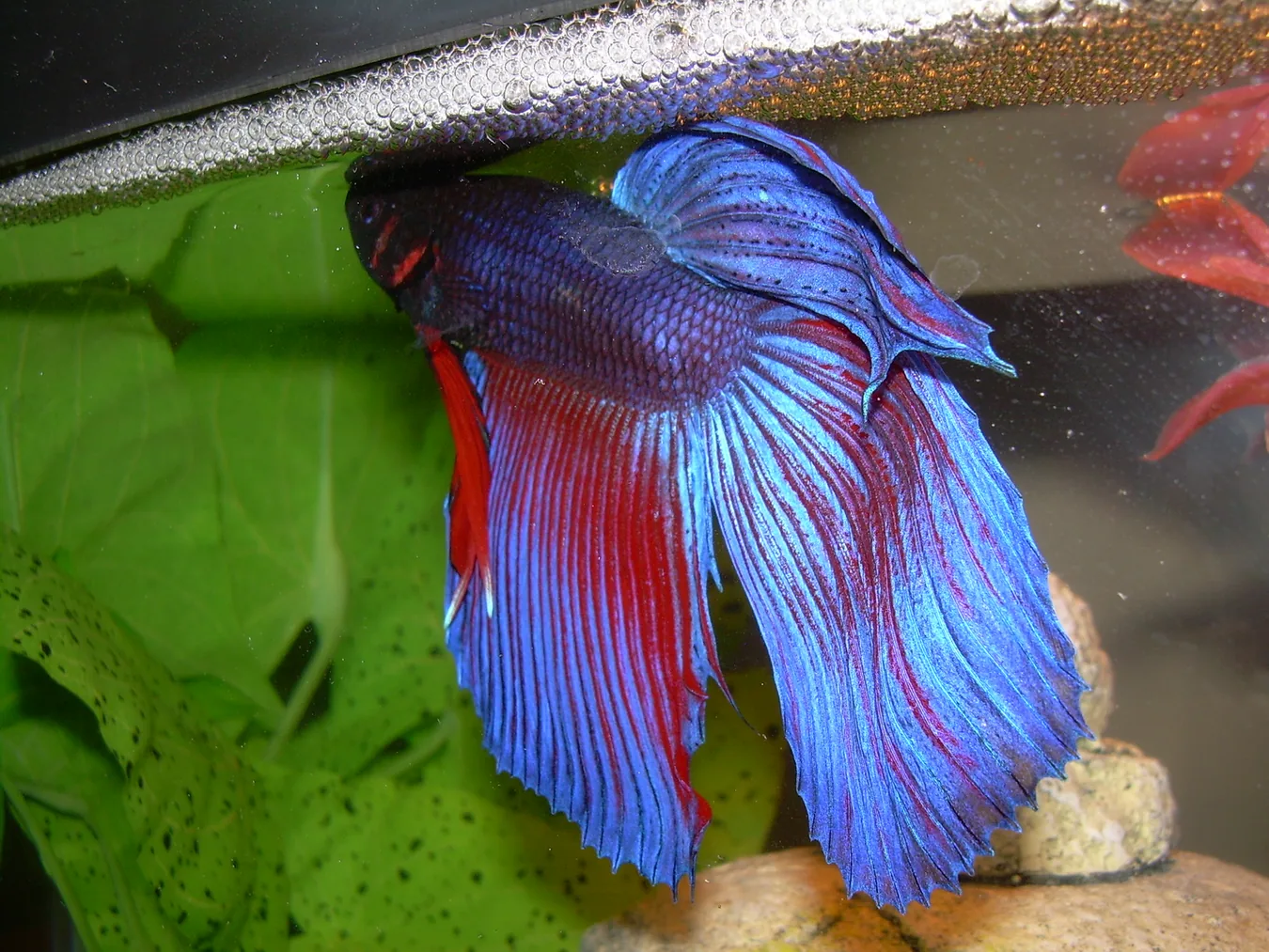
A bubble nest is reproductive behavior, not a score for keeper performance.
Some healthy males build often, some rarely do, and a nest can appear even when other conditions still need attention.
Concern rises when behavior changes from that fish's baseline. Persistent rapid breathing, repeated gasping that replaces normal activity, loss of balance, inability to reach the surface, refusal of food, progressive swelling, open sores, or rapid fin deterioration should not be dismissed as personality.
Water checks are triage, not a diagnosis. Correcting a confirmed equipment or water failure may remove the cause, but ongoing signs still need professional assessment.
How long do betta fish live?
A reasonable expectation for a domestic betta under good care is about 3 to 5 years, according to a veterinarian-authored PetMD care sheet. Published laboratory guidance reports around two years under its own colony conditions, which shows why lifespan should not be presented as a guaranteed countdown.
A shop-bought fish may already be months old, and its exact age and breeding history may be unknown.
Genetics, chronic temperature or water stress, nutrition, injury, infection, and delayed treatment can all change the outcome.
The useful goal is not to force a particular number. Provide stable heat and water, enough furnished space, appropriate food, and early response to change so the fish can maintain normal behavior and body condition for as long as its health allows.
What is the conservation and trade context?
FishBase displays the wild species as Vulnerable under criterion A2ace, based on an assessment dated 25 February 2011. That status applies to wild Betta splendens and should not be confused with the worldwide abundance of captive ornamental strains.
No direct CITES species record was available from the sources checked on 11 September 2026. That absence is not evidence that collection, possession, transport, or export is unrestricted, because national and local rules can apply independently and names in trade may be inaccurate.
Buy captive-bred fish from a seller who can state the identity and origin. Do not collect wild bettas or treat an ornamental trade name as permission to move wildlife across a border.
Is a betta fish right for your aquarium?
A betta is a good fit when you can provide a mature heated and filtered aquarium around 20 L or larger, gentle flow, a lid, cover, open surface access, and daily observation. It also suits a keeper who accepts that the safest social plan may be one fish rather than a mixed display.
Choose another plan if the only available vessel is an unheated bowl, if existing fish are fast fin nippers, if no separation space exists, or if you cannot test the water and maintain the filter. The animal's small body does not make the life-support system optional.
Before purchase, confirm the label says Betta splendens, look for controlled swimming and intact body condition, and ask what water and food the fish currently receives. Then compare that information with the prepared tank instead of trying to redesign the aquarium around an impulse purchase.
Before choosing a tank mate, compare adult size, swimming speed, fin behaviour, group needs, and water overlap in the freshwater fish guide. Treat tank size, feeding, compatibility, breeding, and health as separate decisions whenever the individual fish or aquarium needs closer attention.
Which fish clarify the community decision?
Emperor tetra
A medium tetra whose males hold display positions, adding territory and sight lines to the group decision.
Cardinal tetra
A small blackwater shoaler whose soft-water context and quiet group behaviour narrow the comparison.
Cherry barb
A small planted-stream barb that contrasts sex-linked colour, social structure and habitat cover.
Endler's livebearer
A small livebearer whose hard-water range and constant reproduction create a different maintenance problem.
Ember tetra
A tiny warm-water tetra whose low competitive weight and small mouth change feeding and tankmate choices.
Black neon tetra
A smaller midwater shoaler that offers a useful contrast in body size, group movement and water tolerance.
Chili rasbora
A minute blackwater group fish whose mouth size, water and refuge needs set a much smaller scale.
Celestial pearl danio
A tiny planted-tank danio with cooler documented habitat water and a different style of group behaviour.
Diamond tetra
A medium deep-bodied characin that offers a closer comparison in warm water, adult mass and display behaviour.