
How Do You Set Up a Betta Tank Before the Fish Arrives?
Set up a betta tank before buying the fish: use about 20 litres or more, choose a broad footprint, install gentle filtration and verified heat, add smooth cover, then complete and measure a fishless cycle. The tank is ready only when its equipment, temperature, ammonia and nitrite results all pass together.

What should a betta tank include?
A defensible betta setup starts with about 20 litres or more, a broad usable footprint, thermostat-controlled heat, gentle biological filtration, a secure lid, open surface access and planted or smooth cover. The RSPCA Australia care guide recommends 20 litres or larger and explains why bowls do not provide suitable long-term housing.
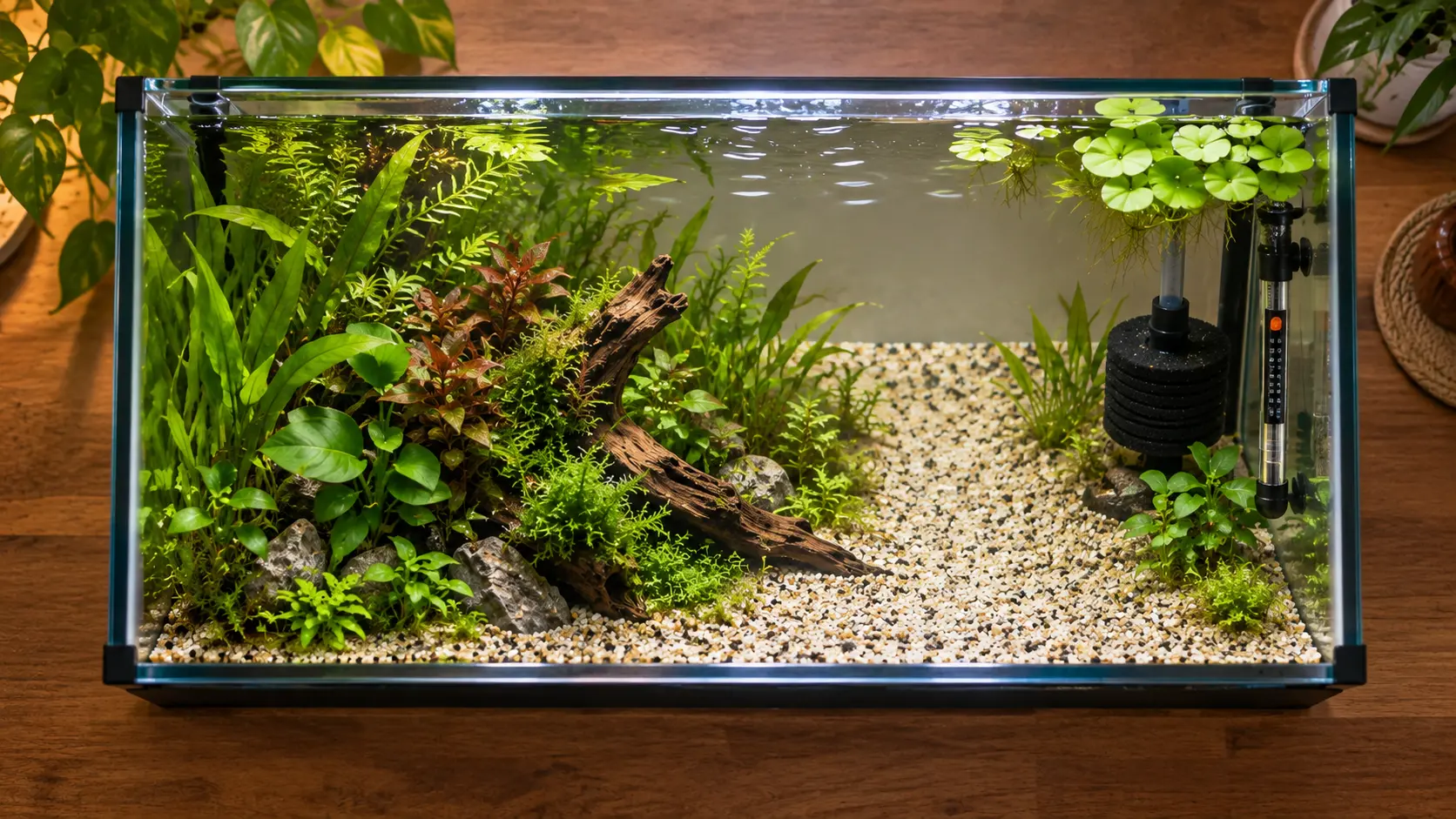
OATA's betta care sheet also uses 20 litres for a single male, with a filter, heater and lid. Treat that figure as a practical welfare starting point, then choose the footprint and equipment around the individual fish's fins, activity and room temperature.
- Practical starting volume
- About 20 litres or more for one betta
- Tank shape
- Broad and usable, not a tall narrow vase
- Temperature plan
- Thermostat-controlled heater plus separate thermometer
- Filtration
- Mature biological filter with flow the fish can leave
- Cover
- Live or soft plants, smooth shelter and a near-surface rest
- Readiness test
- Ammonia and nitrite processing demonstrated before the fish arrives
Where should the aquarium stand?
A level stand rated for the filled weight supports the aquarium without twisting its base. A position away from direct sun, radiators, air conditioners, doors and vibration reduces disturbance, while clearance around the lid and cables keeps maintenance practical.
The filled load includes water, the aquarium, substrate and hardscape. Use the manufacturer's specifications and the actual setup weight; nominal capacity alone cannot establish whether a shelf or stand is adequate.
- The stand supports the aquarium exactly as its manufacturer specifies, with the required level surface and any specified mat.
- No window or heater creates a daily temperature cycle across the glass.
- An electrical outlet is reachable without an extension lying on the floor.
- Every power cable drops below the outlet before rising to it as a drip loop.
- Maintenance buckets can reach the tank without crossing furniture or stairs.
- The lid can open fully without hitting a wall or shelf.
Fill the empty tank partly and check the stand, seams and surface before adding substrate. A small leak is easier to handle before wood, plants and equipment make the aquarium difficult to move.
Which tank shape works best?
Length and width determine usable swimming space more directly than decorative height. Bettas breathe at the surface and benefit from horizontal routes, so a broad rectangular aquarium usually offers more usable space than a narrow column holding the same volume.
Long-finned fish may tire in strong current and need broad leaves or smooth rests near the surface. Short-finned fish can be powerful swimmers and jumpers, so gentle flow does not remove the need for a secure lid.
The aquarium must be ready to support a betta fish before the animal enters it.
How do you choose gentle filtration?
You need a filter that can hold mature biological media and circulate the whole aquarium without forcing the fish to swim continuously. A sponge filter, adjustable internal filter or carefully baffled outlet can work when the actual flow leaves both circulation and a calm resting zone.
A tank-volume rating alone cannot show whether a filter suits a betta. Media capacity, intake safety, maintenance access and the shape of the outlet determine how it behaves in this specific tank.
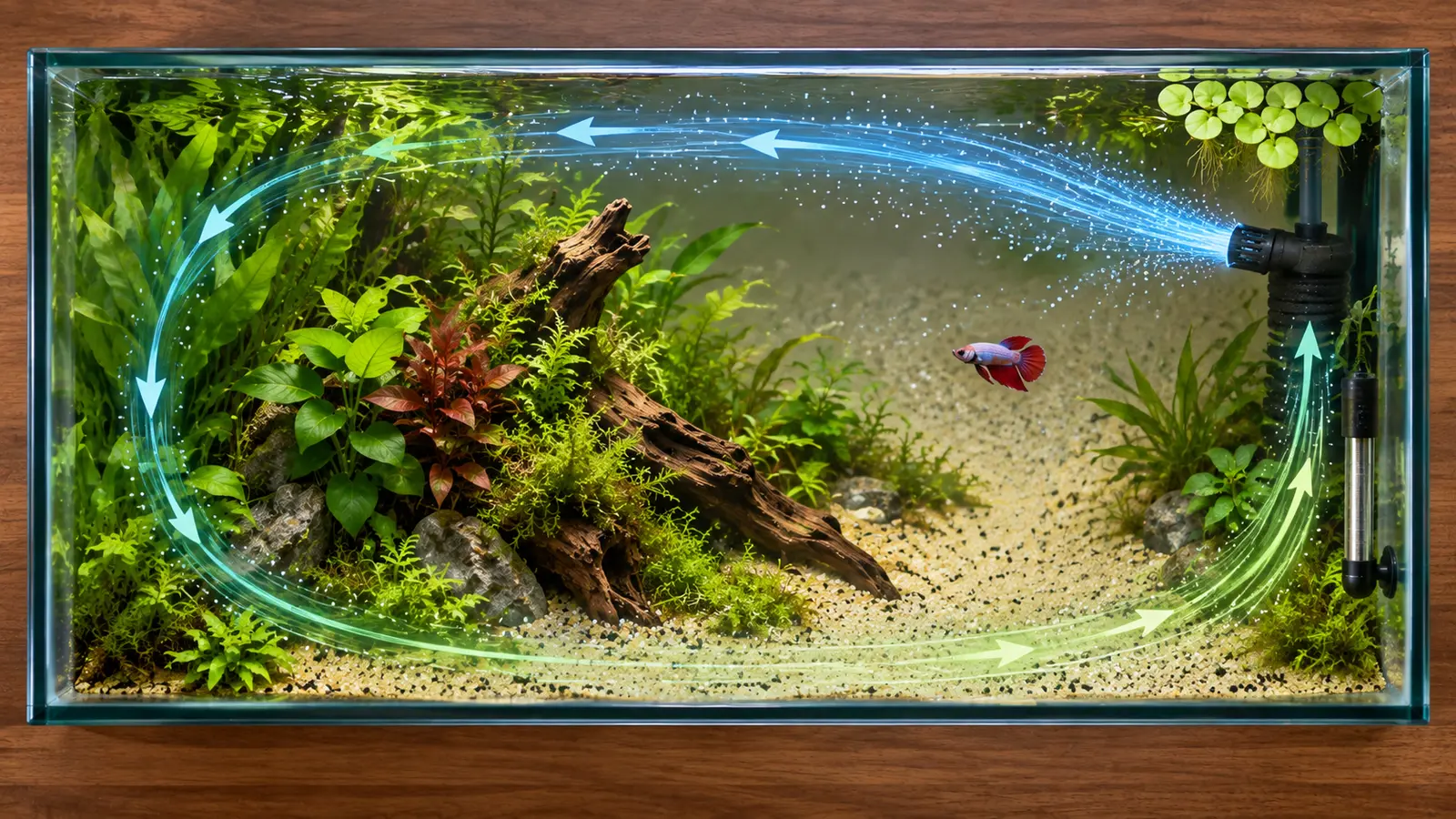
The fish is the final flow indicator. If it is pushed sideways, avoids the outlet half of the tank, cannot hold position while feeding or rests only behind equipment, reduce or redirect the flow without turning filtration off.
Never replace all media at once or wash biological media under untreated chlorinated tap water during routine maintenance.
How should heat and the lid be arranged?
For a domestic Betta splendens setup, RSPCA's 24 to 26 C guidance offers a narrower planning band than OATA's 20 to 28 C range for commonly sold tank-reared bettas. The wider range is not a reason to let the tank swing between its extremes; verify stability with a separate thermometer.
Published betta setup temperature context
- Temperature24 to 26 CHome betta aquarium system. Applies to RSPCA welfare care guidance. Separate aquarium thermometer. Source: RSPCA Australia, checked 2026-09-22.
- Temperature20 to 28 CCommonly sold tank-reared bettas; not every Betta species system. Applies to OATA betta group guidance. Separate aquarium thermometer. Source: OATA, checked 2026-09-22.
- Ammonia0 mg/LMature freshwater aquarium system. Applies to OATA betta group guidance. Appropriate test; zero means below its detection limit. Source: OATA, checked 2026-09-22.
- Nitrite0 mg/LMature freshwater aquarium system. Applies to OATA betta group guidance. Appropriate test; zero means below its detection limit. Source: OATA, checked 2026-09-22.
Every range above.
Install the heater at the water level and orientation specified by its manufacturer, with circulation around it. Disconnect equipment as its instructions require before maintenance, and let the heater cool for the specified time before exposing it to air.
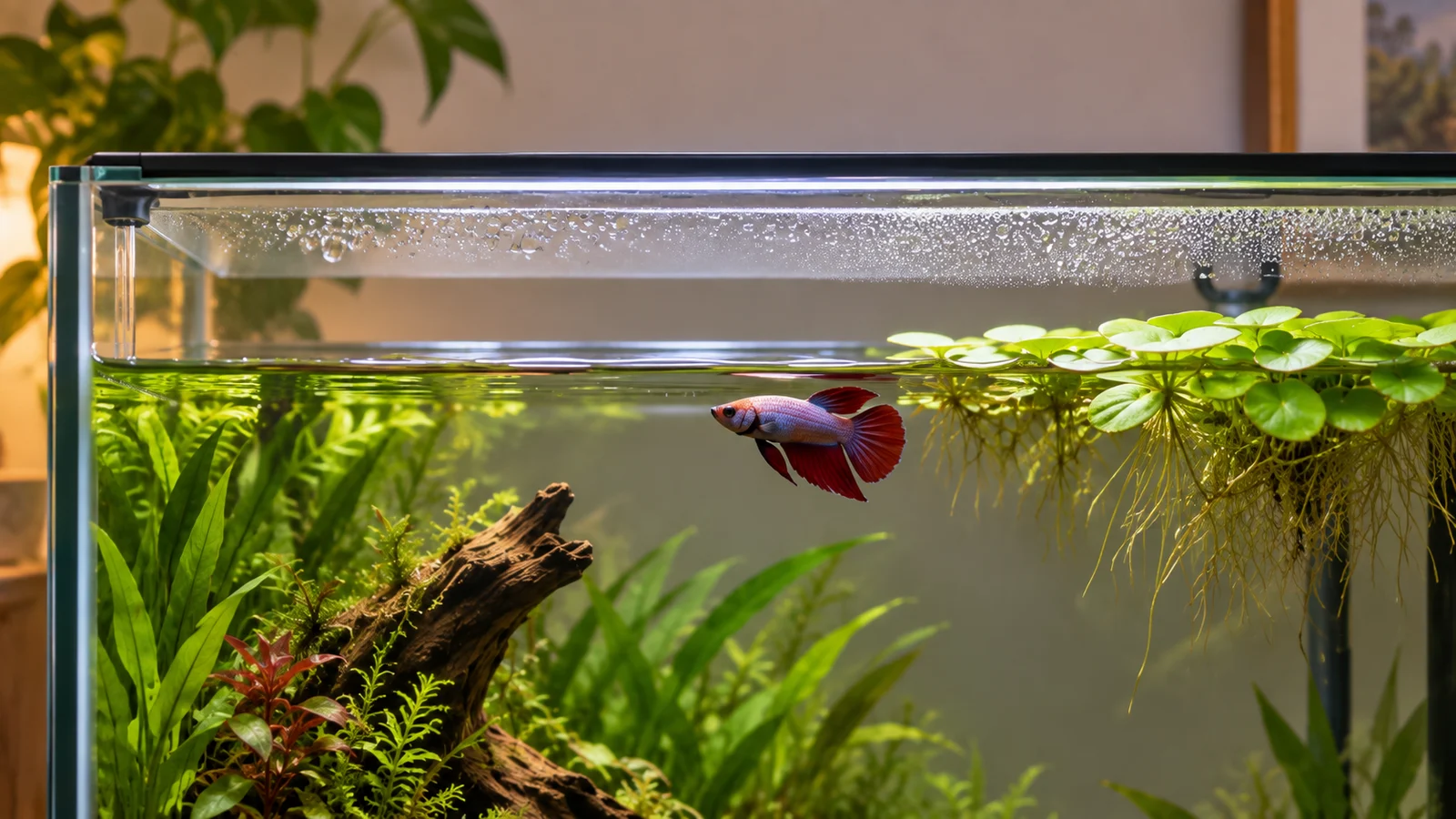
Sudden gasping, loss of balance or inability to reach the surface needs immediate attention. Check aeration, temperature, ammonia and nitrite while seeking urgent aquatic-veterinary advice; do not wait for severe signs to persist.
Which substrate, plants and decor are safe?
Choose inert sand or smooth gravel that can be cleaned without trapping large pockets of waste. Substrate is optional for the fish's survival but useful for plants and visual security when it can be maintained.
Use live plants or soft artificial plants, smooth wood and a shelter without narrow holes. A fabric snag test may reveal roughness, but passing it does not establish chemical safety or rule out entrapment.
| Feature | Job for the fish | Setup check |
|---|---|---|
| Broad leaves near surface | Rest without a long climb for air | Leaf supports the fish and remains below open water |
| Floating cover | Shade and visual security | A large surface route remains clear |
| Wood or cave | Retreat from movement outside the tank | Opening cannot trap the body or fins |
| Open foreground | Normal swimming and easy observation | Decor does not divide the tank into dead ends |
| Smooth substrate | Plant support and manageable cleaning | Siphon can remove waste without uprooting everything |
Arrange cover in clusters instead of filling every centimetre. A betta should be able to disappear from view, return to open water and reach the surface without squeezing through a sharp gap.
How do you fill and condition the tank?
You should rinse the empty tank and inert decor with water only. Add substrate and hardscape, place a plate or bag over the substrate to soften the pour, then fill with tap water treated for the disinfectant used by the local supplier.
Start the heater and filter only after their minimum water levels are met. Confirm that the tank holds temperature, the outlet does not expose the heater as water evaporates, and no air lock stops the filter after a brief power interruption.
- Leak-test the tank on its final level stand.
- Rinse substrate and decor with plain water, never household soap.
- Build stable hardscape and verify that every opening remains safe for the fish.
- Fill slowly, condition the full relevant water volume and start filtration.
- Set the heater, close the lid and verify temperature with a separate thermometer.
- Run the equipment long enough to reveal leaks, noise, blocked flow and restart problems.
Never add the fish immediately because the water looks clear; clear water can still contain toxic ammonia or nitrite.
How do you cycle the tank without the fish?
Fishless cycling establishes microbes that convert ammonia to nitrite and then nitrate before the betta is exposed. It is complete when the system repeatedly processes a measured ammonia input through to no detectable ammonia or nitrite within the method's defined test window.
The calendar alone cannot prove this. Temperature, pH, ammonia source, inoculum, filter media and test method change the pace, and adding bottled bacteria does not remove the need to verify the result.
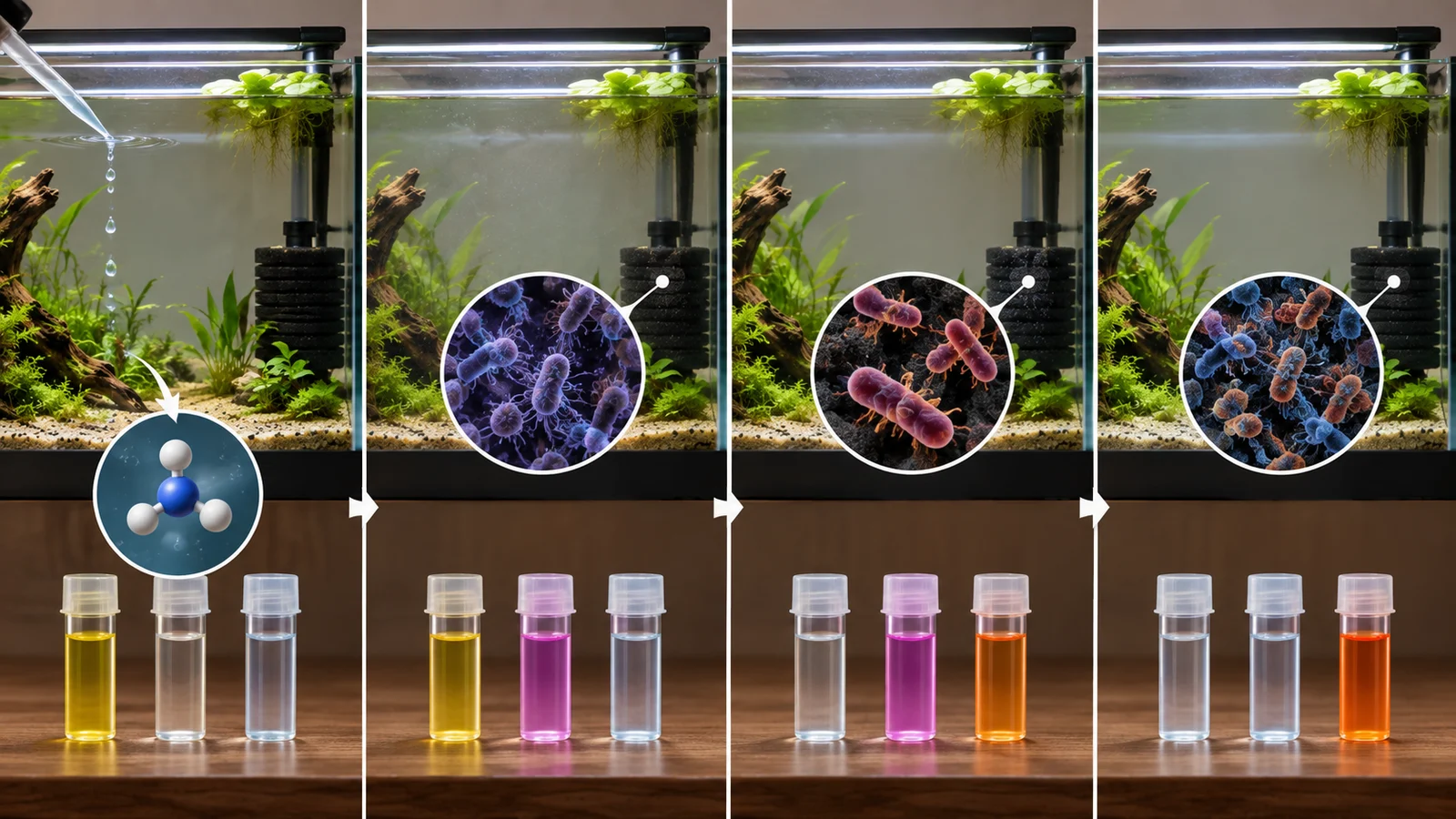
- Add a controlled ammonia source using a method designed for fishless cycling.
- Test ammonia and nitrite with methods that cover the expected range and record every result.
- Keep the filter running, oxygenated and warm while the microbial community develops.
- Continue until a measured input is processed with ammonia and nitrite returning to zero in the defined window.
- Perform the necessary conditioned water change to bring nitrate and the final chemistry into the intended range.
- Recheck temperature, pH, ammonia and nitrite before arranging the fish's arrival.
The aquarium nitrogen cycle guide explains how to assess cycling and test results. Cycling ammonia belongs only in an animal-free system; do not use a live betta to test the filter.
When is the tank ready for a betta?
The tank is ready when the cycle has been demonstrated, temperature is stable through day and night, the filter restarts after a power test, and ammonia and nitrite remain at zero. The lid, intake guard, surface route and separation plan must also be complete.
Footprint and upgrade decisions belong in the minimum tank size for a betta guide. Source-water decisions belong in the betta water parameter guide; this setup sequence does not prescribe a rapid chemistry correction.
- The aquarium processed the measured fishless-cycle challenge.
- Ammonia and nitrite read zero using tests within date and range.
- Temperature remains within the chosen supported band for at least a full day.
- The filter restarts and the heater remains submerged after a simulated outage.
- Flow leaves a calm zone while circulating the whole tank.
- No decor snags fabric, shifts under light pressure or traps the fish.
- The lid closes around every cable and filter opening.
- Conditioned change water and dedicated maintenance tools are ready.
If any item fails, delay the purchase. The cost of waiting is small compared with trying to protect a fish while rebuilding its life-support system.
How should the betta be introduced?
You should ask the seller for the fish's current temperature, water chemistry, food and recent treatment history. Transport it in darkness, keep transport brief and have a prepared observation or quarantine arrangement appropriate to the destination, without sharing water or equipment with existing healthy livestock.
Arrange an acclimation plan with the supplier before collection, using the transport duration and measured difference between waters. A short local transfer and a long shipment should not automatically receive the same bag-mixing procedure.
Prolonged exposure to opened transport water can become hazardous as pH changes the toxicity of accumulated ammonia. If the fish is distressed or the waters differ substantially, obtain prompt qualified guidance instead of improvising hours of drip acclimation.
Never add medication as a precaution without a confirmed indication. A quarantine tank allows observation and treatment boundaries; it is not a reason to expose every new fish to several products.
What should you watch during the first week?
Check temperature, filter flow, surface access, ammonia, nitrite, appetite, breathing and swimming control every day. Feed lightly enough to see every item eaten, and remove leftovers before they decay.
Some exploration and temporary hiding are expected after transfer. Persistent rapid breathing, loss of balance, inability to reach the surface, repeated collision, progressive fin damage or refusal of food with declining condition requires immediate system checks and qualified help.
Rule out the water first
- Confirm temperature with the separate thermometer.
- Test ammonia and nitrite and promptly recheck surprising results, without delaying aeration or urgent help for a distressed fish.
- Check that the filter and heater remain powered and correctly submerged.
- Observe whether outlet flow prevents normal resting or feeding.
- Inspect the lid, decor and intake for injury or entrapment risk.
- Review the fish's baseline at purchase and any recent treatment.
- Contact an aquatic veterinarian immediately for severe breathing difficulty, loss of balance, rapid deterioration or deaths.
Do not make a large pH or temperature correction simply because the result differs from an online midpoint. Stable water inside a supported context is safer than repeated rapid adjustment.
What maintenance keeps the setup stable?
RSPCA suggests replacing about 10 to 25 percent of the water weekly, while the actual amount should respond to stocking, feeding, nitrate trend and the source water. Prepare new water to a compatible temperature and treat it for chlorine or chloramine before it reaches the fish.
Siphon visible waste, clean the intake guard and preserve biological media. Rinse media gently in removed aquarium water when flow declines, and avoid replacing every piece at the same time.
| Task | Normal check | Stop and investigate |
|---|---|---|
| Water change | Match temperature and conditioner dose to measured volume | Fish loses control or temperature shifts unexpectedly |
| Substrate cleaning | Remove visible waste without uprooting all cover | Black foul pockets or repeated gas release |
| Filter service | Restore flow while preserving mature media | Media is dry, chlorinated or filter will not restart |
| Plant care | Keep surface access and remove decayed leaves | Plant mass closes the entire surface |
| Equipment check | Verify heater, thermometer, lid and cables | Cracked glass, exposed heater or damaged cable |
The setup is successful when it keeps ordinary care predictable. It should let you see a developing problem, isolate the cause and correct it without dismantling the whole aquarium around the fish.
Which setup mistakes should stop the purchase?
Do not bring the fish home if the tank is uncycled, the heater is unverified, the filter pushes water across the whole footprint, or the lid has escape gaps. Also stop when the stand is questionable, decor can snag fins, or no conditioned water is available for an urgent change.
Buying the animal does not make the aquarium mature faster. Complete the setup, document the final test results, and let readiness decide the arrival date rather than a sale or delivery window.
Step by step
- Set the empty tank on its final level stand, test for leaks and confirm safe access to power and maintenance space.
- Rinse substrate and decor with plain water, build stable hardscape and leave smooth cover, open swimming room and a surface route.
- Fit a thermostat-controlled heater, separate thermometer, low-flow biological filter and secure lid with safe cable openings.
- Fill slowly, treat the relevant water volume for the local disinfectant and run every device at its proper water level.
- Use a controlled ammonia source and test until the filter repeatedly processes it with ammonia and nitrite returning to zero.
- Confirm stable temperature, zero ammonia and nitrite, safe flow, filter restart, secure decor and an unobstructed surface route.
- Compare transport and tank conditions, use a time-bounded acclimation, discard shop water and observe the fish under dim light.