
Aquarium Nitrogen Cycle: How to Build a Biofilter
The aquarium nitrogen cycle is the microbial conversion of toxic ammonia into nitrite and then nitrate. A tank is ready only after its biofilter repeatedly processes a measured ammonia input, not after a fixed number of days or because the water looks clear.

What is the aquarium nitrogen cycle?
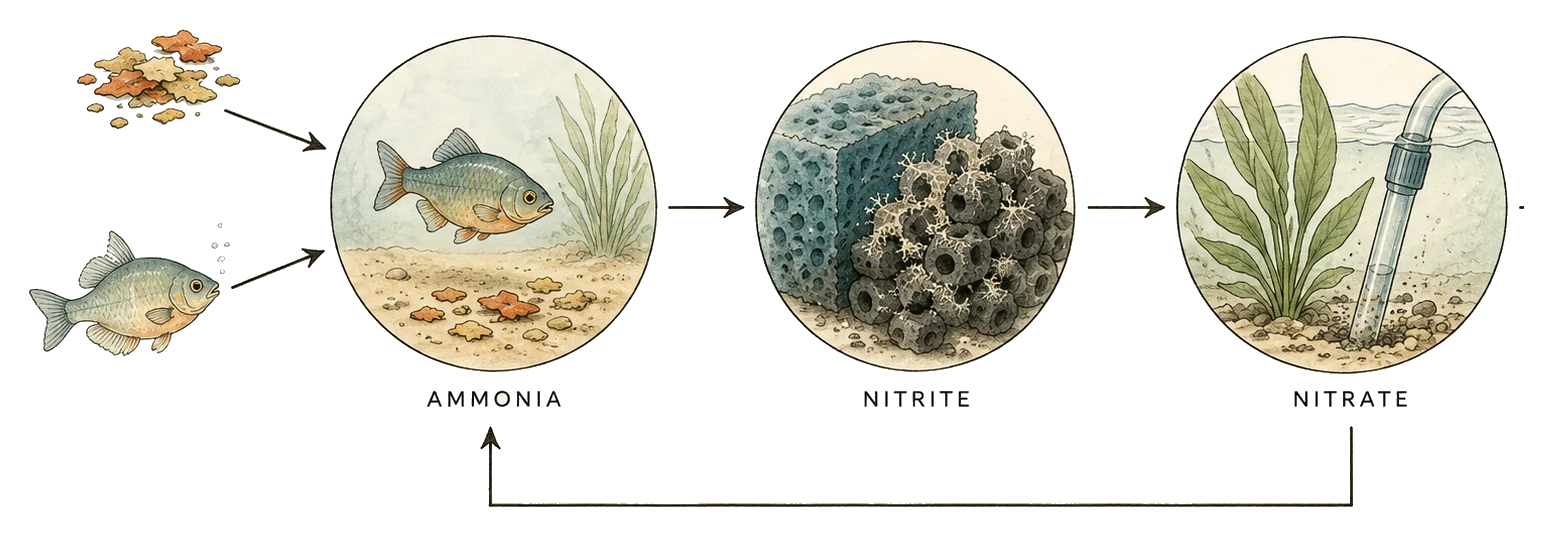
Fish, uneaten food and decaying organic matter release ammonia. Specialized microbes oxidize ammonia to nitrite, and another community oxidizes nitrite to nitrate; plants, water changes and other export processes then remove or use some of that nitrate.
Both ammonia and nitrite can harm fish, so the useful part of cycling is not merely seeing nitrate. It is establishing enough attached microbial biomass to handle the waste load the aquarium will actually receive.
- Input
- Ammonia from waste or a controlled fishless source
- First conversion
- Ammonia to nitrite
- Second conversion
- Nitrite to nitrate
- Main habitat
- Wet oxygenated filter media and other submerged surfaces
- Proof of readiness
- In a fishless system, a documented test input is processed to undetectable ammonia and nitrite
- Calendar
- Variable; temperature, pH, oxygen, inoculum and loading all matter
Where do the beneficial microbes live?
The useful communities attach to surfaces where oxygenated water brings them ammonia or nitrite. Filter media provides concentrated surface area and reliable flow, but substrate, rock, wood and plant surfaces also carry biofilm.
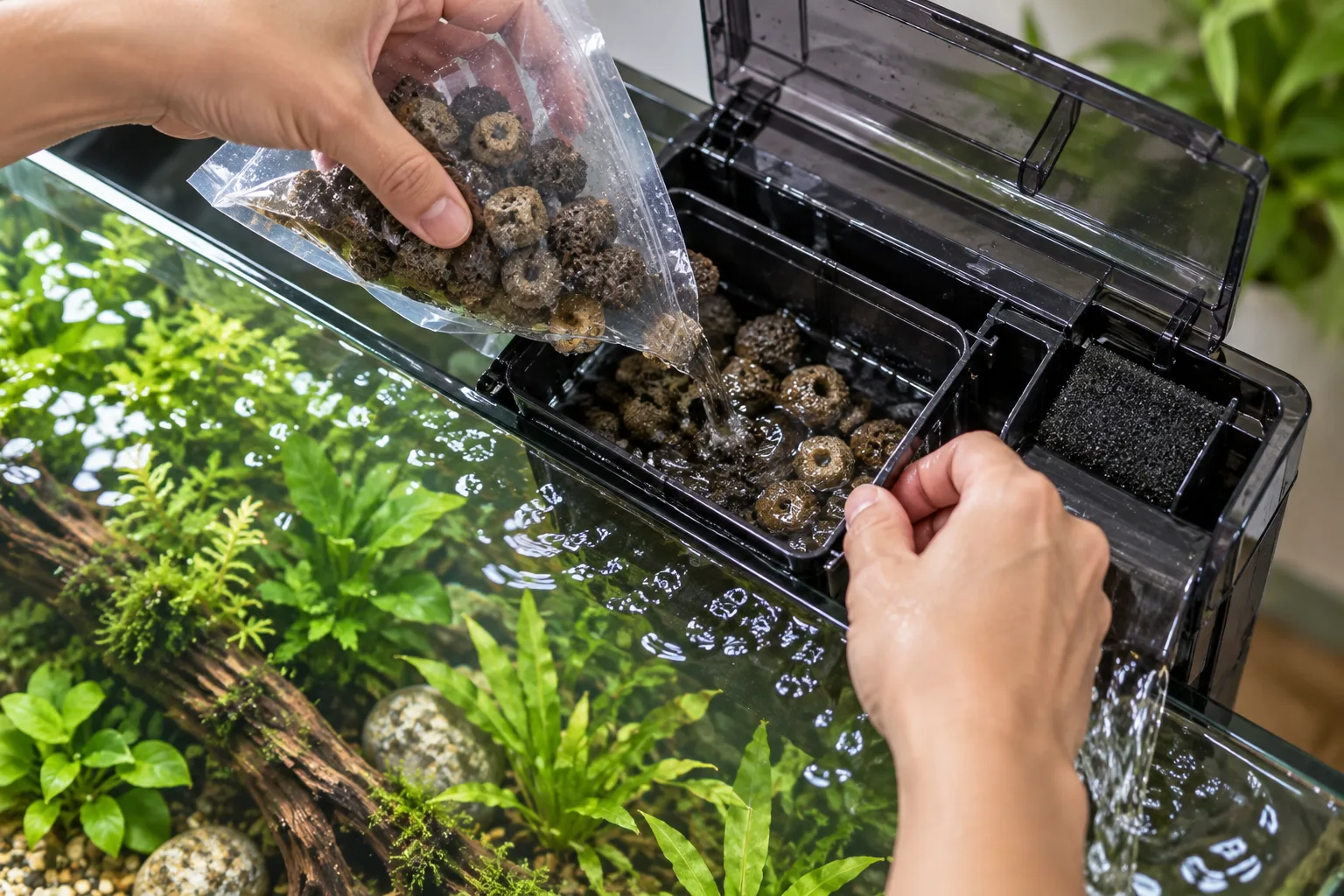
Water from a mature aquarium contains far less attached biomass than mature media. Moving wet mature media can accelerate establishment, but apparently healthy donor fish do not prove the media is free of pathogens.
A cup of old water is not an equivalent transfer of attached biofilm.
How do you cycle an aquarium without fish?
Set up the tank, run the heater and aquarium filtration, condition source water and provide a known ammonia source that is suitable for fishless cycling. Add mature media only from a healthy system whose disease history you trust.
- Assemble the aquarium and confirm that temperature, circulation and aeration remain stable.
- Neutralize chlorine or chloramine before it reaches the new biofilter.
- Add a measured ammonia source according to its documented instructions.
- Test ammonia and nitrite on a consistent schedule and record every addition.
- Allow the microbes to work; do not keep redosing blindly while ammonia remains high.
- Confirm that a final measured input returns to zero ammonia and zero nitrite within the defined test interval.
- Perform the appropriate water change, match temperature and begin with a conservative livestock load.
The SRAC biofilter guide explains that startup time depends on water conditions and inoculation rather than a universal calendar. The Merck Veterinary Manual notes that biological filtration in a new aquarium may take weeks to establish and identifies new-tank ammonia or nitrite as a management problem.
What should the test results look like?
Early in the cycle, ammonia may rise before nitrite becomes measurable. Nitrite can then persist after ammonia begins falling, and nitrate may accumulate if the source water, plants and test method allow it to be seen.
That textbook sequence is helpful but not mandatory in every test log. Seeded media may shorten or blur a stage, plants may take up nitrogen, and some kits have coarse color intervals; readiness still depends on demonstrated processing, not on collecting all three shapes on a chart.
| Result pattern | Likely meaning | Next action |
|---|---|---|
| Ammonia stays high | Dose too large, poor conditions or little active inoculum | Verify dose, pH, temperature, oxygen and dechlorination |
| Ammonia falls but nitrite rises | First community is active; second is still developing | Keep conditions stable and continue measured testing |
| Both return to zero | Biofilter may be ready for the tested load | Confirm with one final controlled input |
| Nitrate remains zero | Plants, dilution or test limits may mask accumulation | Verify the nitrate method; do not use nitrate alone as proof |
| Values rise after stocking | Added waste exceeded established capacity | Protect animals with measured water changes and reduce feeding/load |
What slows or stalls a cycle?
Chlorine or chloramine can damage fish and the microbes you are trying to establish. The EPA aquarium guidance says these disinfectants must be removed or neutralized before aquarium use.
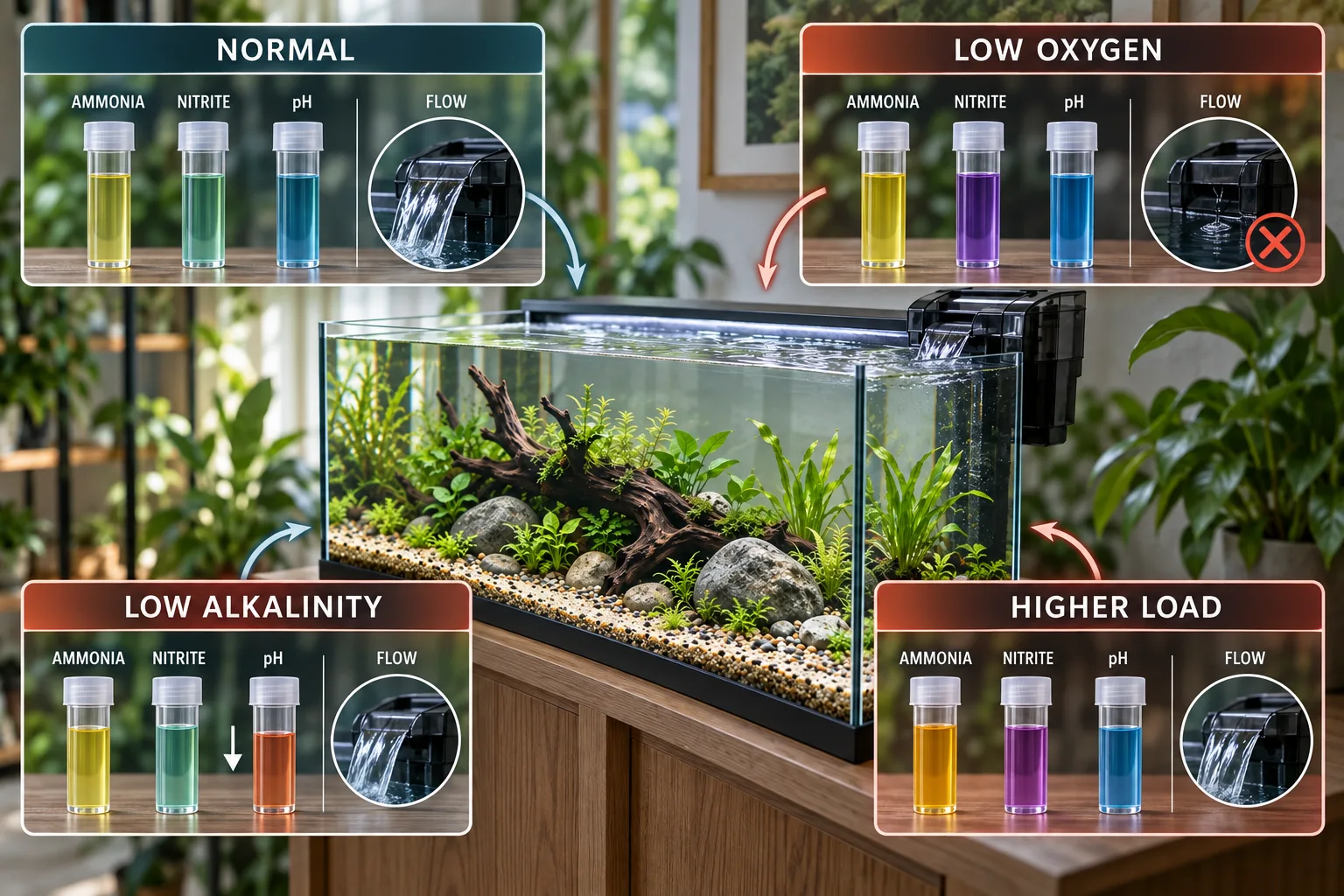
Low oxygen, stopped flow, inappropriate temperature, a major pH drop, drying the media or repeatedly replacing it can also interrupt progress. If ammonia will not fall, use the dedicated ammonia troubleshooting guide rather than adding more bottled products at random.
[kna_callout type="warning" title="Never add a cycling ammonia dose with animals present"] The ammonia-addition and challenge steps apply only before animals are introduced. With fish, shrimp, snails or other livestock already present, do not add a test dose; monitor their existing waste load and control ammonia and nitrite exposure.
Gasping, loss of balance or unresponsiveness needs prompt aquatic-veterinary help while aeration and water quality are checked. Conditioned, temperature-matched water changes can reduce exposure, but replacement water must also suit the animals and the measured problem. [/kna_callout]
Why do oxygen, alkalinity and pH affect cycling speed?
Nitrifying communities need oxygenated water moving across their surfaces. They compete with other organisms for that oxygen, so a tank with decaying food, heavy bacterial clouding or stopped circulation can lose processing performance even when it contains plenty of porous media.
Nitrification consumes alkalinity and produces acidity. In water with little buffering, pH can fall as the cycle progresses; once the pH becomes unsuitable for the microbial community, ammonia processing can slow and the test log may appear to stall.
Measure pH and alkalinity when ammonia stopped declining after earlier progress, particularly in soft source water. Correct the cause gradually and within the future livestock's water requirements, because forcing a high pH only to speed cycling can create a system that must be changed again before animals arrive.
| Observation | What it can indicate | First check |
|---|---|---|
| Ammonia unchanged from the first day | Incorrect dose, inactive inoculum or test limit | Verify source strength and test a control sample |
| Ammonia fell, then stopped | Falling pH, oxygen loss or disrupted flow | Measure pH and confirm aeration and circulation |
| Nitrite remains high | Second-stage community still developing or inhibited | Keep conditions stable and stop adding excess ammonia |
| Both rise after filter service | Media dried, was chlorinated or lost flow | Restore oxygenated flow and protect livestock if present |
| Ammonia rises immediately after a measured addition | The dose itself raised the concentration | Compare processing after mixing and the documented waiting interval |
When is the tank actually cycled?
A fishless tank demonstrates processing capacity when its documented test input repeatedly returns to undetectable ammonia and nitrite within that protocol's interval. Undetectable means below the test's detection limit, not proof that no ammonia molecules remain.
Record the dose concentration, elapsed time and test resolution so the result can be repeated; do not invent a larger challenge to prove extra capacity.
Cycling does not make an aquarium permanently safe. Adding a large school, killing filter media, leaving a filter off or allowing heavy decay can produce an aquarium ammonia spike in a system that had been stable for years.
Biofilter capacity is not a permanent rating. The active community responds to the ammonia supply, oxygen, temperature, pH, available surface and water flow; when the waste load falls for a long period, the system should not be assumed to retain unlimited reserve for a sudden large addition.
A readiness test proves only the load and interval that were actually tested. It does not prove that the tank can accept every animal on a final stocking list at once, or that a filter will perform the same way after media is moved, allowed to cool, packed with debris or deprived of power.
After stocking, use ammonia and nitrite results together with feeding and animal behavior. A zero result before breakfast does not exclude a short peak after a large meal, and gasping at the surface still requires an oxygen and circulation check even when nitrogen tests read zero.
How should you add the first animals?
Make the final water change needed to reduce accumulated nitrate, then match the species' temperature and water context. Start below the intended final load and test after feeding and through the first week.
A mature biofilter handles nitrogenous waste; it does not create adequate swimming room, social structure or oxygen by itself. The betta tank setup, gold barb profile and Amano shrimp profile show why the animal's footprint, group and flow needs remain separate decisions.
How do you preserve the cycle during maintenance?
Keep established media wet and oxygenated, and restore filter flow promptly after service. Rinse reusable media in removed aquarium water when cleaning is needed, and avoid replacing all media on the same day.
The OATA freshwater setup guide specifically warns against washing filter media under tap water. If a long power outage, medication event or accidental chlorination may have damaged the biofilter, resume ammonia and nitrite testing instead of assuming the previous cycle still exists.
How do plants and mature substrate change the cycle reading?
Fast-growing plants can take up ammonium and nitrate, so a planted aquarium may never show the neat nitrate rise seen in an unplanted test tank. That can reduce nitrogen exposure, but plant uptake is variable with light, carbon availability, growth and pruning; it does not prove that filter media can process the intended animal load.
Mature substrate and hardscape also carry biofilm. Moving them can help establish a new system, yet it can also transfer snails, algae, parasites or accumulated detritus, so source history matters as much as apparent maturity.
In a planted tank without animals, the documented fishless test checks the combined removal capacity of plants and microbes. It cannot show how much of the result came from the filter alone.
Note plant mass and lighting in the record so a later reduction in growth does not look like a mysterious biofilter failure.
After stocking, watch the tank through ordinary events such as feeding, pruning and filter service. A cycle that only passes while plants are rapidly growing or while feeding is unusually low has not demonstrated much reserve for a missed maintenance day or a sudden increase in waste.