
What Is an Amano Shrimp, and What Does Its Group Need?
Caridina multidentata
Amano shrimp are social freshwater grazers that need a mature aquarium, shaded textured surfaces, safe filtration and tank mates unable to eat them. They can consume soft algae and biofilm, but they still require deliberate feeding and are especially vulnerable to copper contamination.
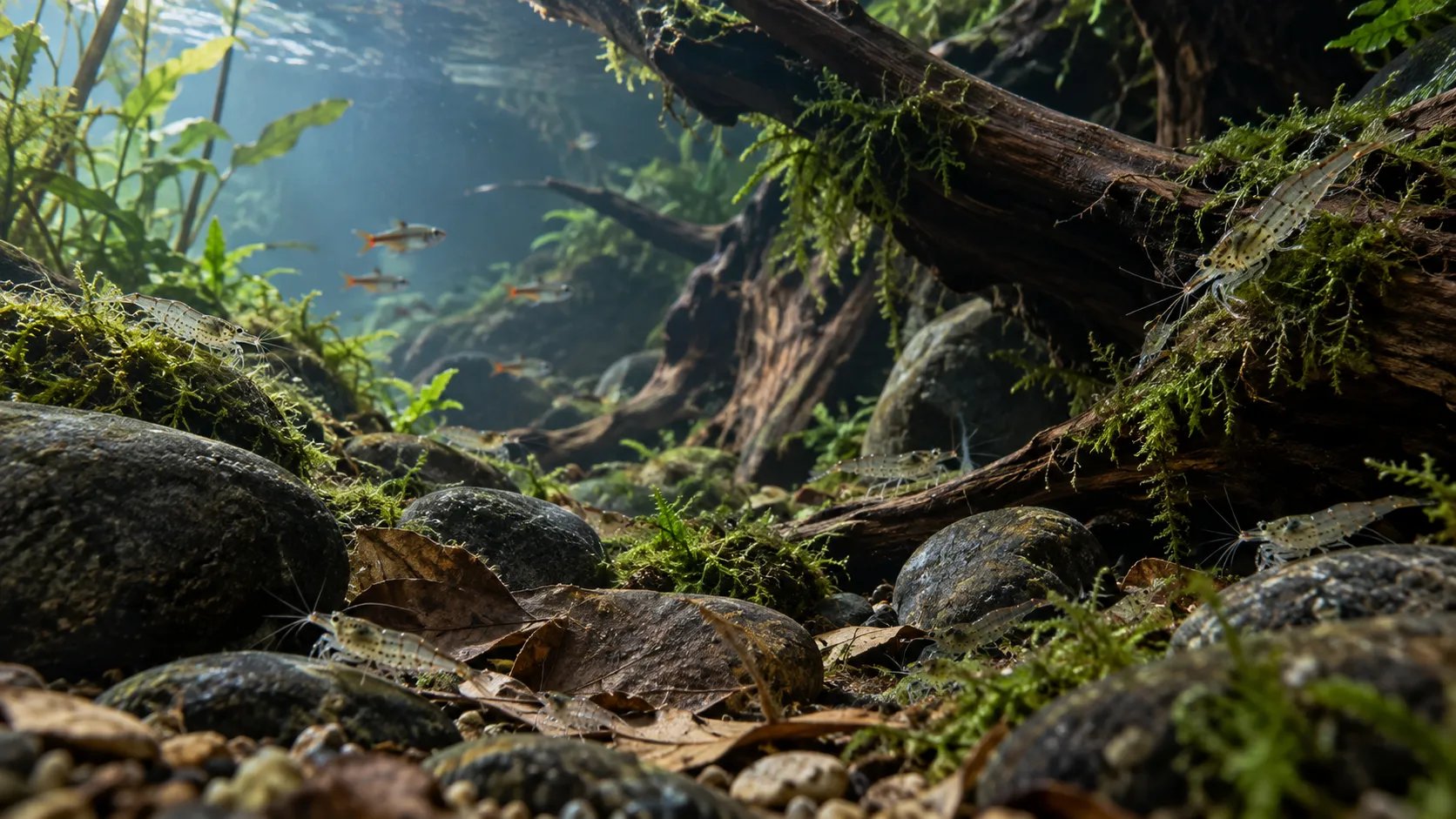
At a glance

- Family
- Atyidae
- Native range
- Japan, the Ryukyu Islands, Taiwan and other western Pacific localities, with records extending farther across the Indo-Pacific
- Conservation status
- Not assigned here because the checked taxonomic and husbandry sources did not provide a current global assessment
What is an Amano shrimp?
The Amano shrimp is Caridina multidentata, a transparent to grey-brown freshwater shrimp marked with rows of dark dots or dashes. The World Register of Marine Species accepts that name and treats the familiar Caridina japonica as a junior synonym.
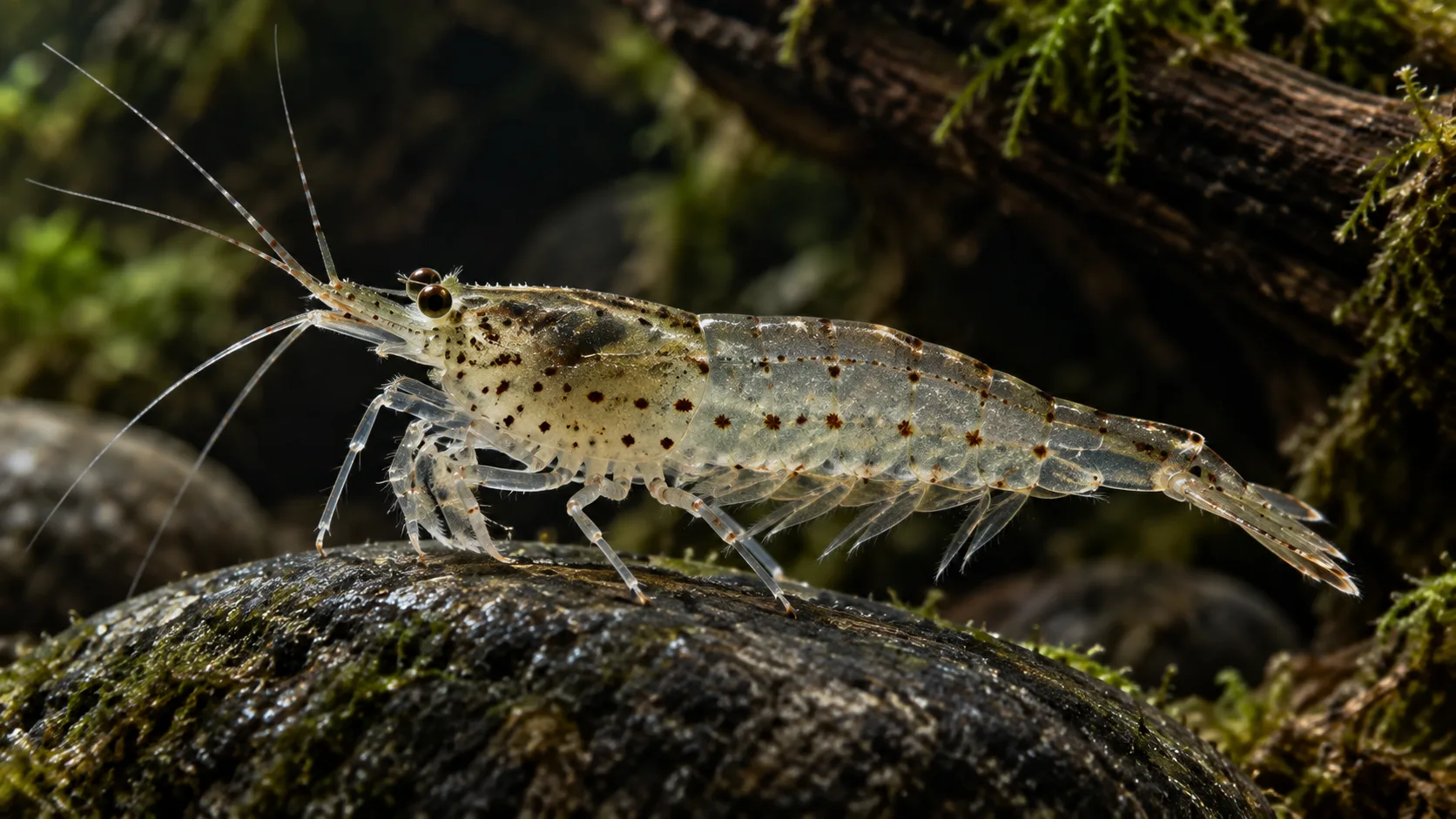
OATA's freshwater shrimp care sheet reports an adult size up to about 5 cm. That makes the species larger and more robust than many dwarf shrimp, but still vulnerable to fish that can swallow or tear it.
- Accepted name
- Caridina multidentata
- Common older name
- Caridina japonica
- Recorded aquarium size
- Up to about 5 cm
- Social baseline
- Keep a group, with OATA advising at least five
- Distinct life-history issue
- Larvae develop through a brackish or marine-influenced phase
- Major safety issue
- High sensitivity to copper and other contaminants
Why should Amano shrimp live in a group?
Amano shrimp are active foragers, and OATA recommends keeping at least five. A group does not turn the aquarium into an automatic cleaning crew, but it allows normal social proximity and makes it easier to see whether one animal is consistently excluded or failing to feed.
Count adult body size and available surface area rather than counting only litres. Wood, stone, leaves and plant cover create grazing routes, while open foreground lets you assess body condition and find an animal that stops moving normally.
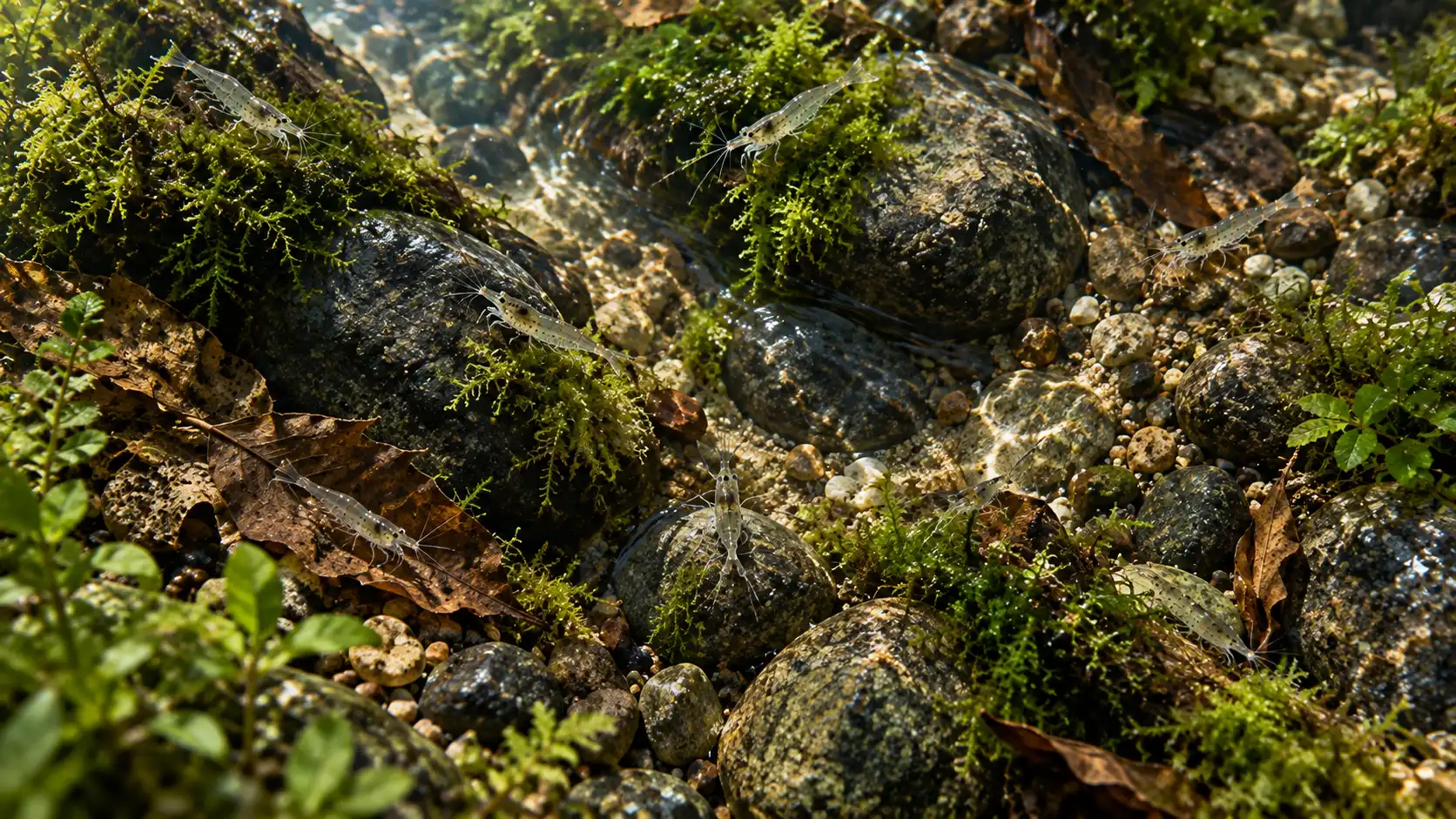
The tank footprint for Amano shrimp depends on group size, mature grazing area, filter safety, tank mates and the stability of a fully cycled aquarium.
What should the aquarium layout provide?
Field and laboratory evidence helps explain why these shrimp often use current, shade and broken hard surfaces. A 2025 Journal of Crustacean Biology study found a preference for flowing water and avoidance of light, while habitat work describes the value of spaces among cobbles and boulders.
Translate that into moderate circulation with calm refuges, shaded cover and loose-looking but physically stable textures. Do not create a high-velocity channel that forces every shrimp to cling constantly, and guard filter intakes so adults and any small animals cannot be drawn in.
- The aquarium is fully cycled and has mature surfaces rather than sterile new decor.
- Wood, stone and plants provide shaded grazing routes and molt refuges.
- Flow reaches the tank without pinning shrimp against one surface.
- Every intake has a shrimp-safe guard that can be cleaned without exposing a gap.
- The lid closes cable and filter openings because shrimp can climb near the waterline.
- Open viewing areas make appetite, molts and missing animals easier to assess.
Avoid gluing every stone into a smooth wall. Irregular gaps are useful, but each rock must remain stable during maintenance and cannot form a trap that a fish or shrimp cannot leave.
Do Amano shrimp live on algae alone?
No. They graze soft algae, biofilm and organic material, but the amount and nutritional value change from week to week, especially in a newly cleaned or recently established aquarium.
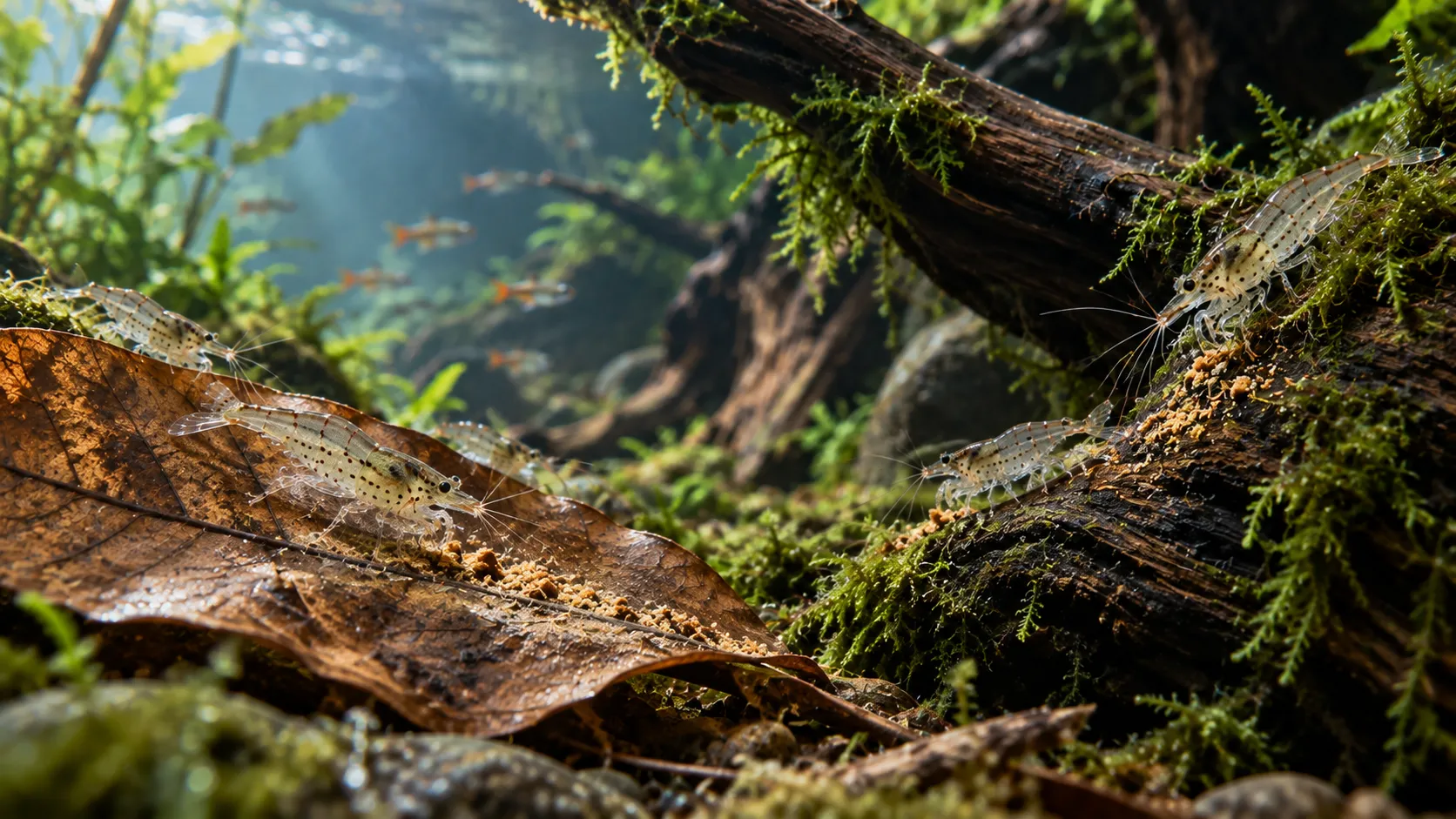
Use an appropriate complete shrimp or invertebrate food as a controlled supplement and offer plant-based variety that the group can reach. An Amano shrimp diet must feed the animals you have, rather than rely on the algae problem you hope they solve.
- Watch the group before feeding and note whether every shrimp is active and able to reach a surface.
- Offer a small portion in more than one place when dominant fish or shrimp crowd the food.
- Confirm active handling and eating instead of assuming food that disappears was eaten by Amanos.
- Remove uneaten concentrated food before it fouls the substrate.
- Change the next portion from body condition, molt quality and water-test trends.
An aquarium can be visibly green while offering little edible growth, and a spotless display can still support biofilm in wood and plant surfaces. Appearance alone does not measure available nutrition.
What does a healthy molt require?
Shrimp replace their exoskeleton as they grow. A complete empty shell is usually a normal molt, and leaving it briefly allows the group to recover some minerals unless the shell must be removed for a specific hygiene reason.
Stable water matters because molting changes the animal's protection and fluid balance. Avoid sudden corrections to pH, hardness or temperature, and do not add mineral products without measuring the source water and understanding what the product changes.
A universal hardness number cannot settle Amano shrimp water requirements because local acclimation, test method and the rest of the aquarium determine how a change should be handled.
Why is copper especially dangerous?
Crustaceans can be harmed by copper at concentrations that may be tolerated by fish. The 2025 study above measured copper toxicity in C. multidentata, while OATA warns that many common fish medications contain copper and should not be used in aquariums housing shrimp.
If exposure is suspected, stop adding the source, verify the product and test with a method suitable for the expected concentration. Use fresh conditioned water and adsorption media only within a measured response plan, because an uncontrolled chemistry swing creates another stress.
Household sprays, soap, hand cream and metal-contaminated tools also matter. Keep dedicated buckets and nets, rinse hands thoroughly with water, and never clean aquarium equipment with household detergent.
Which fish can live with Amano shrimp?
Choose tank mates by mouth size, hunting behavior and feeding pressure, not by the word community. OATA advises against fish large enough to swallow shrimp, and even a fish that cannot eat an adult may injure a newly molted animal or consume larvae.
| Tank-mate question | Lower-risk condition | Stop or separate when |
|---|---|---|
| Can the fish swallow the shrimp? | Adult shrimp is clearly larger than the fish's gape | Stalking, lunging, missing animals or visible injury |
| Will the shrimp reach food? | Food is distributed across several sheltered sites | Shrimp lose condition or remain hidden through every feeding |
| Are molts protected? | Dense plants, wood and stone gaps remain accessible | Fish probe every refuge or attack soft shrimp |
| Do water needs overlap? | Stable shared temperature and chemistry suit both | One animal requires repeated compromise or rapid adjustment |
| Is breeding the goal? | Dedicated specialist rearing system | Larvae are exposed to fish or ordinary filtration |
Snails and other shrimp are not automatically safe either, because disease transfer, competition and incompatible mineral needs still require review.
Why do the larvae disappear in freshwater?
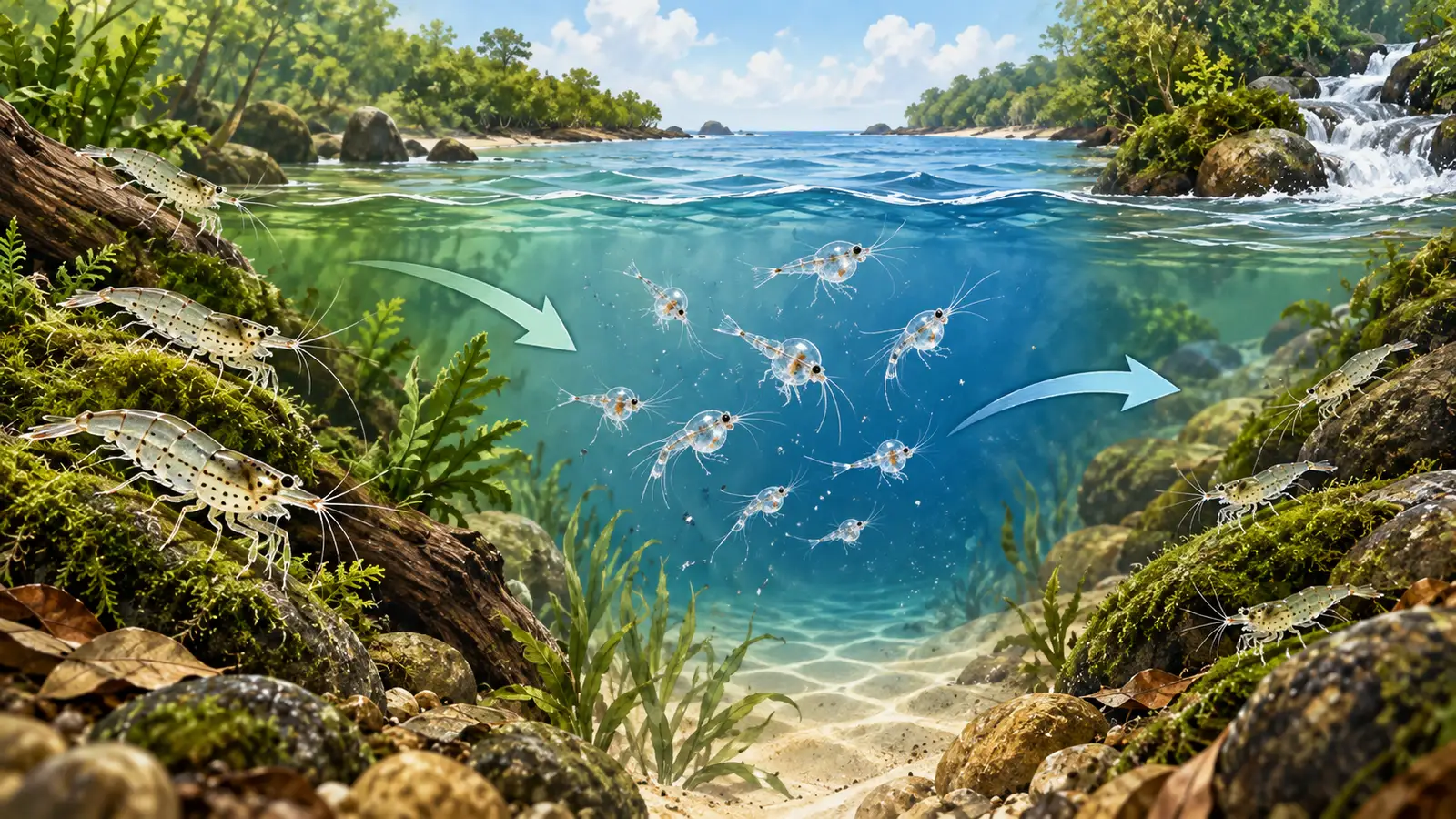
Female Amano shrimp may carry many eggs under the abdomen, but that does not mean juveniles will appear in an ordinary freshwater community tank. The larvae are amphidromous and develop through saline-influenced water before juveniles return to freshwater.
A 2021 Crustacean Research study examined how larvae respond to salinity. That biology explains common failure, but it does not turn one salinity figure into a complete breeding recipe because food, developmental stage, transfer timing, water quality and safe return all matter.
Do not add salt to a community aquarium carrying eggs, because that exposes every resident and biological process to a change they may not tolerate.
How should new shrimp be introduced?
Buy active shrimp with intact appendages and ask for the seller's temperature, pH, GH, KH and medication history. Prepare a mature quarantine or observation system that is safe for invertebrates before transport rather than trying to improvise after the bag arrives.
Measure both waters and use a gradual, time-bounded acclimation when a meaningful difference exists. Do not leave shrimp for hours in cooling transport water, and do not pour shop water into the aquarium.
- The destination is cycled, temperature stable and free of copper medication.
- An intake guard is fitted before the bag opens.
- Seller and destination water are measured with tests that show units.
- Shrimp have shaded refuges and food access on arrival.
- Separate equipment prevents wet transfer from quarantine.
- The group is counted and observed after lights dim and again the next day.
The page on common Amano shrimp care mistakes covers repeated preventable failures. Sudden inactivity, uncontrolled swimming, loss of balance or multiple deaths calls for immediate water and contamination checks rather than an unmeasured additive.
How long can Amano shrimp live?
OATA describes freshwater shrimp generally as living for a couple of years, with lifespan varying by species and conditions. Treat that as a broad husbandry context, not a guaranteed lifespan for a shrimp of unknown age and history.
In daily care, survival is protected by stable mature water, adequate food, safe molts, low predation pressure and rapid response to contamination.
Is an Amano shrimp group right for your tank?
Amano shrimp fit a mature planted or hardscaped freshwater aquarium where a group has shaded grazing surfaces, moderate circulation, safe filter intakes and no fish capable of hunting them. They suit a keeper willing to feed them directly and check every medication for invertebrate safety.
Choose another plan when the tank is newly cycled, aggressive fish control the bottom, copper treatment must occur in the display, or the only goal is guaranteed algae removal. A living animal is an uncertain grazer, not maintenance equipment, and the aquarium still needs manual cleaning and nutrient control.
If the decision is between shrimp types, compare the Amano's larger size and migratory larval biology with the dedicated Amano versus cherry shrimp comparison and the cherry shrimp profile, Amano versus bamboo shrimp and Amano versus ghost shrimp guides. Those comparisons keep species-specific water, feeding and behavior differences out of a generic shopping list.