
What Is a Cherry Shrimp, and What Keeps a Colony Alive?
Neocaridina davidi
A cherry shrimp is the red aquarium line of Neocaridina davidi, a small East Asian freshwater shrimp that grows to about 3 cm and breeds readily in a stable, mature tank. Most losses in a colony come from unstable or contaminated water, failed moults and fish eating the young, so those risks decide how the tank is set up.
At a glance

- Adult size
- 2 to 4 cm
- Minimum footprint
- No footprint is set by the checked sources; floor and plant surface area decide how many shrimp can graze
- Minimum volume
- 10 litres
- Social structure
- Peaceful colony animal that grazes alongside its own kind without territories
- Minimum group
- 5
- Sex ratio
- No fixed ratio needed; a mixed group of both sexes breeds
- Diet
- Omnivore
- Feeding
- Grazes biofilm, algae and detritus, with prepared shrimp food offered in small portions two or three times a week.
- Waste load
- Very low per animal, rising as the colony multiplies
- Lifespan
- 1 to 2 years
- Family
- Atyidae
- Native range
- East Asian fresh waters; sources name Taiwan, mainland China, Korea and Vietnam
Ten litres is OATA's starting point for a small group; a breeding colony outgrows it, and more water resists sudden temperature and chemistry swings.
What is a cherry shrimp?
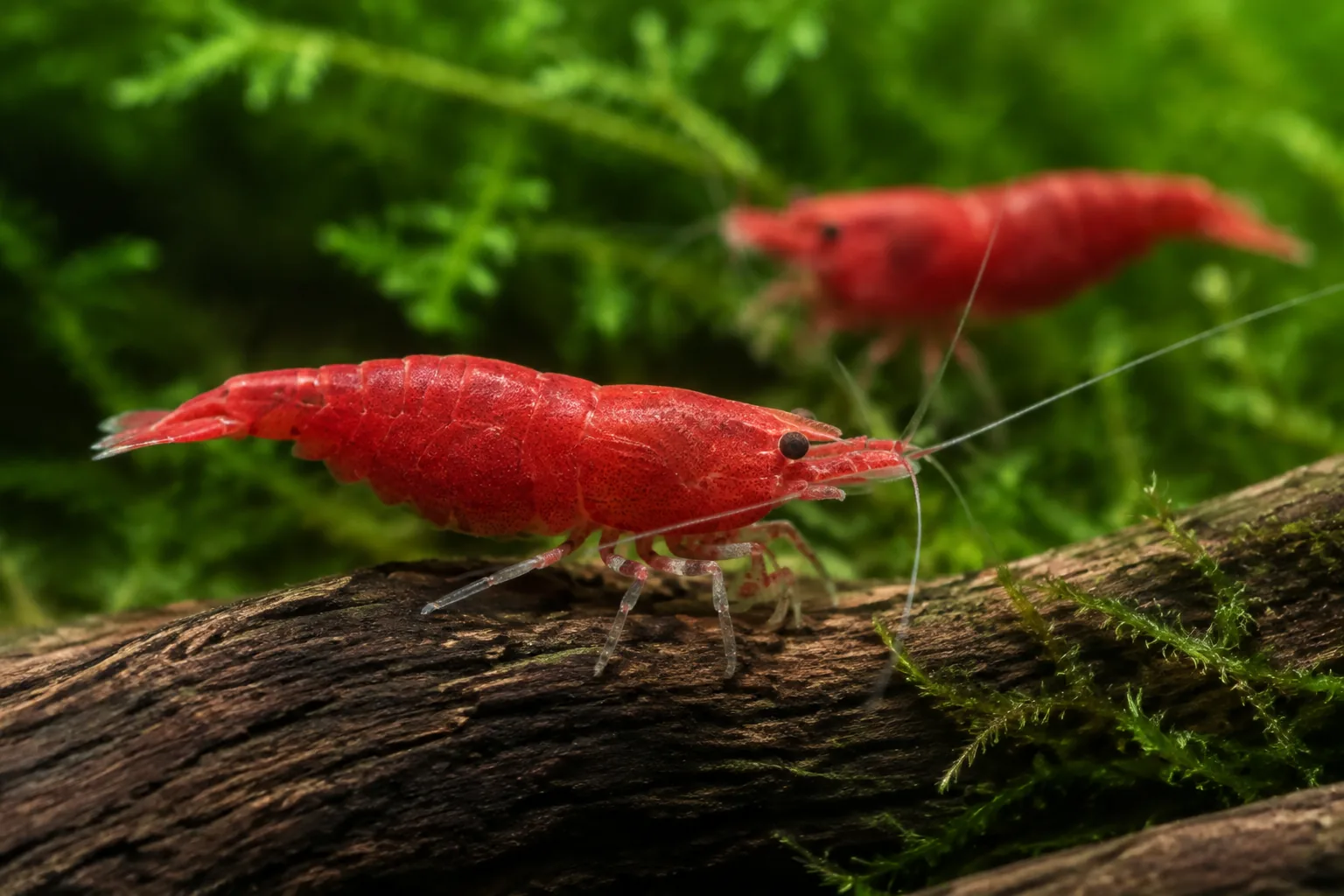
A cherry shrimp is the red colour line of Neocaridina davidi (Bouvier, 1904), a freshwater dwarf shrimp in the family Atyidae. Wild shrimp of the species are transparent to greenish brown, and the University of Florida IFAS fact sheet explains that the red animals sold in shops come from generations of selective breeding.
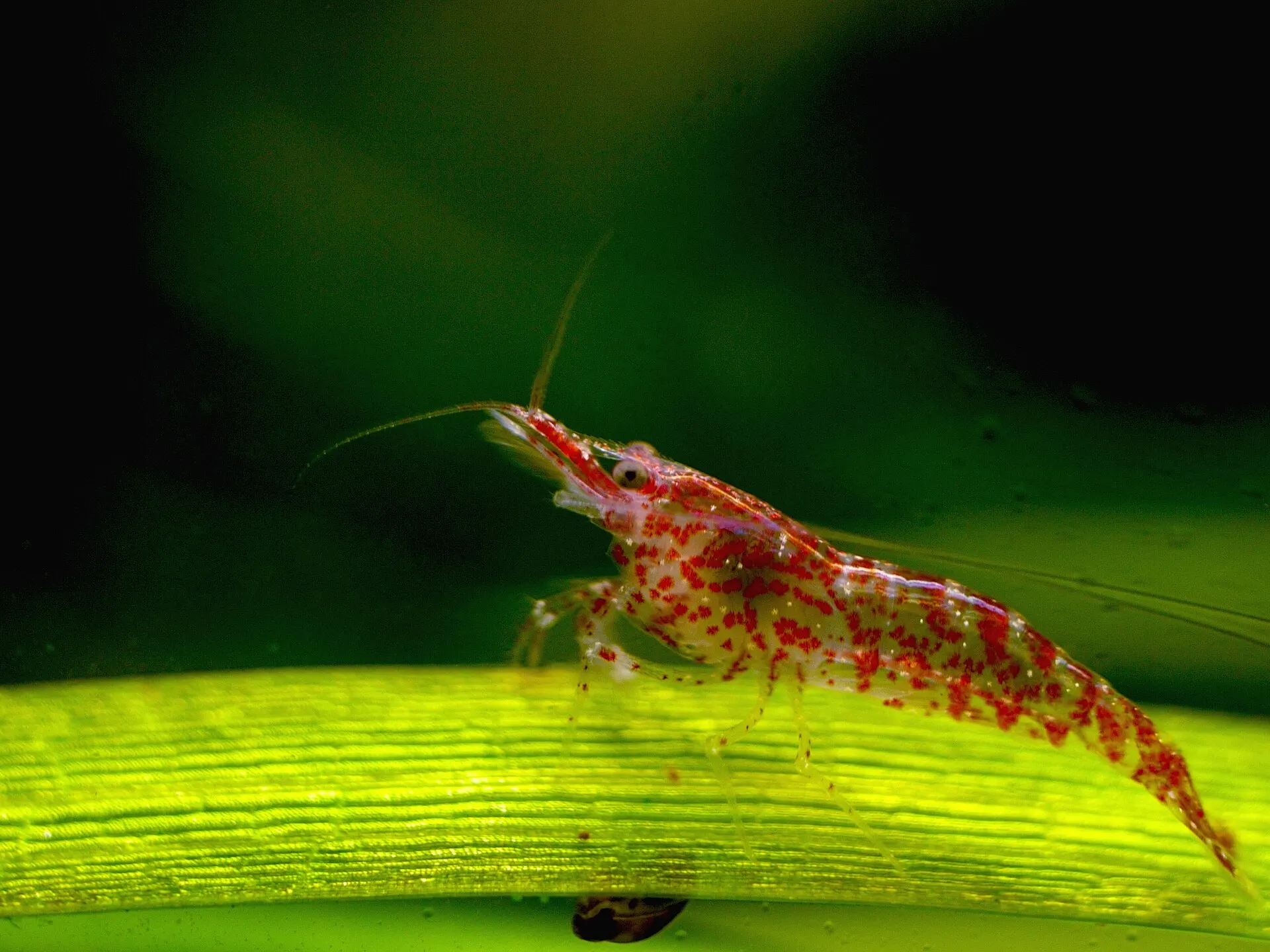
Adults are small. Klotz and colleagues, quoted in the US Fish and Wildlife Service risk screening, record a body size of up to 40 mm, with females averaging 25 mm and males 20 mm.
That size gap is the easiest way to sex a group, because the larger, deeper-bodied shrimp are usually females carrying or preparing to carry eggs.
- Accepted name
- Neocaridina davidi (Bouvier, 1904), accepted by WoRMS
- Older aquarium labels
- Neocaridina heteropoda, N. denticulata sinensis, N. denticulata davidi
- Family
- Atyidae
- Native range
- East Asia; sources list Taiwan, China, Korea and Vietnam
- Adult size
- Up to about 4 cm; females average 2.5 cm and males 2 cm
- Development
- Eggs hatch as miniature shrimp with no free larval stage
- Recorded wild lifespan
- About 10 to 15 months in one Japanese river population
- Conservation
- No global assessment found in the sources checked
- Invasion risk
- Rated high risk by the US Fish and Wildlife Service
Why the shrimp carries so many names
Older books and shop labels often say Neocaridina heteropoda or Neocaridina denticulata sinensis. The World Register of Marine Species treats N. heteropoda Liang, 2002 as a junior synonym of N. davidi, and lists N. denticulata davidi as an unaccepted name for the same animal.
The genus is still under revision. WoRMS keeps the Japanese Neocaridina denticulata as a separate species, while a 2024 study by Yang and colleagues, summarised in the USFWS screening, argues that N. davidi, N. denticulata and N. heteropoda belong to one species.
Those labels on a shop tank therefore describe the same kind of shrimp, and none of them signals different care.
The same species also supplies blue dream, green jade, orange and yellow sakura, and the patterned rili shrimp, all grouped as Neocaridina shrimp. Because every one of those lines is a single species, two colours kept in one tank can interbreed.
They are a different genus from crystal red shrimp and other Caridina dwarf shrimp, which are often sold in the next tank but are not the same animal.
Sources also differ on the wild range. The UF/IFAS fact sheet describes the species as native to streams in Taiwan, while the sources gathered by the USFWS list China, Korea, Taiwan and Vietnam.
Klotz describes its home streams in East and Central China as running from 6 to 8 °C in winter to nearly 30 °C in summer. That wide seasonal swing explains both why the shrimp tolerates so many aquariums and why it survives so well where people release it.
What water do cherry shrimp need?
Cherry shrimp live across a wide spread of chemistry, so steady water matters more than hitting one number. OATA's freshwater shrimp care sheet gives 17 to 27 °C, pH 6.5 to 8.0, 4 to 18 dGH and 3 to 15 dKH, with ammonia and nitrite at zero.
Published cherry shrimp water context
- Temperature17 to 27 °CApplies to Small freshwater shrimp in home aquariums. Thermometer placed away from the heater. Source: OATA, checked 2026-09-21.
- pH6.5 to 8.0 pHApplies to Small freshwater shrimp in home aquariums. Calibrated meter or liquid test kit. Source: OATA, checked 2026-09-21.
- General hardness4 to 18 dGHApplies to Small freshwater shrimp in home aquariums. GH titration test in degrees of hardness. Source: OATA, checked 2026-09-21.
- Carbonate hardness3 to 15 dKHApplies to Small freshwater shrimp in home aquariums. KH titration test in degrees of hardness. Source: OATA, checked 2026-09-21.
- Ammonia0 mg/LApplies to Any aquarium holding shrimp. Liquid test reading total ammonia. Source: OATA, checked 2026-09-21.
- Nitrite0 mg/LApplies to Any aquarium holding shrimp. Liquid nitrite test. Source: OATA, checked 2026-09-21.
- NitrateNo more than 20 mg/L above the tap water readingApplies to Small freshwater shrimp in home aquariums. Nitrate test compared with a tap water test. Source: OATA, checked 2026-09-21.
- Temperature24 to 32 °C tested, 28 °C best for cultureApplies to Laboratory culture of red cherry shrimp at pH 7.5. Controlled tanks held at 24, 28 and 32 °C for 90 days. Source: Tropea and colleagues, 2015, checked 2026-09-21.
- Temperature14 to 30 °CApplies to Captive breeding reported in published studies. Compiled in a federal risk screening. Source: USFWS, checked 2026-09-21.
- pH6.0 to 8.2 pHApplies to Captive breeding reported in published studies. Compiled in a federal risk screening. Source: USFWS, checked 2026-09-21.
Every range above is for a freshwater system.
The OATA ranges cover small freshwater shrimp kept at home in general, while the laboratory study and the breeding reports measured what cherry shrimp tolerate, which is why their spans reach further at both ends.
Temperature has the clearest measured effect: in the culture study by Tropea and colleagues, embryos took 12 days to develop at 32 °C and 21 days at 24 °C, survival tended to be lowest at 32 °C, and every female that matured and mated at 32 °C lost her eggs.
Warmer water therefore speeds a colony up only to a point, and a summer spell that pushes a tank above 30 °C can cost a colony its broods.
Hardness matters for a different reason. GH measures the dissolved calcium and magnesium a shrimp draws on to build each new shell, while KH is what holds pH steady between water changes.
A colony that has settled at pH 7.8 and 12 dGH is better off left there than pushed toward a textbook value. If the water must move, spreading the change over several days, with GH shifting no more than about 2 dGH in 24 hours, gives the shrimp time to adjust, and the change should stop as soon as shrimp stop moving about or fail to moult cleanly.
Why do cherry shrimp suddenly die?
When several cherry shrimp die within a day or two, the cause is usually something that changed in the water every shrimp shares, not a disease in one animal. Checking the water first also costs nothing, whereas guessing at a disease can mean adding a product that makes things worse.
Check the shared water before anything else
- Ammonia and nitrite Test both straight away. Any reading above zero is toxic, and it often follows overfeeding, a dead snail or shrimp left to rot, or a filter cleaned too hard.
- Copper and treatments Read the active ingredients of every product added in the last week, including fish medicines, algae treatments and plant fertilisers.
- Household contaminants Think back over sprays, air fresheners, hand cream and soap used near the tank or on hands, buckets and nets.
- A large water change Compare the temperature, GH and KH of the new water with the tank water, since a big difference can bring on stress and failed moults.
- Temperature Check a separate thermometer against the heater setting, especially after hot weather or a cold night.
- Oxygen Look for shrimp crowding near the surface or the filter outflow, which points toward low oxygen.
- Tank age A tank only a few weeks old may not have a stable nitrogen cycle or enough biofilm for shrimp to graze.
A reading of ammonia or nitrite above zero calls for a partial water change the same day, using dechlorinated water matched to the tank for temperature and hardness. Retesting afterwards shows whether one change was enough, and further water changes in measured steps are safer than one huge one that shocks the survivors.
Why copper deserves its own warning
OATA's care sheet warns that freshwater shrimp are very sensitive to copper and die when exposed even to low levels. A treatment dosed for fish can therefore wipe out a colony that shares the tank, even though the fish recover.
The label word "safe" says little on its own, because the active ingredient list is what shows whether a product contains copper.
A fish that needs a copper-based treatment is better moved to a separate quarantine tank than treated beside the shrimp.
When losses need outside help
An occasional single death is normal in a colony of animals that live only a year or two. Continuing losses with clean water tests, or shrimp that turn cloudy, discoloured or swollen, need an aquatic veterinarian or an experienced specialist.
Shrimp carry parasites and commensals that cannot be told apart by eye, and the USFWS screening records that the microsporidian EHP, which stunts growth, was detected in a feral German population.
How do cherry shrimp moult, and when does it go wrong?
Shrimp grow by shedding their exoskeleton, so a healthy cherry shrimp moults many times over its life. The empty shell looks like a whole pale shrimp lying on the substrate, which alarms many new keepers even though the animal that left it is alive and hiding.
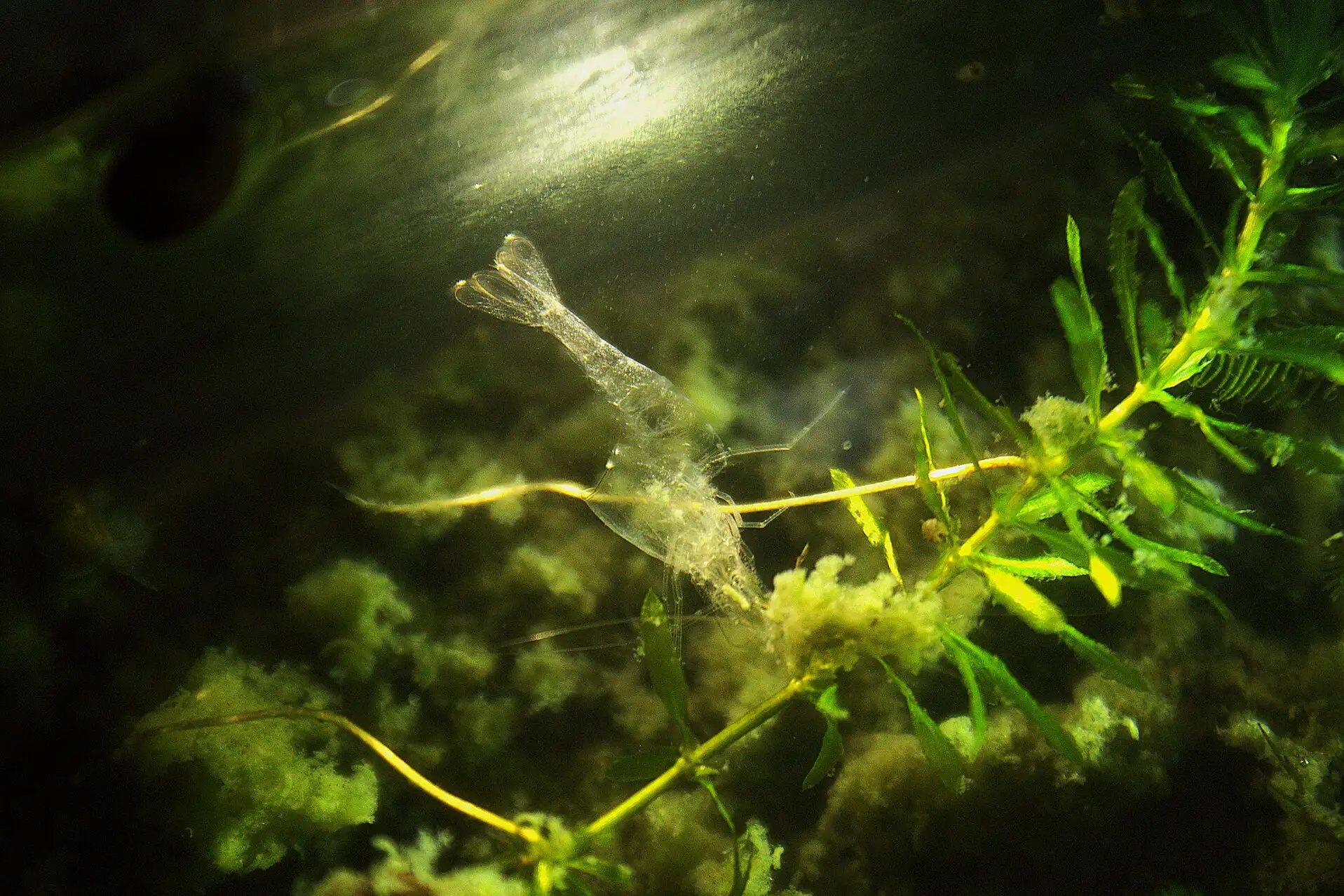
The UF/IFAS fact sheet notes that cherry shrimp eat their old shell to take back its minerals. A moult left in the tank usually disappears within a day or two for that reason, and removing it straight away takes those minerals out of the colony.
A freshly moulted shrimp is soft until the new shell hardens, so it hides, and that is also when fish can injure or eat an adult they would otherwise leave alone.
| Decision factor | Usually normal | Worth investigating |
|---|---|---|
| Shell | Complete and empty | Shrimp stuck partway out of the old shell |
| Timing | Moults found now and then across the group | Several shrimp moulting at once after a water change |
| Afterwards | Shrimp hides for a while, then feeds again | Shrimp lies on its side or cannot right itself |
| Colony pattern | Few deaths over weeks | Repeated deaths around moulting |
Several shrimp moulting together, or dying partway through, points first to a recent change in the water. A large water change with different hardness or temperature is the usual suspect, because it is the one event that reaches every shrimp at once.
Very soft water can show up here as well, since each new shell is built from dissolved minerals.
How does a cherry shrimp colony grow?
A cherry shrimp colony grows on its own when the water stays stable, because the species breeds entirely in freshwater and its young skip the drifting larval stage most shrimp need. That separates it from the Amano shrimp, whose larvae need saline-influenced water and rarely survive in a home tank.
| Stage | What happens | Figure recorded | Source |
|---|---|---|---|
| Carrying eggs | The female holds eggs under her abdomen and fans them with her swimming legs | 43 to 60 eggs per clutch | Pantaleão and colleagues, via UF/IFAS |
| Incubation | Embryos develop while the female carries them | 16 to 19 days; 12 days at 32 °C and 21 days at 24 °C in culture | UF/IFAS; Tropea and colleagues |
| Hatching | Young emerge as miniature shrimp with no larval stage | About 1 to 2 mm long | UF/IFAS |
| Juveniles per female | Fewer young hatch than eggs are laid | Mean of 24.2 juveniles per female | Tropea and colleagues |
| Maturity | Young begin breeding themselves | Around 30 days | UF/IFAS |
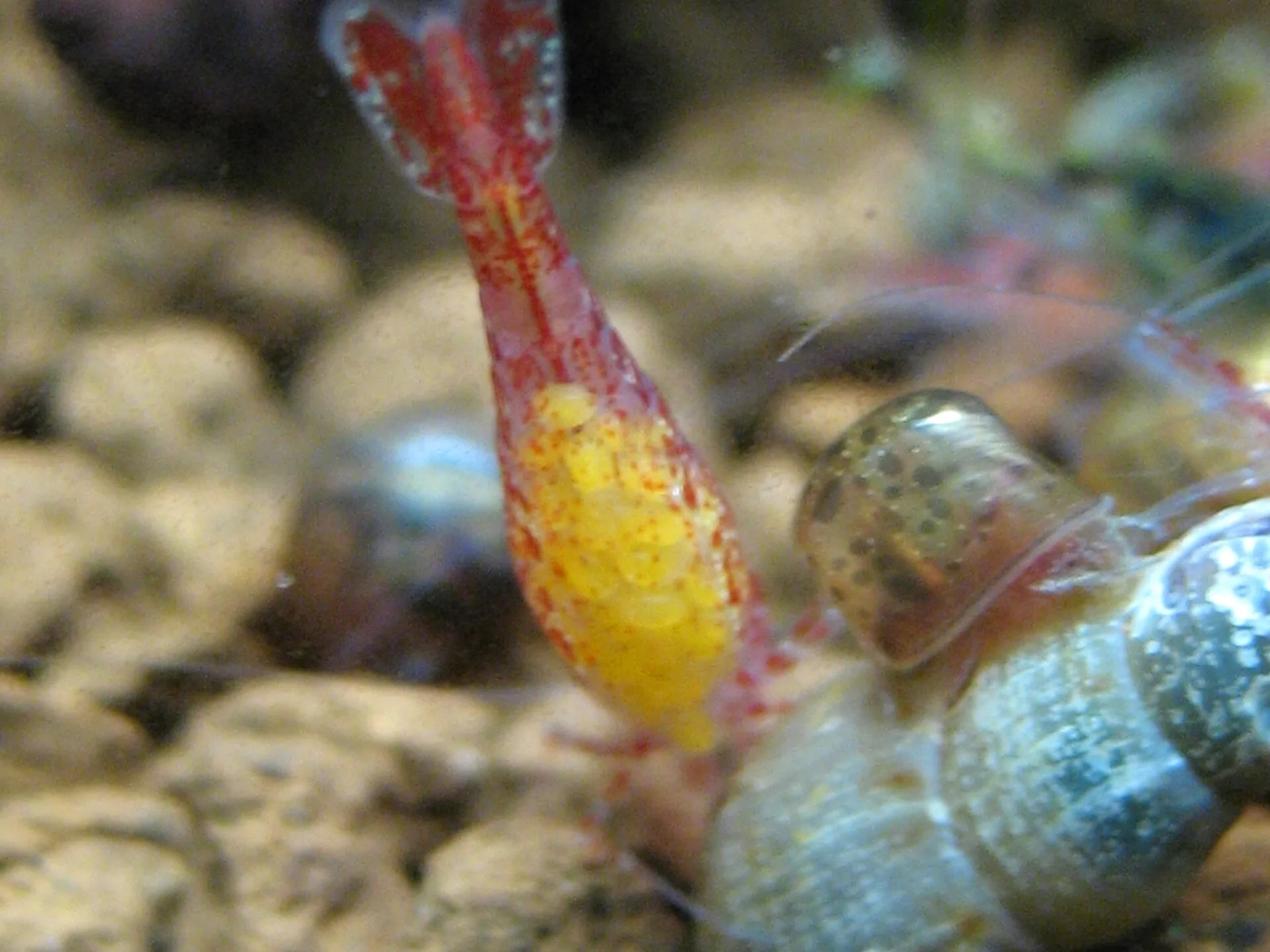
Berried females and lost clutches
A berried female keeps her eggs moving with her swimming legs, which the UF/IFAS sheet explains stops fungus growing on them, and she carries the clutch for two to three weeks until it hatches.
A female that drops her eggs is usually reacting to her conditions. Heat is the best documented cause, since in the Tropea culture every female that mated at 32 °C lost her clutch.
Sources do not agree on the best breeding temperature. The laboratory study found the most berried females at 28 °C, while wild populations summarised by the USFWS showed the highest share of berried females between 15 and 20 °C and the lowest above 25 °C.
Where the shrimplets go
Newly hatched shrimp are only 1 to 2 mm long, small enough to be drawn through the slots of an ordinary filter intake. A fine sponge over the intake, or a sponge filter, prevents that loss.
Dense java moss or similar fine plants give shrimplets somewhere to hide and graze out of reach of anything that eats them, which decides how many reach adulthood.
How long each shrimp lives
Mitsugi and Suzuki estimated that males in a Japanese river population lived about 10 to 13 months and females about 12 to 15 months, though the authors noted that more samples were needed. OATA describes freshwater shrimp as living for a couple of years in a well-matured aquarium with good water quality.
Individual lives are short, so a colony lasts only while it keeps breeding.
A group that stops producing young usually signals a problem with water or food, and it dwindles within about a year even if no shrimp ever appears sick.
What tank size does a cherry shrimp colony need?
OATA uses at least 10 litres for a group of small freshwater shrimp and treats five as the smallest group worth keeping. That figure is a floor for a starting group, not the size of the colony it becomes.
A healthy group multiplies, and a small volume changes temperature and chemistry faster than a large one. Since sudden change is the thing most likely to kill shrimp, a larger tank protects the colony more than it gives it room to swim.
Shrimp live on surfaces rather than in open water, and the floor, plant leaves, wood, stone and glass are where they graze, so a layout with more surface area feeds more shrimp in the same volume.
- The tank has run with a stable nitrogen cycle for several weeks, with ammonia and nitrite at zero.
- Every filter intake is covered with fine sponge, or the tank runs a sponge filter.
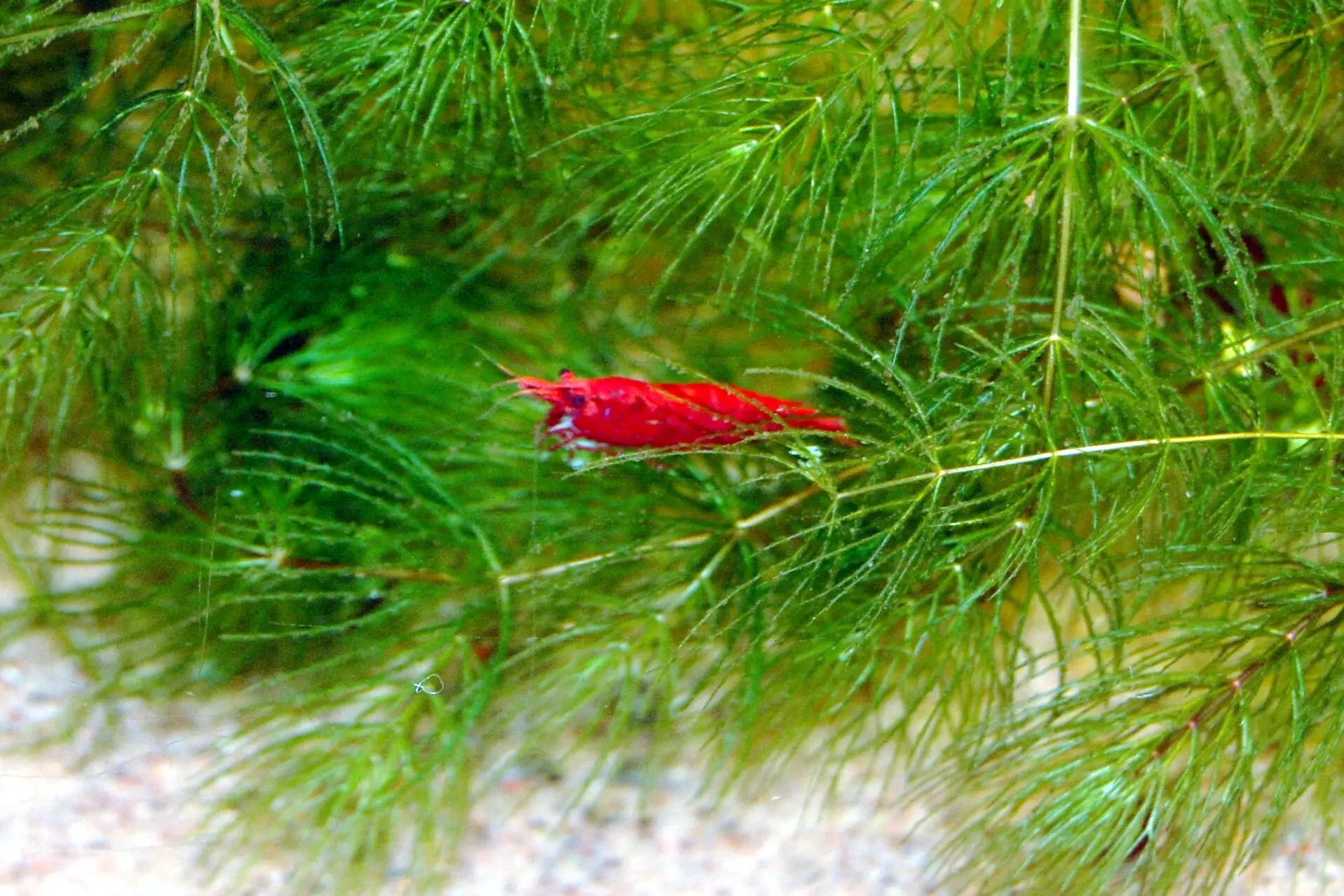
- Fine-leaved plants or moss cover part of the floor and hardscape.
- A heater and a separate thermometer hold the temperature steady through the year.
- Open substrate at the front lets you count shrimp and find moults and dead animals quickly.
- Decor and plants have had time to grow biofilm before the shrimp arrive.
A mature filter matters more than any piece of decor, because shrimp produce little waste but react badly to the ammonia a new or overcleaned filter fails to process.
What do cherry shrimp eat?
Cherry shrimp are omnivorous grazers. A stomach-content study by Weber and Traunspurger found detritus to be the most common item, followed by algae, and showed that the shrimp also eat tiny worms and crustaceans they pick from the sediment.
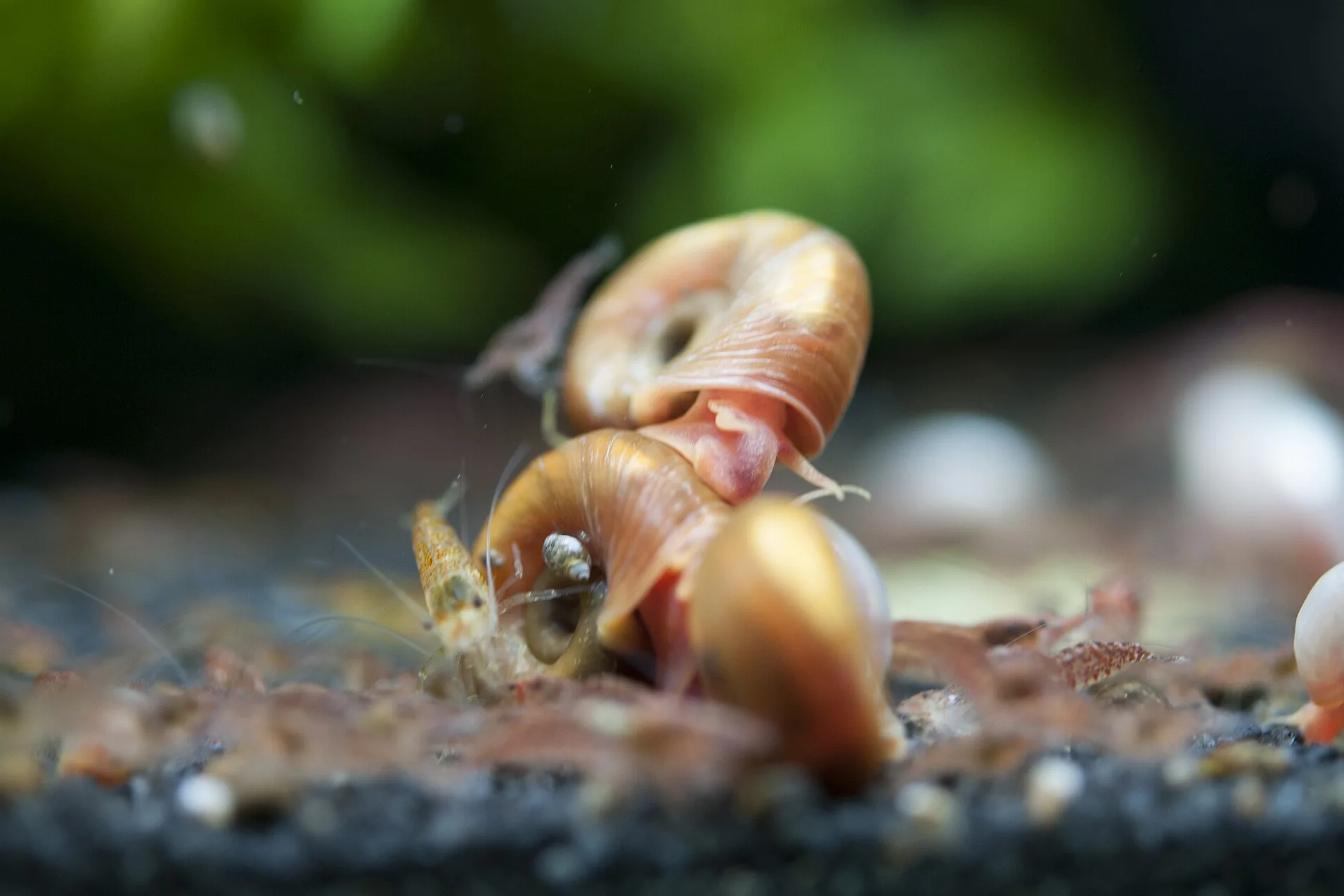
Leaf litter feeds them too: in feeding trials summarised by UF/IFAS, the shrimp preferred alder and goat willow leaves, grazing the biofilm that forms on them as they decay.
Biofilm and algae
The film on plants, wood and glass is grazed all day, which is why a mature tank feeds shrimp better than a new one.
Detritus and leaf litter
Decaying leaves carry the microbes shrimp graze, and alder and goat willow were preferred in trials.
Prepared shrimp food
OATA suggests algae wafers and pellets made for freshwater shrimp, fed two or three times a week.
Life in the substrate
Tiny worms and crustaceans in the gravel are part of the natural diet and add to what is fed.
Portion size matters more than food type. Food still untouched a few hours after feeding decays into ammonia, and in a small shrimp tank that rise can do more harm than a missed meal, which is why overfeeding is a common cause of losses.
A mature, planted tank supplies much of what a small group needs through grazing alone.
As the colony grows the same surfaces are shared by more mouths, so feeding has to rise with the population.
Which tank mates are safe for cherry shrimp?
The safest companion is one that cannot fit a shrimp in its mouth, and even those fish will eat shrimplets. OATA advises against any fish that can fit shrimp in its mouth or any species known to be predatory.
A species-only tank therefore gives the fastest-growing colony. Adding small fish mostly costs young shrimp rather than adults, so a mixed tank can hold a stable group that grows slowly.
Small fish often kept near shrimp, and what each risks
 Chili rasbora
A tiny mouth limits it mostly to newborn shrimplets
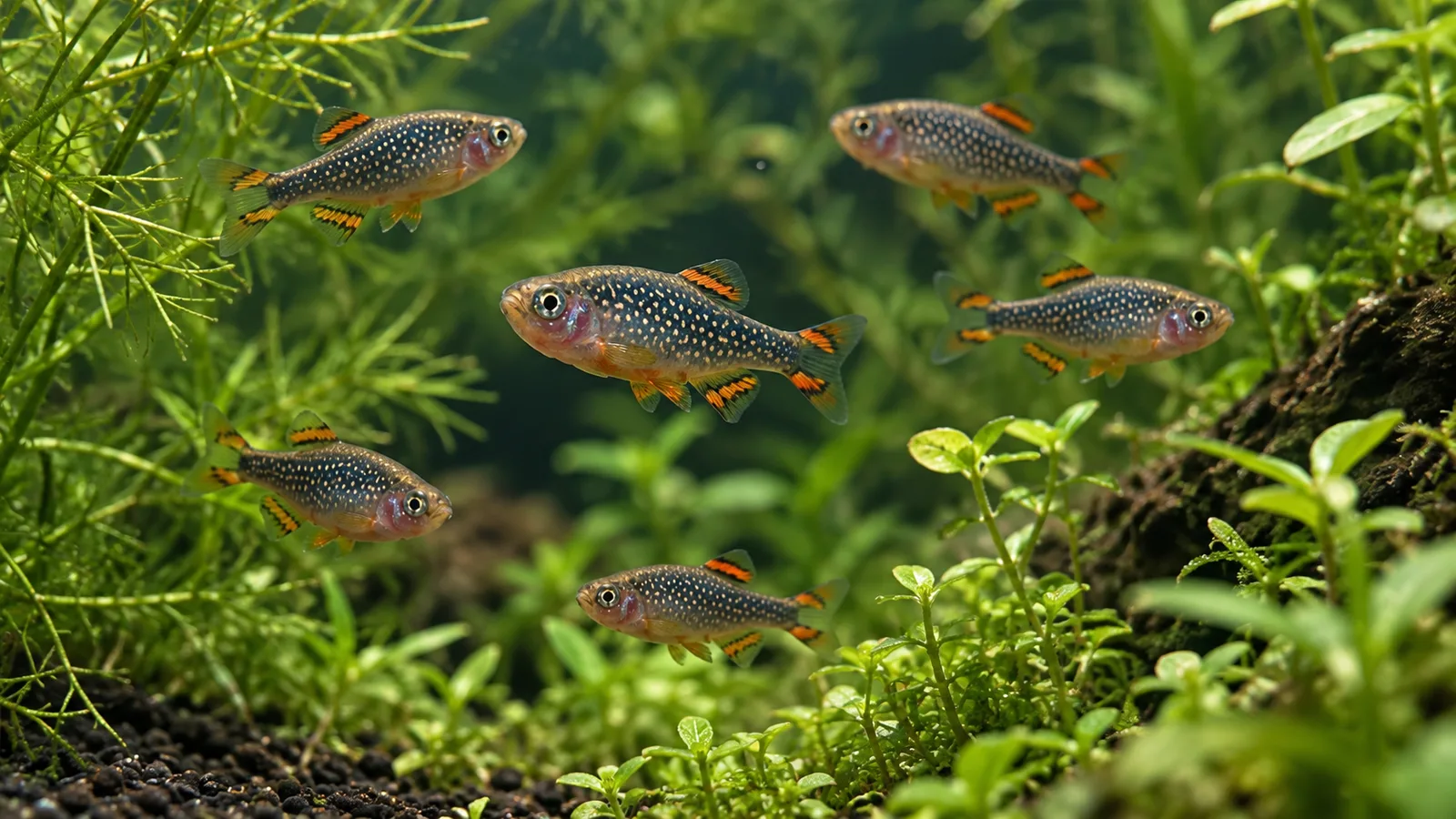 Celestial pearl danio
Small, but hunts young shrimp through plant cover
 Ember tetra
Midwater fish that still picks off exposed young
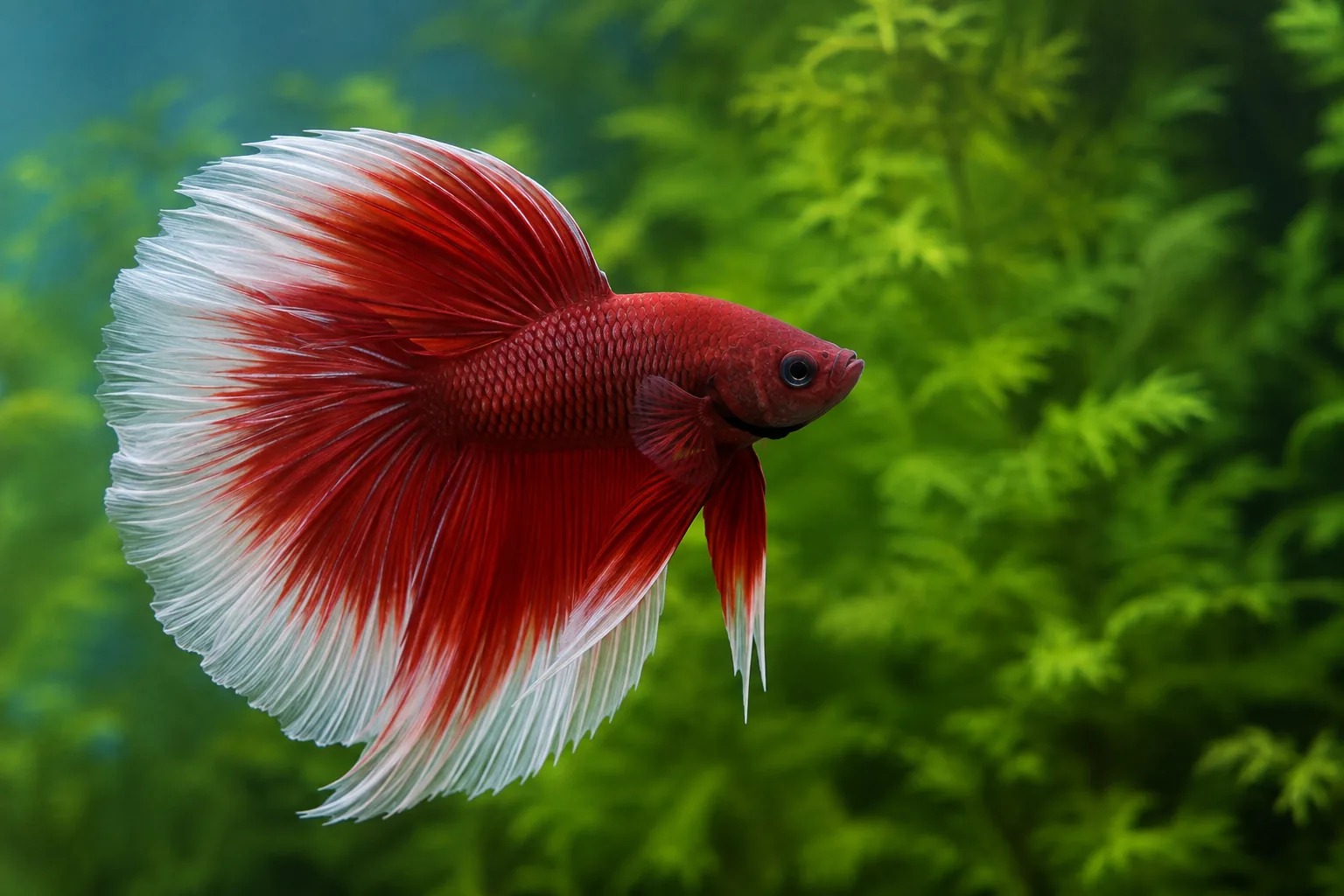 Betta
Temperament varies, and some hunt adult shrimp
Fish large enough to swallow an adult, including most cichlids, gouramis and larger barbs, treat cherry shrimp as food.
Temperature needs to overlap as well, since a companion that needs water outside roughly 17 to 27 °C forces one of the two animals into a compromise.
Snails such as the nerite snail and ramshorn snail share the grazing without hunting shrimp, though they compete for food. Amano shrimp also share a tank well, though they are larger and reach food first.
Other Neocaridina colours are the one invertebrate pairing that changes the colony itself, because they interbreed with the red line.
How should new cherry shrimp be acclimated?
Slowly, because shop water often differs from the tank in temperature and hardness, and a sudden change can bring on a failed moult. OATA describes a floating bag method: about 10 minutes floating for temperature, then small amounts of tank water added over at least 30 minutes.
- Test first Measure temperature, pH, GH and KH in the tank, and ask the seller for their values.
- Float the bag Float the sealed bag in the tank for about 10 minutes so the temperatures meet.
- Mix slowly Open the bag and add small amounts of tank water over at least 30 minutes, and take longer when GH or KH differ widely.
- Move the shrimp, not the water Pour the shrimp through a fine net or lift them out so the shop water stays out of the tank.
- Keep the lights low Leave the tank lights off for the rest of the day so new shrimp can find cover.
- Count the next day Count the group the next morning and remove any dead shrimp before they decay.
Where the two waters differ widely, drip acclimation for shrimp spreads the change over a longer period.
Imported shrimp can also carry attached worms and other hitchhikers, which the USFWS screening records among commensals moved with ornamental shrimp. Holding new shrimp in a separate tank for a few weeks keeps anything they carry away from an established colony.
Why must cherry shrimp never be released?
Released cherry shrimp have founded wild populations on several continents, and an established population is very hard to remove. The USGS records them on O'ahu in Hawaii since the 1990s and in three drainages of central Florida, with further populations in Europe, Japan, Brazil, Réunion and Canadian thermal pools.
In Poland, Jabłońska and colleagues found the species in samples from 2003, 2013 and 2017 in a canal warmed by a power station on the River Oder. German populations live in the thermally polluted Erft and its tributary the Gillbach, according to Klotz and colleagues.
Warm outflows help them, but a cold climate is no guarantee. Klotz also reports red shrimp surviving for several years in a pond near Hannover that freezes over in winter.
The USFWS screening cites work showing the shrimp reduced the secondary production of small bottom-living animals by 20 to 28 percent, and the USGS notes that native atyid shrimp were absent where cherry shrimp became established in Hawaii, Japan and China.
No global conservation assessment or CITES listing for the species appeared in the sources checked. The red line itself exists only through captive breeding, so buying cherry shrimp does not draw on wild populations.