
Aquarium Filtration: What Each Filter Stage Does
Aquarium filtration has three different jobs: trap particles, support microbial waste conversion and, when a specific problem justifies it, adsorb dissolved compounds. The best filter is the one that provides those jobs at a flow your animals can use and that you can service without destroying the biofilter.

What does an aquarium filter actually do?
A filter moves water through media so suspended debris can be captured and oxygenated surfaces can support the microbes of the aquarium nitrogen cycle. It also circulates heat and dissolved oxygen, but it cannot replace water changes, sensible stocking or removal of trapped waste.
Filter labels often emphasize turnover or tank volume. Those numbers do not describe head height, dirty media, pipe resistance, the shape of the aquarium or whether a long-finned fish can leave the current.
- Mechanical stage
- Captures particles before they settle or clog later media
- Biological stage
- Provides wet oxygenated surface for attached microbes
- Chemical stage
- Targets selected dissolved compounds for a limited service period
- Flow job
- Carries oxygen and waste to media, then returns mixed water
- Maintenance goal
- Restore useful flow while preserving mature biological media
- Sizing question
- Can the real system circulate evenly without exhausting its animals?
How do mechanical, biological and chemical media differ?
Mechanical media works by pore size. Coarse sponge catches leaves and large debris, while finer pads polish smaller suspended particles; placing coarse material first usually prevents the fine stage from blocking immediately.
Biological media is valuable because water and oxygen can reach a large colonized surface. Chemical media is optional and purpose-specific: activated carbon, phosphate media or other adsorbents have finite capacity and should not be treated as permanent substitutes for correcting the source of contamination.
| Stage | Useful materials | What it does | What it does not do |
|---|---|---|---|
| Coarse mechanical | Open-cell sponge, coarse pad | Catches leaves, food and large particles | Detoxify ammonia by itself |
| Fine mechanical | Fine pad or floss | Improves clarity by catching smaller particles | Fix dissolved yellowing indefinitely |
| Biological | Porous media, mature sponge | Supports attached nitrifying microbes | Remove unlimited waste from overstocking |
| Chemical | Carbon or targeted adsorbent | Removes selected dissolved compounds while active | Replace diagnosis, water changes or maintenance |
Combining them in one box does not make their functions interchangeable.
How much flow does an aquarium need?
You can use turnover as a starting estimate, then inspect distribution. Water can race through one open channel while waste settles behind wood, and a strong outlet can still leave a dead corner at the opposite end.
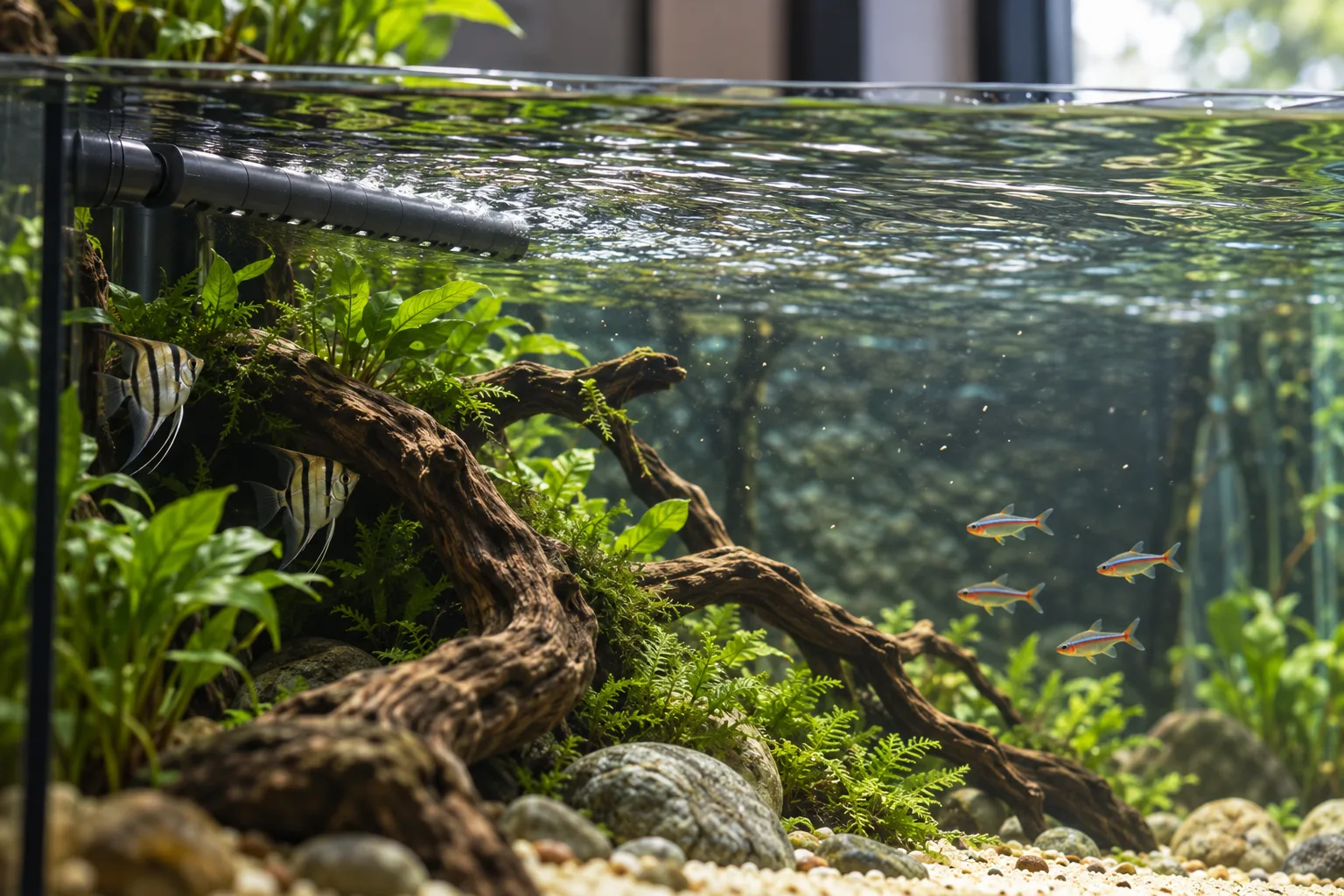
The animals decide whether the resulting current is acceptable. A bicolor blenny in a reef, a school of giant danios and a long-finned betta do not use flow in the same way.
Why is real filter flow lower than the number on the box?
Pump output and filter circulation are different specifications. For example, the Fluval FX manual states the conditions behind its figures, including measurements without media and in-tank inlet or outlet accessories.
Hoses, bends, valves, intake guards, media resistance, trapped air and debris affect installed flow. Follow the installation-height limits for the particular filter rather than assuming every type behaves like an open sump return.
Turnover calculated from a label is therefore a screening estimate, not proof of circulation. A filter rated at several tank volumes per hour can still leave waste behind hardscape, while a modest return aimed across the surface may provide better gas exchange and a more usable current.
If the return can be directed safely into a known container without running the pump dry or flooding the cabinet, timing that volume gives a rough installed-flow check. Do not disconnect pressurized plumbing or defeat an overflow to collect a number; changes in outlet movement, sound and debris settlement are often enough to reveal declining performance.
Compare like with like after service. A clean-media measurement is the upper condition, and the useful maintenance trigger is the point where flow distribution, surface movement or equipment reliability declines before animal welfare is affected.
Which filter type suits the aquarium?
Sponge filters are simple, gentle and easy to preserve during maintenance, making them useful for fry, shrimp and quarantine contexts. Hang-on-back filters offer accessible media and surface agitation but need safe intakes and enough water level to restart reliably.
Internal filters keep plumbing inside the aquarium but occupy swimming space. Canister filters hold substantial media and can distribute flow through pipes or spray bars, yet closed hoses and seals add leak and restart responsibilities; sumps provide flexible volume and equipment access but require overflow, return and power-off planning.
| Decision factor | Filter type | Best fit and main tradeoff |
|---|---|---|
| Air sponge | Gentle biological filtration, simple maintenance | Limited particle pickup far from the sponge |
| Hang-on-back | Accessible media and useful surface movement | Water-level sensitivity and exposed intake |
| Internal power filter | Compact all-in-one circulation | Uses tank space and may create a concentrated jet |
| Canister | High media capacity and flexible return layout | Hoses, seals and trapped debris require deliberate service |
| Sump | Large adaptable equipment area | More plumbing, overflow and return-failure planning |
How should media be arranged?
You should put protection and coarse capture before delicate or fine stages, then give biological media clean oxygenated flow. Position a temporary chemical medium where water must pass through it rather than around it.
Avoid packing a chamber so tightly that bypass or rapid clogging stops useful circulation. The SRAC component review treats solids removal and biological treatment as distinct system functions, which is the same reason an aquarium benefits from separating capture from microbial processing.
Water follows the lowest-resistance route. A gap beside a cartridge, a warped basket or a channel through tightly packed media lets part of the flow avoid the intended stage, so more media can produce less effective contact when it is installed poorly.
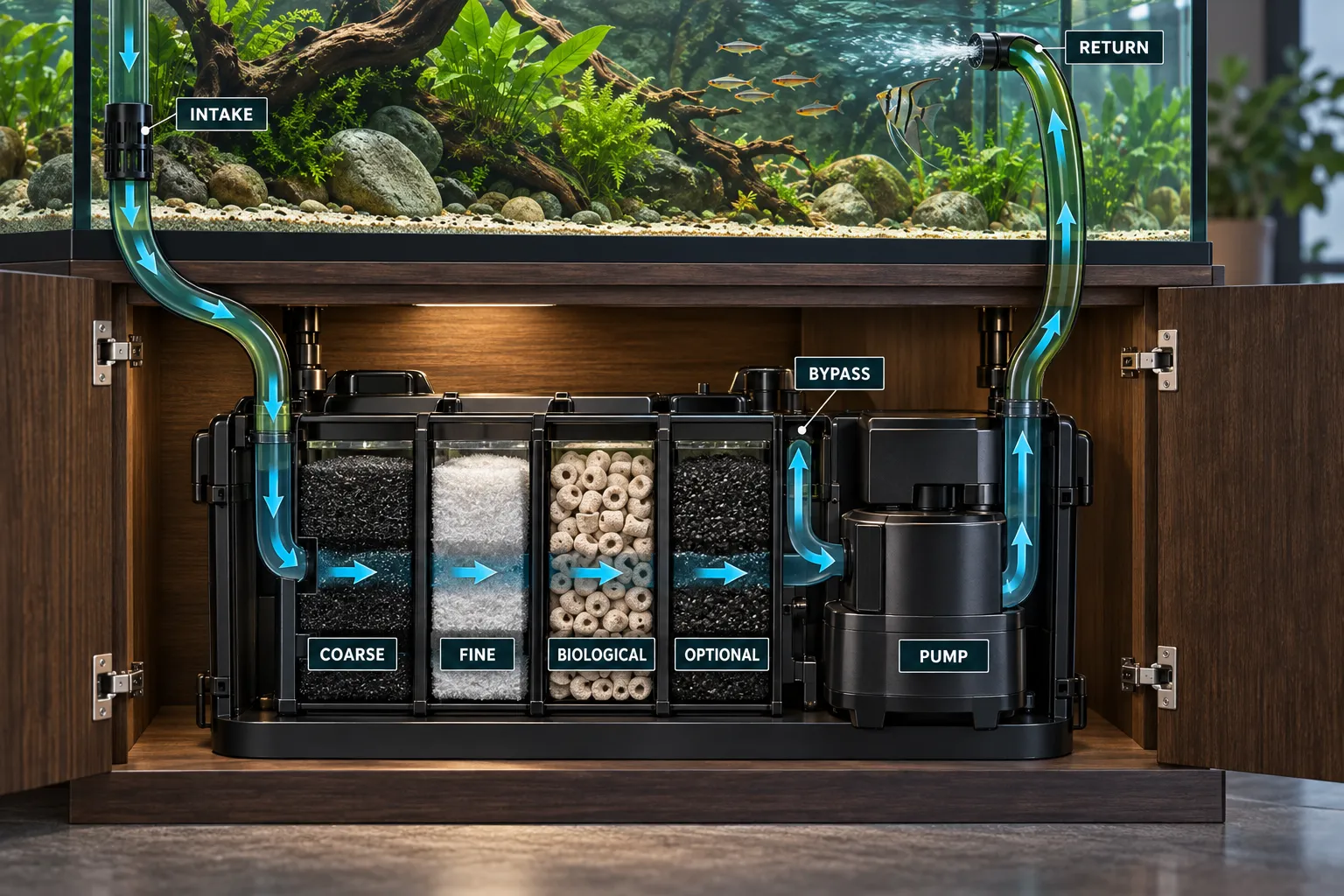
Place the coarsest reusable stage where it can be reached and cleaned before it becomes a dam. Fine polishing media usually needs more frequent replacement or rinsing, while established biological media benefits from steady oxygenated flow and gentle partial cleaning only when debris begins restricting it.
| Symptom | Likely flow problem | Useful first action |
|---|---|---|
| Outlet weak everywhere | Intake, hose or media restriction | Inspect from intake to return and clean one restricted stage |
| Strong outlet, debris in one corner | Poor distribution inside the tank | Redirect the return or add circulation without increasing animal stress |
| Water passes beside a cartridge | Media bypass or poor seal | Reseat the basket and close the gap |
| Fine pad clogs within days | Coarse capture is absent or overloaded | Add accessible coarse media and remove source debris |
| Filter gurgles after restart | Trapped air, low water level or intake leak | Prime by the maker's method and inspect seals |
How do you clean a filter without crashing it?
You should service the part that is restricting flow instead of sterilizing the whole unit. Switch equipment off safely, close valves where applicable, retain removed aquarium water, rinse or squeeze reusable mechanical media gently and keep biological media wet.
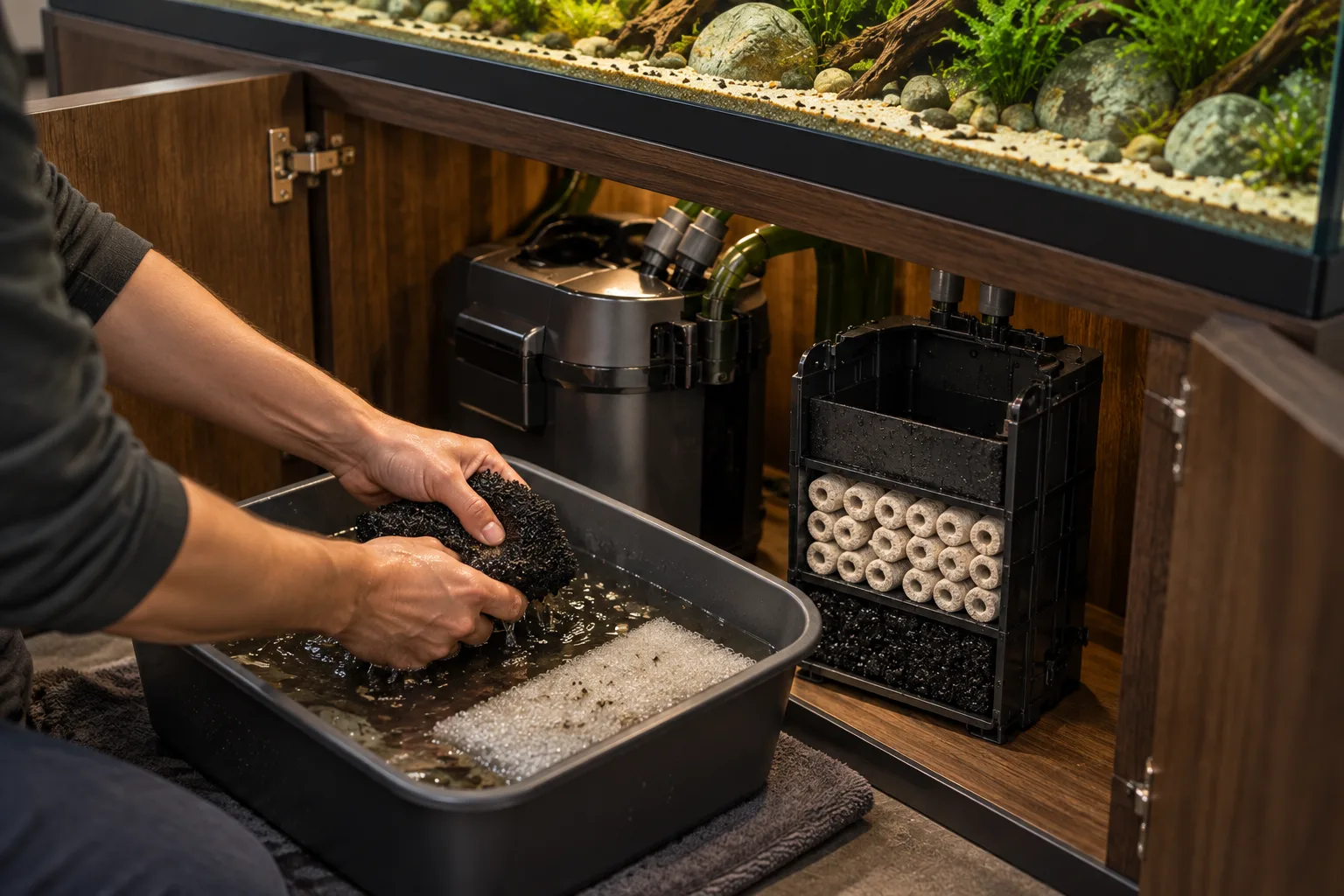
You should never use soap. The OATA freshwater aquarium guide advises rinsing media in old tank water rather than under the tap, which reduces exposure to disinfectants and abrupt water chemistry changes.
- Unplug equipment with dry hands before opening the filter.
- Keep mature media wet in aquarium water throughout the service.
- Clean the intake, impeller and obstructed mechanical stage first.
- Inspect hoses, seals and clips before restarting a closed filter.
- Prime the unit as its instructions require and confirm actual return flow.
- Test ammonia and nitrite after an accidental dry-out or major media loss.
Why can clear water still be unsafe?
Fine mechanical media can make water look polished while dissolved ammonia remains present. Conversely, tannin-stained water or harmless suspended particles can look imperfect while the nitrogen cycle and oxygen supply remain stable.
Use appearance to find debris and flow patterns, then use appropriate tests to assess chemistry. If fish gasp, lose balance or crowd the outlet, treat that behavior as an urgent oxygen or water-quality warning rather than proof that the filter needs prettier water.
When should you upgrade or add filtration?
Measured ammonia or nitrite calls for immediate protection of the animals and investigation, not an automatic filter purchase. Blocked flow, lost media, decay or excess feeding may explain the change even when the filter is adequately sized.
An upgrade becomes useful when inadequate processing or circulation persists after those causes are addressed, or when the existing filter cannot be serviced without losing most mature media. A larger filter still cannot provide missing swimming room or make an excessive stocking plan suitable.
Plan an upgrade so old and new biological media overlap while the new filter matures. After any major change, monitor ammonia and nitrite and keep the next water change ready rather than assuming the manufacturer's capacity label proves the system is safe.
What happens when flow stops or the power fails?
The filter media does not instantly become sterile, but oxygen inside a sealed canister or stagnant chamber begins falling after circulation stops. Warm water, heavy organic loading and dense media can use the available oxygen faster, so a long outage carries more risk than a brief pause for cleaning.
A battery air pump can maintain surface movement during an outage, especially in warm or heavily stocked systems. It must have its own charged power supply; two mains-powered filters both stop when mains power fails.
If a plug or socket is wet, do not touch or unplug it: isolate the circuit from a safe, dry location and obtain qualified help if that cannot be done safely. Equipment with flooded electrical parts or damaged insulation must not be restarted merely because its outside has dried.
After a prolonged outage, follow the filter maker's safe isolation and servicing instructions before reconnecting stagnant filter water to the tank. A lack of bad odor does not prove that the water is safe or the biofilter is working.
Discard foul trapped water and gently clean obstructed media in conditioned or removed aquarium water while preserving colonized surfaces. Confirm return flow after restart and monitor ammonia, nitrite and animal behavior over the following days.
Redundancy should protect a specific failure: two smaller filters can preserve some circulation when one stops, an air-driven sponge can provide backup oxygenation, and a prefilter can keep an intake from blocking. Extra equipment only helps when it is maintained, powered safely and able to operate under the failure you planned for.