
What Is a Bicolor Blenny, and Will It Suit a Reef Tank?
Ecsenius bicolor
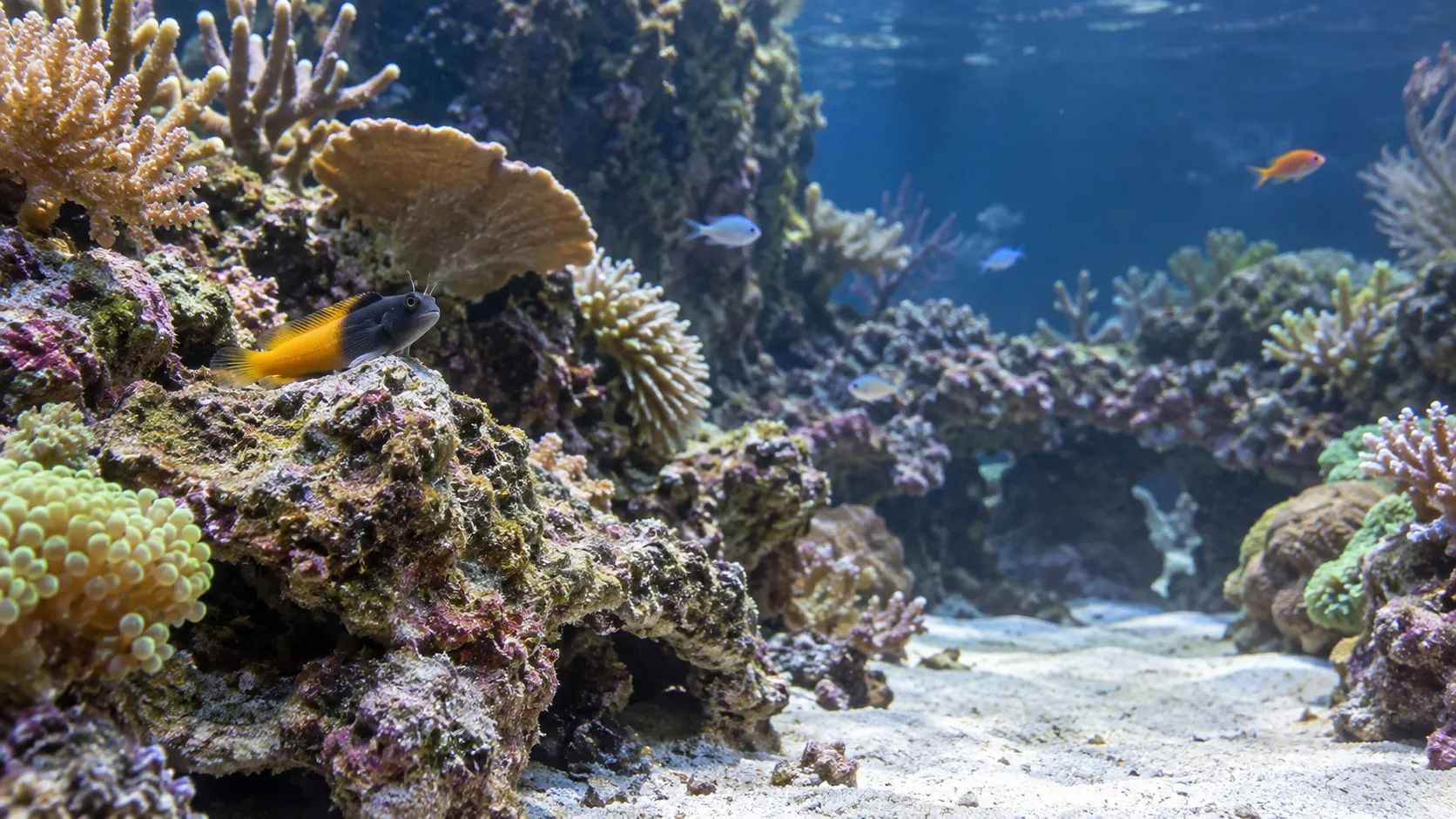
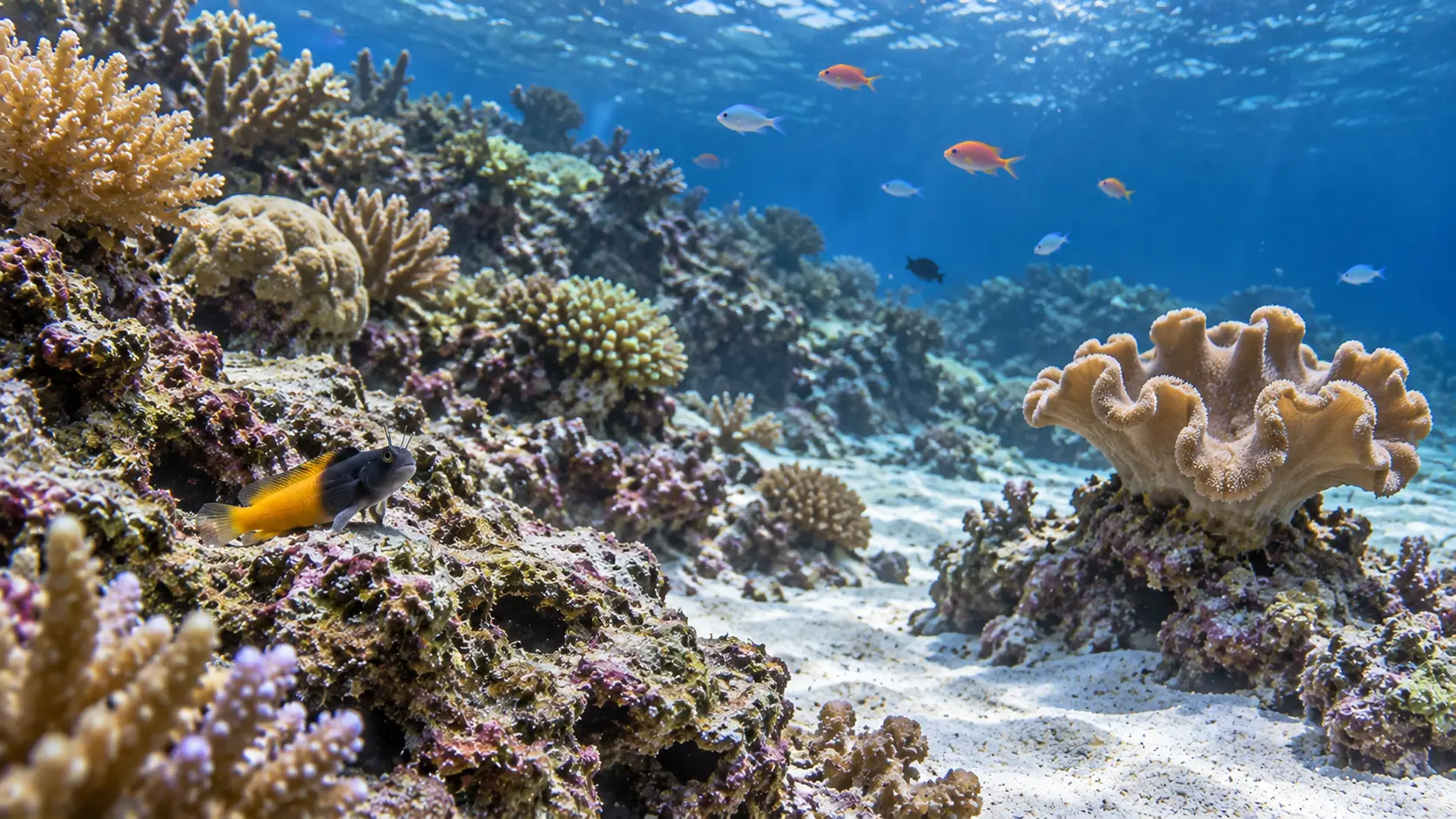
The bicolor blenny is a small Indo-Pacific reef fish that lives close to holes, grazes hard surfaces and watches the aquarium from a perch. It can suit a mature covered marine aquarium, but its territory, access to food and occasional coral or clam nipping need a plan before purchase.
At a glance

- Family
- Blenniidae
- Native range
- Indo-Pacific clear lagoons and seaward reefs
- Conservation status
- Least Concern; assessment shown by FishBase as 2009 Source
What is a bicolor blenny?
The bicolor blenny is Ecsenius bicolor, a small reef-associated fish whose usual adult pattern has a dark front half and a yellow-orange rear half. The World Register of Marine Species lists that scientific name as accepted, while FishBase records a maximum total length of 11 cm.
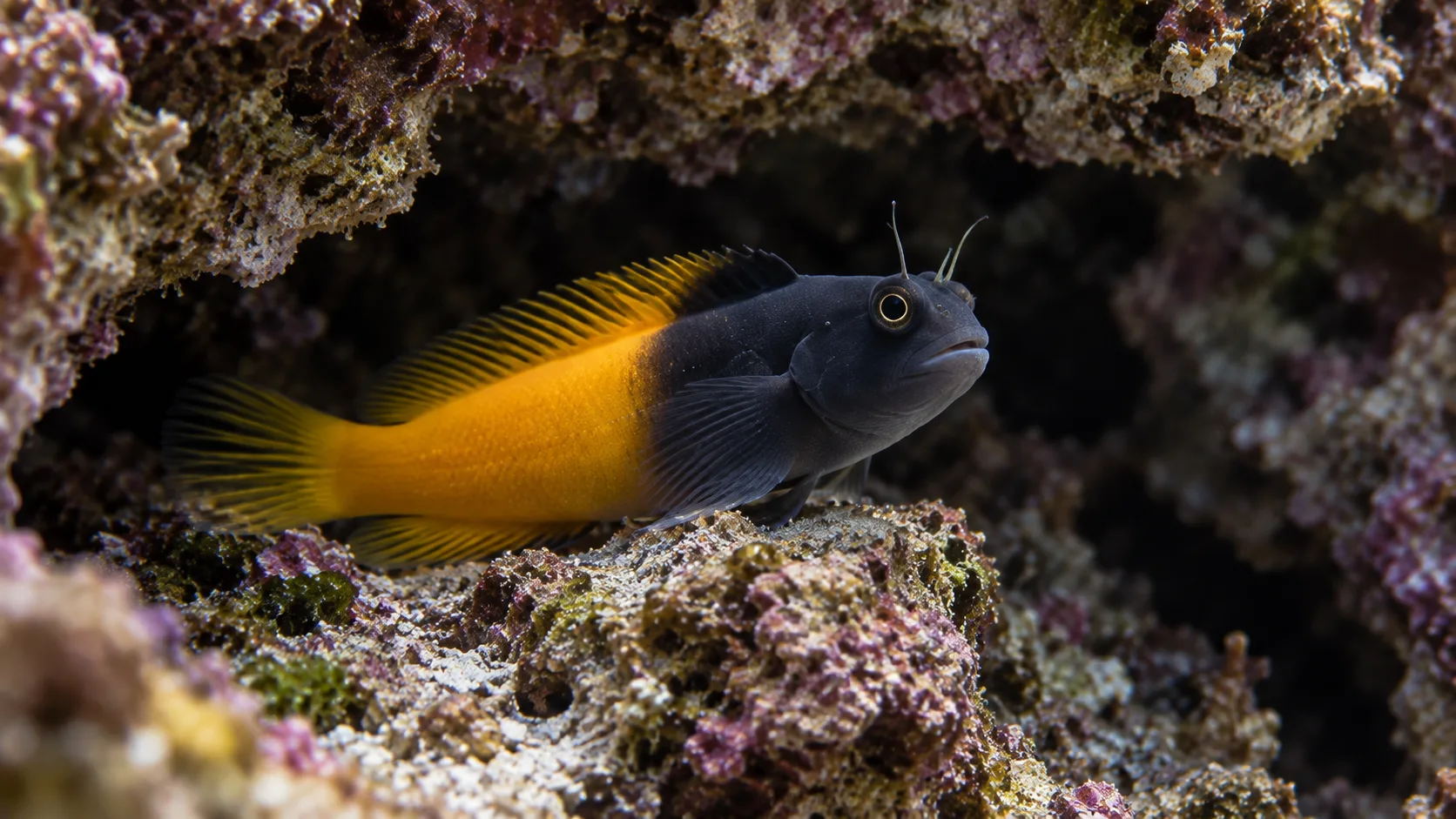
Colour can shift with age, stress, lighting and local form, so a fish that is not divided into two perfect blocks is not automatically a different species. Ask the seller for the scientific name and origin rather than relying on a common label shared loosely across the trade.
- Accepted name
- Ecsenius bicolor
- Recorded maximum length
- 11 cm total length
- Natural setting
- Clear lagoons and seaward reefs with coral and algae-covered rock
- Typical position
- Solitary, close to holes and abandoned tubes
- Main ownership issue
- A territorial grazer that may nip coral or clam tissue
Where does a bicolor blenny spend its time?
FishBase records the species from Indo-Pacific reefs at depths of about 1 to 25 m. It lives close to hard structure, using holes and abandoned tubes as shelter, then moving onto exposed rock to graze or watch the water around it.
That behavior should shape the aquarium more than a decorative theme. Build several correctly scaled crevices with stable rock, keep a clear route between them, and leave open surfaces where the fish can graze without crossing another animal's territory every few seconds.
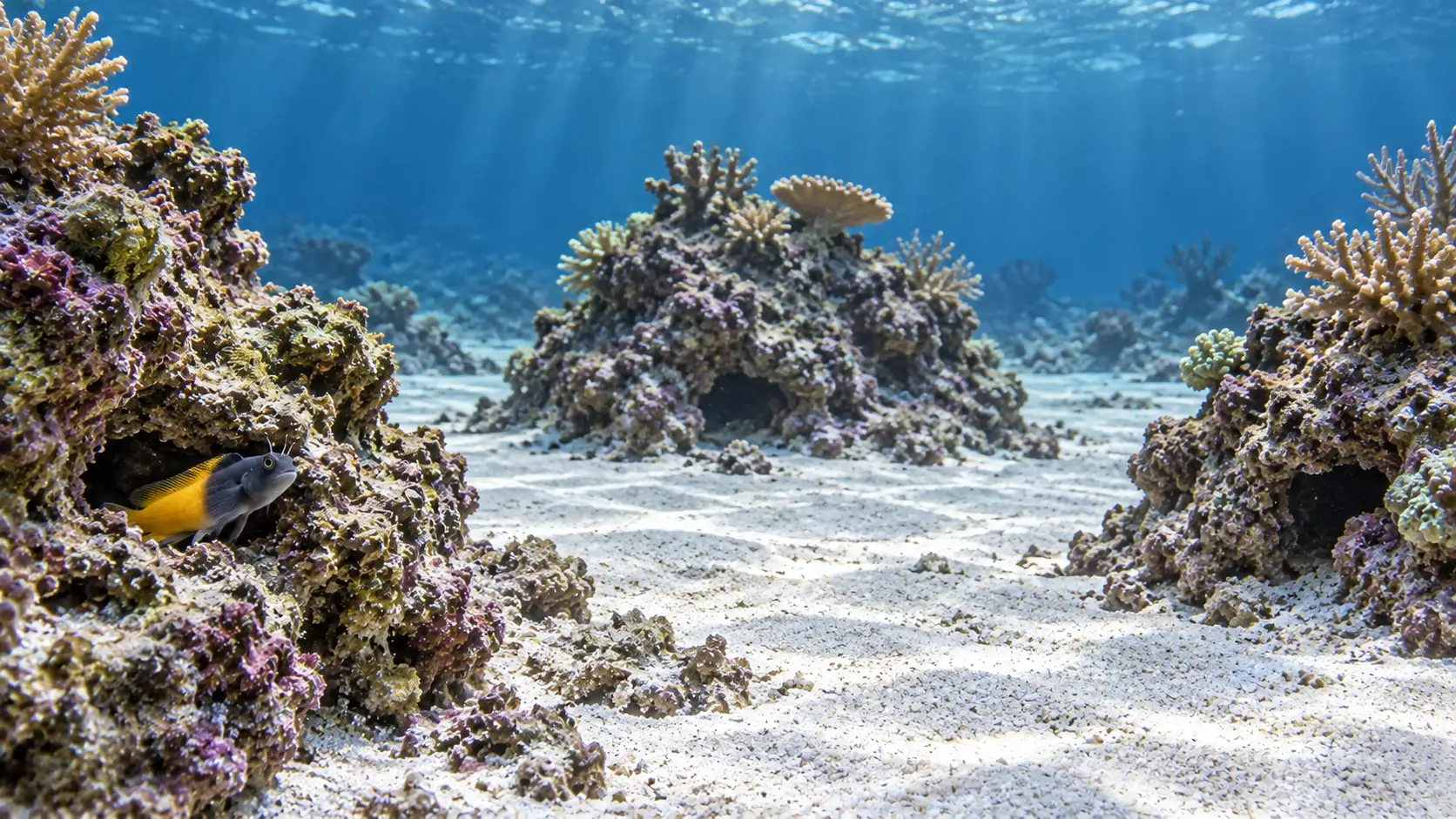
Do not balance loose rocks on sand and assume the fish will never disturb them. Set the load-bearing structure securely before livestock enters, then check that no narrow cavity can trap the fish as it grows.
How much swimming and rock space does it need?
A bicolor blenny uses a modest amount of open water but a much larger behavioral footprint than its body suggests. It needs enough rock face to browse, several retreats, and distance from fishes that compete for the same holes.
A bicolor blenny tank must accommodate usable territory, adult size, community pressure and filtration together instead of treating litres as the only limit.
- The rock structure cannot shift when a fish enters a lower crevice.
- At least two sheltered entrances remain available after corals and equipment are placed.
- An open grazing face receives light without becoming the only route through the reef.
- The fish can reach food without entering a dominant fish's feeding lane.
- The lid or mesh cover closes every escape gap around cables and plumbing.
- The filtration plan can process the whole community's waste, not just one small fish.
A tank can look spacious from the front while offering only one usable cave. Watch where every bottom-oriented fish sleeps and retreats before adding another species that occupies the same layer.
Which water conditions provide a stable marine baseline?
The OATA blenny care sheet gives group-level marine husbandry ranges, not a field measurement for E. bicolor. It lists 24 to 26 C, specific gravity 1.020 to 1.025, pH 7.9 to 8.3, carbonate hardness 8 to 12 dKH, calcium 380 to 450 mg/L and magnesium 1,250 to 1,350 mg/L.
OATA marine blenny husbandry context
- Temperature24 to 26 CSeparate aquarium thermometer.
- Specific gravity1.020 to 1.025Calibrated refractometer or equivalent salinity instrument.
- pH7.9 to 8.3Calibrated pH meter or suitable marine test.
- Carbonate hardness8 to 12 dKHAlkalinity titration test.
Every range above applies to Blennies as a husbandry group in a marine aquarium system. Source: OATA blenny care sheet, checked 2026-09-16.
Use those values as a sourced context and keep the fish near the conditions to which it has been acclimated.
Ammonia and nitrite should remain undetectable in a mature aquarium. Confirm an unexpected result, check oxygenation and filtration, and correct the source of waste without making a sudden salinity or pH swing.
What does a bicolor blenny eat?
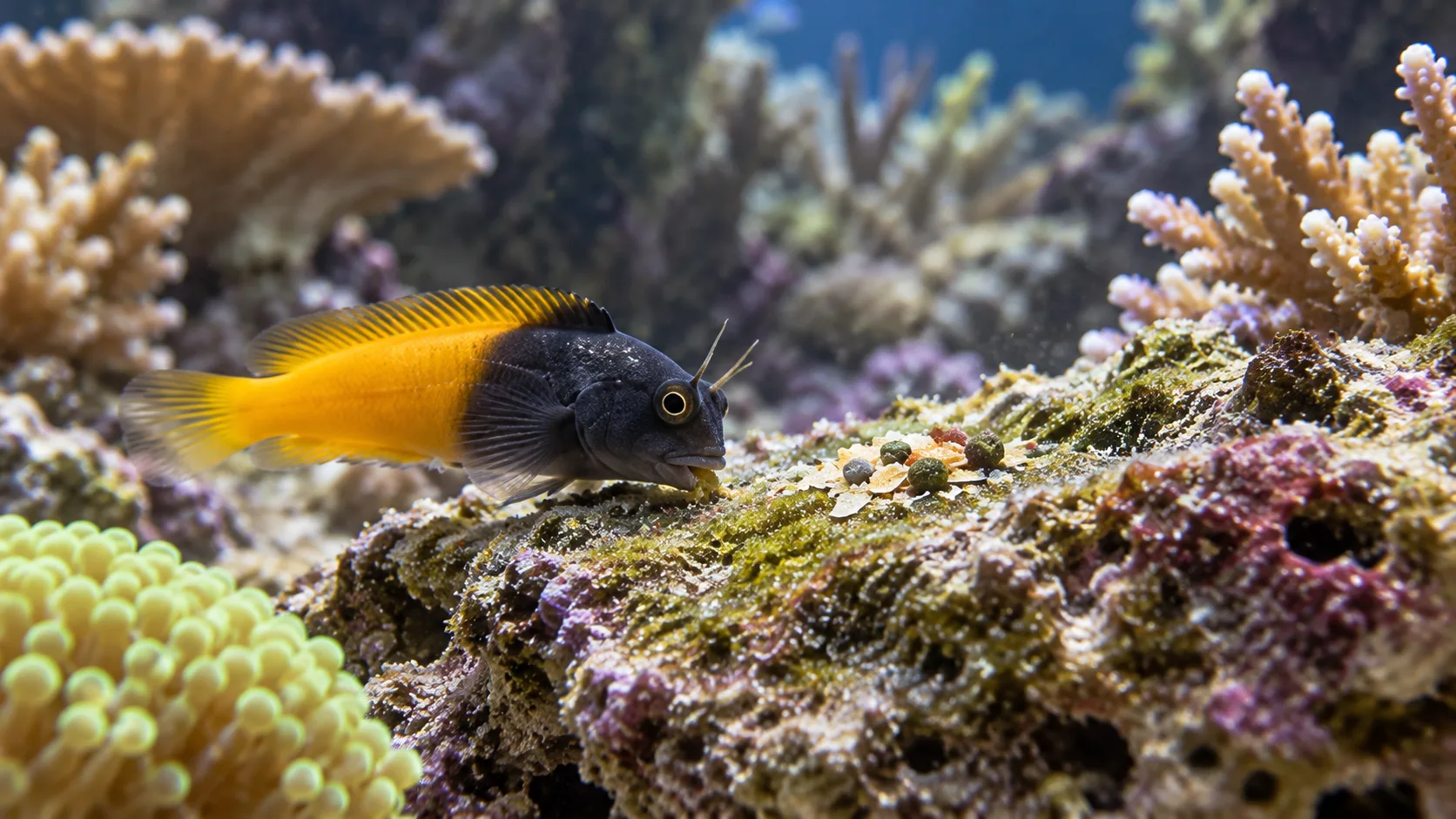
Bicolor blennies spend much of the day inspecting and grazing rock surfaces, but a mature-looking reef does not guarantee enough suitable food. The group guidance from OATA describes many blennies as algae-oriented feeders while also noting that dietary needs vary across species.
Offer a varied marine diet that includes appropriate algae-based prepared foods and small foods the individual takes readily. Watch whether the fish actually swallows food, because fast midwater fish can clear a feeding before a cautious blenny leaves its hole.
- Observe the belly and activity before feeding so a gradual loss of condition is visible.
- Place a small amount near the fish's normal grazing route without forcing it into another fish's territory.
- Confirm swallowing rather than counting food that enters the aquarium.
- Remove persistent leftovers before they decay in a crevice.
- Adjust the next portion from body condition, behavior and water-test trends.
Visible algae is useful habitat, but it should not be the only food for a bicolor blenny.
Can a bicolor blenny live in a community reef?
Often yes, provided its tank mates do not compete aggressively for the same caves or repeatedly chase it away from food. OATA warns that blennies may be territorial with other blennies, and outwardly peaceful species can still conflict when they share one narrow refuge.
| Community factor | Lower-risk condition | Warning sign |
|---|---|---|
| Other blennies | Different ecological space and ample separate retreats | Repeated charging, blocked holes or bite marks |
| Bottom and cave fish | Several territories with broken sight lines | One fish remains exposed or stops feeding |
| Fast feeders | Targeted access for the blenny | Food disappears before the blenny emerges |
| Large predators | No fish able to swallow or pin the blenny | Stalking, lunging or a blenny that never leaves cover |
| New additions | Quarantine and a prepared separation option | Escalating pursuit after the first exploration period |
Use the best tank mates for a bicolor blenny when evaluating a named pairing. A list of generally peaceful fish cannot replace adult size, feeding speed, territory and the behavior of the individuals already present.
Is a bicolor blenny reef safe?
It is better described as reef safe with conditions than as automatically safe. OATA notes that some blennies may nip corals and clam mantles, and the risk matters most when an individual repeats the behavior or the animal being nipped cannot remain open.
Do not assume every peck is damage, because the fish may be taking material from the surrounding rock. Look for a repeated sequence involving the same coral or clam, retraction after contact, fresh tissue injury, or a pattern that stops when the fish is separated.
Extra feeding may improve body condition but cannot guarantee that an established nipping habit will stop. The decision belongs to observed behavior and the welfare of both animals, not to the species' marketing label.
How should you acclimate and observe a new fish?
Ask the seller for the current salinity, temperature, feeding response and time in their system before transport. Match the prepared quarantine system closely enough to avoid a rapid chemistry change, then follow a time-limited acclimation method appropriate to the difference and transport duration.
Do not pour shop water into the display. Avoid exposing a fish to ammonia that becomes more toxic as bag water aerates and pH rises, and never combine copper or other medication merely because a fish is new.
- Quarantine tank is heated, covered, oxygenated and biologically supported.
- Several inert, removable shelters fit the fish without unstable rock.
- Temperature and salinity are measured in both systems before transfer.
- The fish is observed for breathing, balance, skin, fins, waste and appetite.
- Separate tools prevent wet transfer between quarantine and display.
- A qualified aquatic-health professional is contacted if signs worsen.
A saltwater aquarium needs established biological filtration before stocking. Quarantine and veterinary assessment remain separate safeguards; appearance alone cannot establish a diagnosis or justify medication.
What changes should trigger action?
A bicolor blenny often rests in a hole with only its head visible, so hiding by itself is not proof of illness. Concern rises when the fish changes from its normal pattern, breathes rapidly, loses balance, becomes thin, develops spots or sores, or can no longer hold its territory and reach food.
Rule out the water first
- Confirm temperature, salinity, pH, ammonia and nitrite with working instruments.
- Check circulation, surface movement and every pump or filter for loss of flow.
- Look for recent livestock additions, aggression and blocked retreat routes.
- Review whether the fish is swallowing food and whether waste is collecting in rockwork.
- Isolate shared wet tools if infection is possible.
- Seek qualified aquatic-health help for severe breathing, progressive tissue damage or worsening loss of control.
Water checks can reveal a system failure but cannot diagnose a parasite or bacterial disease. Avoid freshwater dips, copper, antibiotics or mixed remedies unless the condition and treatment boundary have been established by a competent professional.
Is a bicolor blenny right for your aquarium?
Choose this fish when the aquarium is mature, covered and stable, with secure reef structure, several crevices, open grazing faces and a community that does not crowd the same holes. You also need a feeding plan that works when natural growth is sparse and a way to remove the fish if coral nipping becomes persistent.
Choose another fish if the aquascape has one small cave, the display contains territorial lookalikes, or delicate clams and corals cannot be protected. Build the life-support system first with the reef tank setup guide.