
What Is an Ocellaris Clownfish, and Does It Need an Anemone?
Amphiprion ocellaris
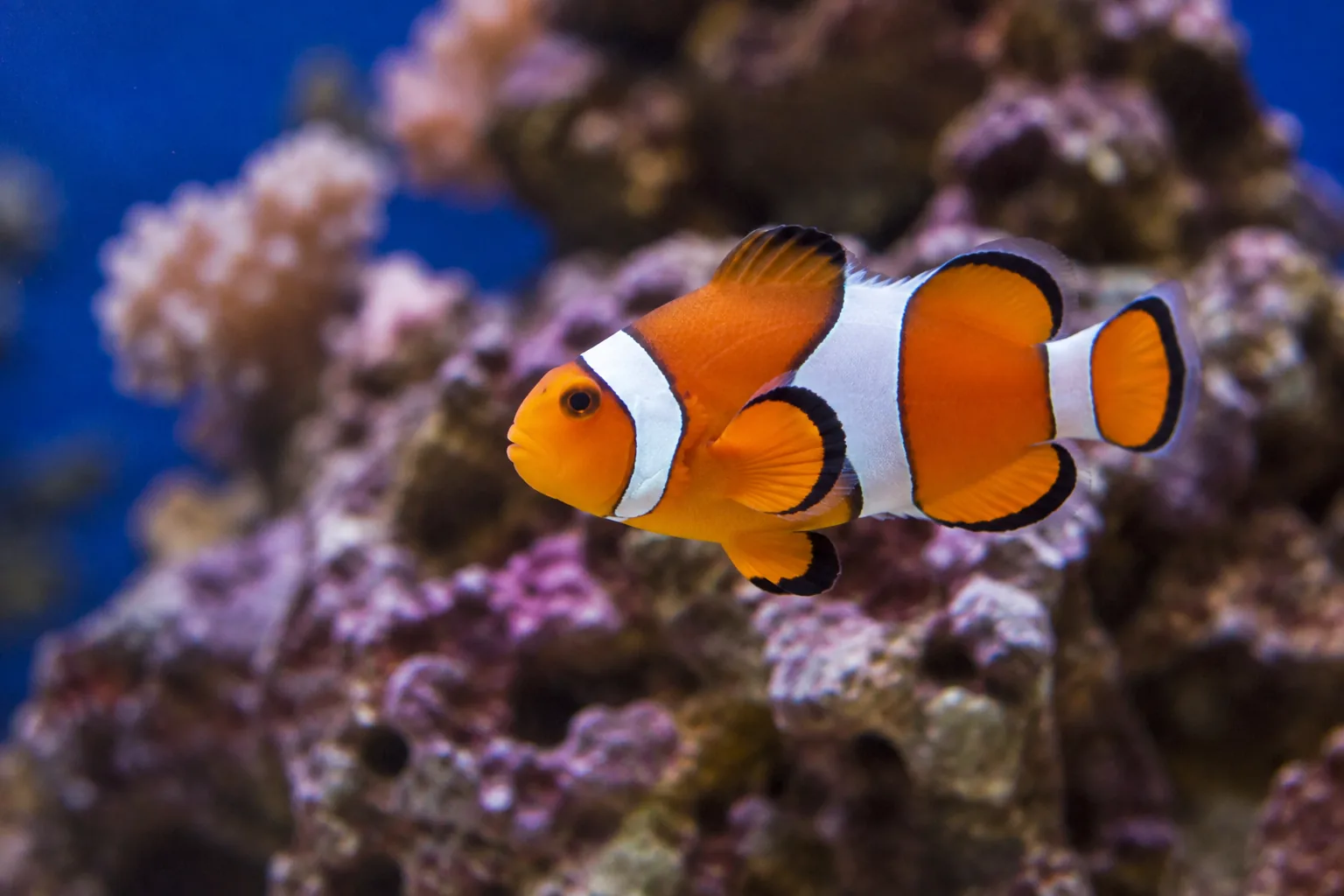
The ocellaris clownfish is Amphiprion ocellaris, an Indo-Pacific anemonefish that reaches 11 cm and lives in pairs ranked by size, with the largest fish female. It lives and breeds well in a stable marine aquarium without an anemone, and most fish sold today are captive-bred.
At a glance

- Adult size
- 11 cm
- Minimum footprint
- 75 x 40
- Minimum volume
- 110 litres
- Social structure
- Lives as a breeding pair ranked by size, with the largest fish female and the second a breeding male; extra fish rank below them.
- Minimum group
- 1
- Sex ratio
- One female and one male forming from two juveniles; sex follows social rank
- Diet
- Omnivore
- Feeding
- Takes marine pellets or flake as a staple with frozen seafood and algae-based food for variety; portions small enough that nothing settles into the rock.
- Waste load
- Moderate for its size; uneaten frozen food is the main source of extra waste.
- Lifespan
- 6 to 20 years
- Reef safety
- Yes
- Family
- Pomacentridae
- Native range
- Eastern Indian Ocean and western Pacific reefs, from Southeast Asia, Indonesia and the Philippines to Taiwan and the Ryukyu Islands
- Conservation status
- Least Concern; IUCN assessment of February 2021 Source
Sized for one pair plus a few peaceful companions: room for the pair's home site and a buffer against evaporation, which raises salinity faster in smaller marine volumes.
What is an ocellaris clownfish?
The ocellaris clownfish is Amphiprion ocellaris, an anemonefish in the damselfish family Pomacentridae.
WoRMS lists it as an accepted name, and FishBase records a maximum length of 11 cm total length, about 4.3 inches. It lives on shallow reefs from the eastern Indian Ocean through Southeast Asia, Indonesia and the Philippines, north to Taiwan and the Ryukyu Islands.
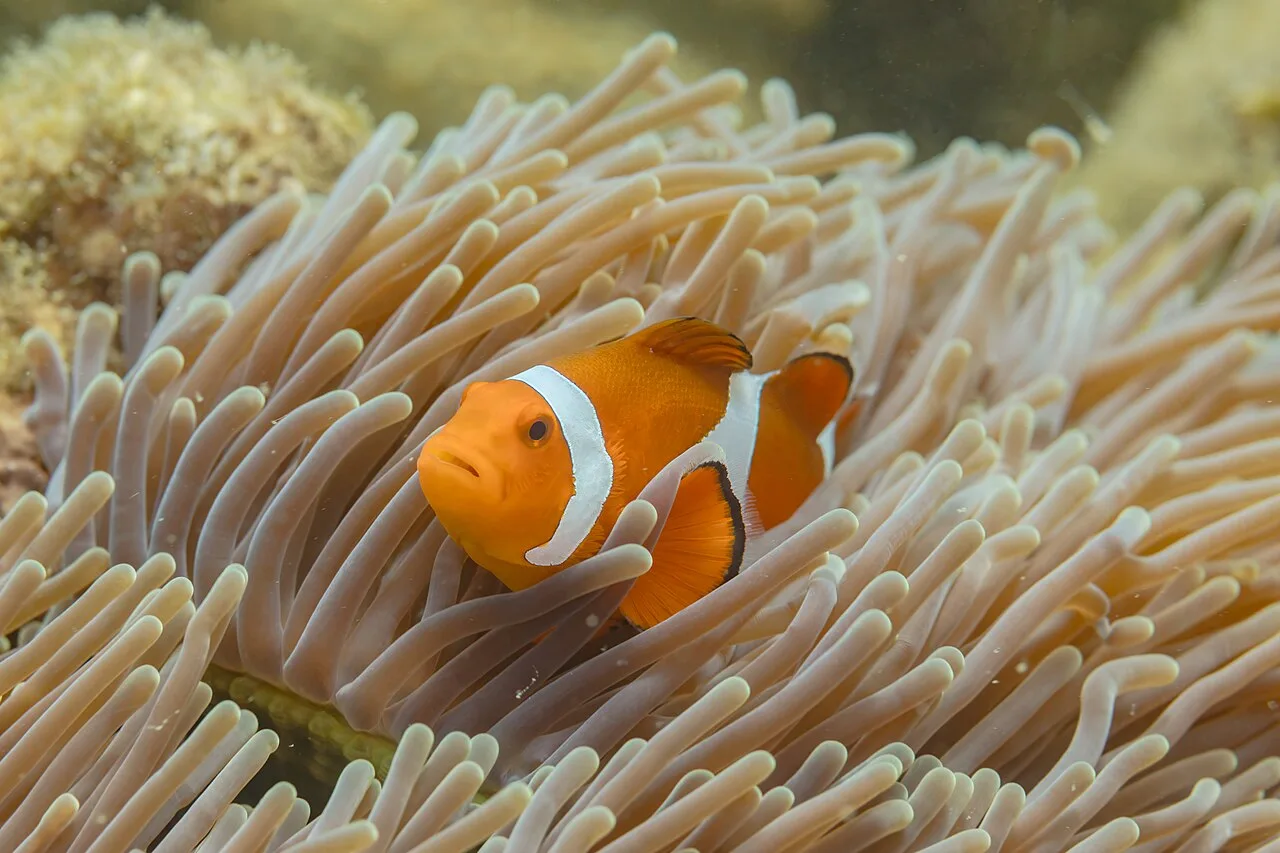
Each wild group lives in one of three large sea anemones: Heteractis magnifica, Stichodactyla gigantea or Stichodactyla mertensii. The anemone is a home site rather than food, because its stinging tentacles keep most predators away from the fish sheltering inside.
The IUCN lists the species as Least Concern, but that status describes the wild population and cannot tell a buyer whether one fish in a shop was bred or collected.
- Accepted name
- Amphiprion ocellaris Cuvier, 1830
- Family
- Pomacentridae, the damselfishes and anemonefishes
- Recorded maximum length
- 11 cm total length
- Natural range
- Eastern Indian Ocean to the western Pacific, about 1 to 15 m deep
- Natural host anemones
- Heteractis magnifica, Stichodactyla gigantea, Stichodactyla mertensii
- Conservation status
- Least Concern, IUCN assessment of February 2021
How can you tell an ocellaris from a percula clownfish?
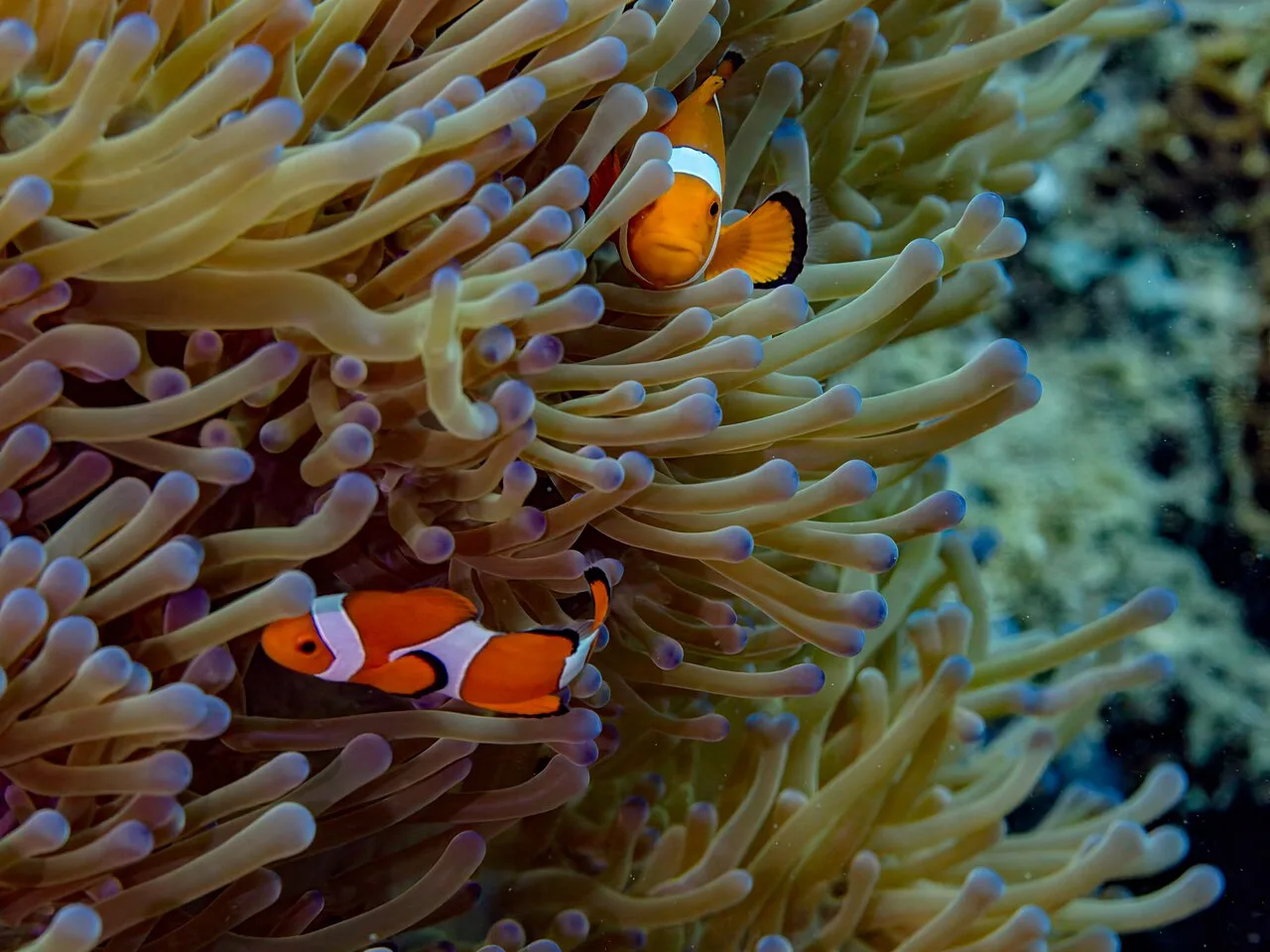
The percula clownfish, Amphiprion percula, has the same orange body and three white bars, and the two are mislabelled so often that a shop tag settles very little.
The most dependable difference is the number of spines in the dorsal fin. Animal Diversity Web gives 11 for the ocellaris, while FishBase gives 9 to 10 for the percula.
The black edging is the quicker check. On an ocellaris the black line around each white bar is thin or faint, while a percula usually shows a broad black band between the orange and the white.
Captive colour lines blur that edging clue, so the spine count carries more weight when the two signs disagree.
Range is a third check for wild-collected fish, because the percula is recorded only from Queensland and Melanesia, including northern New Guinea and the Solomon Islands.
| Decision factor | Ocellaris clownfish | Percula clownfish |
|---|---|---|
| Scientific name | Amphiprion ocellaris | Amphiprion percula |
| Dorsal fin spines | Usually 11 | 9 to 10 |
| Black edging on the white bars | Thin or faint | Usually broad and obvious |
| Wild range | Eastern Indian Ocean to the western Pacific | Queensland and Melanesia |
| Natural host anemones | H. magnifica, S. gigantea, S. mertensii | H. crispa, H. magnifica, S. gigantea |
| Recorded maximum length | 11 cm total length | 11 cm total length |
For a mixed display the label changes little, since both reach the same size on similar reefs. It matters most when someone wants to pair and breed a named species, where the ocellaris versus percula question has to be settled first.
Why does the largest ocellaris in a pair become female?
Every ocellaris that breeds starts as a male, and the fish that becomes female is the largest and most dominant one in its group.
This is protandrous sex change. Sex follows social rank rather than being fixed at hatching, and it explains almost every rule about buying and pairing these fish.
How the ranking forms
A wild group is one breeding pair plus a few smaller juveniles that do not breed, all ranked by size. A laboratory husbandry method for this species describes the pair forming through aggression, with the most dominant fish becoming female and the second becoming the breeding male.
That pair then holds the juveniles below them back from maturing.
FishBase records the change to female at about 4.4 cm total length, well below the 11 cm maximum. A fish of ordinary shop size can therefore already be a working male, and the rank it takes depends on which other clownfish it meets.
What happens when the female is lost
When the female dies or is removed, the breeding male changes sex and becomes the new female, and the largest juvenile matures into the new male.
The change runs one way only, from male to female, which is why two fish that have both become female cannot settle their dispute by one of them turning back.
What the ranking means when you buy
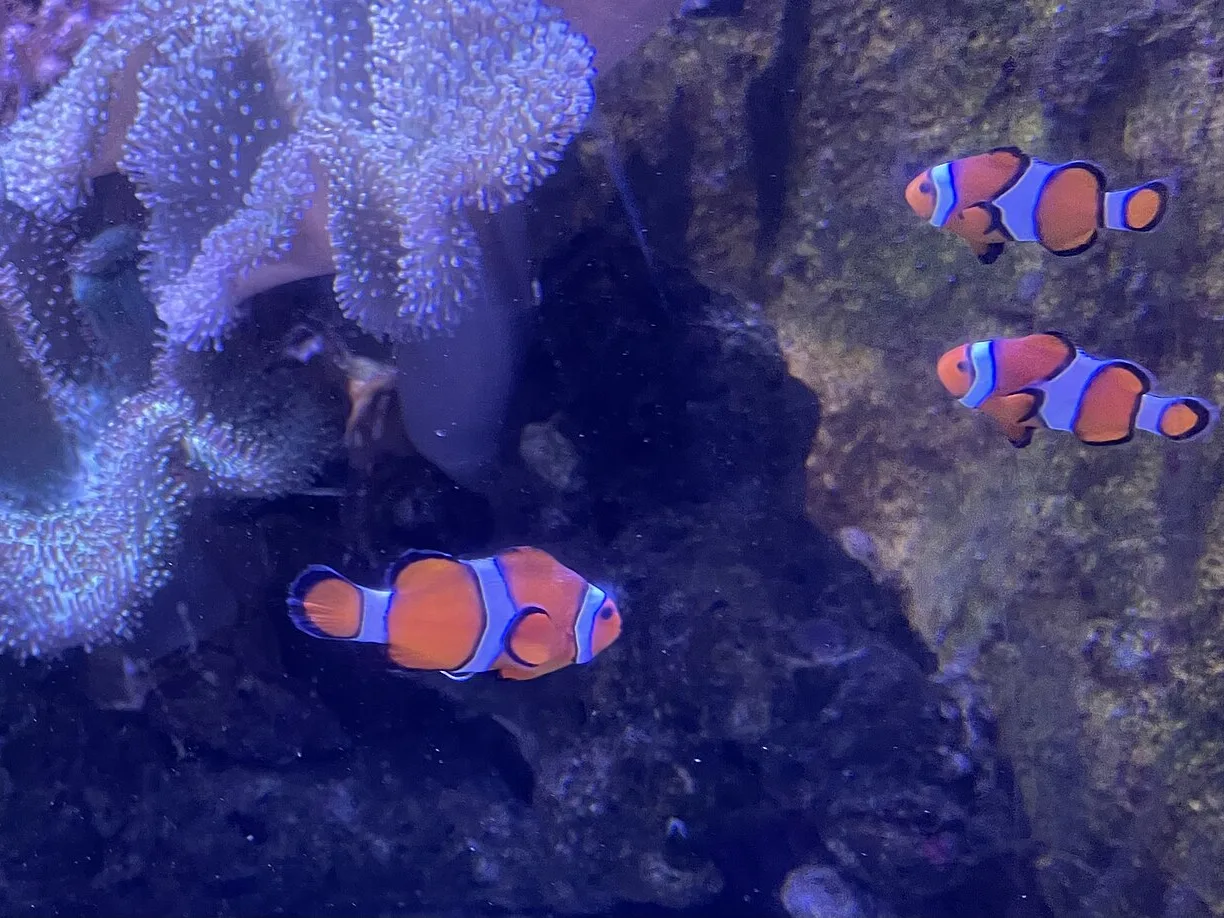
The simplest route is two small juveniles bought together, because neither has settled as female. The research method forms pairs the same way, from one larger and one smaller immature fish, and notes that a new pair can take 6 months to 2 years to spawn.
Two large adults of unknown history are the riskier combination. If both are already female, neither can step down, and sustained fighting may end only with separation.
A third ocellaris added to an established pair enters at the bottom of the ranking. In a small tank the pair can chase it until it hides, tears its fins and stops reaching food.
Reflections can set off the same defence, which is why the research method separates its pair tanks with white panels.
A settled pair spawns every 2 to 3 weeks on a hard surface, and the male does most of the egg care; raising the young is its own project under ocellaris clownfish breeding.
Female
The largest and most dominant fish. She breeds, leads the defence of the home site and was once a male.
Breeding male
Second in rank. He fertilises the eggs, does most of the egg care and becomes female if she is lost.
Juveniles
Smaller fish ranked by size. They stay immature while the pair holds them back and move up only when a place opens.
Does an ocellaris clownfish need an anemone?
No. An ocellaris survives, grows and breeds without any anemone, and the research method for breeding pairs states that anemonefish in aquaria do not require one, because its role is shelter from predators.
The fuller answer is that an anemone is optional but not neutral.
What the anemone does on a reef
On a reef an ocellaris rarely strays far from its host. The tentacles sting most fish that come close, so a small, slow swimmer gains a refuge and a protected place to lay eggs.
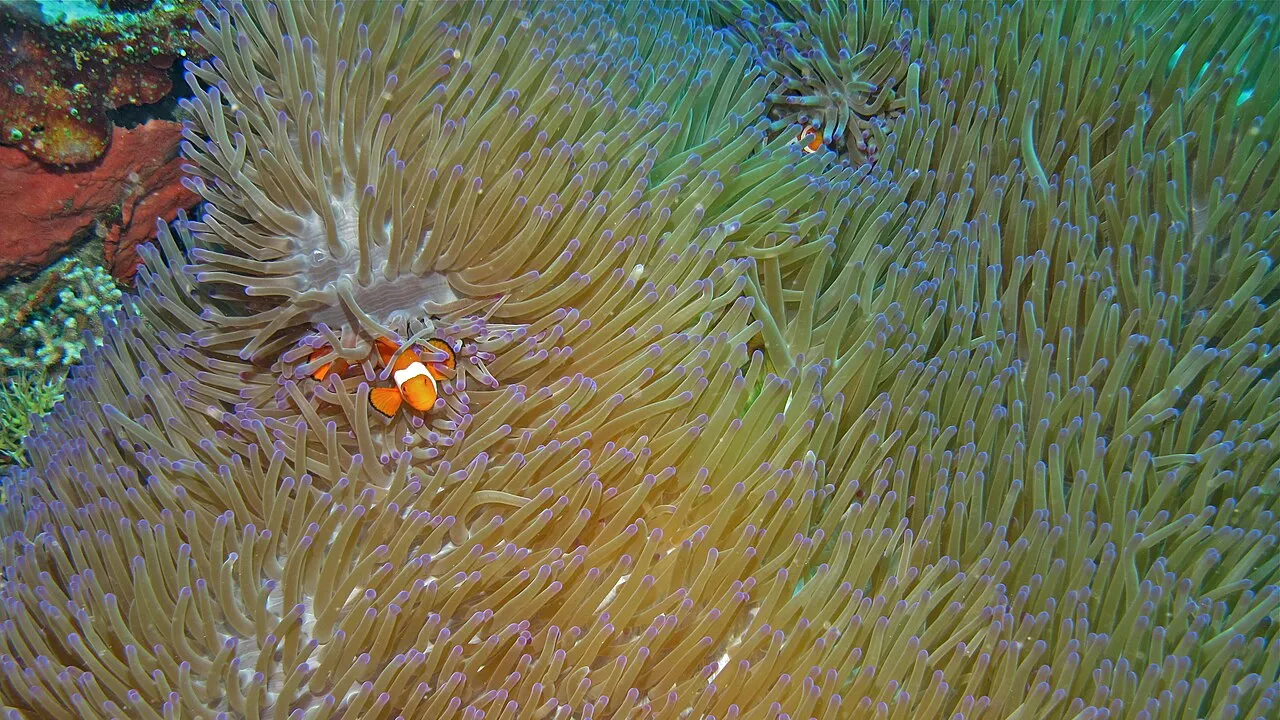
An aquarium without predators removes most of that job, and captive fish often adopt a coral, a rock overhang or a sheltered corner as a substitute home site.
What a controlled study found
A 2019 study in Vietnam offered naive, captive-bred juveniles a choice of anemones and then removed them in stages. Juveniles with their natural host, Stichodactyla gigantea, grew better than those with a non-natural host or none, and swam less, which the authors read as lower stress.
The same study recorded the risk. Once the natural host was removed, the fish moved into a non-natural anemone, Stichodactyla haddoni, and one of them was stung and died.
So the right anemone in good condition can improve welfare, while a wrong or failing one can injure the fish it was bought for.
Why the usual shop anemone is a substitute
The bubble-tip anemone, Entacmaea quadricolor, is the species most often sold for clownfish, yet it is not a natural host, and the Vietnam study treated it as a non-natural one.
The natural hosts are large carpet anemones such as Stichodactyla gigantea, along with Heteractis magnifica. They need strong light, steady flow and a mature reef tank setup, which makes them harder to keep than the clownfish.
An anemone moving around the tank is usually the first sign that its conditions are wrong.
How much space does an ocellaris pair need?
A pair sharing its tank with a few peaceful fish is best housed in about 75 cm (30 inches) of length and roughly 110 litres (29 US gallons). That figure is our judgement rather than a published standard, drawn from adult size, territorial behaviour and the need for stable salinity and temperature.
In the 2019 study, breeding pairs lived alone in 70 litre aquaria on a shared system measured twice a day, which is far more controlled than a home display.
A pair stays close to its home site, so footprint matters for what surrounds that site more than for swimming room. A longer tank lets other fish keep their distance instead of crossing the female's territory all day.
Volume also steadies the water, because evaporation leaves the salt behind and salinity climbs faster in a small tank.
Groups of three or more need more room because of the ranking pressure that comes with sex change, and ocellaris clownfish tank size grows with each fish added.
The saltwater aquarium must be fully cycled before any fish arrives, since a new system can carry ammonia and nitrite, because the aquarium nitrogen cycle takes weeks to build a biofilter in salt water as in fresh.
- About 75 cm of tank length for a pair with a few peaceful tank mates
- One stable home site, such as a rock overhang, cave or sturdy coral, away from the strongest pump outlet
- Open water in front of the home site where the pair can hover
- A lid or mesh cover, which also slows evaporation and the salinity rise it causes
- A heater and thermometer that hold the chosen temperature through the seasons
- A cycled system with ammonia and nitrite at zero before the fish arrive
What water conditions suit ocellaris clownfish?
Published ocellaris water parameters hold the water at 26 to 28 °C (79 to 82 °F), a salinity of 30 to 35 g/L and a pH of 8.0 to 8.5.
A second laboratory system ran warmer, at 28 to 30 °C with salinity 32 to 35, and its fish grew and bred. The sources overlap without agreeing exactly, so neither supports a single ideal number.
Both share stability, and the breeding method warns that constant high temperature can exhaust pairs.
Published ocellaris water ranges
- Temperature26 to 28 °C (79 to 82 °F)Applies to breeding pairs in a laboratory recirculating system. Research husbandry protocol citing aquaculture studies. Source: Roux et al. 2021, checked 2026-09-21.
- Temperature28 to 30 °C (82 to 86 °F)Applies to breeding pairs and juveniles in a laboratory system. Portable probe, read twice daily. Source: Nguyen et al. 2019, checked 2026-09-21.
- Salinity30 to 35 g/L (ppt)Applies to breeding pairs in a laboratory recirculating system. Research husbandry protocol citing aquaculture studies. Source: Roux et al. 2021, checked 2026-09-21.
- Salinity32 to 35 pptApplies to breeding pairs and juveniles in a laboratory system. Portable probe, read twice daily. Source: Nguyen et al. 2019, checked 2026-09-21.
- pH8.0 to 8.5Applies to breeding pairs in a laboratory recirculating system. Research husbandry protocol citing aquaculture studies. Source: Roux et al. 2021, checked 2026-09-21.
Every range above is for a marine system.
Many keepers read aquarium salinity as specific gravity with a hydrometer or refractometer. At 25 °C, 30 to 35 ppt corresponds to roughly 1.023 to 1.026, and because the conversion shifts with temperature, a reading means little without the temperature it was taken at.
No species-specific alkalinity target appeared in the sources checked, so in a reef tank the corals set it and the clownfish lives within it.
Ammonia and nitrite belong at zero. A reading above zero calls for a same-day partial water change matched for salinity and temperature, and the water change volume decides how much of the problem one change removes.
How should ocellaris clownfish be fed?
On the reef the ocellaris is an omnivore that takes zooplankton such as copepods, along with algae.
Captive-bred fish are raised on prepared food, and the research method moves juveniles onto small pellets about 30 days after hatching, so most shop fish already recognise pellets. A varied ocellaris clownfish diet of pellets or flake plus frozen foods covers both the animal and plant sides of the wild diet.
Breeding pairs in that method eat once a day from a frozen mix of squid, mussel, shrimp, pellets and nori, chosen for unsaturated fats that support egg production.
Portion size matters more than the menu. Food that settles into rockwork decays and raises ammonia and nitrate, so small amounts the fish clear before anything reaches the rock keep the water cleaner.
A fish that stops feeding for more than a day or two, especially while breathing fast or hiding, is showing a change worth investigating.
| Food | Role in the diet | Practical note |
|---|---|---|
| Marine pellet or flake | Daily staple | Pick a size the fish can swallow whole; captive-bred fish usually accept it at once |
| Frozen mysis or brine shrimp | Animal protein and variety | Thaw first and offer small amounts so none reaches the rockwork |
| Frozen seafood mix | Richer food for breeding pairs | Research pairs receive squid, mussel and shrimp mixed with pellets |
| Nori or algae-based food | The plant part of a wild omnivore diet | Small pieces or algae-based pellets |
Which fish can live with an ocellaris clownfish?
Good ocellaris clownfish tank mates are peaceful fish that cannot swallow it and do not compete for its home site. Its own aggression is mostly local, because the pair defends the area around its shelter and pays little attention to the rest of the tank.
The strongest conflicts come from other clownfish. Extra ocellaris, a second clownfish species or a forceful relative such as the maroon clownfish all want the same kind of site, and the smaller or later arrival usually loses.
Small, peaceful reef fish tend to work because they use different space. A bicolor blenny perches on rock, gobies sit on the sand and cardinalfish hover in open water.
Groupers, lionfish, large triggerfish and big angelfish can swallow or harass a fish of 11 cm or less.
An ocellaris eats small animal food and algae, so it leaves corals and invertebrates alone and counts among the reef-safe fish, although a pair that adopts a coral as its host can keep it from opening fully.
| Decision factor | Usually workable | Usually a conflict |
|---|---|---|
| Size | Small to medium fish that cannot swallow an 11 cm fish | Groupers, lionfish, large triggerfish and big angelfish |
| Temperament | Peaceful fish that ignore the home site | Bullies that chase smaller fish across the whole tank |
| Other clownfish | One established pair only | Extra ocellaris, a second clownfish species or a maroon clownfish |
| Use of space | Sand dwellers, rock perchers and open-water fish | Fish that claim the same cave, coral or anemone |
How long do ocellaris clownfish live?
In good aquarium care an ocellaris can live well beyond a decade.
FishBase records an age of 12 years in captivity, and a 2020 review of anemonefish biology cites a survey of records in which the ocellaris lived more than 20 years. Animal Diversity Web gives 6 to 10 years for wild fish.
When a captive ocellaris dies young, the cause is worth finding, and common ocellaris clownfish care mistakes such as an uncycled tank are the first places to look.
| Record | Setting | Source |
|---|---|---|
| 6 to 10 years | Wild populations | Animal Diversity Web |
| 12 years | Aquarium record | FishBase |
| More than 20 years | Wild and captive records surveyed in 2019 | Roux et al. 2020, citing Sahm et al. 2019 |
Is the ocellaris clownfish in your shop captive-bred?
Probably, though not always.
A 2026 study of United States online sellers found the ocellaris sold mainly as wild-caught in 2012 and 2013 but mainly as captive-bred from 2021 to 2024. It was one of only three clownfish species to shift that way.
In Europe the ocellaris was the second most imported marine ornamental fish from 2014 to 2021, and a review of that trade found its imports fell by almost 70 percent, partly because more are bred inside importing countries.
A captive-bred fish has already eaten prepared food and lived in aquarium water, and it skips the collection, holding and long transport a wild fish goes through.
Trade names on colour lines carry no verified information about lineage, health or even species, so the scientific name and the breeder's details are what a buyer can check.
- IUCN status
- Least Concern, assessed February 2021; wild population trend unknown
- CITES
- No appendix listing found in the authorities checked; local rules can still apply
- Captive breeding
- Established and commercial for the aquarium trade
- United States online supply
- Mainly captive-bred in 2021 to 2024, after mainly wild-caught in 2012 and 2013
- EU imports
- Second most imported marine ornamental fish from 2014 to 2021, falling by almost 70 percent
- What to ask the seller
- Captive-bred or wild-collected, the breeder or collection country, and the scientific name
Should a new ocellaris go through quarantine?
Yes, whether it is captive-bred or wild-collected.
A separate tank protects the display, because parasites such as Brooklynella hostilis, often called clownfish disease, and Cryptocaryon irritans, the cause of marine white spot, can spread through a whole system from one new fish.
University of Florida extension guidance advises holding new fish for 30 to 90 days, and at least 3 to 6 weeks, because the white spot life cycle can run from 6 days to 11 weeks.
The harder decision during quarantine is when a change needs professional help. Some shyness and a day of poor appetite after transport are common and usually pass.
An aquatic veterinarian or fish health specialist should see the fish when it breathes rapidly, shows grey or white patches, peeling skin or white spots, rubs against surfaces repeatedly, or refuses food for several days. Several marine parasites look alike and move quickly, so any treatment needs a confirmed diagnosis.
The quarantine tank setup and how the fish is acclimated to new water both matter, since a fast change in salinity or temperature adds stress when the fish is most exposed.
- Prepare Set up a separate, cycled quarantine tank at the display's temperature and salinity, with one hiding place.
- Match Measure temperature and salinity in the bag and in the quarantine tank, then bring them together gradually before the transfer.
- Observe Check breathing, skin, fins and appetite every day and keep a short written note.
- Separate tools Keep nets, siphons and buckets for quarantine only, so no water travels to the display.
- Escalate Contact an aquatic veterinarian if breathing speeds up, patches or spots appear, skin peels or the fish refuses food for several days.
- Release Move the fish to the display only after the full period passes with steady feeding and no signs.