
How Much Aquarium Water Should You Change at Once?
A routine aquarium water change is commonly a partial change, but the right percentage comes from nitrate trend, waste load, source-water match and animal sensitivity. Choose the smallest volume that reliably restores water quality, then keep temperature and chemistry close enough to avoid an abrupt shift.

How much aquarium water should you change?
For a stable, normally stocked freshwater aquarium, about 20 to 30 percent is a sensible starting range, adjusted after you compare results before and after maintenance. A lightly stocked planted tank may need less frequent removal, while a heavily fed grow-out system may need more volume or shorter intervals.
The percentage is not a universal prescription. OATA notes that water-change amount varies with species, aquarium size and stocking, so your log should show whether the chosen routine controls nitrate, visible waste and dissolved organics without destabilizing temperature, pH or hardness.
- Routine starting point
- Often 20-30 percent in a stable freshwater aquarium
- Increase based on
- Rising nitrate, heavy feeding, waste accumulation or a measured contaminant
- Reduce or split based on
- Large source-water mismatch, neglected old tank or sensitive animals
- Replacement water
- Conditioned, temperature-matched and chemically appropriate
- Top-off
- Replaces evaporation only; it does not export nitrate or dissolved waste
- Emergency change
- Set by measured hazard and animal condition, not the routine calendar
How do you calculate the actual volume?
Multiply the aquarium's estimated water volume by the chosen fraction. A nominal 100 L tank that contains about 80 L after substrate, rock and air space needs 20 L removed for a 25 percent change, not 25 L based on the box label.
| Actual water volume | 20 percent | 25 percent | 30 percent |
|---|---|---|---|
| 40 L | 8 L | 10 L | 12 L |
| 80 L | 16 L | 20 L | 24 L |
| 120 L | 24 L | 30 L | 36 L |
| 200 L | 40 L | 50 L | 60 L |
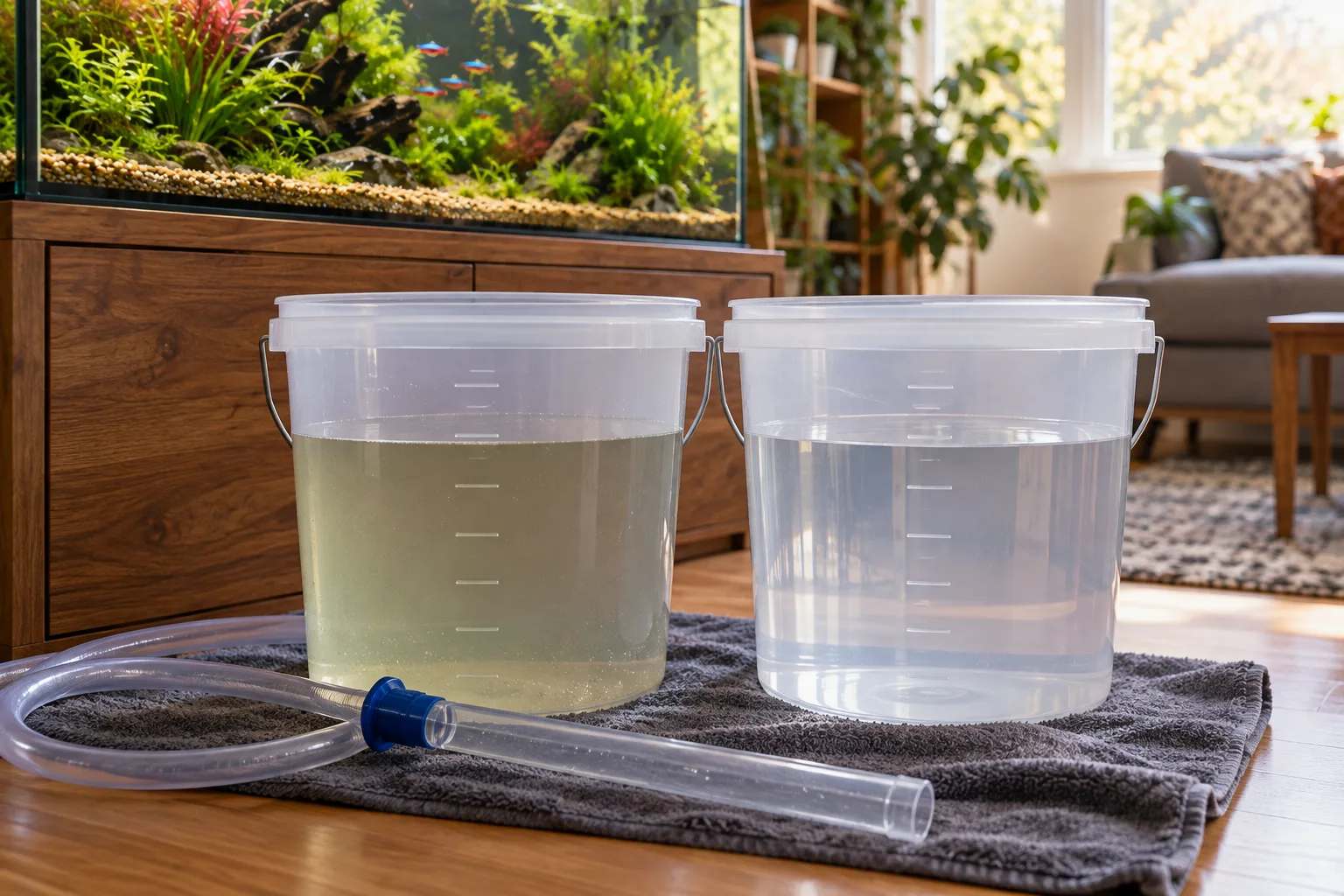
Mark a dedicated bucket or use a known container volume so removal is repeatable. The amount to replace depends on the aquarium's measured trend.
What should make you change more water?
A rising nitrate trend, heavy feeding, visible detritus, medication removal under qualified direction or a known contaminant can justify a larger change. Measure again afterward so you know whether the intervention achieved the intended reduction.
For a dissolved substance that is evenly mixed, the fraction removed approximates the fraction reduced before new production occurs. A 25 percent change lowers 40 mg/L nitrate to roughly 30 mg/L if the replacement water contains none; it does not take the reading to zero.
How do you calculate the result when replacement water is not zero?
For an evenly mixed dissolved substance, use remaining fraction = 1 minus the change fraction when the replacement water contains none of it. After several equal changes, multiply that remaining fraction once for each change, which is why two 25 percent changes leave 0.75 x 0.75, or about 56 percent, of the starting amount.
Replacement water often contains some nitrate, hardness or another measured substance. A practical estimate is: result after the change = tank concentration x remaining fraction + replacement concentration x change fraction.
If an 80 L aquarium reads 40 mg/L nitrate and a 25 percent change uses water containing 10 mg/L, the estimate is 40 x 0.75 plus 10 x 0.25, which gives 32.5 mg/L after complete mixing. The result is higher than the 30 mg/L expected from nitrate-free replacement water.
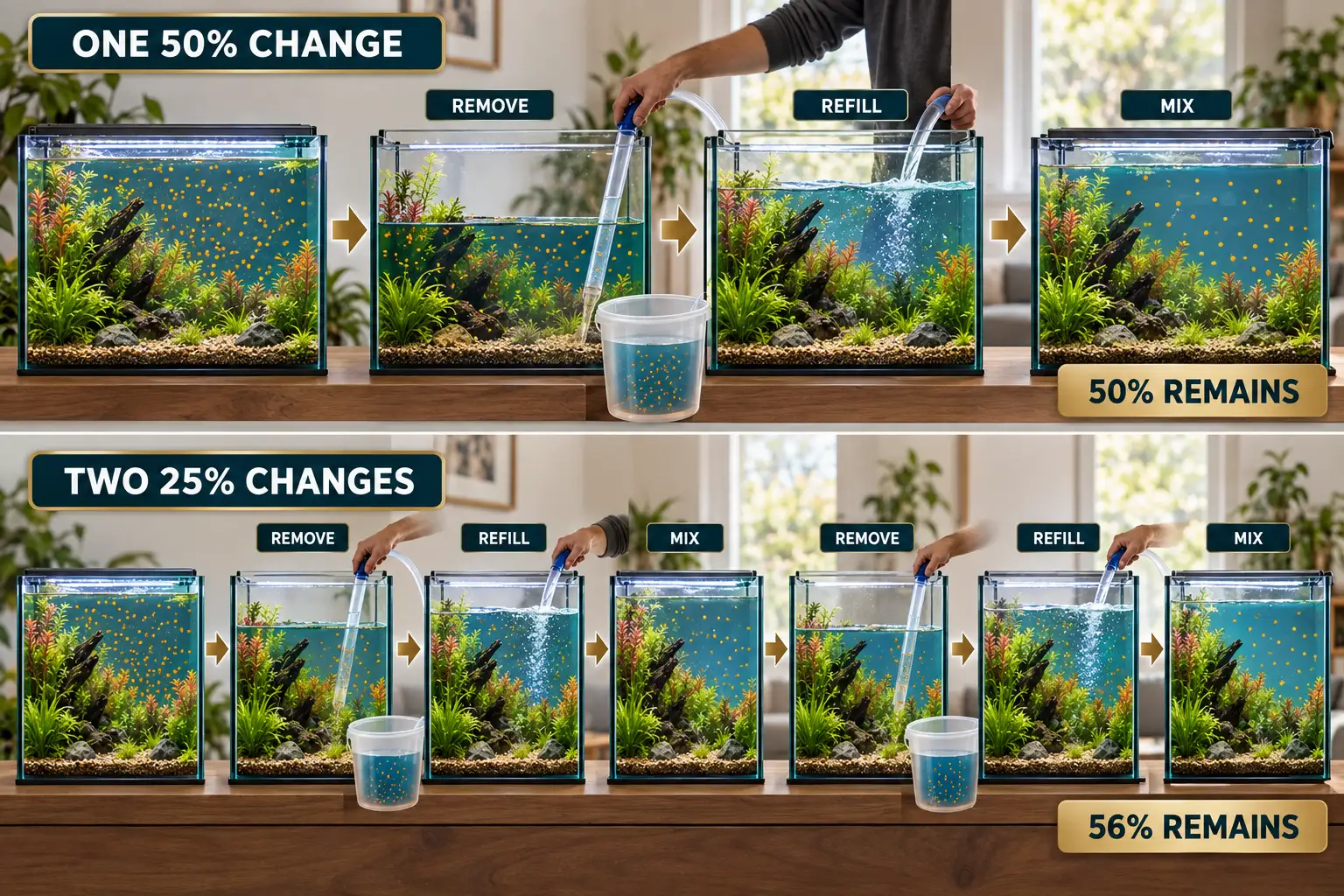
This arithmetic predicts dilution, not the next test exactly. Waste production continues, substrate can release trapped material, replacement water may contain the same substance, and test resolution can be larger than the expected difference.
When can a large water change be risky?
In a neglected aquarium, nitrate may be high while pH and mineral balance have drifted far from the tap or prepared source water. The Merck Veterinary Manual describes old tank syndrome and warns that rapid correction can change ammonia toxicity and stress fish.
That does not mean leaving animals in poor water. Measure tank and replacement water, restore conditions through controlled partial changes, increase aeration when needed and seek aquatic-veterinary help when fish are collapsing, unable to remain upright or severely distressed.
How closely should replacement water match?
Temperature should be close enough that the aquarium does not swing when the refill enters. Match salinity exactly for marine water changes, and compare pH, GH and KH when the source differs from the established aquarium or when sensitive animals are present.
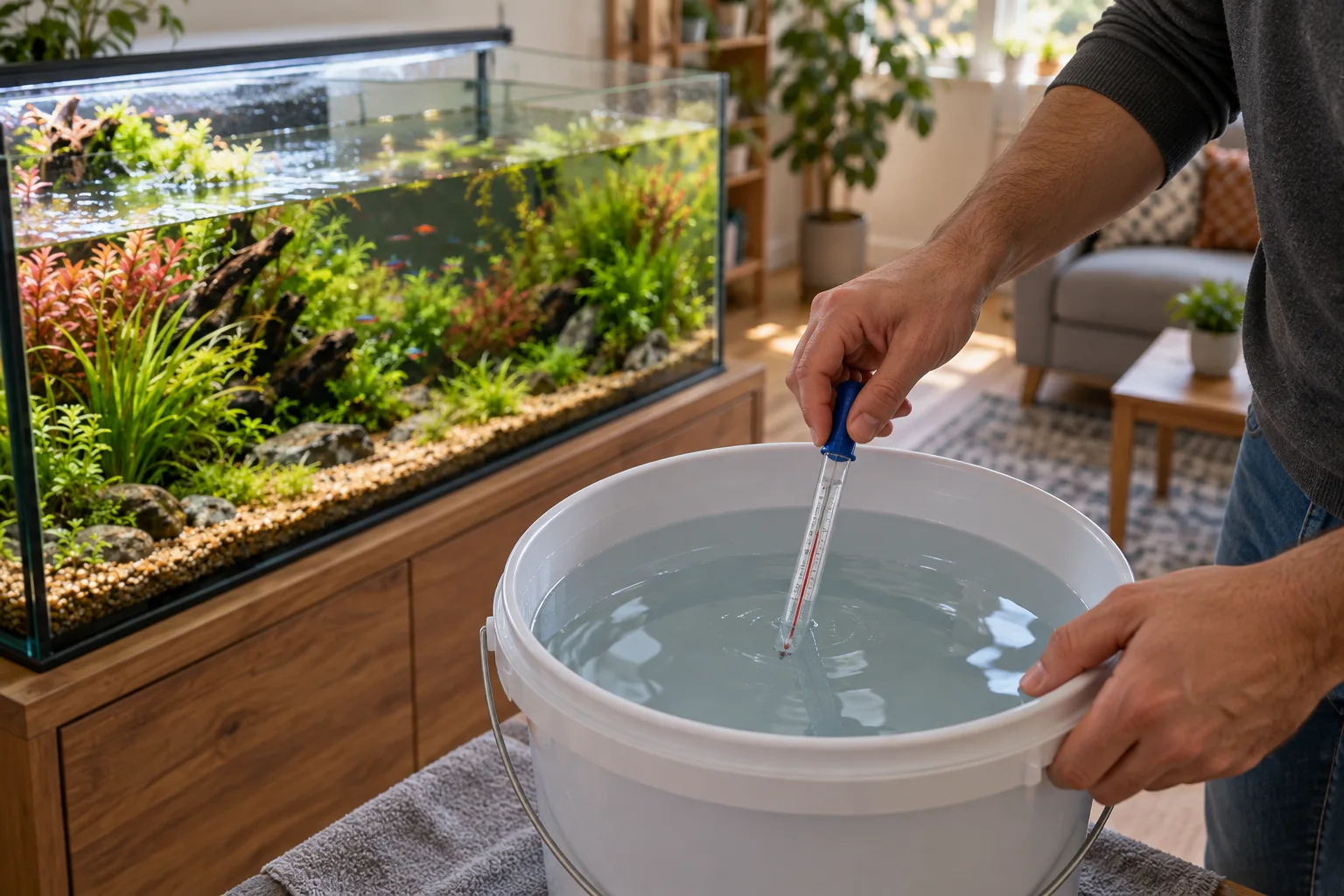
Municipal disinfectants also matter. The U.S. EPA aquarium guidance states that chlorine and chloramine must be removed or neutralized before the water is used in an aquarium.
How do you perform a controlled partial change?
- Test the parameter that is driving the change and record the starting value.
- Prepare enough replacement water, neutralize disinfectant and verify temperature.
- Switch off heaters or pumps that cannot safely run below the planned water level.
- Siphon the measured volume while removing accessible debris without stripping the whole substrate.
- Refill slowly so fish, plants and hardscape are not blasted by the incoming water.
- Restart equipment, confirm flow and check for leaks or trapped air.
- Observe the animals and retest the driving parameter after the water has mixed.
During routine work, avoid deep-cleaning every surface and replacing filter media on the same day because that combines several disturbances and makes a later problem harder to trace.
Why is topping off not a water change?
Evaporation removes water while most salts, nitrate and dissolved solids stay behind. Adding fresh water restores the level but does not export those substances; in marine tanks, replacing evaporation with saltwater makes salinity climb.
If the aquarium loses water unusually fast, also inspect lid gaps, room conditions and leaks instead of treating repeated top-off as ordinary maintenance.
How often should you change water?
Choose an interval that prevents unacceptable drift before the next service. Weekly changes are easy to remember, but a stable schedule should be justified by measurements, animal load, feeding and plant growth rather than by the weekday alone.
A betta tank with one fish, a fast school of pearl danios and a planted shrimp aquarium with Amano shrimp can all produce different waste and disturbance patterns. Log volume, nitrate, temperature and anything unusual, then adjust once the trend is clear.
Should a routine water change and an emergency change use the same rule?
A routine change and an emergency change answer different questions. Routine volume is chosen from the trend between services, while emergency volume is chosen from a measured hazard, the replacement-water match, the condition of the animals and how quickly the source can be stopped.
During ordinary maintenance, repeatability makes the log useful. During an ammonia event or known contamination, protecting livestock can justify a larger or repeated change, but each stage still needs conditioned water, temperature control, restored circulation and a measurement that shows whether the hazard actually fell.
The stop condition also differs. A routine change ends when the planned volume is replaced and equipment is confirmed, while an emergency response continues only until the measured danger and animal condition are controlled enough to diagnose the source safely.
Do not let a large percentage hide an unresolved cause. A dead animal, blocked filter, accidental dose, chloramine exposure or decomposing food can recreate the same hazard after clean water is added.
When is a water change an emergency response?
Measured ammonia or nitrite, known contamination, equipment failure with deteriorating water quality or severe animal distress can require prompt partial changes. Protect animals while identifying the cause; repeated changes without fixing a dead fish, blocked filter or accidental overdose only buy time.
An ammonia spike calls for testing the source water and identifying the new waste load or loss of filtration. If fish continue gasping, rolling or losing control after water quality and oxygen are addressed, contact an aquatic veterinarian.
Which maintenance problem needs a different response?
Use the dedicated guidance for chlorine and chloramine, aquarium nitrate, lowering aquarium nitrate, old tank syndrome and water-change pumps. Each changes why, how quickly or with what equipment water should be replaced.