
What Is a Pearl Danio, and How Much Room Does It Need?
Danio albolineatus
The pearl danio is a fast 9.6 cm schooling fish from running waters of Southeast Asia. A mature group needs a covered aquarium around 90 cm or longer, an open flow lane, a calmer refuge, strong gas exchange, and companions able to share its pace without losing food or space.
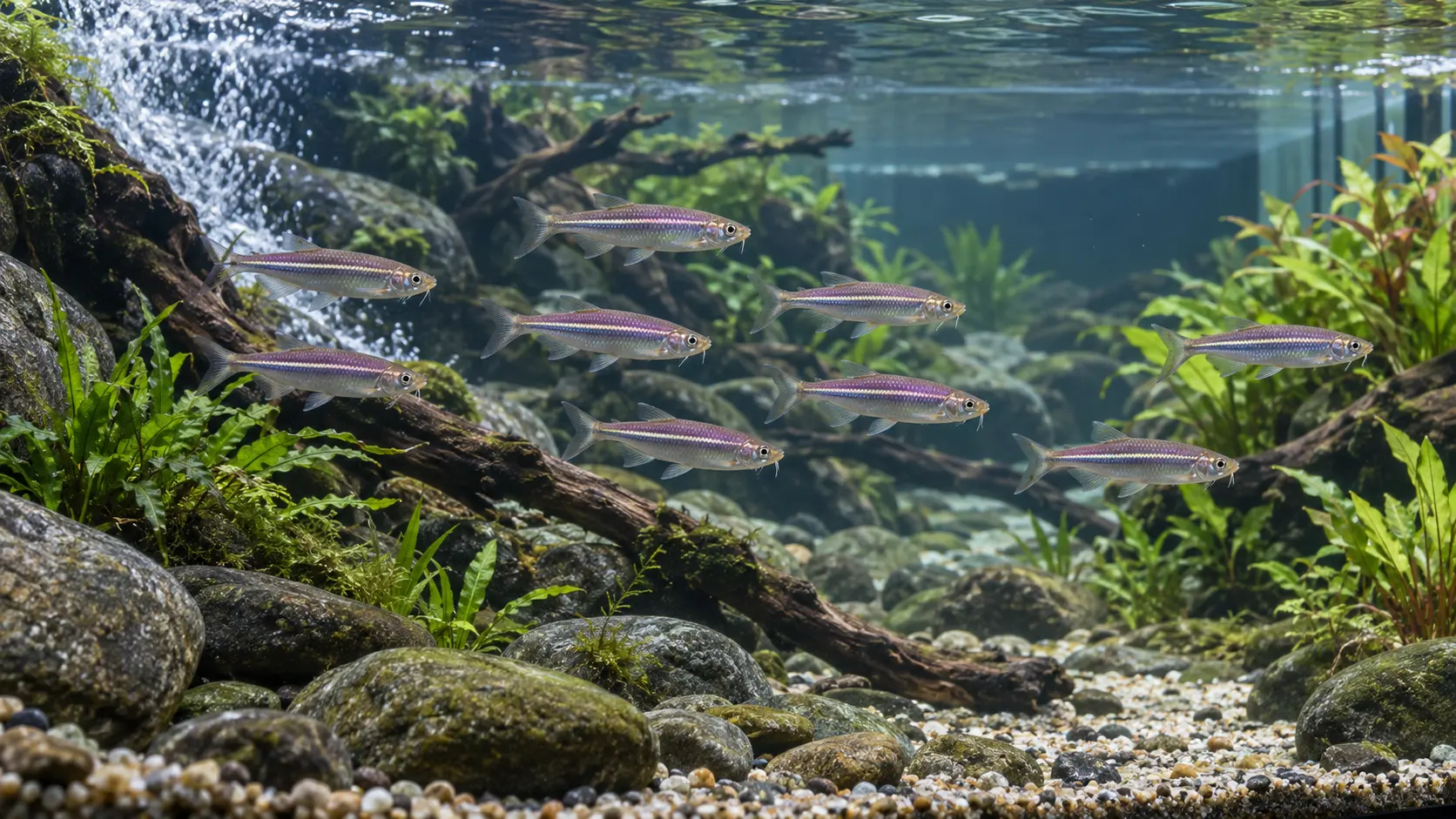
At a glance

- Adult size
- 6 to 9.6 cm
- Minimum footprint
- 90 x 30 cm or larger
- Minimum volume
- 80 litres
- Social structure
- Fast schooling fish; keep a complete group
- Minimum group
- 8
- Diet
- Omnivore
- Feeding
- Provide a long flow lane, a calmer refuge, secure cover, and two feeding positions.
- Waste load
- moderate for an adult school
- Family
- Danionidae
- Native range
- Southeast Asia from Myanmar to Laos and Sumatra
- Conservation status
- Least Concern, assessed 25 March 2011 Source
Adult body size, social structure, swimming behaviour, open routes, and filtration are considered together.
What is a pearl danio?
A pearl danio is Danio albolineatus, an active Southeast Asian schooling fish with a pink to violet sheen and pale iridescent horizontal stripes toward the tail. It is larger and more continuously mobile than the celestial pearl danio, which belongs to a different genus and has a spotted pattern.
FishBase records two pairs of long barbels and an incomplete lateral line among the diagnostic features. Those details help with a probable identification, while seller records and locality information remain important when a fish will be bred or traded as a known form.
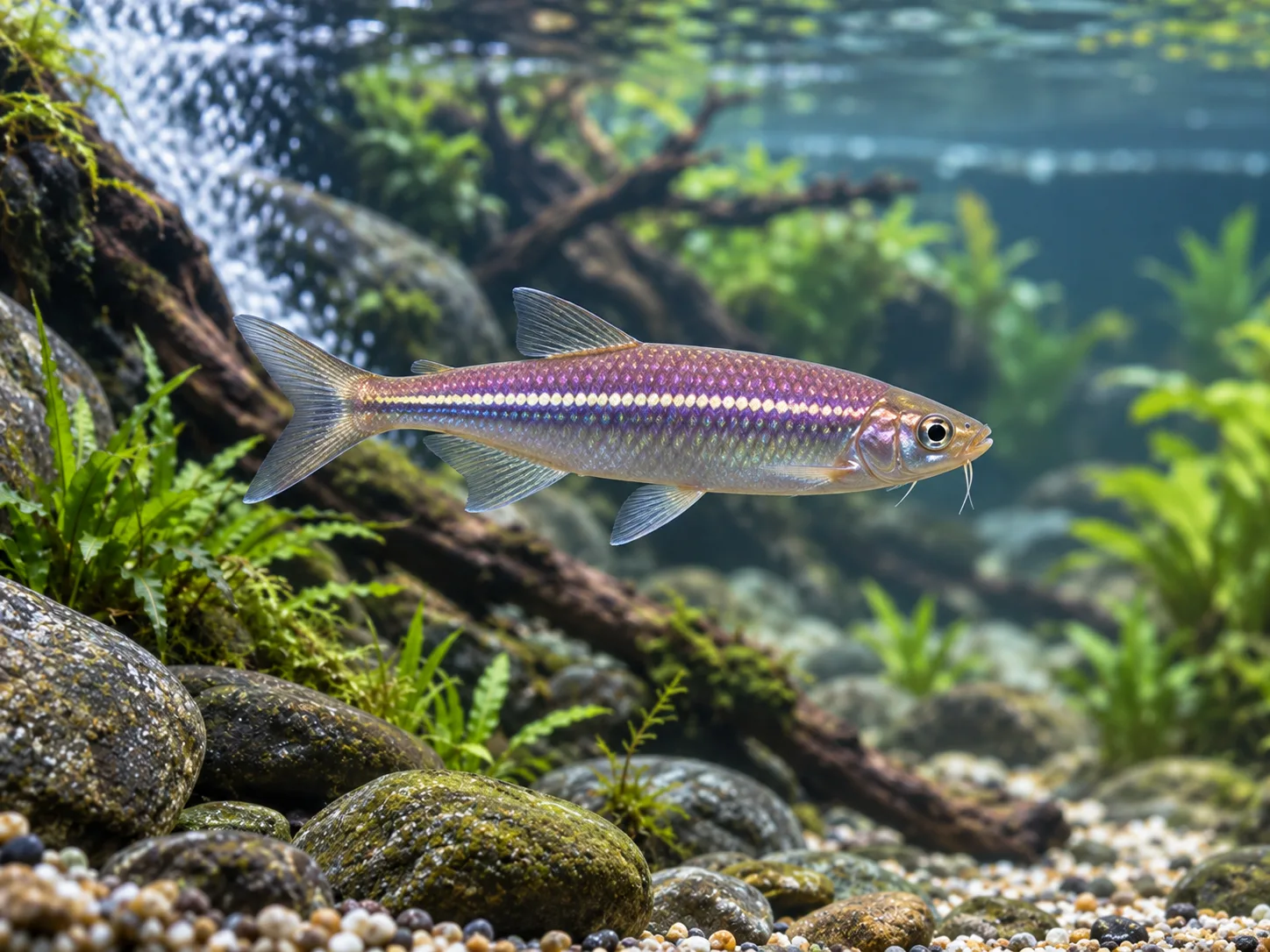
- Accepted identity
- Danio albolineatus (Blyth, 1860)
- Family
- Danionidae
- Verified range
- Myanmar to Laos and Sumatra, with records in major Southeast Asian drainages
- Recorded habitat
- Clear streams, hill streams, and running water
- Published maximum size
- 9.58 cm total length
- Social structure
- Large school near the surface and upper water
- Published aquarium length
- At least 60 cm; more length is prudent for adults
- Compiled water context
- 20 to 25 °C, pH 6.0 to 8.0, 5 to 19 dH
- Diet
- Terrestrial insects and some zooplankton
- Conservation
- Least Concern, assessed 25 March 2011
FishBase accepts the name and records distribution, size, water context, and diet. The U.S. Fish and Wildlife Service summary also describes large schools in streams with leaf litter and dense riparian vegetation.
Why is a celestial pearl danio not a smaller pearl danio?
The shared word pearl is a trade-name similarity. Pearl danio is Danio albolineatus, a streamlined fish recorded near 9.6 cm total length, while celestial pearl danio is Danio margaritatus, a compact spotted species that uses dense cover and remains much smaller.
| Decision | Pearl danio | Celestial pearl danio |
|---|---|---|
| Adult form | Long, streamlined, built for sustained movement | Compact body with spotted pattern |
| Primary space | Long upper and middle swimming route | Dense planted structure with shorter open gaps |
| Social pace | Fast school and strong feeding response | More deliberate movement around cover |
| Compatibility risk | Can overwhelm slow fish through speed | Can be intimidated or outcompeted by larger active fish |
| Planning error | Housing adults by juvenile shop size | Treating a small body as permission for a token group |
The two species should not be combined merely because a label suggests a family pair. The larger pearl danio's speed, mouth size, and feeding rush can change how the smaller fish use cover even when no direct attack occurs.
Use the scientific name on invoices and breeding records. If a seller uses only pearl danio, ask for a clear side view and adult stock information before choosing the tank.
How much swimming room do pearl danios need?
The published maximum of 9.58 cm total length is much larger than the size of many shop juveniles. FishBase records a 60 cm aquarium minimum, but a mature school uses length relentlessly, so 90 cm or more is a more defensible home footprint for eight to twelve adults.
Tank height cannot replace travel distance. A tall 90 litre cube asks the school to turn constantly, while a lower rectangular tank of similar volume can provide a longer uninterrupted route.
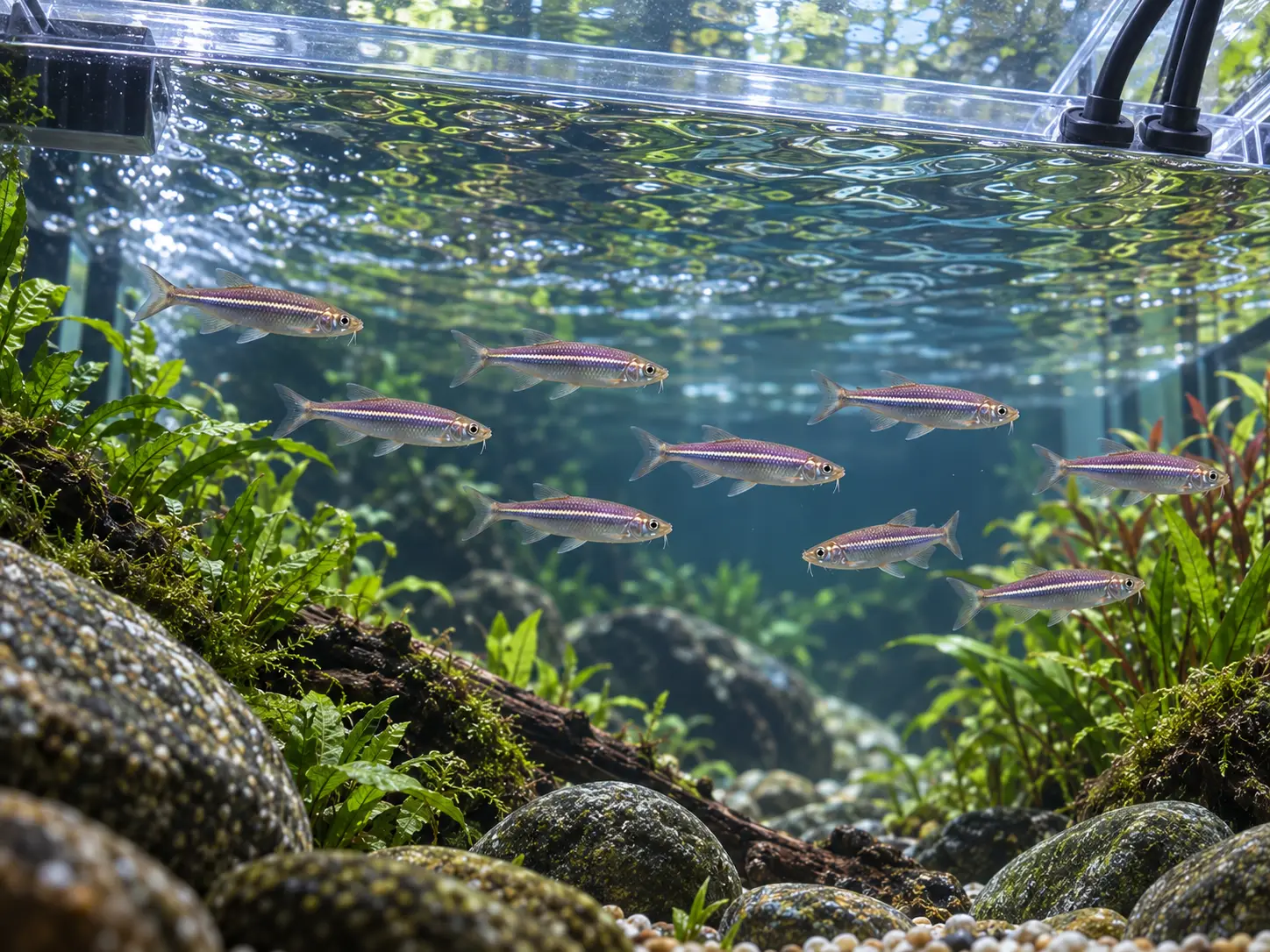
- Choose at least 90 cm of length for a settled adult school.
- Keep eight to twelve rather than a token pair or trio.
- Leave the upper and middle route open across most of the tank.
- Cover every lid gap because fast surface fish can jump.
- Place wood and plants toward the ends and rear.
- Count adult tank mates before using the remaining filtration margin.
The species' pace can overwhelm slow fish even without biting. A tank should be judged by whether other residents still feed, rest, and use open water after the danios settle.
How many pearl danios should live together?
FishBase and OATA give five as a minimum for danios, with OATA stating that more is better. Eight to twelve provides more social choice and spreads brief chases through a group large enough to recover its normal loose-school structure.
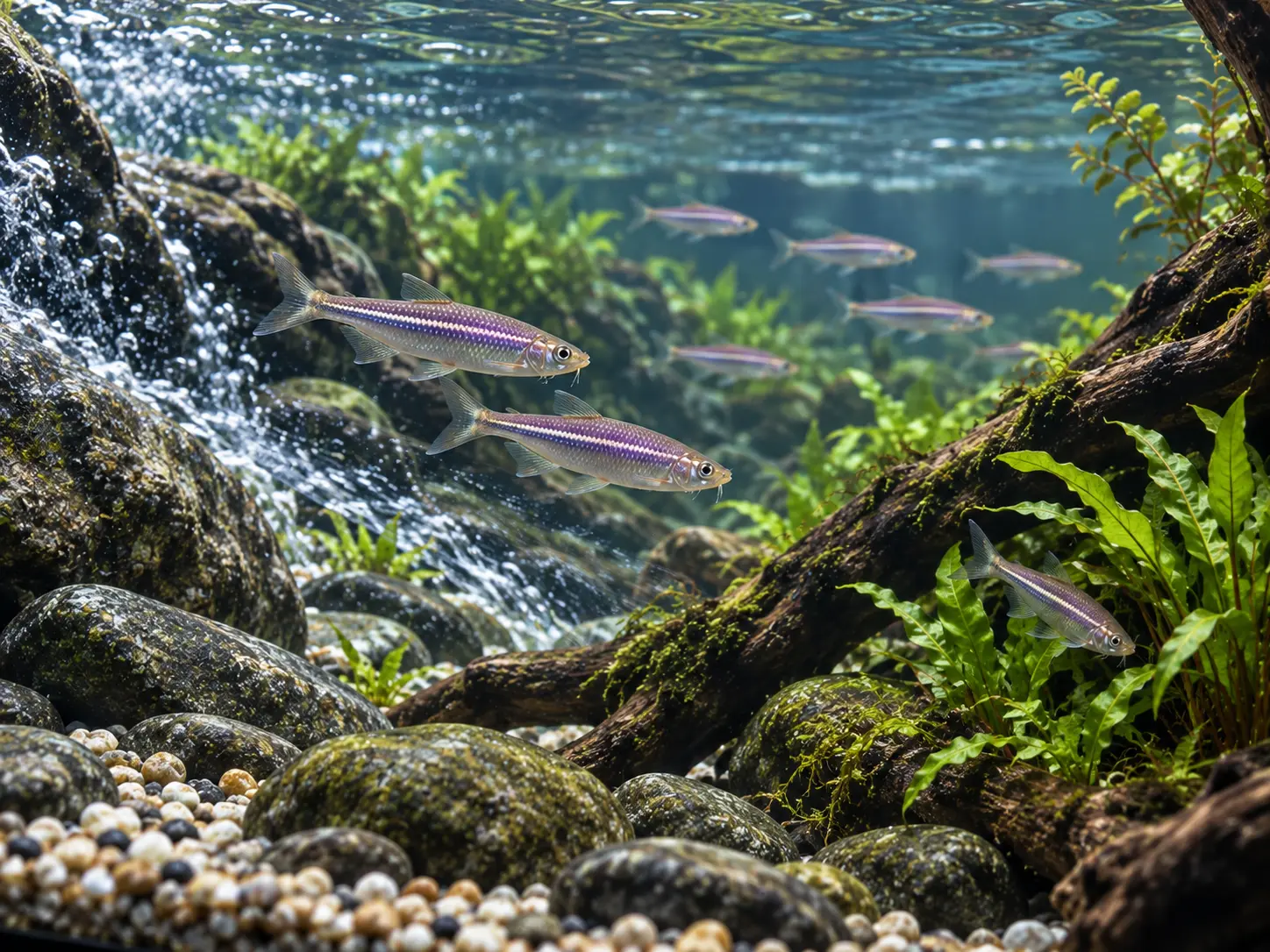
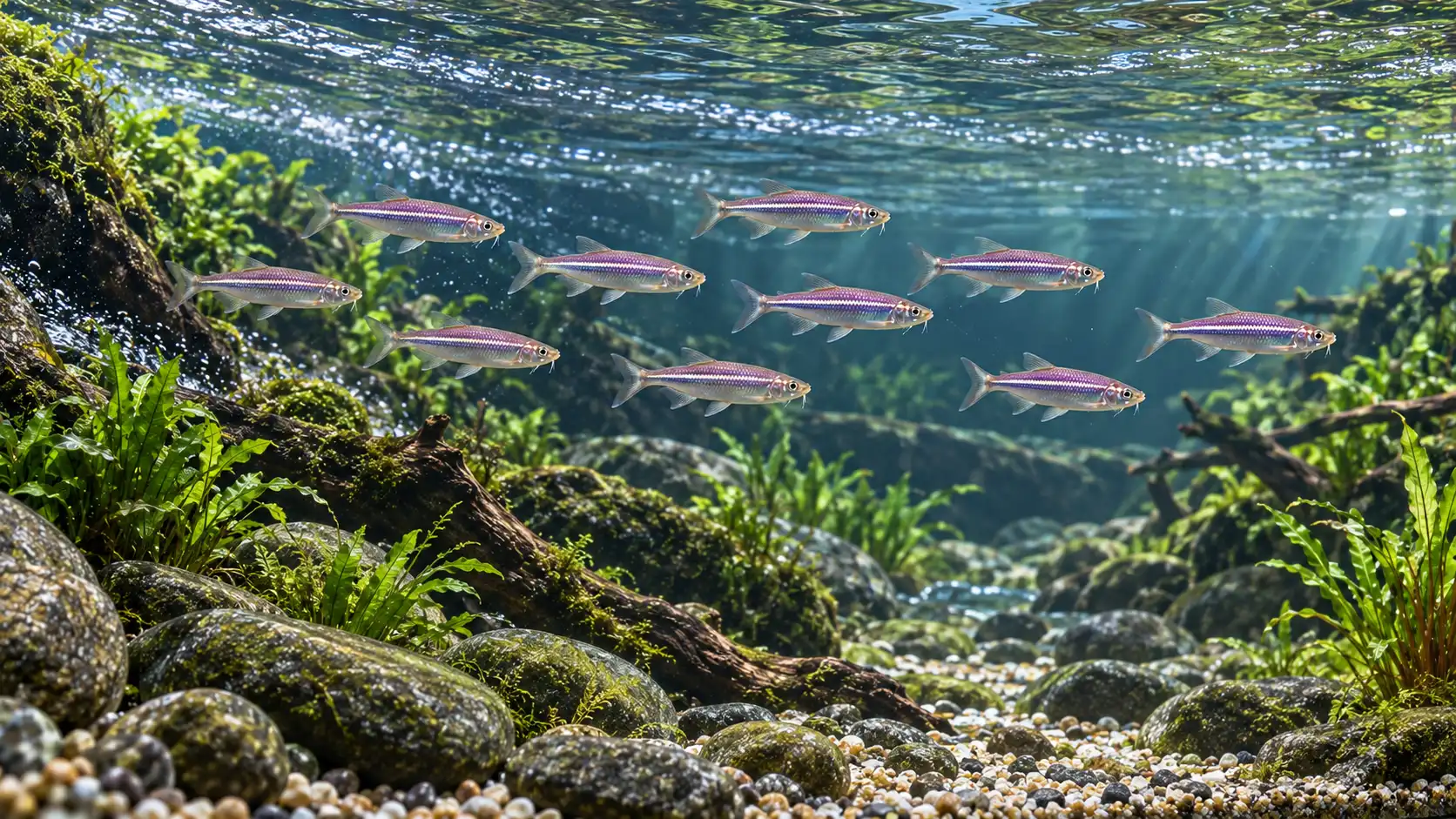
A school is not a treatment for poor conditions. If several fish hold at the return, breathe rapidly, or stop using the tank, check temperature, oxygen, ammonia, nitrite, and actual flow before changing the group size.
What water and flow suit pearl danios?
FishBase compiles 20 to 25 °C, pH 6.0 to 8.0, and 5 to 19 dH. The broad chemistry range makes source-water stability practical, while the stream record makes oxygen and usable current especially relevant.
Published pearl danio water context
- Temperature20 to 25 °CSeparate aquarium thermometer away from heater and return.
- pH6.0 to 8.0 pHCalibrated meter or liquid test spanning source-water value.
- General hardness5 to 19 dHDrop-count GH titration test in degrees of hardness.
Every range above applies to Compiled species range in a freshwater system. Source: FishBase, checked 2026-09-15.
Current should create a route, not pin every fish to one end. Aim the return along the long axis, preserve a calmer margin behind wood or plants, and check the actual response after filter media begins to collect debris.
Cooler water can hold more oxygen, but temperature alone proves nothing about gas exchange. Maintain a visible surface ripple and investigate group-wide rapid breathing promptly.
How can you map usable flow instead of pump output?
Pump ratings describe equipment under test conditions, not the current a fish experiences after lift height, pipe bends, clogged media, hardscape, and plant growth alter it. The useful map shows where water travels, where food drifts, and where a tired or subordinate fish can leave the main lane.
- Observe the surface Confirm broad movement and gas exchange without a violent splash concentrated in one corner.
- Release a tiny food particle Watch its path through the upper and middle water before fish take it.
- Check behind hardscape Find still pockets that collect waste and calm pockets fish can actually enter.
- Watch the full school Healthy fish should choose both current and refuge rather than being pinned at one end.
- Repeat after maintenance Compare the route before and after media cleaning or plant trimming.
- Use behaviour as a stop condition Reduce or redirect flow if fish cannot hold position, feed, or rest.
A calm refuge is useful only when its entrance remains open and food can reach it. A cave behind the strongest jet may look sheltered while forcing a fish to cross the most demanding water every time it leaves.
Map the tank again as plants grow and media loads with debris. Flow is a changing property of the whole layout, so one turnover calculation cannot replace observation.
Which aquarium layout matches their movement?
A hill-stream-inspired layout can combine rounded stones, branchy wood, tough plants at the margins, and a long central channel. It should suggest running water without filling the footprint with rock or turning the whole aquarium into one high-velocity jet.
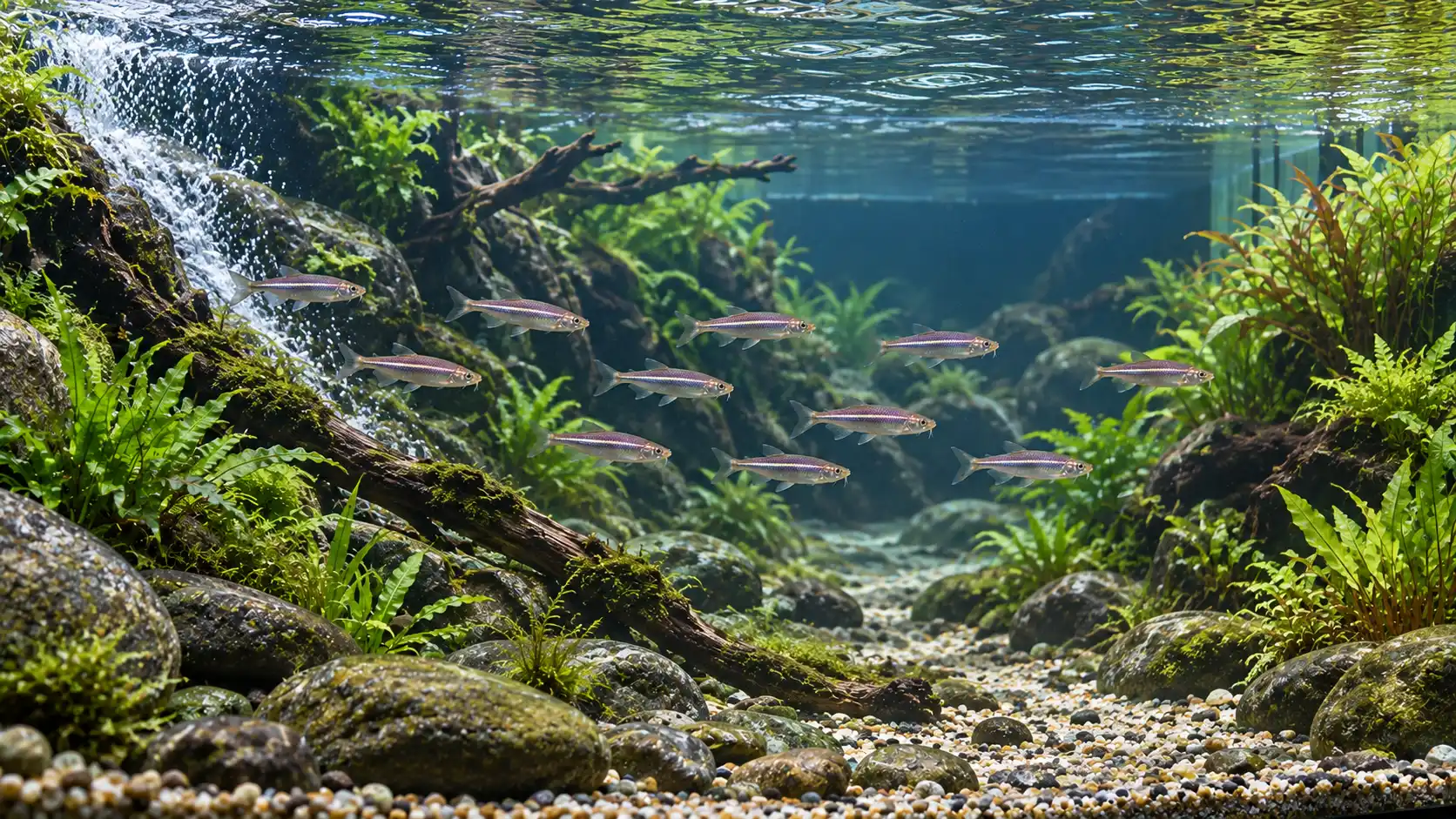
Long flow lane
Water and fish travel along the length rather than into the front glass.
Calm refuge
One planted margin lets tired or subordinate fish leave the main current.
Rounded hardscape
Stones shape flow without sharp collision points.
Open upper water
The school can feed and accelerate without striking branches.
Secure cover
Lid gaps around pipes and cables are closed.
Service access
The intake, substrate edges, and trapped-debris zones remain reachable.
Flow falls as a filter clogs. Judge circulation from plant movement, surface ripple, debris accumulation, and fish distribution rather than the number printed on a clean pump.
What do pearl danios eat?
FishBase records terrestrial insects and some zooplankton, consistent with a fish that often takes food near the surface. Use a complete small pellet or flake as the staple, supplemented with suitable floating or slowly sinking invertebrate foods.
Fast fish can look hungry immediately after eating. Portion from body condition, waste, and water trend rather than the speed of the first feeding rush.
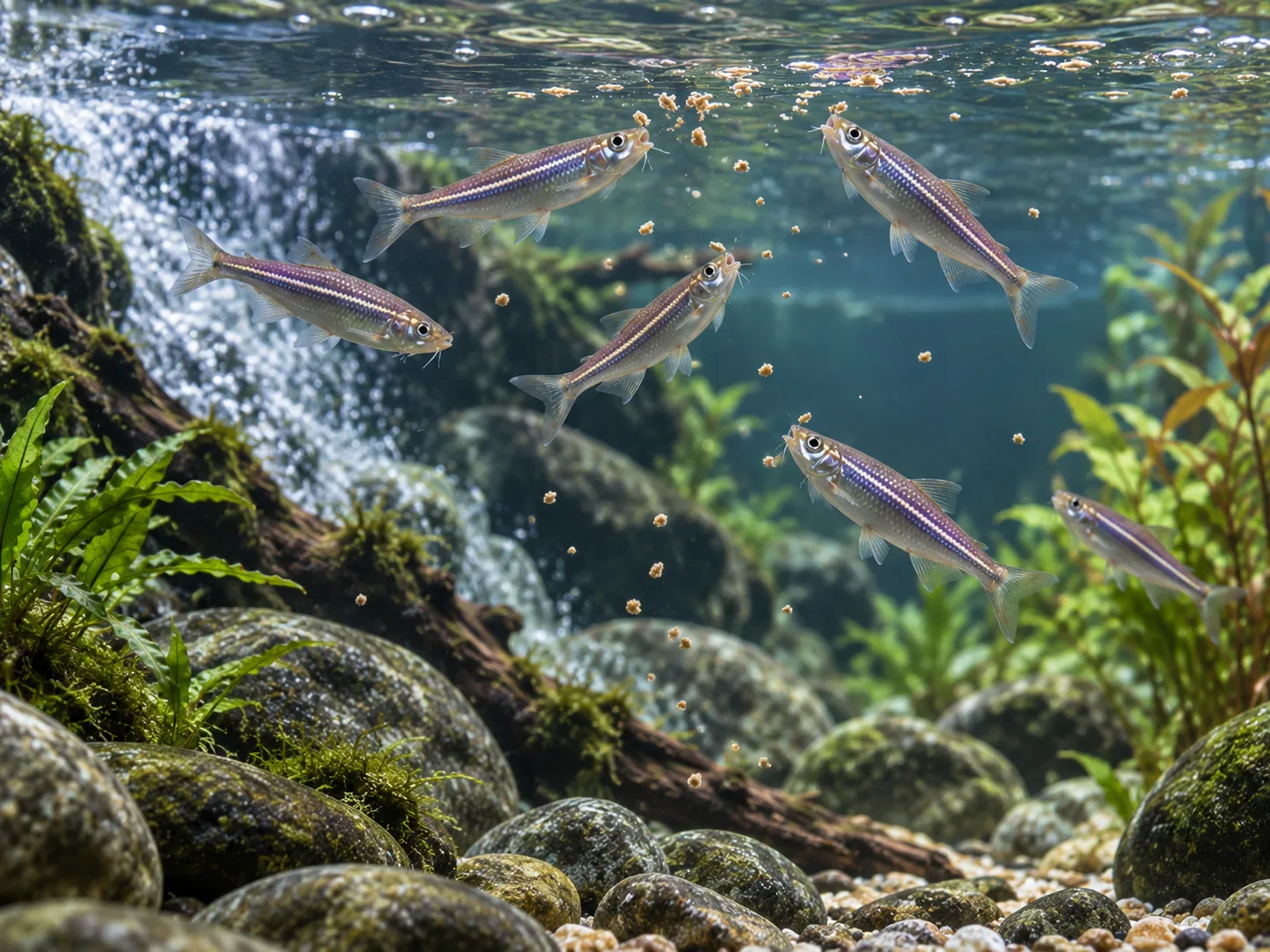
- Start along the flow lane Scatter small food so the current distributes it.
- Feed a second calmer point Give subordinate fish a route that avoids the main rush.
- Check particle size Every piece should be swallowed without repeated rejection.
- Stop before the substrate receives a meal Sinking excess becomes waste, not enrichment.
- Review each week Adjust from body shape, nitrate trend, and filter loading.
Surface insects can add variety when they are safely cultured and appropriately sized. Wild-collected insects can carry pesticides, parasites, or contaminants and should not be assumed safe because they are natural prey.
How do you protect slower fish from a pearl danio feeding rush?
Pearl danios reach drifting food quickly and may continue searching after they have eaten. Slow companions can lose condition without visible aggression when every meal begins in one exposed upper-water spot.
Feed by route rather than by volume. Start a small portion along the danio flow lane, then place a second appropriate food where slower fish normally emerge; adding one larger pinch only gives the fastest animals more time at the same queue.
- Choose food sizes each species can swallow immediately.
- Use separate positions or water levels instead of one feeding ring.
- Watch a named slow individual through the complete meal.
- Stop when food begins reaching the substrate unintentionally.
- Review body condition weekly rather than responding to begging.
- Remove a persistently excluded fish before severe wasting develops.
- Reconsider the community if separation works only when the danios are overfed.
Sinking food is not automatically protected. Active danios may follow it downward, and bottom fish still need enough time to locate their own ration before it disappears under hardscape or into the filter.
If every resident cannot eat an appropriate amount without excess food accumulating, the problem is the community plan or feeding layout. More food raises waste and oxygen demand while leaving the original competition intact.
Which tank mates can keep pace?
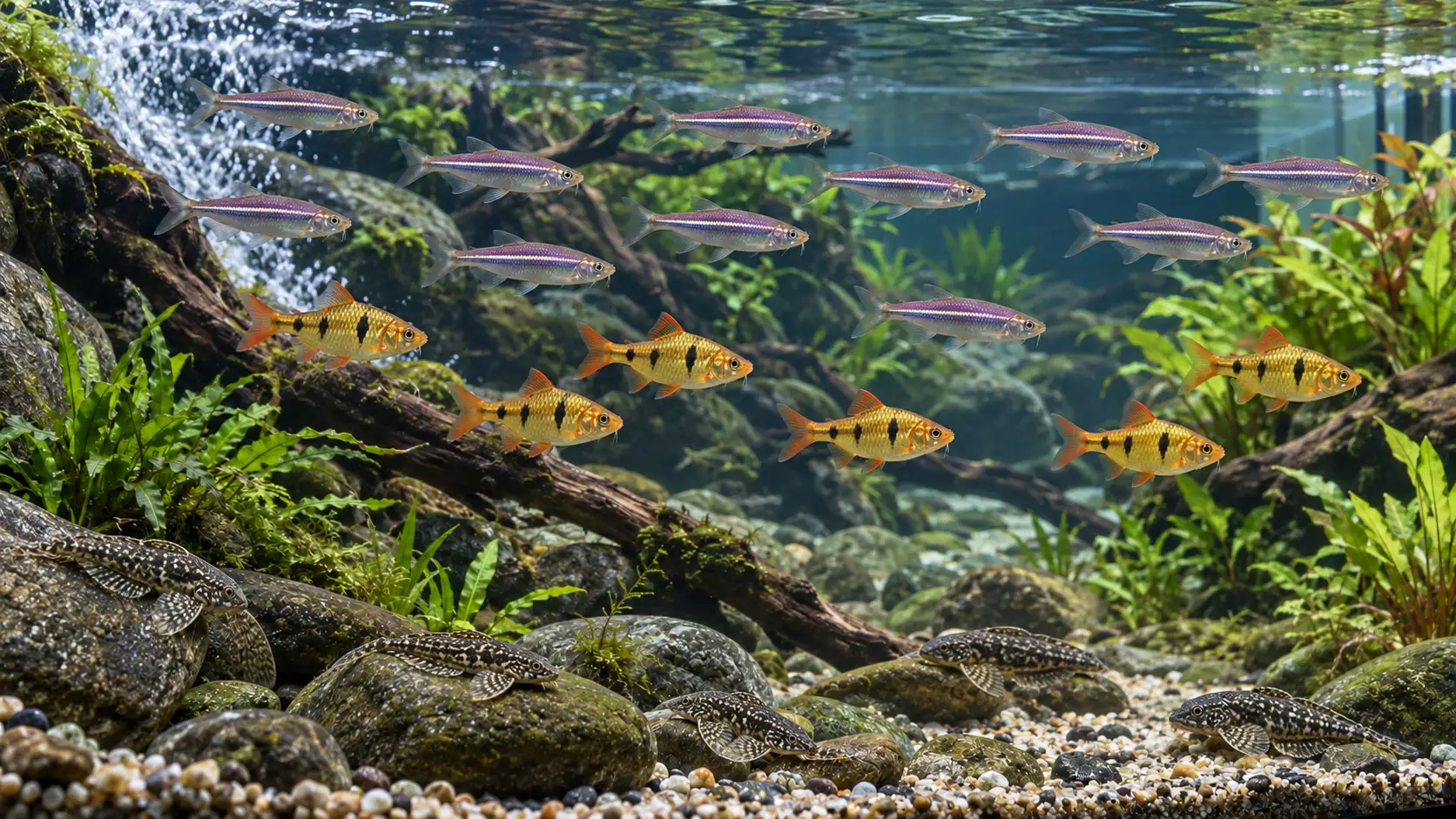
Tank mates should tolerate the same temperature and flow, be too large to swallow, and remain confident around constant movement. Slow, long-finned, or very timid fish may lose feeding access and open-water use even when the danios show no direct aggression.
| Decision | Better match | Poor match |
|---|---|---|
| Pace | Active, confident fish | Slow or long-finned fish that withdraws |
| Temperature | Comfortable at 20 to 25 °C | Requires sustained high tropical heat |
| Flow | Can use current or reach a calm refuge | Is blown away from food and resting sites |
| Adult size | Cannot swallow or be swallowed | Predatory mouth or fry-sized body |
| Feeding | Eats in a separate zone or current | Depends on leftovers after the danio rush |
| Space | Every group retains a route | Several active schools share one short tank |
Gold barbs may match the active temperament in a sufficiently large tank, while giant danios need substantially more room. Celestial pearl danios are much smaller and use dense cover differently, so the shared word “pearl” is not a compatibility reason.
Bottom fish need more than an unused vertical zone. Their temperature, oxygen, substrate, group size, and access to sinking food must all remain suitable after the danios have fed.
When does fast swimming indicate stress?
Healthy pearl danios cruise, sprint briefly, respond to food, and use both current and calmer water. Continuous frantic laps, surface gulping, clamped fins, collisions, isolation, or loss of balance are not ordinary activity.
Check the shared system first
- Temperature and oxygen Verify the thermometer, surface ripple, filter return, and recent heat.
- Ammonia and nitrite Test after stocking, filter maintenance, a power cut, or group-wide change.
- Current pattern Confirm fish can leave the high-flow lane without being trapped.
- Social access Watch whether one animal is excluded from the group or both feeding points.
- Contamination Review sprays, soap, metals, untreated water, and shared equipment.
Several fish showing respiratory distress at once requires immediate water and oxygen checks. Persistent distress, bleeding, sores, major swelling, abnormal posture, or continuing losses requires an aquatic veterinarian rather than a diagnosis based on swimming speed.
How long do pearl danios live and how do they breed?
The accessible authoritative records used here do not establish a dependable aquarium lifespan. Plan for several years, keep acquisition and health records, and treat long-term swimming ability and body condition as more useful than a promised maximum age.
Pearl danios scatter eggs and provide no parental care. Dense fine plants may allow occasional fry to escape adults, but a deliberate project needs separate egg protection, tiny first foods, and space for a rapidly growing group.
Is a pearl danio right for your aquarium?
Pearl danios suit a mature, covered aquarium at least 90 cm long with eight or more fish, an oxygenated flow lane, a calmer refuge, and robust companions. They are a poor choice for a short cube, a very warm slow-water community, or a display built around timid long-finned fish.
- The aquarium provides at least 90 cm of uninterrupted length.
- Eight to twelve adults fit before tank mates are counted.
- Flow travels along the tank and includes a calmer refuge.
- Temperature and chemistry overlap without holding another species at an extreme.
- Two feeding positions let every fish eat.
- The lid closes around every cable and pipe gap.
- Quarantine is ready, and no fish or aquarium water will be released outdoors.