
How to Avoid Feeding Competition in a Community Tank
To avoid feeding competition, put food where each animal feeds, in pieces it can swallow, at the time it is active, and scatter it at two points so no single fish can guard it. Then watch the weakest feeder in the tank, because if it still loses out after those changes, the problem is the mix of animals rather than the way you feed.
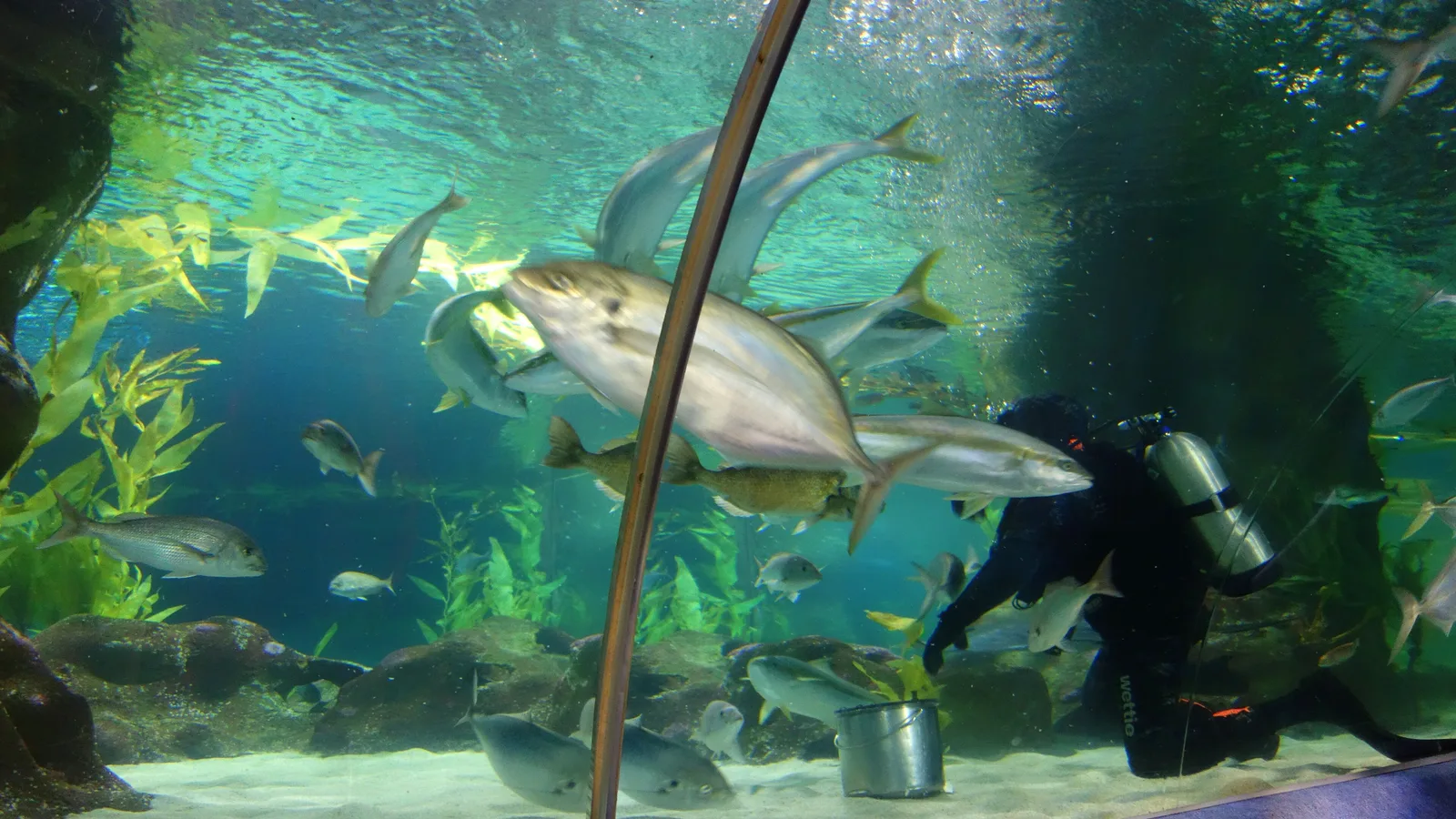
What does feeding competition look like during a feed?
Watch who actually captures and swallows food throughout the feeding period, including after dark for nocturnal animals. A busy feeding response at the front of the tank can hide an individual that gets nothing.
In a tank where every animal eats, the fastest fish take the first mouthfuls, then the group loosens and slower fish feed at their own level while food is still there.
Exclusion rarely looks like a fight. One or two fish, often the largest or boldest, stay where the food arrives and keep turning back to it, while a smaller fish waits at the edge, darts in, and leaves with nothing.
| Decision factor | Every animal eats | One animal is losing out |
|---|---|---|
| First minute | Fast fish take the first food, then the group spreads out | The same fish hold the landing spot for the whole feed |
| Shy or slow fish | Reach suitable food in their preferred feeding zone | Hover at the edge, dart in, and retreat without food |
| Bottom animals | Find sinking food before it disappears | Get only crumbs, or search the gravel once the tank goes quiet |
| Chasing | Brief nips that stop once food is spread | Repeated chases aimed at one fish, sometimes well away from the food |
| Leftovers | Little food reaches the gravel uneaten | Food is left over while one fish is still thin |
| Body shape over weeks | Every fish keeps a full, even outline | One fish grows slimmer or falls behind in growth |
Compare each fish with its own usual appetite and body condition, allowing for species and life stage. Repeated exclusion or declining condition needs attention when noticed; do not wait weeks for obvious thinness.
In coho salmon fry, localized feeding produced greater size variation under low rations than dispersed feeding, but not under high rations (Ryer and Olla). Chasing frequency did not differ overall, so better access to food cannot be assumed to eliminate aggression.
Which part of the water column does each animal feed in?
Most community fish feed at a preferred level, set by where the mouth points and how the fish swims. Food that lands outside that level reaches them late or not at all.
Surface
Fish with upturned mouths, such as the betta and many livebearers, can take floating food, but mouth shape alone does not determine every feeding choice.
Midwater
Tetras, rasboras and danios intercept food as it sinks, and a fast school can empty the water column before anything reaches the bottom.
Bottom
Corydoras catfish and loaches search the substrate by touch and taste, so they need food that actually arrives there.
Grazing surfaces
Plecos, otocinclus, shrimp and snails pick at wood, glass and leaves, and many of them feed slowly or after dark.
Platies take much of their food at the surface but will pick at the bottom, and a hungry midwater school follows sinking pellets all the way down, so the zones overlap more than a diagram suggests.
What matters is the fastest feeder, because it decides how much food gets past it. A school of pearl danios near the surface can catch almost everything before it sinks, which leaves nothing for the catfish below unless food is placed for them separately.
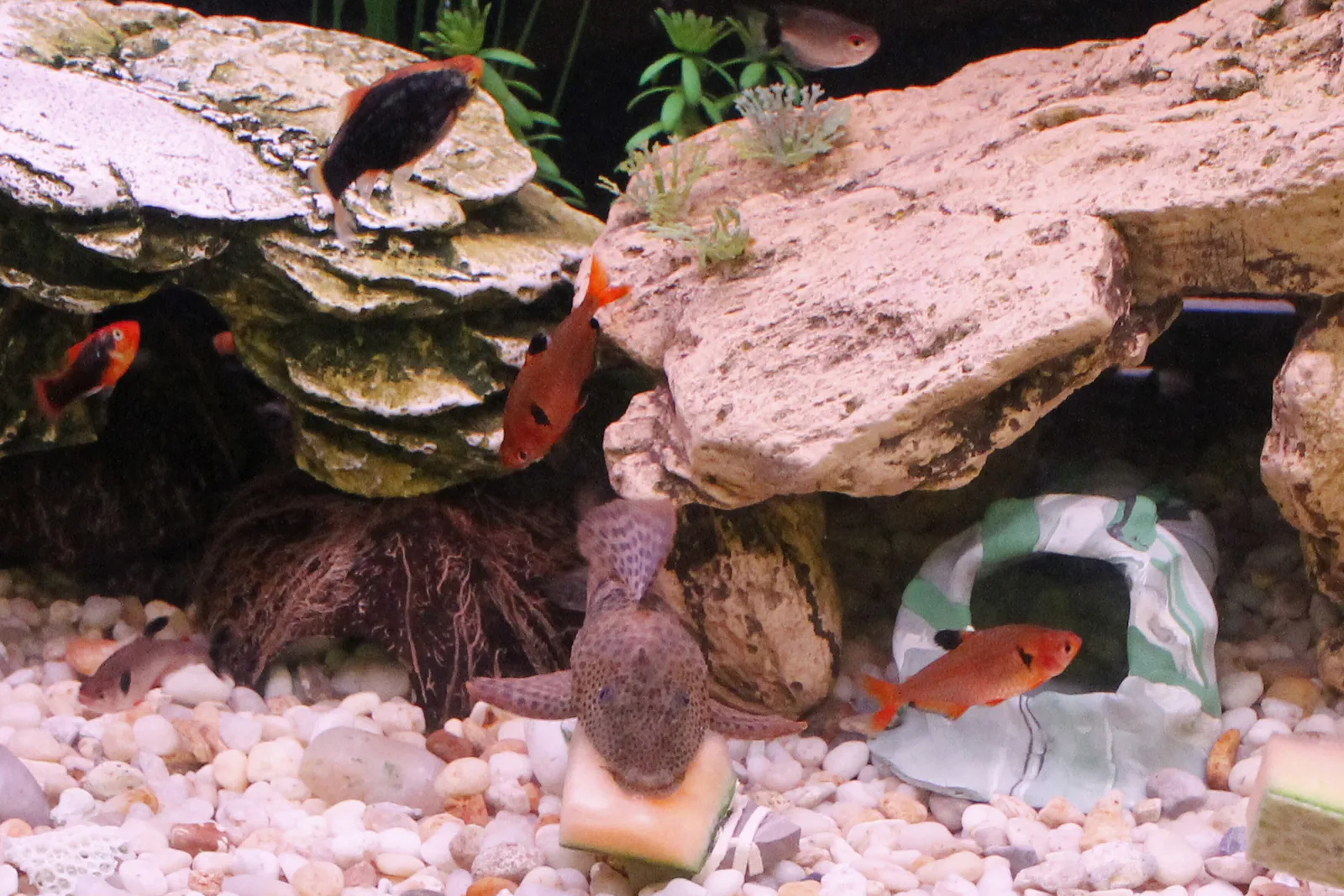
Food size and sink rate decide who gets fed
The form of a food decides where it ends up. UF/IFAS notes that flakes sink very slowly and that pellets can sink quickly unless they are extruded, so the same pinch reaches different fish depending on what it is made of (UF/IFAS).
| Food form | Where it goes | Who reaches it first | What to watch |
|---|---|---|---|
| Flake | Floats, then sinks slowly | Surface and midwater fish | Often eaten completely before any reaches the bottom |
| Micro granule | Sinks steadily through midwater | Midwater schools | Fast fish follow it down to the gravel |
| Sinking pellet | Drops quickly | Bottom fish, unless midwater fish catch it first | Pieces too large for small mouths are spat out |
| Tablet or wafer | Goes to the bottom and softens slowly | Catfish, loaches, shrimp and snails | Midwater fish may break it up; lift out what is left |
| Thawed frozen food | Drifts, then sinks | Every fish, fastest first | Loose pieces lodge in gravel and decay |
UF/IFAS also points out that the mouth gape of a small fish may not allow a larger pellet, while a larger fish may ignore a very small one, so a single particle size can feed one species and starve another.
Different suitable particle sizes offered at separate points can improve access for fish with different mouth sizes. Confirm that the smaller animals actually swallow food rather than assuming the larger fish leave their portion alone.
The comparison between flake food and pellet food is less about quality than about placement. A good flake that never reaches the bottom is still the wrong food for a corydoras.
How do you feed a community tank so every fish eats?
The water comes first, because a fish that holds back at feeding time may be reacting to ammonia, nitrite or low oxygen rather than to a tankmate, and a tank that is still going through the nitrogen cycle produces exactly that kind of listless feeder.
- Test the water first Check ammonia, nitrite, temperature and aeration; undetectable ammonia and nitrite alone do not rule out other water problems or illness.
- Choose one fish to watch Pick the smallest, slowest or most timid animal and follow it through every feed this week.
- Feed the fast fish at one end Scatter a small portion of flake across the surface at one end to draw the surface and midwater fish there.
- Feed a second point straight away While they are busy, drop sinking food at the far end or beside cover where the slower fish live.
- Match food to each zone Use flake or granule for the upper fish and pellet or tablet for the bottom, in pieces small enough to swallow whole.
- Scatter rather than trickle Put each portion in at once across a wide area, because food dribbled into one spot is the easiest to guard.
- Watch actual intake Confirm the chosen fish swallows its food; allow for species-specific grazing time and remove decaying excess.
- Feed after lights out if needed Give nocturnal and slow bottom feeders their own sinking ration once the tank is dark.
- Adjust from body shape each week Change amounts from how every animal looks, not from how hungry the fastest fish act.
A medaka experiment found that aggression within the feeding patch depended on how food was distributed in space and time (Robb and Grant). Whole-tank aggression did not follow every prediction, and the authors cautioned against straightforward extrapolation.
For a home aquarium, separate feeding points are a practical approach to test, not a guarantee. Keep the appropriate total ration and observe whether the previously excluded fish gains access without new chasing elsewhere.
A feeding ring follows the same logic in reverse. It keeps floating food in one small patch, which suits a single betta but concentrates competition when several fish share the tank.
OATA advises feeding only what fish can eat within a few minutes, once a day, and UF/IFAS names overfeeding as the most common mistake owners make, so the fix for one hungry fish is a better route to the food rather than more of it.
Animals that need a different feeding plan
Some animals lose out for reasons that spreading food in daylight cannot solve, so each of these cases changes when, where or how food goes in.
Catfish and loaches that feed after dark
The Merck Veterinary Manual states that bottom dwellers such as loricariids and corydoras are often expected to live on leftovers from other fish, that this is not acceptable, and that they need targeted feeding (Merck Veterinary Manual).
OATA adds that catfish need suitable sinking foods, and that grazing species may take up to 30 minutes to finish.
That time is the problem, because midwater fish clear their share in a few minutes and then start on everyone else's. Sinking food added shortly after the lights go off reaches kuhli loaches, corydoras and bristlenose plecos while the daytime fish are resting.
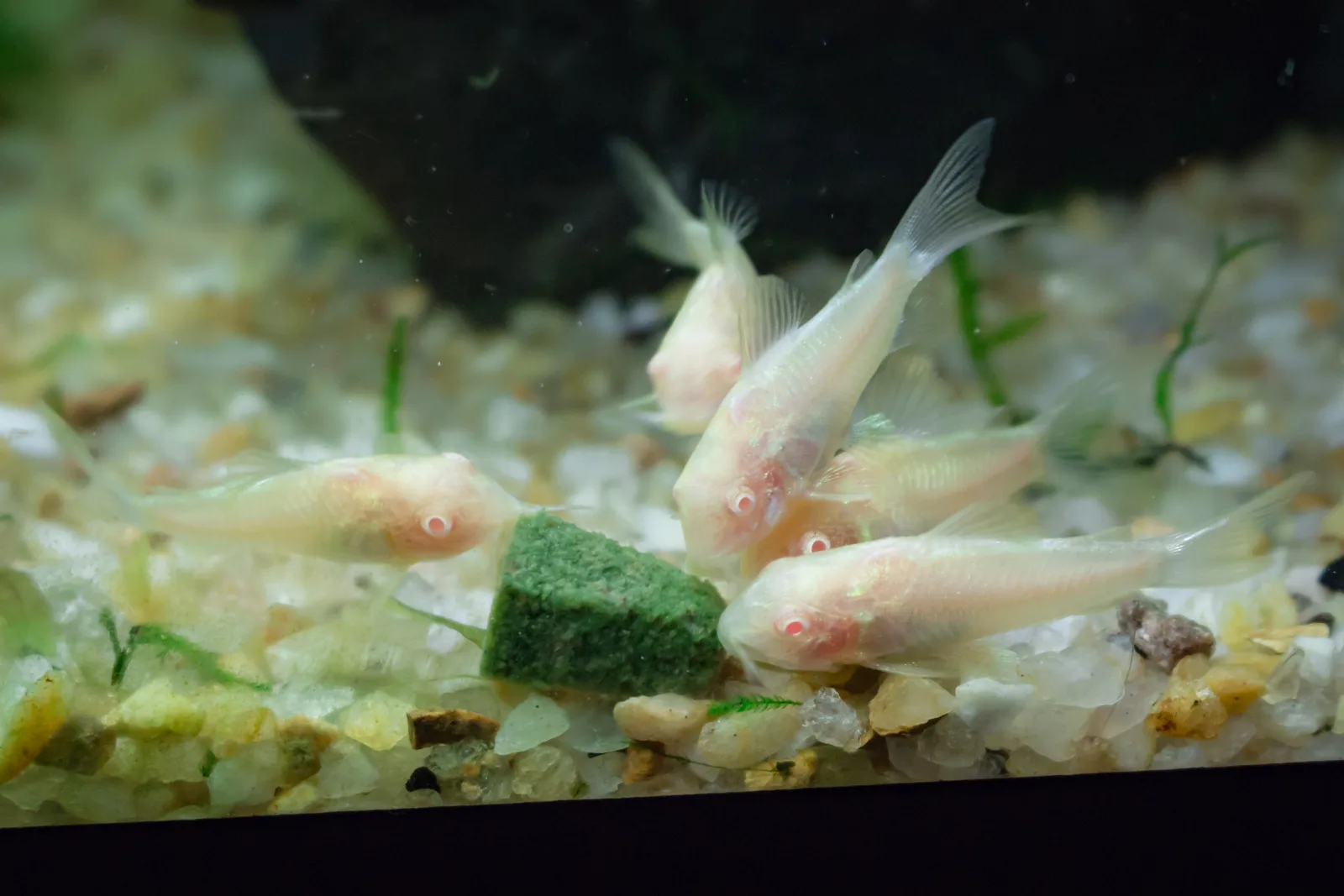
A dim room light, used briefly, is enough to check that the bottom fish found their food, whereas a bright torch every night disturbs the tank more than the check is worth.
Shrimp and snails
OATA suggests feeding freshwater shrimp and snails two or three times a week and leaving pellets or wafers for at least 30 minutes so they have time to eat. Most fish would finish that food long before the shrimp arrived.
In a mixed tank, shrimp food therefore works best after dark or placed inside dense plants where fish cannot easily follow.
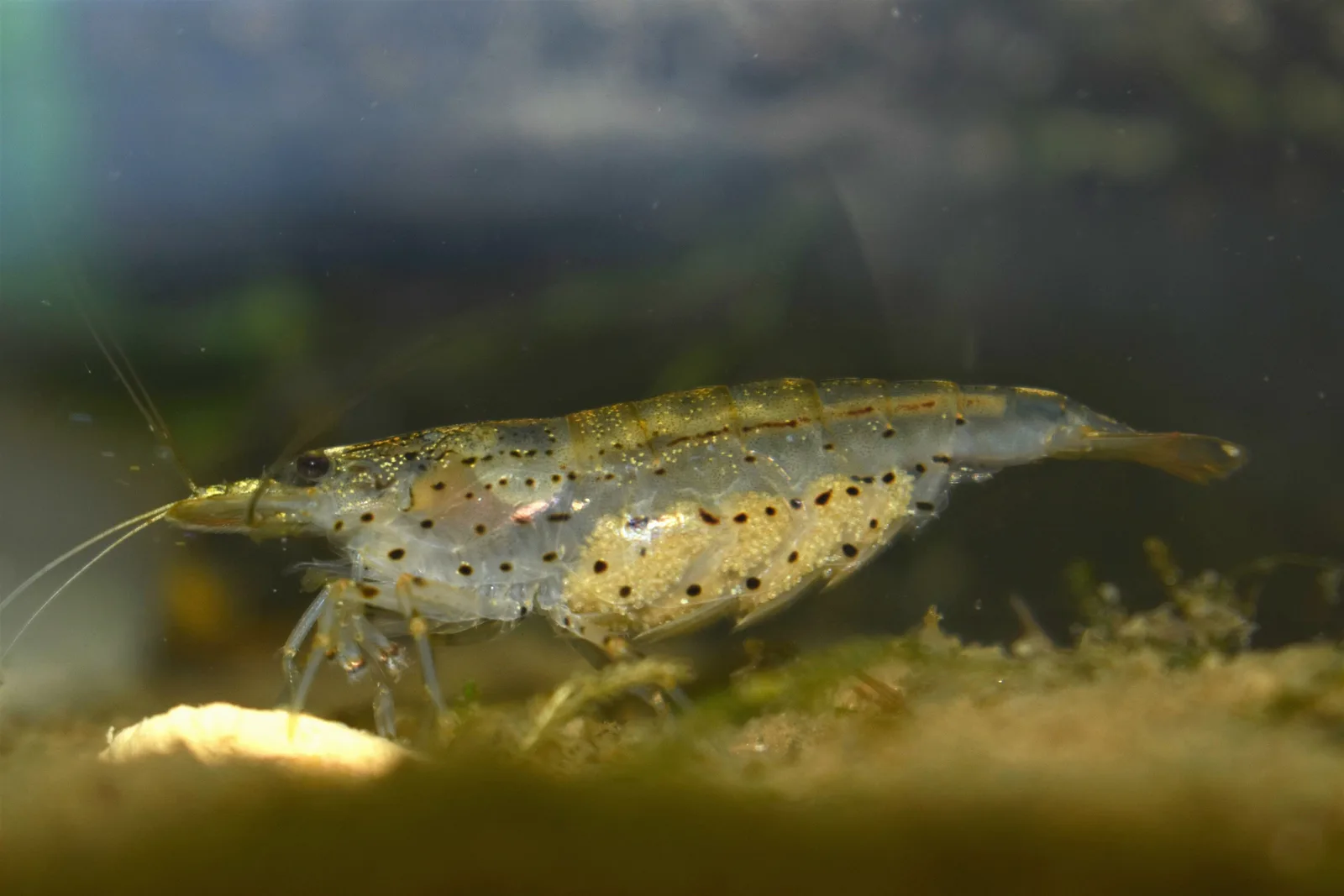
Among the shrimp themselves, larger Amano shrimp tend to reach food before smaller cherry shrimp, so a second small portion a short distance away helps the smaller animals.
A dominant or guarding fish
In paired trials with wild zebrafish, the males that took control of a food source also showed more aggression, and their aggression was linked to how fast they fed in an unfamiliar tank (Roy and Bhat).
A fast feeder may have more difficulty controlling several separated food patches, but watch the result rather than assuming it will settle. Territorial guarding of a cave or spawning site may persist independently of food placement.
Signs that chasing has become territorial aggression include torn fins, a fish pinned behind equipment, and pursuit that continues long after the food is gone.
A new arrival
A newly added fish does not know where food lands, and the residents do.
In public aquariums, species that do not accept pellet, flake or gel foods are often acclimated separately first, so keepers can confirm they are eating enough before they join an established group (Smith, 2023).
A home tank can do the same thing on a smaller scale, and quarantine is the natural place to confirm that a new fish takes the foods the main tank uses. Once it moves in, it becomes the fish to watch for the first week.
Fry in a community tank
Small fry are easily outcompeted, and some adult fish will eat them. Their feeding plan must account for mouth size, developmental stage and predation risk.
Cover can improve the survival chances of young mollies and platies, but plants do not guarantee safety or an adequate ration.
Suitable first foods for fry must reach the young where they feed and be small enough to swallow. A planned brood-rearing setup usually needs separation from predators and controlled feeding access.
How can you tell a shy fish is getting enough?
Watching one named fish tells you more than watching the whole group, because a tank where most fish feed well can still contain one animal that loses almost every meal, and that fish is easy to miss while the others crowd the front glass.
The Merck Veterinary Manual treats regular checks on whether fish are too fat or too thin as part of proper feeding, and a welfare review of public aquariums lists weight loss and changes in food intake among the signs worth recording, with observations made at night as well as by day.
- Watch the chosen fish take food during at least one full feed every day for a week.
- Look at its belly from the side a few minutes after feeding: it should look gently rounded, not hollow.
- Look down at its back just behind the head: a narrow, pinched outline suggests lost condition.
- Compare its condition with earlier observations of that individual; purchase date does not establish equal age or expected size.
- Check nocturnal bottom feeders after dark with a dim light rather than assuming they found food.
- Note whether thinness comes with clamped fins, faded colour or fast breathing, which makes it more urgent.
A shy fish that hides at every feed may not be shy at all. Persistent hiding can come from water quality, lighting or a tankmate, and the cause determines whether a feeding change will help.
Feeding habits that make competition worse
The habits that cause the most trouble look reasonable at the time, and they either concentrate food where one fish can control it or hide the fact that one fish is losing out.
| Habit | Why it backfires |
|---|---|
| Adding more food when one fish looks thin | The fast fish eat most of the extra, leftovers raise ammonia, and the thin fish still waits |
| Feeding in the same corner every time | A fixed landing spot is the easiest place for one fish to guard |
| Relying on leftovers for bottom feeders | Crumbs that pass the midwater school are not a planned diet for a catfish |
| Offering one pellet size only | Small mouths cannot swallow large pieces, and large fish may ignore small ones |
| Judging hunger by begging | The fastest fish always look hungry, even straight after eating |
| Feeding shrimp with the lights on | Fish finish in minutes, while shrimp need a much longer time with their food |
Overfeeding carries a cost of its own, because uneaten food decays and pushes ammonia up between water changes.
Learning to prevent overfeeding protects the whole tank, and a larger water change volume should never become the routine answer to food left behind by a competition problem.
When is feeding competition a stocking problem?
Persistent exclusion after suitable food is offered at accessible points may indicate an incompatible mix or inadequate space. A fish that still does not eat also needs water-quality and health assessment; failed feeding adjustments do not prove a stocking problem.
A fish kept in too small a group can direct more chasing at other species, and schooling fish group size changes how much of that chasing spills onto the rest of the community.
A fish that eats yet loses weight needs investigation beyond food placement. Merck lists emaciation as one possible sign of mycobacterial disease, but appearance alone cannot identify this or any other cause.
Contact an aquatic veterinarian promptly for continuing weight loss or unexplained refusal of food. Gasping, loss of balance, rapid deterioration or deaths require urgent help alongside immediate water-quality and aeration checks.
There is no universal safe waiting period of several days for a fish not eating; fry and already weakened fish may deteriorate sooner. Avoid sharing equipment or transferring a suspect fish into a healthy group while the cause is unresolved.