
First Foods for Fish Fry: What to Feed and When
The right first food is small enough to enter the fry's mouth, moves or remains suspended where the fry can find it, and is available as soon as free swimming begins. Match food to development and feeding behavior, then protect water quality with tiny portions and frequent observation.

When should fish fry receive their first food?
Newly hatched larvae often rely initially on a yolk sac, but external feeding can begin before that reserve disappears. Follow the species' developmental feeding stage, including mouth opening and feeding behavior, rather than waiting for complete yolk absorption or a fixed day after hatching.
Species differ widely.
Some livebearer fry can take finely crushed prepared food soon after birth, while small egg-layer larvae may need microscopic live food before they can capture brine shrimp nauplii.
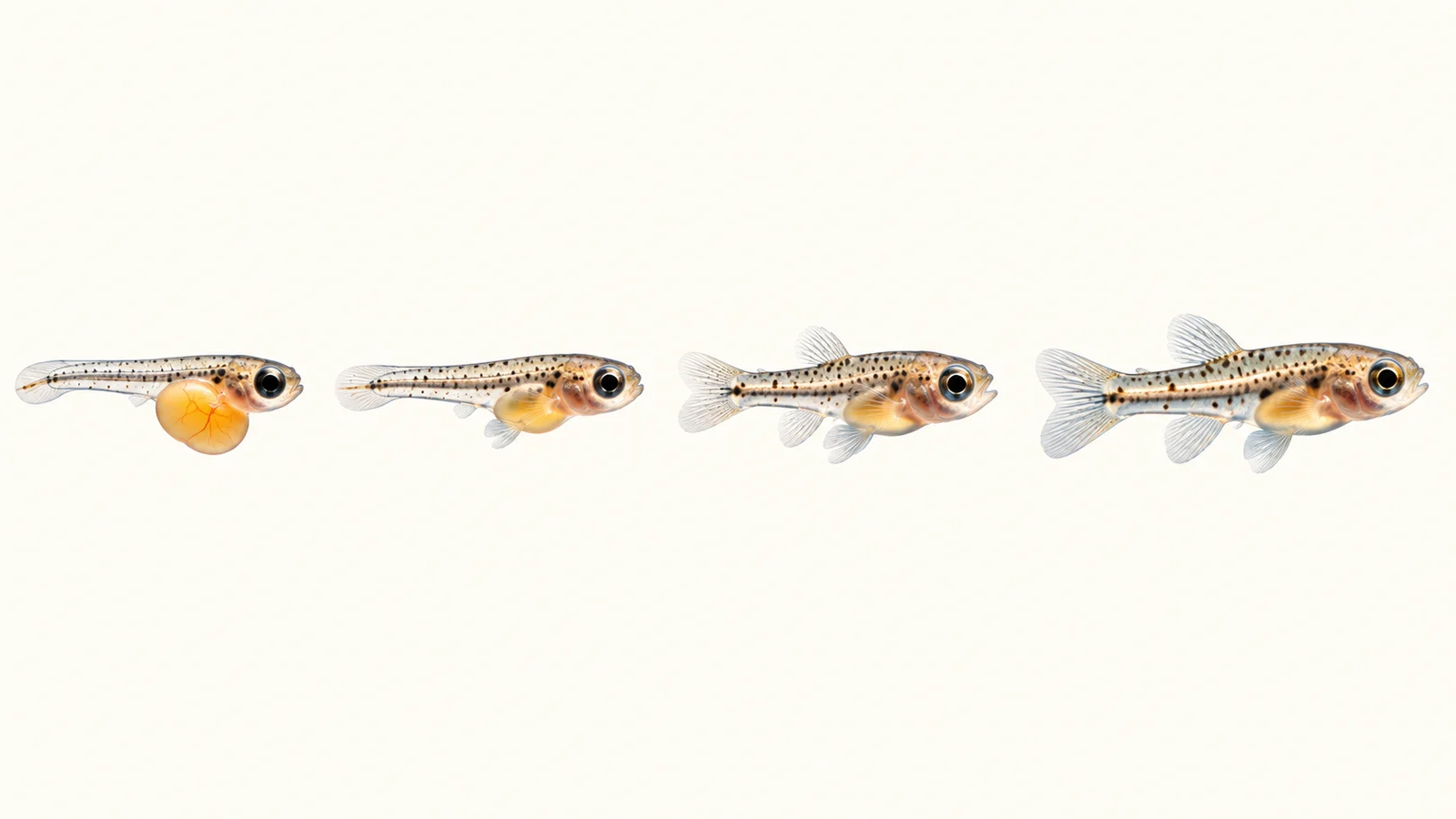
How do you match food to mouth gape?
Food must fit through the mouth opening, but size is only part of capture.
Fry also need to detect it, approach it and swallow it before the particle sinks, escapes or fouls the tank.
Appropriately sized cultured protozoans or rotifers can feed some small larvae; newly hatched brine shrimp suit fry large enough to capture them. Microalgae may feed the live prey or support a green-water method, but green water alone is not a complete first diet for every fish.
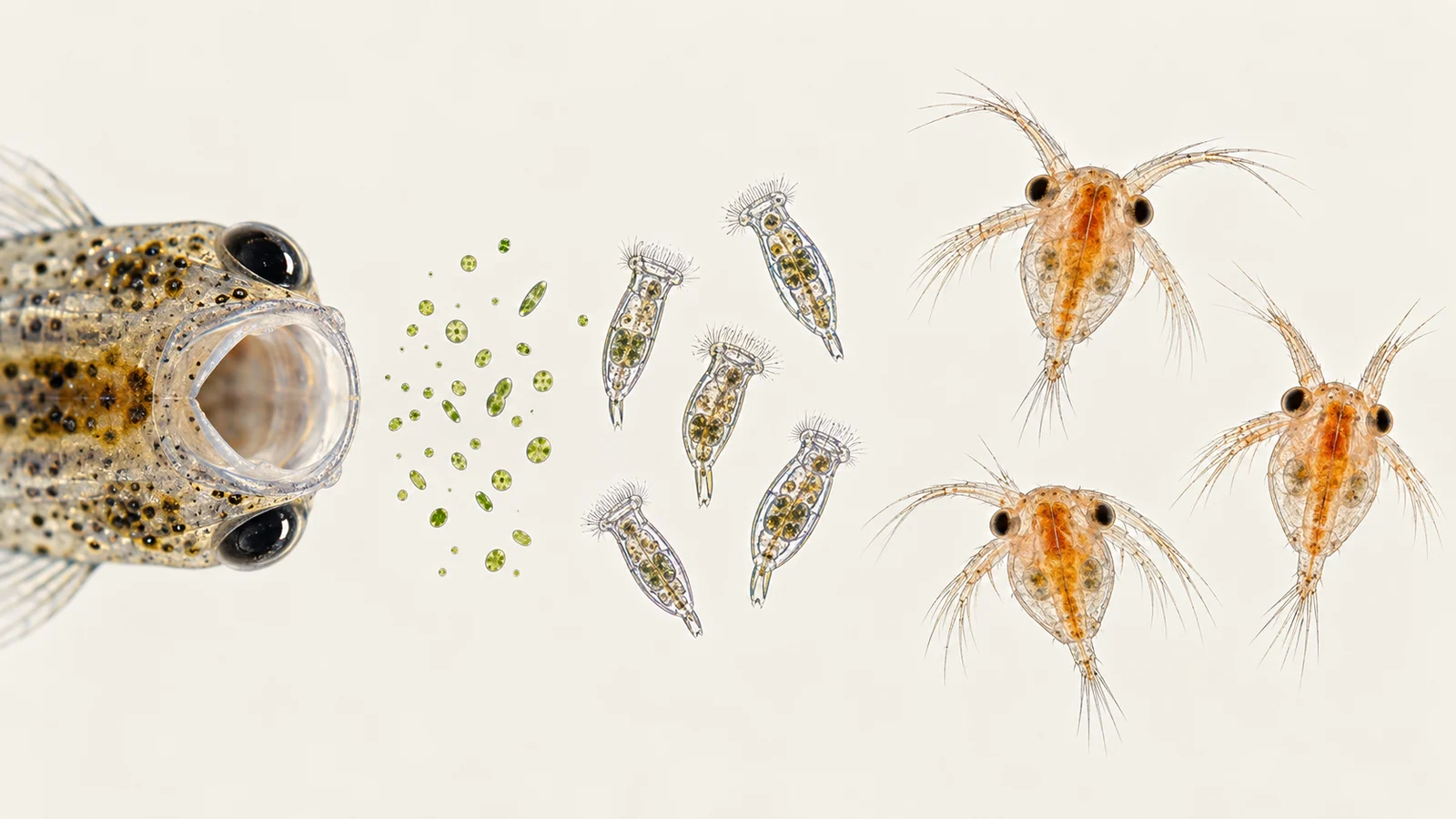
Which first food fits which fry?
| Fry state | Useful starting food | Main check |
|---|---|---|
| Very small free-swimming larvae | Rotifers or appropriately cultured microscopic live food | Food remains within capture distance |
| Small egg-layer fry | Species-appropriate cultured prey or a proven larval diet | Confirm swallowing and nutritional suitability, not just a cloudy suspension |
| Larger fry and many livebearers | Fine prepared food and brine shrimp nauplii | Particles fit and are swallowed |
| Growing fry | Graded crumble, live food and species-appropriate diet | Growth is even and weak fry still reach food |
Do not use "egg layer" or "livebearer" as the entire feeding plan. Adult size, larval size, mouth orientation and whether fry feed near the surface, midwater or bottom all change delivery.
How often should you feed?
Small fry have limited reserves and may benefit from several small opportunities across the day.
A cloud of excess food left between feedings creates bacterial growth and oxygen demand, so frequency never excuses a large portion.
You can offer an amount the group begins capturing immediately, then inspect bellies and remove settled excess. Adjust one variable at a time: food size, density or frequency, not all three after one weak feeding.
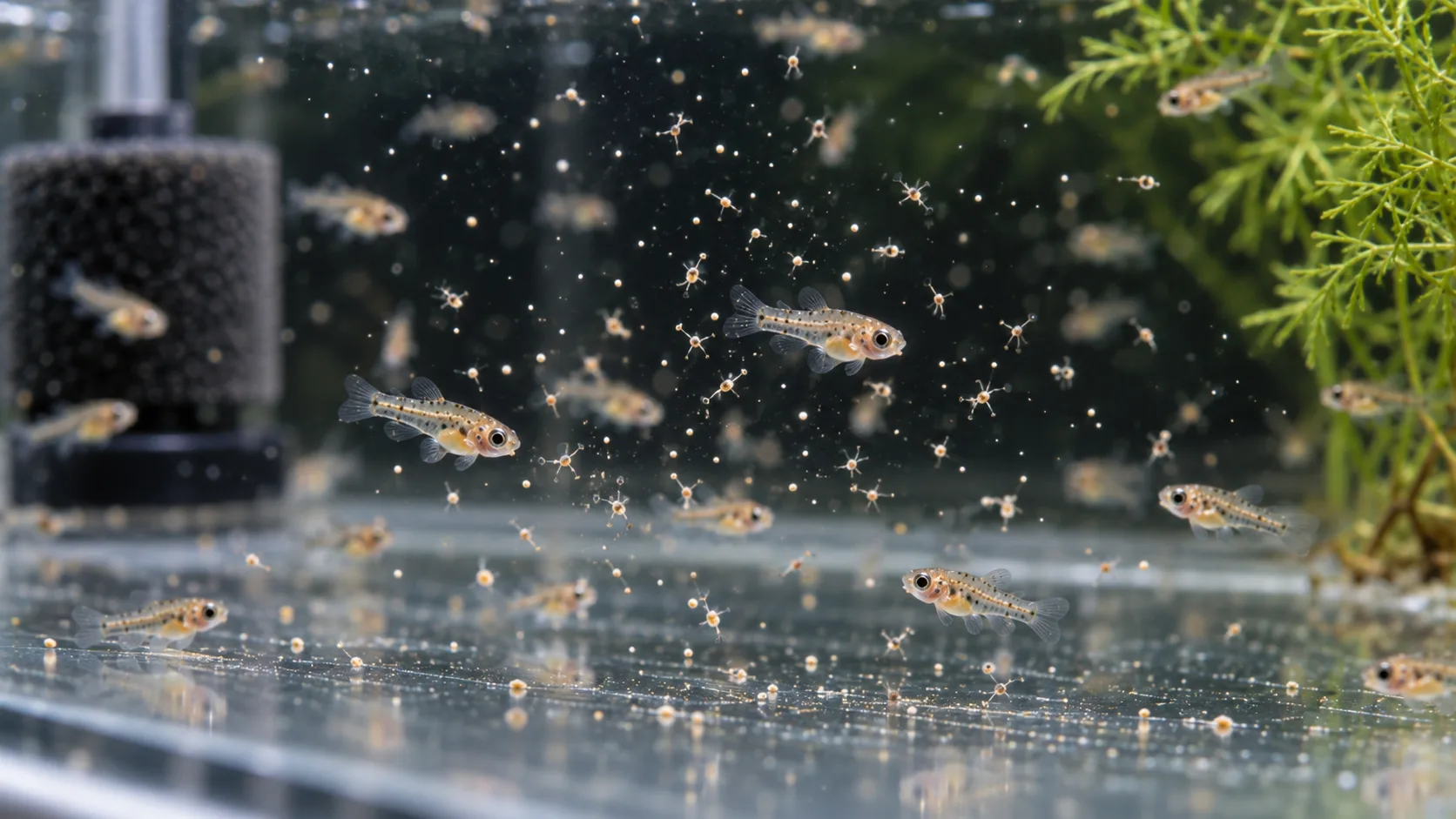
What is co-feeding, and when should you use it?
Co-feeding means overlapping the established live food with a new prepared diet. The overlap lets fry learn a new texture without losing every familiar feeding opportunity on the same day.
You can start with a very small prepared portion while continuing the food that produced filled bellies.
Increase only after most fry take the new particles. A calendar date cannot prove that the smallest individuals have transitioned.
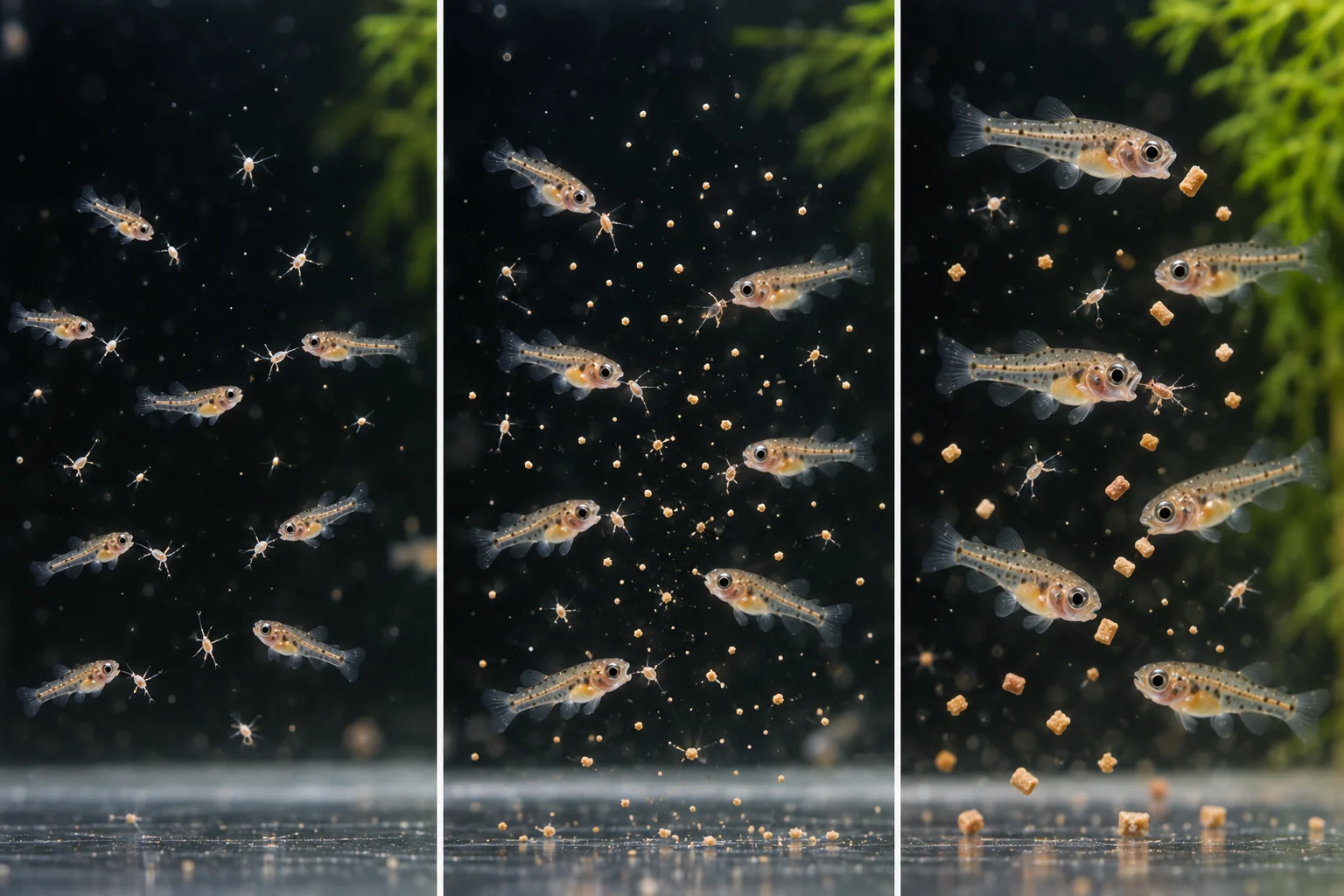
- Confirm the species-specific first-feeding stage; do not wait for all yolk to disappear.
- Offer the smallest suitable food across the water zone they use.
- Inspect several bellies under good light without prolonged handling.
- Siphon visible waste without drawing in fry and replace removed water with matched conditioned water.
- Introduce the next food beside the accepted food rather than replacing it abruptly.
- Grade particle size upward as the smallest healthy fry can swallow it.
How do you protect water quality?
A mature, gentle biofilter helps process feeding waste; protect its intake so it cannot trap fry.
Keep oxygen exchange steady, remove dead food with narrow tubing and replace water with conditioned water matched closely for temperature and chemistry.
Cleaning every nursery surface and replacing all media together can remove established biological filtration. Preserve colonized media while removing waste, and use measured water quality to guide water changes.
[kna_callout type="warning" title="Fry can decline quickly"] If fry gasp, lose balance or die in clusters, seek aquatic-veterinary help promptly while checking temperature, ammonia, nitrite and aeration. Pause feeding during the immediate water-quality assessment; emergency water replacement depends on measured contamination and replacement-water conditions, not a blanket small-change limit.
Avoid moving affected fry into a healthy group or sharing their equipment. Food changes cannot correct unsafe water or diagnose disease. [/kna_callout]
Why do some fry grow faster than others?
Uneven access, genetic variation, hatching time and competition can create size spread.
Large siblings may monopolize food or prey on smaller fry, so distribute food, provide visual structure where appropriate and separate size classes before the gap becomes dangerous.
Track survival and growth across the group instead of judging success from the biggest fish; repeated losses or widening size differences need investigation.
How do you know the food is working?
Useful signs are prompt capture, gently rounded bellies, active swimming between meals and steady growth across most of the group.
Spitting, repeated strikes without swallowing, hollow bellies or food accumulating untouched mean the size, type or delivery zone is wrong.
You should review the smallest living fry, not only the easiest fish to see. A feeding plan is successful when the group can use it without the nursery becoming cloudy or oxygen-poor.
How do live foods differ in practice?
Rotifers remain suspended and reproduce under suitable culture conditions, which can keep prey within reach of weak swimmers.
Their value depends on culture quality, density and nutrition; culture water volume does not tell you how many prey entered the nursery. Marine larvae may require specifically enriched rotifers or other suitable prey, so successful rotifer reproduction alone does not prove nutritional adequacy.
Newly hatched brine shrimp nauplii are larger, conspicuous and nutritionally time-sensitive.
Harvest promptly, rinse away hatch water and shells, and offer only what fry can capture; unhatched cysts and empty shells should not be poured into the nursery.
Microworms sink and may suit fry that inspect lower water, while vinegar eels remain higher for longer. Prepared powders are convenient and consistent, but extremely fine dust can disperse beyond capture and become bacterial fuel, so the visible cloud is not proof that the fry ate.
How do you keep live food cultures dependable?
Maintain at least two separated cultures when fry survival depends on them.
A single overheated, contaminated or crashed container can remove the entire food supply within hours, exactly when newly free-swimming larvae cannot wait.
Label culture start dates and use dedicated pipettes, sieves and water. Smell and appearance can reveal a major crash, but observe prey density under magnification when the organism is too small to judge reliably with the naked eye.
Harvest without transferring fouled culture sediment. Feed the culture itself according to its method, split it before peak density and discard suspect cultures rather than using the fry tank as a test vessel.
What does a useful feeding log record?
Record time, food, approximate amount, water temperature, capture response, belly fill and any waste removed.
A short consistent log shows whether deaths follow a food change, whether morning feeding works better, or whether growth separates after one class of fry begins monopolizing prey.
- Before feeding
- Fry distribution, activity and water clarity
- During feeding
- Strikes, swallowing and which zone receives food
- After feeding
- Belly fill in several large and small fry
- Later check
- Settled waste, cloudiness and respiration
- Daily trend
- Survival, size spread and acceptance of the next food
Use magnification and brief gentle observation instead of netting fry repeatedly. Photographing the same small sample area can help compare growth, but it cannot replace checking individuals across the nursery.
How should portions change as fry grow?
Increase particle size before increasing total food whenever the existing particle has become inefficient to capture. Larger fry spend less energy per useful mouthful, while the smallest siblings may still need the former grade in a separate area or grow-out tank.
Reduce feeding density when food remains visible after the normal capture window. If the group clears food immediately but bellies remain hollow, reconsider particle size, nutrition and access rather than simply clouding the water more heavily.
Common first-food failures
- Waiting for a fixed day instead of observing yolk absorption and free swimming.
- Offering brine shrimp to fry whose mouth gape is still too small.
- Replacing an accepted live food with dry food in one feeding.
- Pouring culture water, shells and sediment into the nursery.
- Feeding one dense spot that only the largest fry control.
- Cleaning the biofilter aggressively after the water clouds.
- Keeping no backup culture for a food-dependent species.
How do you respond when fry are not eating?
You should confirm that the larvae are actually ready to feed, then observe the water zone directly in front of their mouths. Food on the bottom is unavailable to a surface-oriented fry even when plenty was added, and prey that is technically small enough may move too quickly or occur at too low a density to trigger capture.
Offer a small amount of the previous size class beside the proposed food and watch individual strikes. Repeated misses suggest size or movement is wrong; no orientation toward food suggests development, lighting, vision, stress or water quality needs review.
Do not respond by mixing every available food into the tank. That makes capture hard to interpret and increases decay, so test one suitable alternative in a clean observation window.
What should happen before fry move to a grow-out tank?
The receiving aquarium should follow a verified tank setup and be cycled, temperature matched and protected from unsafe intakes before the transfer begins. Confirm that its food reaches the same swimming zones and that current is gentle enough for the smallest fry, not just the average fish.
Keep incompatible size classes apart when larger siblings could injure or eat smaller fry. Use an appropriate gentle transfer method, minimize air exposure and do not transfer fish from a nursery with unexplained illness into a healthy system.
Continue the familiar food during the move, then change diet after fish resume normal swimming and capture. Transport, a new current and a new food on the same day create several causes for one loss of appetite.
Sources
FAO live food guidance Virginia Cooperative Extension rotifer guidance University of Florida IFAS live-feed guidance
Read next
Continue with ethical fish breeding, avoiding inbreeding and managing a breeding pair.