
What Is a Molly Fish, and Which Type Are You Buying?
Poecilia species and domestic hybrids
Molly is a trade name for several Poecilia species and domestic hybrids, so adult size and water needs cannot be read from colour alone. Identify short-fin or sailfin form, provide mineral-rich stable water, plan about two females per male, and account for fry before choosing the aquarium or community.
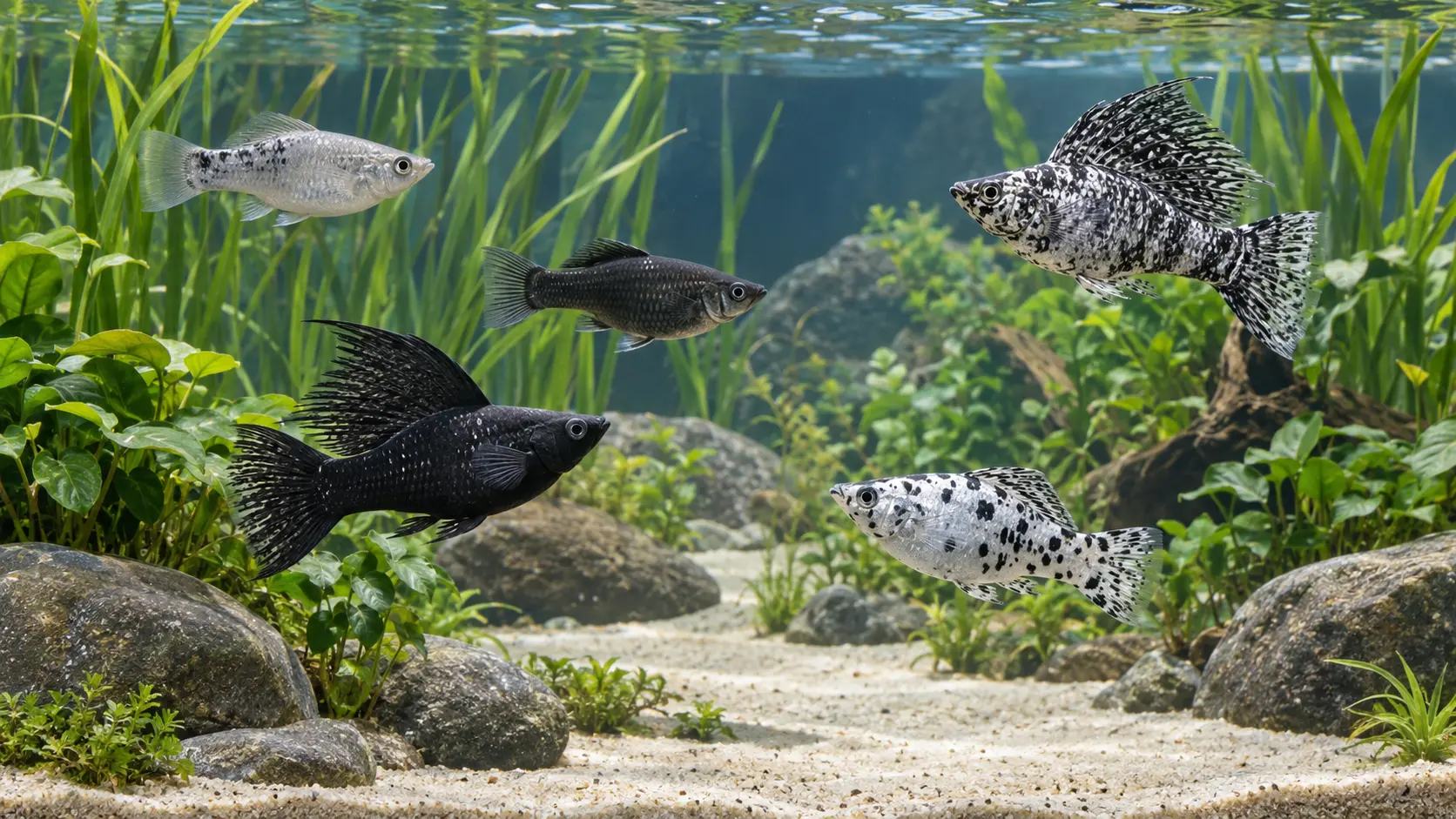
At a glance

- Adult size
- 7.5 to 15 cm
- Minimum footprint
- 75 cm or longer for common short-fin groups; 90 cm or longer for sailfins
- Minimum volume
- 80 litres
- Social structure
- Social livebearer; mixed groups need female-biased sex ratio
- Minimum group
- 3
- Sex ratio
- About two females per male when mixed
- Diet
- Omnivore
- Feeding
- Verify adult type and water history; plan about two females per male and reserve capacity for fry.
- Waste load
- moderate to high, especially with fry
- Family
- Poeciliidae
- Native range
- Parent species originate in fresh and brackish waters of the Americas
- Conservation status
- Species-specific; common parent species include Least Concern taxa Source
Adult body size, social structure, swimming behaviour, open routes, and filtration are considered together.
What does “molly” mean in the aquarium trade?
Molly is a trade name applied to several livebearing fishes in the genus Poecilia and to domestic stocks with mixed ancestry. A short-fin molly may be sold as Poecilia sphenops, while sailfin forms may involve P. latipinna, P. velifera, or hybrids, so colour alone cannot establish the species.
That ambiguity changes care. Common short-fin mollies often remain under 10 cm, while FishBase records male P. latipinna reaching 15 cm total length, and a tall sail fin needs more body condition and swimming room than a juvenile shop fish reveals.
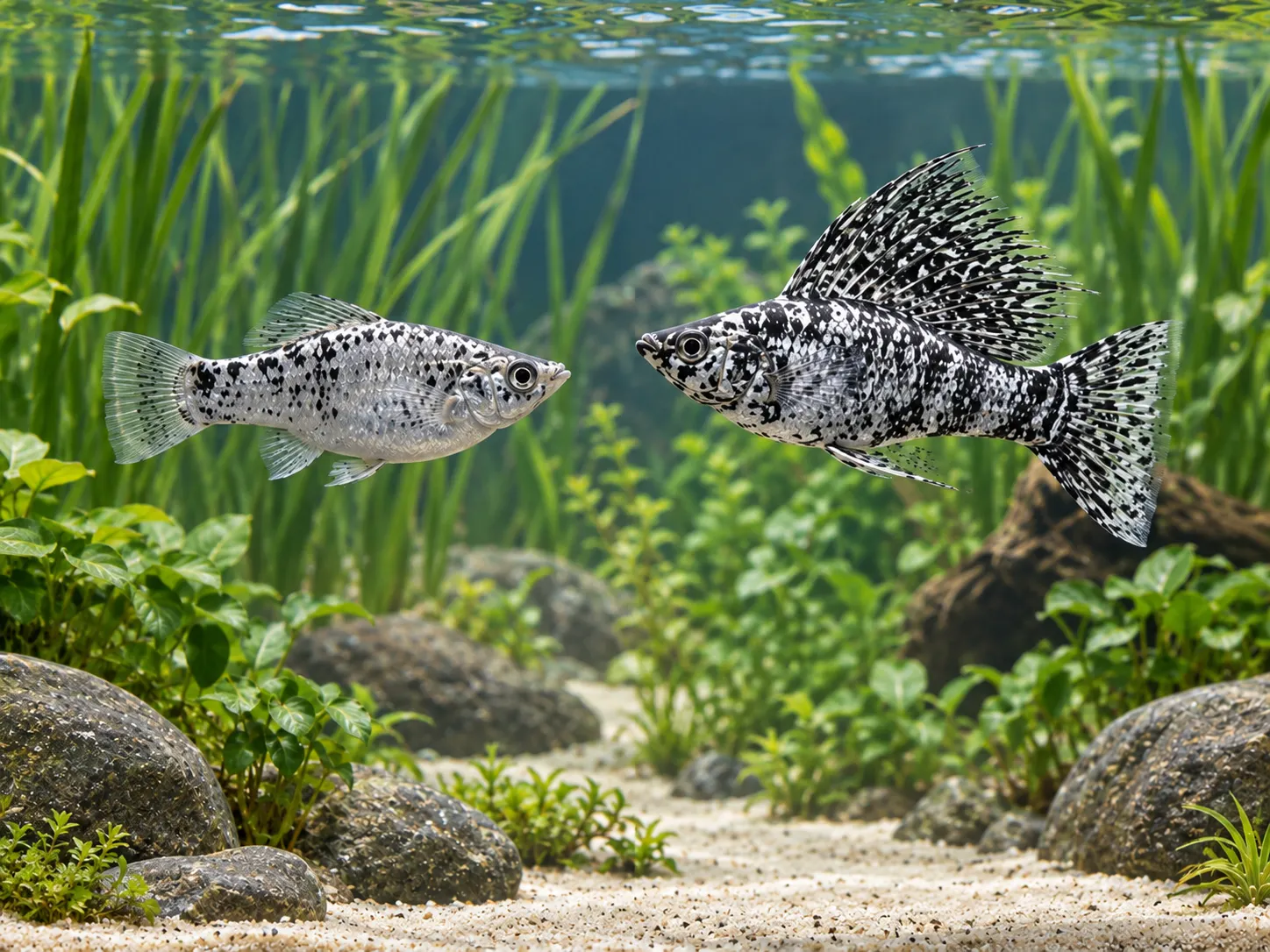
- Trade identity
- Several Poecilia species and domestic hybrids
- Common short-fin reference
- Poecilia sphenops
- Sailfin references
- Poecilia latipinna and Poecilia velifera
- Family
- Poeciliidae
- Adult size
- Common forms usually below 10 cm; sailfins can approach 15 cm
- Social plan
- At least three, with about two females per male when sexes are mixed
- Water tendency
- Medium-hard to hard, alkaline freshwater for common domestic groups
- Diet
- Omnivorous, with algae and plant material important
- Reproduction
- Livebearer with frequent fry possible
- Conservation
- Species-specific; P. sphenops and P. latipinna are listed as Least Concern
The U.S. Fish and Wildlife Service risk summary records the identification problem in ornamental stock, including fish beyond clear assignment to the original parent species. Ask the seller for the scientific name, adult form, and water in which the stock was raised, then keep any uncertainty in your own records.
Which molly type are you actually buying?
Short-fin, sailfin, lyretail, balloon, black, silver, gold, and dalmatian describe different kinds of information. Fin and body terms affect structure, while colour terms describe appearance; several may occur in one fish.
Deliberately shortened balloon bodies can have altered proportions and reduced swimming efficiency. Do not treat the shape as a cute miniature version of a standard molly, and give affected fish clear swimming space, calm tank mates, and close body-condition observation.
How does molly body type change the care decision?
The shop word molly covers fish with different adult lengths, body depths, dorsal-fin development, and ancestry. A short-fin domestic female and a mature sailfin male may share a sales label while placing very different demands on swimming room and social space.
Judge the fish in front of you by adult form rather than current shop size. A juvenile sailfin may not yet show the dorsal profile that later needs open water for display, and heavily selected balloon forms have shortened bodies that should never be used as the model for a normal Poecilia silhouette.
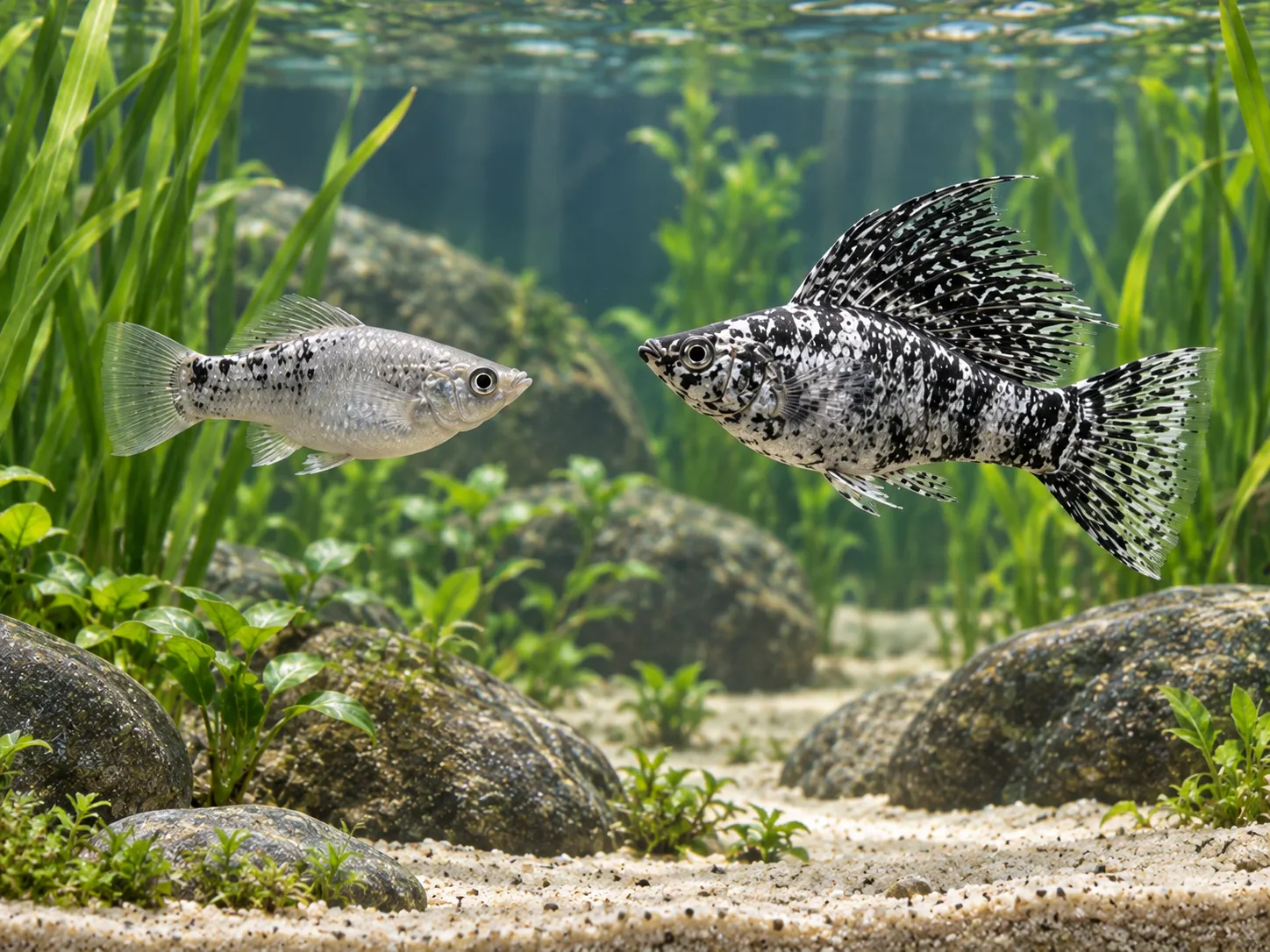
| Feature | Practical consequence | Buying question |
|---|---|---|
| Longer sailfin ancestry | More length for cruising and display | What adult size do the parents reach? |
| Large male dorsal fin | Open vertical and horizontal display room | Is this fish mature or still developing? |
| Deep-bodied female | Higher body mass and possible pregnancy | Is the abdomen symmetrical and is the fish feeding? |
| Very short rounded body | Selected form may swim and give birth differently | Is this a balloon strain rather than a standard body? |
| Mixed unlabelled stock | Adult outcome and crosses are less predictable | Were species or parent strains recorded? |
Body shape also changes how you read condition. A pregnant or recently fed female can be deep without being ill, while pineconing scales, one-sided swelling, laboured breathing, or inability to swim level requires prompt assessment rather than a guess about pregnancy.
When the seller cannot identify the form, plan for the larger and more active plausible adult. That decision costs some empty space now but avoids forcing a mature fish into a footprint chosen around its juvenile length.
How much space does a molly group need?
The answer depends on adult type. OATA suggests at least 45 litres for a small group of smaller guppies or mollies and at least 80 litres for sailfin mollies, but footprint, sex ratio, plant growth, waste, and fry make the printed volume only the beginning of the decision.
For common short-fin adults, a 75 cm or longer aquarium gives a trio more usable travel and separation than a small cube. Sailfins and larger mixed groups are better planned around at least a 90 cm length, with more width where mature males display.
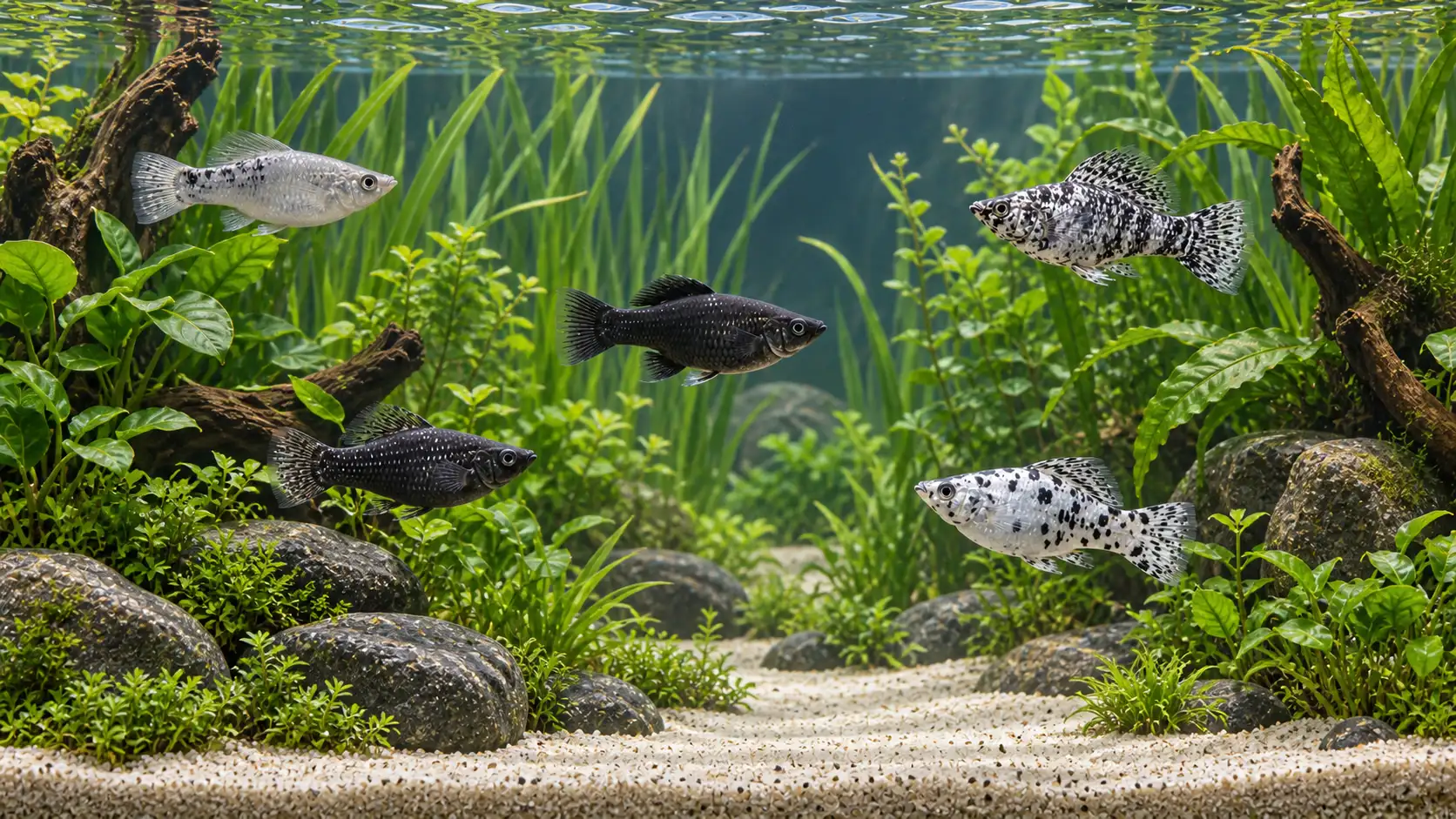
- Confirm whether the stock is short-fin or sailfin before choosing the tank.
- Plan from adult body length rather than sale size.
- Keep about two females per male in a mixed-sex group.
- Provide several visual breaks rather than one cave with one entrance.
- Leave open swimming space across most of the aquarium length.
- Reserve filtration capacity for fry or prevent mixed-sex breeding.
- Use a fitted lid and protect filter openings.
One male with one female concentrates courtship on a single animal. A female-only group avoids that pressure but may still produce stored-sperm broods after purchase, so apparent sex separation does not guarantee an immediate end to fry.
Do mollies need hard water or aquarium salt?
Common domestic mollies generally fit alkaline, mineral-rich freshwater better than soft acidic water. OATA publishes 20 to 28 °C, pH 7.0 to 8.0, and 8 to 18 dH for guppies and mollies, while FishBase records 7.5 to 8.2 and 11 to 30 dH for P. sphenops.
Published molly water context
- Temperature20 to 28 °CFreshwater domestic group guidance system. Applies to Guppies and mollies in home aquariums. Separate aquarium thermometer away from heater and return. Source: OATA, checked 2026-09-15.
- pH7.0 to 8.0 pHFreshwater domestic group guidance system. Applies to Common aquarium guppies and mollies. Calibrated meter or liquid test spanning source-water value. Source: OATA, checked 2026-09-15.
- General hardness8 to 18 dHFreshwater domestic group guidance system. Applies to Common aquarium guppies and mollies. Drop-count GH titration test in degrees of hardness. Source: OATA, checked 2026-09-15.
- Species comparisonpH 7.5 to 8.2 and 11 to 30 dHFreshwater and brackish system. Applies to Poecilia sphenops compiled record. Same pH and GH methods, compared with supplier water. Source: FishBase, checked 2026-09-15.
Every range above.
Some molly species occur in brackish or coastal water, but salt is not a substitute for mineral hardness, a mature filter, or a diagnosis. Adding sodium chloride does not raise GH in the way calcium and magnesium do, and it can exclude plants and tank mates that were chosen for freshwater.
Measure GH, KH, pH, temperature, ammonia, and nitrite before changing chemistry. If the source water is persistently soft, selecting a soft-water species is usually more stable than rebuilding every bucket for the lifetime of a molly group.
What does hard water mean in practical molly care?
General hardness describes dissolved calcium and magnesium, while carbonate hardness describes acid-buffering capacity. The two often rise together in tap water but are not interchangeable, and neither measurement tells you to add aquarium salt automatically.
Start with a current water report or a drop-count test of the source water. If the supplier keeps the fish in similar mineral-rich freshwater, preserving that stable overlap is usually safer than chasing a number with powders after every water change.
- Measure the source Test GH, KH, and pH from the water used for routine changes.
- Ask about supplier water Record whether the stock was raised in freshwater, brackish water, or a mineral-adjusted system.
- Compare before purchase Large differences change acclimation and long-term maintenance decisions.
- Choose one repeatable method If remineralization is necessary, prepare replacement water consistently outside the aquarium.
- Recheck after changes Verify the mixed water instead of trusting a scoop or label alone.
- Stop if fish show distress Do not continue an adjustment because a target has not yet been reached.
Sodium chloride changes salinity but does not replace calcium, magnesium, or carbonate buffering. Routine salt can also exclude plants, invertebrates, and tank mates that otherwise suit the aquarium, so it needs a defined reason and a way to measure the result.
Soft source water does not justify a sudden correction inside an occupied tank. Decide whether mollies are a sensible match for the water you can reproduce every week before buying them.
What layout works for mollies?
Mollies need open swimming room, strong biological filtration, plant cover, and surfaces they can browse. A planted lagoon-style aquarium with open foreground, tall side growth, stones, and wood gives multiple feeding and retreat areas without hiding the entire group.
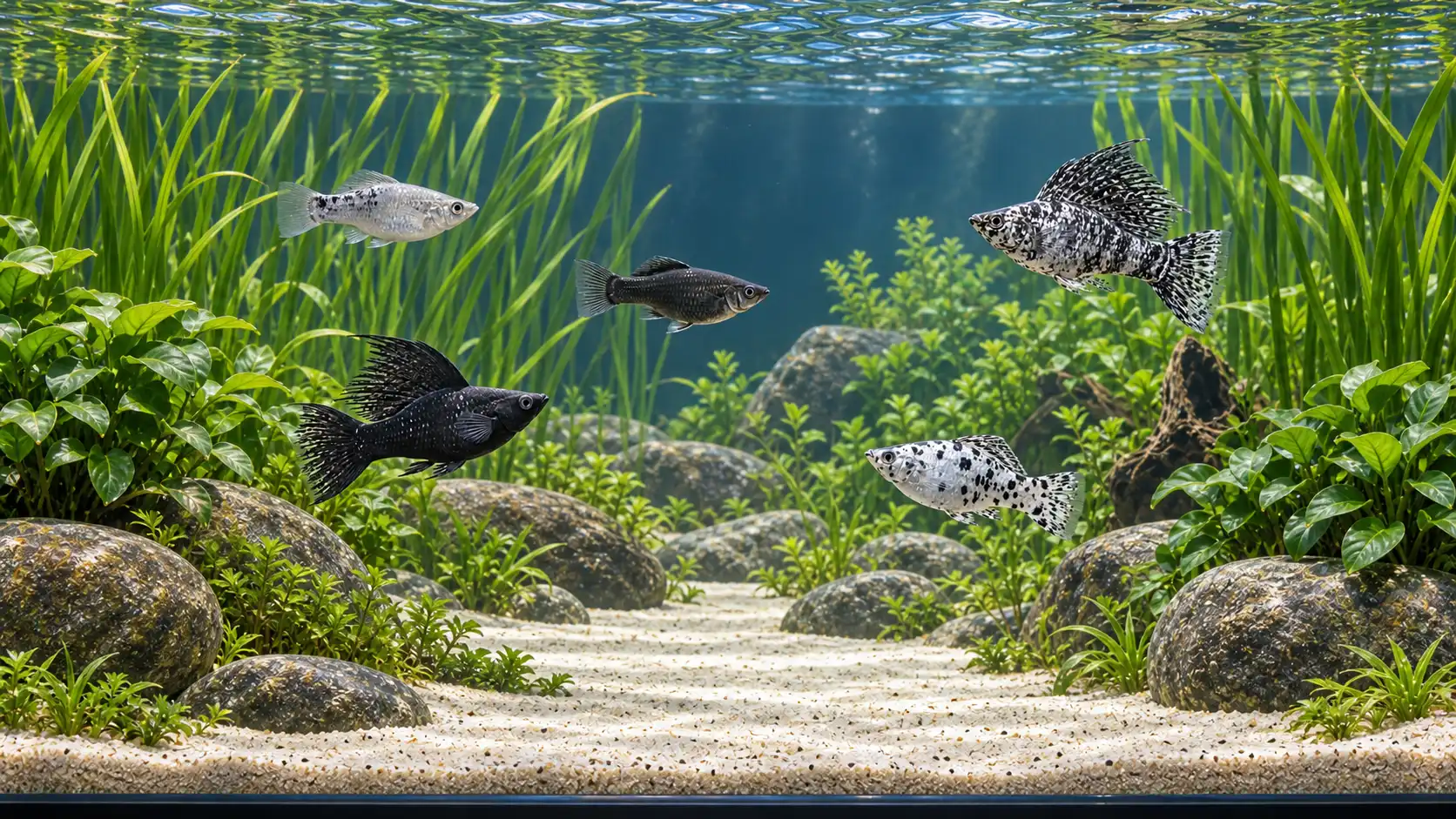
Long open foreground
Adults can travel and sailfin males can display without constant turns.
Separated plant masses
Females and subordinate fish can leave a chase in more than one direction.
Browsing surfaces
Rounded stones, leaves, and wood develop algae and biofilm.
Strong mature filtration
Livebearers eat actively and a growing population increases waste quickly.
Clear surface movement
Warm hard-water systems still need reliable gas exchange.
Accessible substrate
Open areas can be siphoned before settled food becomes a water problem.
Do not use salt-tolerant fish as a reason to neglect water changes. The filter converts toxic nitrogen; it does not remove nitrate, dissolved organics, or the mineral shifts created by topping off evaporation.
What should mollies eat?
Mollies are omnivores with meaningful plant and algae intake. Use a complete food with plant material as the staple, then vary it with suitable invertebrate foods, blanched vegetable matter, and natural grazing surfaces.
A molly picking at algae all day is still feeding. Add prepared food according to body condition and what is actually consumed, not according to the amount of begging at the front glass.
- Offer a plant-rich complete staple Use a size every fish can swallow promptly.
- Spread the ration Feed across the surface so one male cannot control the meal.
- Watch each body type Balloon, sailfin, and standard fish may reach food at different speeds.
- Remove soft leftovers Vegetable pieces and excess food should not decay overnight.
- Track the water trend Rising nitrate or persistent debris means the input exceeds export.
Thin females may be losing food to males or carrying a chronic problem, while continuously swollen fish should not be assumed pregnant. Separate observation and qualified help are safer than treating every change in shape as reproduction.
How should you plan a mixed-sex molly group before purchase?
Male mollies spend substantial time displaying and pursuing females. A common starting arrangement uses more females than males, but a ratio cannot compensate for a small footprint, one exposed female, or several males able to patrol every retreat.
Plan the adult group on paper before choosing colours. Include existing fish, the largest plausible molly form, the chance that females already carry stored sperm, and the space needed if fry survive.
- Decide whether the aquarium will hold one sex or a mixed-sex group.
- For mixed groups, provide multiple female-sized retreats that do not end in a dead corner.
- Keep open feeding routes so hiding fish do not have to enter a male's display area to eat.
- Confirm every fish can leave a chase without reaching glass.
- Prepare a plan for fry before choosing visibly pregnant females.
- Keep a separation tank ready for an injured or exhausted fish.
- Do not buy an extra male simply because its colour differs.
An all-female group can still produce fry after purchase because females may have mated earlier. An all-male group removes fry pressure but may concentrate display and chasing, so it still needs space, sight breaks, and a willingness to separate an individual.
Watch the same female across the day. If she remains behind equipment, misses meals, clamps her fins, or is pursued whenever she enters open water, the group arrangement is failing even when no fin is visibly torn.
Which tank mates can live with mollies?
Tank mates need hard-water overlap, enough adult size to avoid harassment or predation, and feeding access around active livebearers. Soft-water tetras are often recommended because both are sold as tropical community fish, yet their chemistry preferences can pull the tank in opposite directions.
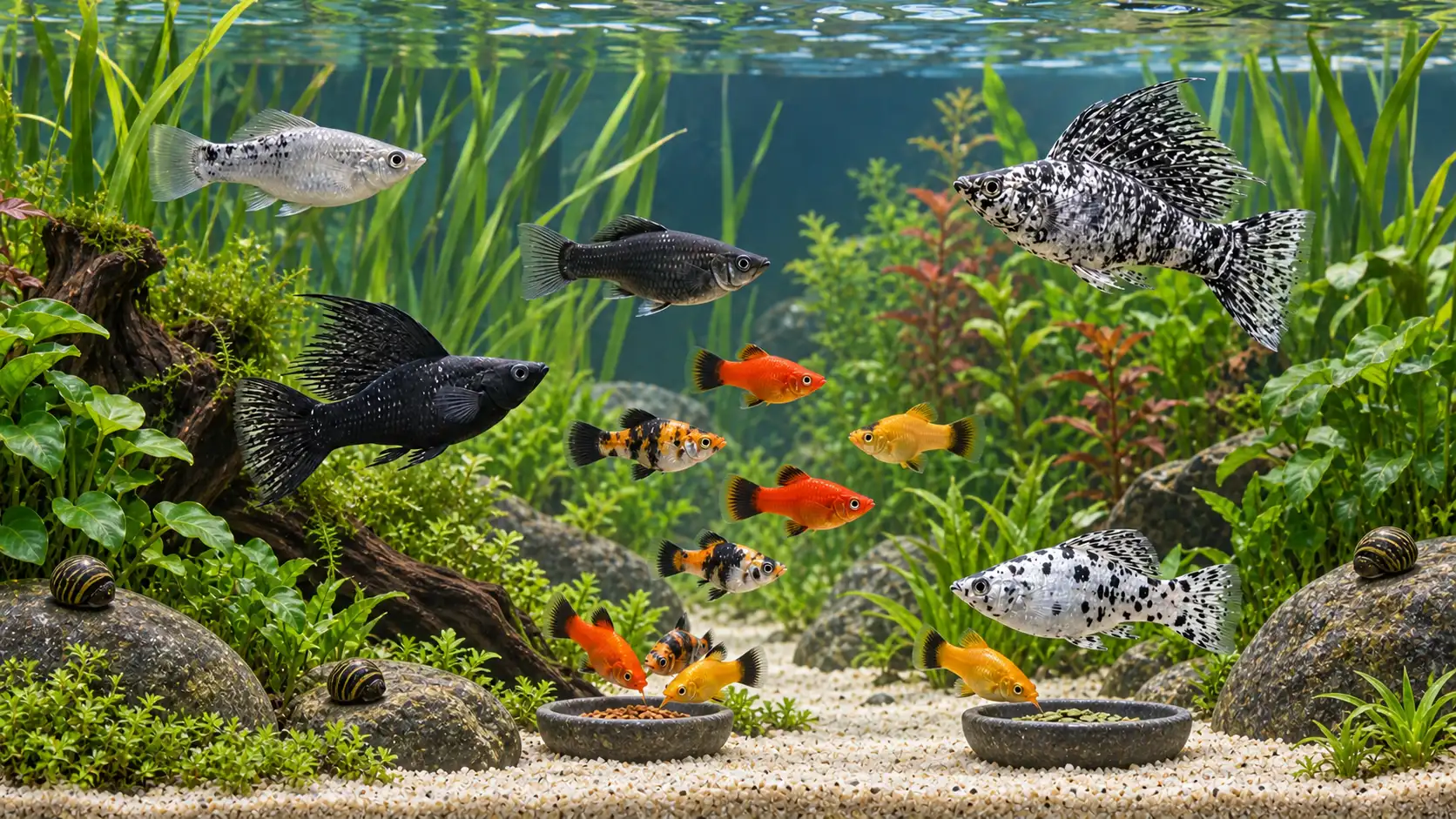
| Decision | Better match | Poor match |
|---|---|---|
| Water | Comfortable in medium-hard to hard alkaline freshwater | Requires persistently soft acidic water |
| Temperament | Robust peaceful fish that can disengage | Timid or long-finned fish stressed by constant attention |
| Feeding | Can reach food at another position or level | Slow feeder that depends on leftovers |
| Adult size | Similar enough to avoid predation | Large predator or very small fry-sized fish |
| Population | Stocking leaves room for live young | Tank is already full before the first brood |
Platies can be a closer water match than neon tetras, while guppies share livebearer behaviour but may add fin and breeding complications. Shrimp young can be eaten, and snails add waste rather than cleaning it away.
How should you manage males, females, and fry?
OATA recommends at least three mollies with about two females per male when sexes are mixed. Males have a narrow gonopodium, while females have a fan-shaped anal fin, although juveniles and stressed shop fish can be difficult to sex accurately.
Females can produce repeated broods, and a planted display may allow some fry to survive. Decide whether adults will remain with young, whether fry will be raised separately, and where healthy juveniles can legally go before encouraging reproduction.
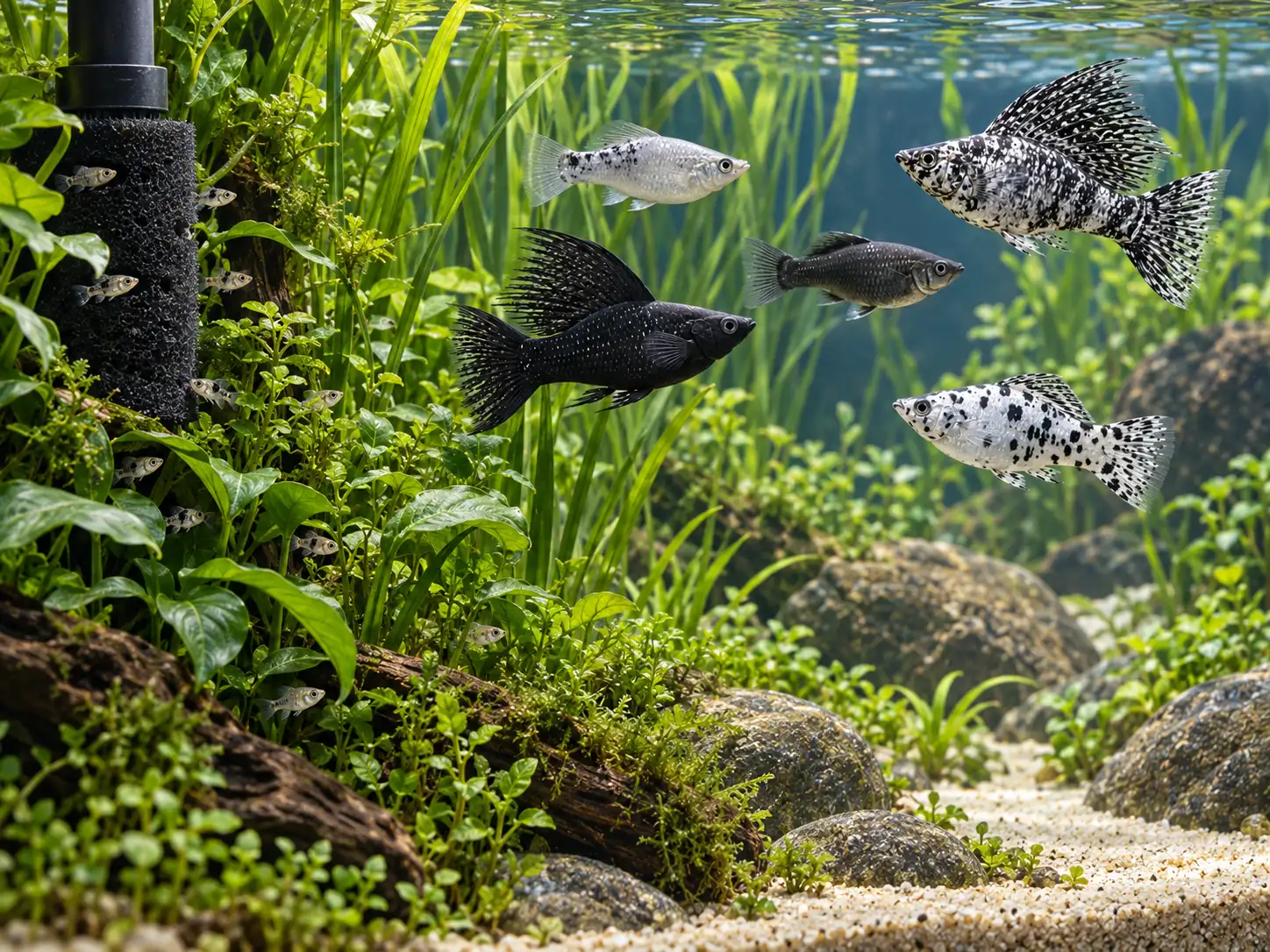
Why can a molly community fail without obvious fighting?
Compatibility can fail through chemistry, feeding pace, body size, and reproduction before it produces a bite mark. Mollies are active livebearers with a substantial appetite, and a group can keep slower fish away from food while also pushing the aquarium toward harder water than soft-water species use comfortably.
Fry add another layer. Adults may eat some young, but surviving juveniles still consume oxygen, food, and filter capacity; a community that looked lightly stocked can change within weeks without any new purchase.
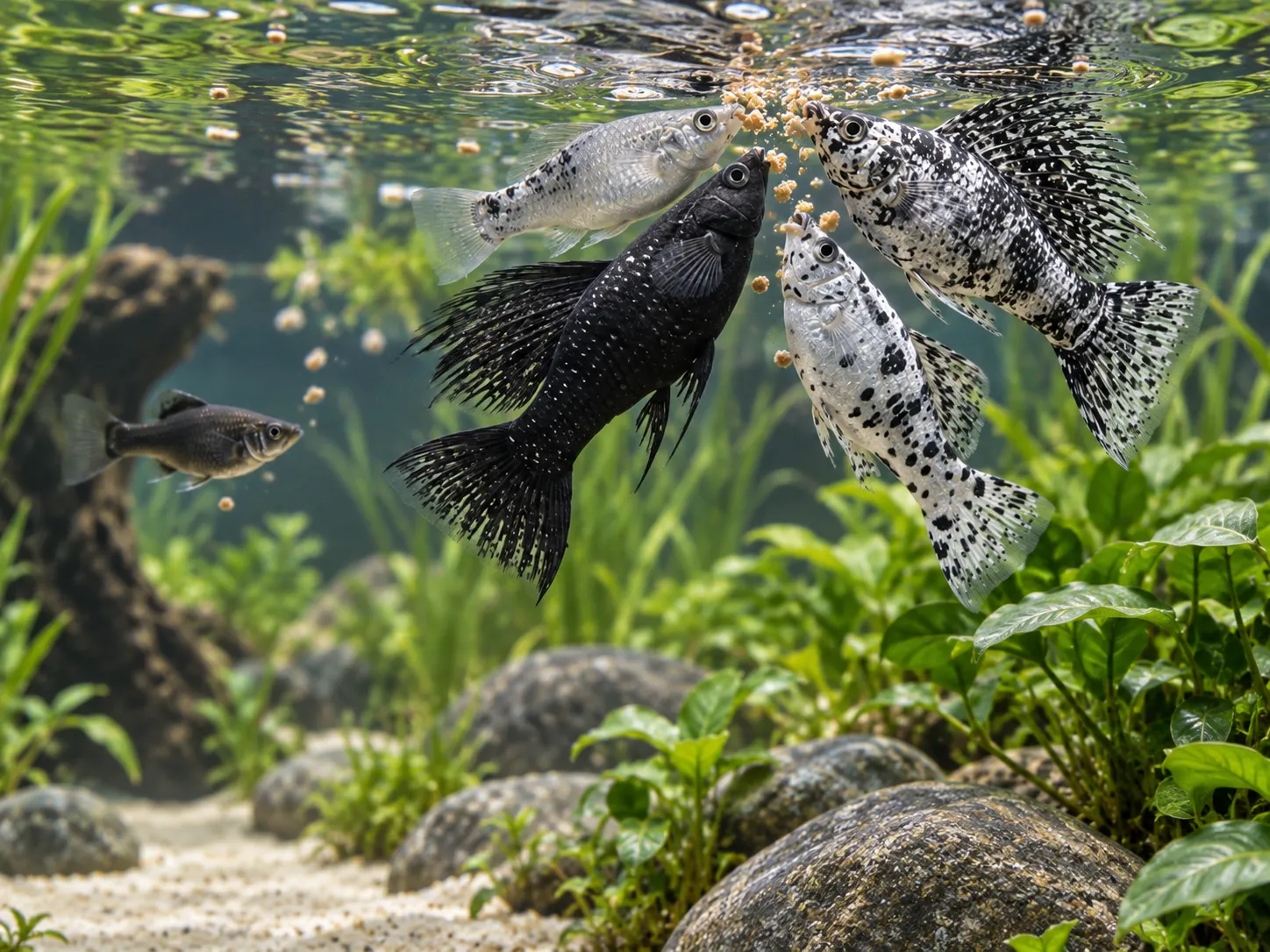
Check hidden competition in a molly community
- Feeding access Follow the smallest and slowest resident through the entire meal.
- Resting space Confirm calm fish can remain still without mollies entering every refuge.
- Water overlap Compare GH, KH, pH, and temperature needs rather than using one broad tolerance list.
- Waste trend Track nitrate and substrate debris as adults and fry grow.
- Reproductive pressure Count surviving juveniles and separate sexes before capacity is exhausted.
- Body-size change Reassess the community when juvenile mollies reach adult mass.
A community is working when every species maintains body condition, uses its normal level, eats without frantic competition, and rests where it chooses. Peaceful appearance at midday is weak evidence if shy residents emerge thin or only feed after the lights go out.
Choose companions around the actual molly form and source water. A combination that works with compact short-fin fish in hard freshwater may fail with larger sailfins or with tank mates kept at the edge of their chemistry range.
When does shimmying or clamping signal a problem?
Shimmying describes a fish apparently swimming in place with side-to-side body movement. It is a sign, not a diagnosis, and common causes include unsuitable mineral conditions, temperature stress, poor water quality, and illness.
Measure before choosing a cause
- Temperature Verify the thermometer and look for heater failure or a cold refill.
- Ammonia and nitrite Test immediately when several fish change together.
- GH, KH, and pH Compare the tank, source water, and supplier water rather than adding salt blindly.
- Oxygen and filter flow Check surface movement, clogged media, and population growth.
- Social pressure Watch whether the same fish is chased away from food and cover.
Several fish breathing hard, rolling, or losing balance requires immediate water and oxygen checks. Persistent severe signs, sores, major swelling, wasting, or deaths need aquatic-veterinary assessment rather than medication selected from the word “shimmy.”
Is a molly right for your aquarium?
Mollies suit a mature, mineral-rich aquarium with room for an adult group, a deliberate sex plan, strong filtration, and a realistic answer for fry. They are a poor fit for very soft source water, a cramped mixed community, or a keeper who expects algae grazing to replace feeding and maintenance.
- The seller can explain the adult body type and likely species or hybrid status.
- The tank is long enough for the adult short-fin or sailfin form.
- GH, KH, pH, and temperature suit the stock without routine emergency correction.
- The group has an intentional sex ratio and a plan for fry.
- Plants and hardscape provide several retreats while preserving open water.
- Tank mates share hard-water conditions and can compete safely for food.
- Quarantine space is ready, and nothing from the aquarium will be released outdoors.