
What Is a Penguin Tetra, and How Should You Keep Its School?
Thayeria boehlkei
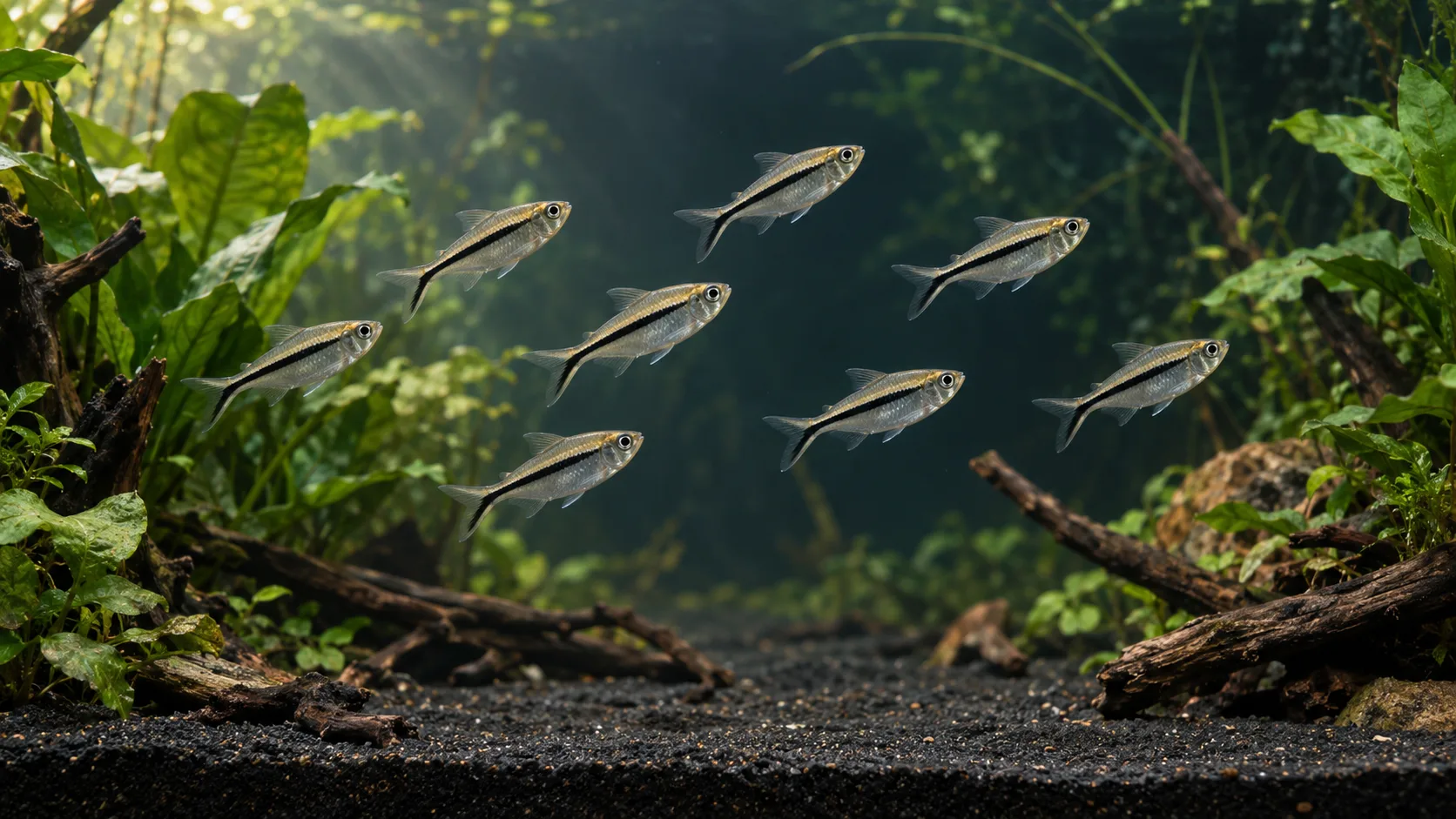
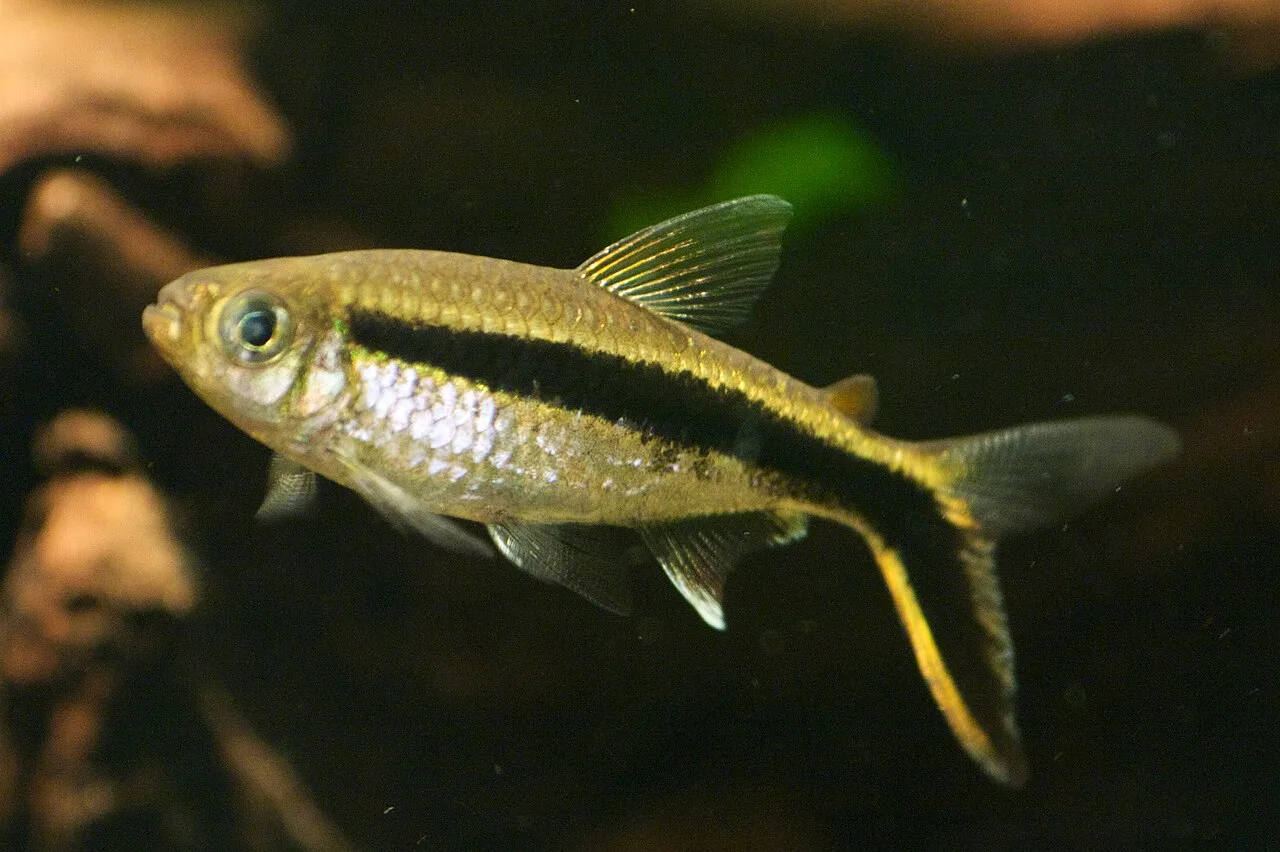
The penguin tetra is Thayeria boehlkei, a 3.6 cm South American schooling fish recognised by a black band that bends down into its lower tail lobe. A settled group needs six to ten or more fish, an aquarium at least 60 cm long, planted edges with open midwater, and short-finned companions too small to eat it.
At a glance

- Adult size
- 3.6 cm
- Minimum footprint
- 60 x 30 cm base for a small group; 75 to 90 cm with other schools
- Minimum volume
- 68 litres
- Social structure
- Schooling fish; keep a group of six to ten or more
- Minimum group
- 6
- Sex ratio
- Females are rounder in the belly and less intensely coloured than males.
- Diet
- Carnivore
- Feeding
- Micropredator: fine flake or micro granules daily, with frozen daphnia, brine shrimp, and occasional bloodworm.
- Waste load
- low for an adult school
- Family
- Acestrorhamphidae
- Native range
- Western and upper Amazon basin, including Peru, and the Rio Araguaia in Brazil
- Conservation status
- Least Concern, assessed 7 November 2018 Source
Length matters more than height for a midwater school, and every added school draws on the same oxygen and filtration, so a community tank needs more length than a single-species group.
What is a penguin tetra?
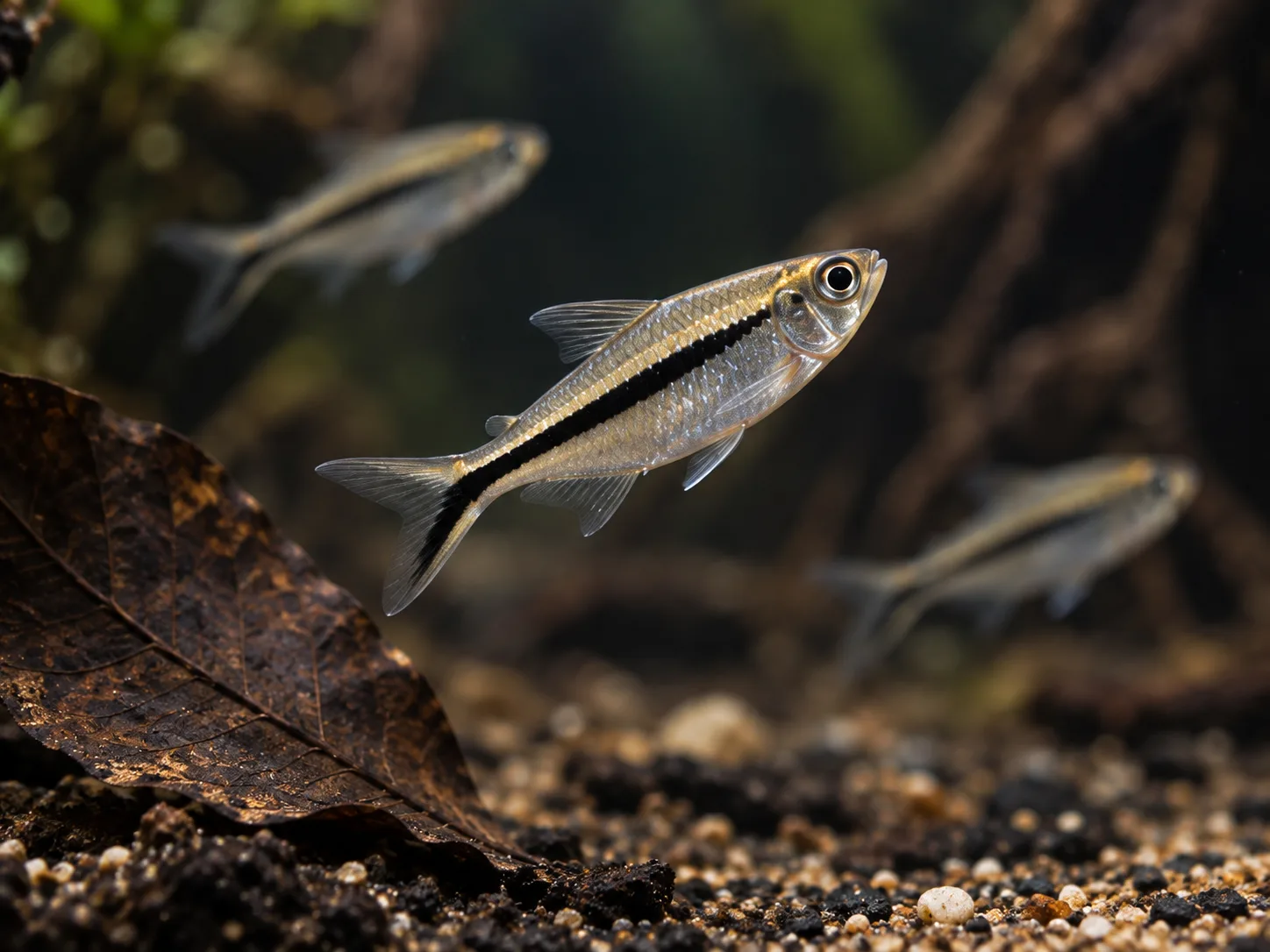
A penguin tetra is Thayeria boehlkei, a small South American characin with a brassy olive body and one thick black band that runs from just behind the gill cover to the tip of the lower tail lobe. Seen side on, the band bends down into the tail like a hockey stick, which is where the alternative name hockeystick tetra comes from.
Adults reach about 3.6 cm standard length according to FishBase and Seriously Fish, so a grown fish is a little longer than a neon tetra and noticeably more robust.
It lives in groups, feeds on small invertebrates, and adapts to a broad spread of soft to moderately hard water.
- Accepted identity
- Thayeria boehlkei Weitzman, 1957
- Family
- Acestrorhamphidae, subfamily Thayeriinae
- Other trade names
- Hockeystick tetra, blackline penguinfish, false penguin tetra
- Recorded range
- Western and upper Amazon basin, including Peru, and the Rio Araguaia in Brazil
- Recorded habitat
- Densely vegetated wetlands and forest streams with plant-lined margins
- Published maximum size
- 3.6 cm standard length
- Social structure
- Schooling fish kept in groups
- Compiled water context
- 22 to 28 °C, pH 6.0 to 8.0, 5 to 19 dH
- Diet
- Worms, small insects, and small crustaceans
- Conservation
- Least Concern, assessed 7 November 2018
The family name on older labels will usually read Characidae. A 2024 revision moved Thayeria and many other American tetras into Acestrorhamphidae, and the Catalog of Fishes now lists the species there, so both names describe the same fish rather than two different ones.
Weitzman described the species in 1957 from aquarium specimens with no exact collection locality. That origin explains why published ranges still differ: FishBase and Seriously Fish describe the upper Amazon in Peru plus the Rio Araguaia, while the Catalog of Fishes also lists Ecuador and Bolivia within the western Amazon.
How can you tell a penguin tetra from Thayeria obliqua?
Two Thayeria species reach the hobby under penguin names, and the stripe is the quickest way to separate them. In Thayeria boehlkei the black band runs forward along the flank as far as the gill cover, while in Thayeria obliqua the band tapers upward and fades out before it reaches the level of the dorsal fin.
Seriously Fish notes that T. boehlkei is by far the more common of the two in the trade, and that it now carries the penguin tetra name even though T. obliqua was the original penguin fish.
A shop tank labelled penguin tetra is therefore very likely to be T. boehlkei, but the stripe is still worth checking before you buy a group.
| Feature | Thayeria boehlkei | Thayeria obliqua |
|---|---|---|
| Black band on the flank | Runs forward to the gill cover | Tapers and fades behind the dorsal fin |
| Lower tail lobe | Dark band continues into it | Dark band continues into it |
| Trade frequency | By far the usual fish sold | Much less often offered |
| Usual label | Penguin tetra, hockeystick tetra | Penguin fish, sometimes also penguin tetra |
| Recorded range | Upper Amazon and Rio Araguaia | Central Amazon, Rio Tocantins, and Rio Guaporé |
Mixing the two in one group does no obvious harm, since their care overlaps closely. The distinction matters most to anyone breeding the fish, keeping a biotope with a stated origin, or trying to match published data to the animals actually in the tank.
Why do penguin tetras swim head-up?
Penguin tetras often hover with the head raised and the tail slightly lower, a posture keepers describe across the whole Thayeria genus. Combined with the black band sweeping down into the tail, it gives a resting group the tilted, upright look that earned the penguin name.
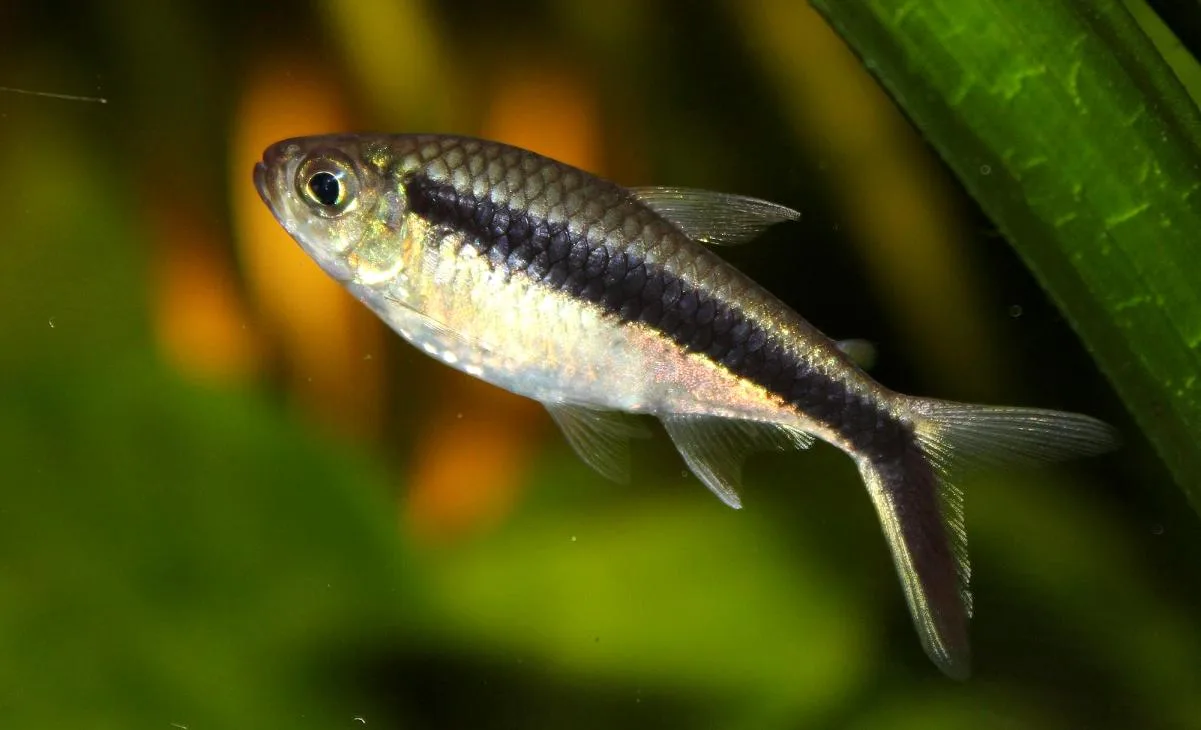
That angle is normal behaviour, so a new keeper does not need to treat it as a buoyancy problem.
What deserves attention is a change from the fish's own baseline, especially when it arrives with other signs.
| Decision factor | Usually normal | Worth investigating |
|---|---|---|
| Body angle | Slight head-up tilt while hovering | Steep head-up or nose-down hanging for long periods |
| Movement | Swims level when cruising or feeding | Struggles to hold depth or sinks when it stops swimming |
| Fins | Open and relaxed | Clamped against the body |
| Breathing | Slow, even gill movement | Rapid gill movement or gulping at the surface |
| Group position | Stays within or near the school | Hangs apart, hides constantly, or ignores food |
When several fish change posture at once, the shared water is the first suspect rather than an individual illness. A single fish that cannot hold its depth while the rest look normal points more toward a problem with that animal.
What tank does a penguin tetra group need?
A group of six to ten penguin tetras needs an aquarium of at least 60 cm in length, and 75 to 90 cm gives a group of ten or more, plus tank mates, room to school without crowding.
FishBase gives 60 cm as its minimum, and Seriously Fish gives a base of 60 by 30 cm, about 68 litres, for a small group.
How many penguin tetras should live together?
FishBase records a group of five or more as the minimum, and Seriously Fish asks for at least six and preferably ten or more. The larger figure is the better plan, because a bigger school settles more quickly, shows more natural behaviour, and spreads any squabbling across more individuals.
Group size also protects other fish, since Seriously Fish records that fin nipping falls when penguin tetras are kept in adequate numbers, and a small group of tetras tends to turn its attention outward to slow or long-finned tank mates.
How much length and swimming room do they use?
Penguin tetras spend most of their time in the middle and upper water, where they hover in loose groups and make short bursts forward. Length matters more than height for that pattern, because a long tank gives the whole group a clear lane to move through while a tall, narrow tank of the same volume leaves them crowded near the surface.
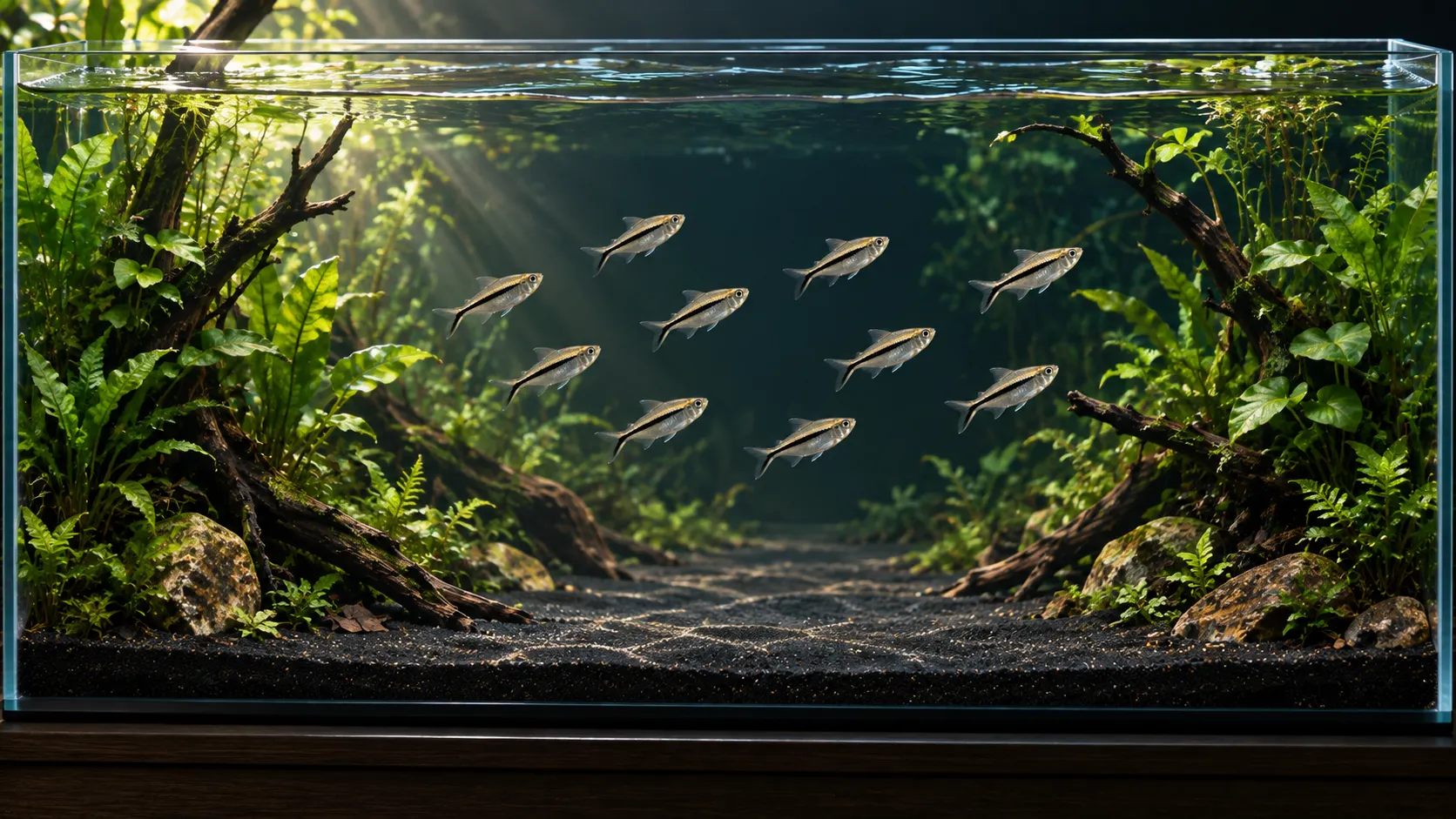
Adult size, group size, and the other fish all draw on the same filter capacity and oxygen. A ten-fish penguin group in a 60 cm tank is a reasonable single-species display, but adding another school and a bottom-dwelling group usually calls for the longer 75 to 90 cm footprint.
What layout suits their habitat?
Seriously Fish describes wild habitats ranging from wetlands thick with aquatic plants to forest streams with plant-lined banks but few plants in the water itself. Both settings share cover at the edges, subdued light, and open water in the middle, and that combination translates well into an aquarium.
- Dark substrate and background, which usually make the fish calmer and their colour stronger.
- Dense planting or roots along the back and sides, with open midwater left clear.
- Floating plants over part of the surface to soften the light without covering it entirely.
- Driftwood and a few dried leaves if you want a biotope-style layout.
- A fitted cover, since startled tetras can jump from an open tank.
- Gentle to moderate flow rather than a strong jet across the whole tank.
A fully matured biofilter matters more than any piece of decor, because adding a school before the nitrogen cycle has established exposes the whole group to ammonia at once.
What water conditions suit penguin tetras?
Penguin tetras tolerate a wide spread of chemistry: FishBase compiles 22 to 28 °C, pH 6.0 to 8.0, and 5 to 19 dH, and Seriously Fish extends the range to pH 5.5 and 0 to 20 dGH. The two sources agree on temperature and overlap almost entirely on chemistry, which is why stable tap water within that span usually suits them without adjustment.
Published penguin tetra water context
- Temperature22 to 28 °CApplies to Compiled species range. Separate aquarium thermometer away from the heater. Source: FishBase, checked 2026-09-21.
- pH6.0 to 8.0 pHApplies to Compiled species range. Calibrated meter or liquid test covering the source-water value. Source: FishBase, checked 2026-09-21.
- General hardness5 to 19 dHApplies to Compiled species range. GH titration test in degrees of hardness. Source: FishBase, checked 2026-09-21.
- pH5.5 to 8.0 pHApplies to Husbandry profile range. Calibrated meter or liquid test covering the source-water value. Source: Seriously Fish, checked 2026-09-21.
- General hardness0 to 20 dGHApplies to Husbandry profile range. GH titration test in degrees of hardness. Source: Seriously Fish, checked 2026-09-21.
Every range above is for a freshwater system.
These are the conditions the species is recorded in, not targets to chase. A fish held at a steady pH 7.4 is better off than one moved toward pH 6.5 in a weekend, because a fast shift in pH or hardness stresses the whole school more than a stable value near the edge of the range.
Temperature has more day-to-day effect than chemistry. Most homes run below 22 °C for at least part of the year, so a reliable heater and a separate thermometer are part of the basic setup, and the heater setting is worth checking against the thermometer rather than trusted on its own.
Ammonia and nitrite have no safe range for any fish, and a tank that reads above zero for either has a filtration or stocking problem that softening the water or changing the temperature will not correct.
What do penguin tetras eat?
Penguin tetras are small micropredators that eat worms, small insects, and small crustaceans in the wild, according to FishBase. In an aquarium they take a good flake or small granule readily, and Seriously Fish recommends adding small live or frozen foods such as bloodworm, daphnia, and brine shrimp.
Mouth size is the practical limit, because large pellets get picked at and spat out into the substrate while fine flake and small granules are swallowed whole in midwater before they can sink.
| Food | Role in the diet | What to watch |
|---|---|---|
| Quality flake or micro granule | Daily staple | Crumble flake if pieces are larger than the mouth |
| Frozen daphnia | Regular variety | Thaw first so it disperses instead of floating as a block |
| Frozen or live brine shrimp | Regular variety | Newly hatched nauplii suit small fish best |
| Frozen bloodworm | Occasional treat | Rich food, so keep portions small |
| Live insect larvae from a clean culture | Enrichment | Avoid wild-collected pond food, which can carry parasites |
Small daily meals suit a school better than one large feed. The fish take most food in the middle and upper water, so feeding along the length of the tank spreads the group out and gives the slower or more timid individuals a fair chance at a share.
Portions are easiest to judge in the first minute or two: food that regularly reaches the substrate uneaten means the portion is too large, and overfeeding pushes ammonia up faster than a small tank can clear it.
A group of tetras can always look hungry, so body shape is a better guide than begging. Adults should look slim but full, with no hollow belly and no swollen, rounded outline in a fish that is not carrying eggs.
Which tank mates suit penguin tetras?
Penguin tetras live peacefully with most fish of similar size that share their temperature and do not treat a 3.6 cm fish as food. Seriously Fish lists other South American tetras, pencilfish, dwarf cichlids such as Apistogramma, corydoras catfish, and smaller rasboras and barbs as suitable companions.
The black neon tetra and glowlight tetra are similar-sized, peaceful schools with an overlapping temperature range.
The lemon tetra and harlequin rasbora fit the same pattern of small, calm midwater fish that share open water without crowding a penguin group.
A shared temperature is worth checking pairing by pairing. A cardinal tetra usually wants warmer water than most community fish, which puts the penguin group near the top of its range, while a cooler-water species can hold the penguins near the bottom of theirs.
| Question | Better match | Poor match |
|---|---|---|
| Size | Similar adult size, from about 3 to 6 cm | Fish large enough to swallow a 3.6 cm tetra |
| Fins | Short-finned, active companions | Slow fish with long flowing fins |
| Temperature | Comfortable within 22 to 28 °C | Needs water outside that range |
| Pace at feeding | Takes food in its own zone or level | Relies on leftovers after the tetras have fed |
| Temperament | Peaceful or mildly boisterous | Persistent nippers or aggressive territory holders |
Long-finned fish are the main risk on the penguin tetra's side. A betta or long-finned guppy moves slowly and trails its fins, and a small or unsettled penguin group can start nipping at them even though the same fish ignore short-finned companions.
The risk also runs the other way, because angelfish grow large enough to eat small tetras as they mature and persistent nippers such as tiger barbs can shred penguin fins.
Bottom fish such as corydoras use a different level of the tank, but they still share the same oxygen, filter capacity, and temperature. Sinking food placed where they gather keeps them properly fed, whereas relying on whatever drifts down after the tetras have eaten is the most common form of feeding competition in a mixed tank.
When does penguin tetra behaviour signal a problem?
Healthy penguin tetras hover in a loose group, move together when disturbed, rise to food quickly, and hold their fins open. Clamped fins, hiding for days, rapid breathing, gasping at the surface, loss of balance, or a fish that stops feeding all point to a problem that needs checking.
Check the shared water first
- Ammonia and nitrite Test after new fish, overfeeding, filter cleaning, a power cut, or any change affecting several fish.
- Temperature Compare a separate thermometer with the heater setting, especially after hot or cold weather.
- Oxygen Look for surface movement and check whether several fish are breathing faster at once.
- Recent changes Review new fish, new decor, cleaning products, sprays, and untreated top-up water.
- Social pressure Watch whether one fish is excluded from the group or chased away from food.
A sudden reading of ammonia or nitrite above zero calls for a partial water change with temperature-matched, dechlorinated water the same day. Retest afterwards, and keep changing water in measured steps until both read zero while the cause is traced.
Several fish gasping at the surface is an emergency whatever the test kit shows, so increase surface movement straight away and test afterwards, because low oxygen can kill a school faster than most water-chemistry problems.
When the water tests clean and the problem persists, an aquatic veterinarian is the right next step. Bleeding, ulcers, cotton-like growths, swelling, fish wasting despite eating, or continuing losses need a professional diagnosis rather than a guess from symptoms, and new fish kept in a separate quarantine tank for several weeks protect an established group from bringing in disease.
How do penguin tetras breed, and how long do they live?
Penguin tetras are prolific egg scatterers that give no parental care. Seriously Fish records clutches of around 1,000 eggs and occasionally up to 3,000, with hatching in 12 to 24 hours and fry swimming freely after three to four days.
Females are rounder in the belly and less intensely coloured than males, which makes a mature group fairly easy to sex once the fish are full grown. In a community tank the adults eat most eggs and fry, so a few young survive only in heavily planted setups.
| Decision factor | Community display | Breeding project |
|---|---|---|
| Main goal | A settled, active school | Collecting eggs before adults eat them |
| Layout | Open water with planted edges | Fine-leaved plants or mesh with adults removed after spawning |
| Water | Stable tap water within the published range | Softer, slightly acidic water is often preferred for spawning |
| Food | Flake plus small frozen foods | Infusoria and then brine shrimp nauplii for fry |
| Space | One planned group | Room for hundreds of juveniles, or a plan for them |
A deliberate project raises two practical questions before it starts: where hundreds of young tetras will go, and how they will be fed through the first-food stage while they are too small for anything but microscopic food.
FishBase and Seriously Fish give no lifespan for this species, so any exact figure should be read with caution. Small tetras of similar size commonly live several years in stable aquariums, and long-term condition depends far more on water quality, diet, and group stability than on a number printed on a care sheet.
Is a penguin tetra right for your aquarium?
Penguin tetras suit a mature, planted aquarium at least 60 cm long with room for a group of six to ten or more, stable water between 22 and 28 °C, and peaceful companions of similar size.
They are a poor match for a tank built around long-finned or very slow fish, or for anyone planning to keep only two or three.
- The aquarium is at least 60 cm long, and longer if other schools are planned.
- There is room for six to ten penguin tetras before any tank mates are counted.
- The biofilter is fully cycled, with ammonia and nitrite reading zero.
- A heater and a separate thermometer hold the water between 22 and 28 °C.
- Planted edges and open midwater are both in place.
- Tank mates are peaceful, short-finned, and too small to swallow a 3.6 cm fish.
- The tank has a fitted cover.
- New fish have somewhere to be quarantined, and no fish or tank water will be released outdoors.