
What Is a Harlequin Rasbora, and What Does Its School Need?
Trigonostigma heteromorpha
The harlequin rasbora is Trigonostigma heteromorpha, a deep-bodied Southeast Asian schooling fish with a broad black wedge on the rear flank. Adults reach 5 cm total length in FishBase, so a complete school needs a long open lane as well as planted cover.
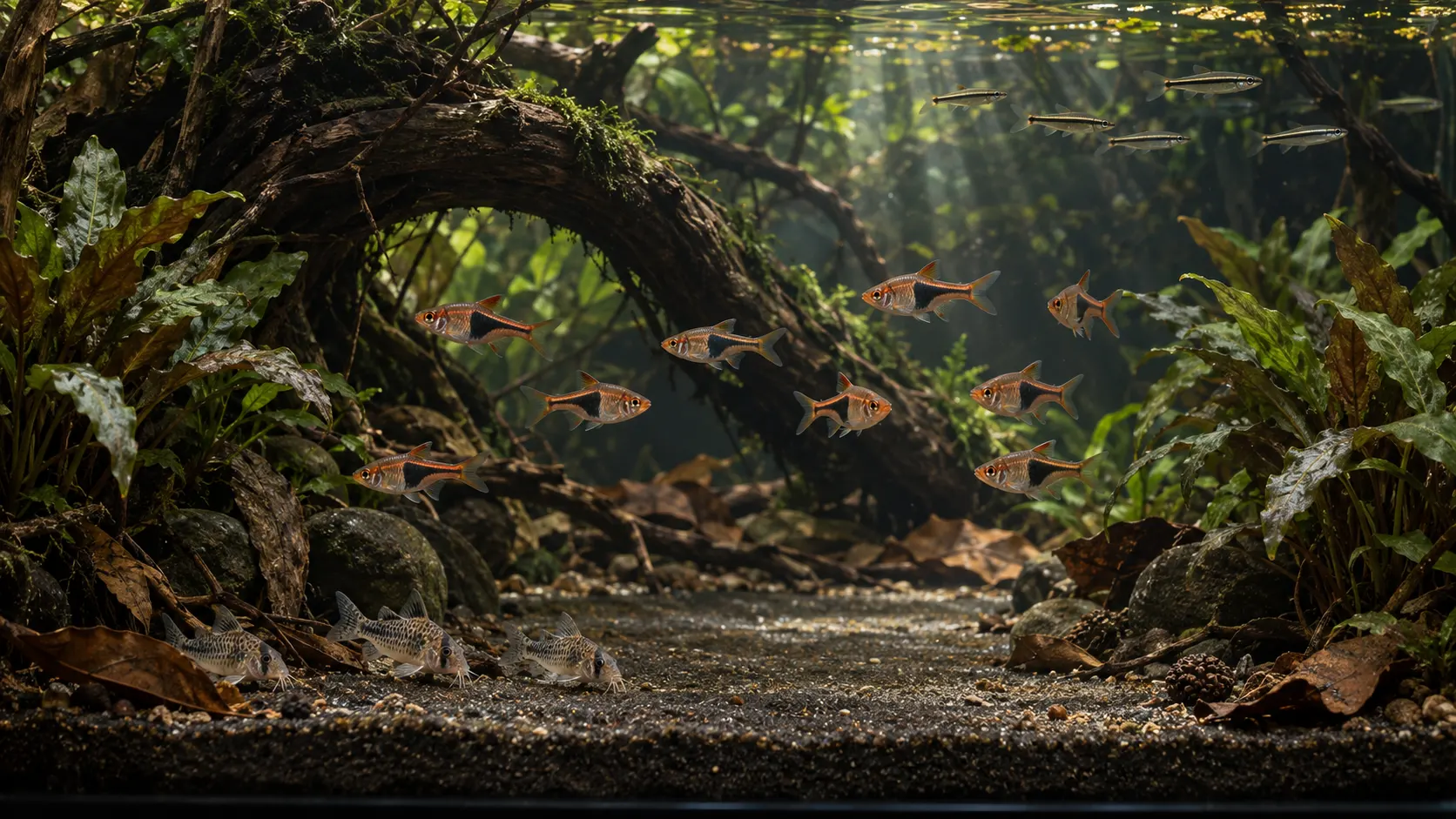
At a glance

- Adult size
- 5 cm
- Minimum footprint
- At least 75 × 30 cm for eight adults, with planted margins and a broad uninterrupted midwater lane
- Social structure
- A coordinated midwater school; begin with at least eight adults and count every additional schooling species separately.
- Minimum group
- 8
- Sex ratio
- No routine sex ratio is established.
- Diet
- Carnivore
- Feeding
- Use a complete small staple with suitably sized frozen or live invertebrate foods, distributed along the school front.
- Waste load
- moderate for a complete adult school
- Family
- Danionidae
- Native range
- Peninsular Malaysia, Singapore, and Indonesia
- Conservation status
- Least Concern, assessed 26 January 2019 Source
Footprint follows adult group movement, cover displacement, feeding access, and maintenance capacity; it is not a pet-store survival minimum.
What is a harlequin rasbora?
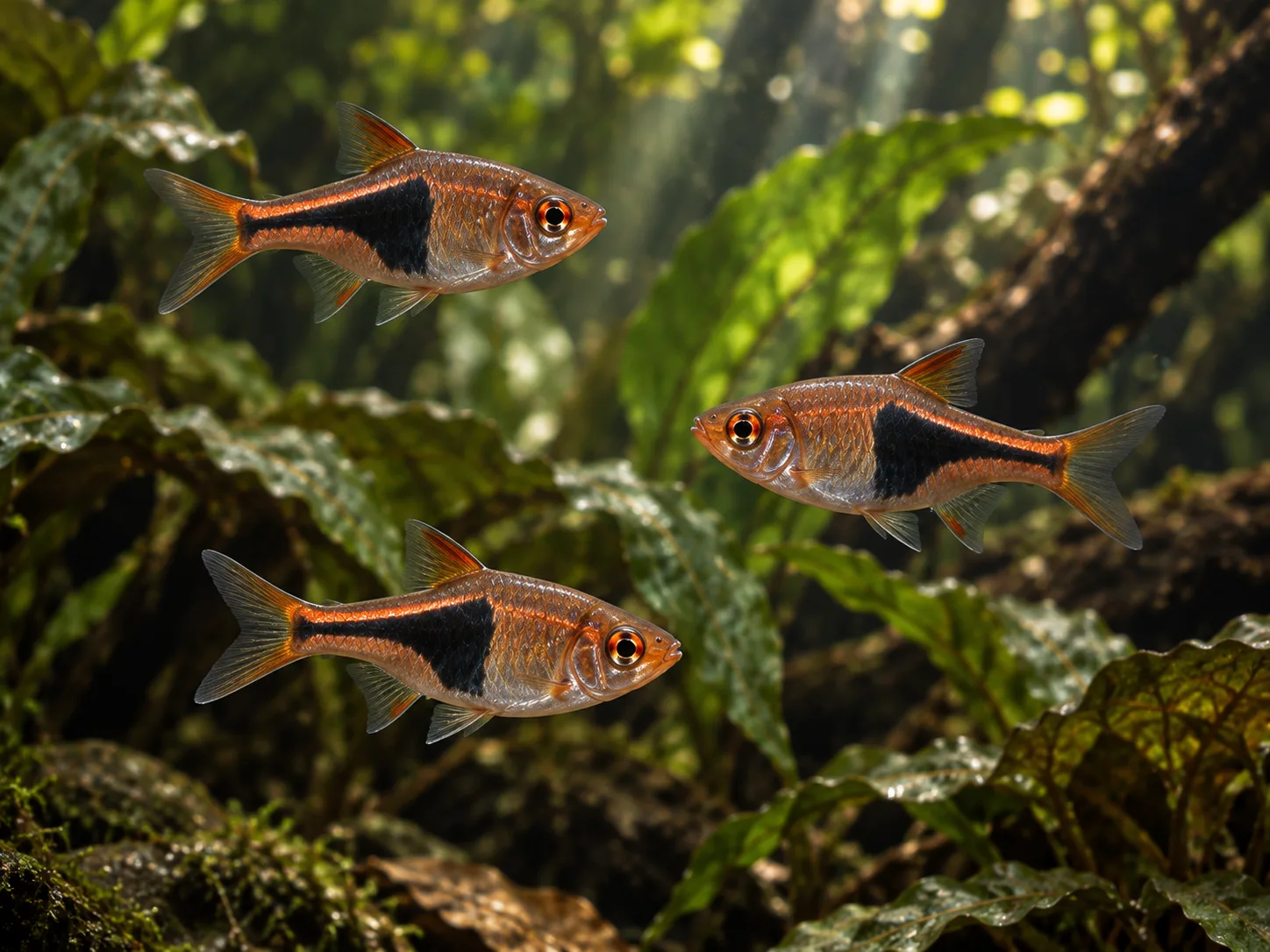
The harlequin rasbora is Trigonostigma heteromorpha, a deep-bodied Southeast Asian schooling fish marked by a large black wedge on the rear flank. Its adult size reaches 5 cm total length in FishBase, so the useful care unit is a complete school with lateral swimming space rather than one small copper fish.
FishBase places the species in Danionidae and records it from Peninsular Malaysia, Singapore, and Indonesia. It associates the fish with forest streams and primary peat swamps, including records of groups larger than 100 fish.
- Accepted identity
- Trigonostigma heteromorpha (Duncker, 1904)
- Family
- Danionidae
- Verified range
- Peninsular Malaysia, Singapore, Sumatra, and nearby Indonesian range records
- Published maximum
- 5 cm total length
- Habitat
- Forest streams and primary peat swamps
- Social structure
- Midwater school, with wild groups recorded above 100 fish
- Practical starting group
- At least 8 adults
- Starting footprint
- 75 × 30 cm for the first adult school
- Published water context
- 22 to 25 °C, pH 5.0 to 7.0, 5 to 12 dH
- Conservation
- Least Concern, assessed 26 January 2019
Older books and shop cards may place the species in Rasbora. The currently accepted combination is Trigonostigma heteromorpha, and a label from Thailand may require extra care because a related Thai population was described as T. truncata in 2020.
Which black wedge identifies a true harlequin?
The harlequin's black marking is a broad axine, or wedge-like blotch, beginning around midbody and extending to the caudal-fin base. FishBase records a relatively steep head-to-back profile and black wedge apices that begin near the dorsal- and pelvic-fin origins.
The lambchop rasbora has a slimmer body and a narrower hooked mark, while the glowlight rasbora has a reduced dark mark with a bright orange line. T. truncata resembles the harlequin closely, and locality plus taxonomic documentation may matter more than a quick aquarium photograph.
| Fish | Body and flank mark | Practical identification limit |
|---|---|---|
| Harlequin rasbora | Deep body with a large black wedge reaching the tail base | Aquarium angle and colour do not prove collection locality |
| Lambchop rasbora | Slimmer copper body with a narrower hook or lambchop mark | Trade labels may use false harlequin or Espe's rasbora |
| Glowlight rasbora | Slender body with a thinner dark mark and bright orange highlight | Lighting can exaggerate the glowing line |
| Trigonostigma truncata | Very similar broad wedge with differences in profile, mouth, and wedge position | Exact identification may require reliable locality and specialist examination |
You should keep the seller's scientific name, supplier, purchase date, and origin claim together. Do not silently convert every wedge-marked Thai fish into T. heteromorpha or invent a locality from appearance.
How much swimming room does the school use?
FishBase compiles aquarium groups of five or more, but a practical display should begin with at least eight adults. A larger group gives the fish more social choices and makes normal spreading, regrouping, and brief display easier to separate from chronic hiding.
At 5 cm total length, eight harlequins form a substantial midwater group. Add the displacement of wood and plants, the feeding path, the oxygen demand of warm water, and the complete adult groups of any companions before deciding that a nominal volume is sufficient.
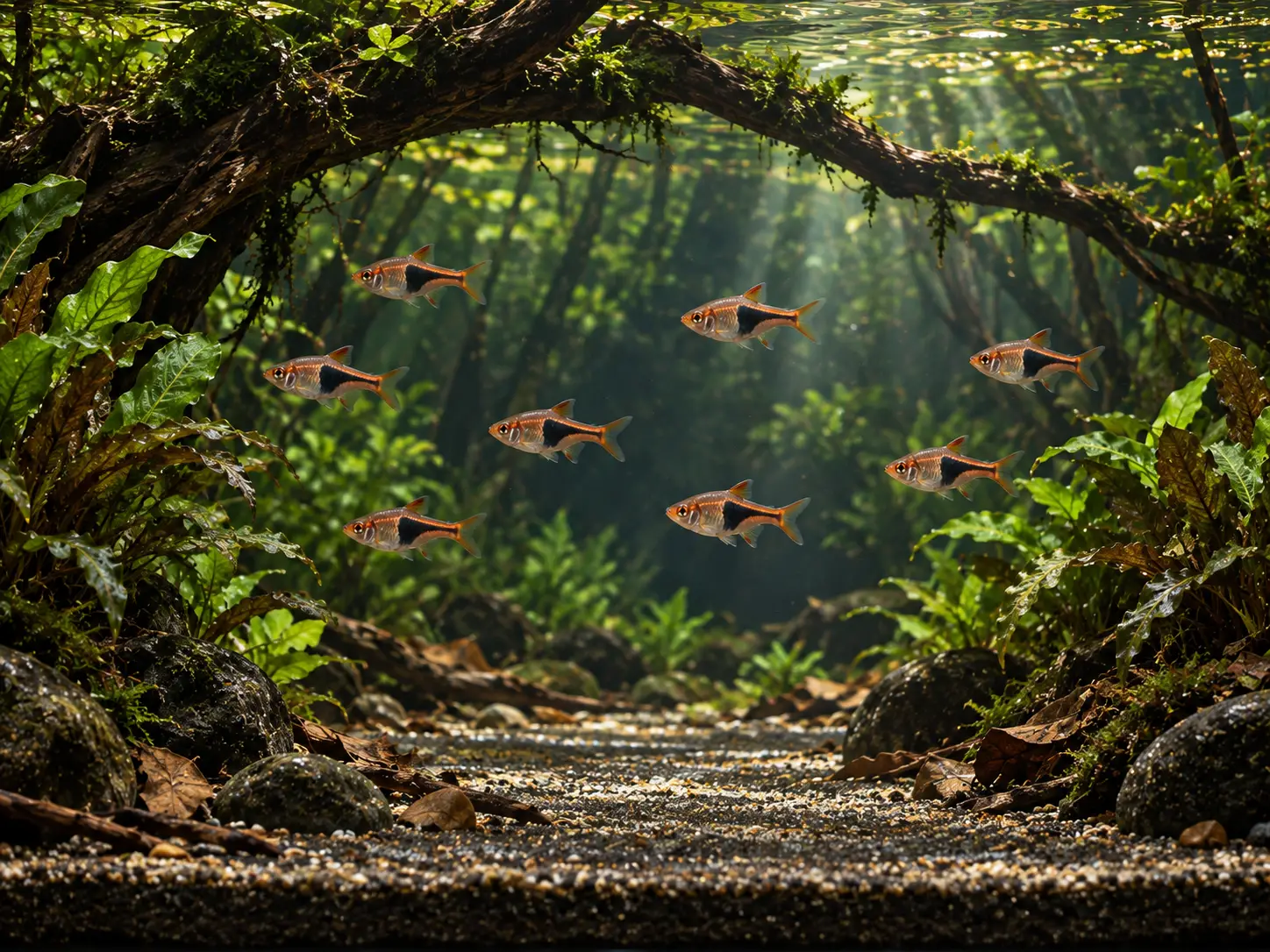
- Reserve space for at least eight full-sized harlequin rasboras.
- Keep one continuous lateral route through the middle water.
- Count a second school as another complete group, even when the fish use a slightly different depth.
- Confirm that quiet fish can reach food at both ends of the school.
- Leave enough open surface for gas exchange in warm water.
- Choose an upgrade point before juveniles become 5 cm adults.
The school may loosen when the fish feel secure and tighten after movement outside the tank. Constant tight formation can therefore indicate alertness rather than comfort, especially when it is paired with rapid breathing or refusal to leave one end.
What tank setup supports plant cover and open water?
A 75 × 30 cm footprint or larger provides a better starting route for eight adults than a short cube with similar litres. FishBase lists 60 cm as a compiled aquarium length, but extra length protects the school from hardscape displacement and leaves some capacity for maintenance delays or a carefully selected bottom group.
You can use dark sand or fine gravel, roots or branches, and broad-leaved plants around the rear and ends. Leave the centre open enough for group movement, and position your filter return so circulation crosses the aquarium without pinning the fish into one calm corner.
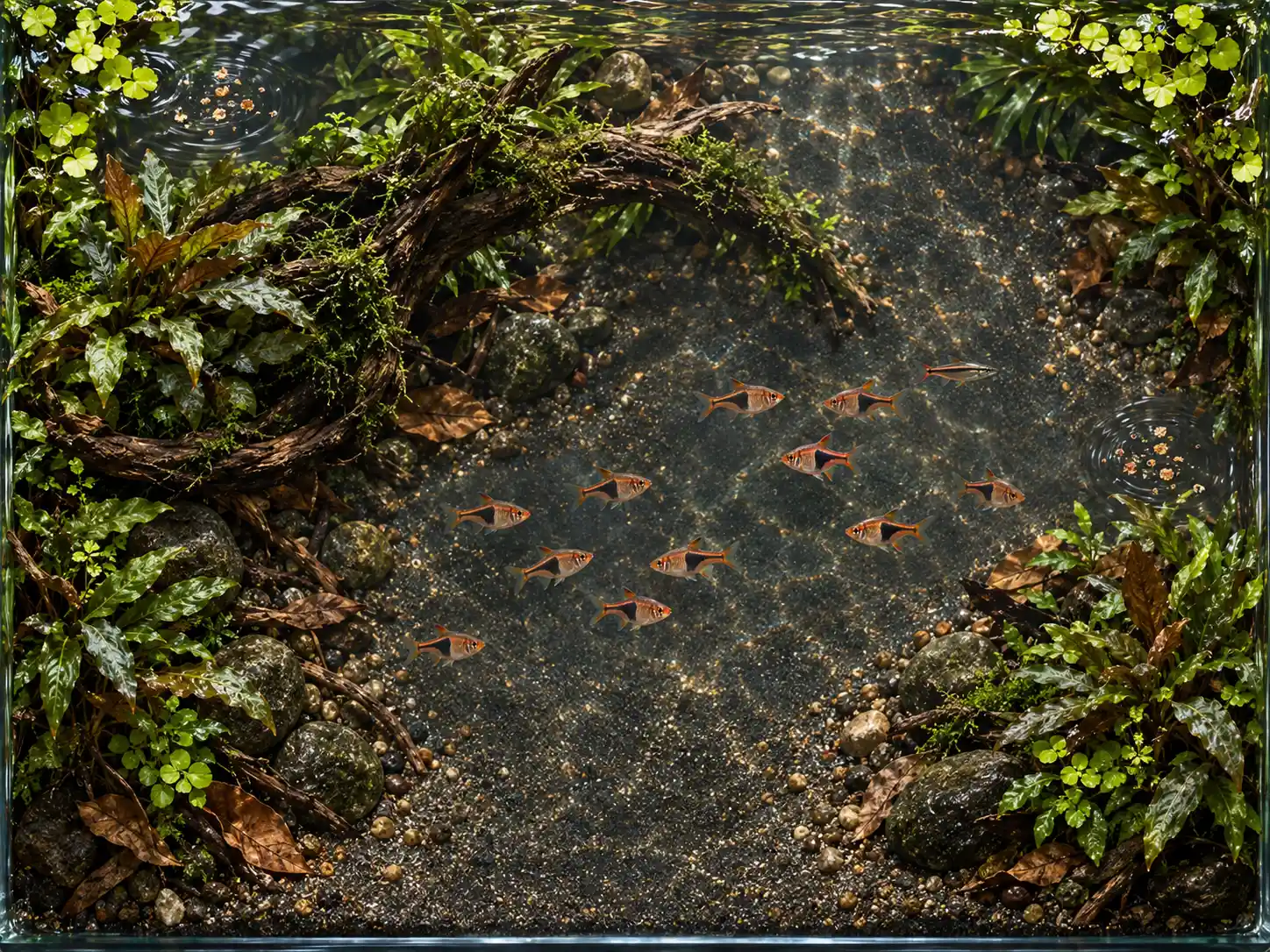
Broad-leaf margins
Use plants and roots along the rear and ends instead of filling the middle with a dense wall.
Open midwater
Protect the lane used by the complete school after décor and equipment are installed.
Broken light
Floating cover or a restrained lamp suits a shaded forest-stream presentation without eliminating plant growth.
Observable flow
Maintain circulation and surface movement while leaving at least one slower retreat zone.
Safe equipment
Guard intakes, close lid gaps, and secure heaters and hardscape before the school is introduced.
Maintenance path
Keep enough front access to remove trapped food and inspect the substrate beneath wood.
Broad leaves also matter to the species' recorded reproductive behaviour, but a display tank should not be presented as a controlled breeding system. Egg production, parent removal, and fry care belong to a separate plan when breeding is the objective.
Which water conditions suit harlequin rasboras?
FishBase compiles 22 to 25 °C, pH 5.0 to 7.0, and 5 to 12 dH for T. heteromorpha. These values fit a soft, slightly acidic forest-water context, yet supplier water and captive history still need to be measured before transfer.
Published harlequin rasbora water context
- Temperature22 to 25 °CSeparate thermometer away from heater and filter-return flow.
- pH5.0 to 7.0 pHCalibrated meter or liquid test that covers acidic water.
- General hardness5 to 12 dHDrop-count GH titration test reported in degrees of hardness.
Every range above applies to Compiled aquarium range for Trigonostigma heteromorpha in a freshwater system. Source: FishBase, checked 2026-09-15.
Do not average this range with a tank mate's range and assume the midpoint is safe. Choose a stable zone where both species have meaningful overlap, then confirm that the actual fish were not raised at a very different hardness or temperature.
Ammonia and nitrite should remain undetectable in an occupied mature aquarium. Test after new stocking, filter cleaning, overfeeding, a hidden death, or reduced filter flow rather than waiting for fading colour to become severe.
What do harlequin rasboras eat?
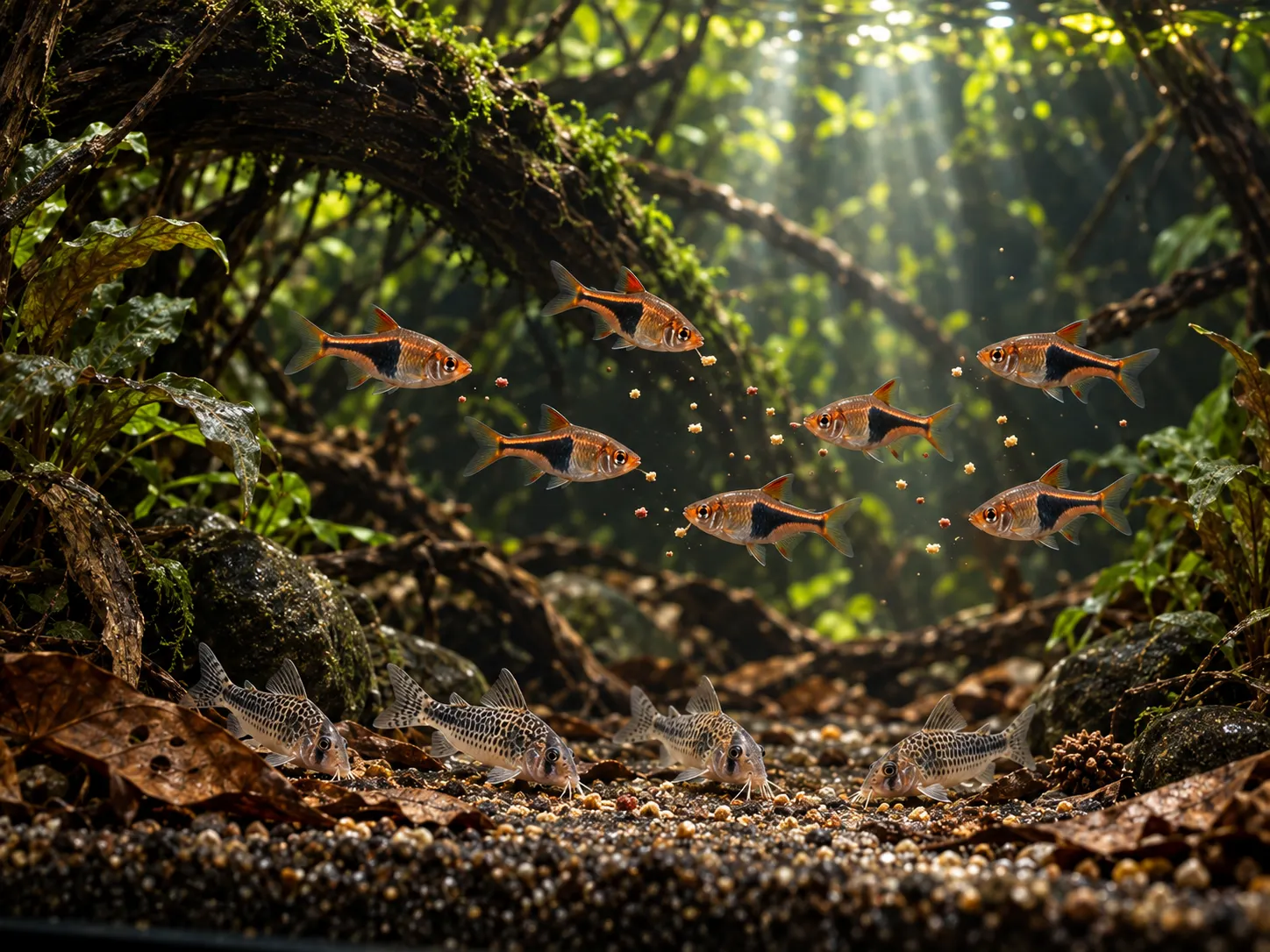
FishBase records worms, crustaceans, and insects in the natural diet. In an aquarium, use a complete small pellet or quality flake as the staple and rotate appropriately sized frozen or live invertebrate foods without allowing treats to displace balanced nutrition.
Harlequins feed through the upper and middle water and can become quick at a familiar feeding point. Distribute the ration so individuals near plant cover can eat without crossing a dense cluster of bolder fish.
- Choose a complete small staple Match particle size to the adult mouth and confirm the food remains available in midwater.
- Split the first portion Release food at two points so the school spreads instead of forming one feeding knot.
- Watch the rear fish Confirm individuals near plants swallow food and do not remain excluded.
- Feed bottom animals separately Place their ration after the rasboras have begun feeding above.
- Stop before deposits form Remove persistent food and reduce the next portion when particles reach inaccessible pockets.
- Review the trend Use body condition, appetite, waste, nitrate, and filter performance rather than a fixed pellet count.
Live food can introduce pathogens or unwanted animals when the culture source is uncertain. Quarantine or culture practices matter, and a varied diet does not require feeding wild-collected insects or larvae from contaminated water.
Which tank mates leave the school enough room?
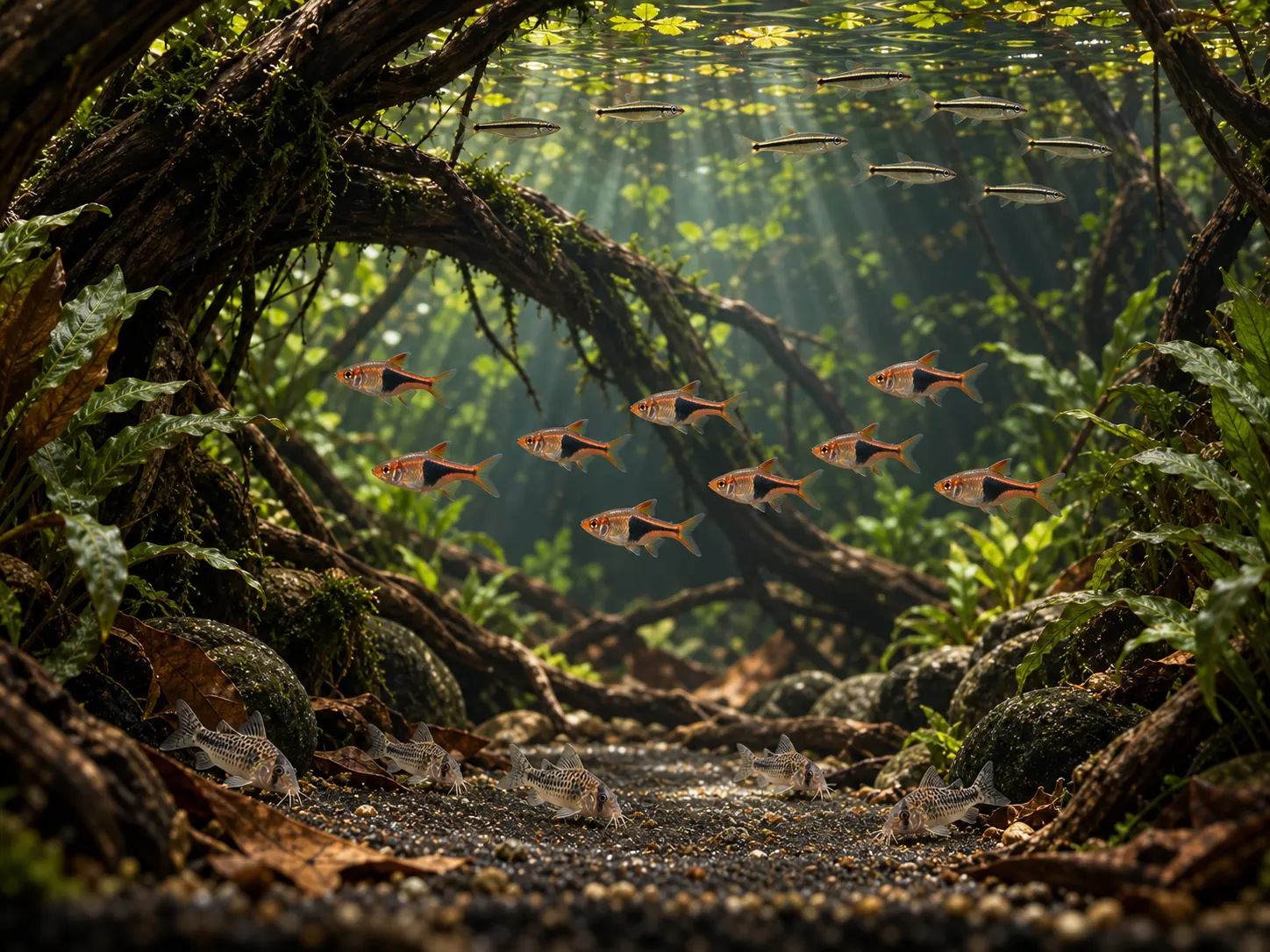
Harlequin rasboras are generally peaceful, but a suitable companion must share the water range, remain unable to swallow them, avoid persistent fin contact, and still fit after both species receive complete social groups. Another midwater school competes for the same route even when every fish appears calm.
Bottom fish can make good use of a different layer when the substrate, temperature, and oxygen suit them. Surface fish may also fit, but lid security and feeding distribution must account for all three layers rather than treating vertical separation as extra volume.
Compare possible community fish
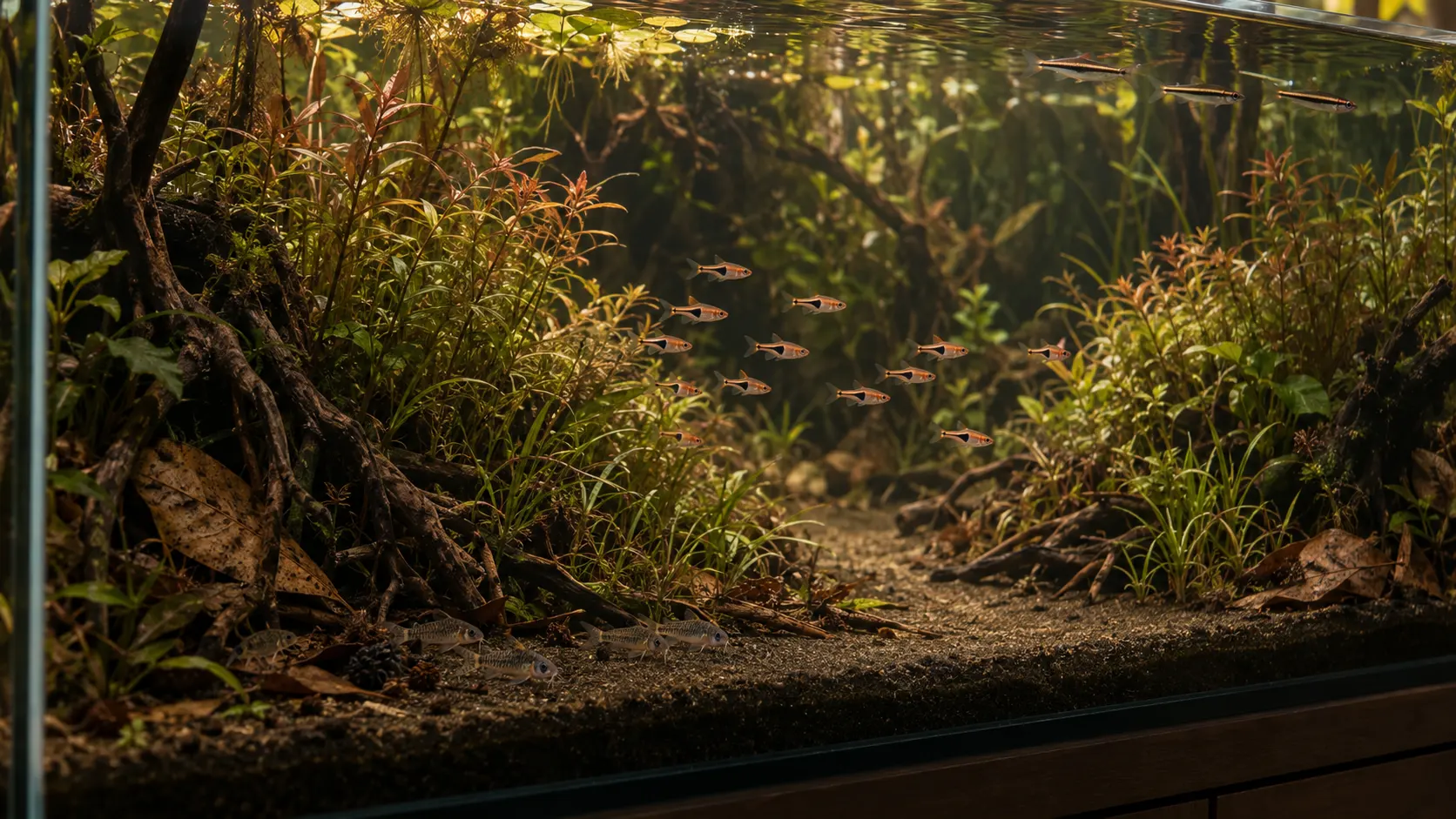 Lambchop rasbora
Smaller and slimmer, with a separate full school that would occupy much of the same midwater lane.
 Ember tetra
Calm and small, but its own group and feeding needs still add to midwater demand.
 Cardinal tetra
Warm soft-water overlap can work only where both complete schools retain space and oxygen.
 Cherry barb
Similar peaceful reputation with different social and planted-cover behaviour.
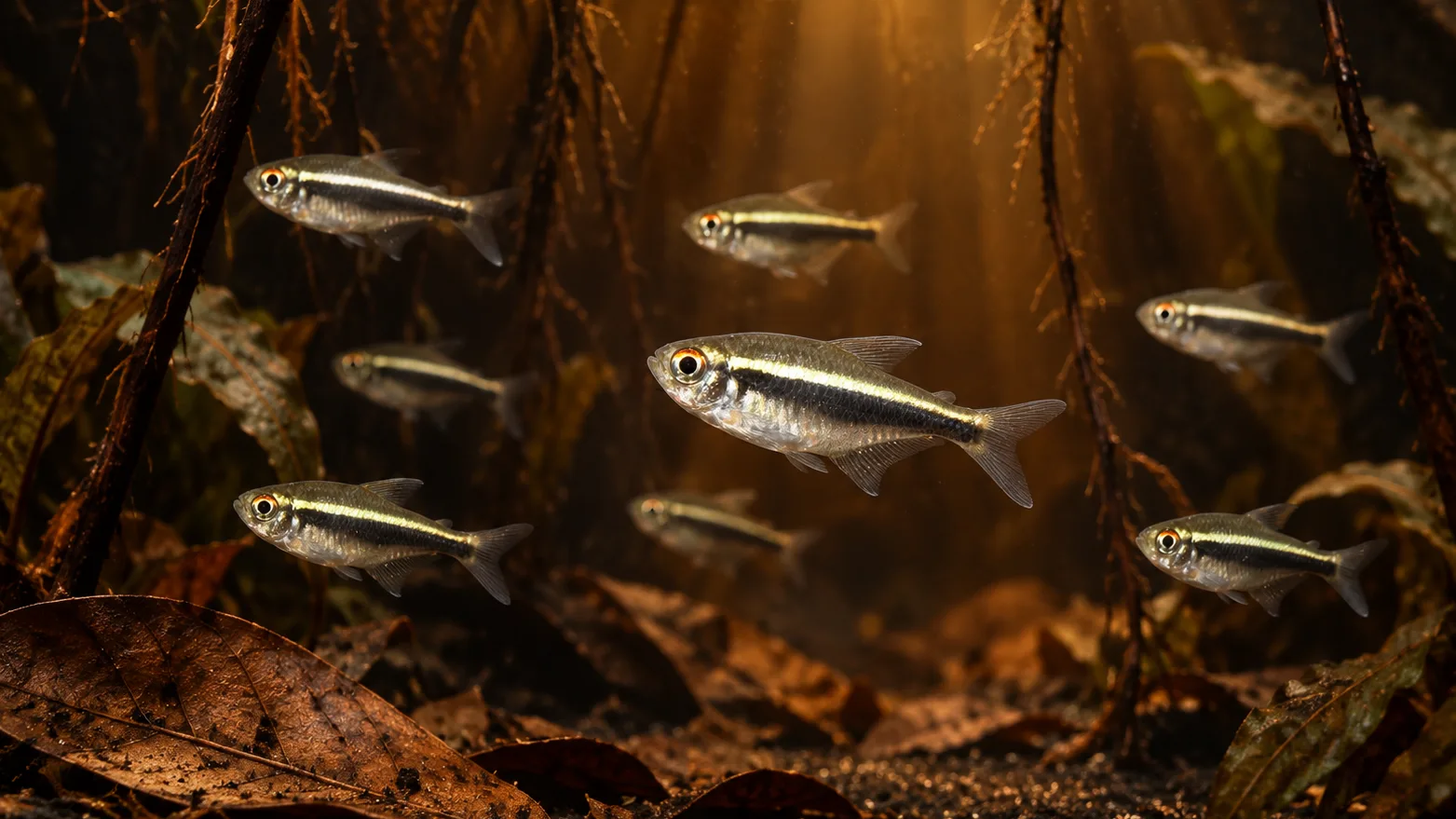 Black neon tetra
Larger and more assertive at food, changing both footprint and meal distribution.
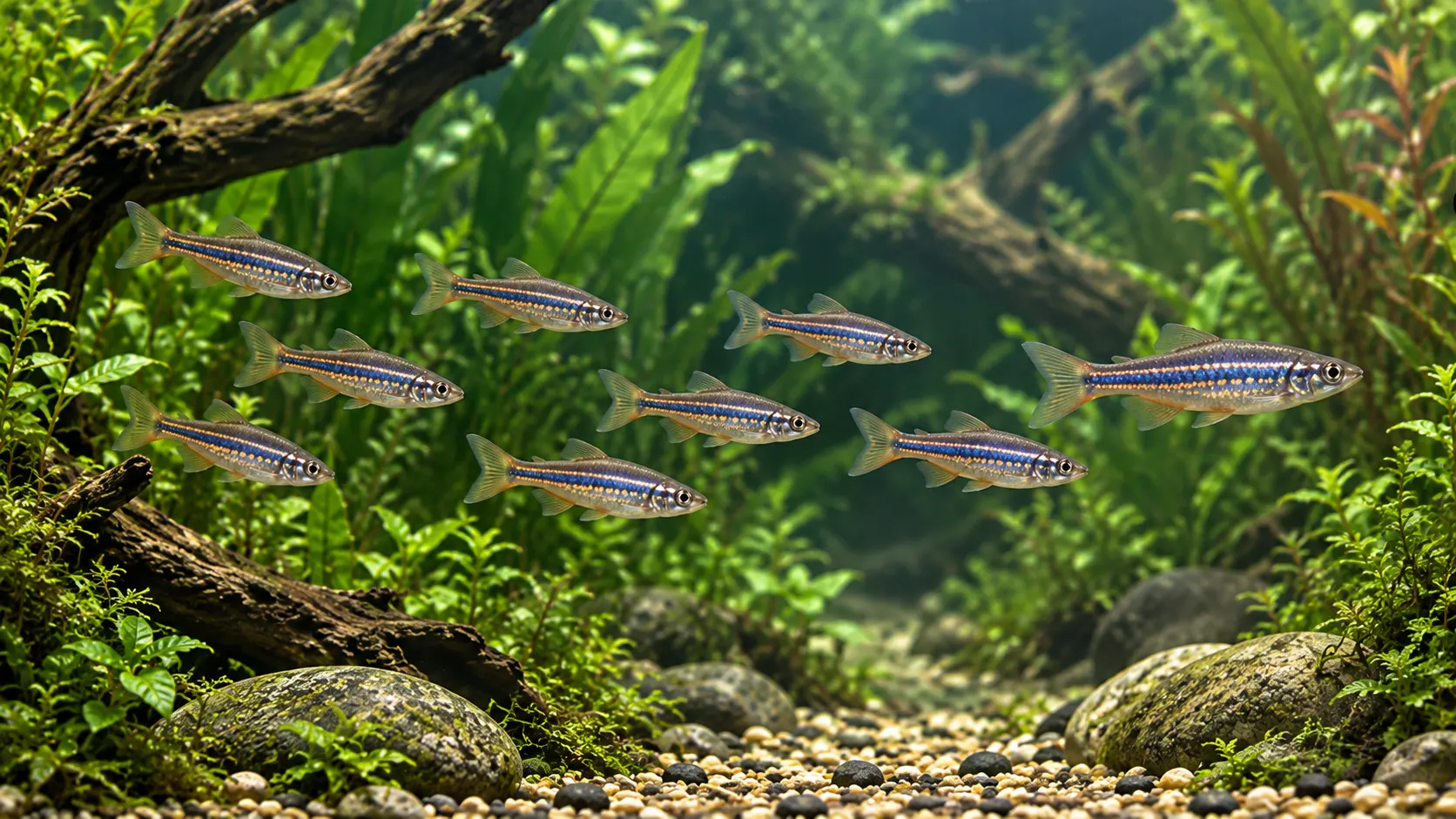 Giant danio
Much larger and faster, making it a poor comparison for a modest harlequin aquarium.
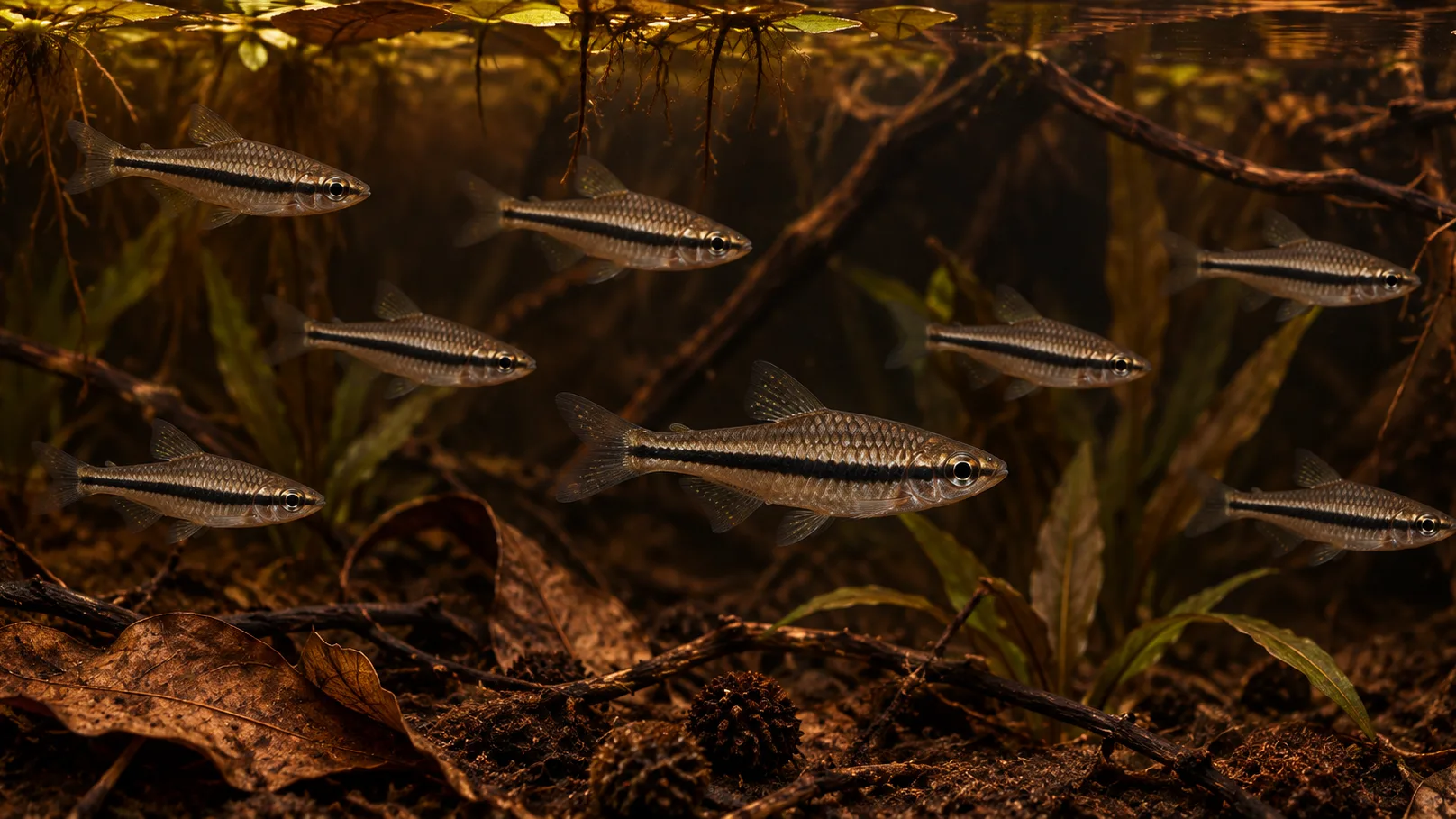 Brilliant rasbora
A longer rasbora whose adult footprint and open-water demand are substantially greater.
 Clown rasbora
A larger dark-marked rasbora with a different identity and capacity requirement.
 Emerald eye rasbora
A slimmer school with different body scale and habitat details.
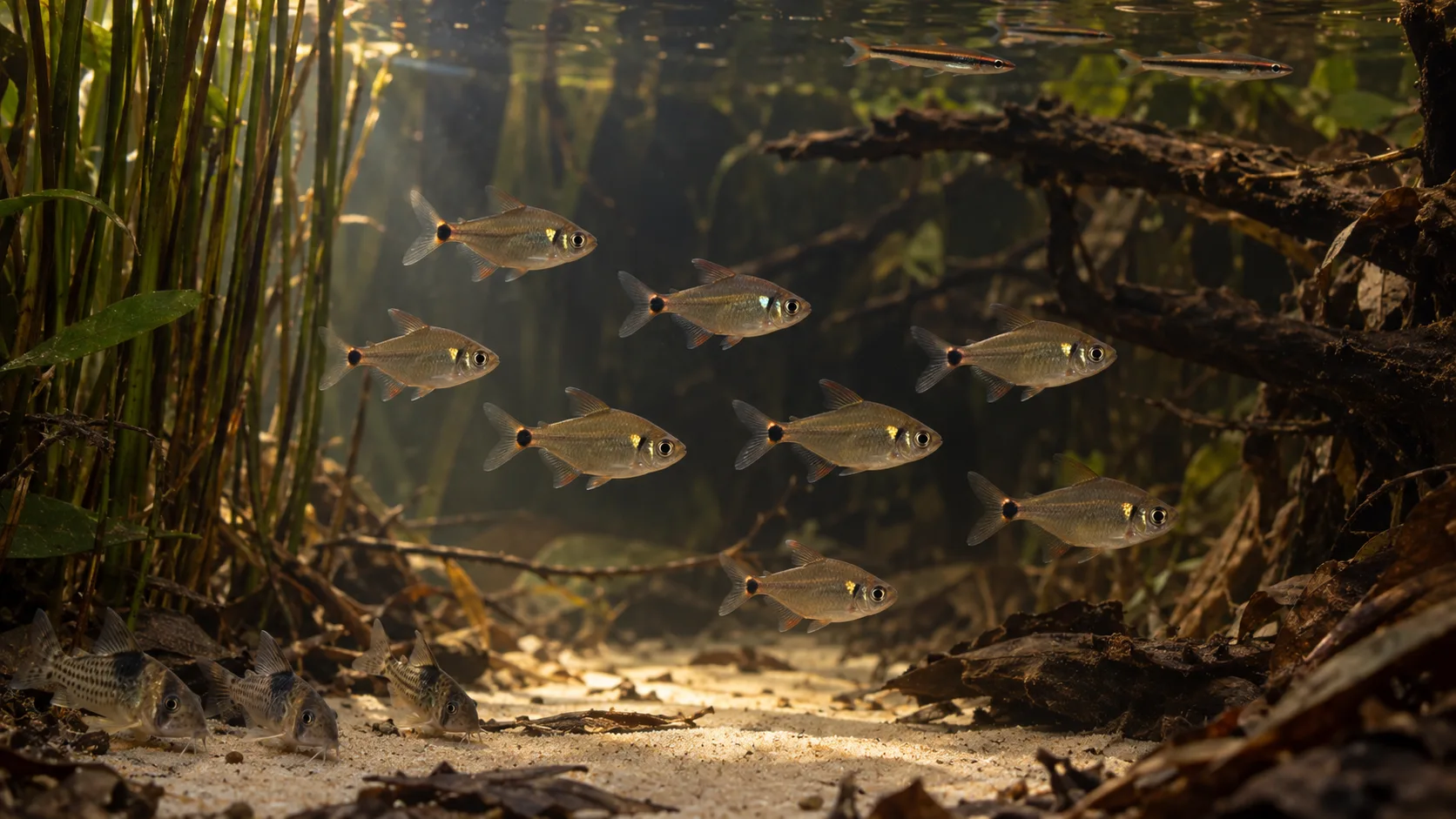 Head and tail light tetra
A similarly subtle community school whose reflective spots need shaded contrast.
You should exclude or use high caution with long-finned slow fish, territorial cichlids, forceful barbs, and any predator with a suitable mouth. Keep a ready separation option because a species-level reputation cannot guarantee the behaviour of one fish in one footprint.
What does normal display or spawning behaviour look like?
Settled harlequins may intensify colour, perform short parallel displays, and inspect broad leaves. FishBase records eggs being placed on the underside of broad leaves, which differs from the open scattering behaviour often applied generically to small cyprinids.
Breeding is a separate project from normal display. Do not alter temperature or chemistry sharply to trigger spawning, and do not retain eggs or fry without a mature nursery, suitable first foods, and an adult population plan.
When should colour loss trigger action?
Colour can soften after transport, at night, or when viewed over a pale bright substrate. Persistent fading matters more when the fish also hide, breathe rapidly, clamp fins, stop eating, lose balance, or fragment into several isolated individuals.
Check the aquarium before changing several variables
- Temperature and oxygen Verify the thermometer, surface movement, filter return, and recent hot weather or power loss.
- Toxic nitrogen Test ammonia and nitrite after stocking, filter work, heavy feeding, or a death.
- Recent water change Compare replacement temperature, conditioner, source chemistry, and anything that contacted the hose or bucket.
- Social access Confirm each fish can leave a chase, enter the open lane, and eat at both feeding points.
- External contamination Review sprays, soap, untreated water, metal, and shared aquarium equipment.
Several fish gasping, rolling, losing balance, or crowding the surface at once points first to shared water or oxygen. Increase safe surface movement, verify temperature, test toxic nitrogen, and use conditioned temperature-matched replacement water when contamination or toxicity is confirmed.
Do not diagnose a named disease from a faded wedge or photograph. Avoid combining medication, chemistry adjustment, complete filter cleaning, and a major rescape without a confirmed condition.
Are harlequin rasboras threatened or restricted?
FishBase lists T. heteromorpha as Least Concern, assessed 26 January 2019, and lists CITES as Not Evaluated. A global category does not establish the condition of every peat swamp, the legality of a shipment, or the identity of a fish sold under a broad regional common name.
The 2020 description of T. truncata also shows why locality records matter. A fish once grouped casually with the harlequin may belong to a different accepted species, so origin claims should be preserved rather than rewritten to match an old label.
A harlequin school fits when you can provide at least eight adults with a long open midwater route, planted margins, stable soft-water conditions, distributed food, and companions that leave the school enough space. The copper wedge is the visible attraction, but adult group size and whole-tank care decide whether the display remains workable.