
What Is a Lemon Tetra, and What Does Its School Need?
Hyphessobrycon pulchripinnis
The lemon tetra is a small South American schooling fish whose colour and confidence depend on a complete group, stable water, shaded cover, and open midwater. Plan the aquarium around eight or more adults rather than one 3.8 cm fish, then add tank mates only if every group retains space, oxygen, and feeding access.
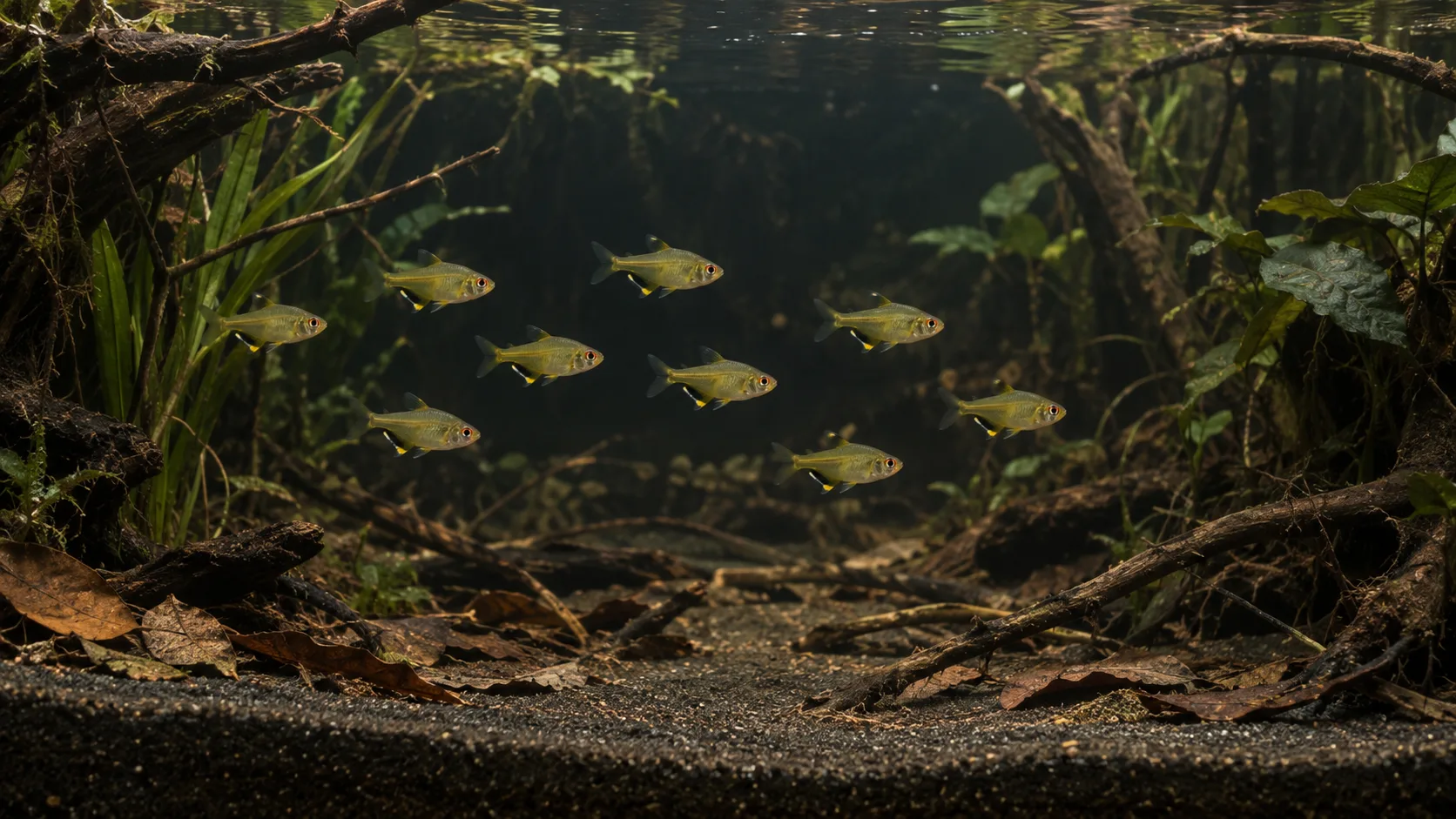
At a glance

- Adult size
- 3.6 to 3.8 cm
- Minimum footprint
- 60 x 30 cm or larger
- Minimum volume
- 54 litres
- Social structure
- Schooling midwater fish; keep a complete group
- Minimum group
- 8
- Diet
- Omnivore
- Feeding
- Keep shaded margins and an open midwater lane; distribute fine food across the group.
- Waste load
- low per fish; moderate for a full school
- Family
- Acestrorhamphidae
- Native range
- Tapajós River basin, South America
- Conservation status
- Least Concern, assessed 7 November 2018 Source
Adult body size, social structure, swimming behaviour, open routes, and filtration are considered together.
What is a lemon tetra?
A lemon tetra is Hyphessobrycon pulchripinnis, a small South American characin from the Tapajós River basin in Brazil. Its useful identifying combination is a translucent yellow body, a red upper iris, and an anal fin marked with yellow, black, and a pale leading edge.
Young or unsettled fish can look almost grey. Colour becomes easier to judge after the group has settled, eaten consistently, and spent time under restrained light, so a pale shop fish is not automatically a different species.
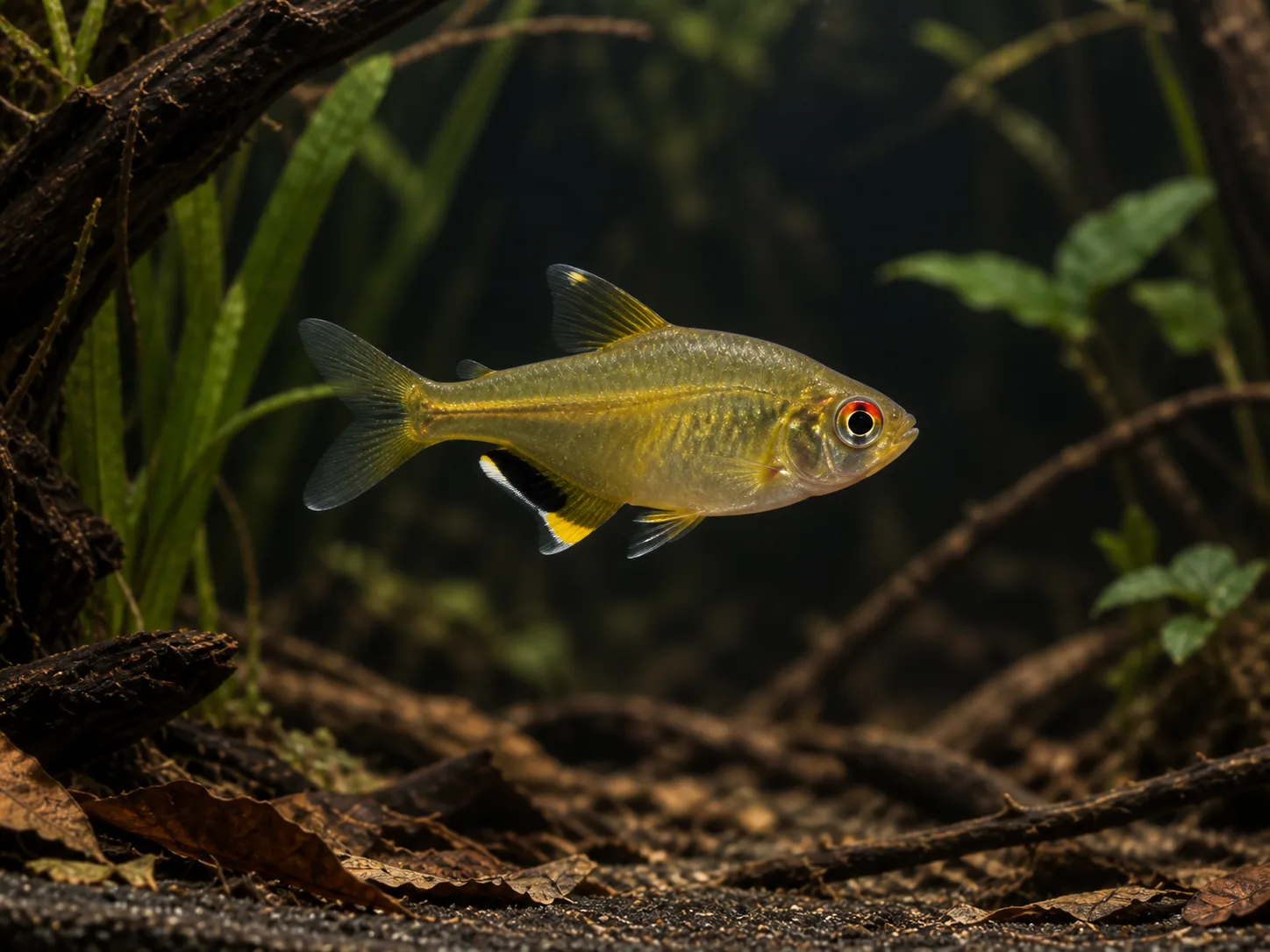
- Accepted identity
- Hyphessobrycon pulchripinnis Ahl, 1937
- Family
- Acestrorhamphidae
- Verified native range
- Tapajós River basin, South America
- Published maximum size
- 3.8 cm standard length for males and 3.6 cm for females
- Social structure
- Schooling fish, kept in a complete group
- Published aquarium length
- At least 60 cm
- Compiled water context
- 23 to 28 °C and pH 5.5 to 8.0
- Recorded diet
- Worms, crustaceans, and plant material
- Conservation
- Least Concern, assessed 7 November 2018
FishBase accepts the name, records the distribution and adult measurements, and lists the species as Least Concern. The broad pH and hardness entries describe compiled occurrence or husbandry records, not a target that every aquarium should be pushed toward.
How can you assess a lemon tetra group before buying?
Judge the whole sales aquarium before choosing individual fish. A group that moves through open water, responds to food, and resumes loose schooling after a brief disturbance gives you more useful information than the brightest fish in a dark corner.
Body yellow varies with age, lighting, background, diet, transport, and social state. The red upper iris, translucent body, and layered anal-fin pattern are better identity clues, while severe wasting, open sores, rapid breathing, loss of balance, or unexplained deaths in the same system are reasons to leave the group where it is.
- Watch the tank before anyone approaches it or adds food.
- Confirm that most fish use open midwater rather than pressing against one wall.
- Ask how long the shipment has been in the shop and whether losses occurred.
- Look for full but not swollen bellies after feeding.
- Check that fins are open and both sides of the body look symmetrical.
- Choose the complete group from one stable system when possible.
- Prepare quarantine before the fish leave the shop.
Do not assemble a school from several weak groups merely to reach a preferred number. Each extra source adds another acclimation history and another opportunity to share pathogens, so a smaller healthy group held temporarily in quarantine is safer than mixing compromised shipments immediately.
The trip home matters as well. Keep the bag shaded and temperature-stable, go directly home, and avoid opening it repeatedly; once there, compare bag and aquarium conditions before deciding how slowly the transfer needs to proceed.
How large a group and aquarium do lemon tetras need?
One adult is physically small, but the keeper is housing a social group rather than a single 3.8 cm body. FishBase records groups of five or more and a 60 cm aquarium length; in a home display, eight to twelve fish gives more social choice and a clearer group response without treating five as a stocking target.
A 60 by 30 cm footprint can support a restrained species-focused group when the filter is mature and the middle remains open. A larger community needs more length because every additional school occupies water, consumes oxygen, and competes at feeding time.
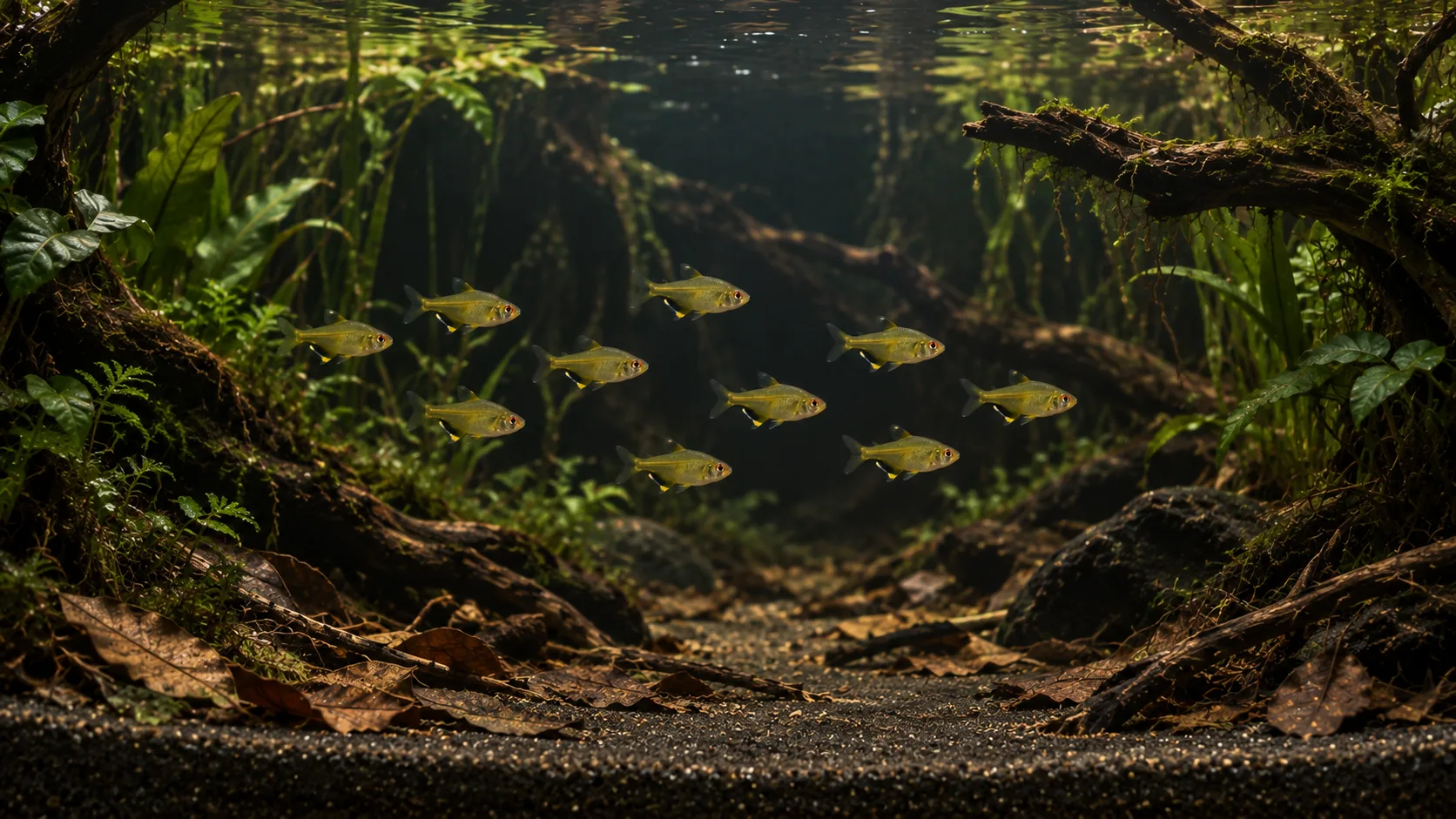
- Count the full adult group before choosing tank mates.
- Keep a continuous horizontal swimming route through the middle.
- Place dense cover at the rear and ends rather than filling every open lane.
- Use a fitted lid around cables and filter openings.
- Leave enough filtration and oxygen margin for a missed maintenance day.
- Watch whether every fish can leave a chase and reach food.
Short display chases can occur, especially among mature males. The important distinction is whether both fish disengage and return to the group, or whether one animal is repeatedly intercepted, loses colour, and stops feeding.
How should you read schooling, display, and chasing?
A lemon tetra school changes shape through the day. Fish may spread while feeding, align loosely while cruising, tighten after a sudden movement, and display more directly when mature males meet; one frozen picture of a tight group does not prove either comfort or fear.
The useful question is whether every fish can disengage. A brief parallel display that ends with both animals returning to the school differs from repeated interception that drives the same fish under leaves, away from food, or into a corner.
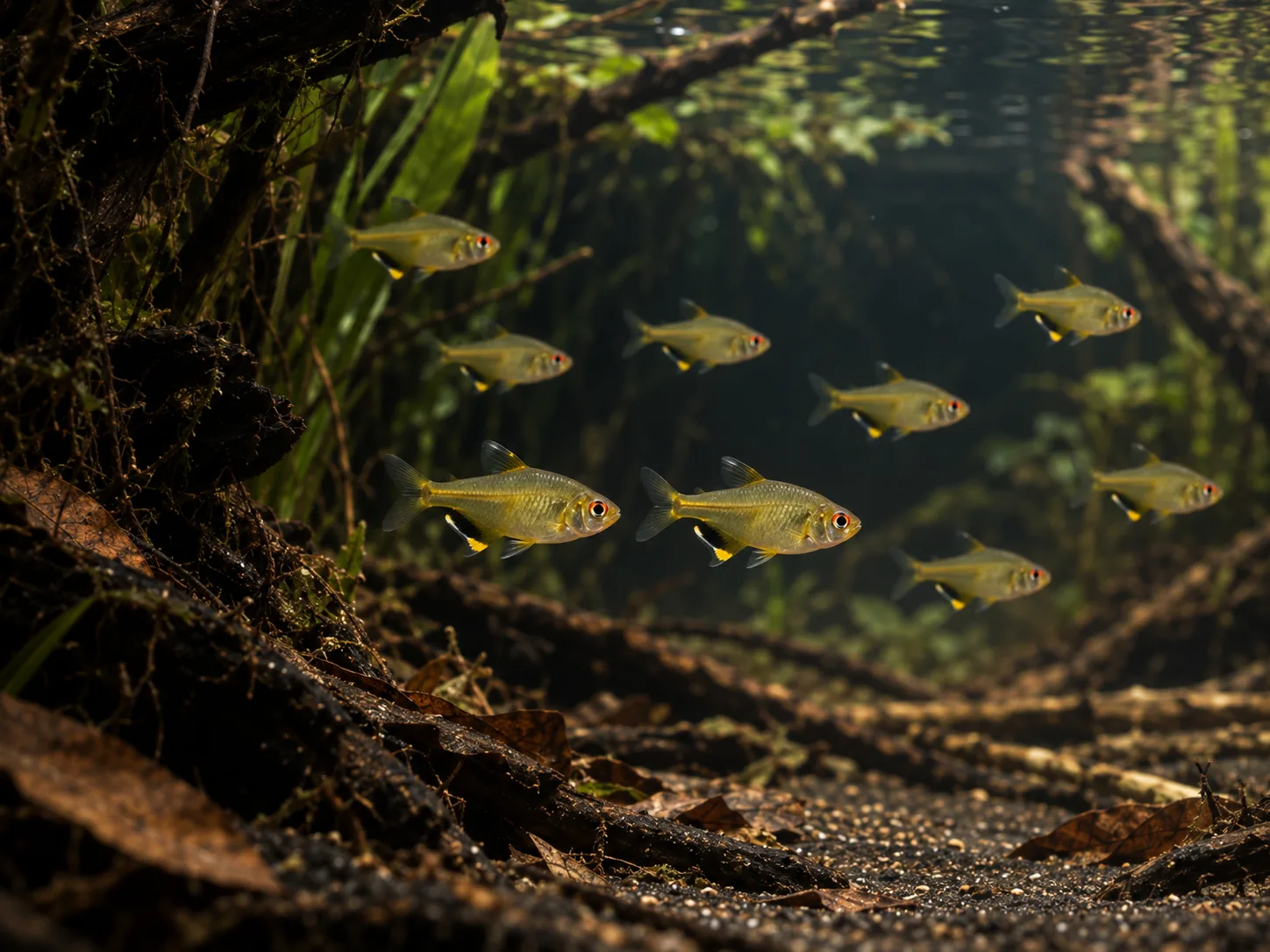
| Observation | Likely context | What to verify |
|---|---|---|
| School tightens for seconds | Startle or unfamiliar movement | Group spreads again after the disturbance |
| Two fish display side by side | Short social contest | Both disengage without torn fins |
| One fish stays behind cover | Possible pressure or illness | Feeding access, breathing, body condition, and water readings |
| Whole group holds at the return | Oxygen or water-quality concern | Temperature, surface movement, ammonia, and nitrite |
| School scatters at every approach | Insecure layout or abrupt routine | Shade, sight lines, room traffic, and lighting transitions |
Adding more fish can improve social choice only when the aquarium has space and filtration margin for them. It cannot repair toxic water, a predator in the tank, or a layout that leaves one narrow route controlled by the most assertive animals.
Record what happens before the behaviour, how long it lasts, and whether the same individual loses access afterward. That sequence is more useful than labelling every chase as aggression or every tight school as healthy.
What water conditions suit lemon tetras?
FishBase compiles 23 to 28 °C and pH 5.5 to 8.0, with hardness reported up to 25 dH. That wide hardness record is a reason to verify the supplier's water and your source water, not permission to move a settled tank abruptly across the range.
Published lemon tetra water context
- Temperature23 to 28 °CApplies to Compiled species range. Separate aquarium thermometer away from the heater.
- pH5.5 to 8.0 pHApplies to Compiled species range. Calibrated meter or liquid test spanning the source-water value.
- General hardnessUpper record of 25 dH; lower bound not suppliedApplies to Incomplete compiled hardness record. Drop-count GH titration test in degrees of hardness.
Every range above is for a freshwater system. Source: FishBase, checked 2026-09-15.
Ammonia and nitrite should remain unmeasurable with the method you use. A rising nitrate trend, reduced filter flow, or several fish breathing rapidly points to a system problem that must be measured before pH products or other additives are considered.
A stable value within an appropriate overlap is safer than a rapid correction toward a preferred number. Compare bag water and tank water before acclimation, then slow the transfer when temperature or conductivity differs substantially.
Which layout supports colour and normal movement?
Lemon tetras show best against subdued ground with shaded margins, but they still need open water. A riverbank-inspired layout with fine branches, low leaf litter, and plants gathered behind the school gives contrast without turning the aquarium into a narrow corridor.
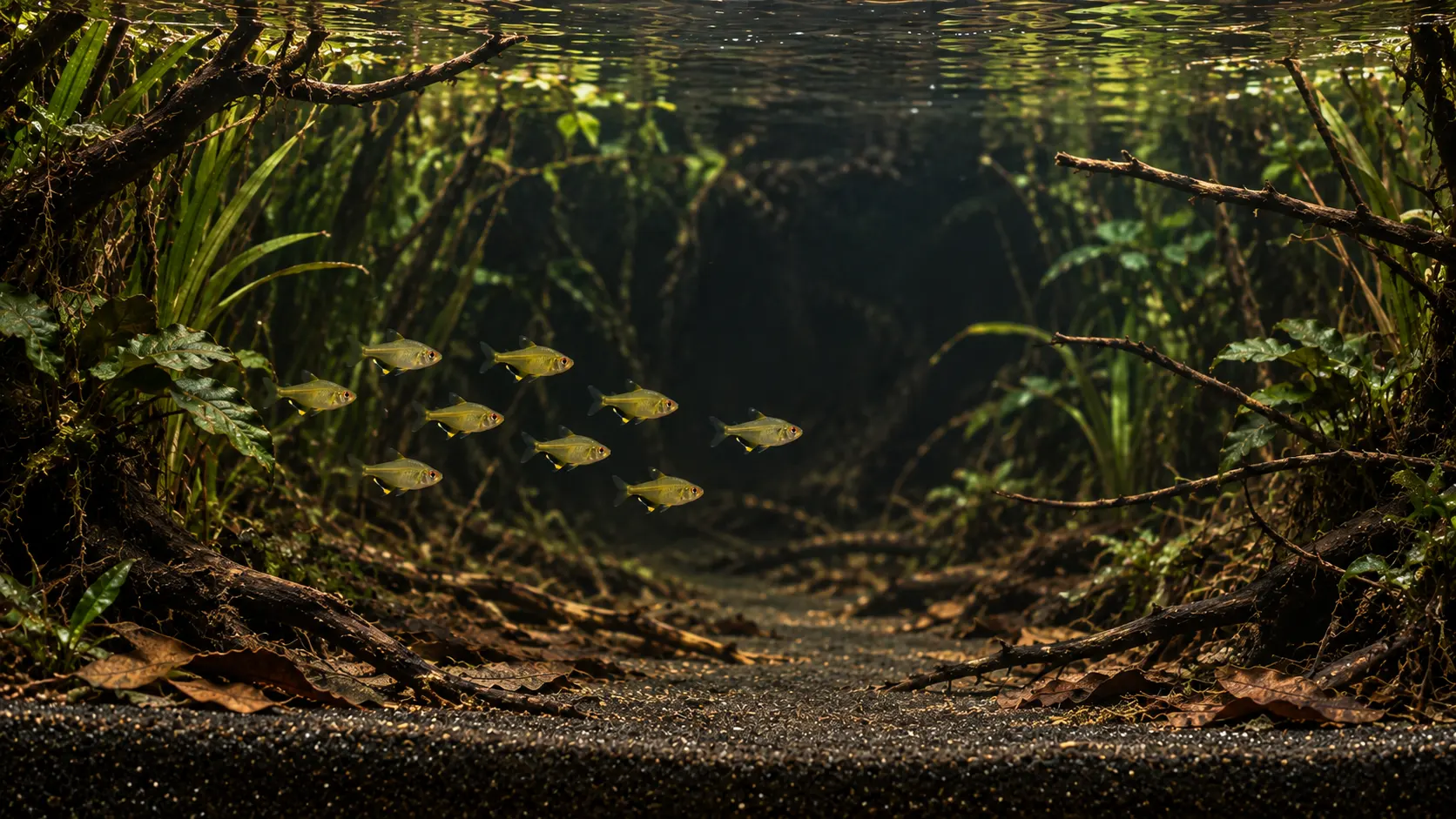
Open midwater
Keep one clear route at least most of the tank length.
Shaded retreat
Floating leaves or tall marginal plants soften glare and give the group a choice.
Fine hardscape
Slim branches divide sight lines without consuming turning room.
Dark lower ground
Sand and restrained leaf litter make yellow bodies easier to see.
Gentle surface ripple
Gas exchange remains visible without blasting the school across the tank.
Predictable lighting
A timer and a short room-light transition reduce abrupt starts.
Dense floating plants should not seal the surface. Remove enough growth to preserve gas exchange and light access, especially during warm weather when water holds less oxygen.
What should lemon tetras eat?
FishBase records worms, crustaceans, and plant material. In an aquarium, a complete fine flake or micro-pellet can form the staple, with appropriately sized frozen or cultured foods used for variety rather than as the only diet.
The practical problem is distribution. Bold fish collect a concentrated pinch quickly, while quieter animals near cover can become thin even though the aquarium receives plenty of food.
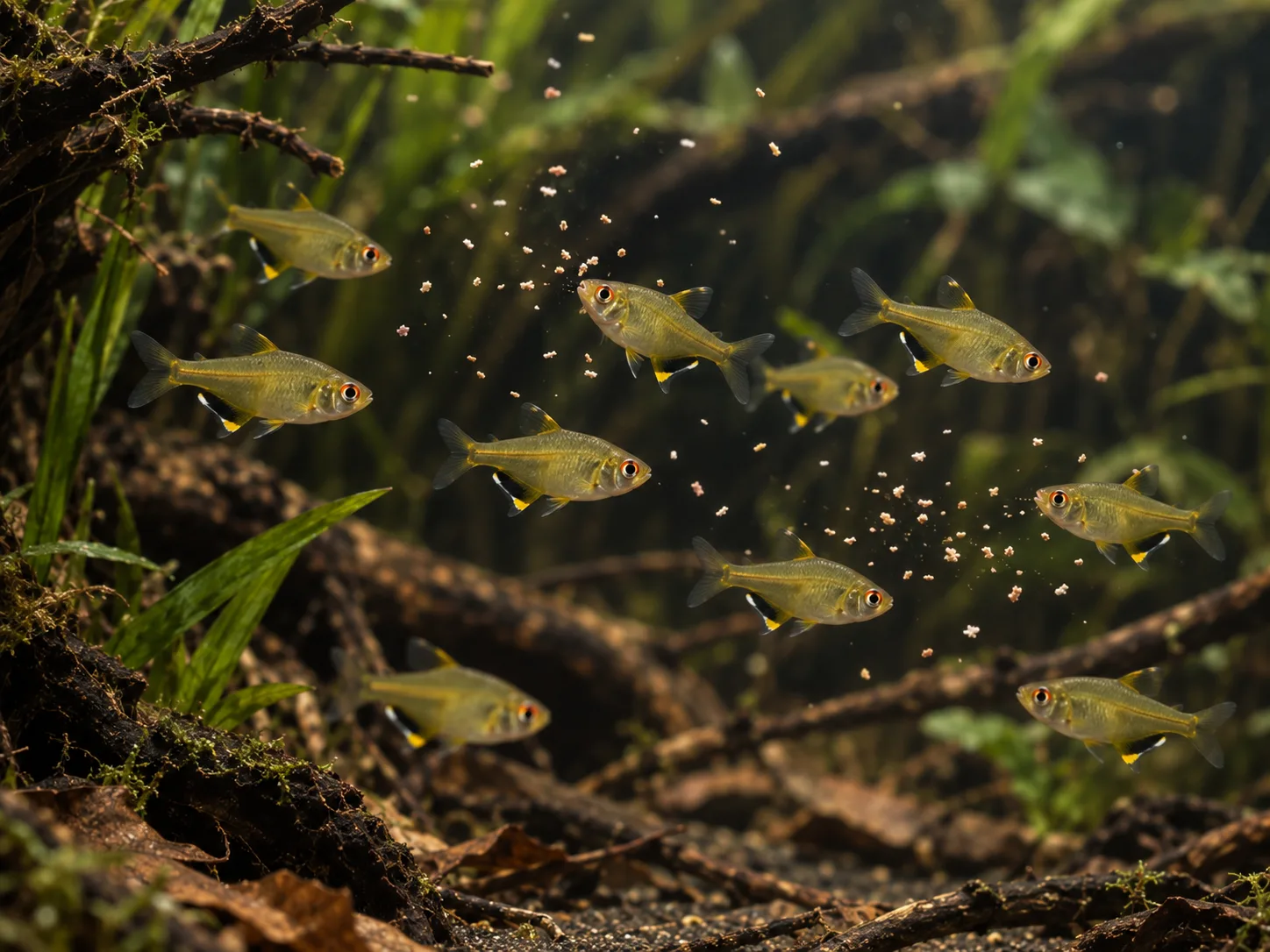
- Choose a small particle It should enter the mouth without repeated taking and spitting.
- Split the portion Feed two separated areas so the group cannot form one tight queue.
- Watch the rear fish Confirm that animals near cover take several pieces.
- Stop before food settles Remove the cause of avoidable waste rather than relying on cleanup animals.
- Review body condition Adjust the next meals from fish shape and water trend, not begging behaviour.
A rounded abdomen immediately after a meal should settle; persistent swelling, wasting, or refusal to eat needs investigation. More food cannot correct exclusion, poor water quality, or disease.
Which tank mates are a sensible match?
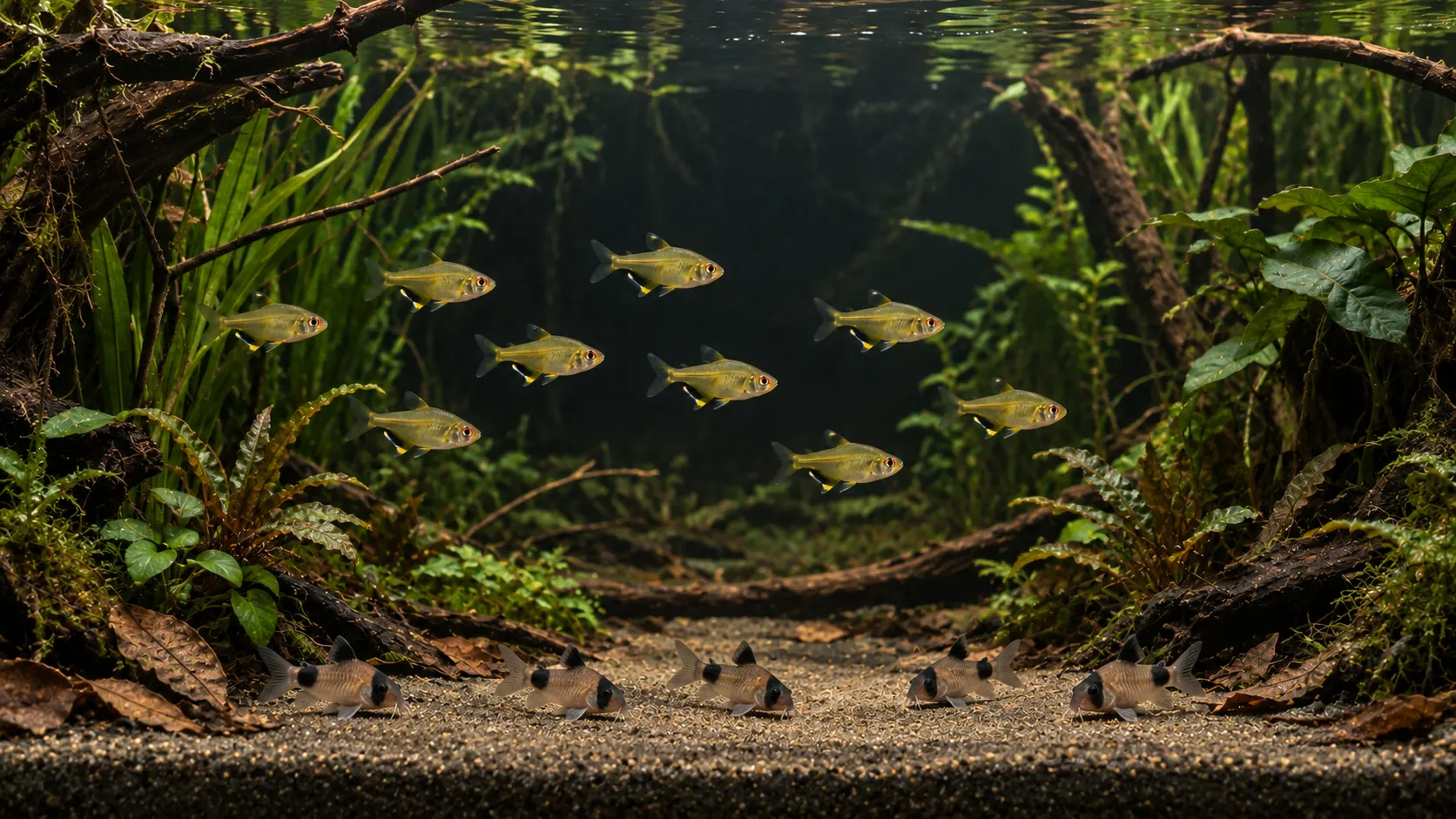
Suitable companions are peaceful, unable to swallow an adult lemon tetra, comfortable in the same stable water, and unlikely to dominate every feeding point. The aquarium must still fit each species' complete group and leave separate routes for midwater and bottom residents.
| Decision | Better match | Poor match |
|---|---|---|
| Adult size | Small peaceful fish that cannot swallow a tetra | Large predatory mouth or ambush hunter |
| Temperament | Brief display followed by disengagement | Persistent chasing or fin damage |
| Water overlap | Both species sit comfortably in one stable range | One species held at an edge of tolerance |
| Feeding access | Food can be offered in separate places or levels | One fast group clears every meal |
| Space | Full groups retain open lanes and retreats | Several schools compressed into the same middle strip |
Ember tetras and glowlight tetras are possible midwater comparisons, but each requires its own school and adds feeding competition. Panda corydoras use the lower zone where temperature, sand area, and oxygen overlap remain suitable, while a giant danio is too large and fast for the same compact plan.
Long-finned fish can be unsettled by quick tetras even when no injury appears. Shrimplets may be eaten, so an adult-shrimp display should never be described as a safe breeding colony.
When does a change in colour or behaviour matter?
Lemon tetras can look muted after transport, at lights-on, or during a brief disturbance. Concern rises when the change persists and comes with clamped fins, isolation, missed meals, rapid breathing, rubbing, swelling, sores, or loss of balance.
Check shared causes before guessing at disease
- Temperature and oxygen Verify the thermometer, surface movement, filter return, and recent warm weather.
- Ammonia and nitrite Test after new stocking, filter cleaning, a power cut, or several fish changing together.
- Recent water change Compare temperature, conditioner, source-water chemistry, and anything that touched the bucket.
- Social pressure Watch whether one fish is blocked from food or cover.
- Contamination Review sprays, soap, metals, untreated water, and equipment shared with another tank.
Several fish gasping or losing balance at once requires immediate oxygen and water-quality checks. Persistent breathing distress, open sores, bleeding, major swelling, or continuing losses warrant an aquatic veterinarian rather than a medicine chosen from appearance alone.
How long do lemon tetras live and how do they breed?
The accessible authoritative species records used here do not establish a dependable aquarium lifespan. Plan for several years of care, record the purchase date, and judge success from long-term body condition and behaviour rather than an unsupported expiry age.
The published reproductive work describes repeated spawning acts, territorial males during morning breeding activity, females entering those territories, and eggs released near plant material. Adults provide no parental care, so a community aquarium may produce spawning without producing surviving young.
Buying a complete group from one healthy system is usually safer than assembling pairs from several shipments. Reject fish with persistent respiratory effort, obvious sores, severe wasting, or a tank containing unexplained deaths, then quarantine the group before it shares water or equipment with established fish.
Is a lemon tetra right for your aquarium?
A lemon tetra group suits a mature, covered aquarium with at least 60 cm of length, stable warm water, shaded margins, and open midwater. It is a poor choice when only two or three fish fit, the tank is newly cycled, or existing residents already control the whole feeding zone.
- The tank is mature and ammonia and nitrite remain unmeasurable.
- At least eight fish fit before community additions are counted.
- The aquarium provides both shaded cover and an open horizontal route.
- Source water overlaps the supplier's conditions without a rapid chemistry correction.
- Fine food can be distributed where every fish is visible eating.
- A separate quarantine setup is ready before purchase.
- No aquarium animal, plant, or water will be released outdoors.