
What Is a Medaka Ricefish, and Can It Live Outdoors?
Oryzias latipes
Medaka ricefish are small subtropical surface fish whose temperature and day length change their activity and breeding. They can suit an unheated aquarium or a secure seasonal container, but only when the actual daily range, predators, overflow, group size, and winter plan have been measured rather than assumed.
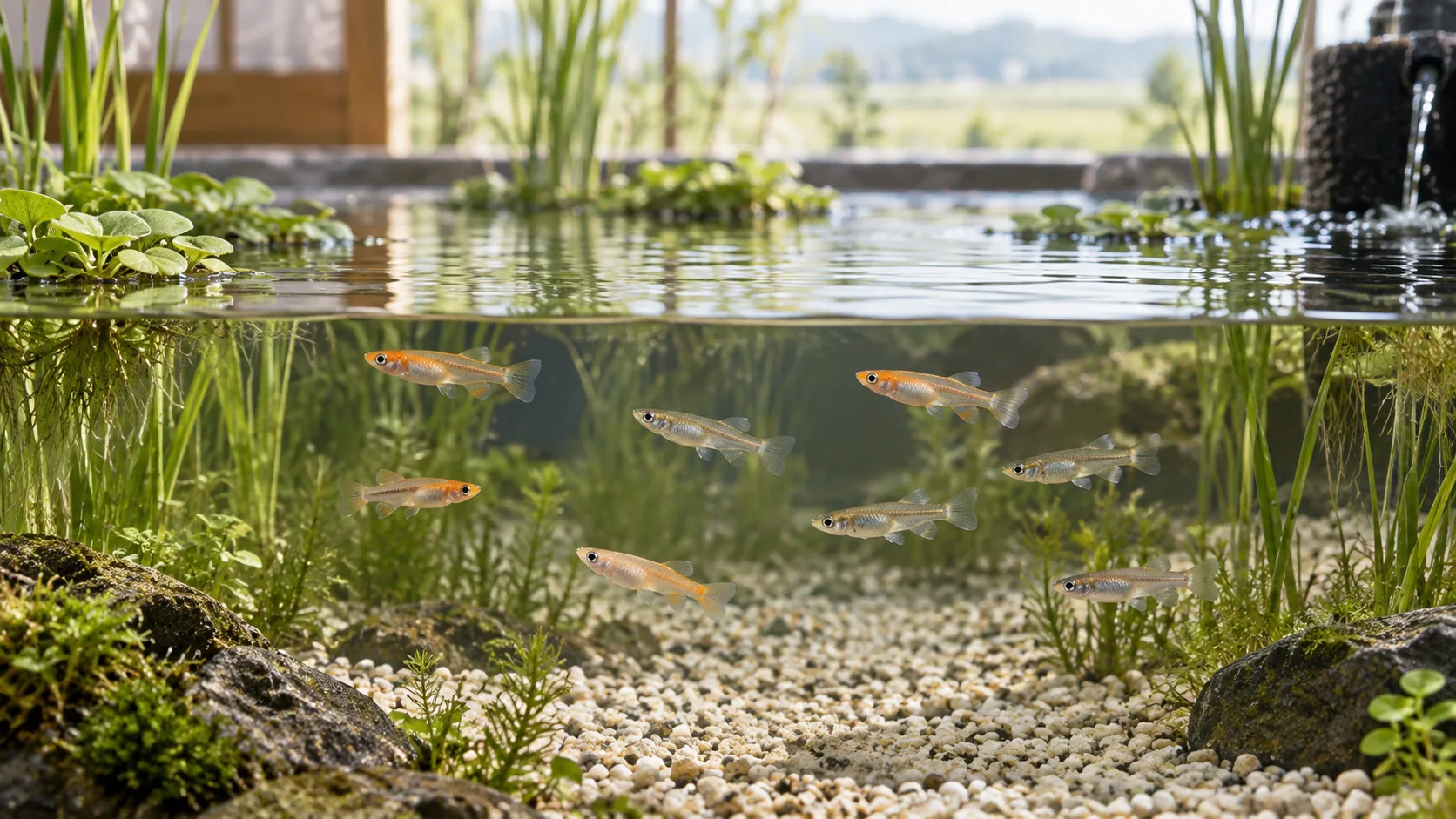
At a glance

- Adult size
- 3 to 4 cm
- Minimum footprint
- 60 x 30 cm or larger with broad surface area
- Minimum volume
- 54 litres
- Social structure
- Social surface fish; keep a group
- Minimum group
- 8
- Diet
- Omnivore
- Feeding
- Keep open surface lanes between floating plants and prevent jumps, predators, and overflow escapes.
- Waste load
- low per fish; population can grow quickly
- Family
- Adrianichthyidae
- Native range
- East Asia, including Japan, Korea, China, and Viet Nam
- Conservation status
- Least Concern, assessed 1 March 2018 Source
Adult body size, social structure, swimming behaviour, open routes, and filtration are considered together.
What is a medaka ricefish?
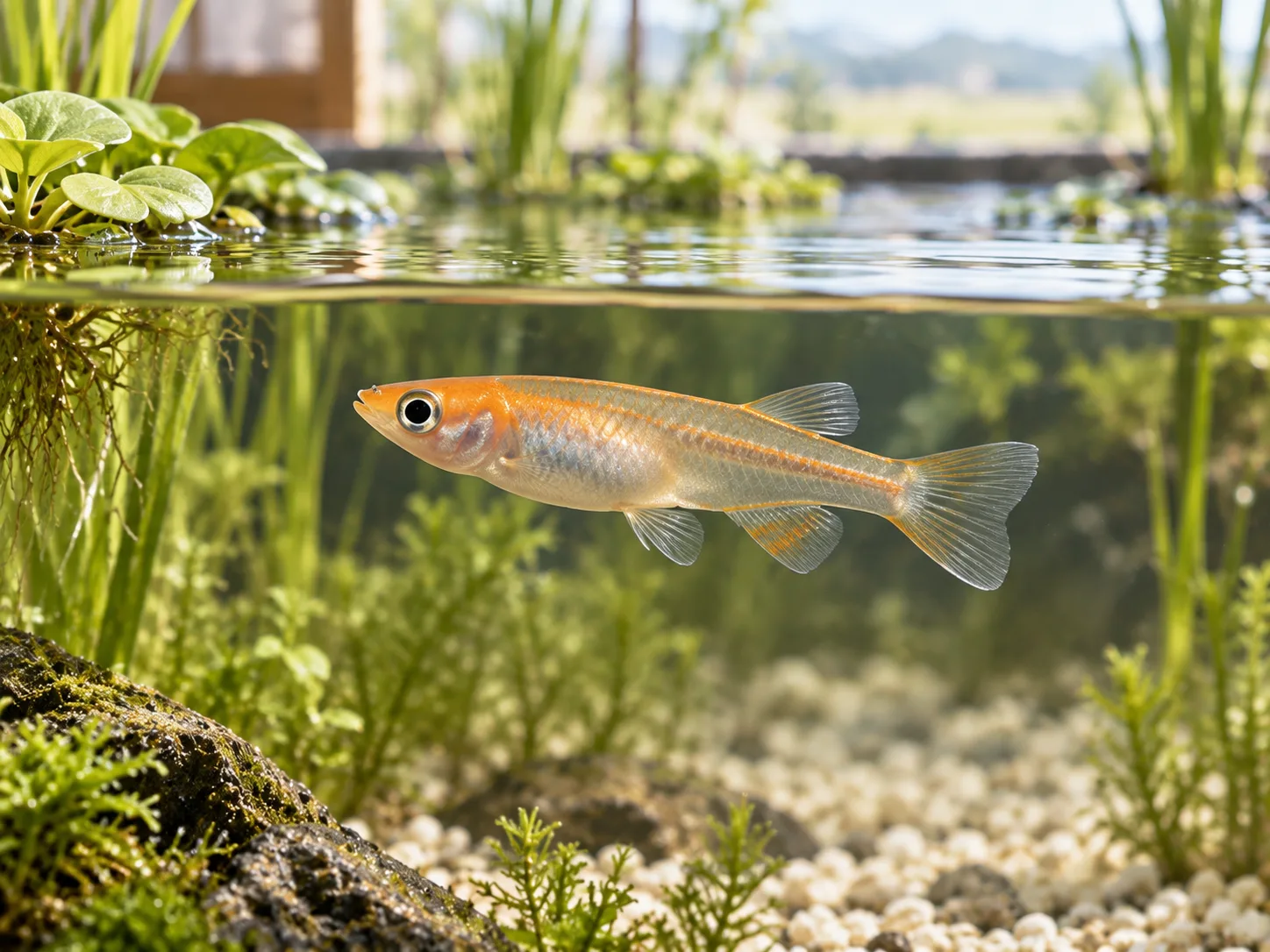
A medaka ricefish is Oryzias latipes, a small East Asian ricefish long kept as an ornamental animal and laboratory model. It has an elongated body, an upturned mouth suited to surface feeding, and dorsal and anal fins set well back toward the tail.
Wild-type medaka are subdued silver-brown, while domestic strains may be orange, white, black, metallic, or patterned. Colour names describe a strain, not a separate species, and crossing strains can change the appearance of later generations.
- Accepted identity
- Oryzias latipes (Temminck and Schlegel, 1846)
- Family
- Adrianichthyidae
- Recorded habitat
- Ponds, marshes, rice fields, and slow lowland waters
- Published maximum size
- 4.0 cm standard length
- Water use
- Freshwater and some brackish habitats
- Compiled water context
- 18 to 24 °C, pH 7.0 to 8.0, 9 to 19 dH
- Diet
- Omnivorous, with strong surface-feeding behaviour
- Reproduction
- Egg-laying fish; females may carry attached eggs before deposition
- Conservation
- Least Concern, assessed 1 March 2018
FishBase records the accepted name, habitat, size, and environmental range. The U.S. Fish and Wildlife Service notes introductions outside the native range, which is why surplus fish, eggs, plants, and outdoor-container water must never reach a natural watercourse.
Can medaka live without a heater or outdoors?
Medaka are subtropical rather than permanently warm-water fish. FishBase compiles 18 to 24 °C, and research shows that temperature and day length alter activity and reproduction, but this does not create one safe outdoor rule for every climate or strain.
An unheated indoor aquarium is suitable only when its measured daily and seasonal range stays appropriate. Outdoor tubs add rapid heat, cold nights, predators, rain dilution, pollutants, and escape routes, so local weather and containment matter as much as the species label.
, open surface water, shaded refuge, and a thermometer](/images/photo/medaka-ricefish-seasonal-v01.webp?v=1789518797)
Do not move fish directly between a warm indoor aquarium and cold outdoor water. Compare temperatures, plan around the actual forecast, and stop the move if the new container cannot remain stable through the next day and night.
How should medaka move between indoor and outdoor water?
Choose the transfer day from measured conditions because calendar dates cannot show whether the two systems overlap. Two containers can sit in the same town and still differ sharply because one receives morning sun, one loses heat overnight, and each has a different volume, shade pattern, and source water.
Measure both locations at the fish's depth in the morning and late afternoon for several days. A suitable transfer window has overlapping temperatures and no forecast likely to push the outdoor container beyond the range you have already observed safely.
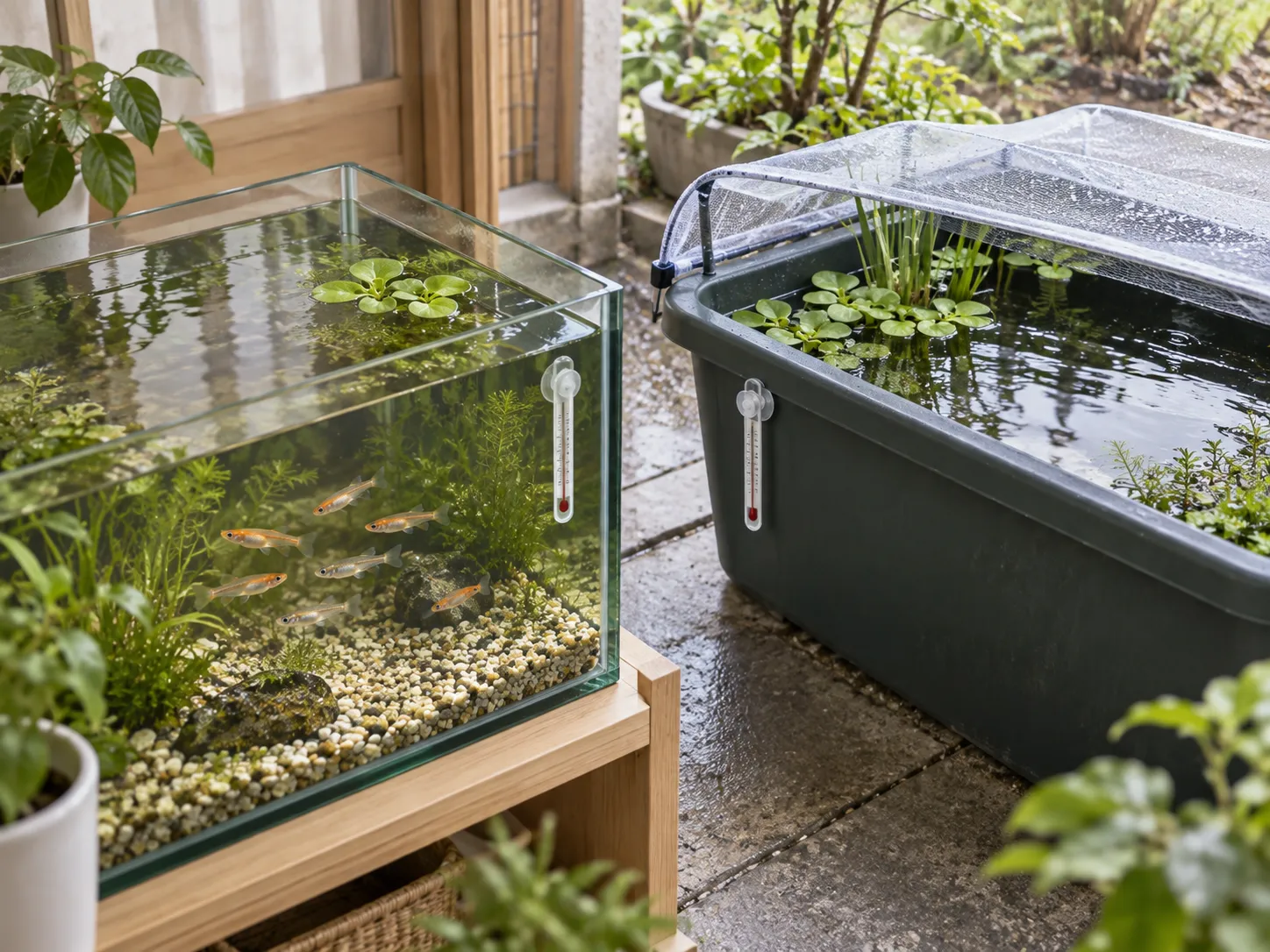
- Stabilize the outdoor container first Fill, dechlorinate, establish filtration or mature biological media, and verify ammonia and nitrite before fish move.
- Compare source water Check temperature and relevant chemistry rather than assuming both taps or rain-diluted containers match.
- Choose a mild weather window Avoid moving fish just before a heat wave, cold night, storm, or long absence.
- Transfer the whole social group Do not leave one or two fish isolated merely to test the container.
- Observe through the next day and night Confirm feeding, breathing, distribution, and temperature at both daily extremes.
- Keep the indoor backup usable A return plan needs cycled filtration and enough space, not an empty emergency bucket.
Moving fish back indoors in autumn requires the same preparation. A warm room can produce as much temperature difference as a cold night, and outdoor plants, nets, or water can carry animals and contaminants that should not enter an established aquarium without inspection.
If the two systems do not overlap, postpone the move. Repeatedly carrying fish back and forth to chase daily weather exposes them to more handling and instability than choosing one controlled location.
What group size and tank footprint work?
Medaka are social, visible fish that use the upper water rather than hiding as isolated individuals. A group of eight or more allows normal interaction, while a long tank or tub gives the group more usable surface than a tall vessel with the same volume.
A practical indoor starting footprint is 60 by 30 cm for a modest group, with additional length and filtration for breeding adults or tank mates. The lid must be secure because the fish feed and display close to the surface.
- Choose a long surface rather than paying for unused depth.
- Cover the aquarium without sealing off gas exchange.
- Keep open water between floating plant patches.
- Protect filter intakes from small fish and loose eggs.
- Leave room for the population increase that breeding can produce.
- Count hardscape and plant growth that reduce the usable surface.
Research colonies often use densities designed for controlled systems and daily observation. Those figures are not home-aquarium stocking recommendations; one husbandry study found reduced female growth and egg production as density increased.
How do you make an outdoor medaka container secure?
An outdoor container needs a route for rainwater that does not become a route for fish, eggs, plants, or snails. Set the overflow below the rim, guard it with material that cannot trap adults, and direct discharged water away from ponds, drains, and natural waterways.
Shade must move with the sun. A container shaded at breakfast may receive several hours of direct afternoon light, while a dense floating-plant mat can reduce gas exchange overnight even though it lowers glare during the day.
Overhead protection
A rigid or well-supported mesh excludes birds and prevents jumping without sagging into the water.
Controlled overflow
A screened outlet handles rain before water reaches the rim.
Open surface
Plant islands leave broad gaps for feeding and gas exchange.
Thermal refuge
Part of the water remains shaded through the hottest part of the day.
Stable base
The full container cannot tip, settle unevenly, or be reached by small children.
Service access
Nets, test equipment, and the overflow remain reachable without dismantling the habitat.
Depth adds thermal inertia, but deeper water does not guarantee safety when the whole vessel heats in direct sun. Volume, material, colour, wind exposure, shade, and nighttime air temperature act together, so the thermometer must settle the question.
Inspect after storms and windy days. Leaves can block an outlet, mesh can lift, plant mats can shift, and rain can dilute hardness or overflow a container that was safe in dry weather.
What water conditions suit medaka?
FishBase compiles 18 to 24 °C, pH 7.0 to 8.0, and 9 to 19 dH. These values describe the species record and should be read beside the water in which a particular strain was raised.
Published medaka water context
- Temperature18 to 24 °CSeparate thermometer measured at the fish's depth, morning and late afternoon outdoors.
- pH7.0 to 8.0 pHCalibrated meter or liquid test spanning the source-water value.
- General hardness9 to 19 dHDrop-count GH titration test in degrees of hardness.
Every range above applies to Compiled species range in a freshwater system. Source: FishBase, checked 2026-09-15.
The record also includes brackish occurrences and salinity tolerance. A freshwater-raised group does not need salt by default, and salinity should never be used to cover an uncycled filter, poor source water, or an unidentified illness.
Ammonia and nitrite should remain unmeasurable. Surface fish are easy to mistake for oxygen-starved fish, so learn the difference between level, relaxed feeding near the surface and repeated gulping with rapid gill movement throughout the group.
How should a medaka aquarium be arranged?
The useful layout is broad and open at the top, with plants arranged as islands rather than a complete mat. Fine-leaved growth gives females places to deposit eggs and young fish places to avoid adults, while open water preserves feeding access and gas exchange.
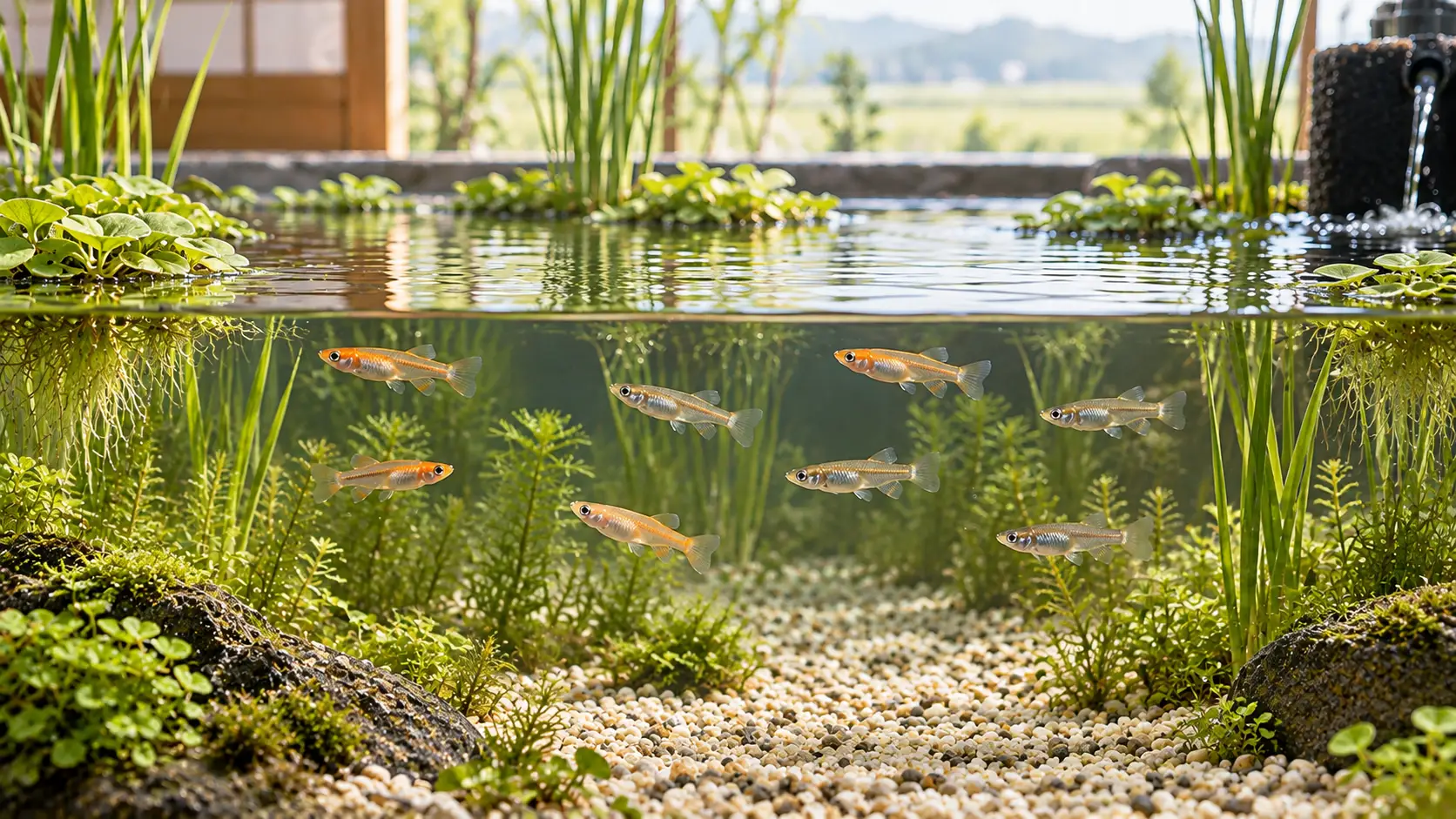
Open surface lanes
The group can travel and feed without pushing through a solid plant mat.
Floating islands
Roots provide egg and fry cover while leaving visible gaps.
Gentle filtration
A sponge intake protects small fish and avoids a harsh surface jet.
Emergent stems
Vertical structure gives shade without filling the swimming area.
Secure rim
Mesh or a fitted lid blocks jumps, predators, and overflow escape.
Observation space
One clear side makes body condition and feeding access easy to check.
In a cold season, reduced activity and feeding may reflect temperature and day length rather than disease. Measure first, then reduce food to what the fish actually take instead of allowing uneaten food to decay in a slower system.
What do medaka eat?
Medaka are omnivores that readily take small food at the surface. Use a complete micro-pellet or fine flake as the staple, then add appropriately sized live or frozen invertebrate foods and natural grazing opportunities for variety.
Food should remain small enough to swallow immediately. A particle that is repeatedly mouthed and rejected is too large even when the label calls it a micro food.
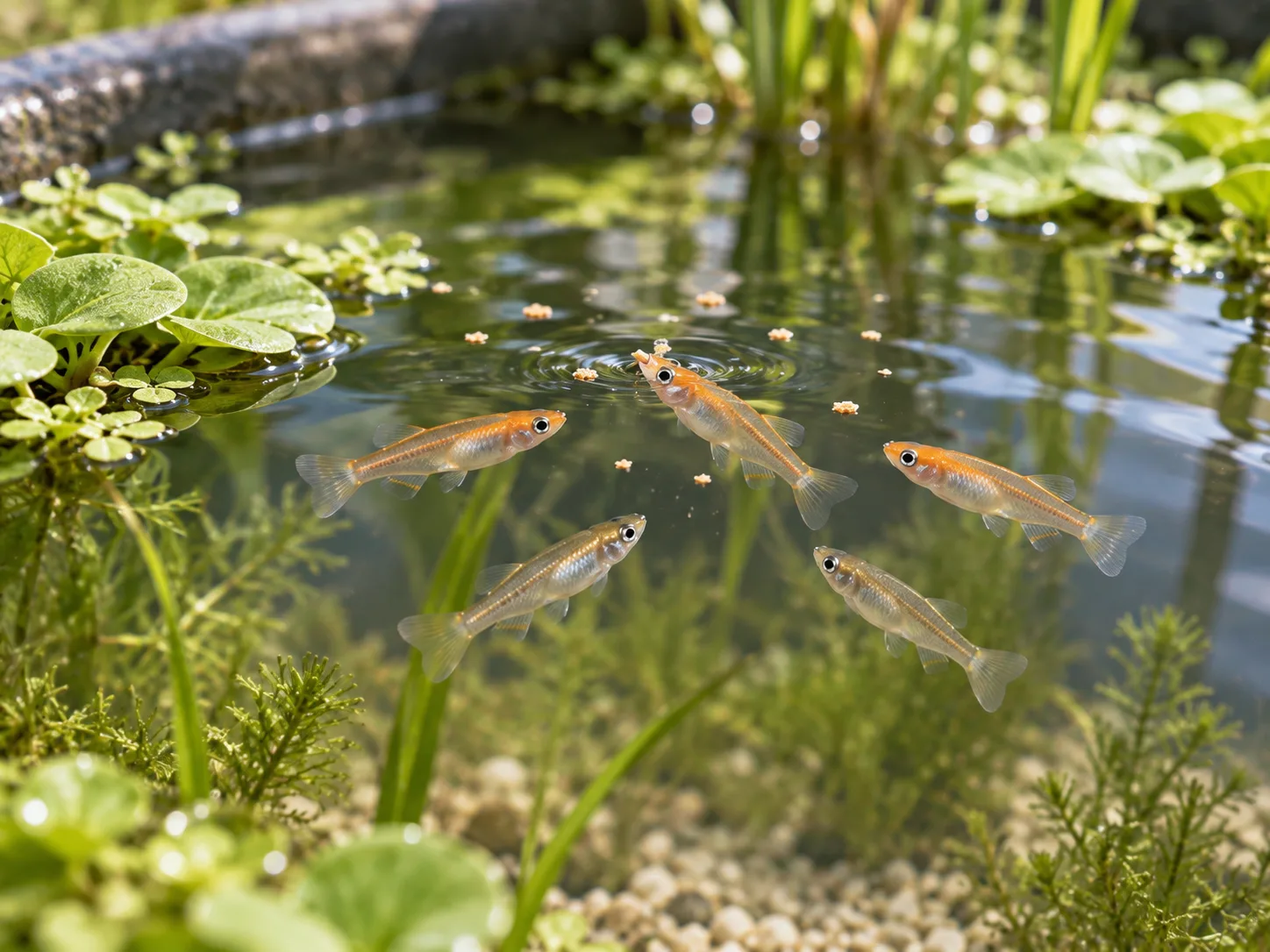
- Scatter a thin first portion Spread food along the open surface instead of one pile.
- Watch the less assertive fish Confirm that animals at the group edge eat.
- Add only what is still needed Let the first response determine the second portion.
- Remove settled excess Do not expect snails or shrimp to erase uneaten food.
- Adjust for season Cooler, less active fish usually require less food than actively breeding fish.
Young fry need food much smaller than the adults' ration, and producing eggs is not proof that a display tank can rear them. Breeding intent changes filtration, plant cover, feeding frequency, and population planning.
Which fish can live with medaka?
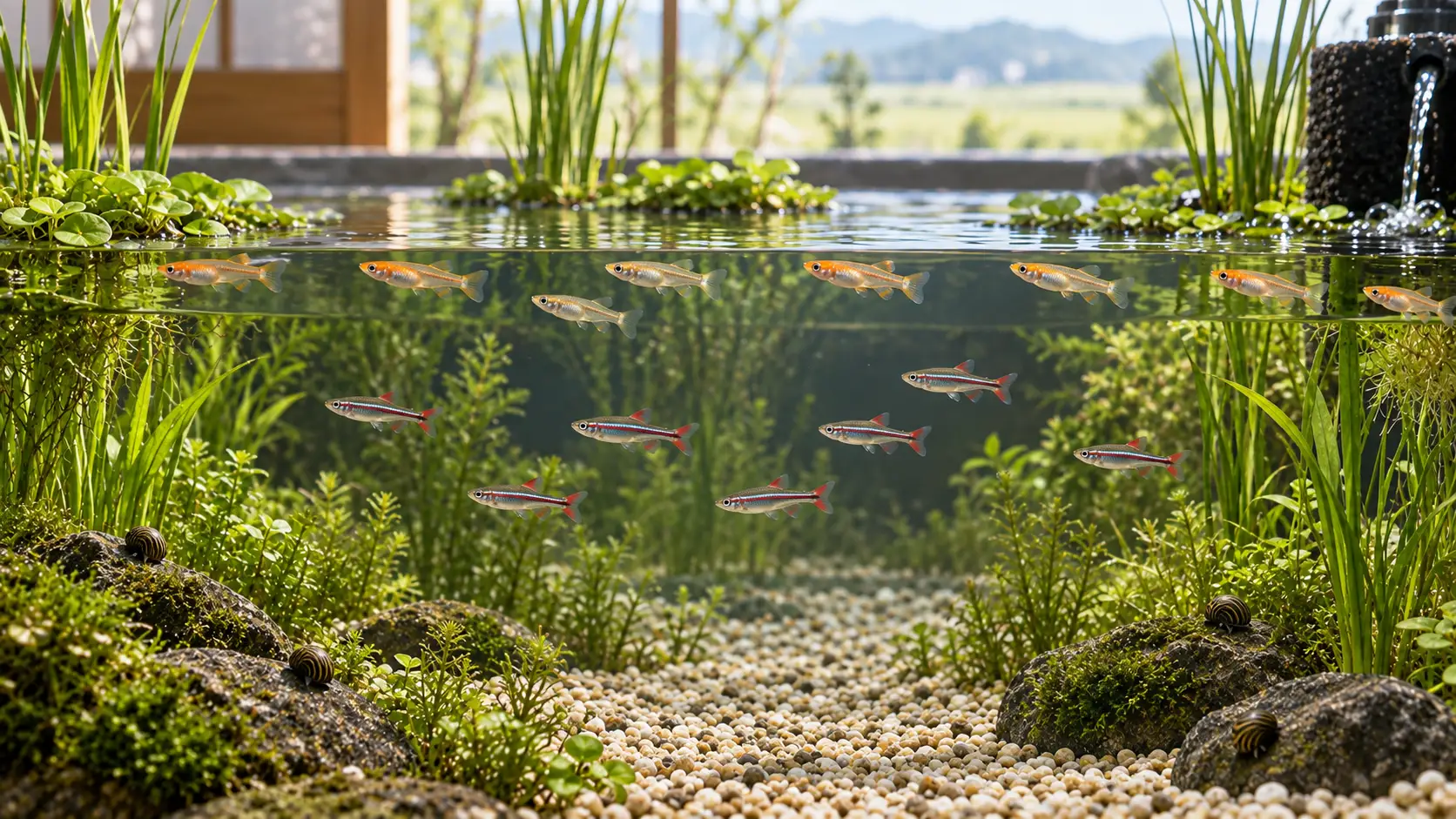
Tank mates must share the measured temperature, avoid swallowing a 4 cm fish, leave the surface feeding zone usable, and tolerate the same water movement. Warm tropical species kept at the bottom of their range and cool-water species kept at the top can overlap on paper while neither is held comfortably.
| Decision | Better match | Poor match |
|---|---|---|
| Temperature | Comfortable through the same measured seasonal range | Needs constant tropical heat |
| Feeding | Uses another level or leaves surface access | Clears floating food before medaka reach it |
| Temperament | Calm, small, and able to disengage | Persistent chaser or fin nipper |
| Adult size | Cannot swallow an adult medaka | Predatory mouth or ambush behaviour |
| Breeding | Fry losses are accepted or managed | Every egg and fry must survive in the display |
White cloud mountain minnows can overlap in some indoor systems, but both species need a full group and enough length. Fast danios can turn the surface into a feeding race, while warm-water tetras often narrow the temperature overlap more than a shop display suggests.
What should you plan before medaka eggs appear?
Females may carry a cluster of eggs briefly before depositing them on plants or spawning material. In a well-fed seasonal group this can happen often enough that population planning should begin before the first fry is visible.
Decide whether the aquarium is an adult display, a colony where a few young may survive, or a deliberate breeding project. Each choice changes egg access, filtration intake, first foods, sorting, and the space required when juveniles are no longer tiny.
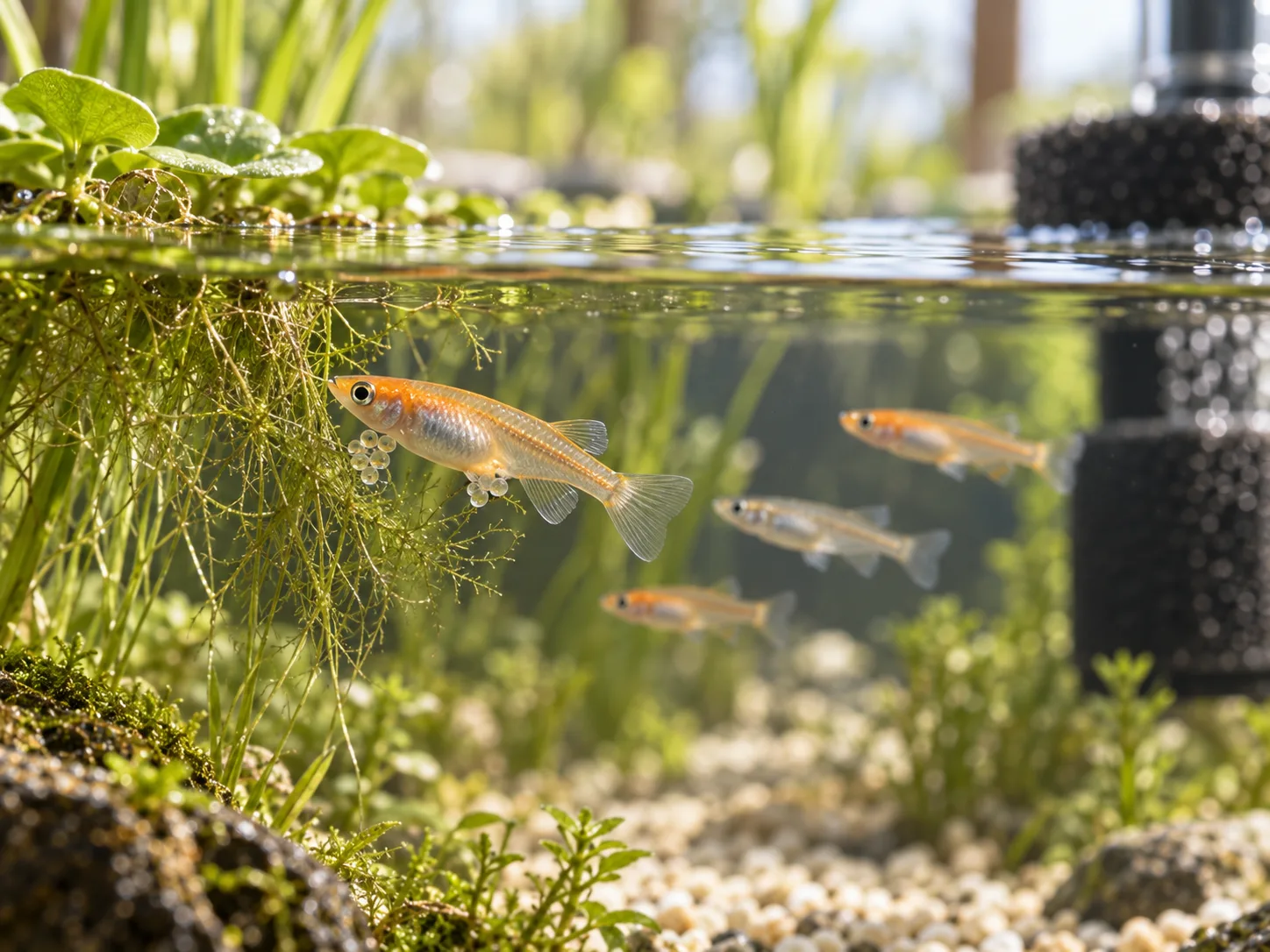
Fry survival creates a delayed stocking problem. The water may test well while juveniles are minute, then lose oxygen and filtration margin as dozens of bodies grow and begin competing at the surface.
Never solve surplus by releasing fish, eggs, plants, or container water outdoors. Arrange responsible homes before breeding, and keep strains separate when preserving a named colour line matters.
How quickly can a medaka group reproduce?
Females may carry a cluster of fertilized eggs near the vent before brushing them onto plants or spawning material. Long days and warm conditions increase reproductive activity, while shorter photoperiod and cooler water reduce it.
Separate breeding work also protects the adults from repeated disturbance. Moving plants, eggs, and fry between containers can move pathogens and can create an outdoor escape route, so use dedicated tools and dispose of water onto soil away from drains and natural waterways.
When does surface behaviour signal trouble?
Normal medaka hold a level posture, track food, and move between open surface and cover. Several fish crowding a return, gulping continuously, clamping fins, or losing balance suggests a shared oxygen or water-quality problem.
Check the system in this order
- Temperature Measure current water and the highest and lowest point across the day.
- Oxygen and flow Confirm the filter runs, the surface moves, and plant mats leave open water.
- Ammonia and nitrite Test after stocking, spawning growth, filter cleaning, or a power interruption.
- Rain or refill water Check dilution, conditioner, contaminants, and sudden chemistry change.
- Social access Verify that one fish is not excluded from food or shelter.
Increase safe aeration and correct confirmed water problems without creating a sudden temperature or chemistry swing. Severe respiratory distress, sores, major swelling, loss of balance, or continuing deaths require qualified aquatic-veterinary help.
Is medaka the right fish for your setup?
Medaka fit a mature long aquarium or securely covered seasonal container where temperature is measured rather than assumed. They are a poor choice for an open bowl, an uncontrolled sunlit tub, or a warm community built around tropical species.
- The water remains within a suitable measured daily and seasonal range.
- The group has broad open surface space and plant cover.
- The lid or mesh prevents jumping, predators, and overflow escape.
- The filter is mature and safe for eggs and fry.
- Population growth has a practical limit and destination.
- Tank mates share the same temperature without living at an extreme.
- No fish, eggs, plants, or water will enter a natural waterway.