
What Is a Platy, and How Do You Plan for a Group That Breeds?
Xiphophorus maculatus
A platy is a small livebearing fish, usually the southern platyfish Xiphophorus maculatus from the Atlantic slope of Mexico and Central America, and females give birth to free-swimming young about once a month. That breeding rate changes every other decision, because a mixed group bought as a handful of fish can span several generations within half a year unless the sex ratio, tank and outlet for young are planned first.
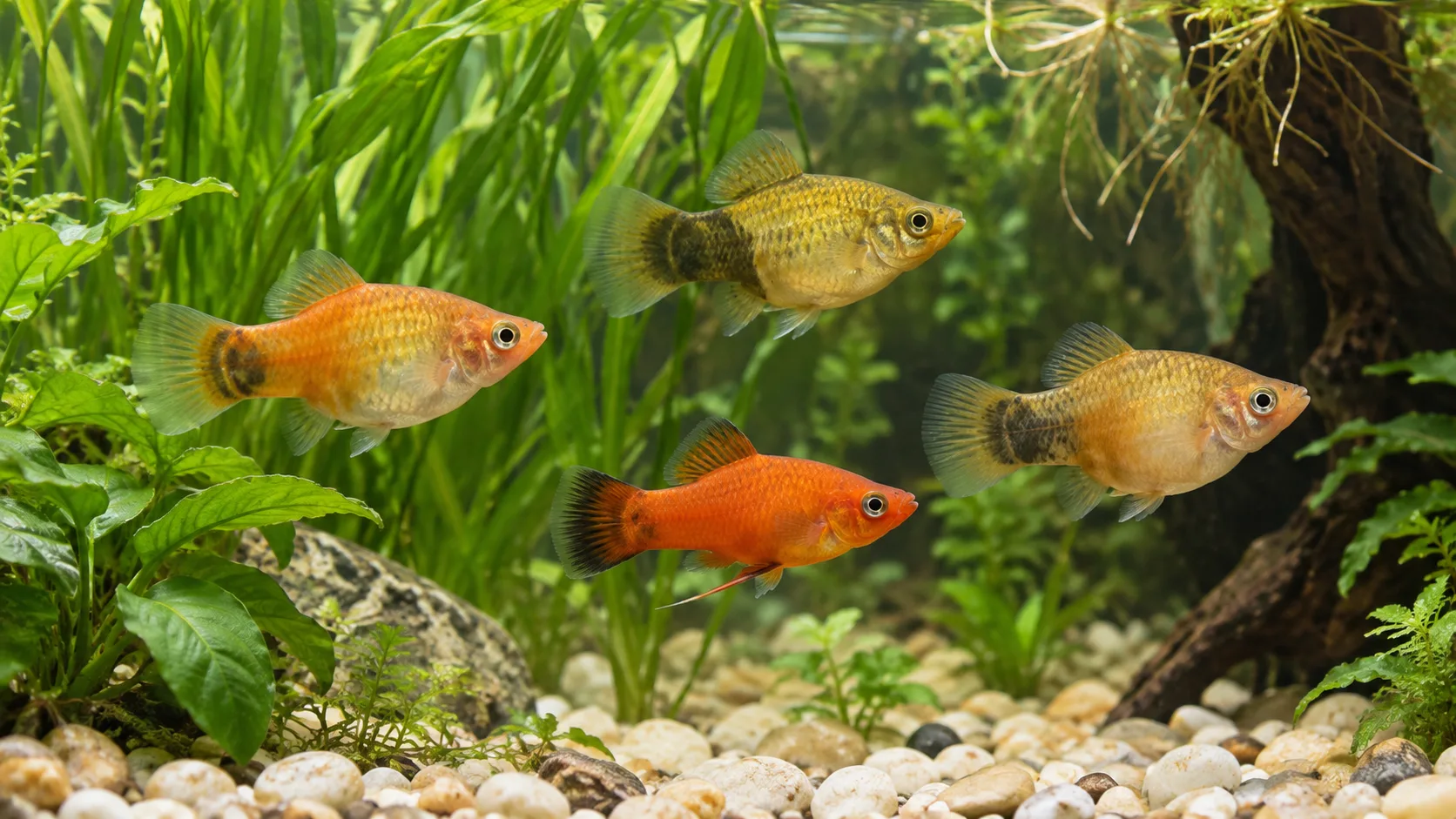
At a glance

- Adult size
- 4 to 6 cm
- Minimum footprint
- 60 x 30
- Minimum volume
- 54 litres
- Social structure
- Social livebearer kept in groups; males pursue females, while males kept together are not aggressive.
- Minimum group
- 3
- Sex ratio
- Two or more females per male, or an all-male group to avoid breeding
- Diet
- Omnivore
- Feeding
- Algae-rich flake or granule daily, with vegetables and small frozen foods for variety; portions the group clears in a few minutes.
- Waste load
- Moderate per fish, rising quickly as broods survive
- Family
- Poeciliidae
- Native range
- Atlantic slope of Mexico, Guatemala and Belize; introduced widely elsewhere
- Conservation status
- Data Deficient (IUCN, assessed 3 April 2018) Source
Room for an adult group plus the juveniles a mixed tank adds each month, with cover for fry and for females escaping males.
What is a platy?
A platy is a small freshwater livebearer of the family Poeciliidae, and the fish sold under that name is usually the southern platyfish, Xiphophorus maculatus. Females give birth to free-swimming young instead of laying eggs, so a mixed group keeps adding fish to the tank until someone decides otherwise.
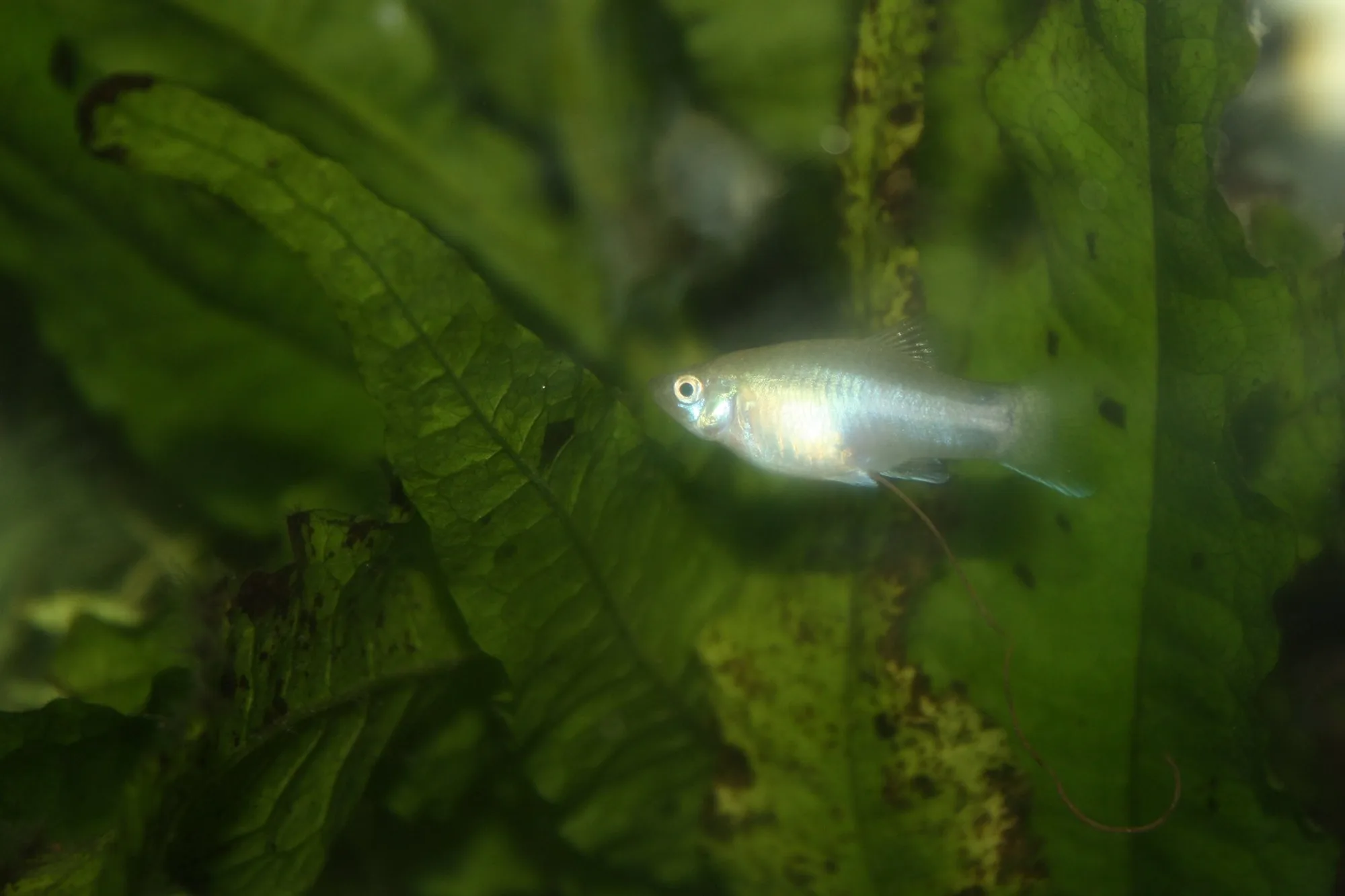
Günther described the species in 1866 as Platypoecilus maculatus, and the Catalog of Fishes now lists it as valid in Xiphophorus, the genus that also holds the swordtails.
The wild range runs along the Atlantic slope of Mexico, Guatemala and Belize.
FishBase records the fish in warm springs, canals, ditches, creeks and swamps with slow water, silt bottoms and weedy banks, which explains why cover and calm water suit it better than a strong current.
- Accepted identity
- Xiphophorus maculatus (Günther, 1866)
- Family
- Poeciliidae, subfamily Poeciliinae
- Other names
- Southern platyfish, platyfish, platy
- Native range
- Atlantic slope of Mexico, Guatemala and Belize
- Wild habitat
- Warm springs, canals, ditches, creeks and swamps with slow water and weedy banks
- Adult size
- Males to 4 cm and females to 6 cm total length (FishBase); domestic fish often larger
- Reproduction
- Livebearer; gestation 24 to 30 days, 20 to 80 young per brood
- Water tendency
- Neutral to alkaline, moderately hard to hard freshwater
- Diet
- Omnivore: worms, crustaceans, insects and plant matter
- Conservation
- IUCN Data Deficient, assessed 3 April 2018; CITES not evaluated
Size figures disagree because sources measure different things. FishBase gives total length, which includes the tail, while Seriously Fish gives 5 cm standard length, measured to the base of the tail.
OATA's 6 to 8 cm describes the larger domestic fish in shops, so a well grown female bought today can outsize the wild figures.
Data Deficient means the assessors lacked enough evidence to judge wild populations, so it does not show that the species is secure. FishBase lists CITES as not evaluated, and OATA notes that most platies in the trade are now captive bred, which means a buyer never needs a wild-caught fish.
How fast does a platy group grow?
A platy group grows in monthly steps. FishBase records a gestation of 24 to 30 days and broods of 20 to 80 young, and the Xiphophorus Genetic Stock Center at Texas State University reports that producing females drop a new brood about every 30 days.
Stored sperm is the fact that surprises most new keepers.
Work summarised by Yang and colleagues in 2011 records that a Xiphophorus female can hold enough sperm from one mating for three to five broods, with 28 to 30 days between them, so a female moved from a mixed shop tank can keep giving birth for months with no male present.
| Time after buying a mixed group | What can happen | Why it matters |
|---|---|---|
| Day 1 | Females from a mixed shop tank may already carry stored sperm | Births can start even in a females-only tank |
| About 4 weeks | First broods of 20 to 80 young per female | The tank's population changes long before the first plan is tested |
| Every 28 to 30 days after | Each female can drop another brood | Three to five broods can follow one mating |
| About 8 weeks | The oldest fry show the first sign of a gonopodium if male | The earliest point when young can be sexed and separated |
| 3 to 6 months | The first fry reach sexual maturity | A second generation starts breeding alongside the first |
Survival changes the real number far more than brood size does. Four females producing only the low figure of 20 young each would add 160 fish in two months if every fry lived, and a densely planted tank with no fry-eating companions can come surprisingly close to that.
In a busy community tank most newborn fry are eaten, which keeps numbers down but still lets a few survivors through each month.
Maturity sets the pace of the second wave. FishBase gives 3 to 4 months, the Stock Center 3 to 6 months, and Kallman and Borkoski found in 1978 that a sex-linked gene called P controls the timing, with platies maturing anywhere from 8 to 73 weeks depending on genotype.
The consequence is practical: some young can breed before anyone has looked closely enough to sex them, which is why a platy breeding plan starts before the first brood rather than after it.
Which platy group should you start with?
For a mixed group, OATA suggests at least three platies with two females to each male. Seriously Fish gives the reason: males pursue females constantly, and more females spread that attention so no single fish is chased all day.
The starting number matters less than the decision about births, because every mixed group becomes a breeding group.
All males
No births and no pursued females. Seriously Fish reports that males show no aggression toward each other, which makes this the simplest way to hold a stable number.
Females only
No new matings, but females bought from mixed tanks can still produce three to five broods from stored sperm before the births stop.
Mixed, two or more females per male
Regular broods and natural behaviour. This suits a keeper who has space for young and somewhere for them to go.
A single platy
Not a good option. OATA advises keeping at least three because platies need company of their own kind.
A group bought as juveniles needs checking again at adult size. Shop fish are often sold before every male has developed a gonopodium, so a group sold as females can include a late male months later.
How can you tell male and female platies apart?
Adults are easy to sex from the anal fin.
In males it develops into a gonopodium, a narrow rod used to fertilise the female internally, while the female keeps a fan-shaped, triangular anal fin.
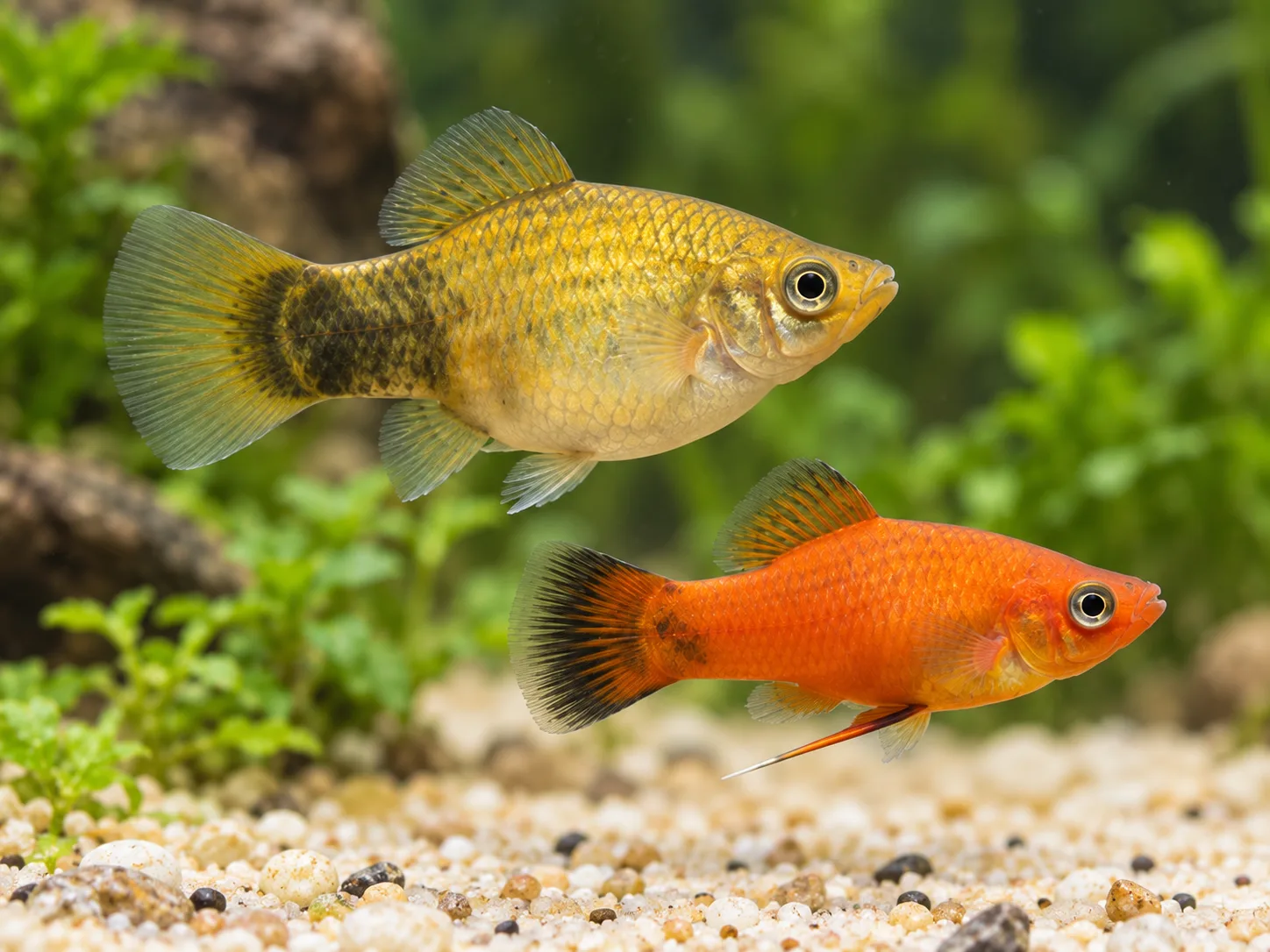
| Decision factor | Male | Female |
|---|---|---|
| Anal fin | Gonopodium, a pointed rod held back along the belly | Triangular, fan-shaped fin |
| Adult size | Smaller, to about 4 cm total length in FishBase records | Larger, to about 6 cm total length |
| Body shape | Slimmer and more even in depth | Deeper and rounder, especially when carrying young |
| When the sign appears | Gonopodium begins forming around 8 weeks in early lines, much later in late-maturing fish | Confirmed only when no gonopodium has formed by adult size |
| Behaviour | Follows females and displays with fins spread | Grazes and feeds; may hide when males press too hard |
Timing and size carry the real risk.
Because the P gene can delay maturity for over a year in some fish, a platy that looks female at three months can still turn into a male, and Kallman and Borkoski found that late-maturing males grow significantly larger than early ones.
A large, plain fish in a females-only tank therefore deserves a second look before it is assumed to be a big female.
What tank does a platy group need?
FishBase gives 60 cm as its minimum aquarium length, and Seriously Fish recommends a base of 60 by 30 cm, about 54 litres (14 US gallons). OATA's figure of 45 litres (about 12 US gallons) is a starting point for a small group of adults, and none of these figures allows for the young a mixed group will add.
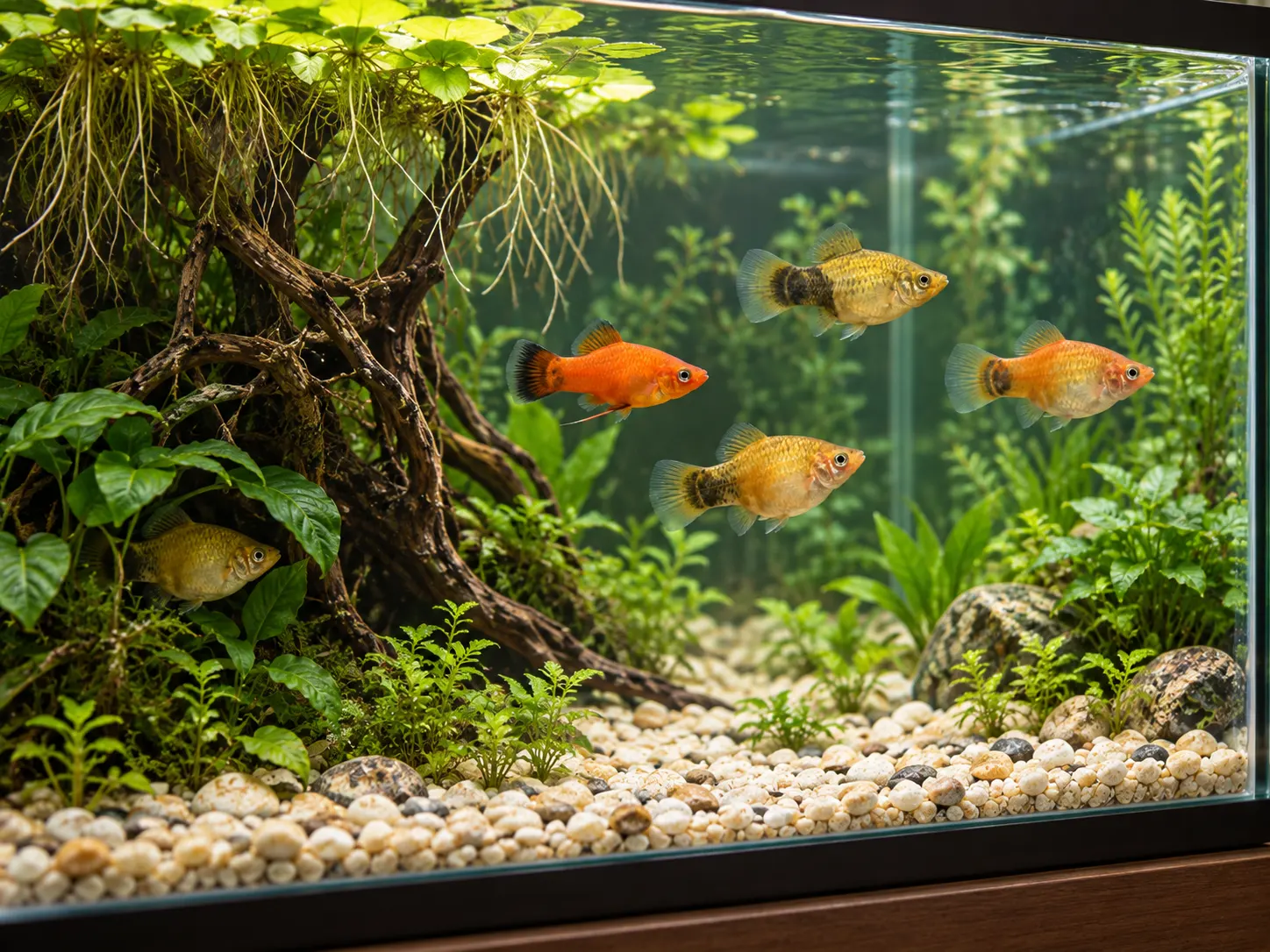
A mixed tank should be sized for the population it will hold in three to six months, not for the six fish carried home. Seriously Fish notes that well fed fry grow very quickly, so each surviving brood adds to the bioload a little more every week.
Length matters because platies use the middle and upper water and males follow females across it. A 60 cm tank gives a pursued female room to move away, and planted areas let her break the male's line of sight.
- At least 60 cm of length for an adult group, and more for a mixed group that will keep breeding.
- Dense fine-leaved cover such as hornwort, java moss or guppy grass where newborn fry can hide.
- Floating plants over part of the surface, which newborn fry use as cover.
- A guarded filter intake, since fry are small enough to be drawn in.
- A heater and a separate thermometer if the room falls below the published temperature range.
- A spare tank, or an agreed outlet for young fish, arranged before the first brood.
Seriously Fish describes platies as undemanding but appreciative of a planted aquarium. The filter still has to mature first, because a growing group added before the nitrogen cycle has established meets ammonia at the worst possible moment.
Should you raise platy fry?
Whether to raise fry is a decision best made before the first brood, because the answer sets how many platies the tank will hold. Seriously Fish reports that adult platies do not usually eat their own young, but most other community fish will, and OATA recommends rearing fry separately until they are too large to be eaten.
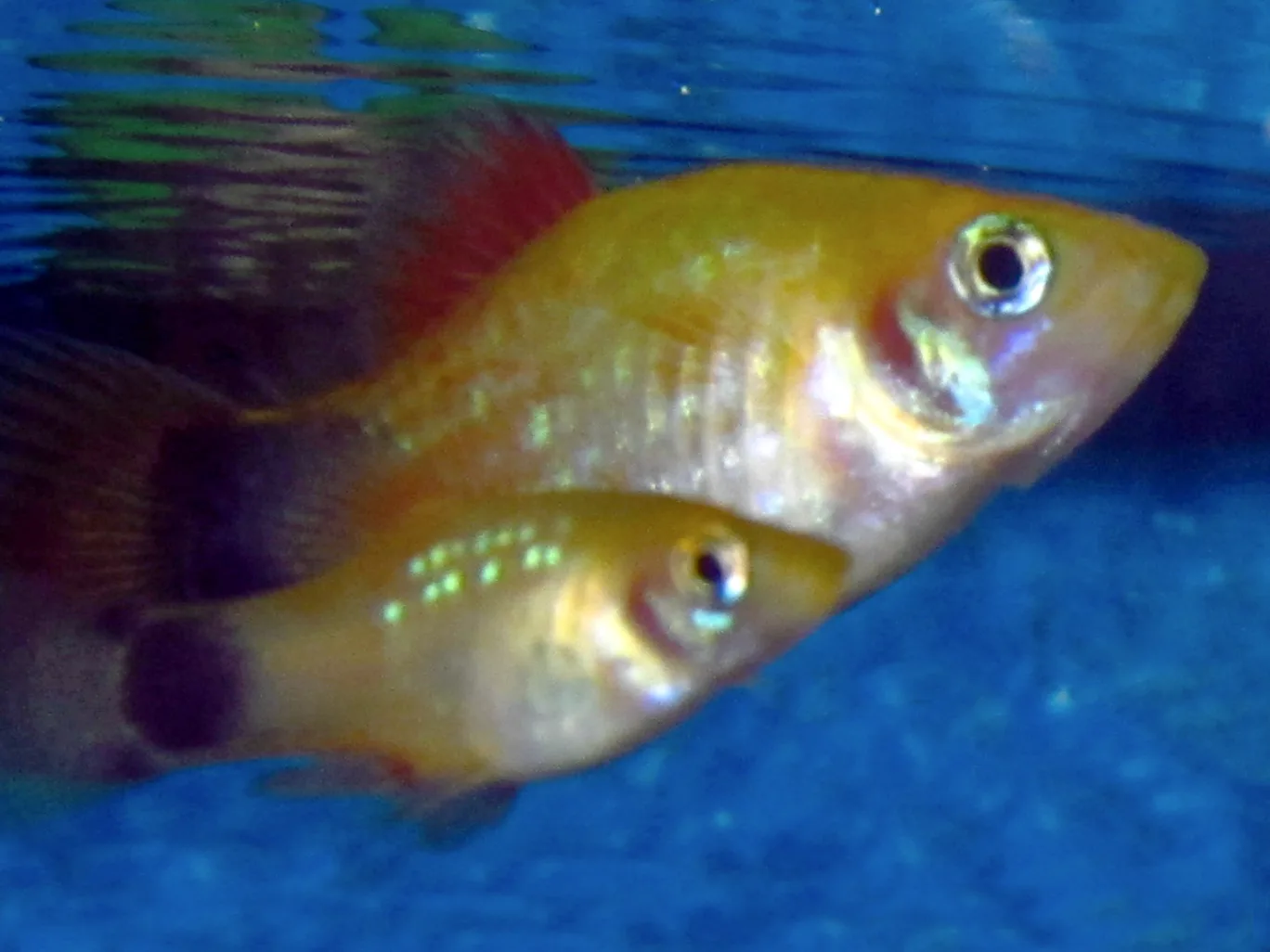
Newborn platies are large for fry.
Seriously Fish records that they take brine shrimp nauplii or powdered flake from birth, which makes the first-food stage far simpler than it is for egg-scattering fish.
- Arrange the outlet first Agree where the juveniles will go, or how many the tank can absorb, before collecting any fry.
- Move the fry, not the mother Net newborn fry into a separate cycled tank or a floating nursery rather than repeatedly netting a heavily pregnant female.
- Feed small and often Offer powdered flake or brine shrimp nauplii two to three times a day, taking out anything left after a few minutes.
- Keep the water clean Change small volumes often, because frequent feeding fouls a small rearing tank quickly.
- Separate the sexes at about eight weeks Move males out as soon as a gonopodium starts to form, so young fish do not breed before they are rehomed.
- Recheck the females Look again at three to four months for late males that were missed.
Letting the tank decide is also a legitimate choice.
A community tank with few hiding places keeps numbers low because most fry are eaten, while dense plants tip the balance toward survival, and the detail of raising livebearer fry matters only once survival is the goal.
What can you do with surplus platies?
Surplus young are the predictable result of a mixed group, so the options deserve settling before the second brood arrives. Some local shops and aquarium clubs take healthy juveniles by prior arrangement, and asking early avoids a tank that has already doubled while an outlet is found.
Stopping the births is the only method that works every time.
Separating the sexes, or keeping an all-male group, ends new pregnancies once any stored sperm runs out, which the reproductive clock puts at three to five broods.
Generations bred within one closed group also carry a cost. Seriously Fish warns that inbreeding and over-production have left many commercial platies less hardy and prone to disease, which is why avoiding inbreeding matters to any keeper who lets a group breed for several generations.
A fish that is sick or deformed and cannot be rehomed is a welfare question, and an aquatic veterinarian can advise on humane euthanasia.
What water do platies need?
Platies come from neutral to alkaline, mineral-rich water, and every source checked here puts pH at 7.0 or above. Seriously Fish states plainly that the species will not thrive in soft, acidic water.
Published platy water ranges
- Temperature18 to 25 °CApplies to Compiled species range. Separate aquarium thermometer away from the heater. Source: FishBase, checked 2026-09-21.
- pH7.0 to 8.0 pHApplies to Compiled species range. Calibrated meter or liquid test covering the source-water value. Source: FishBase, checked 2026-09-21.
- General hardness9 to 19 dHApplies to Compiled species range. GH titration test in degrees of hardness. Source: FishBase, checked 2026-09-21.
- Temperature20 to 26 °CApplies to Husbandry profile range. Separate aquarium thermometer away from the heater. Source: Seriously Fish, checked 2026-09-21.
- pH7.0 to 8.2 pHApplies to Husbandry profile range. Calibrated meter or liquid test covering the source-water value. Source: Seriously Fish, checked 2026-09-21.
- General hardness10 to 30 dGHApplies to Husbandry profile range. GH titration test in degrees of hardness. Source: Seriously Fish, checked 2026-09-21.
- Temperature17 to 27 °CApplies to Trade care sheet range. Separate aquarium thermometer away from the heater. Source: OATA, checked 2026-09-21.
- pH7.0 to 8.0 pHApplies to Trade care sheet range. Calibrated meter or liquid test covering the source-water value. Source: OATA, checked 2026-09-21.
- General hardness4 to 12 dGHApplies to Trade care sheet range. GH titration test in degrees of hardness. Source: OATA, checked 2026-09-21.
- Carbonate hardness3 to 10 dKHApplies to Trade care sheet range. KH titration test in degrees of carbonate hardness. Source: OATA, checked 2026-09-21.
Every range above is for a freshwater system.
The sources agree on pH and part company on hardness. Seriously Fish starts at 10 dGH while OATA stops at 12 dGH, so the only band inside all three ranges is roughly 10 to 12 dGH, and tap water already near that level needs no adjustment at all.
Temperature is the other point where platies differ from many tropical fish. Their published ranges start between 17 and 20 °C, so a room that stays around 20 to 24 °C may need only a thermostat heater as insurance against cold nights.
Population growth changes the water more than the source chemistry does.
Every new brood adds waste, so nitrate rises faster in a breeding tank than in a stable one, and the water change volume that suited six fish will not suit twenty.
Ammonia and nitrite have no safe range for any fish.
A reading above zero after a burst of births means the filter has fallen behind the population, which extra hardness or a new temperature cannot correct.
What if your tap water is soft?
Soft, acidic tap water is the one setting where platies consistently struggle. Raising hardness is possible, but it must happen slowly and be repeated at every water change, since fresh soft water pulls GH and pH straight back down.
Two measurements decide the job.
General hardness (GH) is the dissolved calcium and magnesium the fish uses, while carbonate hardness (KH) is the buffer that holds pH steady, and low KH allows pH to fall overnight even when GH looks acceptable.
Where tap water is very soft, choosing fish that already suit it can be kinder than committing to adjust every change for the several years a platy group may live.
What do platies eat?
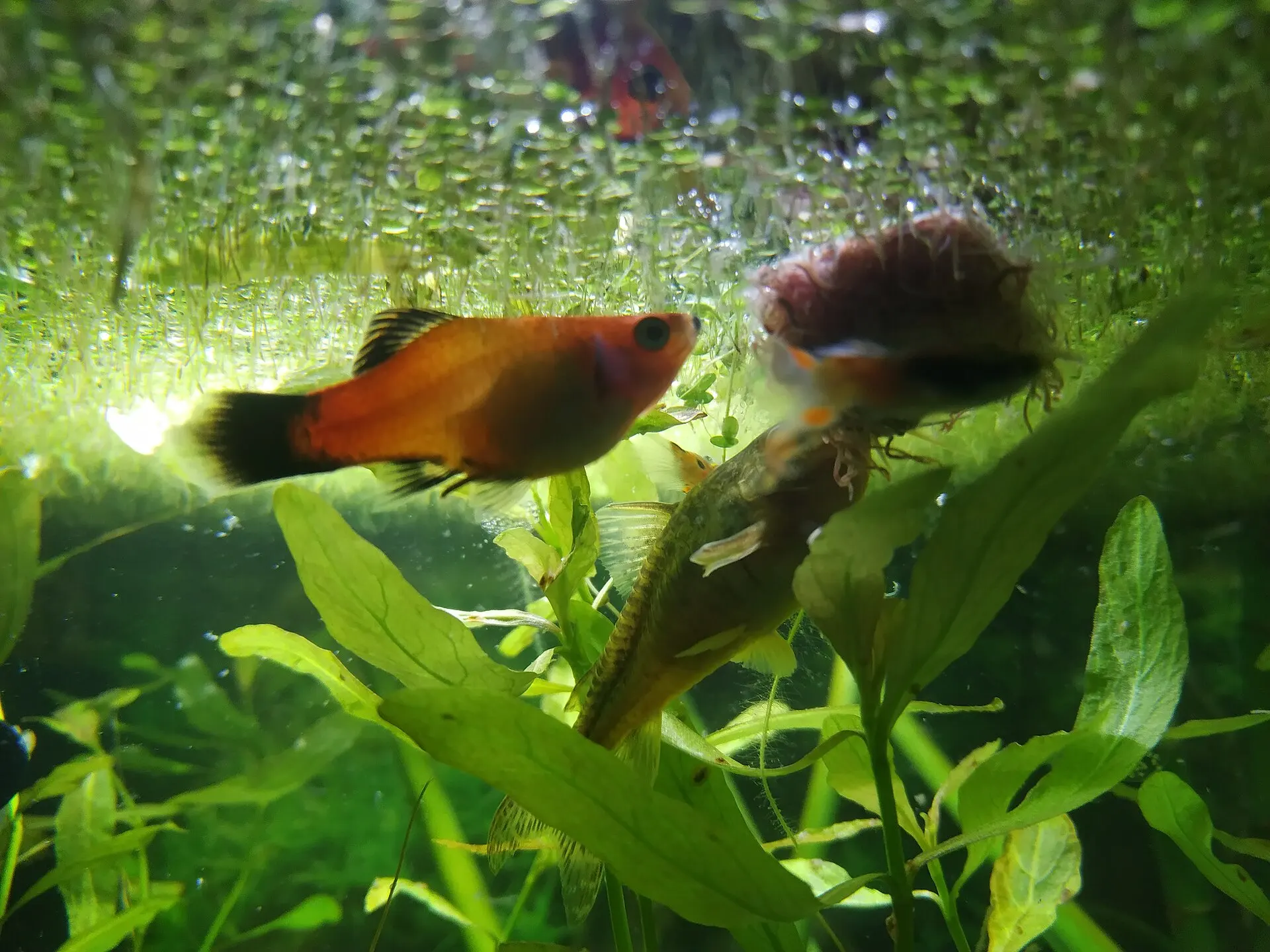
Platies are omnivores that graze as much as they hunt. FishBase records worms, crustaceans, insects and plant matter in the wild diet, and OATA recommends a good flake or granule with a high algae content plus occasional live or frozen food.
| Food | Role in the diet | What to watch |
|---|---|---|
| Algae-rich flake or granule | Daily staple | Crumble it for juveniles so pieces fit the mouth |
| Blanched soft vegetables | Plant matter the wild diet includes | Lift out leftovers within a few hours before they decay |
| Frozen daphnia, brine shrimp or bloodworm | Regular variety | Bloodworm is rich, so small portions only |
| Algae and biofilm in the tank | Grazing between meals | Useful enrichment, never the whole diet |
| Powdered flake or brine shrimp nauplii | Food for newborn fry | Several small feeds a day while fry grow |
OATA advises feeding only what the fish eat within a few minutes, once a day. Food is also a population lever, because a tank fed heavily lets far more fry survive, while uneaten food decays and pushes ammonia up, which is why overfeeding hurts a breeding tank twice.
Vegetable foods matter more for platies than for most small community fish, since plant matter is a real part of what they eat. Adults should look full but not swollen, and a female with a squared, heavy belly is more often pregnant than overfed.
Which fish can live with platies?
Seriously Fish calls the platy very peaceful and suitable with most community species, without the aggression of some swordtails and mollies. The real tests are shared water, shared temperature, and whether a companion will eat fry or be crowded out by a growing livebearer group.
Companions that share platy water
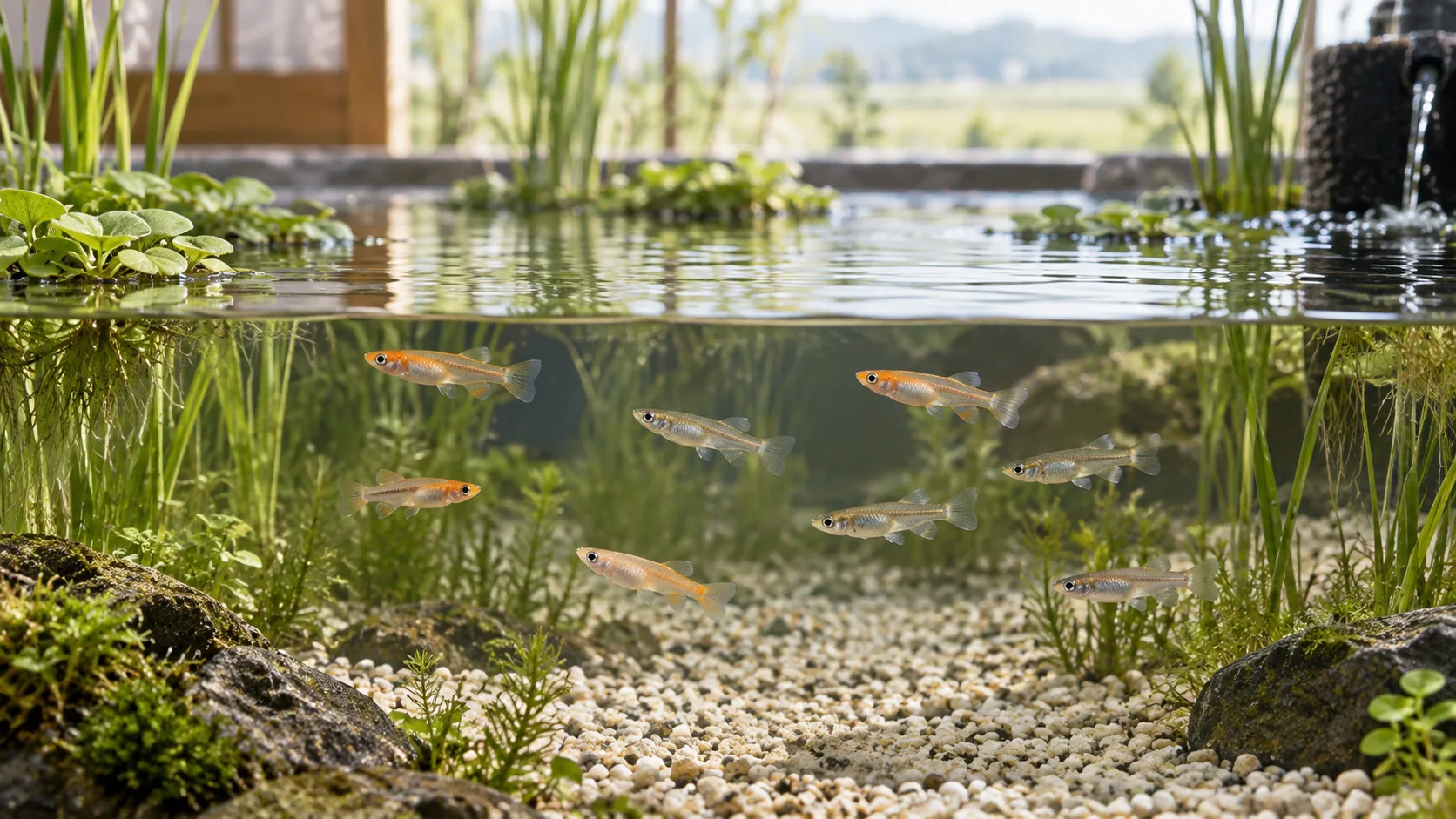 Medaka ricefish
Published range of 18 to 24 °C, pH 7.0 to 8.0 and 9 to 19 dGH overlaps closely with the platy's cooler, harder water.
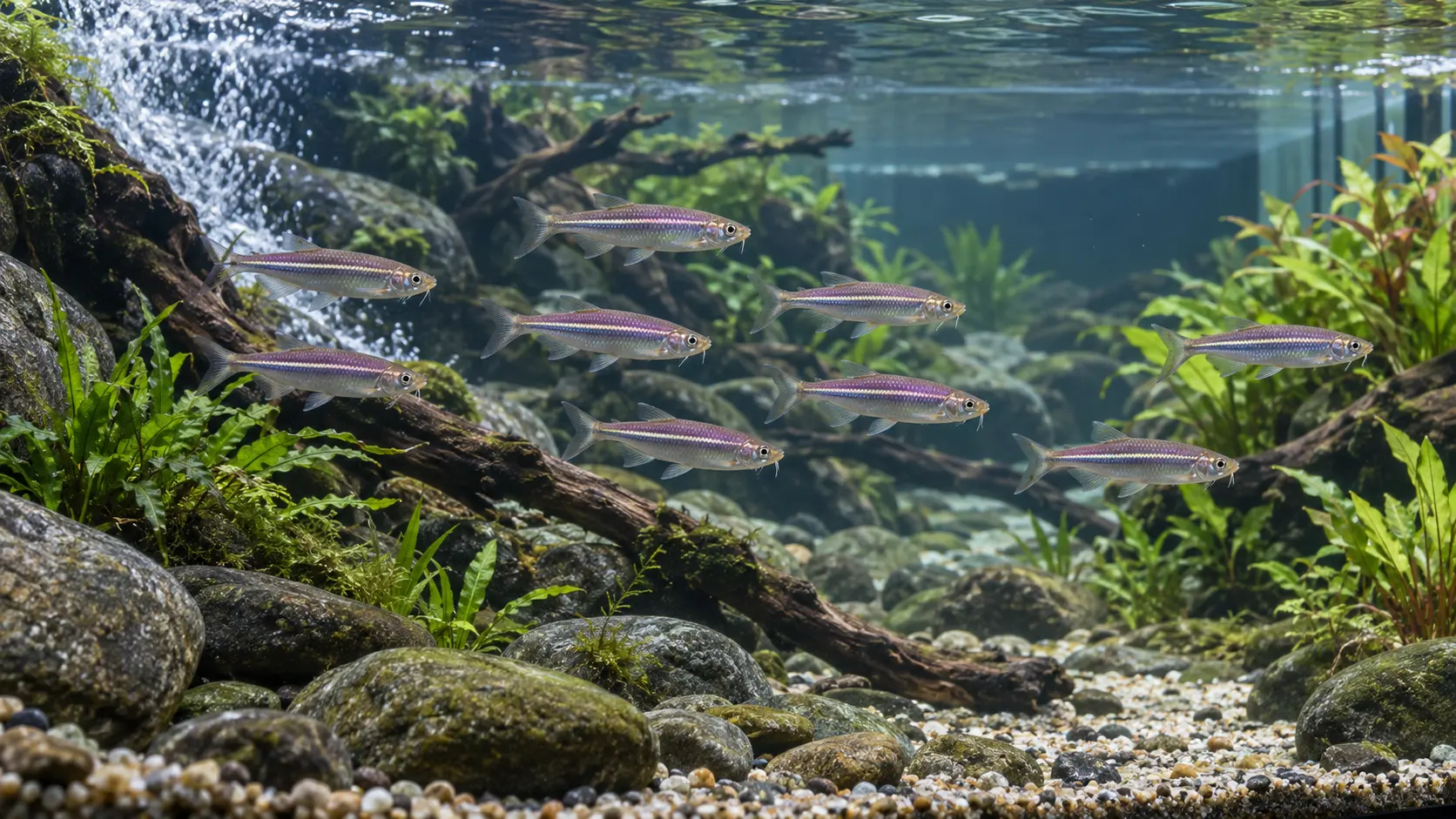 Pearl danio
An active midwater fish whose published 20 to 25 °C range sits inside the platy's.
 Cherry barb
A calm fish of similar size whose published range reaches pH 8.0.
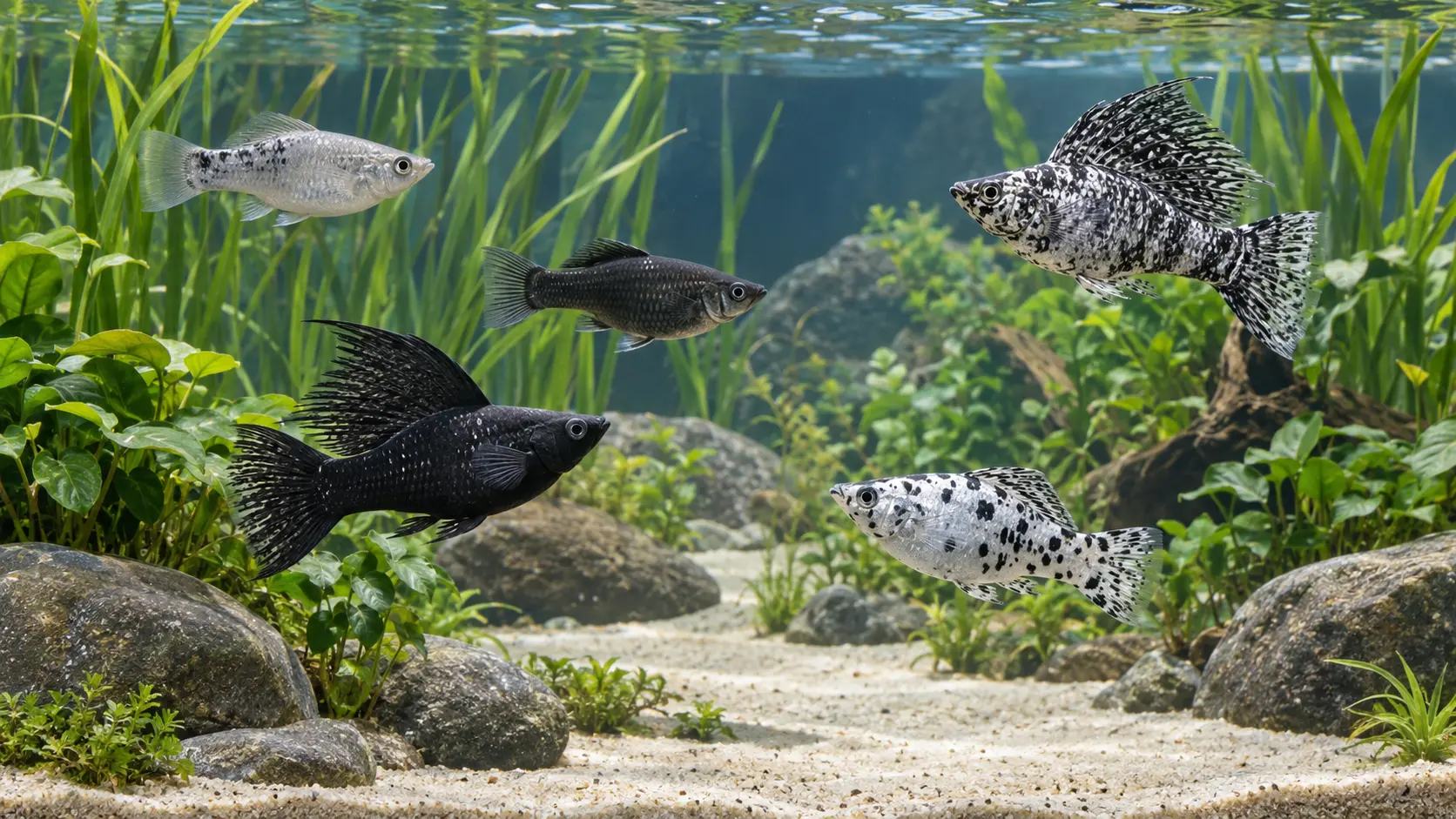 Molly
A hard-water livebearer that grows larger and adds its own fry to the population.
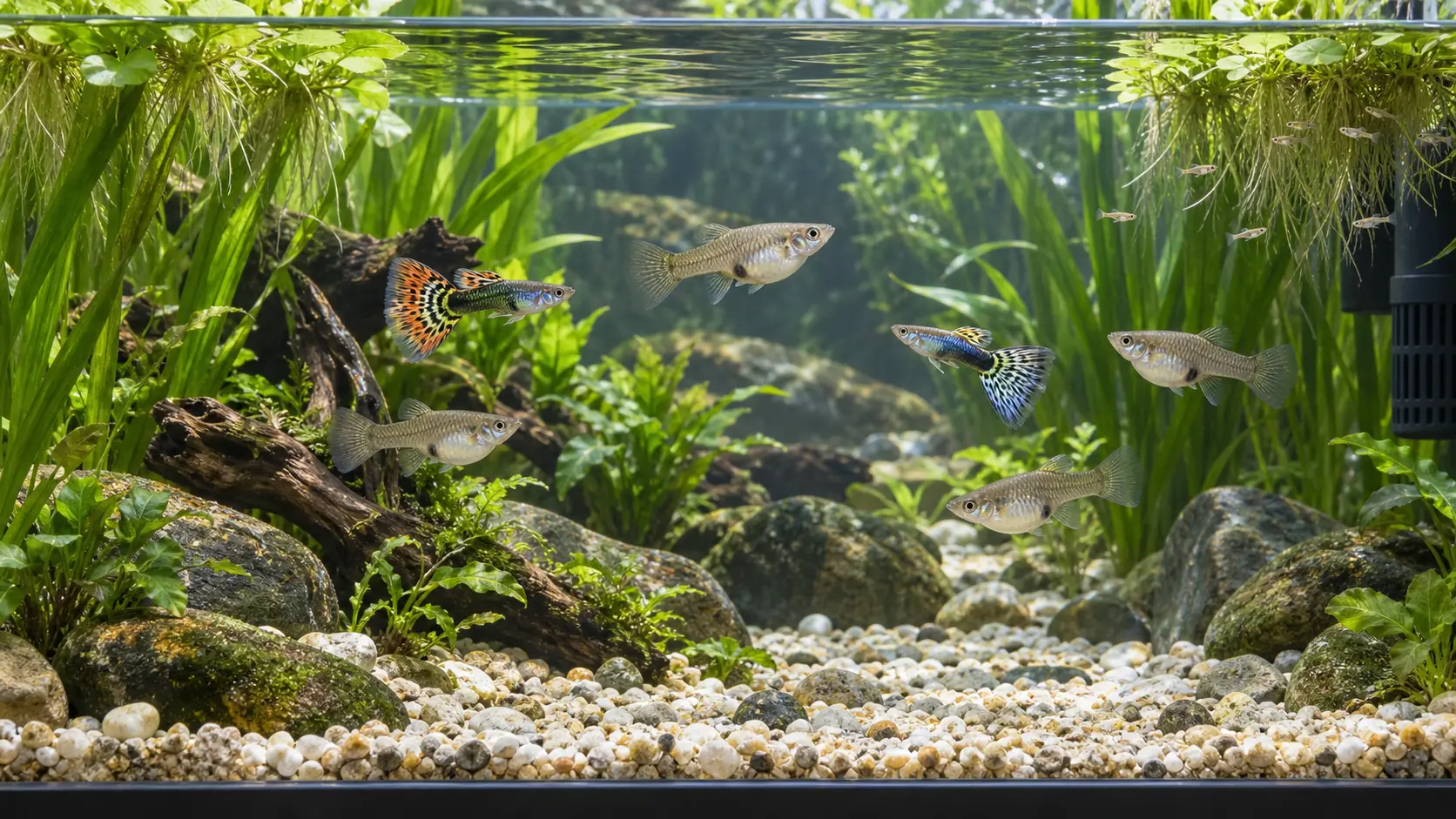 Guppy
A small, peaceful livebearer, which doubles the surplus question rather than solving it.
Another livebearer brings its own reproductive clock.
An Endler's livebearer also needs warmer water, with a published captive range of 24 to 30 °C that overlaps the platy's only at the top.
Swordtails and variatus platies belong to the same genus.
UF/IFAS notes that hybridization between platies, variatus and swordtails is believed to account for many of the varieties now produced, so mixing them can give hybrid young, which matters to anyone keeping a line true.
Small invertebrates are food to a platy, because FishBase lists crustaceans in its wild diet. Adult cherry shrimp are usually too large to eat, but newly hatched shrimplets are not, and a colony kept with platies will grow far more slowly.
Any fish with a mouth large enough to swallow a 4 cm male is a predator here, and many fish that leave adults alone still hunt fry.
Why do shop platies look so different?
Most platies in shops are domestic lines rather than wild-type fish. Seriously Fish lists dozens of selectively bred varieties, including mickey mouse, wagtail, tuxedo, moon, blue, red, comet and hi-fin, and notes that some came from crosses with X. helleri or X. variatus.
| Label you may see | What it usually indicates | What it cannot prove |
|---|---|---|
| Platy or southern platy | X. maculatus or a domestic line built on it | That the fish carries no swordtail or variatus ancestry |
| Variatus or variegated platy | X. variatus (Meek, 1904), a separate species from Tamaulipas to Veracruz | Pure species rather than a cross |
| Colour or pattern name, such as red, blue, mickey mouse or tuxedo | A pigment pattern fixed by selective breeding | Species, adult size or hardiness |
| Hi-fin | A line bred for an enlarged dorsal fin | Normal swimming in every individual |
The practical consequence is that published species data describe X. maculatus, while an individual shop fish may be larger, differ slightly in its water tolerance, or carry the weaknesses of heavy inbreeding. Buying from a seller who can say where a line came from, and whether it is kept in hard water, reduces those unknowns.
Pigment has a research history worth knowing.
The Xiphophorus Genetic Stock Center manual traces work back to Myron Gordon in the 1930s showing that some crosses between platies and other Xiphophorus species carrying black spotting genes develop melanoma.
That finding does not mean a black-marked shop platy will become ill. It does mean a black patch that becomes raised, lumpy or spreads quickly should be seen by an aquatic veterinarian rather than treated at home.
How long do platies live, and what shortens it?
FishBase, Seriously Fish and the Stock Center manual give no measured lifespan for the species. OATA says platies can live several years in a well matured setup with good water quality, so a keeper should plan for years rather than months and treat any exact figure on a care sheet with caution.
What shortens a platy's life is usually a husbandry pressure rather than age: a population that outgrows its filter, water that is too soft, a female who is chased without rest, and weak or diseased stock brought in without checks.
Check these before blaming age
- Ammonia and nitrite Test after every burst of births, a filter clean or a missed water change; any reading above zero needs action the same day.
- Nitrate trend Compare readings week to week, because a steady rise shows the population outrunning the water change routine.
- Hardness and pH Test GH, KH and pH together if the tap water is soft, since slow drift toward acidity weakens platies before any sign is obvious.
- Sex ratio and pursuit Watch whether one female hides or is chased constantly, which calls for more females, fewer males or a separate tank.
- New arrivals Keep new fish in quarantine for several weeks, since a thriving group can lose many fish to one introduced disease.
A reading of ammonia or nitrite above zero calls for a partial water change with temperature-matched, dechlorinated water the same day, followed by retesting until both read zero. Several fish gasping at the surface is an emergency whatever the test shows, so surface movement should increase at once.
When the water tests clean and problems continue, an aquatic veterinarian is the next step. Ulcers, bleeding, a swollen body that is not pregnancy, wasting in a fish that eats, a raised black growth, or continuing deaths all need a professional diagnosis rather than a guess.