
What Is a Pristella Tetra, and How Wide Is Its Water Range?
Pristella maxillaris
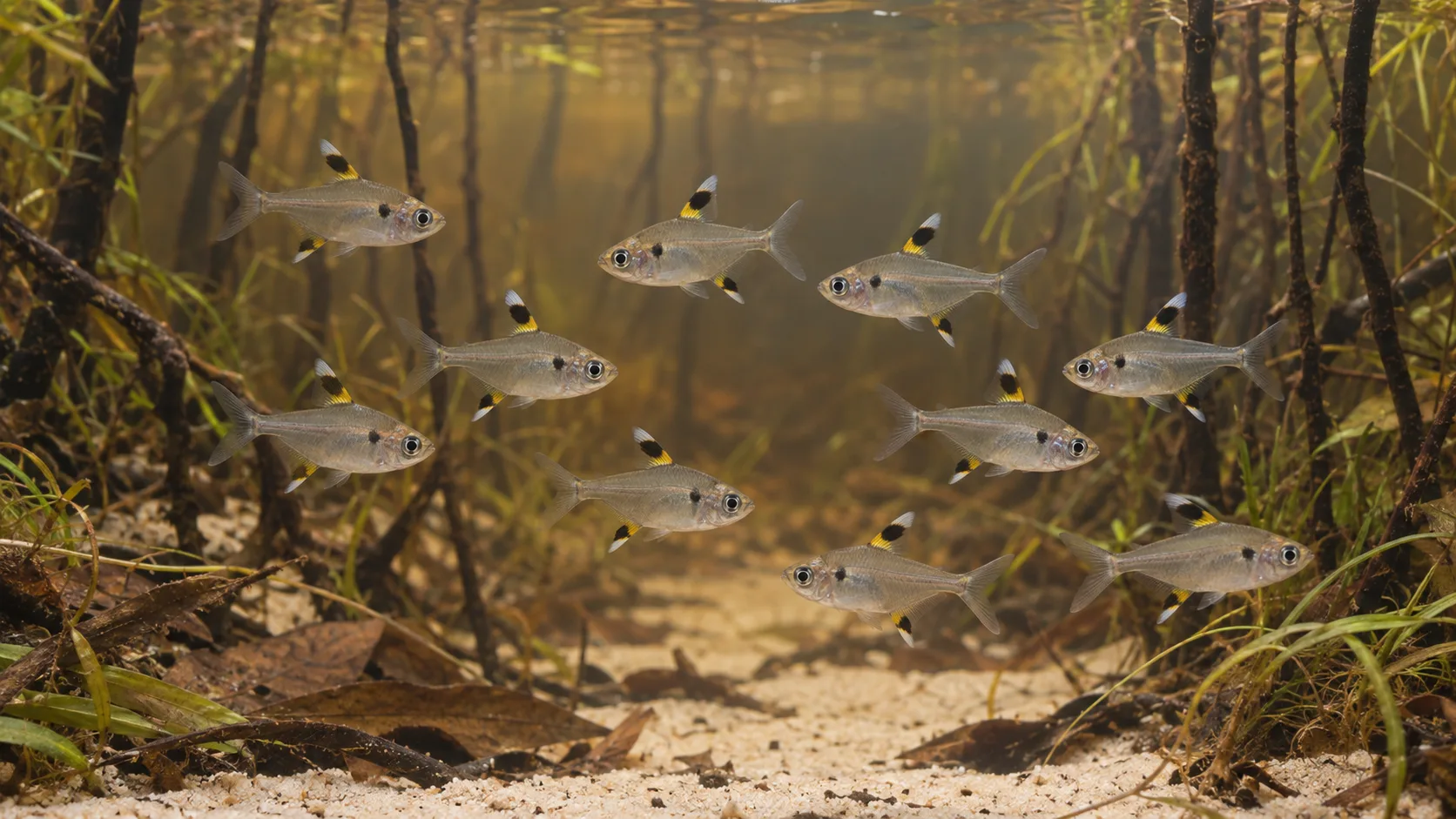
A pristella tetra is Pristella maxillaris, a translucent 4.5 cm schooling fish from the Amazon, the Orinoco and the coastal rivers of the Guianas, also sold as the X-ray tetra. It is recorded across unusually varied water, from soft to very hard, which makes it easy to match to most tap water but no more tolerant of sudden change than any other small tetra.
At a glance

- Adult size
- 4.5 cm
- Minimum footprint
- 60 x 30 cm base for a single-species group; 75 to 90 cm when other schools share the tank
- Minimum volume
- 54 litres
- Social structure
- Peaceful schooling fish that settles and colours up in larger groups.
- Minimum group
- 6
- Sex ratio
- No set ratio; adult females are larger and deeper bodied than males.
- Diet
- Carnivore
- Feeding
- Small invertebrate eater that takes fine flake and granules daily, with frozen Daphnia or brine shrimp for variety.
- Waste load
- Low per fish, but a group of ten or more adds up in a 60 cm tank.
- Family
- Acestrorhamphidae
- Native range
- Amazon and Orinoco basins and the coastal river drainages of the Guianas, from Venezuela to northern Brazil.
- Conservation status
- Least Concern (IUCN, assessed 16 November 2020) Source
About 54 litres follows from a 60 x 30 cm base for six or more fish; length and swimming lane decide more than the litre figure.
What is a pristella tetra?
The pristella tetra is Pristella maxillaris, a small South American schooling fish that shops also sell as the X-ray tetra, because its body is translucent enough for the spine and swim bladder to show through in good light.
Adults reach about 4.5 cm. FishBase gives that figure as total length and Seriously Fish as standard length, so a large female can look a little bigger than the number suggests.
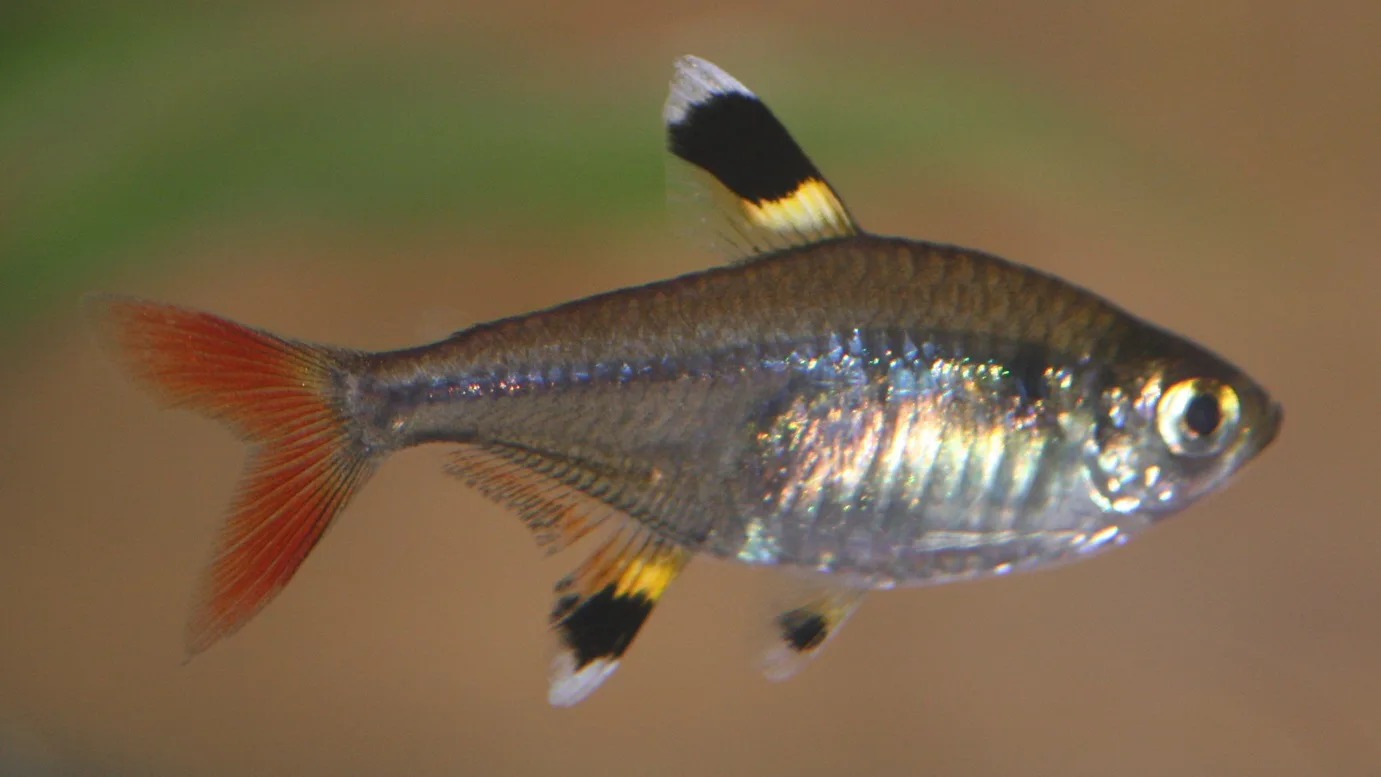
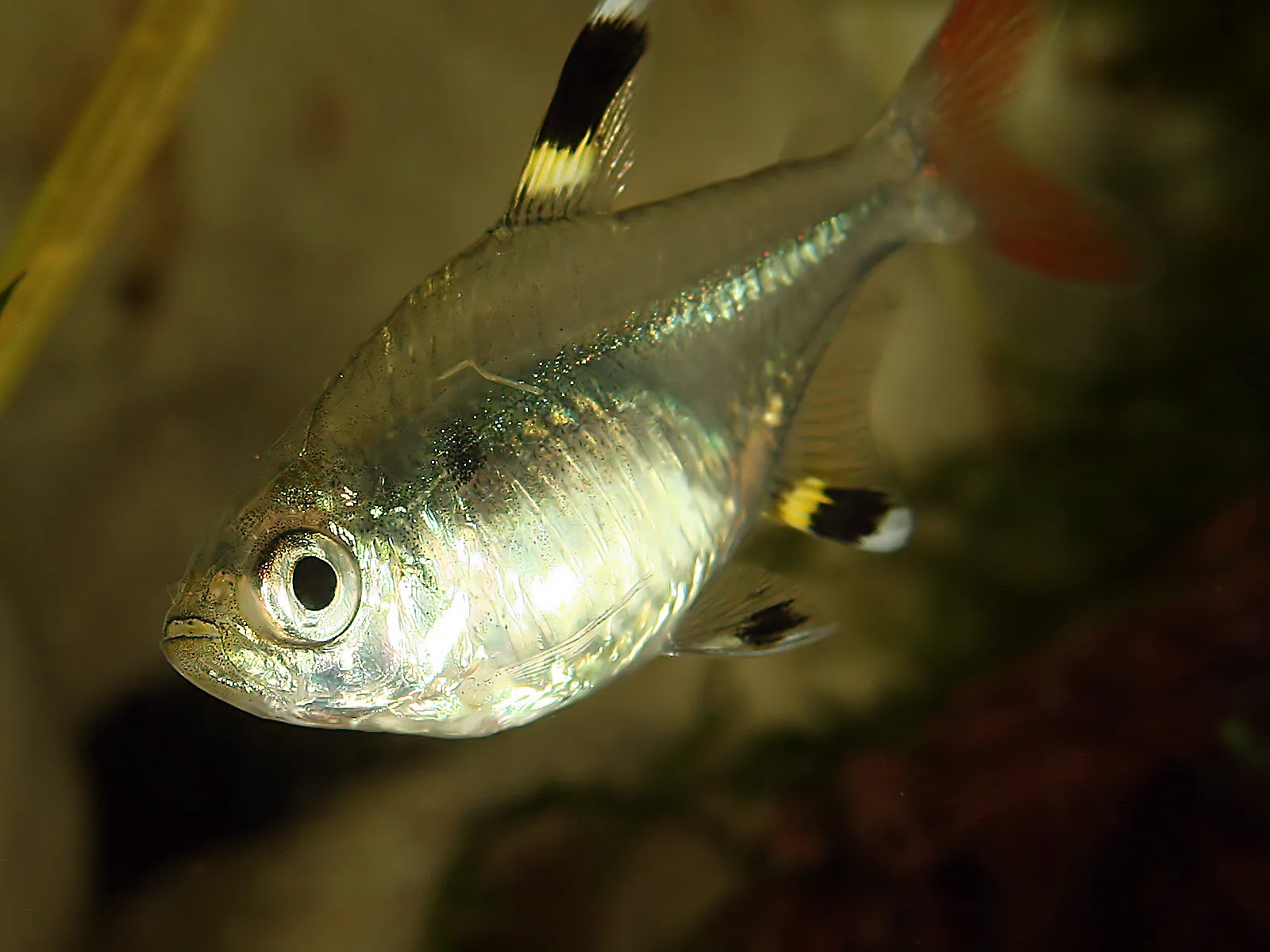
The quickest identification mark is on the dorsal and anal fins, which each carry a black blotch edged with yellow on one side and white on the other. A small round shoulder spot about the size of the pupil sits just behind the gill cover, and the tail is usually washed with red.
- Accepted name
- Pristella maxillaris (Ulrey, 1894)
- Other names
- X-ray tetra; Pristella riddlei is a synonym
- Family
- Acestrorhamphidae, formerly Characidae
- Adult size
- About 4.5 cm
- Wild range
- Amazon, Orinoco and coastal river drainages of the Guianas
- Conservation
- IUCN Least Concern, assessed 16 November 2020
Ulrey described the fish in 1894 as Aphyocarax maxillaris. Meek later named the same fish Holopristis riddlei, and that name survives as the synonym Pristella riddlei in older books.
A 2024 reclassification of the American tetras moved the genus out of Characidae into Acestrorhamphidae, which is why WoRMS and FishBase now show the new family while many shop labels still carry the old one.
Where do pristella tetras live in the wild?
FishBase records the species across the Amazon, the Orinoco and the coastal rivers of the Guianas, and Seriously Fish places it in the coastal waters of Venezuela, Guyana, Suriname, French Guiana and northern Brazil.
That is a large area for a fish this small, and it spans very different kinds of water.
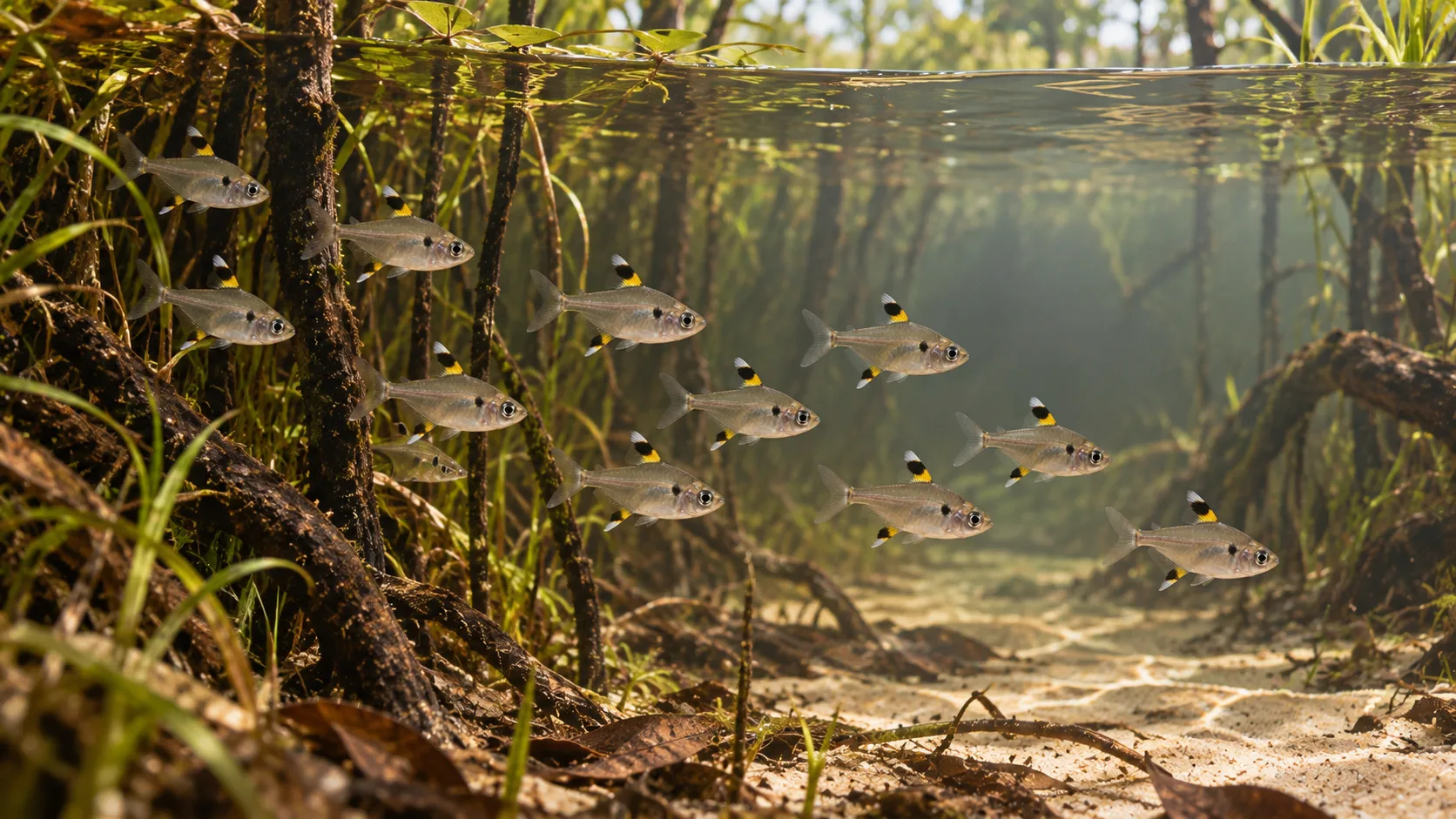
Clearwater streams
Seriously Fish records the species in streams and tributaries during the dry season.
Flooded savannah
When the rains come, the fish move onto flooded grassland and spawn among the submerged vegetation.
Coastal swamps
FishBase describes calm coastal waters and densely vegetated swamps as its habitat.
Seasonal flooding changes depth, temperature and chemistry over weeks rather than hours. The tolerance the species shows in the wild is therefore built on gradual change, which matters when that tolerance is carried into a glass box.
None of this has to be copied at home. Seriously Fish notes that most pristellas on sale in the UK come from farms in the Far East or Eastern Europe, so a shop fish has usually spent its whole life in hatchery water.
A biotope aquarium with sand, roots and leaf litter suits the species well, and Seriously Fish mentions a tea-coloured blackwater setup as one option. Both are choices about cover and appearance rather than survival requirements.
What water parameters do pristella tetras need?
A planning range of 24 to 28 °C, pH 6.0 to 7.5 and 2 to 20 dGH sits inside both main published sources, so most dechlorinated tap water in that span suits the species without any adjustment.
Published pristella tetra water context
- Temperature24 to 28 °CApplies to Compiled species range. Aquarium thermometer read away from the heater. Source: FishBase, checked 2026-09-21.
- pH6.0 to 8.0 pHApplies to Compiled species range. Calibrated meter or liquid test covering the source-water value. Source: FishBase, checked 2026-09-21.
- General hardnessup to 35 dH, no lower limit givenApplies to Compiled species range. GH titration test in degrees of hardness. Source: FishBase, checked 2026-09-21.
- Temperature22 to 28 °CApplies to Husbandry profile range. Aquarium thermometer read away from the heater. Source: Seriously Fish, checked 2026-09-21.
- pH6.0 to 7.5 pHApplies to Husbandry profile range. Calibrated meter or liquid test covering the source-water value. Source: Seriously Fish, checked 2026-09-21.
- General hardness2 to 20 dGHApplies to Husbandry profile range. GH titration test in degrees of hardness. Source: Seriously Fish, checked 2026-09-21.
Every range above is for a freshwater system.
The two sources agree at the bottom of the pH scale and part company at the top. FishBase runs to pH 8.0 and a hardness of 35 dH, which is very hard water, while Seriously Fish stops at pH 7.5 and 20 dGH.
Neither figure is a mistake. A compiled range gathers the widest values reported across several references, while a husbandry profile describes water that keepers have held healthy groups in, so the narrower figure is the safer one to plan around when the two differ.
Temperature has the larger day-to-day effect. FishBase lists nothing below 24 °C, which means a room that cools at night can pull an unheated tank out of the band both sources share, and a reliable aquarium heater is part of the basic kit.
Can pristella tetras live in brackish water?
No authoritative record shows that pristellas need salt or benefit from it, and the reference databases classify the species as a freshwater fish.
The brackish claim is common on care sheets, which often describe the pristella as one of the few tetras found in slightly brackish coastal water. It probably grew out of the coastal part of the range, but a coastal swamp fed by rivers can be entirely fresh.
| Source | What it records | What that supports |
|---|---|---|
| FishBase | Freshwater, pelagic; calm coastal waters and vegetated swamps | A freshwater fish living near the coast |
| WoRMS | Freshwater flag set; brackish and marine flags not set | Freshwater classification only |
| Seriously Fish | Clearwater streams and flooded savannah, with no mention of salt | Freshwater husbandry |
| Hobby care sheets | Tolerance of slightly brackish water, sometimes with a quoted specific gravity | Unverified: no locality, measurement or study is cited |
For a home tank, salt adds risk without a recorded benefit. Aquarium salinity belongs in a brackish water system built for species that require it, and not in a community of soft-water tetras.
Why does a hardy tetra still need stable water?
A wide tolerance range describes where the species can live, and it says nothing about how fast one fish can move from one end of that range to the other.
Every freshwater fish spends energy keeping the salts in its blood at a steady level against water that is always more dilute.
When hardness or pH changes overnight, that workload changes overnight too, and a fish recorded from pH 6.0 to 8.0 still feels a jump from 7.8 to 6.8 in an afternoon.
Each pristella is also adjusted to the water it grew up in rather than to the whole species range.
A farmed fish raised at one pH and hardness, moved to a shop at another and then to your tank at a third, meets three sets of chemistry in a few weeks, and gradual acclimation of new fish matters for that reason.
The penguin tetra makes a useful comparison. It is recorded across almost the same span, pH 6.0 to 8.0, and the same rule applies to both fish: a broad range lets a keeper skip chemistry adjustment, but it never lets them skip slow change.
Most sudden swings in a settled tank come from maintenance rather than from the tap. In a tank that goes weeks without a water change, nitrate builds up and the carbonate buffer, KH, is slowly used up, so pH drifts down, and one very large change then lifts it back in minutes.
Regular, moderate water changes prevent that pattern because they never let the tank drift far from the tap water in the first place.
Chemical breadth also does nothing against ammonia or nitrite. A pristella that shrugs off hard tap water is as vulnerable as any fish in a tank whose nitrogen cycle has not yet established, because both compounds are toxic at any measurable level.
This is also why the pristella is often suggested as a first tetra. The recommendation holds for the right reason: it copes with tap water that would limit a neon or a cardinal, but it is no more forgiving of an uncycled filter or a sudden pH drop than they are.
What tank and group size suit pristella tetras?
A group of at least six, and preferably ten or more, in a tank at least 60 cm long matches both sources. FishBase gives a 60 cm minimum for groups of five or more, and Seriously Fish a 60 by 30 cm base of about 54 litres for at least six fish.
Group size carries more weight than the litre figure. Small tetras kept in twos or threes tend to stay nervous and pale, and the settled, spread-out display a pristella group gives only appears once there are enough fish.
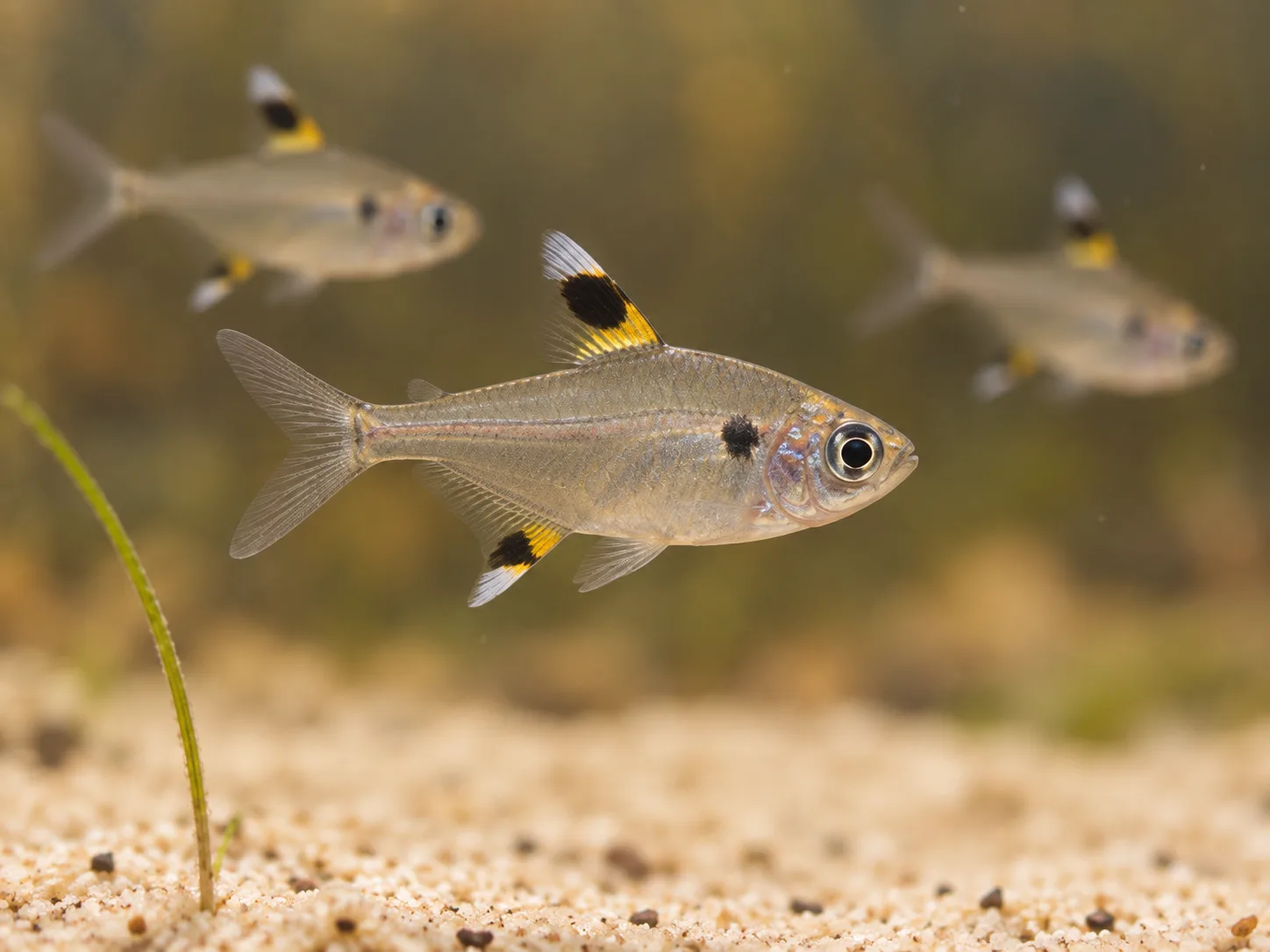
That 60 cm length suits a single-species group, not a full community. Every additional school draws on the same filtration and the same swimming lane, so a tank that will also hold corydoras and a second tetra species is better planned at 75 to 90 cm.
- A tank at least 60 cm long, and longer when other schools share it
- Six pristellas as the minimum, ten or more for a settled group
- Planted or root-lined edges with an open strip of midwater
- A fitted aquarium lid, since startled tetras can jump
- A filter that is fully cycled before the first fish arrive
What do pristella tetras eat?
Pristellas are micropredators that eat worms, small crustaceans and insects in the wild, according to FishBase, and in an aquarium they take dried food readily.
Seriously Fish recommends a mix of flake and granules with small live or frozen foods such as Daphnia and brine shrimp, which gives the fish both a dependable staple and some variety.
| Food | Role | What to watch |
|---|---|---|
| Flake or micro granules | Daily staple | Pieces must fit a mouth this size, so large flakes are crumbled first |
| Frozen Daphnia | Variety several times a week | Thawed food spreads through the water instead of sinking as a block |
| Frozen or live brine shrimp | Variety and conditioning | Newly hatched brine shrimp suit adults and fry alike |
| Live food collected from ponds | Occasional only | It can carry parasites and pest insects into the tank |
Portions matter more than the food list. A small group clears a feed within a minute or two, and flake that reaches the substrate and stays there decays into ammonia, so overfeeding is one of the usual ways a stable tank slips between water changes.
Frozen foods are the simplest way to add variety without the disease risk of wild-collected live food.
Which fish live well with pristella tetras?
Peaceful fish of similar size that share the 24 to 28 °C band make the best pristella tetra tank mates, and Seriously Fish names other small South American tetras, pencilfish and dwarf cichlids.
The pristella's breadth changes how companions are chosen. Because it tolerates so much, the tank mate with the narrowest range decides the water, and the pristella adjusts to that fish rather than the other way round.
A cardinal tetra is recorded at pH 4.0 to 6.0 and a neon tetra at 1 to 2 dGH, so either one pulls a mixed tank toward soft, acidic water where the pristella sits at the lower edge of its range.
A penguin tetra group is the opposite case. Its recorded span of pH 6.0 to 8.0 and 22 to 28 °C almost matches the pristella's, so the two can share ordinary tap water, although penguins only reach about 3.6 cm and a small penguin group can nip.
Companions that overlap the pristella's water
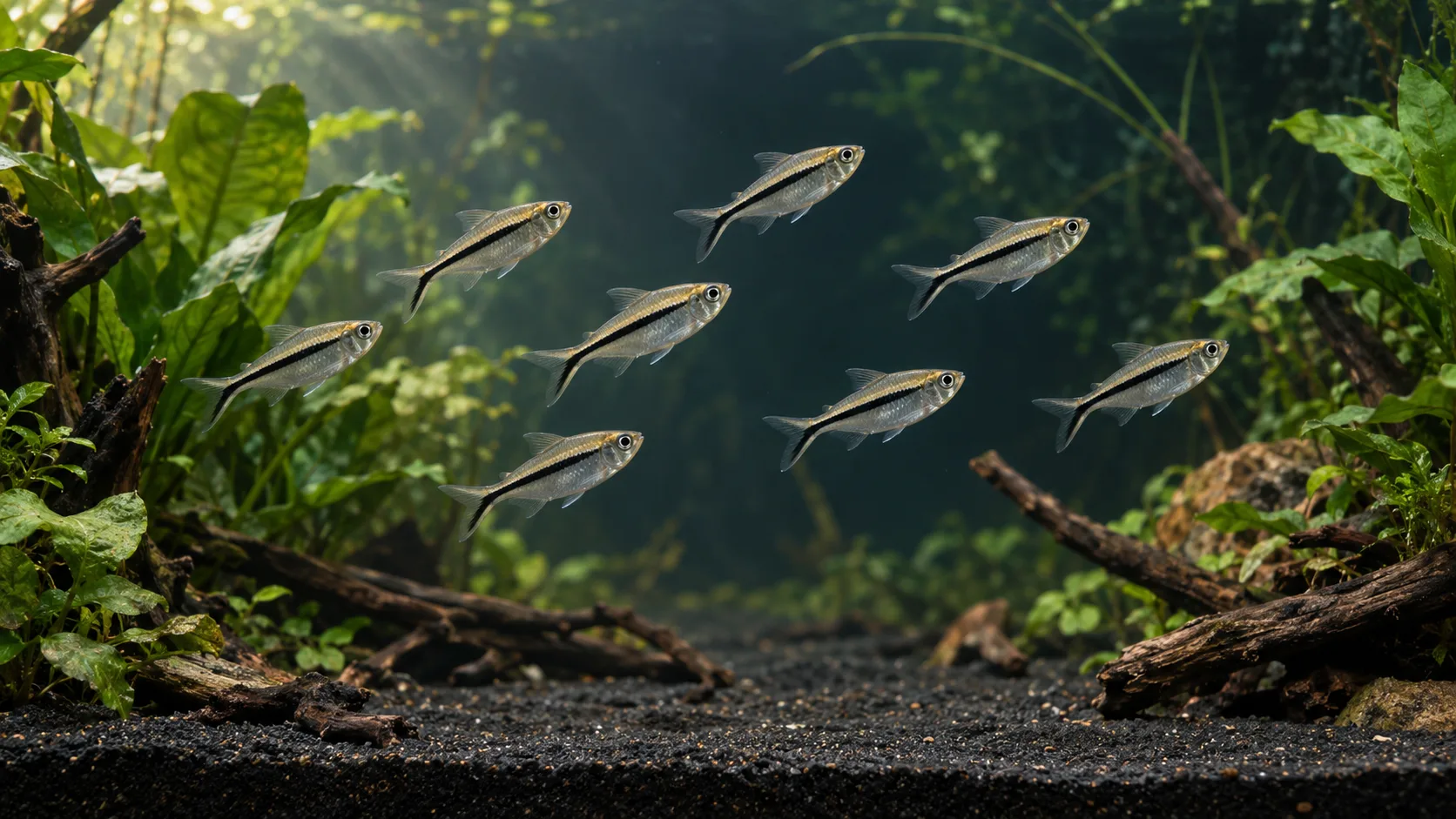 Penguin tetra
pH 6.0 to 8.0, the closest chemistry match
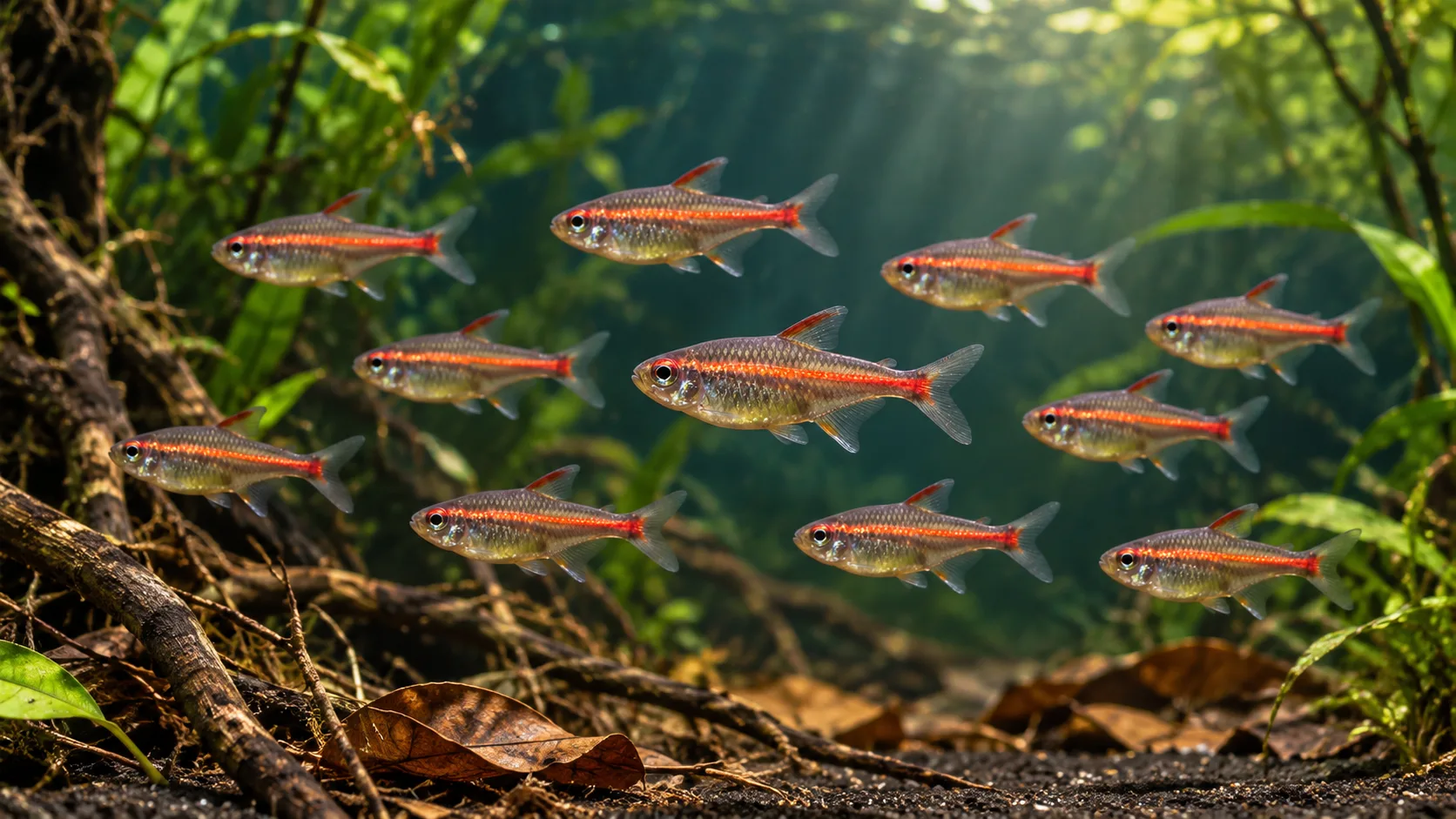 Glowlight tetra
24 to 28 °C, the same temperature band
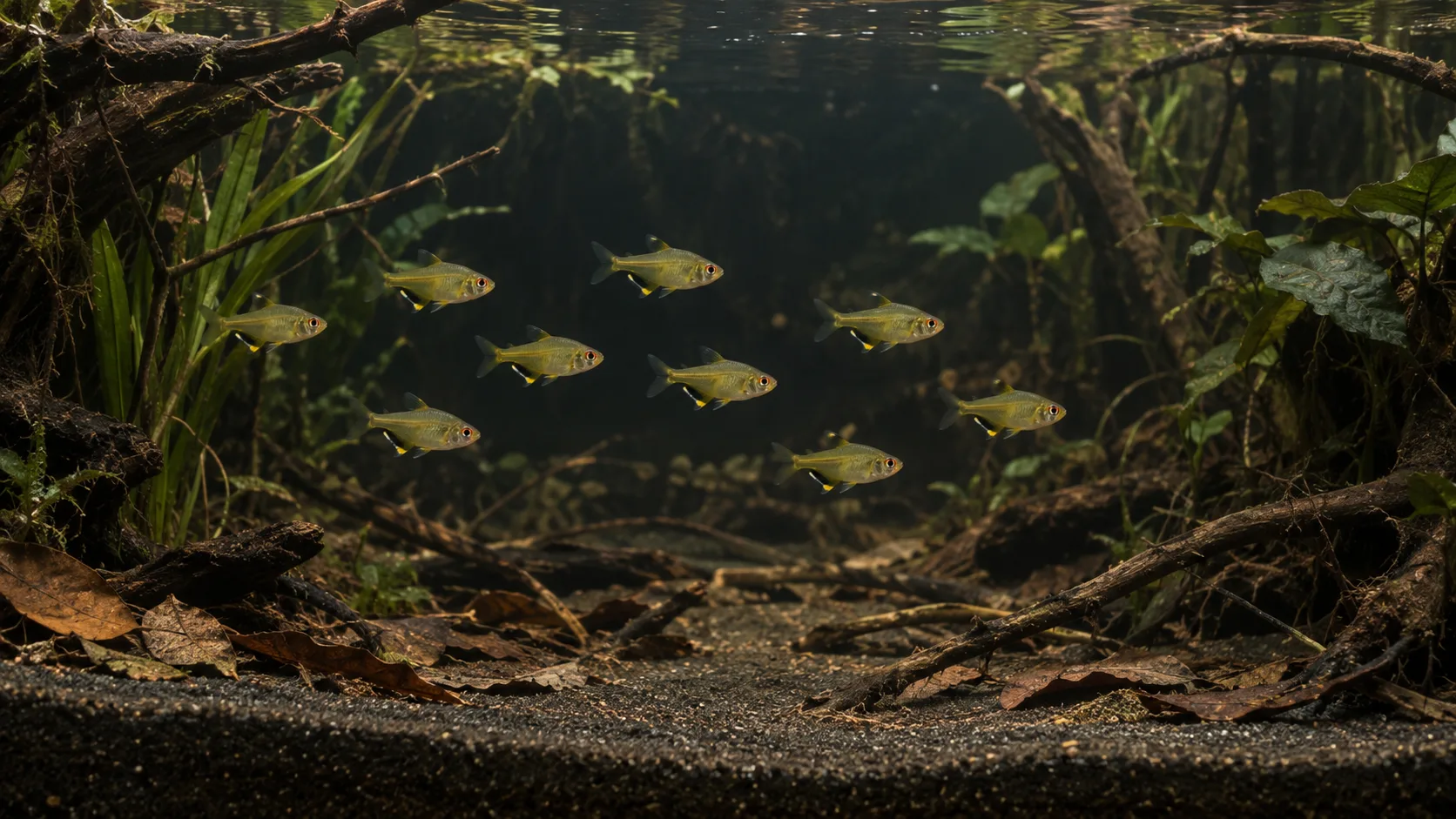 Lemon tetra
pH 5.5 to 8.0, a similarly broad range
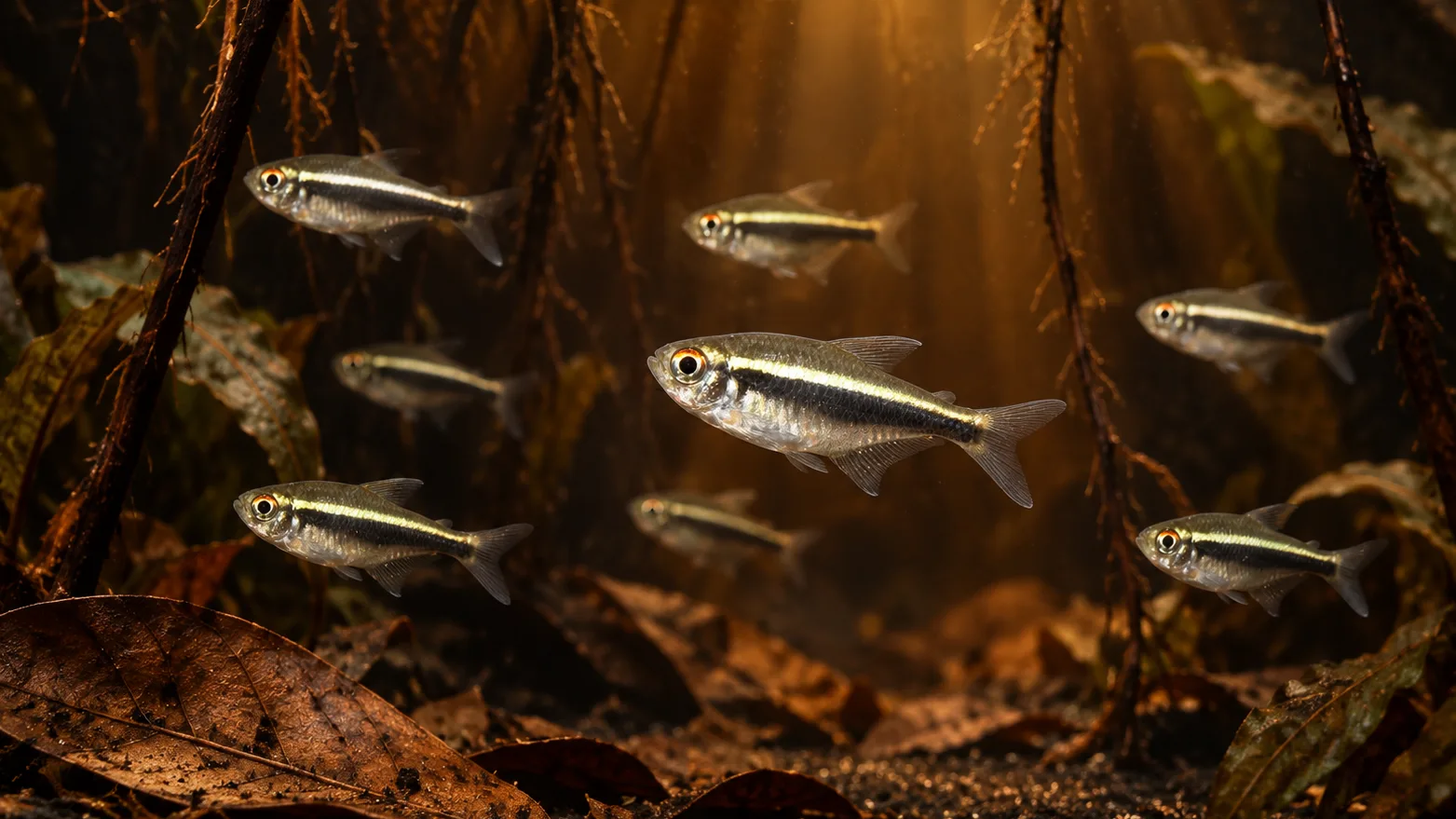 Black neon tetra
pH 5.5 to 7.5, inside the planning range
 Ember tetra
24 to 28 °C, though only about 2 cm long
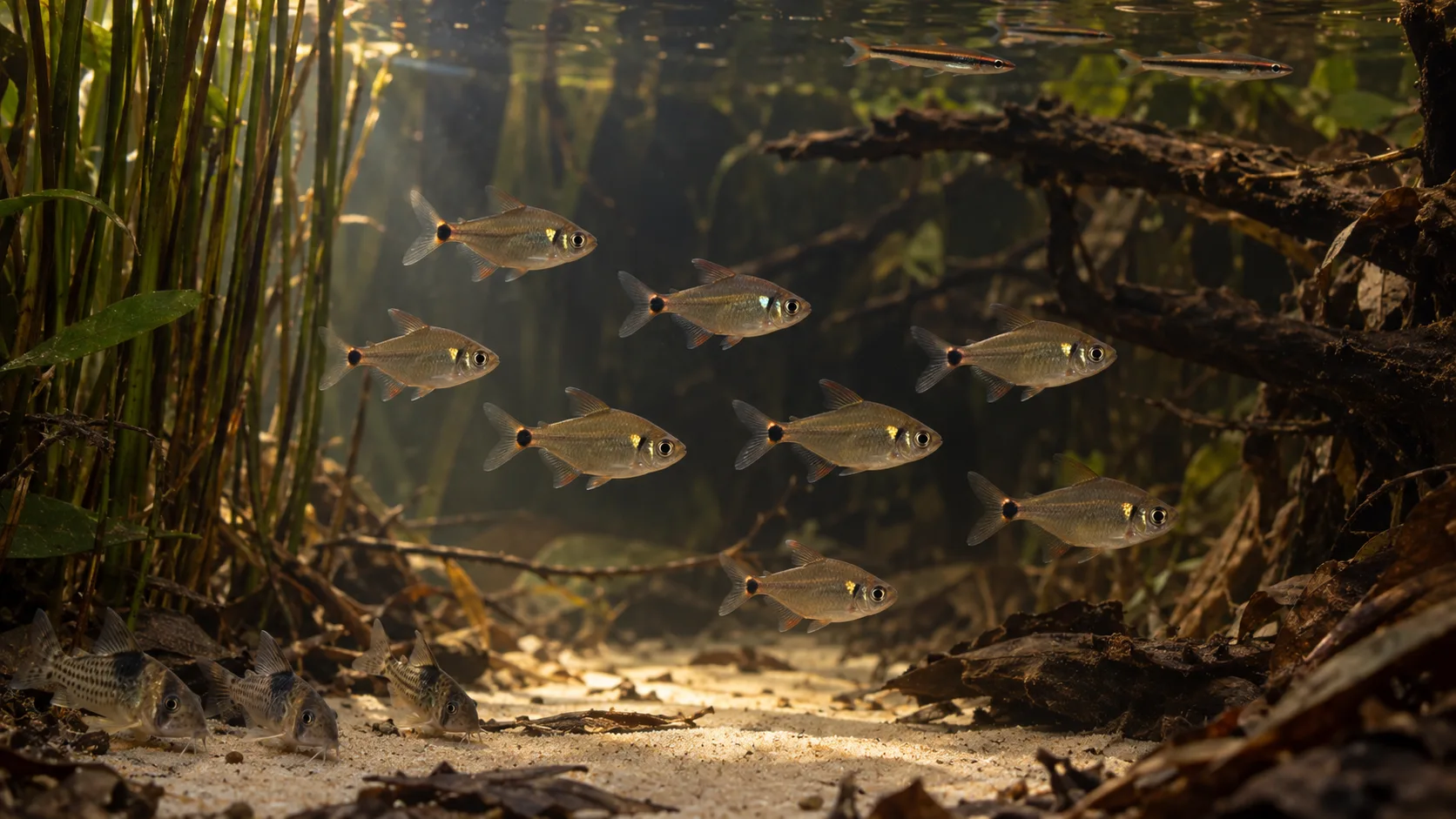 Head and tail light tetra
Overlaps only between 24 and 26 °C
Seriously Fish advises against boisterous or much larger tank mates. A 4.5 cm tetra fits in the mouth of a large cichlid, and a group that is chased at every feed stops competing for food long before any fish is injured.
Will pristella tetras breed in a home aquarium?
They spawn readily, and FishBase records 300 to 400 eggs per spawning. The water a group spawns in, though, is far narrower than the water it lives in.
| Decision factor | Keeping a group | Spawning |
|---|---|---|
| Temperature | 22 to 28 °C | 26.5 to 29 °C |
| pH | 6.0 to 7.5 | 5.5 to 6.5 |
| Hardness | 2 to 20 dGH | 1 to 5 dGH |
| Eggs | Eaten by adults in a community tank | Scattered among fine plants and protected from the parents |
| Fry | Rarely survive in a community tank | Hatch in 24 to 36 hours and swim freely after 3 to 4 days |
Here the tolerance argument runs in reverse. A group that lives well at pH 7.5 and 15 dGH may never produce viable fry, because Seriously Fish gives soft, acidic water as the condition for spawning.
Pristellas are egg scatterers, so a separate pristella tetra breeding tank is the realistic route, and the fry need infusoria-sized first foods for their first days.
Are pristella tetras wild-caught, and what are gold pristellas?
Almost all are farmed. Seriously Fish describes the species as commercially bred in huge numbers and rarely wild-caught, and FishBase lists commercial aquaculture alongside the aquarium trade.
IUCN lists Pristella maxillaris as Least Concern, assessed on 16 November 2020, and FishBase shows no CITES evaluation, so the species carries no international trade listing.
A golden, semi-albino strain is sold beside the normal form, and Seriously Fish records its care as much the same as for the standard fish.
A 2019 study of pristellas bought at a market in Wuhan compared the normal fish with a silvery-white mutant and a fully transparent one, and found different pigment cell patterns in each. Labels such as "albino" or "gold" are trade descriptions rather than recorded varieties with their own care data, so the wild-type ranges remain the only ones with published support.
What shortens a pristella tetra's life?
Neither FishBase nor Seriously Fish gives a lifespan for the species, so any single figure on a care sheet is an estimate rather than a measured result. The losses a keeper can prevent come from water, temperature and social stress rather than old age.
Check these before blaming the fish
- Ammonia and nitrite Any reading above zero on an ammonia or nitrite test points to an immature or overloaded filter and calls for a partial water change the same day.
- Temperature A reading below 24 °C, or a swing of several degrees between morning and evening, means the heater or the room temperature needs attention.
- pH drift A pH well below the tap-water value signals overdue water changes, and the correction has to be gradual.
- Group and companions A pristella kept alone, or chased by larger fish, stops feeding normally.
- New arrivals Fish added without quarantine can bring disease into an established group.
Clamped fins, rapid breathing or a fish hanging apart from the group are worth checking against the water first, because a shared-water problem affects every fish at once.
Bleeding, ulcers, swelling, white fuzzy growths or deaths continuing over several days need an aquatic veterinarian. Those signs cannot be told apart by eye, and treating without a diagnosis can make a sick group worse.