
What Is a Head and Tail Light Tetra, and What Does Its School Need?
Holopristis ocellifera
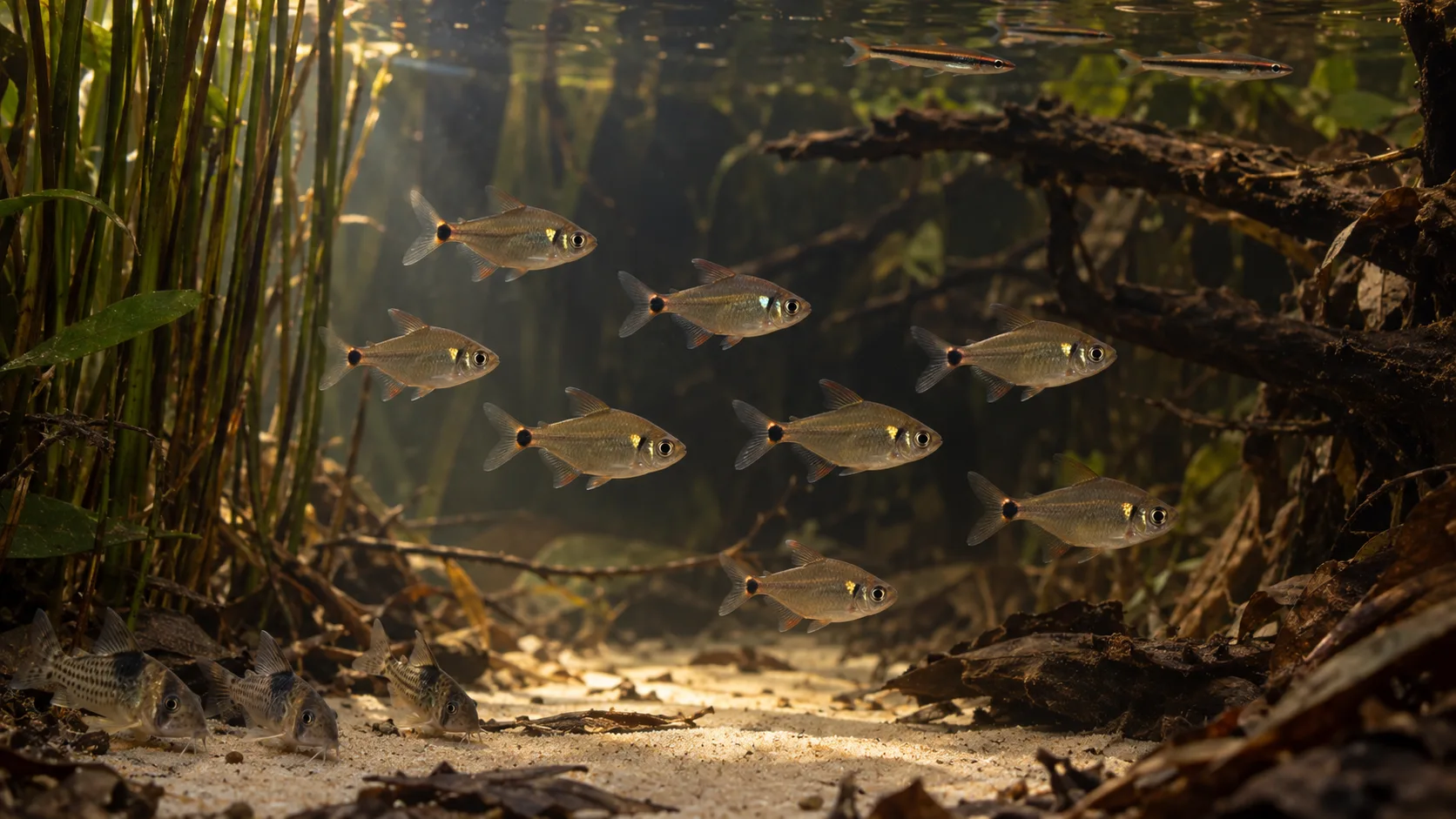
The head and tail light tetra is a South American schooling fish currently listed by FishBase as Holopristis ocellifera. Its reflective shoulder and tail spots show best against shaded cover, but adult group size, measured water, and feeding access determine the care plan.
At a glance

- Adult size
- 4.9 cm
- Minimum footprint
- At least 75 × 30 cm for eight adults, with shaded margins and a clear central midwater route
- Social structure
- A subtle midwater school; begin with at least eight adults and avoid larger faster feeding competitors.
- Minimum group
- 8
- Sex ratio
- No routine sex ratio is established.
- Diet
- Omnivore
- Feeding
- Use a complete small staple with modest invertebrate and plant variety, spread over more than one point for the whole school.
- Waste load
- moderate for a complete adult school
- Family
- Acestrorhamphidae
- Native range
- Guianas and the Amazon basin
- Conservation status
- Least Concern, assessed 4 March 2021 Source
Footprint follows adult group movement, cover displacement, feeding access, and maintenance capacity; it is not a pet-store survival minimum.
What is a head and tail light tetra?
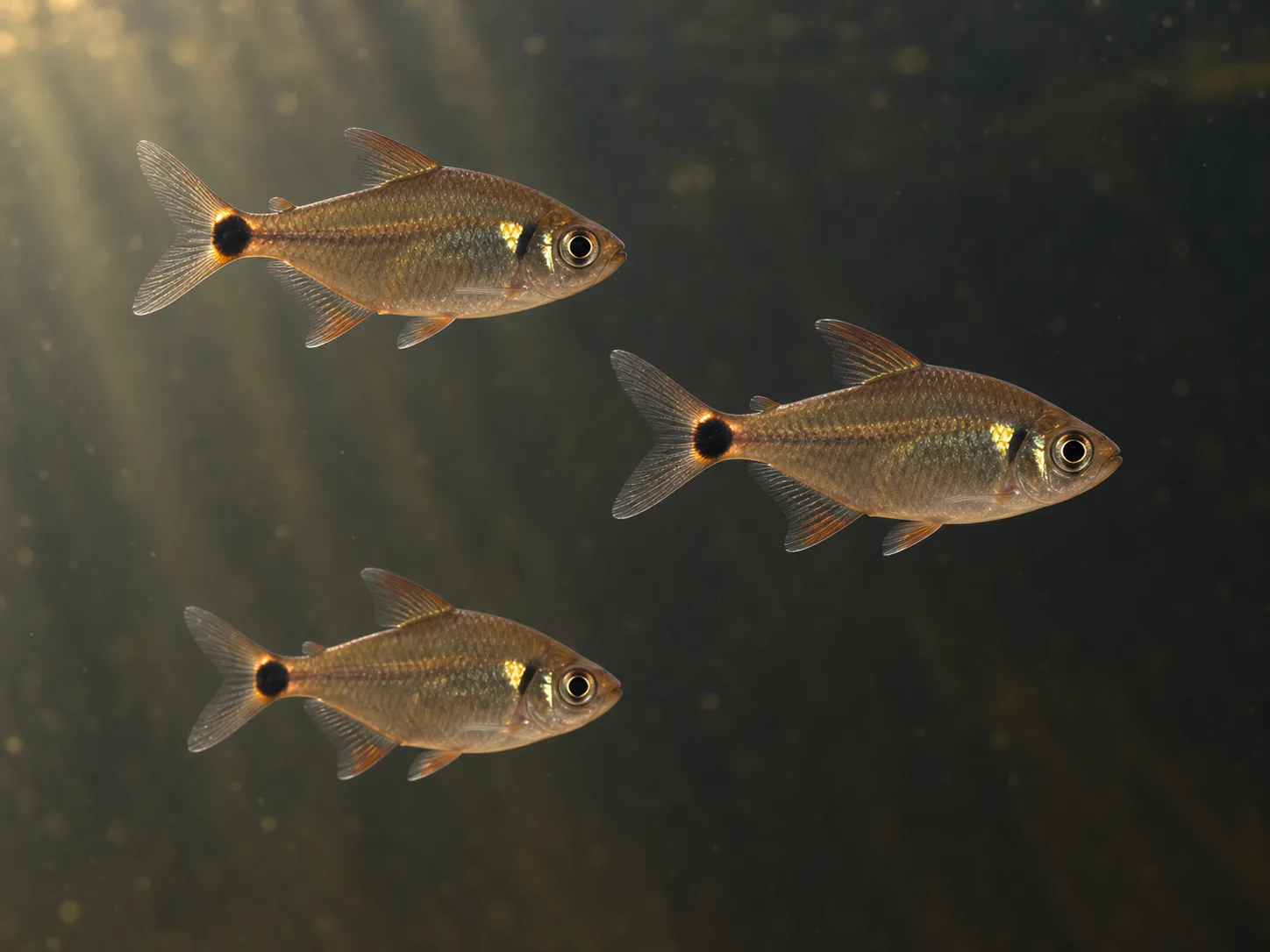
The head and tail light tetra is a small South American characin currently listed by FishBase as Holopristis ocellifera. It reaches about 4.9 cm total length and lives in groups, so the aquarium must support a complete school even though its translucent body looks visually light.
FishBase records the species from rivers of Guyana, Suriname, French Guiana, and the Amazon basin in Brazil and Peru. It associates adults with quieter coastal-zone waters and records a broad diet of worms, small insects, crustaceans, and plant matter.
- Current FishBase identity
- Holopristis ocellifera (Steindachner, 1882)
- Common alternate combination
- Hemigrammus ocellifer
- Family
- Acestrorhamphidae
- Verified range
- Guianas and Amazon basin records in Brazil and Peru
- Published maximum
- 4.9 cm total length, flagged as questionable in FishBase
- Habitat context
- Quiet freshwater, including coastal-zone water bodies
- Social structure
- Group-living benthopelagic tetra
- Practical starting group
- At least 8 adults
- Starting footprint
- 75 × 30 cm for the first adult school
- Conservation
- Least Concern, assessed 4 March 2021
The name also appears as head-and-taillight tetra, beacon fish, and head-and-tail light tetra. Preserve the exact seller label, supplier, purchase date, and scientific name because spelling differences and older combinations can otherwise make records look like several species.
Why do scientific names differ between sources?
FishBase currently displays Holopristis ocellifera, while GBIF presents Hemigrammus ocellifer and records Holopristis ocellifer among its synonym combinations. The gender ending also changes between ocellifer and ocellifera when the generic placement changes.
This is a live taxonomic disagreement between major data systems, not a reason to choose whichever name looks familiar. Keep both combinations in search and purchase records, then date the authority used so later updates can be traced.
| Name | Where it appears | Practical meaning |
|---|---|---|
| Holopristis ocellifera | Current FishBase display and Catalog of Fishes links | Check the accepted name and date when comparing older identification records |
| Hemigrammus ocellifer | GBIF and extensive aquarium literature | A widely used combination that still leads to the same species record |
| Head-and-taillight tetra | FishBase common name | Same common-name concept with closed compounds |
| Head and tail light tetra | Common search and trade wording | Same fish when the scientific identity agrees |
| Beacon fish | Regional or historical common name | Too broad to establish taxonomy by itself |
Do not use one aquarium image to settle the generic placement. Taxonomy depends on published anatomical and phylogenetic work, and databases may adopt revisions at different times.
How many head and tail light tetras should live together?
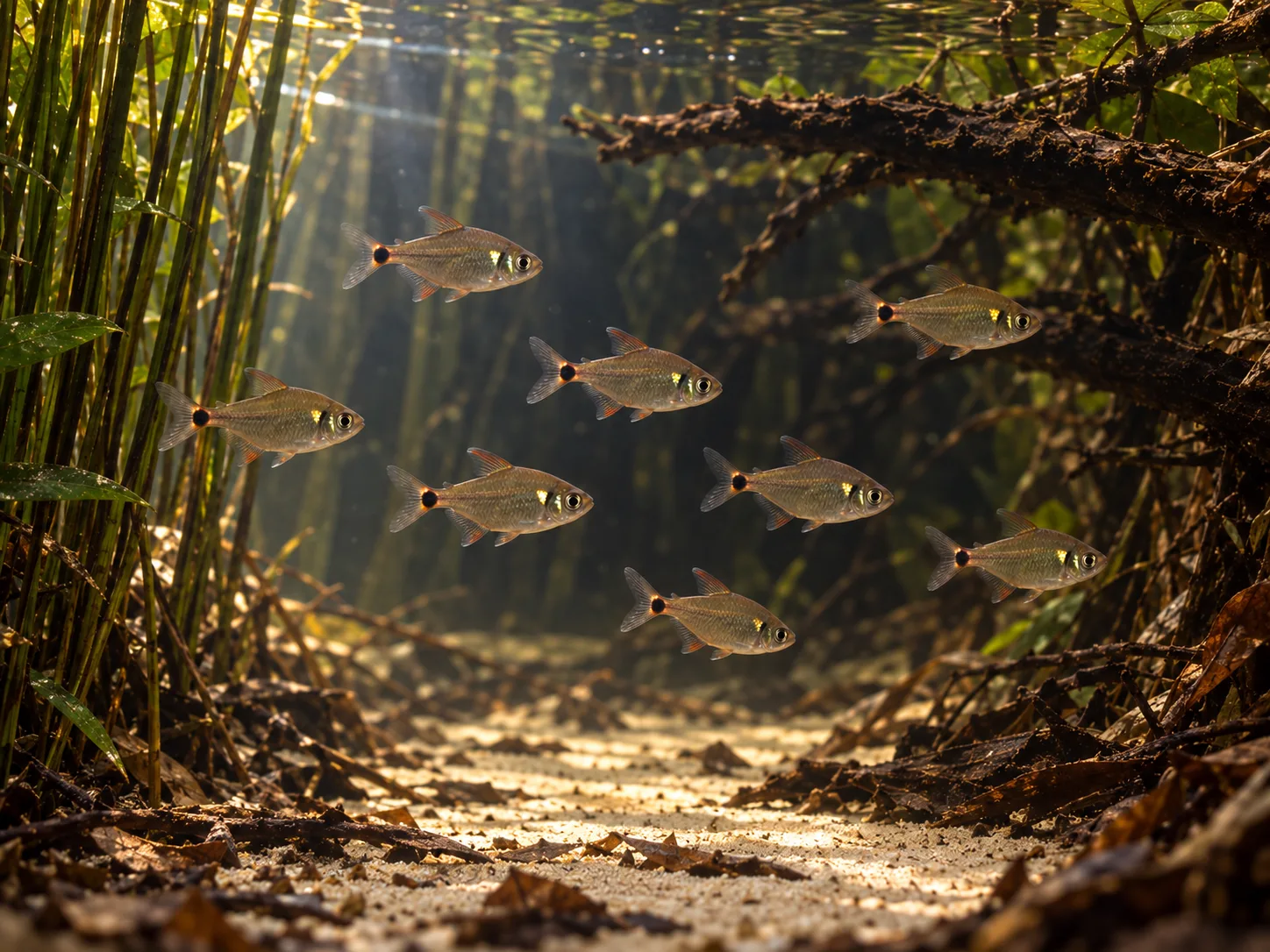
FishBase compiles aquarium groups of five or more. A practical starting group is at least eight adults, giving the fish more neighbours and making normal group spacing easier to observe without forcing every interaction onto the same few individuals.
Eight adults at nearly 5 cm form a real bioload and midwater presence. Their pale bodies do not make them smaller, and a second school still needs its own adult allowance, feeding route, and oxygen margin.
- Reserve the footprint for at least eight full-sized adults.
- Keep an uninterrupted middle-water route between the shaded ends.
- Count every companion at adult size, including its complete social group.
- Confirm that the same fish does not remain detached or miss both feeding zones.
- Leave open surface for warm-water gas exchange.
- Choose an upgrade point before juveniles reach adult body depth.
A secure school may spread out and browse rather than moving in a permanent formation. Concern rises when one fish stays apart with rapid breathing, clamped fins, poor appetite, or repeated exclusion.
What aquarium layout keeps both light spots visible?
A 75 × 30 cm footprint or larger provides useful lateral room for the first adult school. FishBase lists 60 cm as a compiled aquarium length, but extra distance makes room for plant cover, equipment, two feeding points, and the turning space lost around branches.
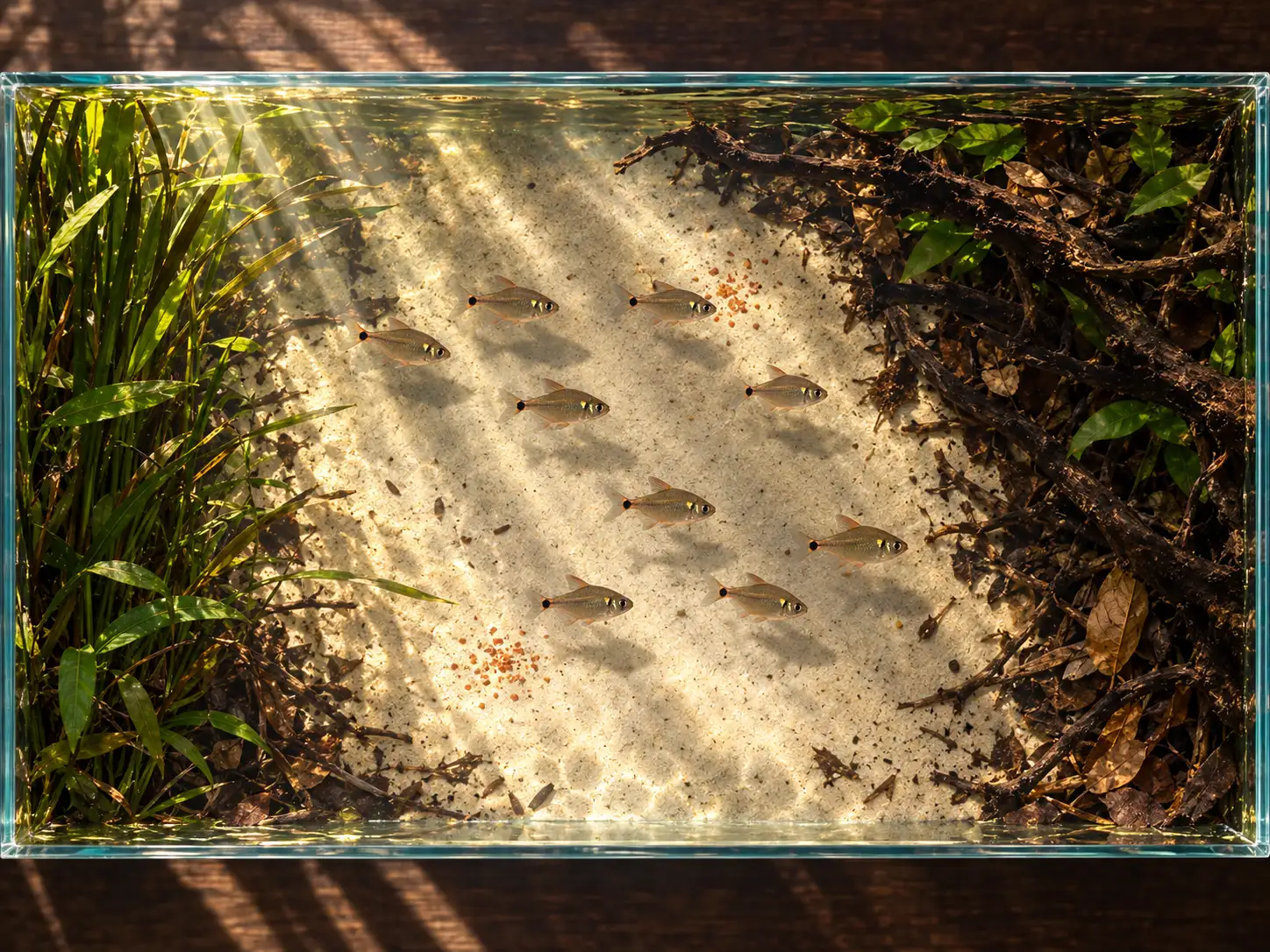
Use a darker rear background and shaded cover at the ends, then leave pale sand and open water through the middle. Side or angled light reveals the reflective spots more naturally than an intense lamp aimed straight down at a bare aquarium.
Dark rear cover
Plants and branches create contrast behind a translucent school without filling the swimming lane.
Open centre
Pale sand and clear midwater make group spacing, feeding, and waste easier to inspect.
Angled light
Place the main light to reveal reflective spots during normal turns rather than increasing intensity everywhere.
Gentle current
Circulate oxygenated water along the length while retaining quieter water around the planted ends.
Protected intake
Guard openings and inspect them after leaves or plant fragments collect.
Secure top
Close gaps around cables and filters before the school is introduced.
Reflective décor and bright white gravel can create glare that hides the subtle marks. A visually calmer tank makes behaviour and breathing easier to judge than a brighter display full of competing highlights.
Which water conditions suit this tetra?
FishBase compiles 22 to 26 °C, pH 6.0 to 8.0, and 5 to 19 dH. The breadth suggests the record covers several environments or captive contexts, so it should be used as an outer evidence band rather than a command to move stable water toward the midpoint.
Published head and tail light tetra water context
- Temperature22 to 26 °CApplies to Compiled range for Holopristis ocellifera. Separate thermometer away from heater and filter-return flow.
- pH6.0 to 8.0 pHApplies to Broad compiled range across the species record. Calibrated meter or liquid test spanning the source-water value.
- General hardness5 to 19 dHApplies to Broad compiled range that requires supplier-water comparison. Drop-count GH titration test reported in degrees of hardness.
Every range above is for a freshwater system. Source: FishBase, checked 2026-09-15.
Measure the seller's water and the receiving aquarium before transfer. A fish acclimated to one edge of this range may be harmed by an abrupt correction even when the new number remains inside the published band.
Ammonia and nitrite should remain undetectable in an occupied mature aquarium. Test after stocking, filter cleaning, overfeeding, a hidden death, or reduced flow instead of using spot brightness as a water-quality indicator.
What does a head and tail light tetra eat?
FishBase records worms, small insects, crustaceans, and plant matter. A complete small pellet or quality flake can provide the nutritional base, with controlled portions of suitably sized frozen or live invertebrate food used for variety.
The fish feed through the middle and upper water, but a familiar school can crowd one release point. Divide the ration and watch the back of the group because reflective flashes can make activity look higher than actual successful feeding.
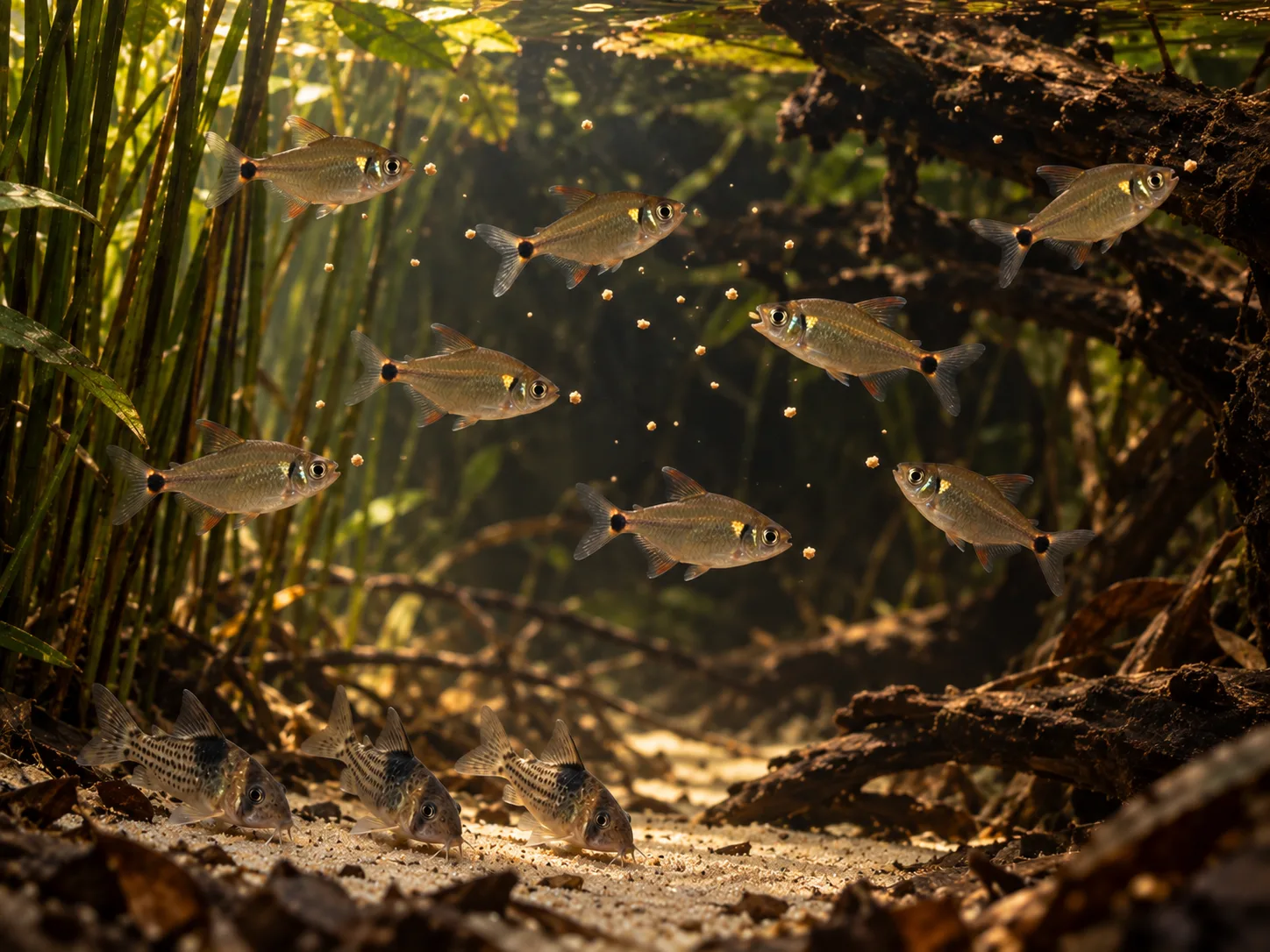
- Choose a complete small staple Match the particle to the adult mouth and the food's time in midwater.
- Release the first portion Feed one side and observe which fish leave cover.
- Use the second point Give the opposite end a separate opportunity before the bold cluster crosses the tank.
- Confirm swallowing Watch individual bites instead of counting surface strikes.
- Stop before food settles Remove persistent deposits and reduce the next portion when particles reach inaccessible areas.
- Review body condition Adjust from appetite, weight trend, waste, and water tests rather than a universal pellet number.
Food variety cannot compensate for chronic competition. A fish that approaches meals but becomes thinner may be losing access, carrying an illness, or facing a water problem that needs direct observation.
Which companions suit a subtle tetra school?
A suitable companion is calm enough that the head and tail light school continues to use open water. It must share a stable temperature and chemistry zone, remain unable to swallow the tetras, and receive food without forcing both groups into one crowded layer.
Bottom-oriented fish can reduce overlap when their substrate and group needs are met. A second midwater school can work only in a larger footprint because similar size and peaceful behaviour do not create extra swimming room.
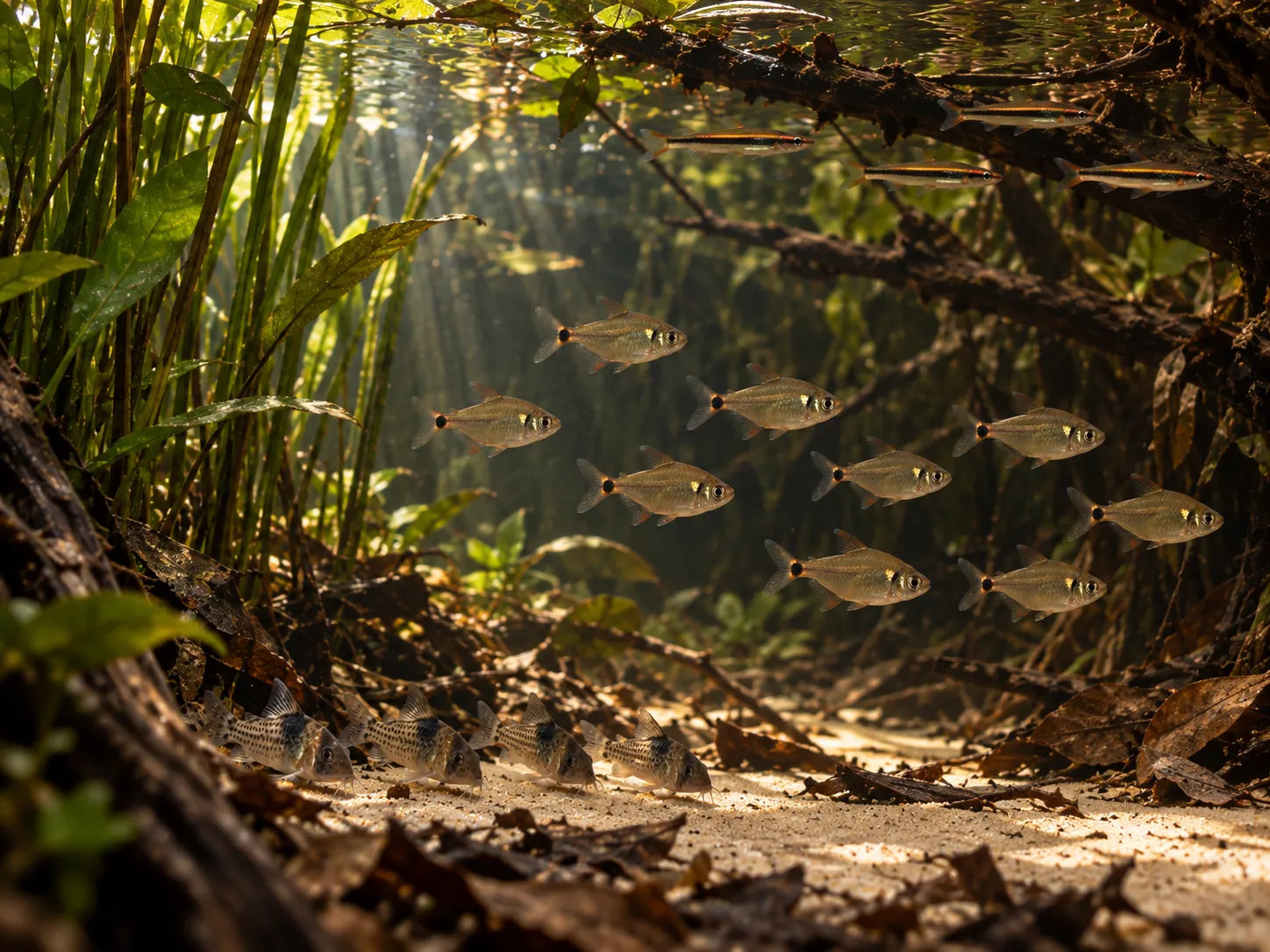
Compare community demands
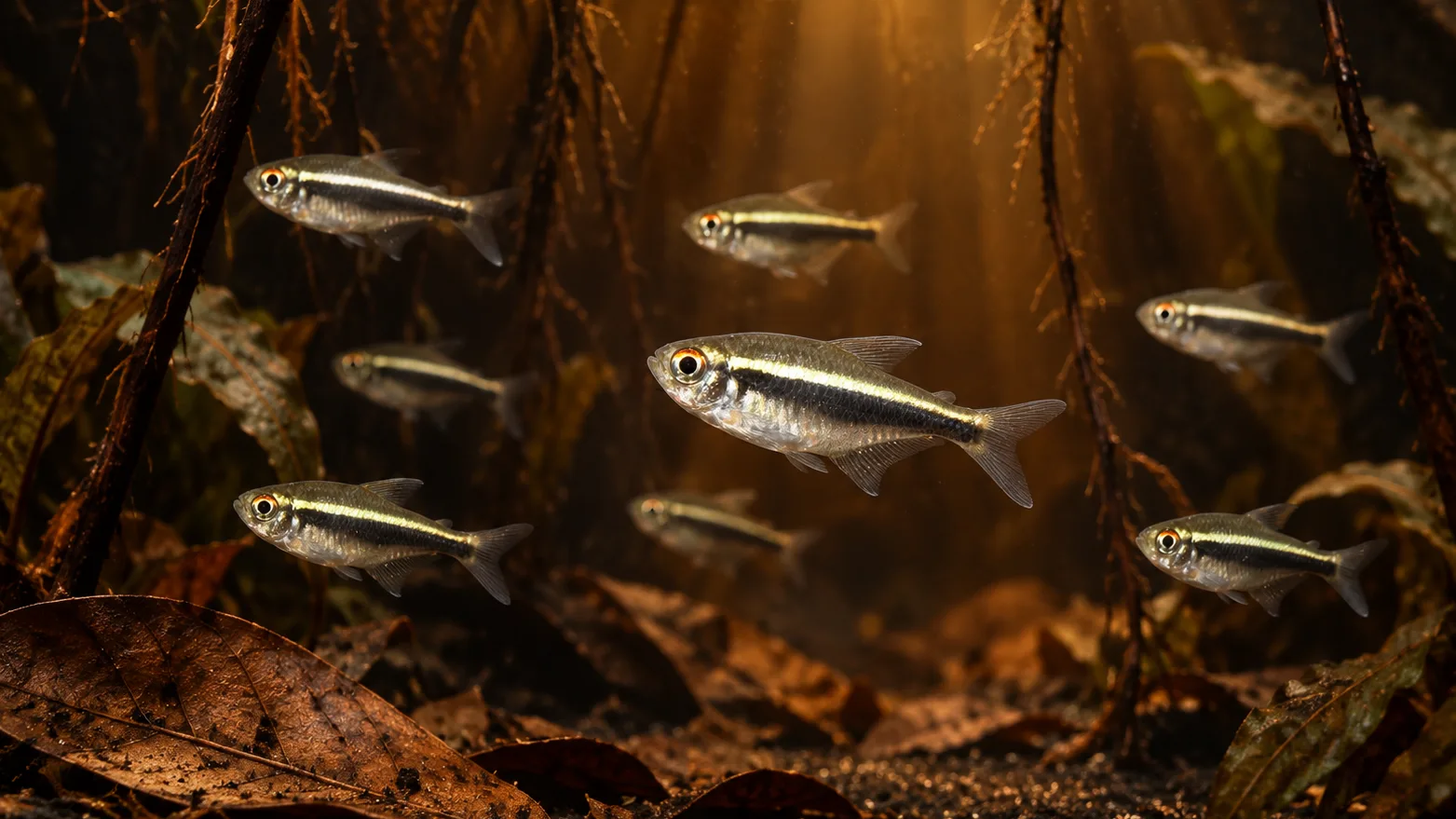 Black neon tetra
Similar silver-and-dark contrast with a stronger stripe and a separate full school in the same midwater band.
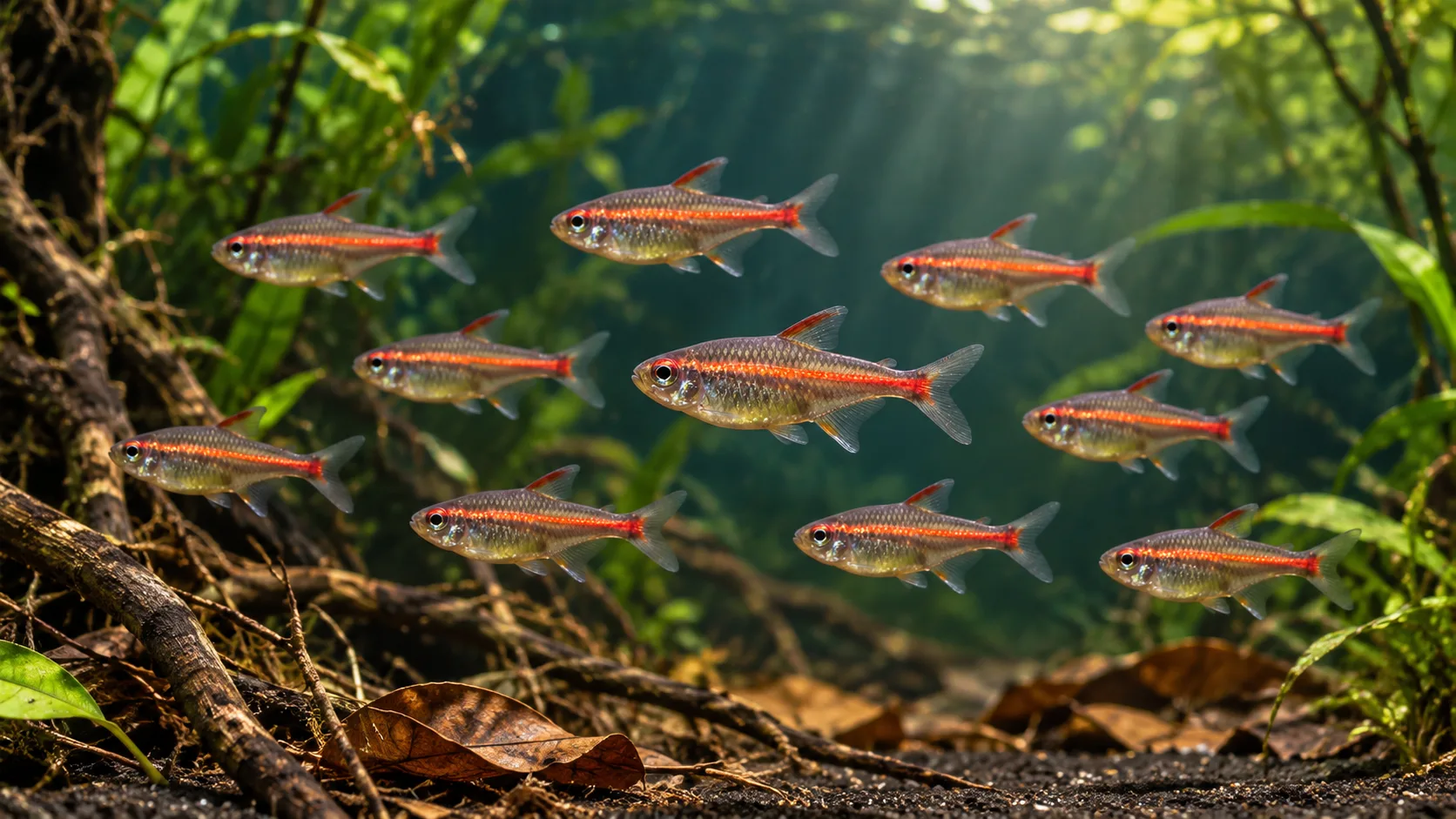 Glowlight tetra
Similar reflective appeal but usually associated with softer acidic water and another complete group.
 Ember tetra
Much smaller and quieter at food, requiring protection from crowding by larger tetras.
 Cardinal tetra
Stronger colour and warm soft-water needs can shift the community's chemistry decision.
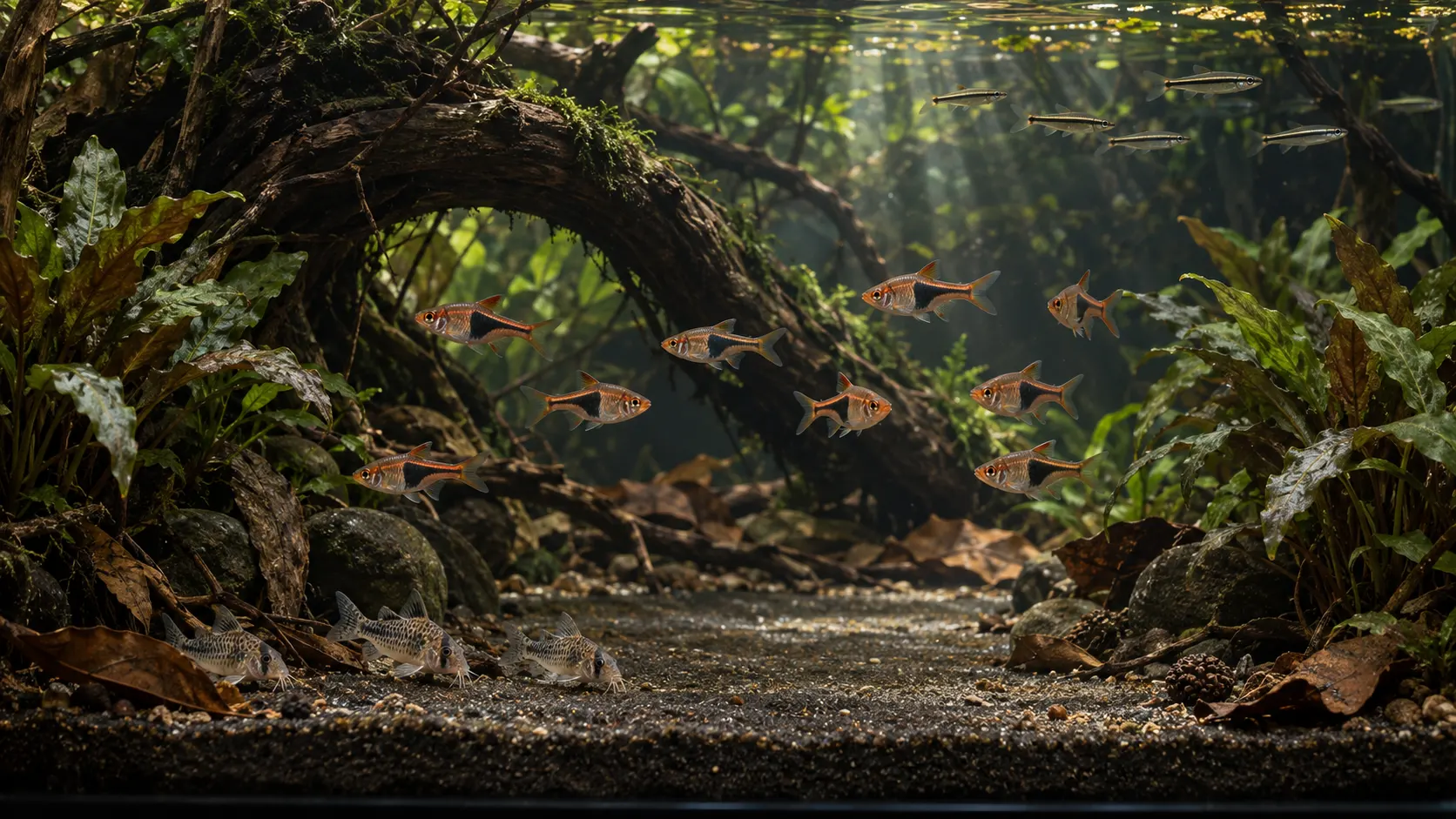 Harlequin rasbora
Deeper-bodied and more visually forceful, with its own school and open-lane requirement.
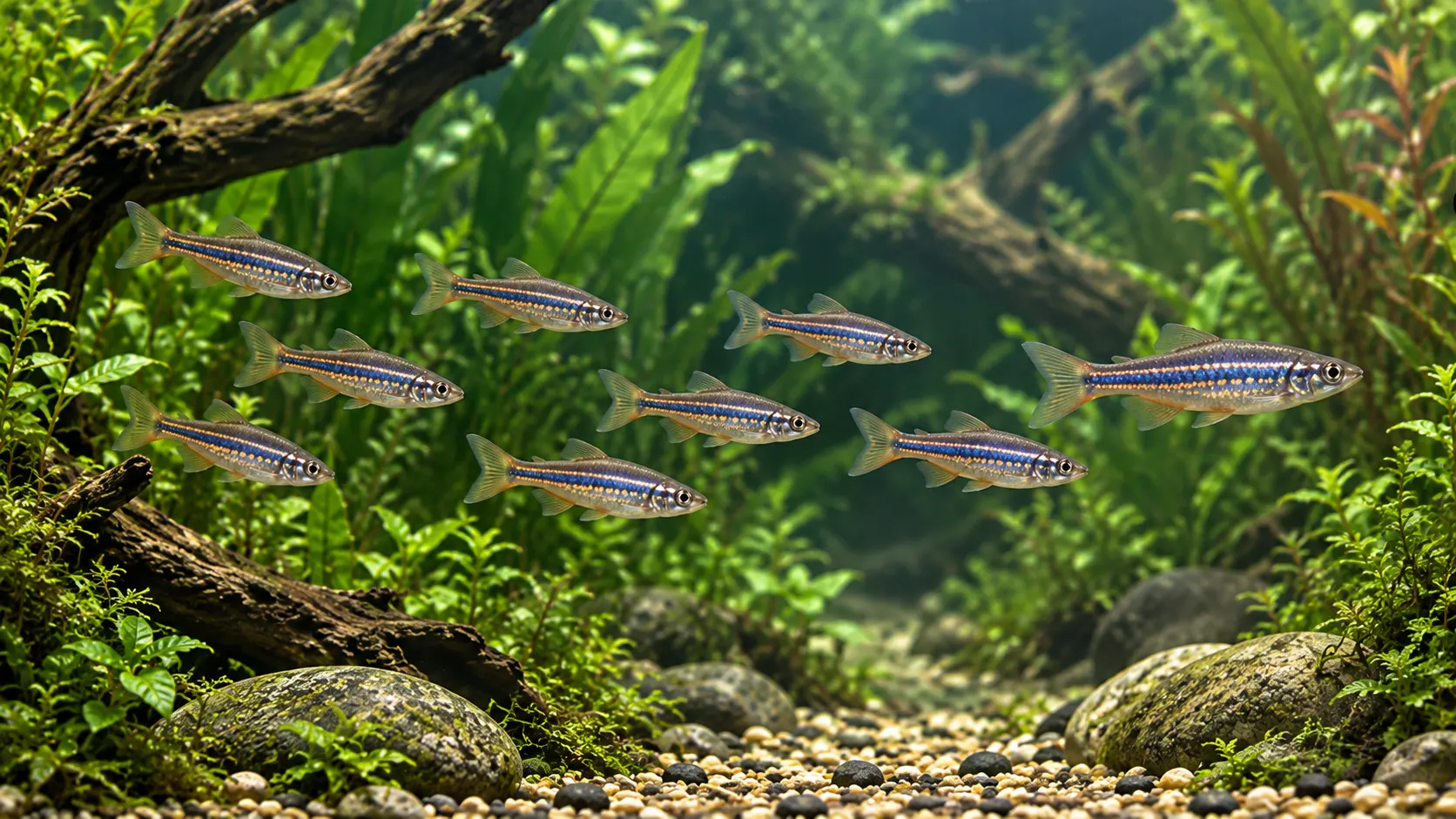 Giant danio
Its adult size and speed make it unsuitable for a modest subtle-tetra display.
 Diamond tetra
A deeper-bodied tetra whose display behaviour and adult mass change the community plan.
 Emperor tetra
Males may hold display positions, adding sightline and territory decisions.
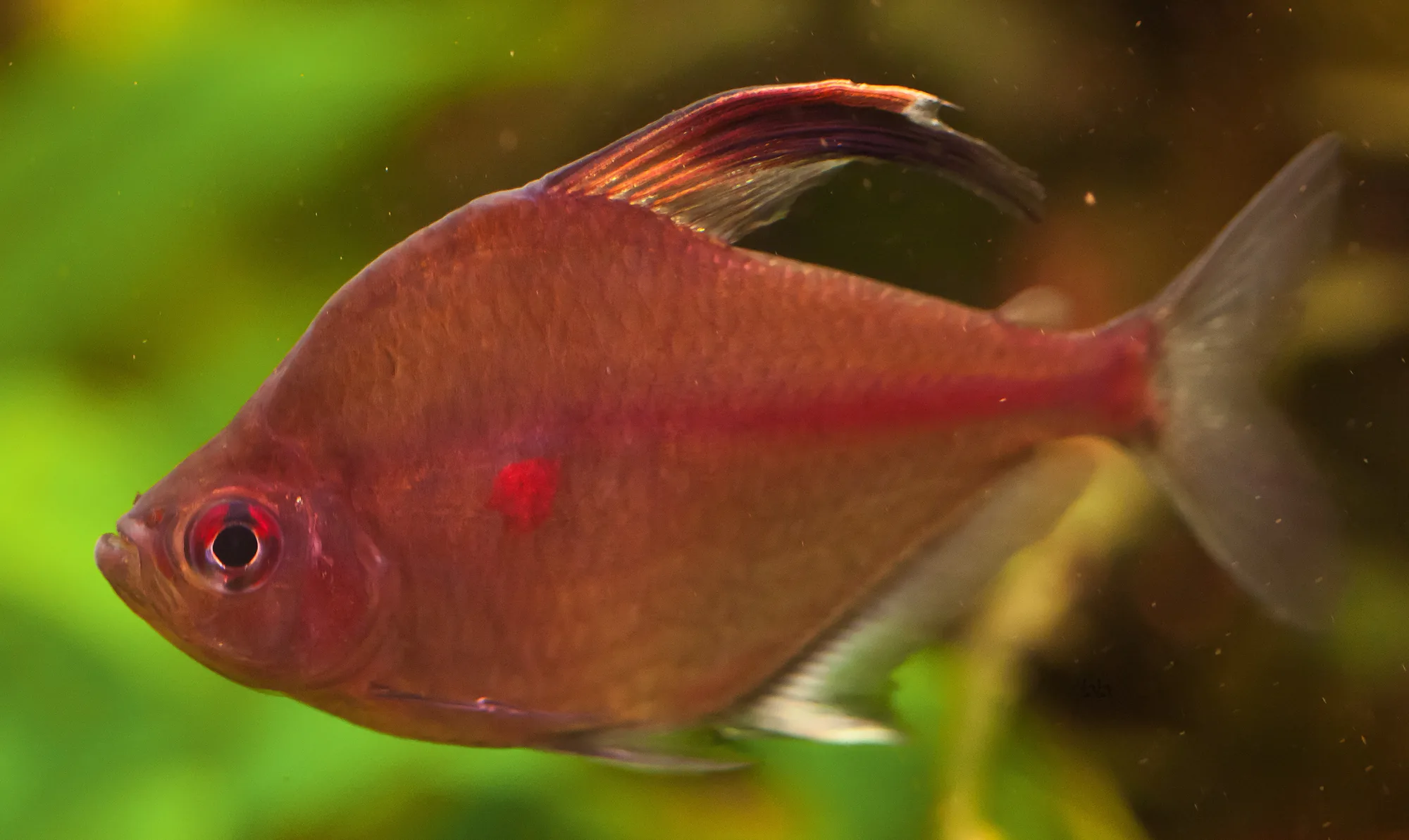 Bleeding heart tetra
A larger characin whose complete group requires more midwater capacity.
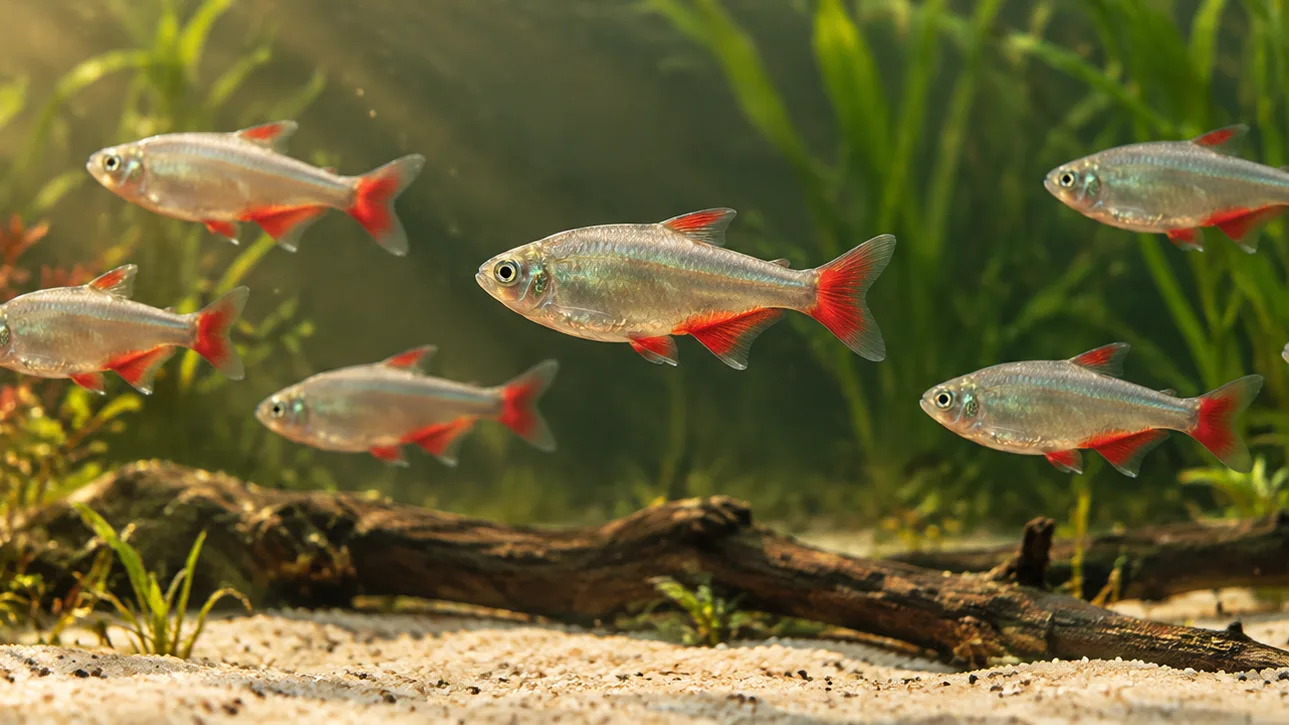 Bloodfin tetra
A more active school whose speed can change feeding access for subtle fish.
Avoid large predators, forceful fin nippers, and territorial fish that guard the only open lane. Keep a ready separation option because individual behaviour and the exact aquascape can overturn a general community reputation.
When are fading spots or hiding a warning?
The two spots may appear dim when the fish turns away from the light, rests after darkness, or arrives stressed from transport. Normal reflective change reverses as the fish resumes group movement and feeding.
Check measurable causes before chasing colour
- Light angle Observe the fish from another position and compare several settled group members.
- Temperature and oxygen Verify the thermometer, surface movement, room heat, and recent power interruptions.
- Toxic nitrogen Test ammonia and nitrite after stocking, filter work, heavy feeding, or a death.
- Social access Confirm the same fish can leave encounters and feed at either release point.
- Contamination Review sprays, soap, untreated water, metals, and shared equipment.
Several fish gasping, losing balance, crowding the surface, or trying to leave the water requires immediate water and oxygen checks. Increase safe surface movement, verify temperature, test toxic nitrogen, and use conditioned temperature-matched replacement water when contamination or toxicity is confirmed.
Do not diagnose a named condition from one dim tail spot or a photograph. Avoid combining medication, major chemistry change, complete filter cleaning, and a rescape without a confirmed reason.
What long-term commitment should you plan for?
Primary species records do not establish a dependable head and tail light tetra lifespan range. Plan for a multi-year school and keep purchase dates, source names, approximate starting sizes, losses, and major water changes rather than presenting a consumer estimate as a guarantee.
FishBase lists the species as Least Concern, assessed 4 March 2021, and CITES as Not Evaluated. That status does not settle every local population, trade rule, or taxonomic update.
A head and tail light tetra school fits when you can provide at least eight adults with open midwater, shaded contrast, stable measured water, distributed food, and calm companions that leave the group visible. The reflective spots help you recognize the fish, but the adult school and shared system determine the real care commitment.