
What Is a Lambchop Rasbora, and What Does Its School Need?
Trigonostigma espei
The lambchop rasbora is Trigonostigma espei, a small copper-orange schooling fish from Thailand and Cambodia. Its narrow hooked flank mark separates it from a harlequin, while its complete group still needs a mature planted aquarium and continuous swimming room.
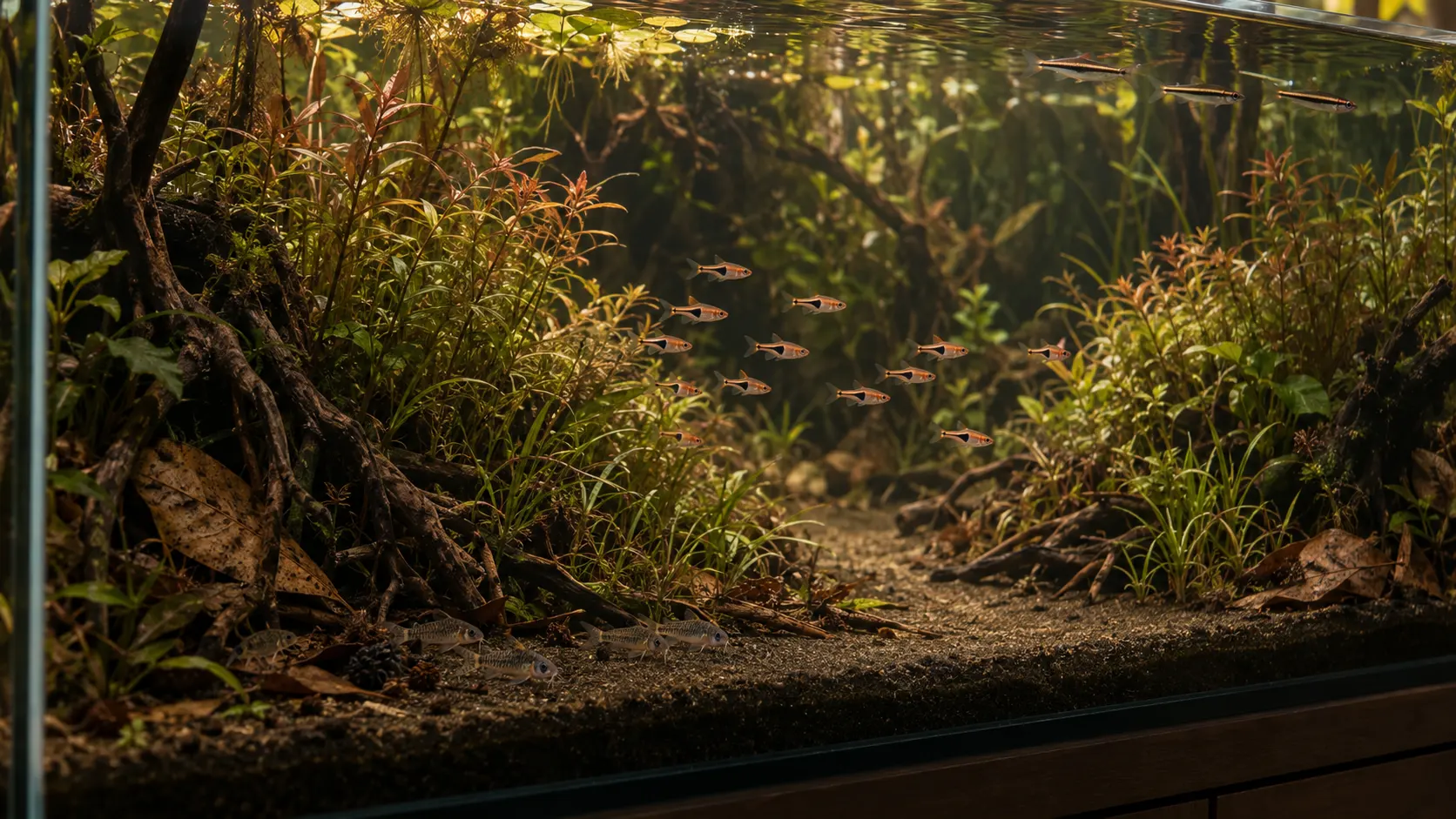
At a glance

- Adult size
- 2.5 cm
- Minimum footprint
- At least 60 × 30 cm for ten adults, with offset plant islands and a continuous open lane
- Social structure
- A small midwater school; begin with at least ten adults and protect feeding access from larger faster fish.
- Minimum group
- 10
- Sex ratio
- No routine sex ratio is established.
- Diet
- Omnivore
- Feeding
- Use a complete micro staple with suitably small frozen or live invertebrate foods, distributed along the group front.
- Waste load
- low per fish, meaningful for the complete warm-water school
- Family
- Danionidae
- Native range
- Thailand and Cambodia
- Conservation status
- Least Concern, assessed 27 March 2011 Source
Footprint follows adult group movement, cover displacement, feeding access, and maintenance capacity; it is not a pet-store survival minimum.
What is a lambchop rasbora?
The lambchop rasbora is Trigonostigma espei, a slender copper-orange schooling fish from Thailand and Cambodia. FishBase publishes a maximum of 2.5 cm standard length, but its tiny body does not remove the need for a complete group, lateral swimming space, and calm feeding access.
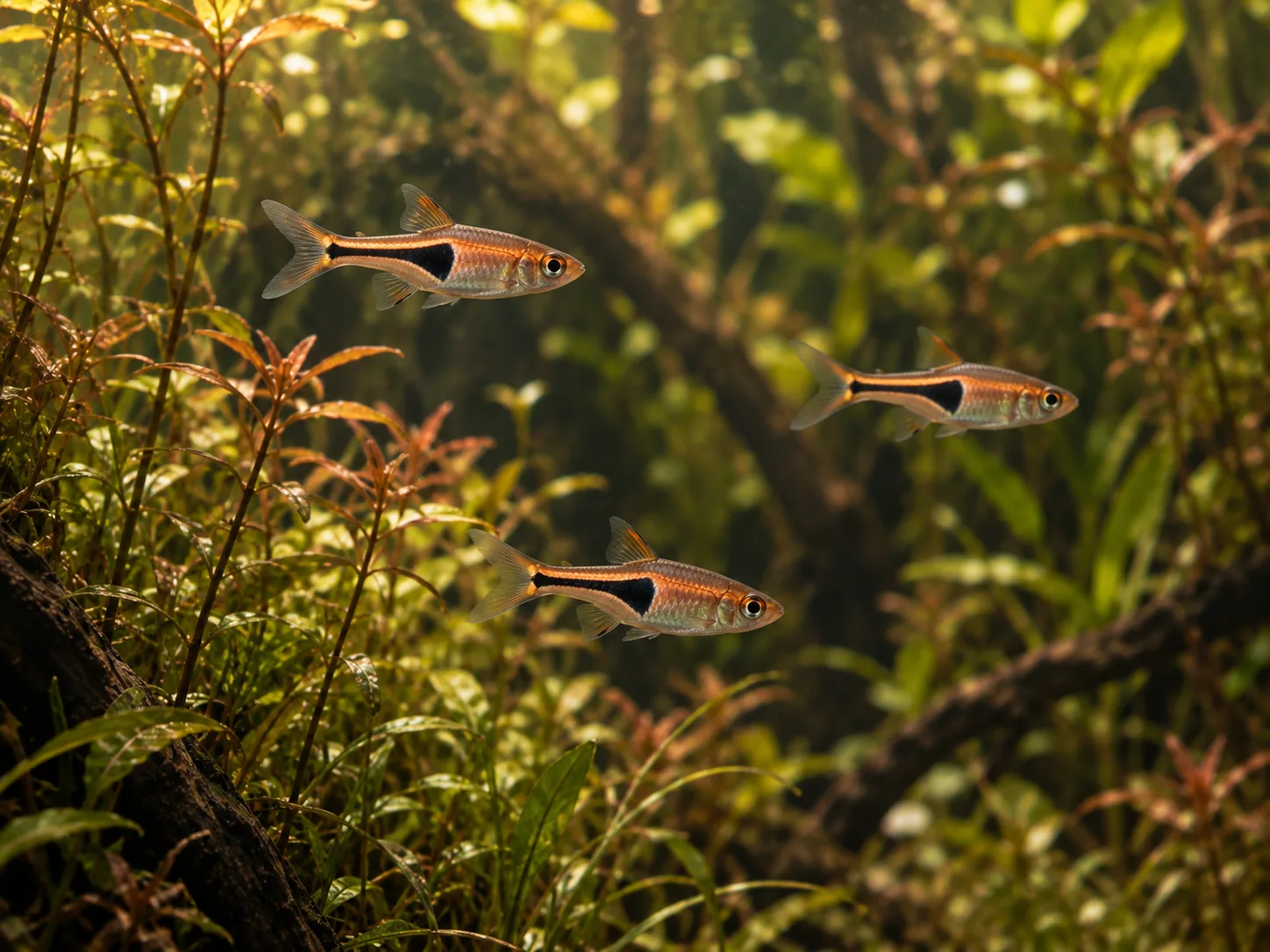
FishBase accepts the species in Danionidae and records it from ponds, pools, marshes, and swamps with heavy submerged plant growth. The defining broad mark is a black blotch shaped like a narrow hook or lambchop on the caudal peduncle.
- Accepted identity
- Trigonostigma espei (Meinken, 1967)
- Family
- Danionidae
- Verified range
- Thailand and Cambodia
- Published maximum
- 2.5 cm standard length
- Habitat
- Ponds, pools, marshes, and swamps with dense submerged plants
- Social structure
- Small midwater school
- Practical starting group
- At least 10 adults
- Starting footprint
- 60 × 30 cm for a species-led school
- Published water context
- 23 to 28 °C, pH 6.0 to 6.5, hardness up to 12 dH
- Conservation
- Least Concern, assessed 27 March 2011
Espe's rasbora, espei rasbora, and false harlequin may refer to the same species in trade. Keep the exact scientific name, seller, date, and origin claim because false harlequin can also be used loosely for other wedge-marked fish.
How is a lambchop different from a harlequin rasbora?
The lambchop is slimmer and carries a narrow black mark whose forward portion is short and whose rear section extends toward the tail. The harlequin rasbora is deeper-bodied and has a broad triangular wedge occupying much more of the rear flank.
Glowlight rasboras can appear similarly slim, but their dark mark is paired with a bright orange line and is shaped differently. A pale juvenile, stressed shipment, or oblique view can blur all three distinctions, so preserve the supplier identity rather than naming fish from one photograph.
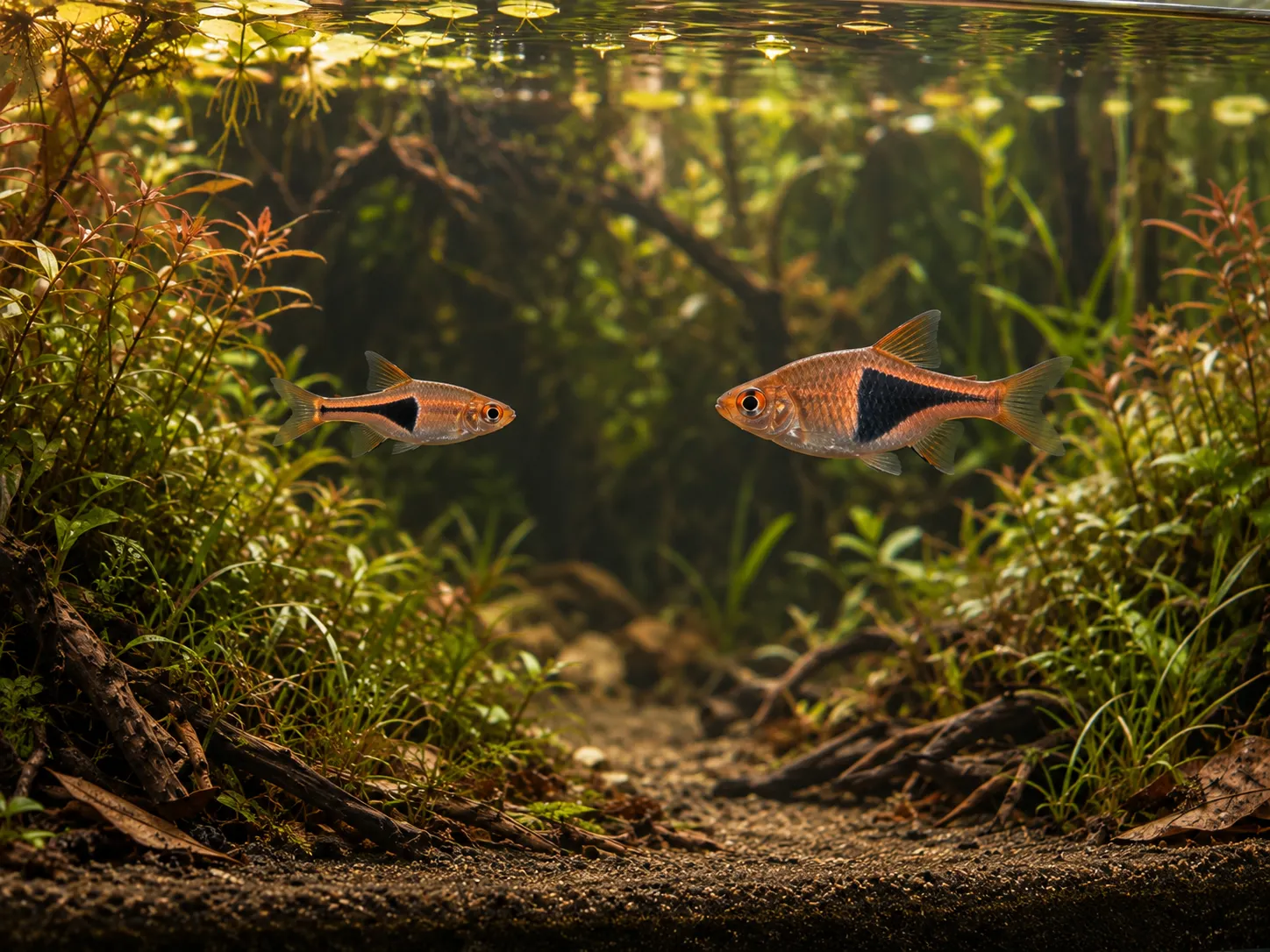
Mixing the species does not guarantee one combined school. Each species may retain its own social preference, so plan complete groups and enough midwater for both rather than buying partial groups that are expected to merge.
How large should a lambchop school be?
A practical school begins with at least 10 adults. The number is larger than the common compiled minimum for many rasboras because a 2.5 cm fish benefits from more same-species neighbours and becomes easier to observe as a group.
Ten tiny fish still require a mature filter, dependable oxygen, and distributed food. Adding more can improve the visual school only while the aquarium retains open water, low crowding, and enough capacity for maintenance delays.
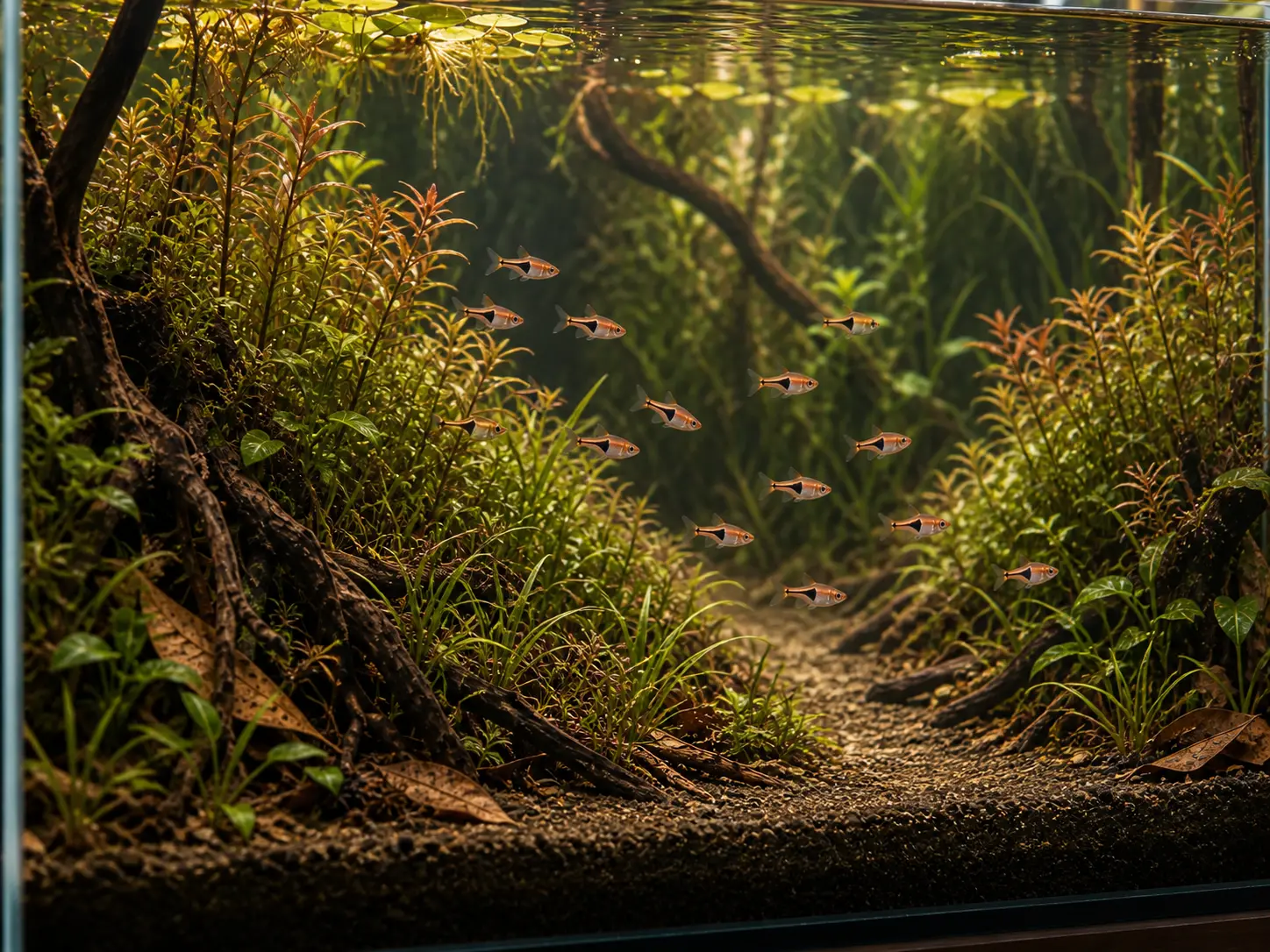
- Reserve the footprint for at least ten full-sized lambchop rasboras.
- Keep a continuous midwater lane through most of the tank length.
- Use fine plants at the margins without filling the centre with stems.
- Confirm the intake cannot trap a 2.5 cm fish.
- Provide two feeding areas for timid individuals.
- Count every second school as a complete adult group.
- Leave oxygen and filter capacity for warm weather and delayed maintenance.
The group may scatter into plants to forage and reform after movement near the tank. A permanent tight cluster at one end can show that flow, light, tank mates, or water conditions are keeping the fish alert.
What tank layout suits a small planted-stream fish?
A 60 × 30 cm footprint or larger gives a lambchop school a useful lateral route while keeping the plants close enough for retreat. A shorter nano cube may hold similar litres but forces every turn, feeding event, and social encounter into the same small distance.
You can place fine-leaved or narrow-stem plants at the back and ends while leaving an offset open corridor through the middle. Small roots and low stones can define the route without creating a hard wall, and your filter should move water gently through both open and planted zones.
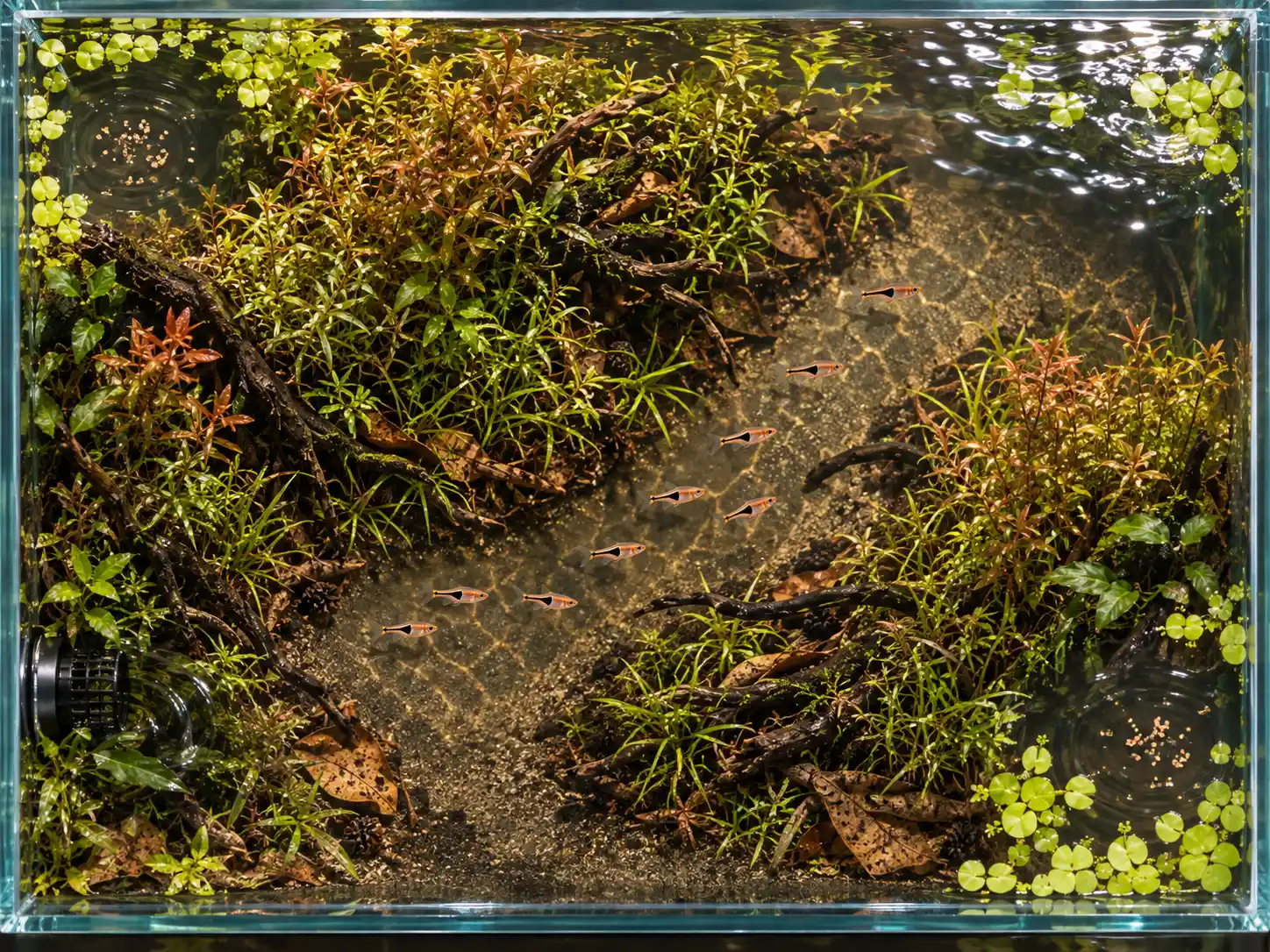
Offset plant islands
Stagger fine stems and low roots so the fish can leave view without losing the complete swimming route.
Open S-shaped lane
Preserve a clear path long enough for the school to spread and turn.
Gentle through-flow
Carry oxygenated water around both islands without blasting the narrow-bodied fish.
Safe intake
Fit a guard and clean it before collected leaves reduce flow.
Broken surface light
Use modest floating cover while retaining open gas-exchange space.
Maintenance access
Leave a siphon route around plant bases and beneath the feeding zones.
FishBase records spawning in shallow water around 15 to 20 cm deep, but a display aquarium should not be made shallow or unstable to imitate a breeding note. Breeding needs a separate controlled system, egg plan, and fry food rather than an improvised change to the community tank.
Which water conditions suit lambchop rasboras?
FishBase compiles 23 to 28 °C, pH 6.0 to 6.5, and hardness up to 12 dH. The pH band is narrow while the hardness record lacks a stated lower bound, so the data should not be converted into a precise universal target.
Published lambchop rasbora water context
- Temperature23 to 28 °CApplies to Compiled aquarium range for Trigonostigma espei. Separate thermometer away from heater and filter-return flow.
- pH6.0 to 6.5 pHApplies to Compiled range for Trigonostigma espei. Calibrated meter or liquid test that resolves mildly acidic water.
- General hardnessUp to 12 dH; lower bound not statedApplies to Incomplete compiled hardness range. Drop-count GH titration test reported in degrees of hardness.
Every range above is for a freshwater system. Source: FishBase, checked 2026-09-15.
You should measure the seller's water and your receiving tank before acclimation. Captive history may explain why a shipment has lived outside the narrow pH band, but that history must be documented rather than assumed from the word tank-bred.
Ammonia and nitrite should remain undetectable in an occupied mature aquarium. Warm water and dense plants still need circulation and surface movement, especially at night when plants and animals both consume oxygen.
What do lambchop rasboras eat?
FishBase does not provide a detailed species diet in its current summary, so avoid claiming one exact natural menu. In an aquarium, use a complete micro-pellet or finely crushed quality flake as the base and offer controlled portions of suitably small frozen or live invertebrate food for variety.
Particle size and feeding position matter because a 2.5 cm fish can approach food that it cannot swallow. Release fine food across the school front and stop while particles are still being found quickly.
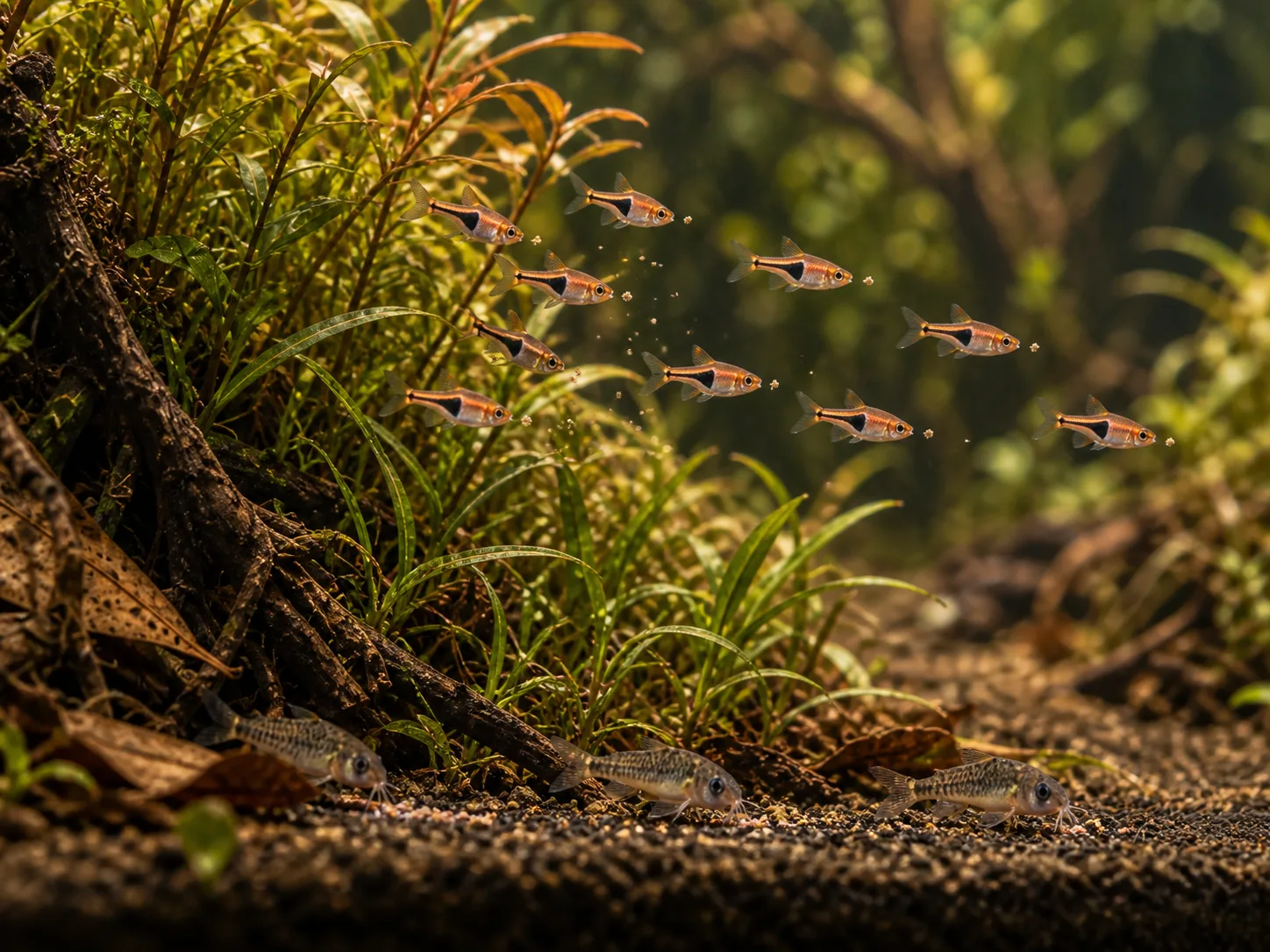
- Choose a complete micro staple Confirm the particles can be swallowed quickly by adult lambchops.
- Feed along the group front Spread the first portion rather than dropping it over one dominant cluster.
- Use a second release point Give fish beside the opposite plant island a direct chance to eat.
- Watch individual bites Check the smallest and quietest fish instead of judging the whole meal from motion.
- Stop before food settles Remove persistent deposits and reduce the next portion when fine food reaches plant bases.
- Review trends Adjust from body condition, waste, nitrate, and filter performance rather than a fixed pinch.
Live-food cultures need a known source because contaminated water can introduce pathogens or unwanted organisms. Variety should widen nutrition without turning collection from outdoor water into an uncontrolled risk.
Which tank mates fit their small body size?
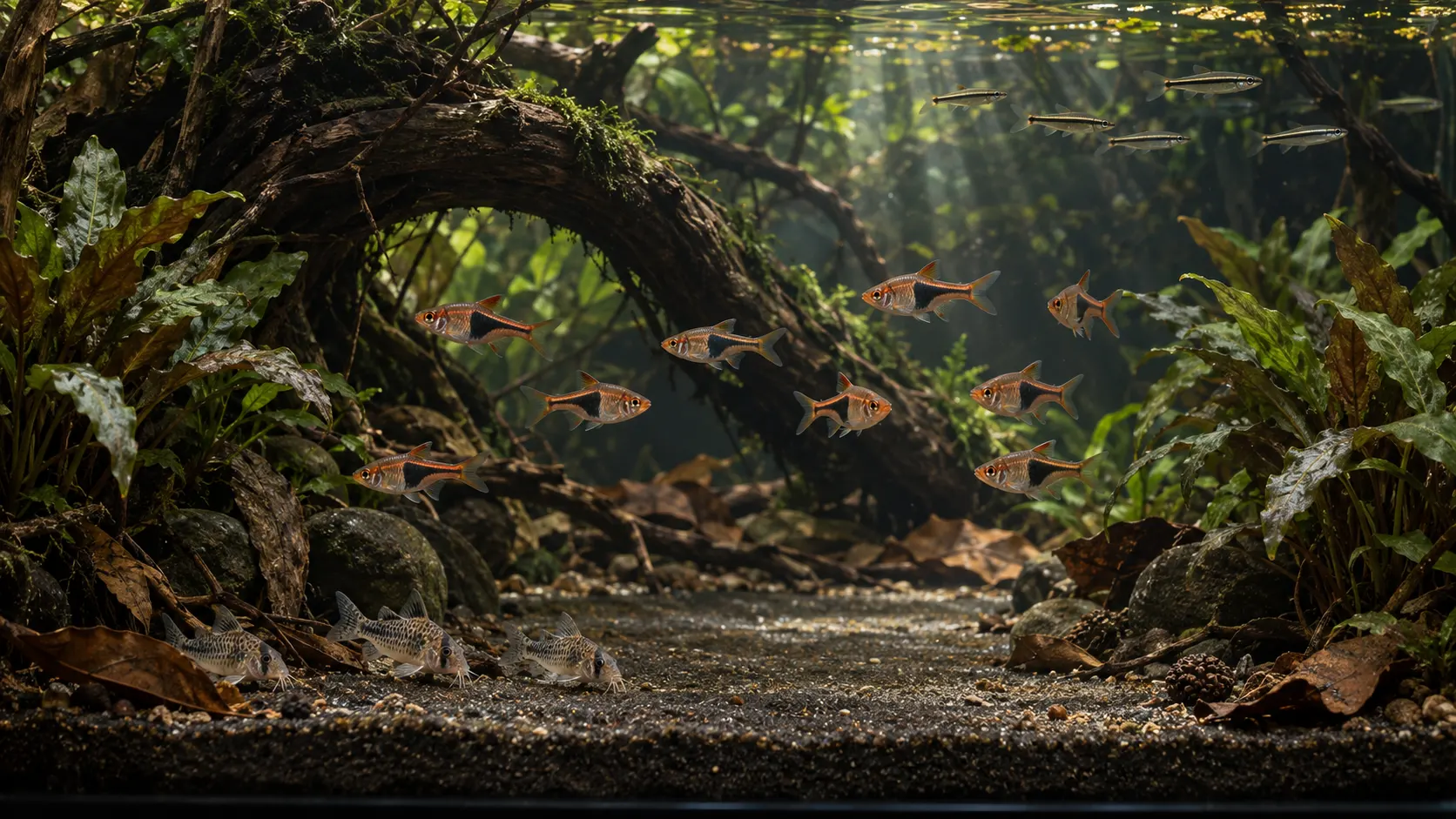
Adult mouth size is the first screen. A fish described as peaceful may still swallow a 2.5 cm lambchop, intimidate the school through constant movement, or take every particle before the rasboras feed.
Small calm companions can work when their temperature and chemistry overlap and the aquarium provides each species with its complete social group. Bottom-oriented animals reduce midwater competition only when their substrate, oxygen, and feeding needs are also met.
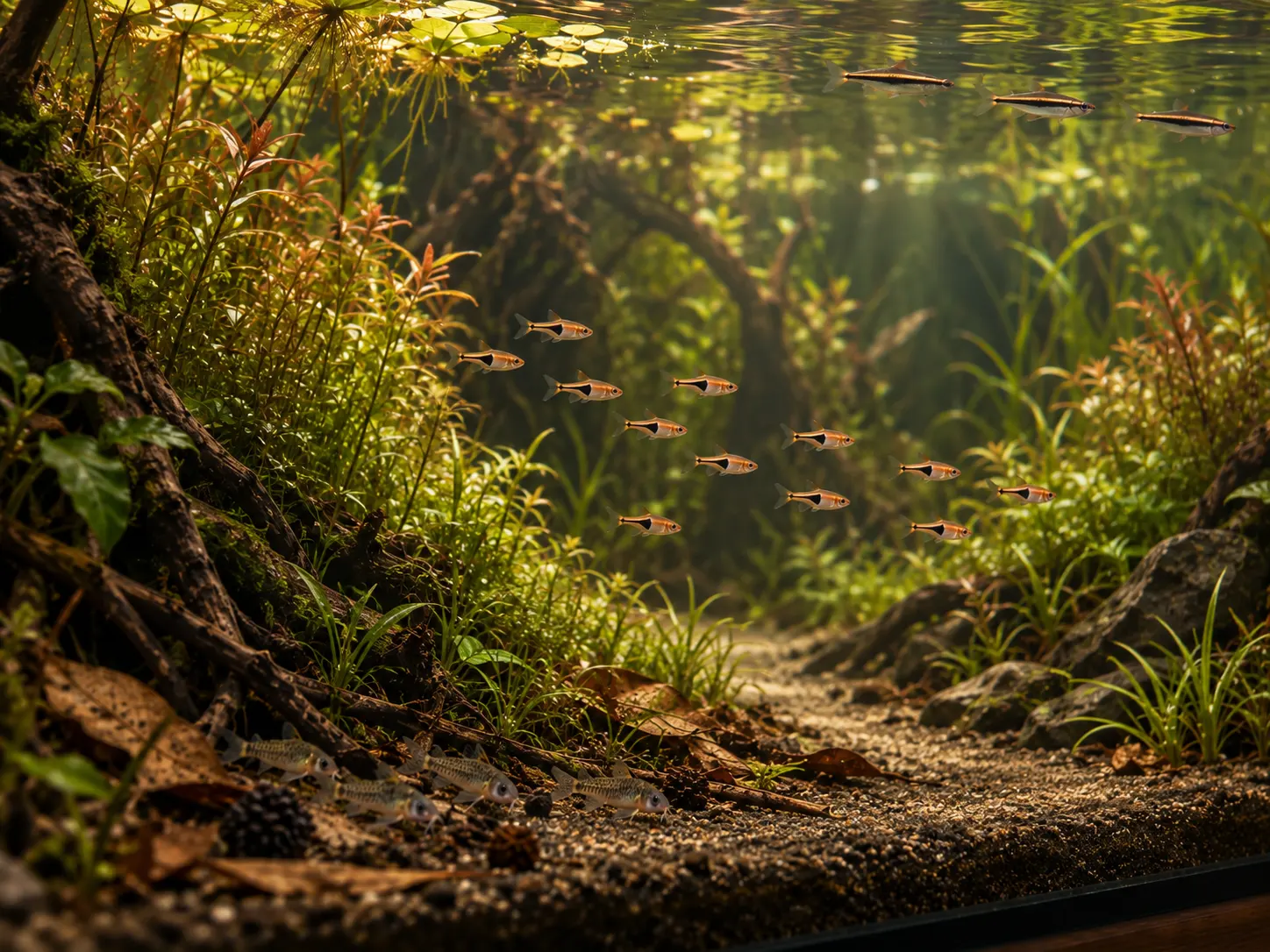
Compare small community candidates
 Harlequin rasbora
Twice the published maximum length and much deeper-bodied, with a larger school footprint.
 Ember tetra
Similar nano scale and calm pace, but another complete midwater group still consumes space.
 Chili rasbora
Smaller and often associated with very soft subdued water, requiring its own social unit.
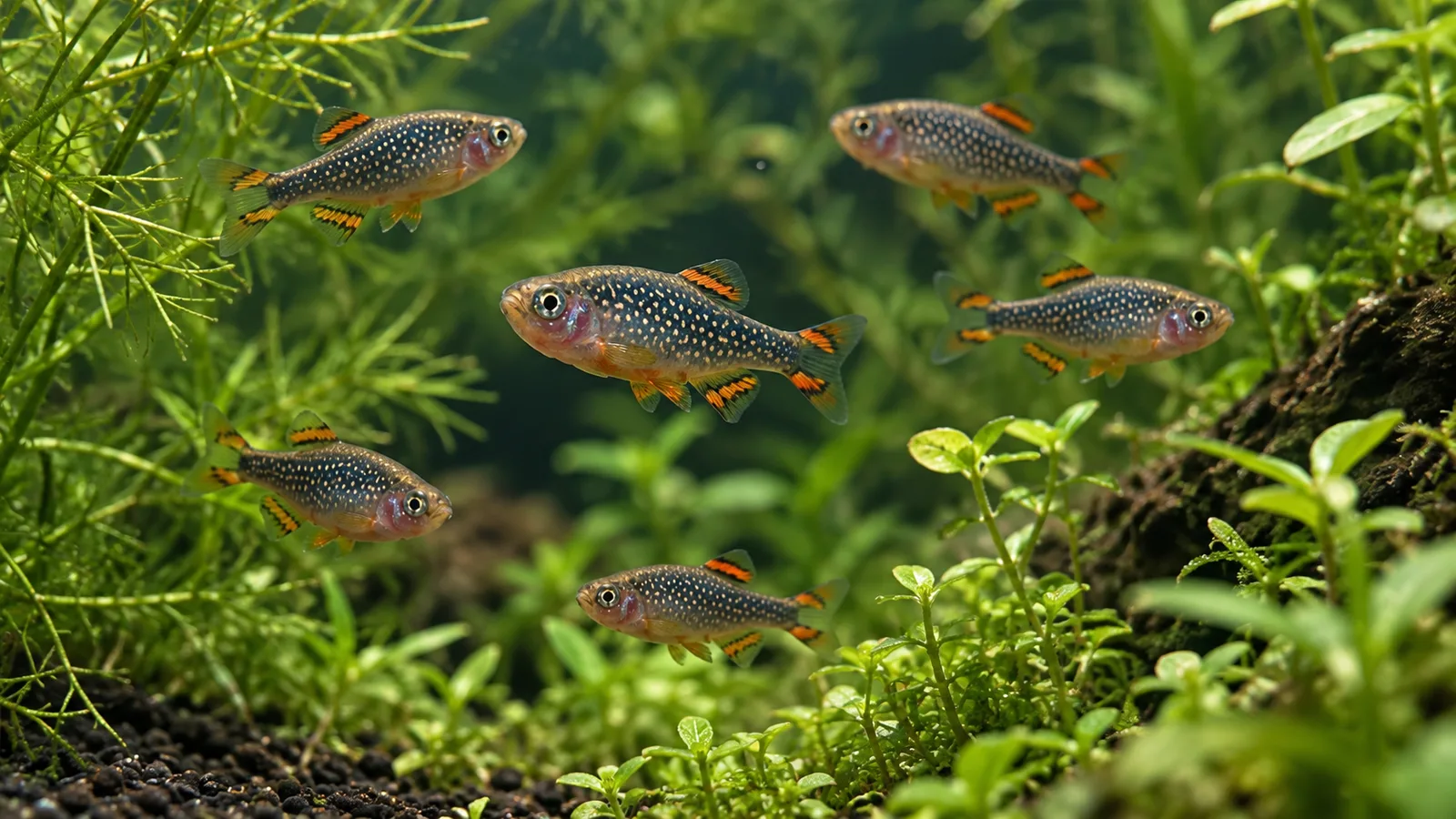 Celestial pearl danio
Uses planted cover differently and often fits a cooler temperature plan.
 Cardinal tetra
Larger and more forceful at food, with a separate warm soft-water school.
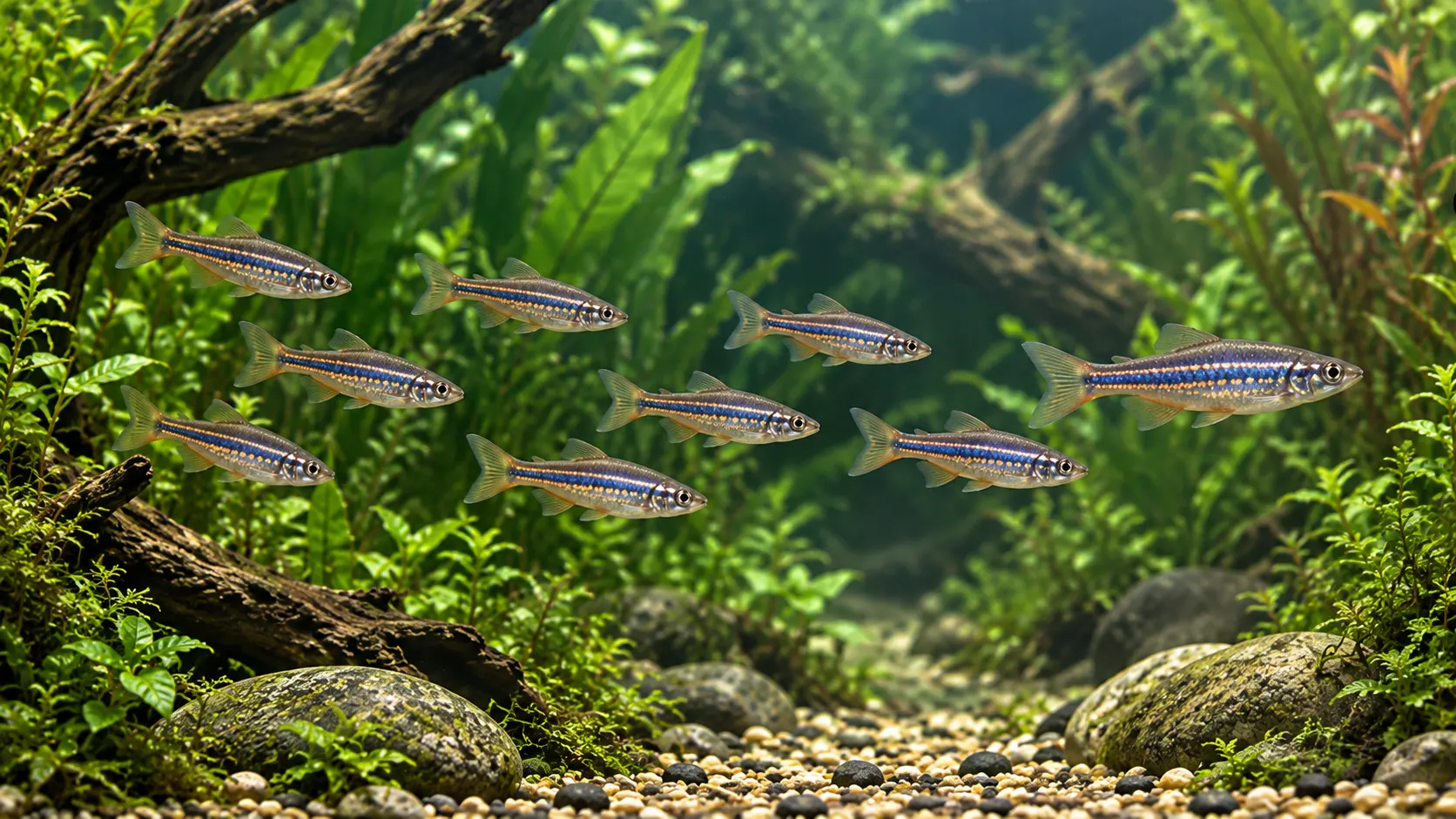 Giant danio
Far larger and faster, making it unsuitable for a modest lambchop display.
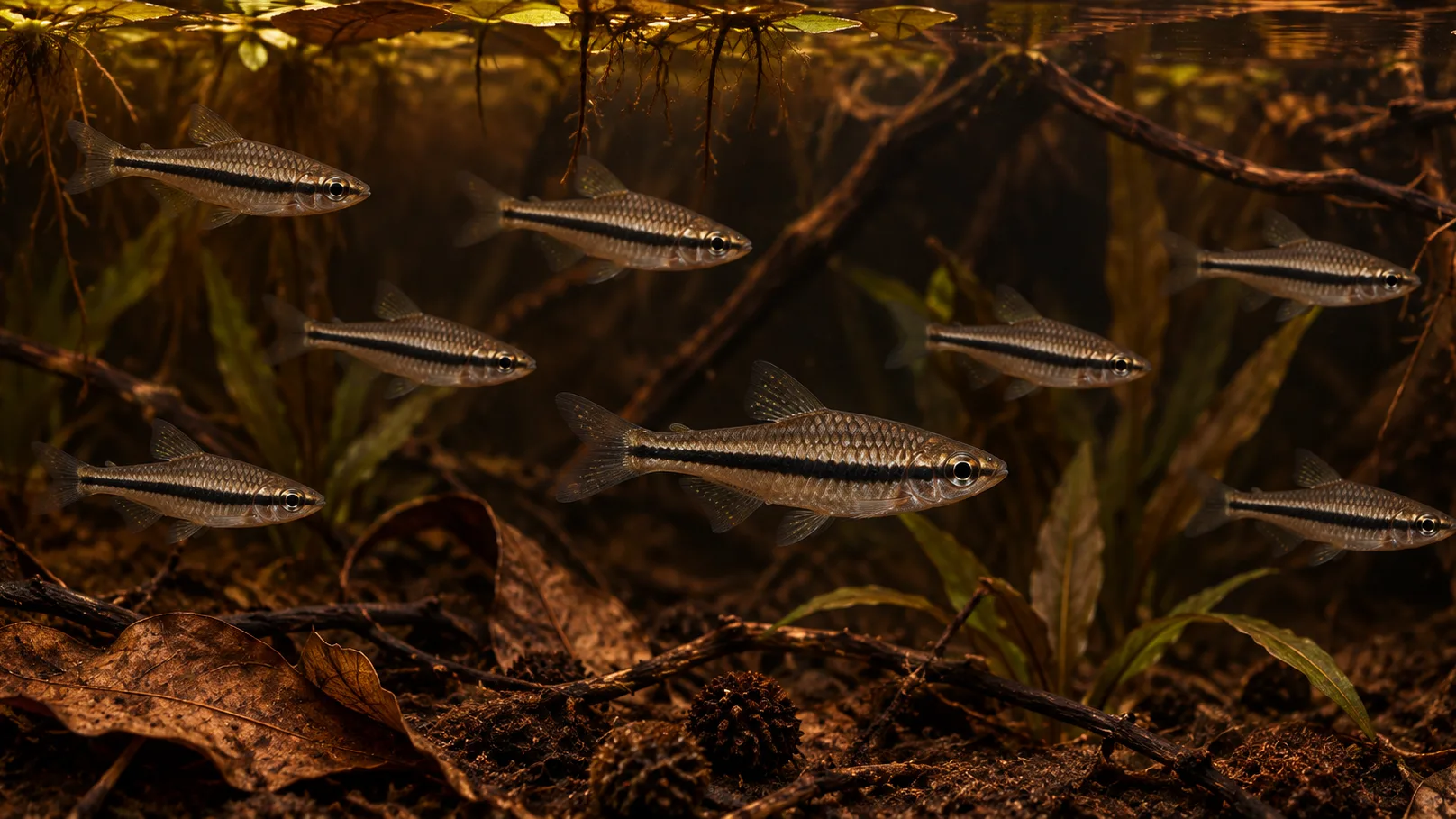 Brilliant rasbora
A substantially longer rasbora with a larger open-water footprint.
 Emerald eye rasbora
Another small school whose identity and habitat details still need separate planning.
 Clown rasbora
A larger marked rasbora that changes both mouth-size risk and tank length.
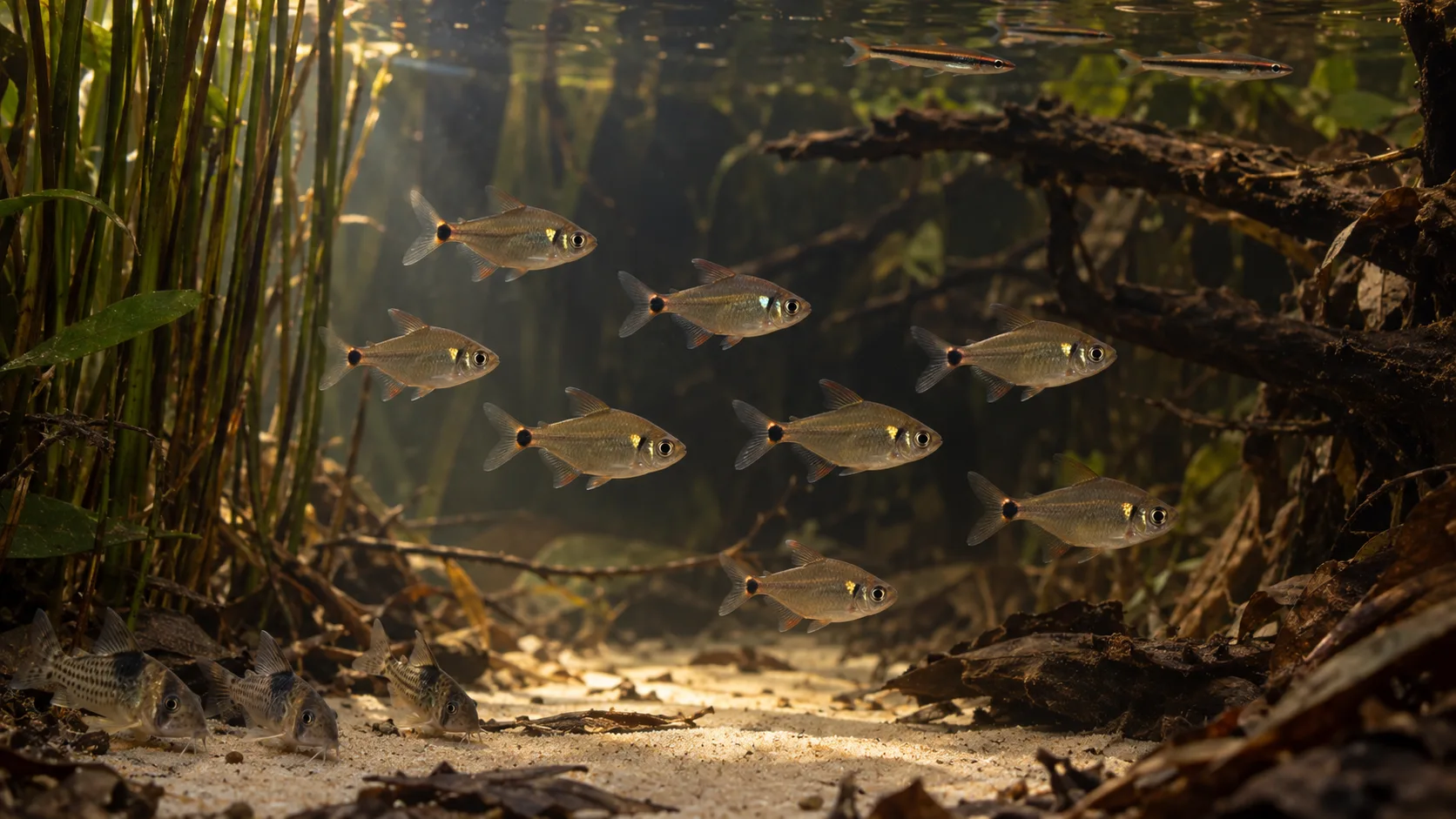 Head and tail light tetra
A larger subtle tetra whose full school uses the same middle layer.
You should avoid large gouramis, adult angelfish, forceful barbs, and any fish that guards the only open route. Shrimp adults may coexist in some layouts, but shrimplets can be eaten and should not be promised safety.
What behaviour shows the group is settled?
A settled school uses open water, spreads to forage, regroups after disturbance, and allows every fish to feed. Brief parallel movement or colour intensification can occur without injury or one fish losing access.
Several fish breathing rapidly, crowding the surface, losing balance, or trying to leave the water points first to a shared water or oxygen problem. Increase safe surface movement, verify temperature, test ammonia and nitrite, and replace contaminated water with conditioned temperature-matched water when measurements support it.
Do not diagnose a disease from a pale flank mark or photograph. Avoid combining medication, major chemistry adjustment, complete filter cleaning, and a rescape without a confirmed reason.
What care limits matter over several years?
Primary records do not establish a dependable lambchop rasbora lifespan for T. espei. Plan for a multi-year school and record purchase dates, source, approximate starting size, losses, and major water changes instead of turning a broad consumer estimate into a guarantee.
FishBase lists the species as Least Concern, assessed 27 March 2011, and CITES as Not Evaluated. That global category does not prove every wetland population is secure or every shipment meets current local law.
A lambchop rasbora school fits when you can keep at least ten adults in a mature planted aquarium with a continuous horizontal lane, stable warm soft water, fine distributed food, and companions that cannot swallow or outcompete them. Their small size makes the group visually delicate, but complete-school care remains concrete.