
What Is an Emerald Eye Rasbora, and Why Does Its Shoal Matter?
Brevibora dorsiocellata
The emerald eye rasbora is commonly Brevibora dorsiocellata, a 2.3 cm Southeast Asian shoaling fish marked by a reflective eye and black dorsal-base spot. Its trade name can hide taxonomic ambiguity, while its small size makes group confidence, cooler stable water, fine food and tank-mate scale decisive.

At a glance

- Adult size
- 2.3 cm
- Minimum footprint
- About 60 cm of usable length as a welfare starting point for a stable full shoal
- Social structure
- A genuine shoal, commonly eight or more when the aquarium can support it, with shaded margins and open midwater.
- Sex ratio
- No verified universal sex ratio is supported; avoid assigning juveniles by eye alone.
- Diet
- Omnivore
- Feeding
- Fine complete foods plus tiny crustacean or insect foods, released at several points for group access.
- Waste load
- low per fish; meaningful as a full shoal
- Family
- Danionidae
- Native range
- Malay Peninsula and Indonesia
- Also sold as
- eyespot rasbora, hi-spot rasbora. Trade and hobby names, not accepted species names.
- Former scientific names
- Rasbora dorsiocellata. Superseded names for this same species.
- Conservation status
- Endangered, assessed 24 December 2018 Source
The footprint is expressed as usable horizontal room because adult movement and social escape cannot be inferred from litres alone.
What is an emerald eye rasbora?
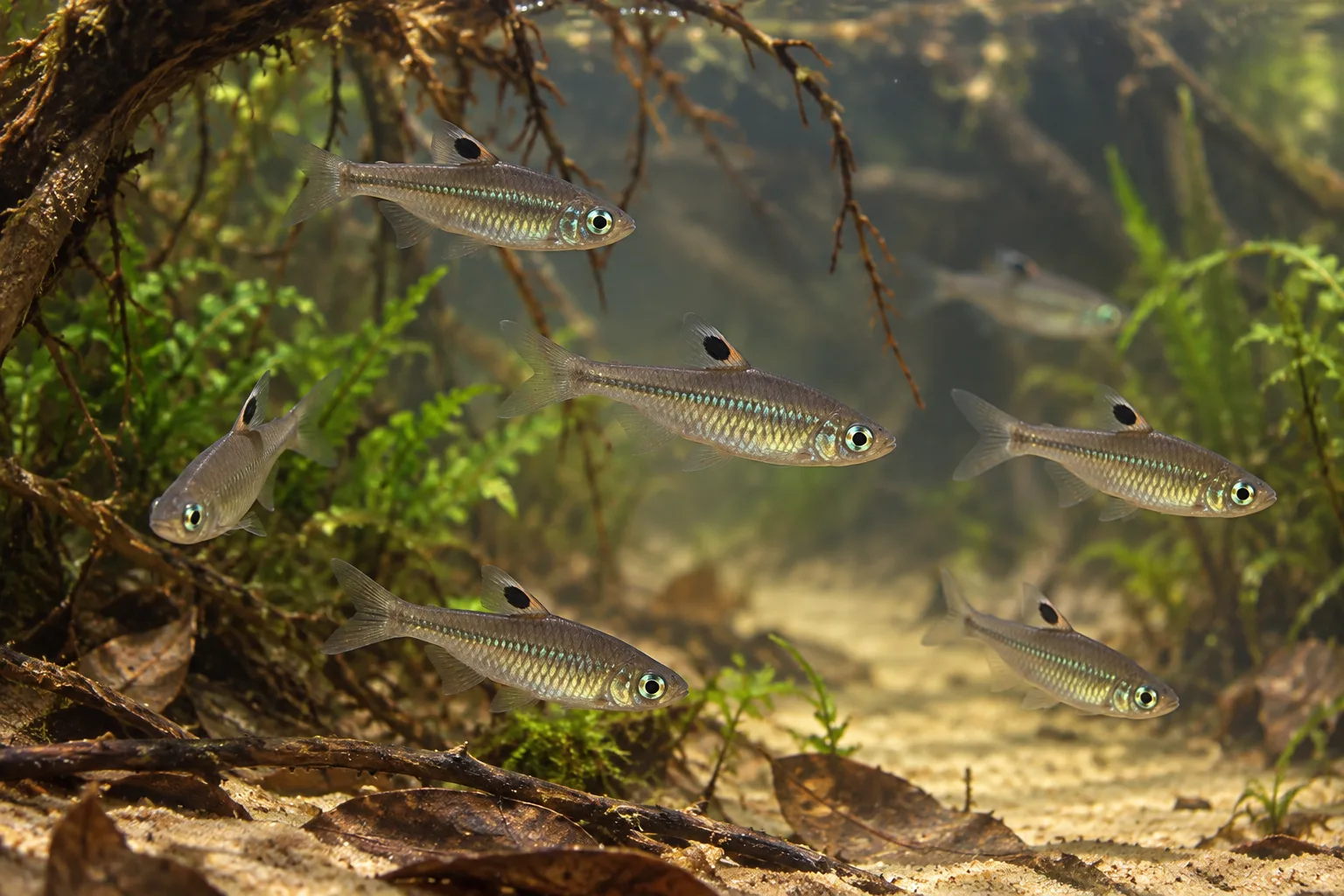
The emerald eye rasbora is commonly applied to Brevibora dorsiocellata, a tiny Southeast Asian cyprinid with a bright reflective eye and a black mark at the base of the dorsal fin. The accepted name matters because trade labels have also been attached to forms called macrophthalma.
- Accepted identity
- Brevibora dorsiocellata (Duncker, 1904)
- Former combination
- Rasbora dorsiocellata
- Family
- Danionidae
- Native range
- Malay Peninsula and Indonesia
- Maximum published size
- 2.3 cm standard length
- Temperature
- 20 to 25 °C
- Recorded diet
- Worms, crustaceans and insects
- IUCN assessment
- Endangered, assessed 24 December 2018
The Catalog of Fishes places the species in Brevibora and gives the Muar River in Johore, Malaysia, as the type locality. A shop label alone cannot show whether a seller is using the accepted species name or an older trade convention.
Why is the name confusing in aquarium shops?
“Emerald eye rasbora,” “hi-spot rasbora” and “eyespot rasbora” can overlap in commerce. Older aquarium writing may add Rasbora dorsiocellata macrophthalma, while the current Catalog entry accepts Brevibora dorsiocellata at species level.
| Name | What it tells you | What it does not prove |
|---|---|---|
| Brevibora dorsiocellata | Current accepted species combination | Origin of a particular shop batch |
| Rasbora dorsiocellata | Older genus combination for the same species | That an old care number is current |
| Emerald eye rasbora | Common trade name | Whether the seller means a named subspecies or regional form |
| Hi-spot or eyespot rasbora | Descriptive trade name | A separate accepted species |
| macrophthalma on a label | A historical or trade-level distinction worth checking | Accepted status without a current taxonomic source |
The safest purchase record includes the binomial used by the supplier and, when available, the breeding or collection origin. That information is more durable than a handwritten common name.
Which marks help with identification?
Look for three features together: a small translucent body, a distinct black dorsal-base spot and a reflective green-blue eye. The body remains understated, so the eye can appear much brighter than the fish around it.
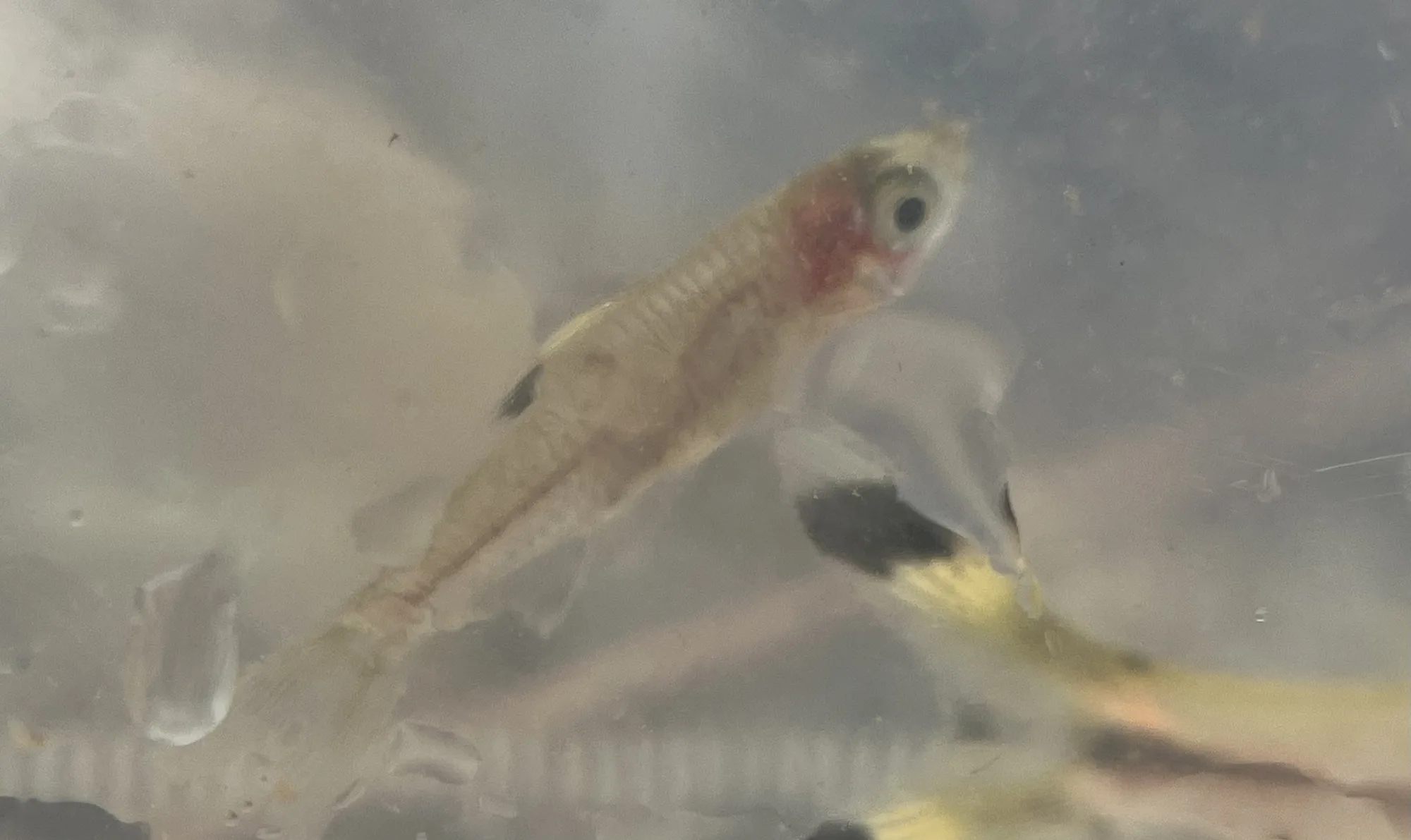
Stress and viewing angle can dim the eye. The black dorsal mark is usually the more stable screening character, although fin position and poor photography can partially hide it.
At 2.3 cm standard length, this fish is easy to overestimate in a close image. Its compact size changes the safety of filter slots, food particles and tank mates.
What kind of habitat does it come from?
FishBase records the species from the Malay Peninsula and Indonesia, and the Catalog ties the original description to the Muar River. The broad regional record does not justify recreating one exact stream chemistry for every aquarium population.
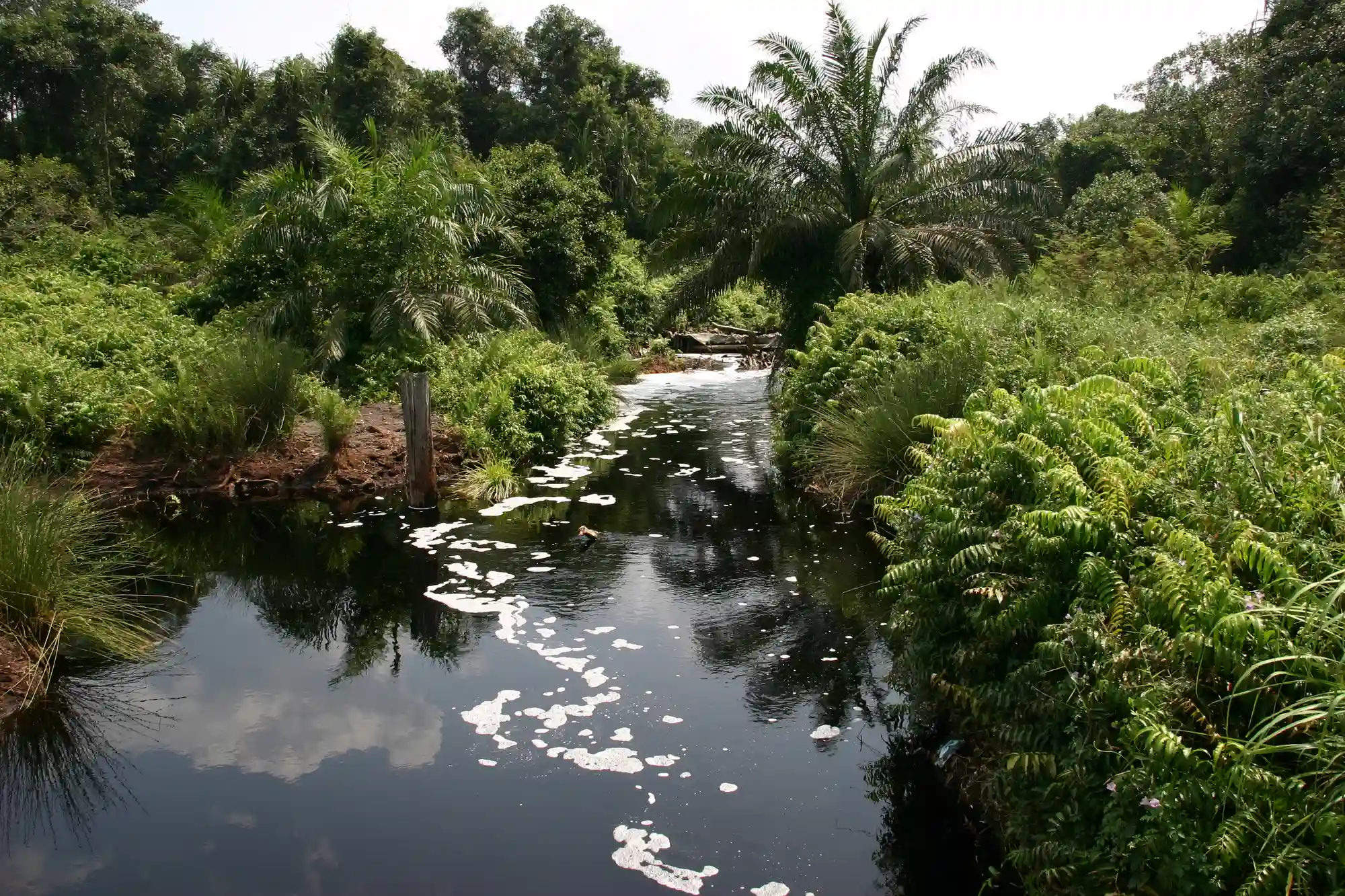
Fine branches, subdued areas and planted margins help a small shoal settle. The middle still needs to remain open enough for coordinated movement and feeding.
Botanical materials can change pH and dissolved organics, so add them for structure only when their effect is understood and measured. A dramatic “blackwater” transformation is not automatically more authentic or safer.
How much space does such a small fish need?
Body length is only one part of the answer. The aquarium must also fit a shoal, a stable filter, retreat structure and a continuous lane that larger tank mates do not occupy.
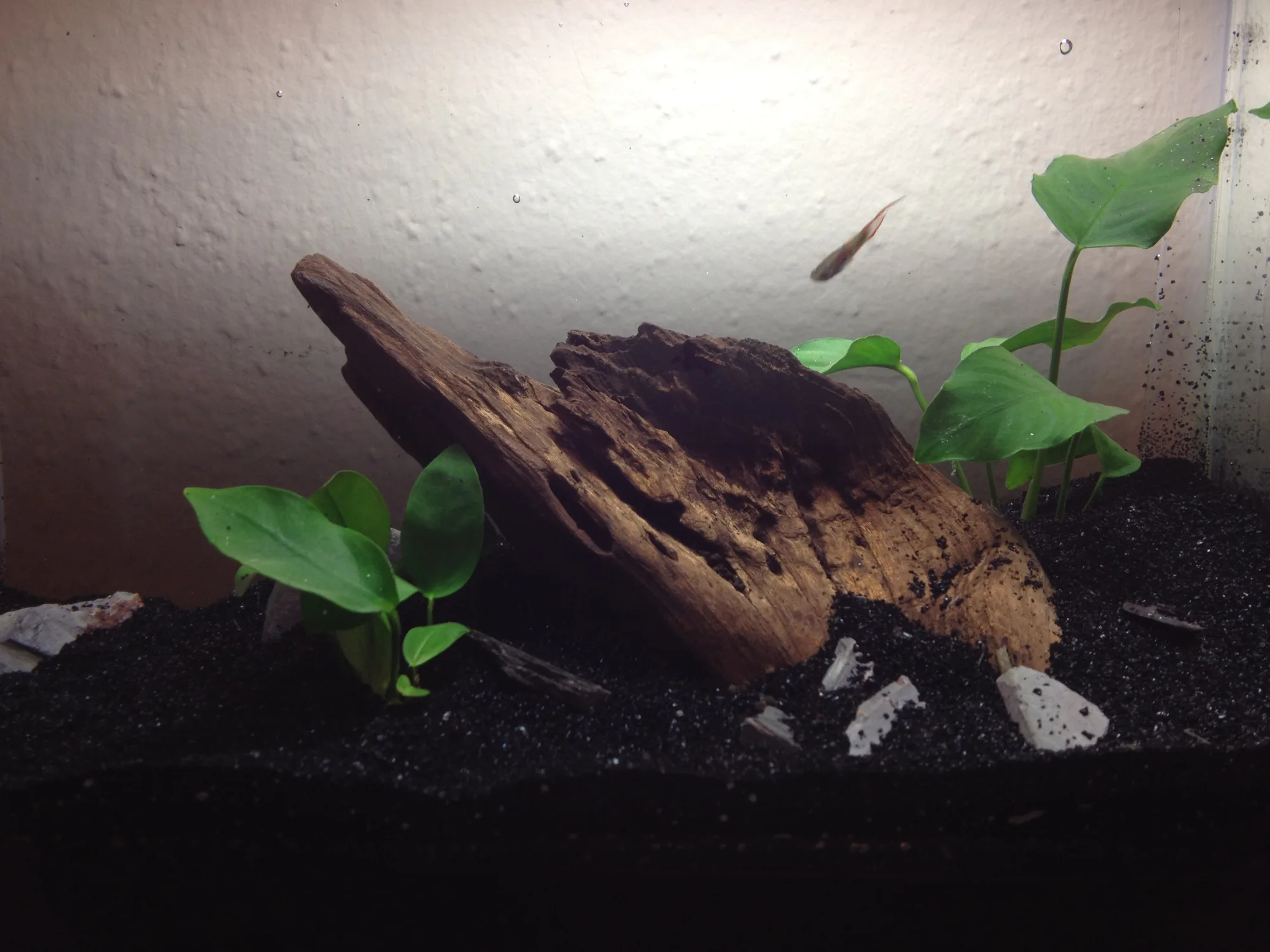
A 60 cm footprint is a practical welfare starting point for a dedicated group because it provides more stable water and a usable horizontal route. That conservative starting point follows from the fish's group needs and usable swimming length; FishBase does not publish a universal minimum volume.
- Measure the clear route between hardscape rather than the front glass alone.
- Guard intake slots that could trap a 2.3 cm fish.
- Leave open midwater between two shaded margins.
- Reserve carrying capacity for the whole group, not one sample fish.
- Keep access for siphoning fine waste from beneath leaf litter and wood.
A taller or more ornate tank is not automatically better. Horizontal continuity and stable water provide more value than height this fish rarely uses.
What group size supports natural behavior?
Emerald eye rasboras should not be kept singly. The reviewed institutional records describe the species and its range but do not publish one universal aquarium group minimum.
Plan a genuine shoal, commonly eight or more when the tank can support it, and judge success by distribution rather than a number alone. A coherent group uses open water, separates briefly and reforms without one fish remaining excluded.

Adding fish to an unstable tank does not solve social stress. Confirm ammonia, nitrite, temperature and oxygen first, then decide whether the group or the environment is the limiting factor.
What water conditions are recorded?
FishBase compiles 20 to 25 °C, pH 6.0 to 6.5 and hardness up to 12 dH. The record does not provide a lower hardness boundary, so none should be invented.
Published emerald eye rasbora water ranges
- Temperature20 to 25 °CSeparate aquarium thermometer, checked across the daily cycle.
- pH6.0 to 6.5Calibrated pH meter or a test with useful resolution in the acidic range.
- General hardnessUp to 12 dHGH titration test in degrees of hardness.
Every range above applies to Brevibora dorsiocellata in a freshwater system. Source: FishBase, checked 2026-09-13.
The relatively cool upper limit deserves attention in mixed tropical tanks. A permanent 28 °C community may be comfortable for other small tetras and still sit outside this species' published range.
Do not force pH downward with a large acid addition. Compare source and destination water, acclimate to the measured difference and favor stability inside the supported range.
Maintenance must preserve that stability without allowing leaf litter and fine food to become a waste trap. Siphon accessible pockets, rinse clogged mechanical media in removed aquarium water and match replacement-water temperature before refilling.
- Measure the tank before the change Temperature and pH provide a baseline for matching replacement water.
- Remove water and visible debris Target exposed waste while leaving useful cover and established biological surfaces in place.
- Restore filter flow Clear the intake and rinse mechanical media without sterilizing the whole filter.
- Refill gently Avoid a sudden temperature or chemistry shift in a small aquarium.
- Watch the shoal reform Normal distribution and breathing confirm that maintenance did not create a new stressor.
What and how should it eat?
FishBase records worms, crustaceans and insects. The aquarium challenge is translating those foods to a mouth on a 2.3 cm fish without losing nutrition or water quality.
Complete staple
Fine micro pellets or crushed flake that each fish swallows without repeated spitting.
Animal variety
Appropriately small frozen or live crustaceans and insect foods from a safe source.
Delivery
Several small release points so the fastest fish cannot intercept everything.
Waste control
Stop when food begins to settle, then remove trapped material during maintenance.
Body check
Look for straight backs and gently filled abdomens, not swollen fish after every meal.
Large food can create an illusion of feeding because fish chase and mouth it. The useful observation is whether the particle is swallowed and retained.
Which tank mates are safe at this scale?
Select companions by adult mouth size, feeding speed and water overlap. A fish described as peaceful can still swallow a 2.3 cm rasbora or keep it away from every meal.
| Decision factor | Better match | Higher risk |
|---|---|---|
| Adult size | Similar small fish that cannot swallow the rasbora | Any fish with a mouth large enough to take it |
| Feeding | Calm or zone-separated feeders | Fast surface feeders that clear fine food immediately |
| Temperature | Comfortable from 20 to 25 °C | Requires permanently warmer water |
| Behavior | Brief approach without pursuit | Stalking, cornering or repeated charges |
| Aquarium zone | Bottom or gentle midwater use with space left | Another dense fast shoal occupying the full lane |
Adult shrimp may coexist in a well-structured tank, but shrimplets are prey-sized. No community containing fish can promise newborn shrimp survival.
How do you investigate hiding, faded eyes or poor feeding?
Treat those signs as observations that narrow a search. They do not identify a disease by themselves.
A bounded check for a struggling shoal
- Temperature Verify that the tank has not drifted above the published 25 °C upper range.
- Water quality Test ammonia and nitrite, then review recent nitrate and maintenance trends.
- Light and cover Check whether bright light leaves no shaded edge for settlement.
- Tank mates Observe the group before and after larger fish enter the feeding zone.
- Particle size Confirm that food is swallowed rather than mouthed and dropped.
- Health Escalate ulcers, swelling, loss of balance, rapid breathing or continued weight loss to qualified help.
Change one verified cause at a time. Several simultaneous adjustments can create a new temperature or chemistry swing while hiding which change helped.
Lifespan is another area where confident retail numbers outrun the institutional record. The reviewed sources do not provide a verified aquarium lifespan, so the responsible plan is a multi-year social commitment rather than a promised number.
That commitment includes the late life of the group. If deaths leave one or two elderly fish, the keeper must decide whether the aquarium can support compatible new companions or whether the remaining animals need a carefully chosen established group elsewhere.
Why does Endangered status matter here?
FishBase records Brevibora dorsiocellata as Endangered from a 2018 IUCN assessment, with commercial aquarium use and no CITES evaluation. The combination of a small fish, broad trade name and serious wild status makes supplier identity important.
CITES not evaluated does not mean unrestricted everywhere. National rules and collection restrictions can apply independently, especially when a trade name obscures the exact population being sold.
Is an emerald eye rasbora right for your aquarium?
It suits a mature, gently lit aquarium that stays within the cooler published range and can support a full small shoal without larger fish dominating it. The bright eye is most visible when the group feels secure enough to use open water.
It is a poor fit for hot communities, predator tanks, an exposed filter intake or any purchase where the seller cannot clarify what species the trade label represents. Resolve identity before solving husbandry around the wrong animal.
Which schooling fish are useful comparisons?
Brilliant rasbora
A slender but substantially larger rasbora whose adult footprint can rule out tanks suited to nano species.
Clown rasbora
A larger blackwater rasbora that tests whether length, group size and swimming room have been underestimated.
Chili rasbora
A minute blackwater group fish whose mouth size, water and refuge needs set a much smaller scale.
Celestial pearl danio
A tiny planted-tank danio with cooler documented habitat water and a different style of group behaviour.
Ember tetra
A tiny warm-water tetra whose low competitive weight and small mouth change feeding and tankmate choices.
Cardinal tetra
A small blackwater shoaler whose soft-water context and quiet group behaviour narrow the comparison.
Black neon tetra
A smaller midwater shoaler that offers a useful contrast in body size, group movement and water tolerance.
Cherry barb
A small planted-stream barb that contrasts sex-linked colour, social structure and habitat cover.
Diamond tetra
A medium deep-bodied characin that offers a closer comparison in warm water, adult mass and display behaviour.
Emperor tetra
A medium tetra whose males hold display positions, adding territory and sight lines to the group decision.