
What Is a Green Neon Tetra, and What Does Its School Need?
Paracheirodon simulans
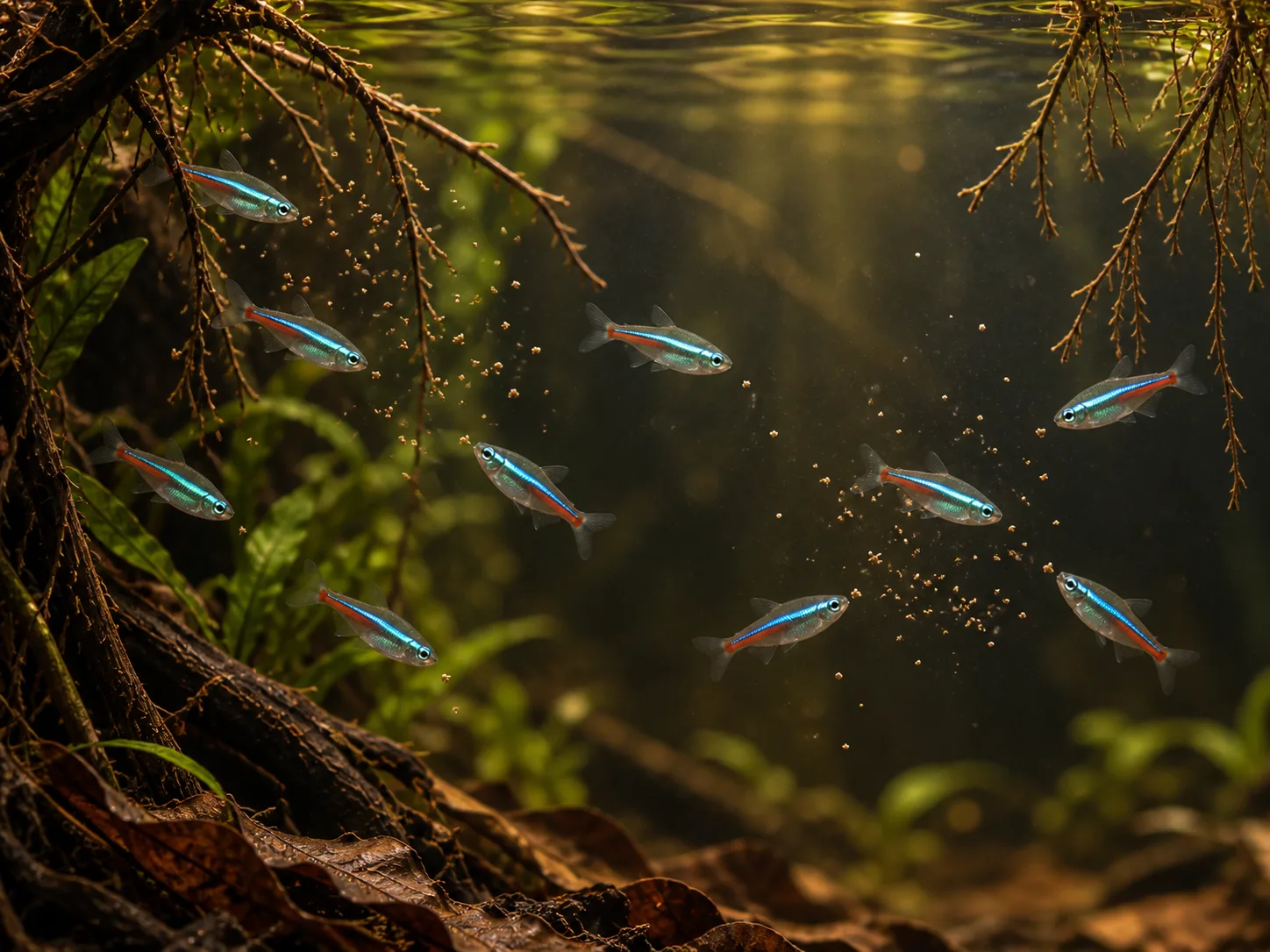
The green neon tetra is Paracheirodon simulans, a tiny South American schooling fish with a blue-green stripe and little red on the body. A complete group needs stable warm water, calm feeding access, cover, and more horizontal room than its short adult length suggests.
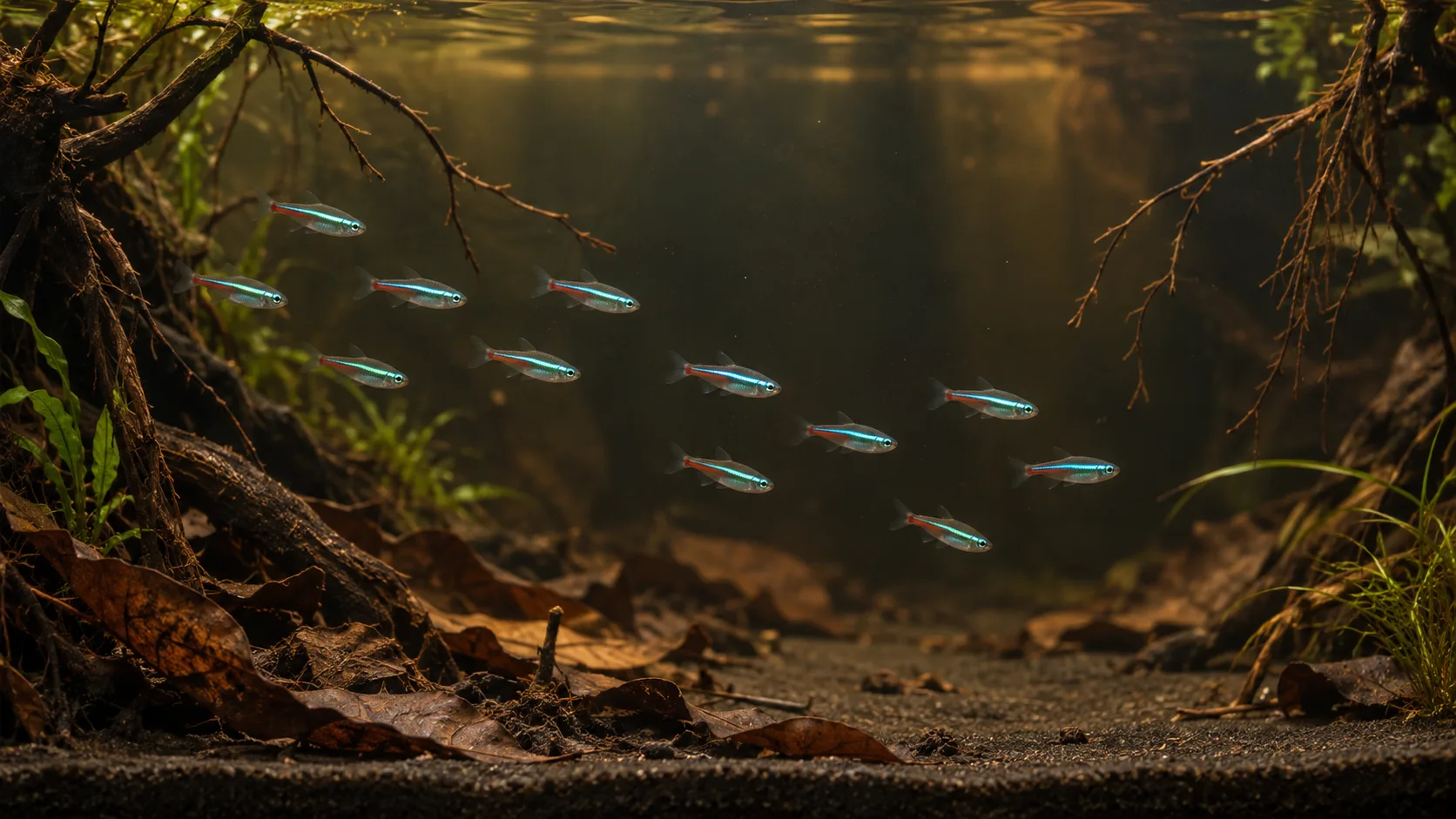
At a glance

- Adult size
- 2 cm
- Minimum footprint
- At least 60 × 30 cm for a species-led school, with an open horizontal lane and shaded refuge
- Social structure
- A close social school; begin with at least ten adults and preserve one uninterrupted midwater route.
- Minimum group
- 10
- Sex ratio
- No routine sex ratio is established.
- Diet
- Carnivore
- Feeding
- Use a complete micro staple and suitably small frozen or live foods, distributed across more than one feeding point.
- Waste load
- low per fish, meaningful for the complete warm-water school
- Family
- Acestrorhamphidae
- Native range
- Upper Negro and Orinoco River basins in Brazil, Colombia, and Venezuela
- Conservation status
- Least Concern, assessed 4 March 2021 Source
Footprint follows adult group movement, cover displacement, feeding access, and maintenance capacity; it is not a pet-store survival minimum.
What is a green neon tetra?
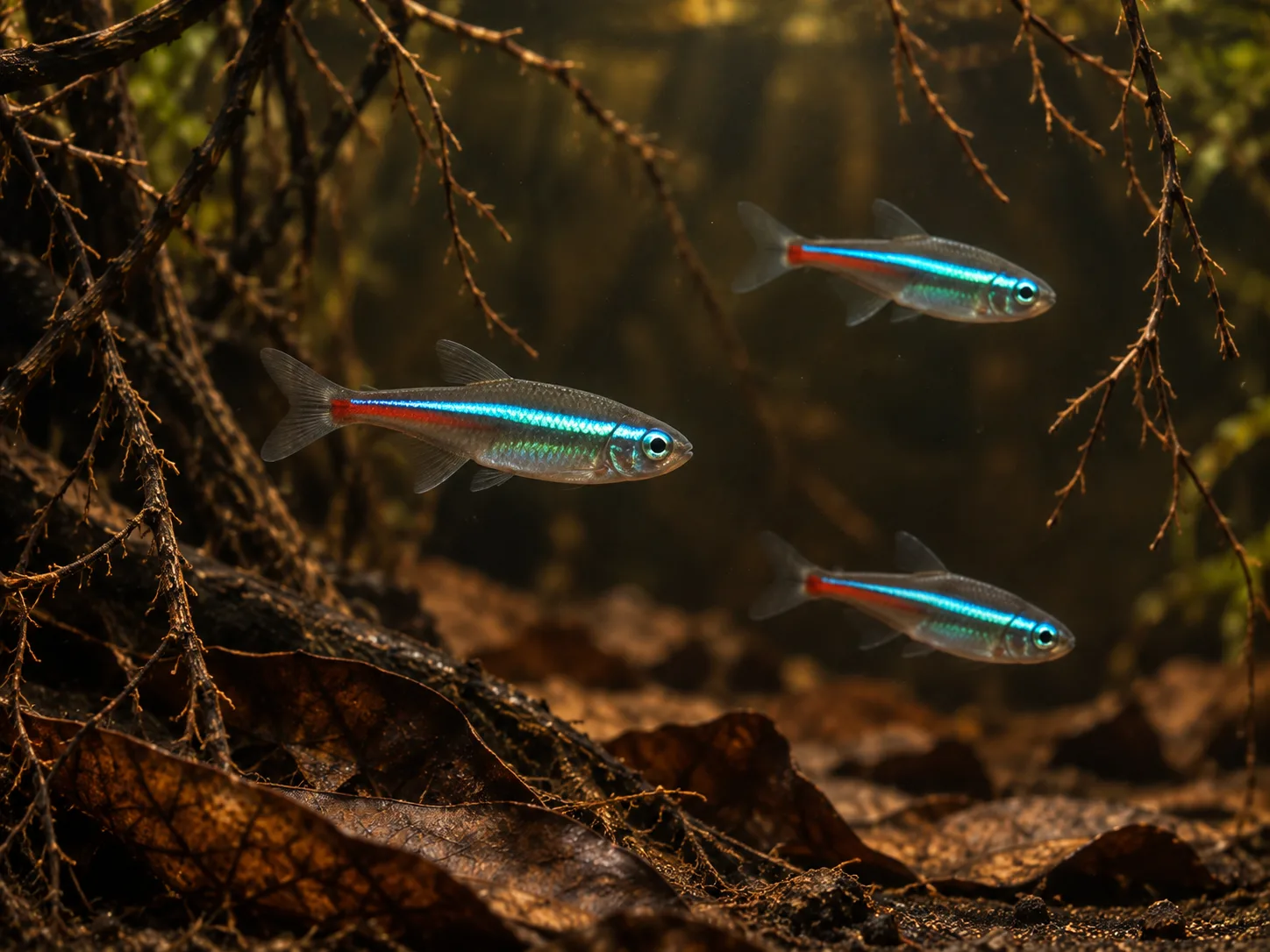
The green neon tetra is Paracheirodon simulans, a tiny South American characin whose adult body is shorter and more delicate than the familiar neon and cardinal tetras. Its useful care boundary comes from that scale: a complete school needs stable, warm, very soft water and calm feeding access even though each fish reaches only about 2 to 2.5 cm standard length.
Eschmeyer's Catalog of Fishes accepts P. simulans in Acestrorhamphidae and records the corrected type locality in the Rio Negro drainage. FishBase places it in the upper Negro and Orinoco basins and publishes a maximum of 2.02 cm standard length.
- Accepted identity
- Paracheirodon simulans (Géry, 1963)
- Family
- Acestrorhamphidae
- Verified range
- Upper Negro and upper Orinoco river basins
- Published maximum
- 2.02 cm standard length in FishBase; some husbandry records round adults to 2.5 cm
- Social structure
- Small pelagic school
- Practical starting group
- At least 10, with more only when the footprint and filtration allow it
- Starting footprint
- 60 × 30 cm for a stable species-led display
- Water context
- Warm, acidic, very soft blackwater; supplier history still matters
- Conservation
- Least Concern, assessed 4 March 2021
Names such as green cardinal, blue neon tetra, and false neon tetra appear in the trade. Keep the scientific name, supplier, purchase date, and any claim of captive breeding together because the common name cannot establish origin or husbandry history.
How can you distinguish it from other neon tetras?
The most useful broad distinction is the colour pattern. A green neon normally has a greener blue lateral stripe that extends farther along the body, while the red flank pigment is far less extensive than the red lower half of a cardinal tetra.
The common neon tetra usually shows a shorter blue stripe and a red band concentrated on the rear half. Body condition, stress, viewing angle, water colour, and the first minutes after the light turns on can weaken all three patterns, so compare settled adults rather than one pale new arrival.
A metallic gold scale or unusual shine does not establish a named colour strain. Natural variation, reflected light, health, and skin changes can all alter appearance, and exact identification still belongs with a reliable source record or qualified taxonomic examination.
How many green neon tetras should live together?
Green neons are social fish that use group movement as security. A practical purchase starts at 10 adults, because a larger group is easier to see, gives each fish more neighbours, and reduces the chance that one timid fish spends the day detached from the school.
Ten is a starting social unit, not permission to fill a small aquarium with ten fish and then add several more groups. The tank must still support the adult waste load, warm-water oxygen demand, feeding access, quarantine history, and uninterrupted swimming room.
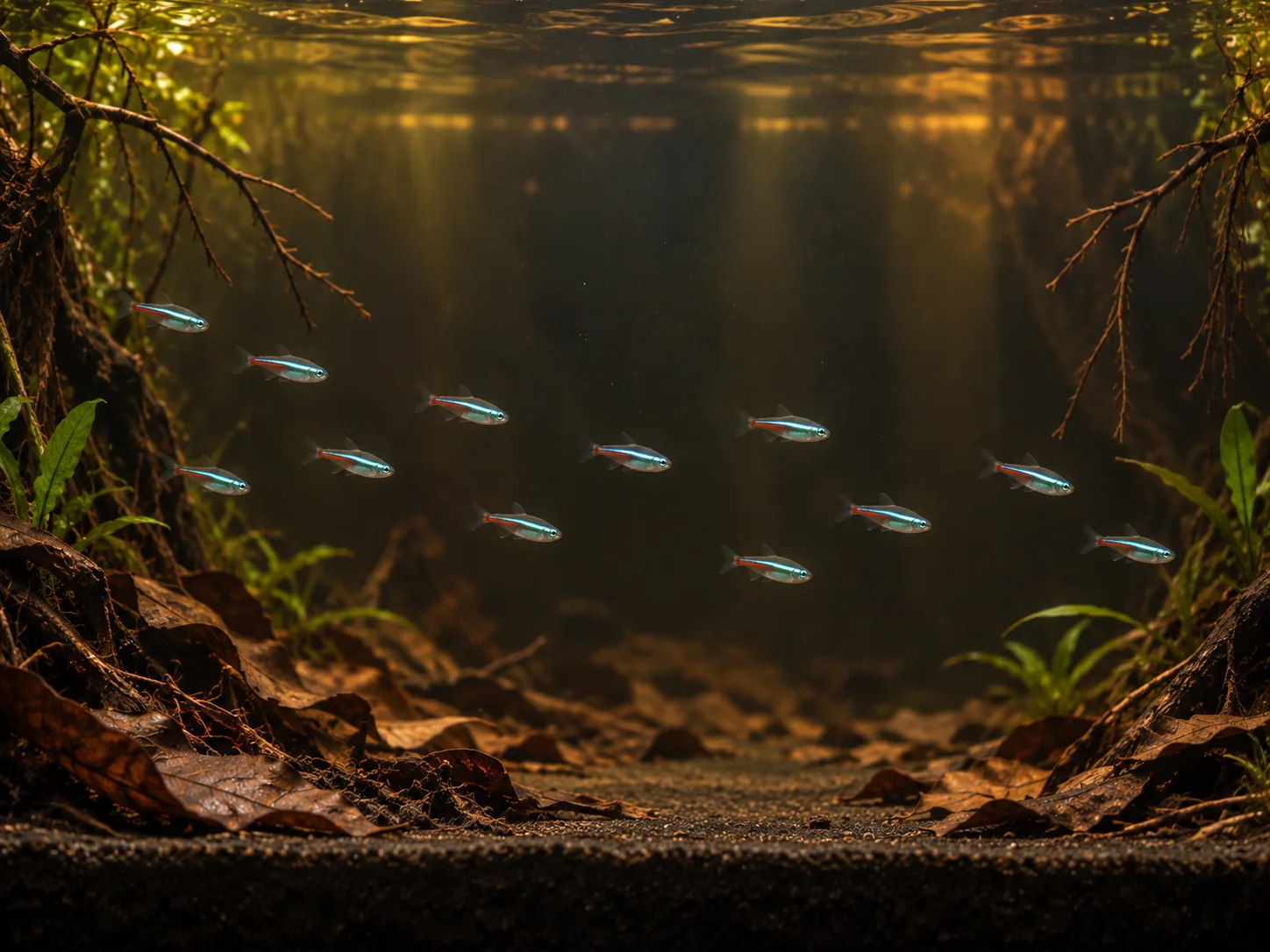
- Count the complete green neon school as one stocking unit.
- Reserve an open route long enough for the group to spread and turn together.
- Check that quieter fish can reach food without leaving cover for long.
- Keep the filter intake safe for a fish barely a few centimetres long.
- Leave warm-water oxygen capacity for hot days and filter slowdown.
- Add a second schooling species only when both full groups retain space.
Loose spacing does not automatically mean the group is distressed. Concern rises when the same fish remains isolated, loses weight, breathes rapidly, refuses food, or stays pressed into one corner while the others move normally.
What tank layout keeps a tiny school visible?
A 60 × 30 cm footprint or larger gives a green neon school a more useful horizontal route than a short cube with similar volume. A mature 54 to 60 litre aquarium also changes temperature and chemistry more slowly than a very small vessel, which matters for wild-origin fish moved between different water supplies.
You can build cover along the rear, ends, and upper margins while keeping a clear band through the middle. Fine roots, leaf litter, dark sand, slender branches, subdued plants, and floating cover create retreat without turning the aquarium into a solid wall.
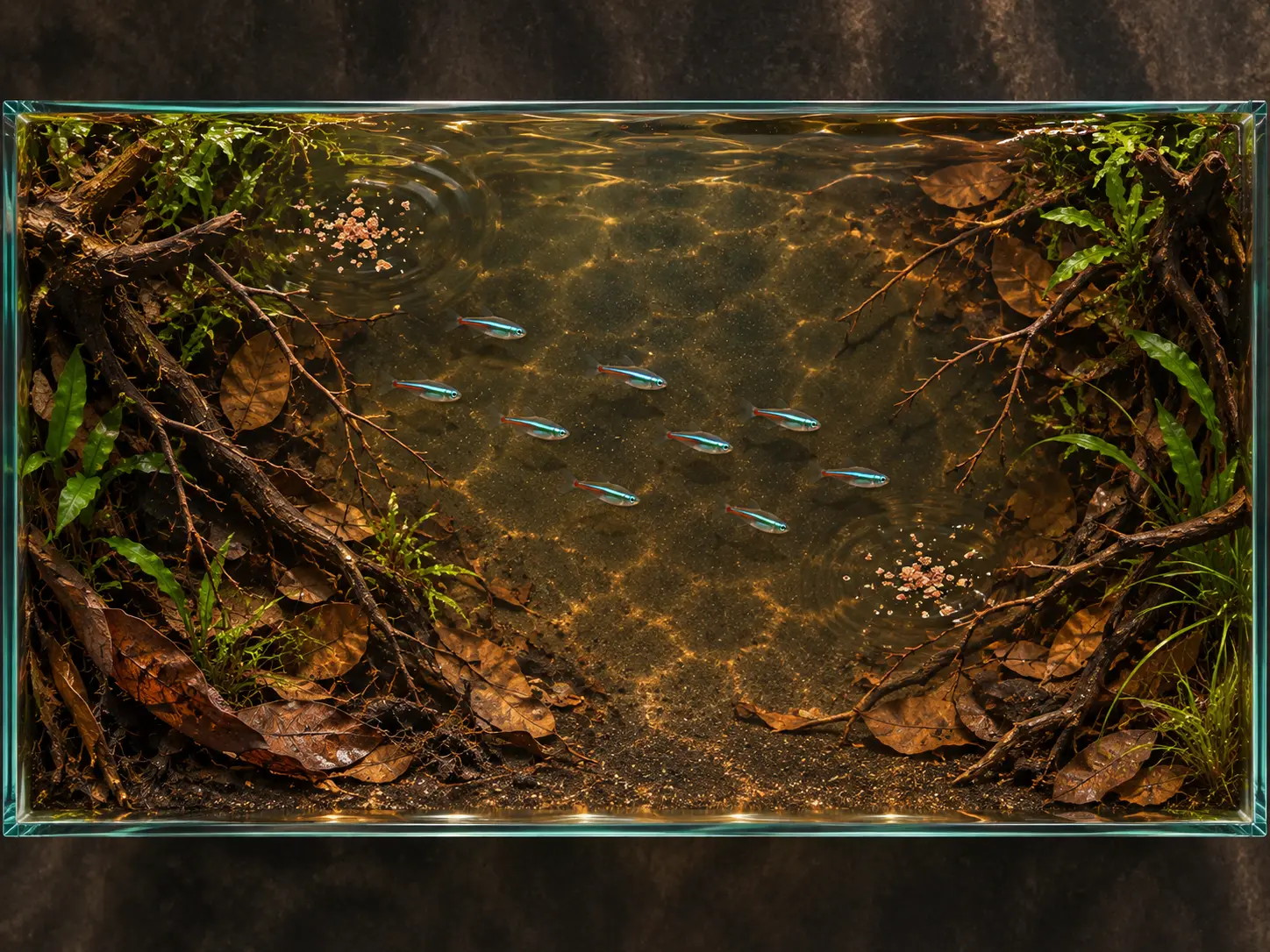
Dark outer margins
Leaf litter, roots, and shaded planting give the small fish a readable boundary and nearby refuge.
Open middle band
Preserve a continuous swimming lane instead of dividing the footprint with a central hardscape wall.
Gentle circulation
Move oxygenated water through the aquarium while retaining slower pockets near roots and plants.
Safe intake
Cover openings that could trap a 2 cm fish and inspect the guard as debris accumulates.
Subdued light
Use floating cover or a moderate lamp rather than exposing blackwater fish over bright pale gravel.
Secure top
Close cable and filter gaps because small startled tetras can pass through narrow openings.
Blackwater character should come from controlled materials and stable maintenance, not from chasing a dark colour. Leaves and wood change the system as they age, so remove excessive decaying material when oxygen, flow, or cleanliness begins to suffer.
Which water conditions suit green neon tetras?
FishBase reports pH 5.5 to 6.0 and 4 dH for P. simulans. A detailed husbandry synthesis reports a wider 21 to 35 °C temperature band, pH 3.0 to 6.5, and 1 to 8 dGH, while field research in middle Rio Negro palm swamps recorded unusually warm habitat water.
Those figures describe different evidence contexts and should remain separate. The wide thermal tolerance observed in habitat does not justify driving an aquarium toward 35 °C, where oxygen availability falls and the other animals, plants, and microbes may face very different limits.
Green neon tetra water evidence
- Temperature24.6 to 35.2 °C recorded in studied habitat; 21 to 35 °C in a husbandry synthesisApplies to Habitat measurements and compiled husbandry context, not a target midpoint. Separate thermometer away from heater and return flow. Source: Marshall et al. and Seriously Fish, checked 2026-09-15.
- pH5.5 to 6.0 in FishBase; 3.0 to 6.5 in a husbandry synthesisApplies to Published species records differ in breadth. Calibrated low-range meter or liquid test that resolves acidic water. Source: FishBase and Seriously Fish, checked 2026-09-15.
- General hardness4 dH in FishBase; 1 to 8 dGH in a husbandry synthesisApplies to Very soft water context with different compiled bounds. Drop-count GH titration test reported in degrees of hardness. Source: FishBase and Seriously Fish, checked 2026-09-15.
Every range above is for a freshwater blackwater system.
You should measure the seller's water before acclimation and compare it with your receiving aquarium. When the difference is large, stability and a controlled transition matter more than forcing the fish toward the most dramatic blackwater number on the day of arrival.
Ammonia and nitrite should remain undetectable in an occupied aquarium. Warm water needs dependable gas exchange, so a dim calm display still requires surface movement, a mature filter, and a plan for power loss or unusually hot weather.
What do green neon tetras eat?
Direct diet evidence for P. simulans is limited, but its tiny pelagic body and close relatives support feeding very small invertebrate and mixed particles. Use a nutritionally complete micro-pellet or finely crushed quality flake as the staple, then rotate suitably small frozen or live foods whose source is controlled.
Food that is technically small enough may still fall too quickly or gather where only bold fish feed. Release a modest portion across two areas and watch individual swallowing rather than judging the meal by surface excitement.
- Select a complete micro food Check that the particle remains small enough for an adult green neon to swallow promptly.
- Release a small first portion Place it near one end of the school and watch which fish respond.
- Feed the second area Give fish near the opposite cover a separate opportunity instead of making them cross the boldest cluster.
- Confirm swallowing Look for repeated successful bites rather than food merely entering the tank.
- Stop before particles settle Remove persistent deposits and reduce the next portion when food accumulates.
- Review body condition Change the ration only after comparing bellies, behaviour, waste, and water tests over time.
Do not use a universal number of pellets. Product density, particle size, school size, temperature, live-food contribution, and competition all change the useful amount.
Which tank mates fit their size and pace?
The safest community screen begins with adult mouth size. A fish described as peaceful can still eat a 2 cm tetra, dominate a food cloud, or keep the school hidden through constant movement.
Good candidates are small, calm animals that share warm soft water and use a different feeding position. Each candidate still needs its own group, floor area, oxygen allowance, and quarantine space, so a bottom-dwelling species does not become free stocking capacity.
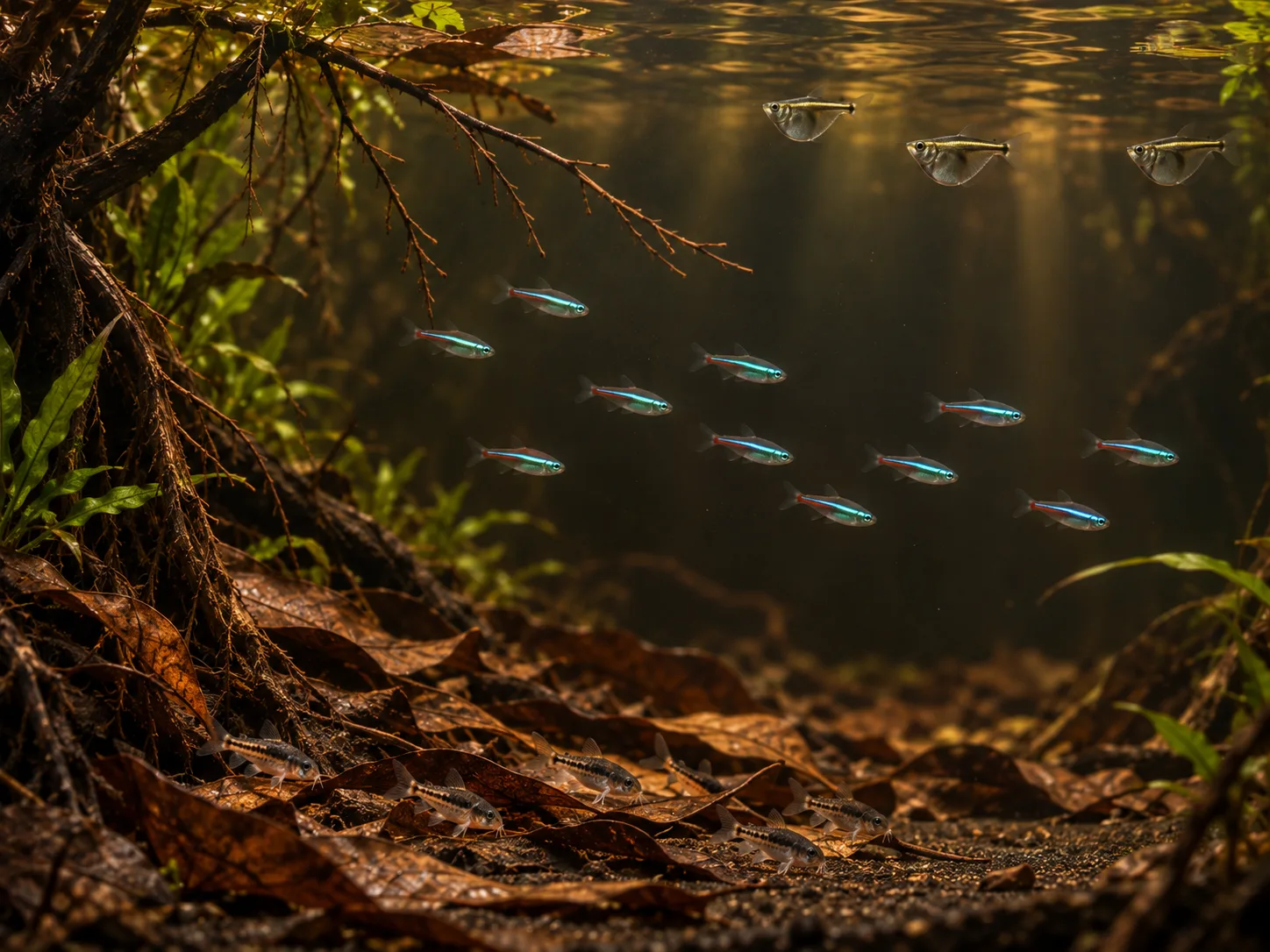
Compare small community candidates
 Cardinal tetra
Larger and more strongly red, with overlapping warm soft-water needs but a separate full school and different identity.
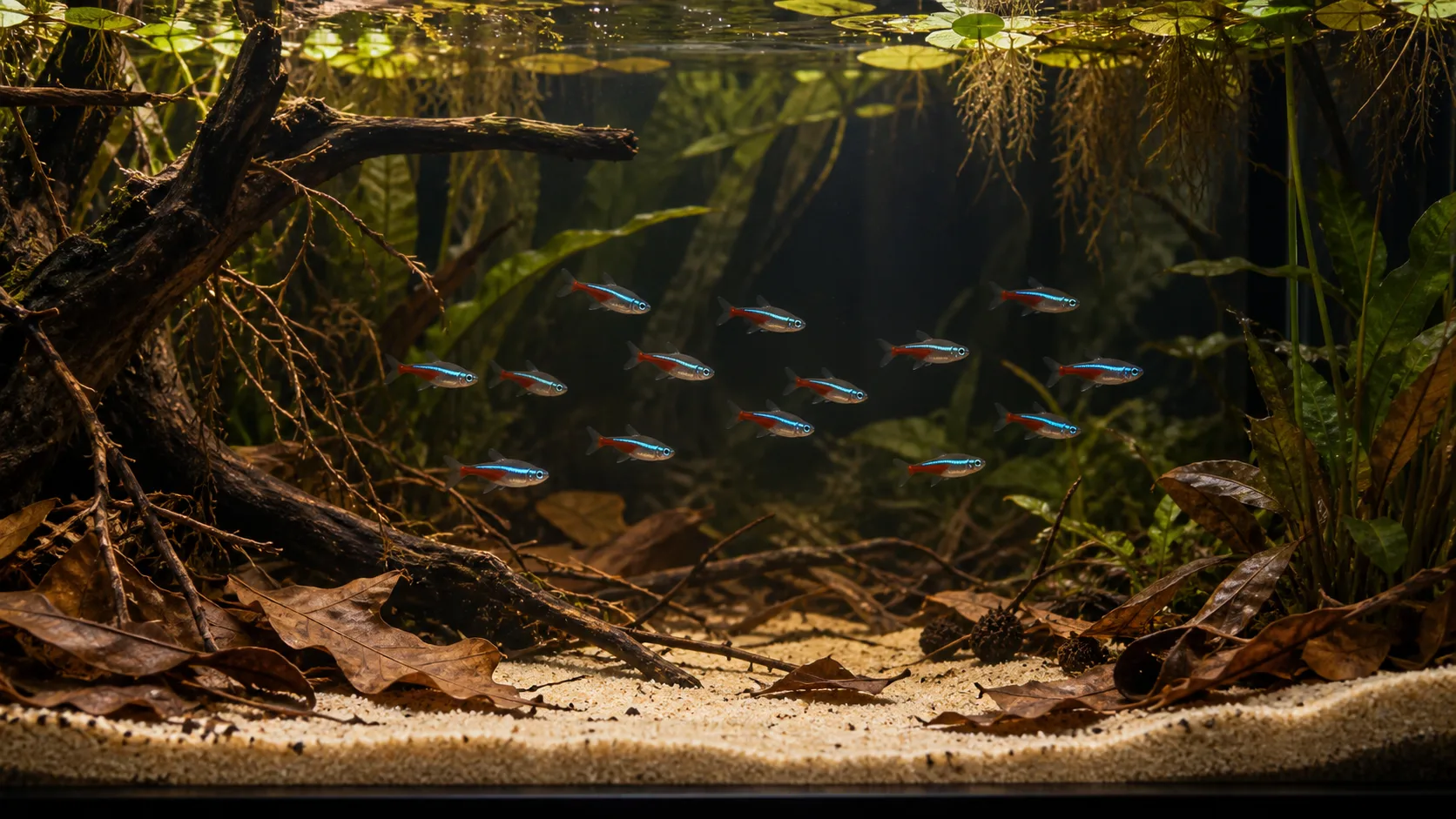 Neon tetra
A larger relative commonly kept cooler, so temperature should be compared before appearance.
 Ember tetra
Small and calm, yet its complete group still competes for the same midwater footprint.
 Chili rasbora
Similar nano scale and subdued conditions, with its own group and feeding requirements.
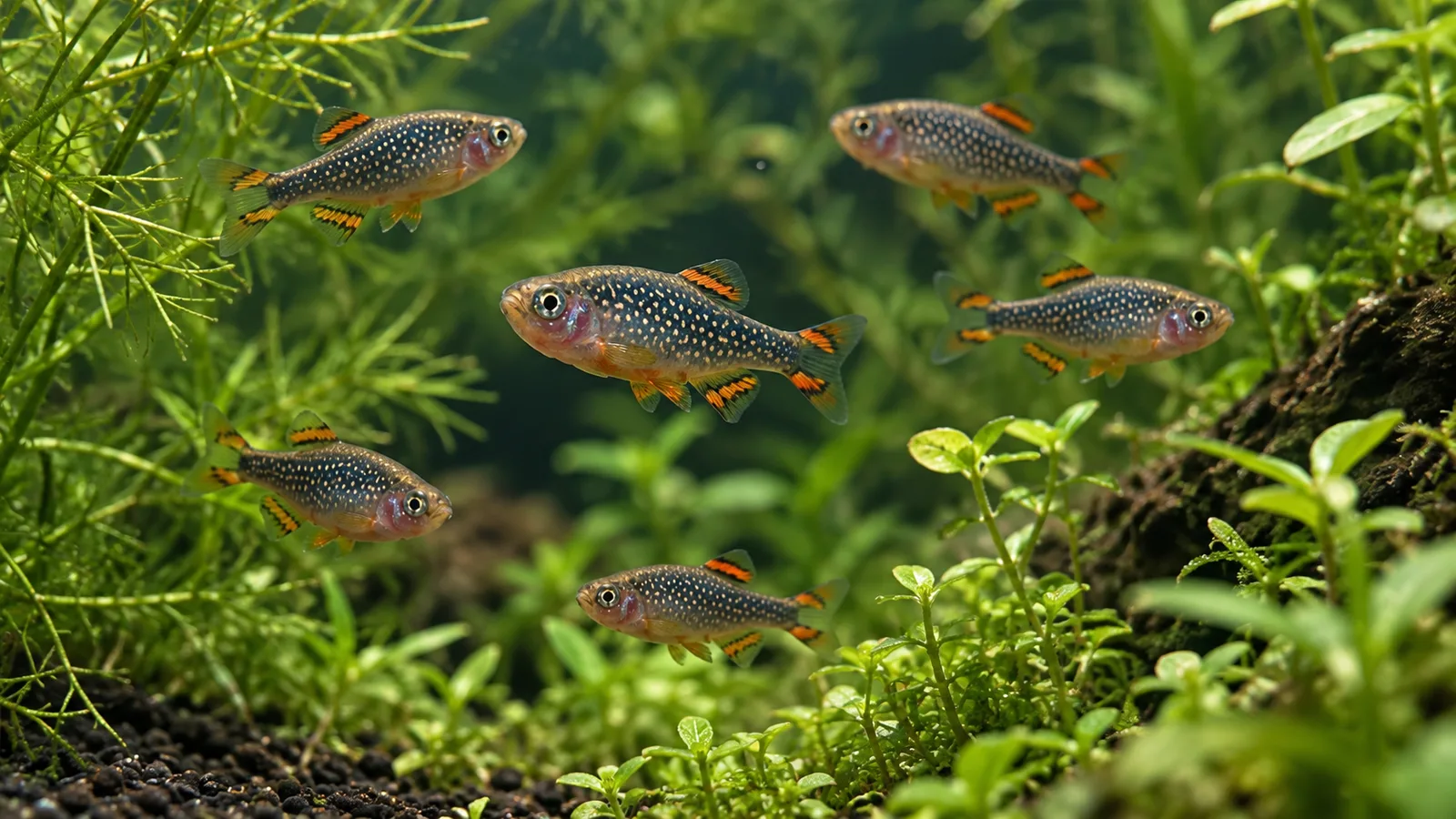 Celestial pearl danio
Uses cover differently and often suits cooler water than the warmest green neon setups.
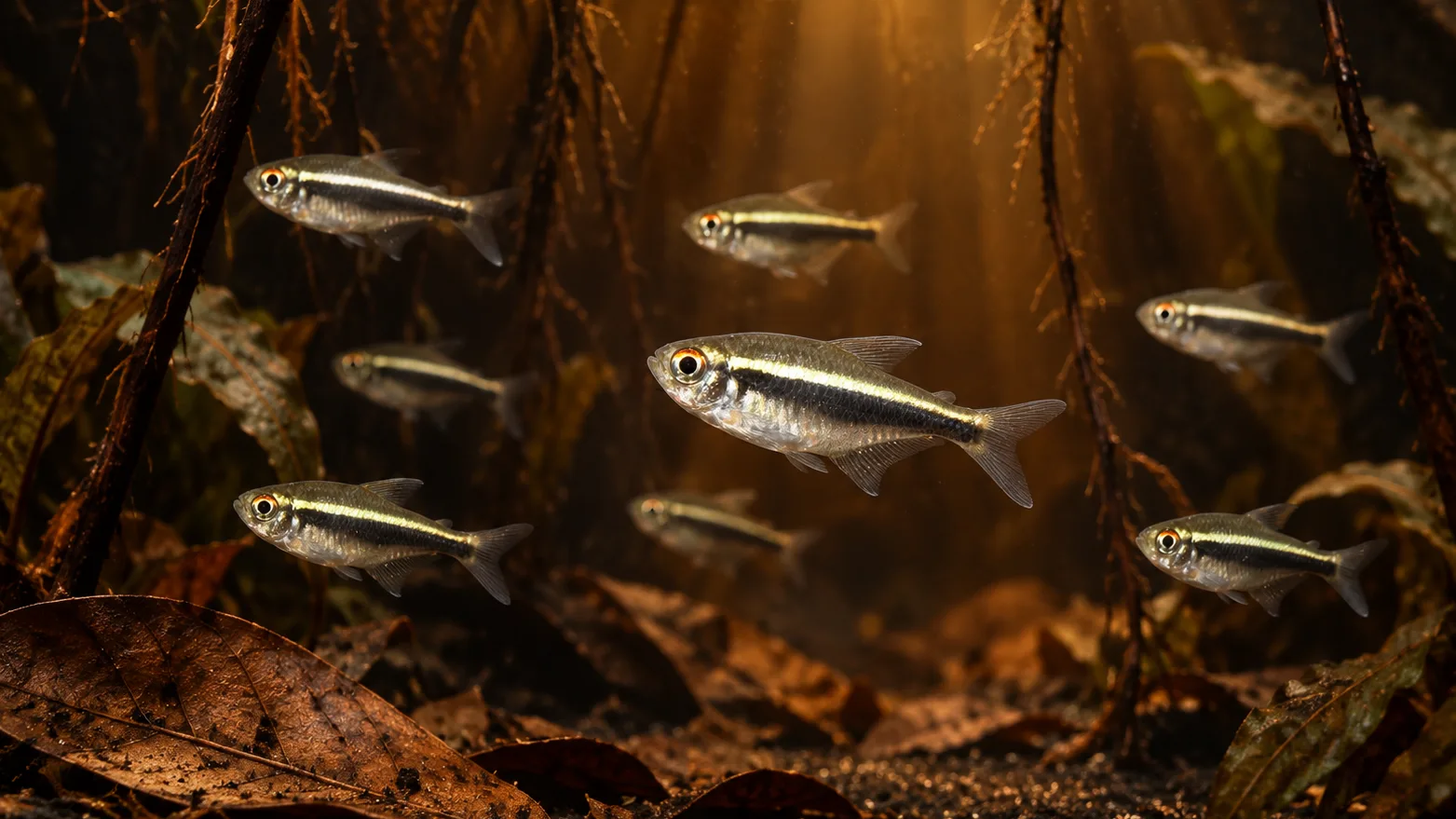 Black neon tetra
Substantially larger and more assertive at food, which changes the footprint and feeding plan.
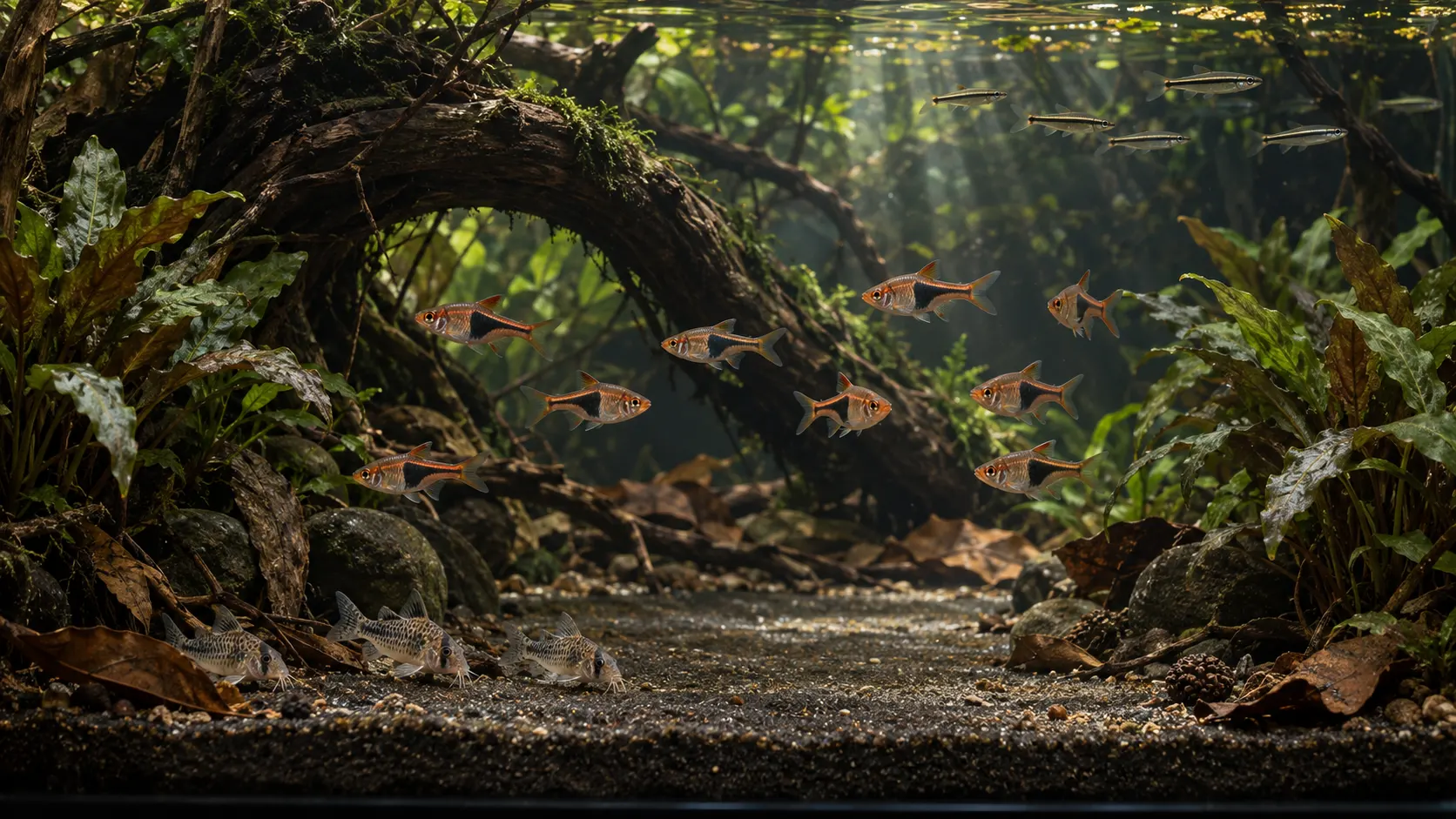 Harlequin rasbora
A deeper-bodied school whose larger adult size needs more open midwater.
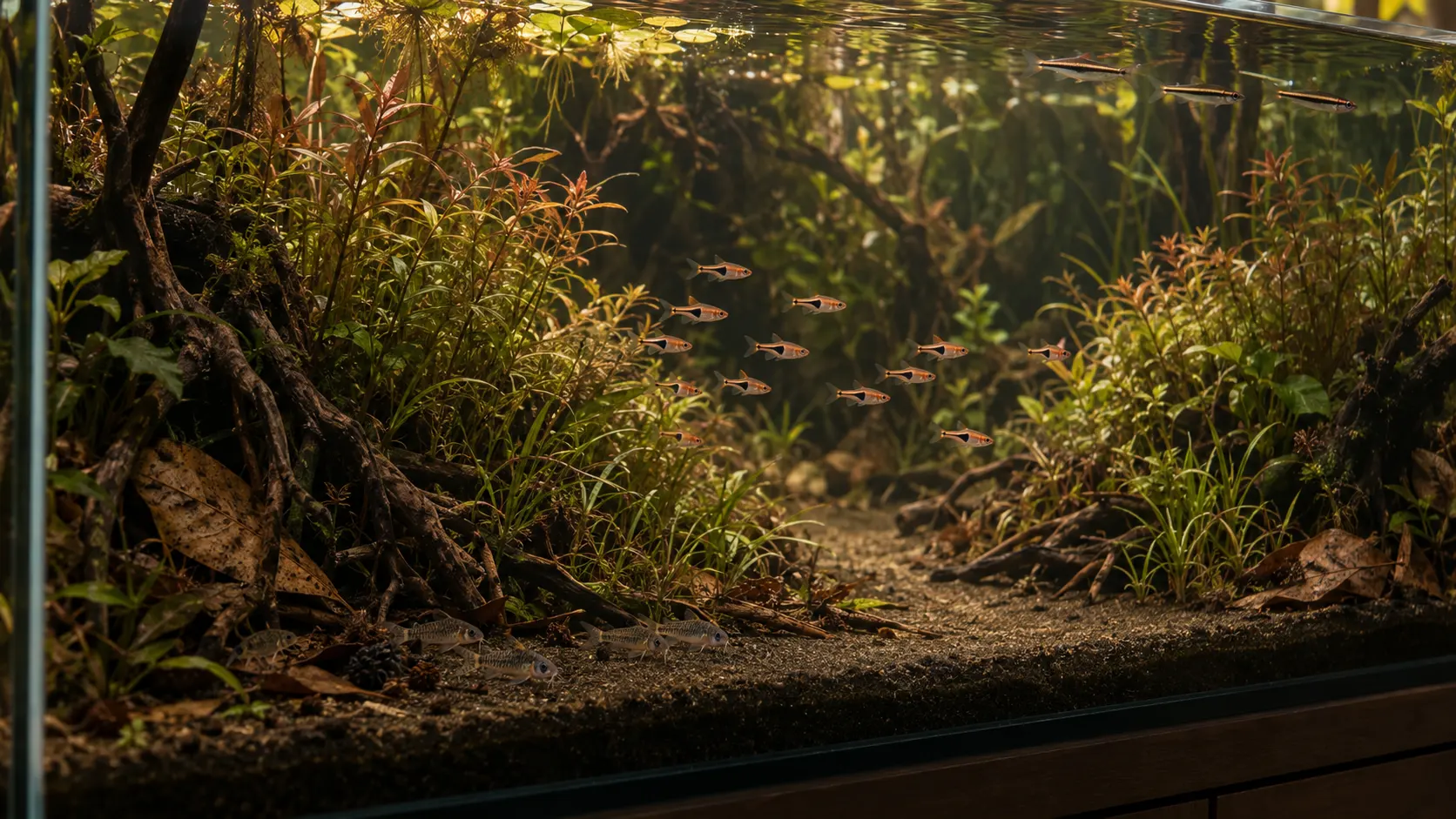 Lambchop rasbora
Similar tiny scale but a planted-stream fish with a separate complete school.
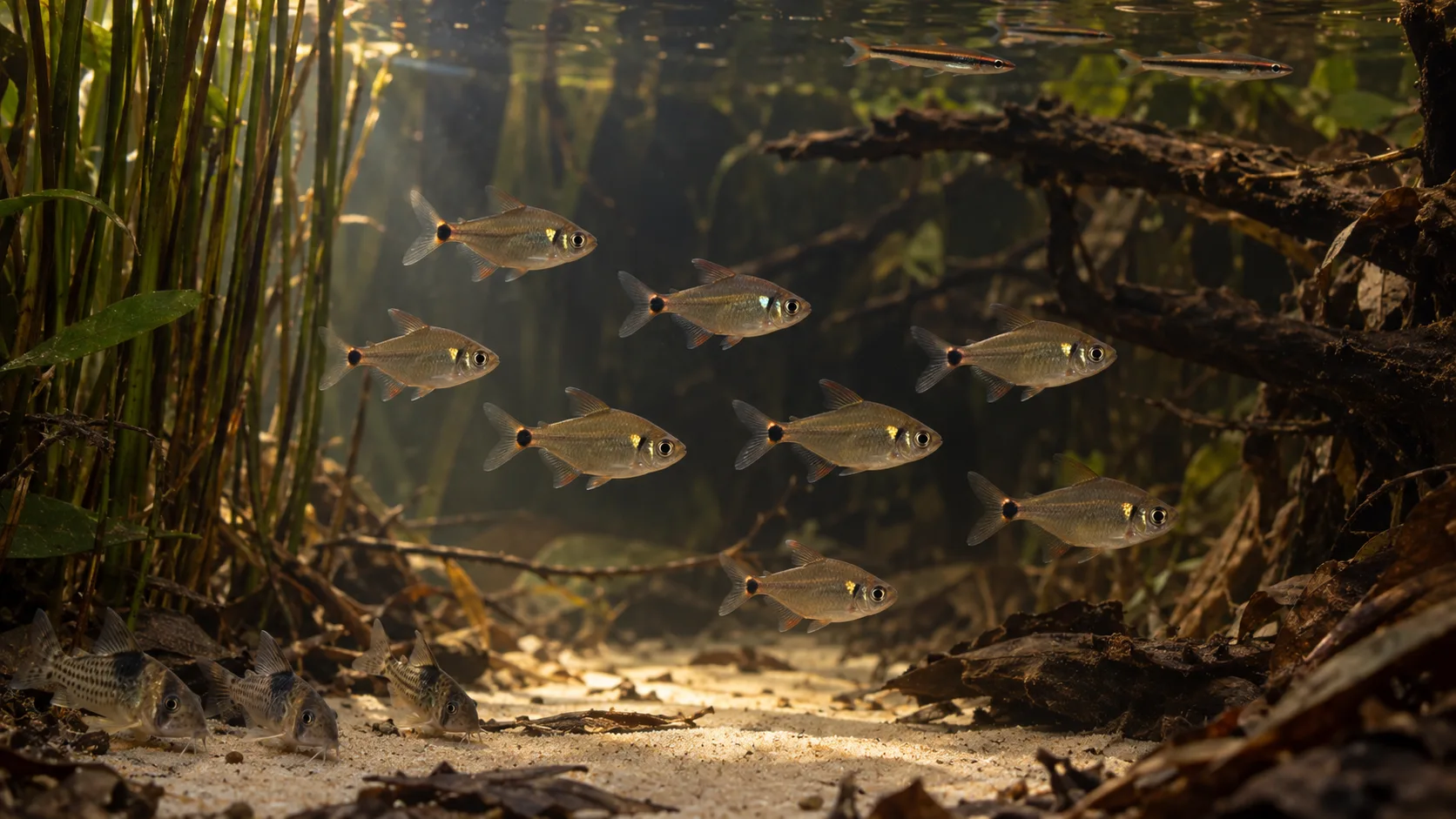 Head and tail light tetra
A larger subtle tetra suited to a broader measured water context.
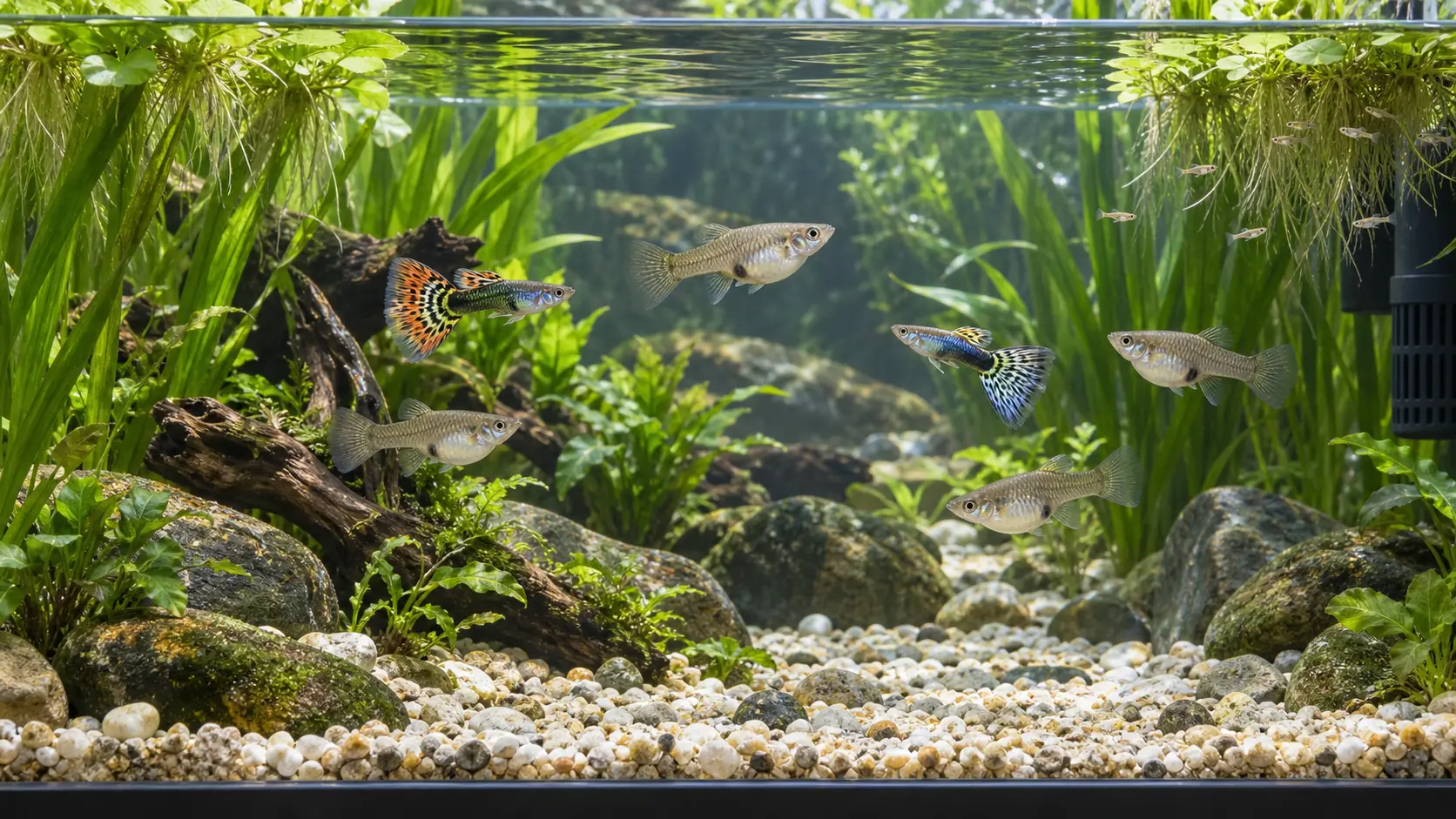 Guppy
A livebearer whose harder-water history and population growth change the whole plan.
 Cherry barb
A planted-cover fish with different group behaviour and feeding competition.
You should avoid boisterous barbs, large gouramis, adult angelfish, and other fish whose mouth, speed, or territorial behaviour can turn the school into permanent cover. Shrimp adults may coexist in some layouts, but small shrimplets remain potential food and cannot be guaranteed safe.
When does hiding or fading need action?
Green neons may look dull immediately after transport, during darkness, or from an angle that does not catch the iridescent stripe. A settled group should still leave cover to feed, regroup after disturbance, and distribute itself through the available midwater.
Check the shared system before treating a colour change
- Temperature and oxygen Verify the thermometer, surface movement, filter return, room heat, and any recent power interruption.
- Toxic nitrogen Test ammonia and nitrite after stocking, overfeeding, filter cleaning, or a hidden death.
- Acclimation difference Compare shop water, receiving water, transport time, and the rate at which the fish were transferred.
- Group pressure Watch whether one fish is excluded, repeatedly chased, or unable to reach either feeding zone.
- Contamination Review sprays, soap, metal, untreated tap water, and equipment shared with another aquarium.
Several fish breathing rapidly, losing balance, crowding the surface, or trying to leave the water point first to a shared water or oxygen emergency. Increase safe surface movement, verify temperature, test toxic nitrogen, and use conditioned temperature-matched replacement water when a contaminated or toxic condition is confirmed.
Do not diagnose a named disease from a stripe change or photograph. Avoid combining medication, large chemistry shifts, complete filter cleaning, and a major rescape without a confirmed reason because the fish then face several new stresses at once.
What commitment does a green neon tetra school require?
Primary records do not establish a dependable green neon tetra lifespan range for P. simulans. Plan for a multi-year group and keep the purchase date, supplier, losses, major water changes, and origin claims with the aquarium rather than turning a broad consumer estimate into a promise.
FishBase lists the species as Least Concern, assessed 4 March 2021. That global category does not prove that every locality is secure, that every fish in trade was collected legally, or that a wild-origin shipment will adapt to your source water.
A green neon school fits when you can provide a mature warm aquarium with very soft stable water, subdued cover, an open horizontal lane, tiny foods that every fish can reach, and companions too small and calm to dominate them. The fish's short body reduces individual waste, but it does not reduce the care required by the complete group.