
What Is a Chili Rasbora, and How Small Is It Really?
Boraras brigittae
The chili rasbora is Boraras brigittae, a red minnow from southern Borneo usually encountered at under two centimetres. It was described in a German aquarium magazine as a subspecies of another fish, and it still has no completed conservation assessment.

At a glance

- Adult size
- 1.8 cm
- Minimum footprint
- A small but mature planted aquarium with dense fine planting and open water above it
- Social structure
- Ten as a floor and fifteen to twenty where the species starts behaving and colouring normally. The whole group can reasonably be introduced at once.
- Minimum group
- 10
- Sex ratio
- Males carry the deep red; females are paler and rounder-bellied.
- Diet
- Carnivore
- Feeding
- Crushed or micro-sized dried food with small live and frozen items. Mouth size is the binding constraint, not nutrition.
- Waste load
- low
- Family
- Danionidae
- Native range
- Southern Borneo, Indonesia
- Also sold as
- mosquito rasbora. Trade and hobby names, not accepted species names.
- Former scientific names
- Rasbora brigittae, Rasbora urophthalma brigittae. Superseded names for this same species.
- Conservation status
- Data Deficient, assessed 6 February 2019 Source
The fish needs a stable volume rather than a large one. Very small tanks swing in temperature and lose buffering, which is what actually fails here.
What is a chili rasbora?
The chili rasbora is Boraras brigittae, a red minnow from southern Borneo that is usually encountered at under two centimetres long.
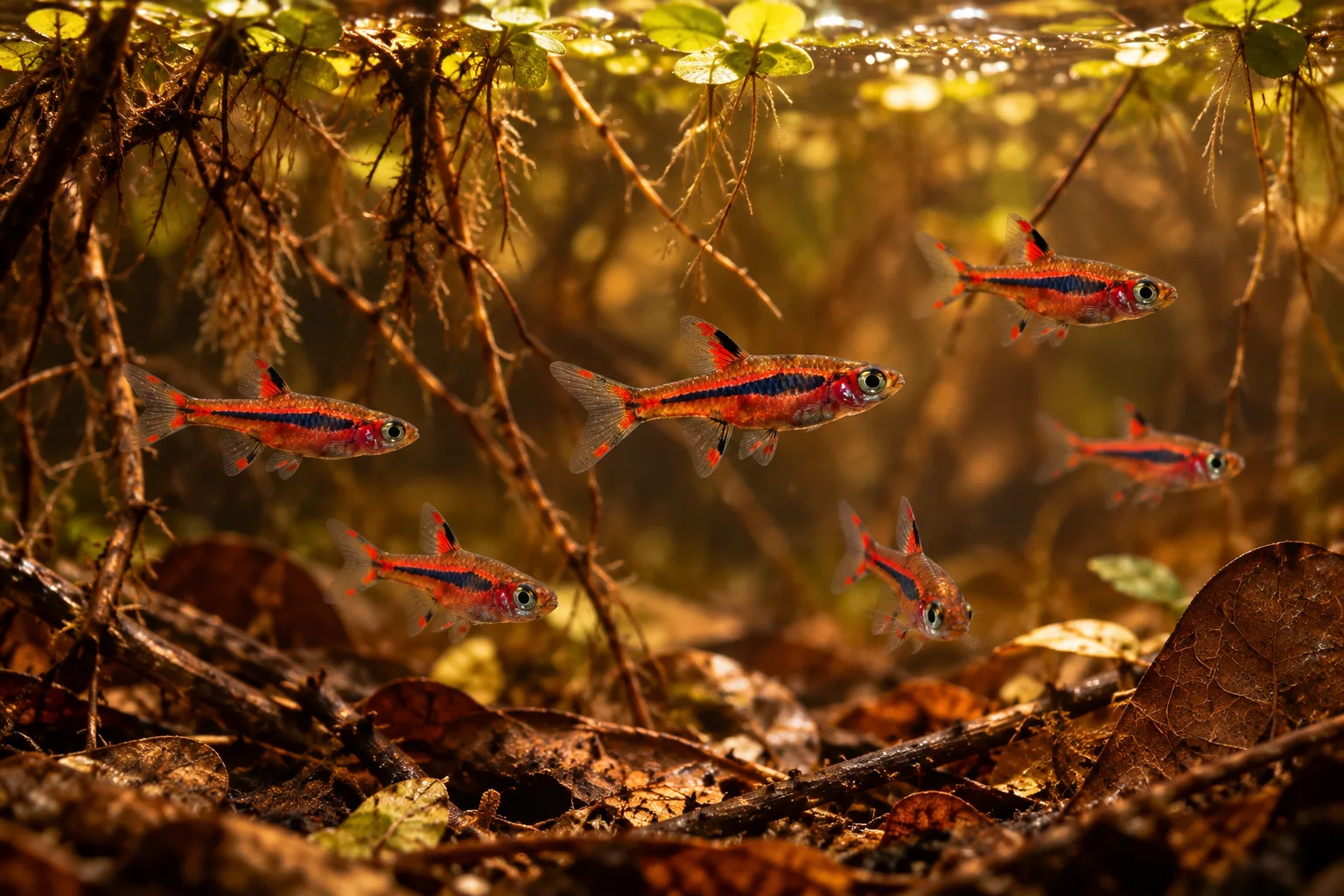
It is one of the smallest fish in general aquarium trade, and the word nano attached to it has caused more problems than the fish ever has.
Dieter Vogt described it in 1978, in the German aquarium magazine Die Aquarien- und Terrarienzeitschrift, from Bandjarmasin in Borneo. He described it not as a species but as a subspecies of another fish, Rasbora urophthalma.
- Accepted identity
- Boraras brigittae (Vogt, 1978)
- Described as
- Rasbora urophthalma brigittae, a subspecies
- Family
- Danionidae, subfamily Rasborinae
- Type locality
- Bandjarmasin, Borneo, Indonesia
- Native range
- Southern Borneo
- Common length
- 1.8 cm standard length
- Recorded maximum
- 3.5 cm total length
- Spawning
- Up to 50 eggs placed on the undersides of leaves
- IUCN assessment
- Data Deficient, assessed 6 February 2019
Two facts shape the main decisions: the fish's length and its conservation assessment.
How small is it, actually?
Small enough that the usual aquarium vocabulary stops being helpful.
| Figure | Source | Measured how | What it tells you |
|---|---|---|---|
| 1.8 cm | Kottelat and colleagues, Freshwater Fishes of Western Indonesia and Sulawesi, 1993 | Standard length, to the tail base | The length you will actually be looking at |
| 3.5 cm | Riehl and Baensch, Aquarien Atlas, 1996 | Total length, to the tail tip | An outer bound from aquarium literature |
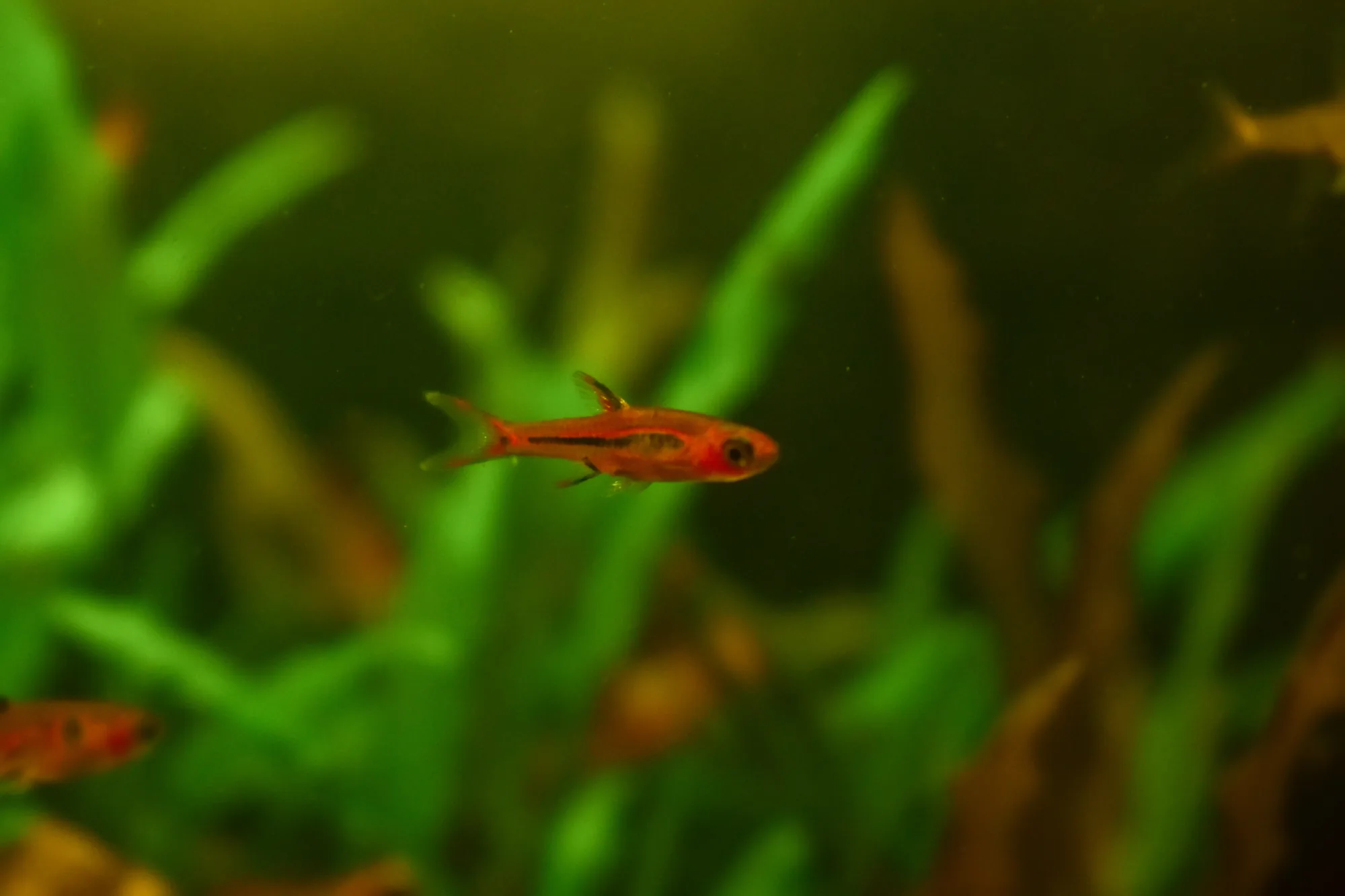
The first figure comes from a regional ichthyological reference and describes the common length. The second comes from an aquarium atlas and describes a maximum.
They are not in conflict so much as answering different questions, but the gap between them is nearly double, and it is the smaller one that should drive decisions.
Why did the name change twice?
Vogt placed it inside Rasbora urophthalma as a subspecies, which is why older books list it under that name.
Kottelat and colleagues raised it to full species in 1993. In the same year Kottelat and Vidthayanon moved it, with several relatives, into a new genus, Boraras.
Eschmeyer's Catalog of Fishes gives Boraras brigittae as the current status. The genus name is an anagram of Rasbora, which is a small joke that also records exactly what happened.
Does a nano fish mean a nano tank?
This is the part the name gets wrong, and it is worth separating into two questions.
A chili rasbora does not need a large volume of water for itself. What it needs is a stable volume of water, and small volumes are not stable.
A five-litre tank swings in temperature with the room, exhausts its buffering quickly, and turns a small feeding mistake into a measurable ammonia reading. The fish is tiny; the chemistry is not forgiving.
The second question is the group. This is a schooling fish that colours up and behaves normally only in numbers, and ten or twelve of them need somewhere to swim even though ten or twelve of them weigh almost nothing.
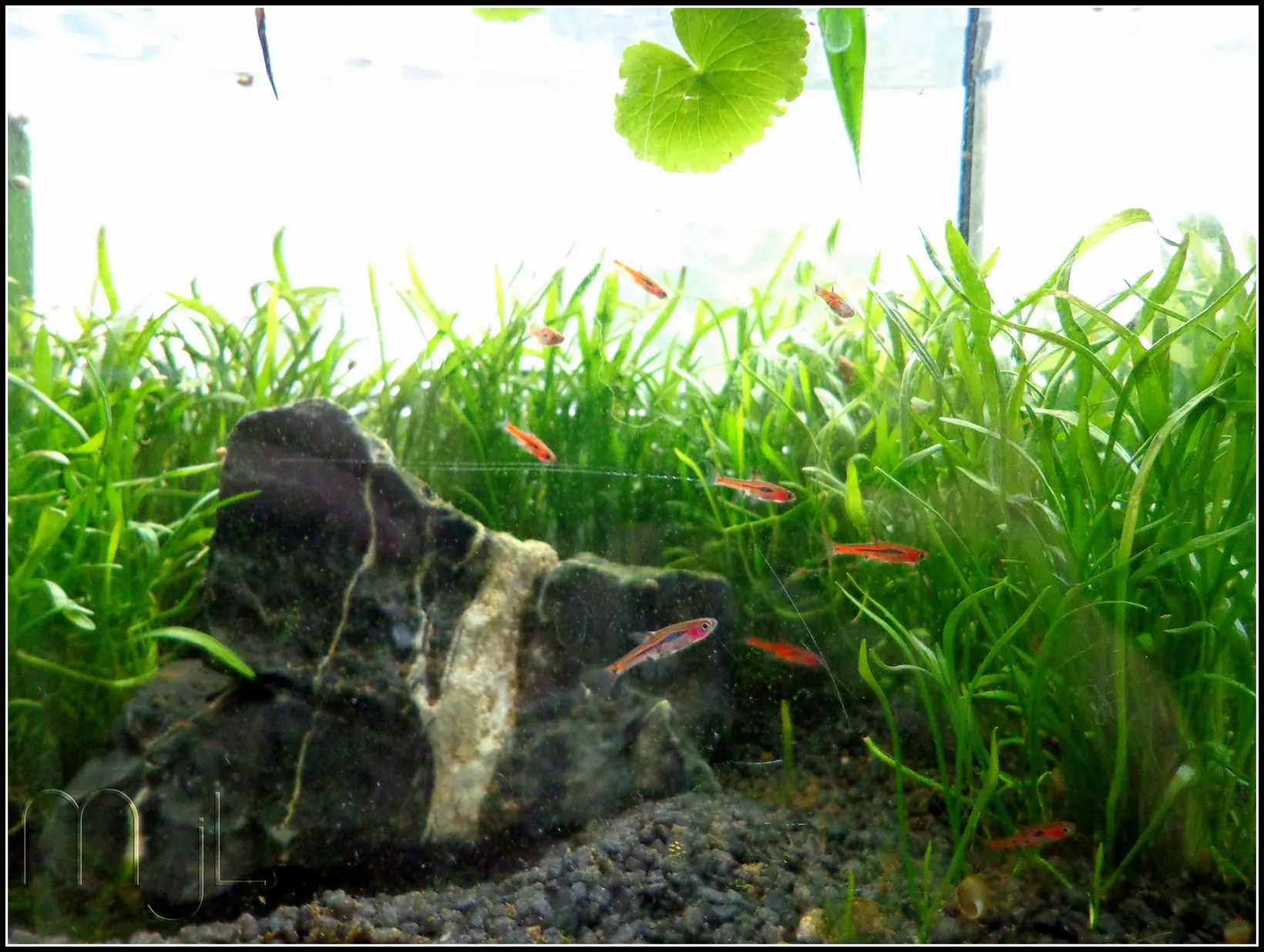
So the honest answer is that a small, heavily planted, mature, stable aquarium suits them very well, and a brand-new desktop cube suits them badly.
What makes them turn red?
The photograph that sells this species is a male in breeding condition, and that is not the default state.
Colour here is produced by three things, and two of them are free.
- Sex: males carry the deep red, females are paler and rounder-bellied, so a tank of females will never look like the photograph.
- Security: planting and a dark substrate. A fish this size over pale gravel under a bright light behaves like prey.
- Company: males colour up hardest against rivals, which is why a group of six never matches a group of fifteen.
Males carry the deep red, with a dark lateral stripe running through it; females are paler and rounder-bellied.
Security comes from planting and a dark substrate. A fish this size over pale gravel under a bright light behaves like prey, because it is.
Company is the one most often skipped.
Males colour up hardest when they have rivals to display at, so a group of six will never look like a group of fifteen.
How many should you keep?
More than feels necessary for a fish this size, and the reason is not sentiment.
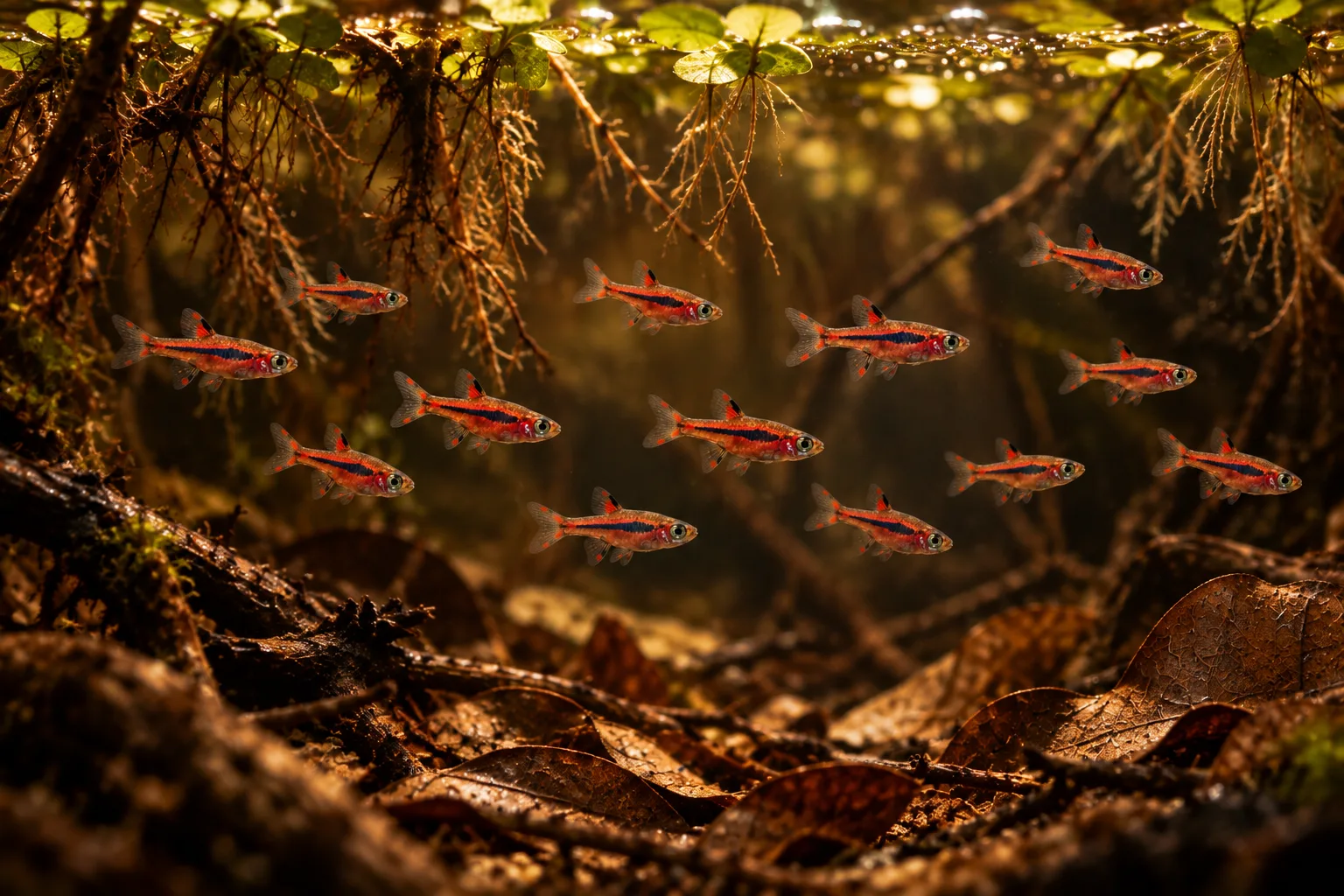
A small school spends its time watching for threats. A large one spends its time on everything else, which includes feeding properly and displaying.
Ten is a reasonable floor and fifteen to twenty is where the species starts looking like the photographs. The biological load of twenty chili rasboras is still less than that of a single medium community fish.
Buying them in stages works badly. Adding five at a time to an established handful gives you a group that never quite settles, and it repeats the acclimation risk for every batch.
How do you feed a fish with a mouth this small?
Mouth size, not nutrition, is the binding constraint.
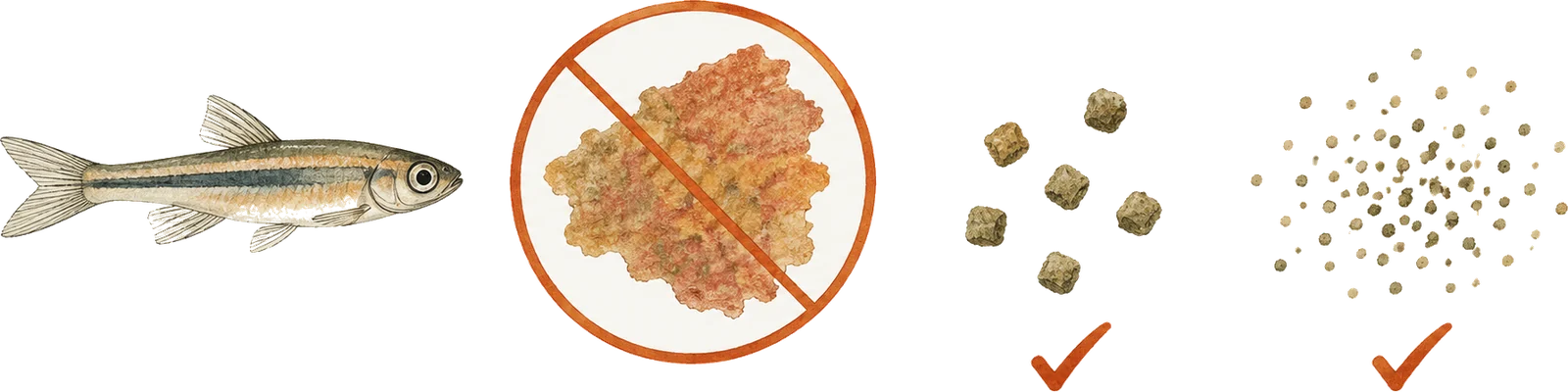
Crush dried food finely or buy food sold for nano fish and fry. Small live and frozen items, the sort used for raising fry, produce the fastest visible improvement in condition.
Feed small amounts more than once a day. A heavily planted tank hides uneaten food efficiently, so err towards frequency rather than quantity.
Watch individual fish rather than the group. A shoal of fifteen tiny fish can look busy while two of them are steadily losing condition at the back.
What water does the record support?
Recorded freshwater context
- Temperature25 to 28 °CSeparate aquarium thermometer.
- pH6.5 to 7.0Calibrated pH meter or an aquarium test covering the range.
- General hardnessUp to 10 dGH, upper boundary onlyGH titration test in degrees of general hardness.
Every range above applies to Boraras brigittae aquarium reference range in a freshwater system. Source: FishBase species summary, checked 2026-09-12.
That compiled range comes from an aquarium atlas of 1991 and sits close to neutral.
It is worth holding lightly. Southern Borneo is peat swamp country, and the aquarium literature consistently associates this genus with soft, acidic, tannin-stained water, which a range of pH 6.5 to 7.0 does not obviously describe.
Picking one number would hide that disagreement. What both accounts agree on is the direction: soft rather than hard, and acidic rather than alkaline.
Warmth is the firmer part of the record. This is a fish from the warm end of the tropical range, and 25 to 28 °C is a genuine requirement rather than a preference.
Stability outranks position, as usual. Measure with the same test each time, change water in small regular amounts rather than large occasional ones, and stop a transfer if fish gasp or lose balance.
Which tank mates suit a fish this size?
Very few, and the constraint is size rather than temperament.
A chili rasbora is prey for a great many ordinary community fish, and it is outcompeted at feeding time by almost all of them even when it is safe.

The species documented elsewhere on this site are mostly the wrong answer for exactly that reason. A cardinal tetra is roughly twice the length and will clear the food first; a cherry barb forages over the same bed and is considerably bulkier.
A brilliant rasbora is in a different category altogether at four or five times the length, and a bucktooth tetra is not a conversation worth having.
Dwarf shrimp, small snails, and other fish of genuinely similar size are the company this species is suited to. A single-species tank is not a compromise here; it is the arrangement that shows the fish at its best.
Filter intakes matter for the same reason tank mates do. Guard a powered intake with sponge or fine mesh before the fish go in.
Can chili rasboras be bred at home?
The mode is recorded and it is unusual enough to be worth stating precisely.
FishBase records that up to 50 eggs are deposited on the undersides of leaves and that larvae hatch after 48 hours.
That is not a broadcast scatterer. It means broad-leaved plants and dense fine planting give eggs somewhere to be, and a bare tank gives them nowhere.
Adults eat eggs and fry, and the fry are extremely small. Anything beyond occasional survivors in a heavily planted tank means a separate container and infusoria-grade first food.
Occasional young appearing in a mature planted tank is common, and it says more about the tank than about the keeper.
A tank producing the odd surviving fry has dense cover, stable water and a living population of microscopic food in it, which is exactly the state this species does best in.
Which signs mean act now?
On a fish this small, most problems present as behaviour before they present as anything visible.
Gasping, loss of balance, a group that stops schooling and scatters into cover, or fish sitting on the substrate all point at the water first.
What to measure, in this order
- Temperature This species wants 25 to 28 degrees. A cool room and an undersized heater is the commonest failure in a small tank.
- Ammonia and nitrite Zero on both. A small volume reaches a harmful reading from one missed uneaten feed.
- Count the fish On a 2 cm animal, a disappearance is far more often the filter intake than a disease.
- What changed A water change larger than usual, a new plant, or a fresh batch of fish in the last few days.
Colour loss across the whole group usually points at the water or the temperature. Colour loss in one fish that is also hiding and not feeding usually points at that fish.
Slower signs deserve a slower response: wasting despite feeding, clamped fins, a fish that stops using open water it previously used.
Appearance does not diagnose a disease, and on a 2 cm fish a photograph diagnoses even less. Contact an aquatic veterinarian or an experienced fish-health professional when several fish decline together, or when measured water is normal and the animals are not.
What do conservation and trade records show?
Put the entries together and the gap is the point.
| Record | Status | Dated |
|---|---|---|
| IUCN Red List | Data Deficient | 6 February 2019 |
| CITES | Not Evaluated | Checked 12 September 2026 |
| Fisheries interest | Recorded as of no interest as a food fish | FishBase, checked 12 September 2026 |
Data Deficient is not a clean bill of health. It records that the assessors did not have enough information to place the species in any category at all.
That is a striking gap for a fish this widely sold. The species is restricted to southern Borneo, an area whose peat swamps are among the most heavily drained and converted freshwater habitats anywhere, and nobody has been able to say what that has done to it.
Captive-bred stock exists and is increasingly common. Ask a seller where fish came from, and prefer bred stock where the choice is available.
Never release aquarium fish, plants, water or live food outdoors.
Should you buy chili rasboras?
For a mature, small, densely planted, warm and stable tank, this is one of the most rewarding fish in the hobby, and the running costs are trivial.
For a new tank, a bare tank, a cool tank or a community of ordinary-sized fish, it is a bad purchase that usually ends quietly.
- The tank is cycled and has been stable for weeks, not days.
- It is planted densely, with a dark substrate and shaded light.
- The heater holds 25 to 28 °C without swinging.
- At least ten fish are going home together, and more is better.
- Any powered filter intake is guarded before the fish arrive.
- Tank mates, if any, are shrimp, snails, or fish of genuinely similar size.
Get that right and the fish that arrives pale and invisible will be scarlet and out in the open within a fortnight. Get it wrong and you will have bought a fish you cannot find.
Which schooling fish are useful comparisons?
Ember tetra
A tiny warm-water tetra whose low competitive weight and small mouth change feeding and tankmate choices.
Celestial pearl danio
A tiny planted-tank danio with cooler documented habitat water and a different style of group behaviour.
Emerald eye rasbora
A tiny rasbora whose cooler range, small body and quiet shoaling pattern create a different constraint set.
Endler's livebearer
A small livebearer whose hard-water range and constant reproduction create a different maintenance problem.
Black neon tetra
A smaller midwater shoaler that offers a useful contrast in body size, group movement and water tolerance.
Diamond tetra
A medium deep-bodied characin that offers a closer comparison in warm water, adult mass and display behaviour.