
What Is an Emperor Tetra, and How Can You Identify the Males?
Nematobrycon palmeri
The emperor tetra is Nematobrycon palmeri, a 4.2 cm Colombian characin whose mature males develop extended fins and central tail rays. It belongs in a group of five or more in an 80 cm or longer aquarium where open display water, broken sight lines and distributed feeding prevent normal male posturing from becoming exclusion.

At a glance

- Adult size
- 4.2 cm
- Minimum footprint
- At least 80 cm aquarium length, following the FishBase aquarium benchmark
- Social structure
- A group of five or more with open display water and broken sight lines; males may hold short-lived positions.
- Minimum group
- 5
- Sex ratio
- No universal ratio is promised; mature males usually show longer fins and central caudal rays, while juveniles remain uncertain.
- Diet
- Omnivore
- Feeding
- A complete small staple with appropriately sized crustacean or worm-based variety, distributed across several points.
- Waste load
- low-medium
- Family
- Acestrorhamphidae
- Native range
- Atrato and San Juan river basins, Colombia
- Conservation status
- Data Deficient, assessed 9 October 2014 Source
The footprint is expressed as usable horizontal room because adult movement and social escape cannot be inferred from litres alone.
What is an emperor tetra?
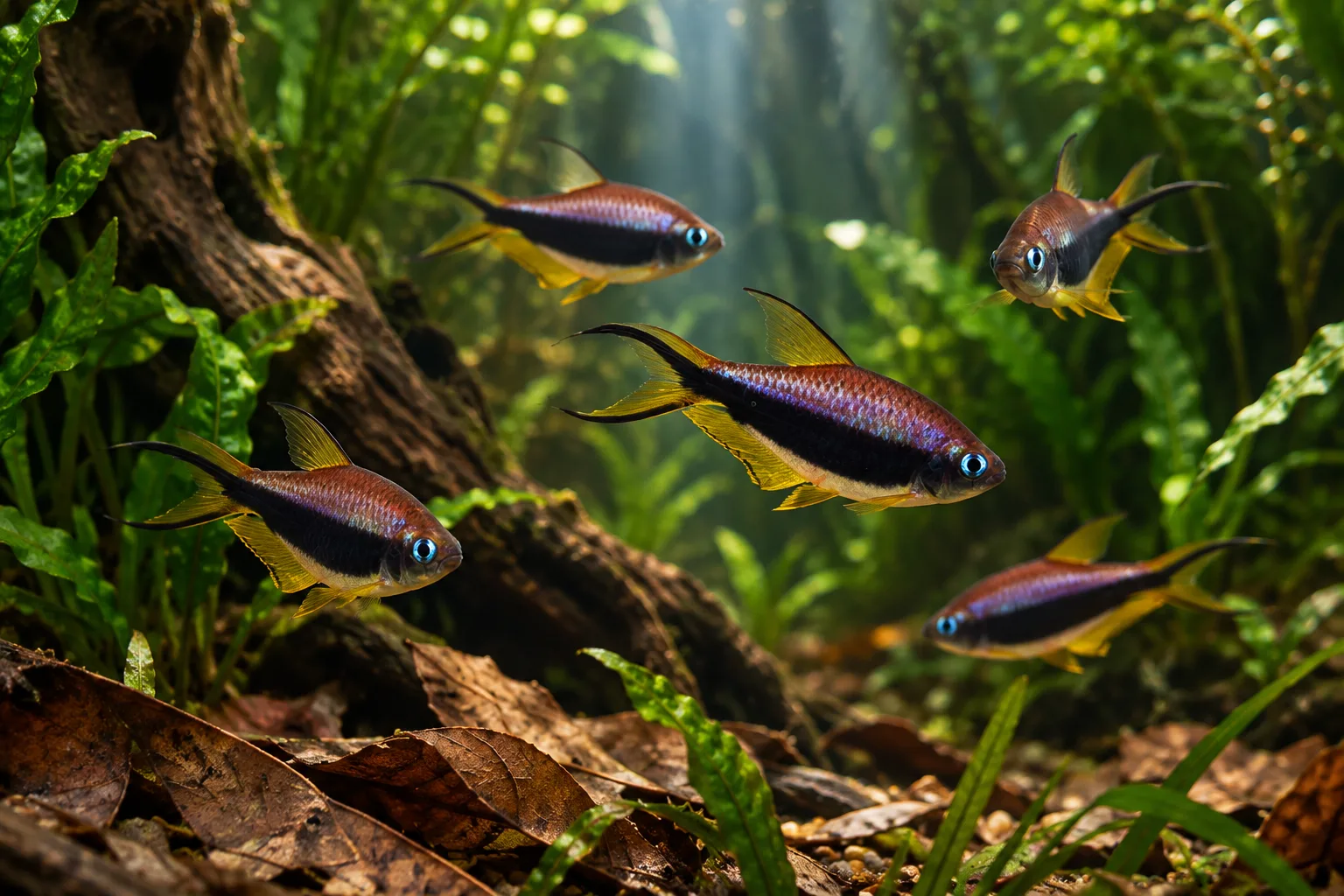
The emperor tetra is Nematobrycon palmeri, a Colombian characin with a dark horizontal stripe, blue-green iridescence and a distinctive tail in mature males. It is social, but males can hold display positions rather than moving as a perfectly synchronized shoal.
- Accepted identity
- Nematobrycon palmeri Eigenmann, 1911
- Family
- Acestrorhamphidae
- Native range
- Atrato and San Juan river basins, Colombia
- Maximum published size
- 4.2 cm standard length
- Temperature
- 23 to 27 °C
- Published aquarium group
- Five or more
- Published aquarium length
- 80 cm
- IUCN assessment
- Data Deficient, assessed 9 October 2014
“Purple emperor tetra” often refers to Inpaichthys kerri, which is a different fish. A color adjective in a shop does not override the scientific name.
How can you identify an emperor tetra?
The species carries a dark band along the side, reflective blue-green color above it and yellowish fin accents. Mature males often show a three-pronged tail effect because the central caudal rays extend beyond the outer lobes.
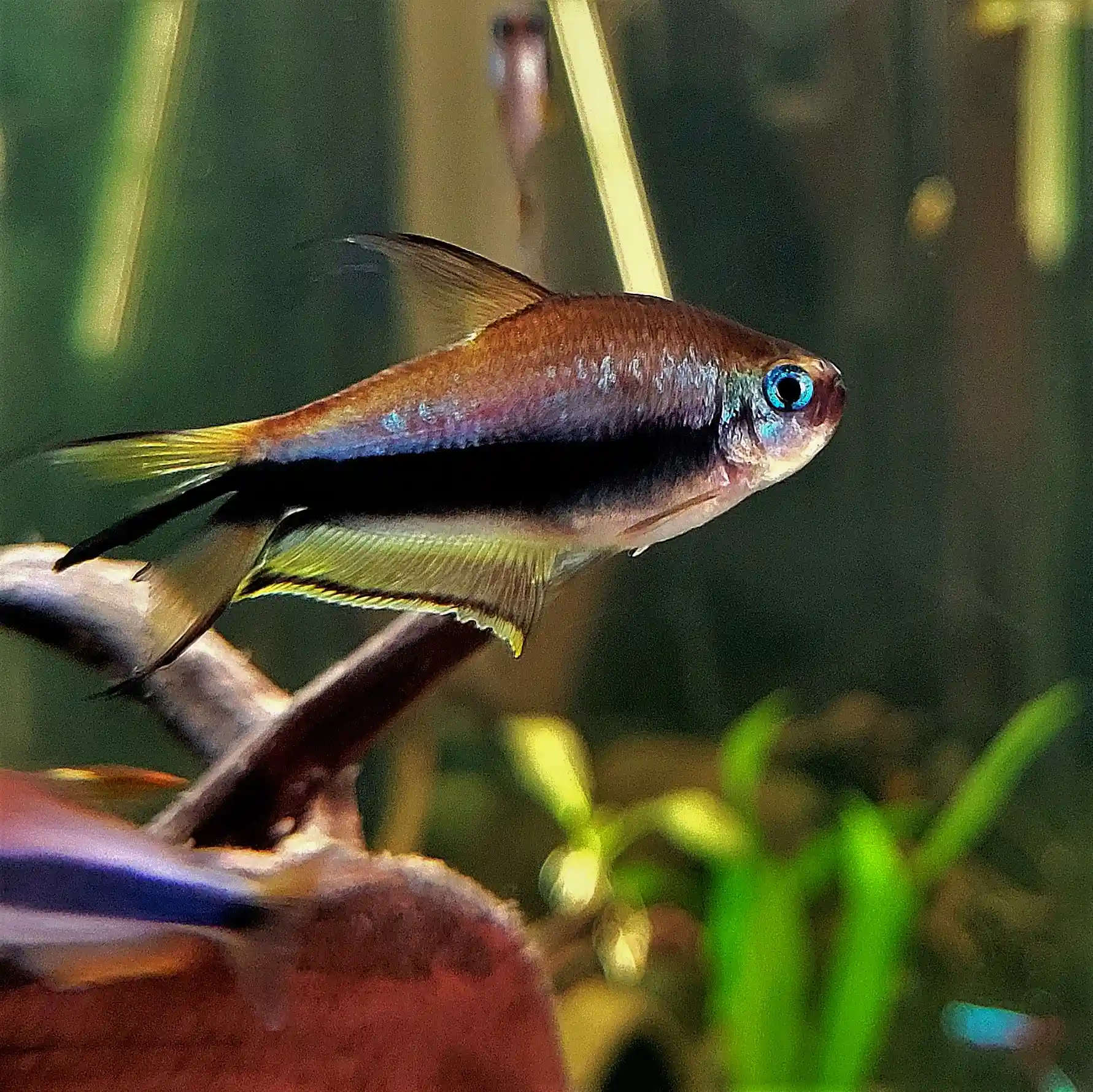
The popular claim that males always have blue eyes and females green eyes can help with mature fish, but light angle and individual variation make it a supporting character rather than a standalone test.
How can you tell male and female emperor tetras apart?
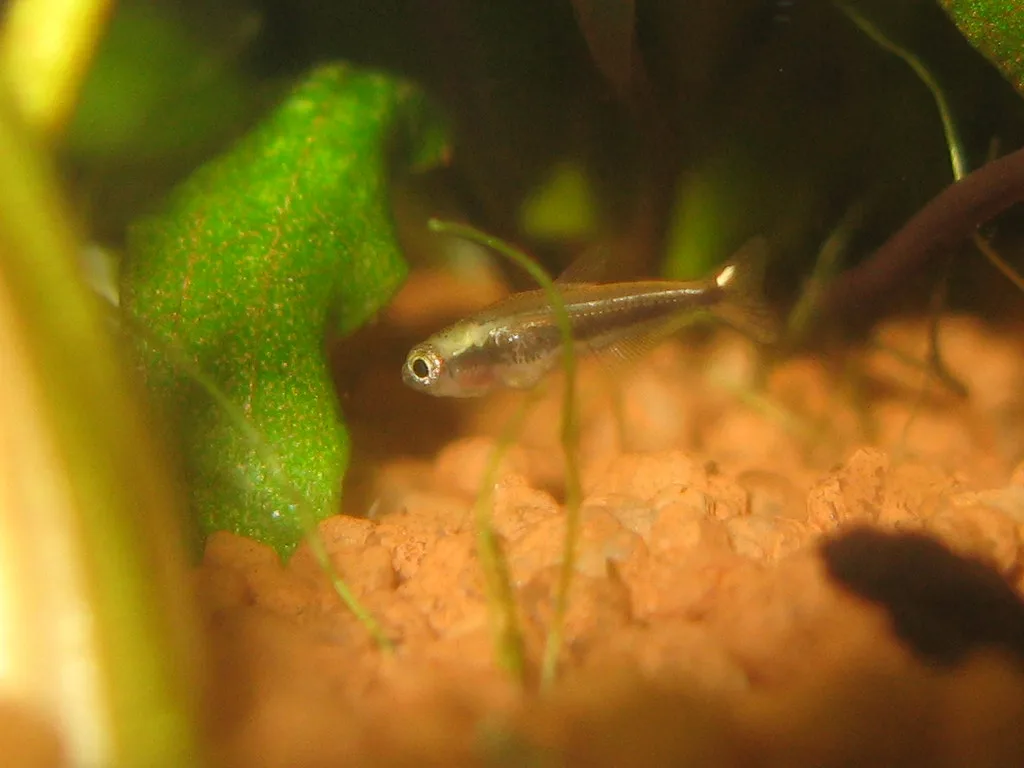
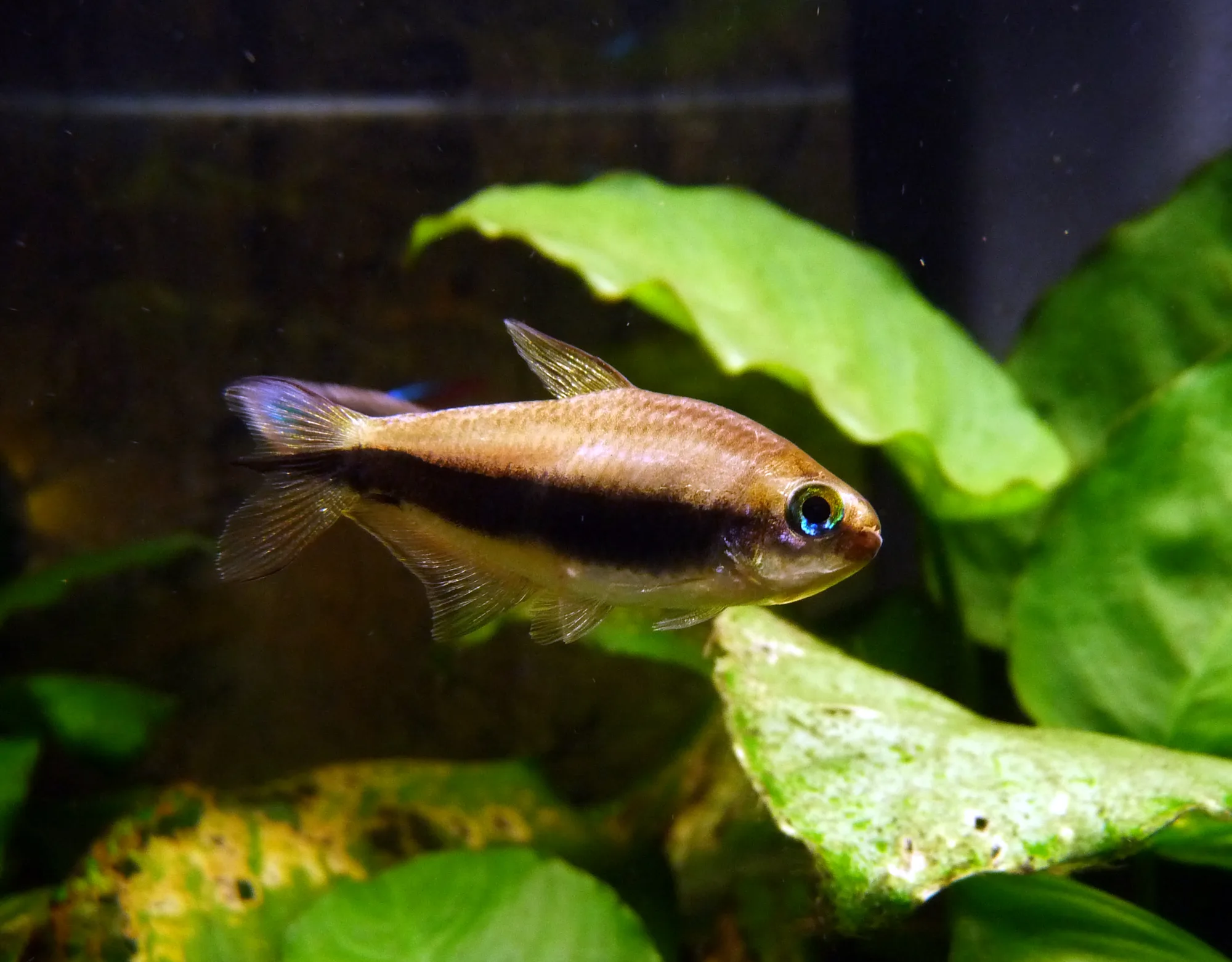
Mature males are usually slimmer with more extended dorsal, anal and central caudal rays. Females tend to be fuller through the abdomen and keep shorter, rounder fin outlines.
| Character | Mature male | Mature female | Limitation |
|---|---|---|---|
| Central tail rays | Often extend beyond the outer lobes | Usually shorter and less pronounced | Damage can remove the extension |
| Dorsal and anal fins | More pointed or extended | Shorter, rounder outline | Juveniles have not completed development |
| Body | Usually slimmer | Often fuller through the abdomen | Feeding and spawning condition alter depth |
| Eye reflection | Often described as bluer | Often described as greener | Lighting and individual variation overlap |
| Display | More likely to hold and defend a visual position | More likely to move through the group | Behavior changes with group composition |
Buying juveniles means accepting uncertainty. A rigid sex ratio cannot be guaranteed from a tank of undeveloped fish.
Are emperor tetras aggressive?
They are usually suitable community fish, yet males may display and chase around preferred positions. The behavior becomes harmful when one fish cannot disengage, feed or rest.
| Decision factor | Normal social display | Welfare problem |
|---|---|---|
| Pattern | Short flare, parallel swim or chase that ends | Repeated pursuit of the same fish |
| Space | Both fish return to open water | One fish remains behind equipment or at the surface |
| Fins | Open and intact | Split, clamped or progressively worn |
| Feeding | Every fish reaches food | A subordinate fish waits until the meal ends |
| Breathing | Settles after activity | Rapid breathing continues at rest |
Do not label all movement aggression and do not dismiss injury as harmless display. Duration, repetition and the targeted fish's ability to leave provide the distinction.
What group composition works best?
FishBase records aquarium groups of five or more. That number is a floor for social housing, not a promise that every set of five will distribute male attention well.
A mixed group with sight breaks is usually easier to manage than several mature males forced to share one exposed strip. No universal sex ratio can be guaranteed from juveniles or substituted for enough space.
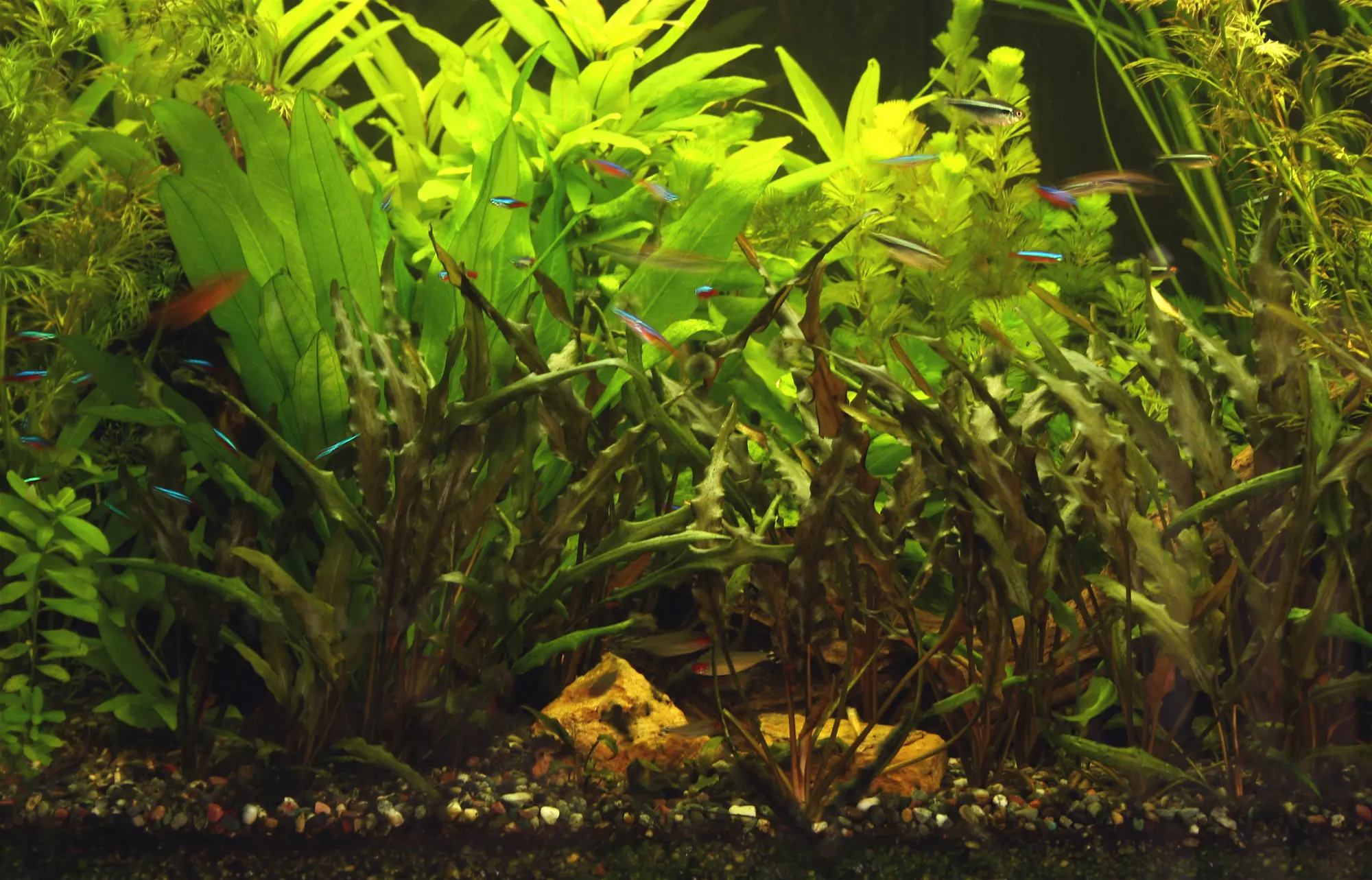
- Identify whether the same individual starts and receives each chase.
- Confirm that every fish can cross the tank and feed.
- Check fins under neutral light for new splits or shortening.
- Observe after the room lights change, when displays may intensify.
- Measure water quality before treating group inactivity as a social issue.
Adding fish can spread attention, but it also raises waste and crowding. Make that change only when the aquarium has space and filtration for the adult group.
Why is 80 cm the useful tank benchmark?
FishBase gives a minimum aquarium length of 80 cm. The figure aligns with the fish's need for an open social zone plus enough distance for a display to end.
Length is more informative than litres because two aquariums of equal volume can offer very different horizontal routes. Tall narrow tanks store water but compress every interaction.
Open middle
Gives the group a shared feeding and display zone.
Broken side views
Plants or wood interrupt repeated pursuit without enclosing fish.
Quiet margins
Allow a subordinate fish to pause while still seeing the group.
Guarded flow
Circulates oxygen and waste without pinning long fins in a jet.
Covered top
Prevents a startled fish from leaving the aquarium.
The benchmark should rise when another midwater shoal shares the tank or hardscape occupies much of the route. Count usable space after setup, not empty-glass dimensions before it.
What water does an emperor tetra need?
FishBase compiles 23 to 27 °C, pH 5.0 to 8.0 and 5 to 19 dH. The pH and hardness spans are broad, which makes stability and acclimation more useful than chasing a narrow target.
Published emperor tetra water ranges
- Temperature23 to 27 °CSeparate aquarium thermometer away from the heater.
- pH5.0 to 8.0Calibrated meter or an aquarium test covering the source-water value.
- General hardness5 to 19 dHGH titration test in degrees of hardness.
Every range above applies to Nematobrycon palmeri in a freshwater system. Source: FishBase, checked 2026-09-13.
A broad species record does not mean one fish can move from pH 5 to pH 8 quickly. The relevant starting point is the water in which the actual batch has been held.
Compare bag and aquarium temperature, pH and conductivity when possible. Acclimate to the measured difference, then keep ammonia and nitrite at zero with steady maintenance.
The native Atrato and San Juan basin record is useful as geographic context, but it does not turn one collection site into a universal recipe. Captive-bred lines may have spent generations in water unlike a photographed Colombian stream.

What should emperor tetras eat?
FishBase records worms and crustaceans. In captivity, use a complete small staple and add appropriately sized frozen or live foods for variety.
The social layout affects nutrition. A subordinate fish may appear shy or sick when it is simply unable to cross one male's feeding area.
- Start with a complete small staple Use a particle each fish can swallow without breaking it apart.
- Release food in more than one place Spread access across the group instead of rewarding the fish that owns the center.
- Watch the last fish to feed Confirm that it swallows food before the quick fish return.
- Rotate suitable animal foods Add small crustacean or worm-based variety without replacing the balanced staple.
- Stop before accumulation Remove the cause of leftover food rather than relying on bottom fish to clear it.
Color enhancement is secondary to body condition, intact fins and regular feeding access. A bright dominant male does not prove that the rest of the group is receiving enough.
Which tank mates suit emperor tetras?
Choose peaceful fish that overlap in temperature and are neither large enough to swallow an emperor tetra nor slow enough to be overwhelmed by display and feeding. Similar small tetras, gentle rasboras and compatible bottom fish can use the aquarium differently.
Avoid persistent fin nippers around mature males' extensions. Large predators, aggressive cichlids and extremely boisterous feeders fail for more direct reasons.
Freshwater fish with useful comparison points
 Diamond tetra
Similar warm-water characin with its own male display, so the combined midwater load and sight lines need room.
 Ember tetra
Far smaller and less competitive at food, making it a weak scale match despite peaceful temperaments.
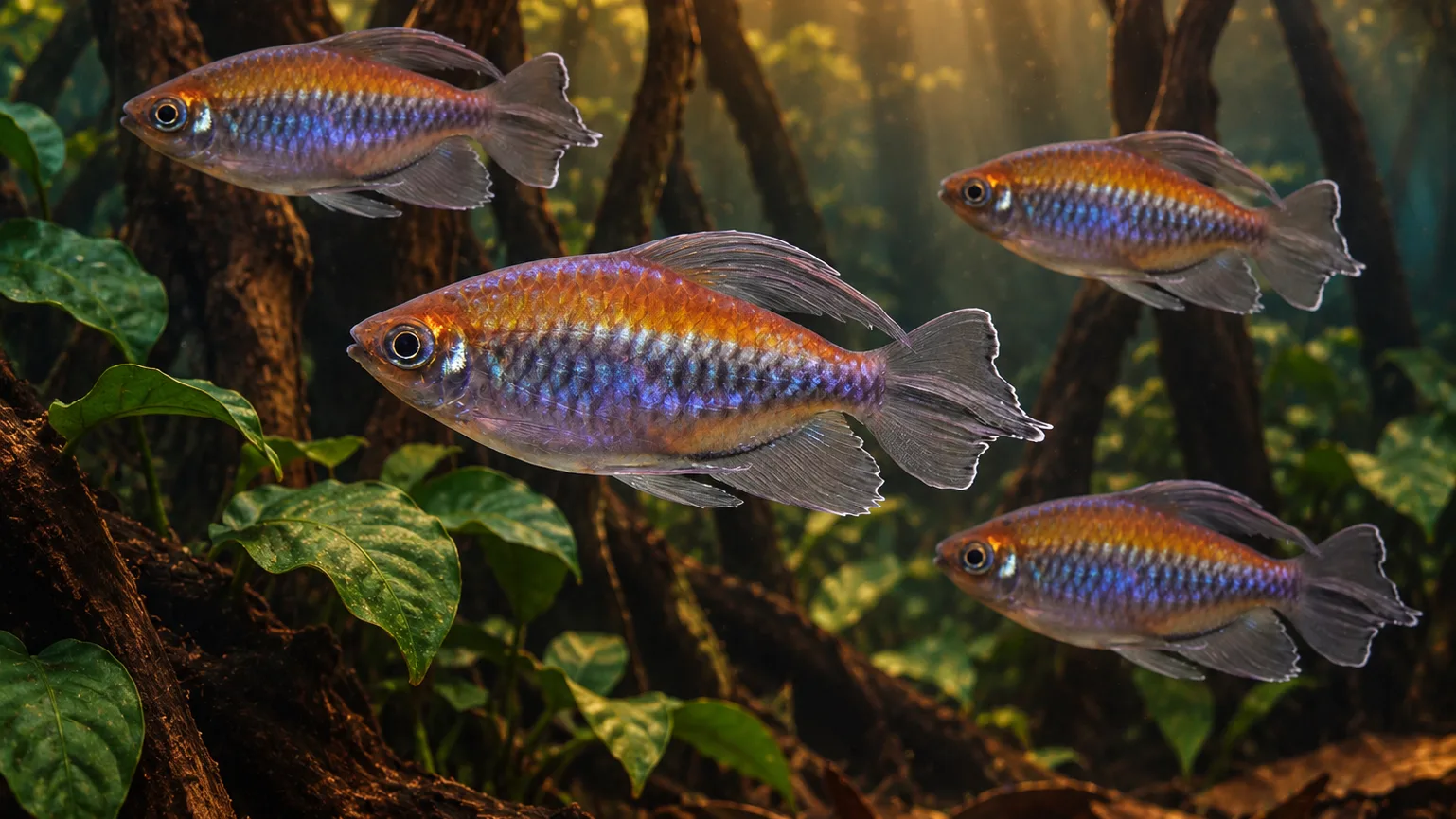 Congo tetra
Larger and faster, with long male fins that make crowding and fin contact a serious concern.
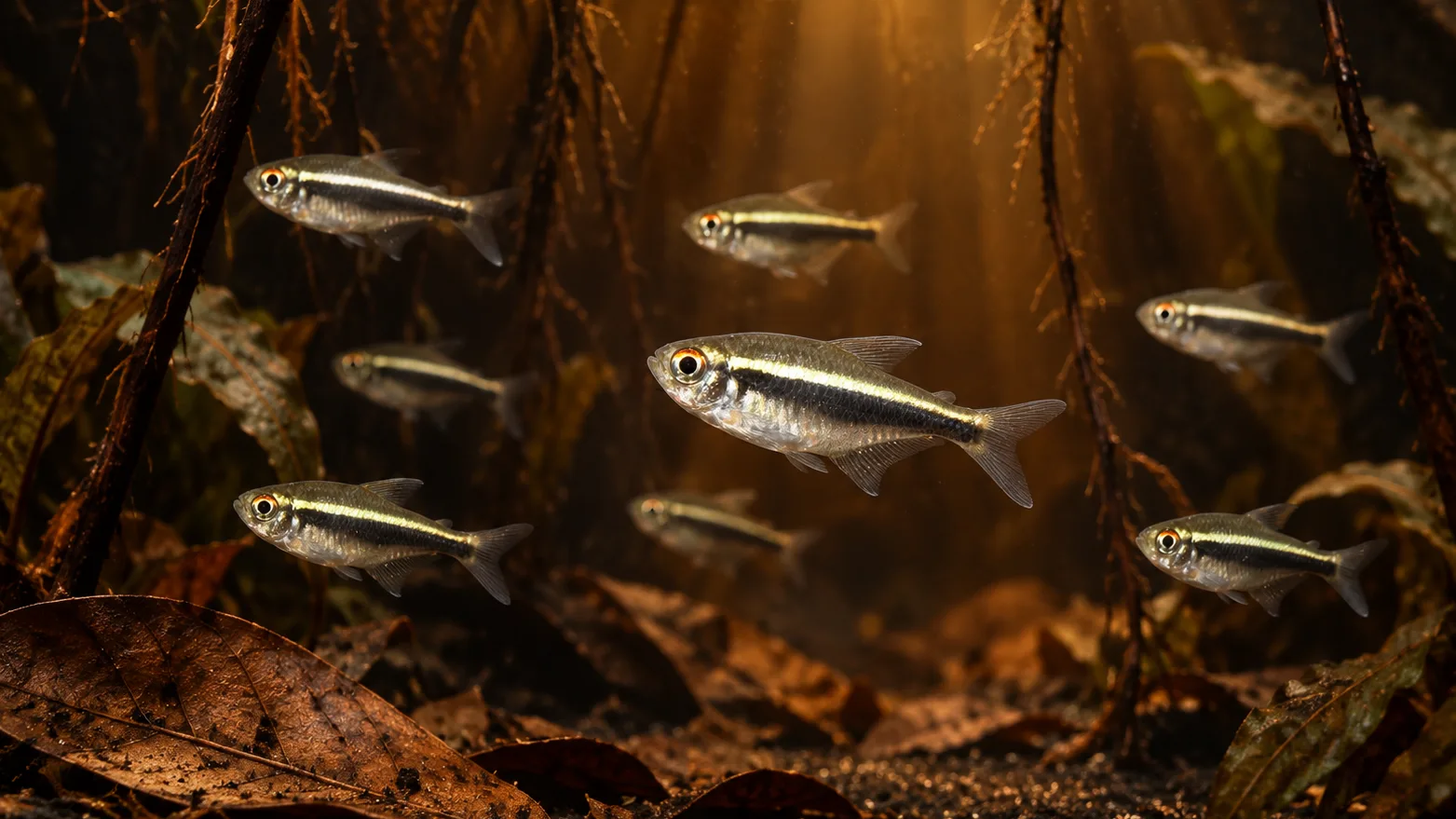 Black neon tetra
A more uniform shoaling pattern and comparable community intent, provided water and space overlap.
The right question is whether both species can complete their normal behavior in the same tank. A generic “peaceful” label does not allocate swimming space or food.
What causes hiding, clamped fins or persistent chasing?
Begin with shared environmental causes, then separate social pressure from individual illness. Changing chemistry and group composition together makes the result harder to read.
Check in this order
- Water quality Test ammonia and nitrite and verify temperature before interpreting behavior.
- Oxygen and flow Look for rapid breathing across the whole group or fish collecting near the outlet.
- Sight lines Note whether one male can see every other fish from a single central position.
- Group access Observe one full meal and confirm that no fish is excluded.
- External disturbance Rule out sudden light changes, tapping and repeated movement at the glass.
- Health Escalate sores, swelling, balance loss, continued weight loss or abnormal breathing in clean water.
If one fish is being injured, separation may be necessary while the layout and group are reviewed. Medication is not a substitute for removing a persistent aggressor or correcting toxic water.
Introduce a new group with the lights reduced and several sight breaks already in place. Rearranging the entire tank after conflict begins adds another stressor and may simply move one dominant position to the center.
Quarantine remains a complete aquarium job, not a small empty box. Provide mature filtration, stable heat, a cover and simple visual shelter, then observe appetite, breathing, waste and fins before the fish joins the display group.
No strong institutional lifespan figure appears in the reviewed records. Plan for several years of group care and for the possibility that aging losses will eventually leave too few fish for normal social life.
What does Data Deficient status mean?
FishBase records the emperor tetra as Data Deficient from a 2014 IUCN assessment. This does not mean safe, threatened or unassessed; it means the available information did not support a confident extinction-risk category.
The same record lists commercial aquarium use and no CITES evaluation. A buyer should still ask whether the fish are captive-bred and retain the supplier name with the receipt.
Is an emperor tetra right for your tank?
It fits a mature aquarium at least 80 cm long with a social group, open swimming water and broken sight lines. It rewards a keeper who enjoys watching display behavior and can distinguish a brief chase from sustained exclusion.
It does not fit a tiny tank, a predator community or a setup where every midwater fish must compete at one feeding point. The male's appearance is the attraction, but the group's access to space and food is the real care decision.
Which tetras make useful comparison points?
Colombian tetra
A robust medium tetra whose feeding pace and fin-nipping risk change an otherwise similar community plan.
Cardinal tetra
A small blackwater shoaler whose soft-water context and quiet group behaviour narrow the comparison.
Bloodfin tetra
A small, active school that changes the temperature, swimming-speed and feeding-access questions.
Cherry barb
A small planted-stream barb that contrasts sex-linked colour, social structure and habitat cover.
Chili rasbora
A minute blackwater group fish whose mouth size, water and refuge needs set a much smaller scale.
Celestial pearl danio
A tiny planted-tank danio with cooler documented habitat water and a different style of group behaviour.