
What Is a Glowlight Tetra, and What Does Its School Need?
Hemigrammus erythrozonus
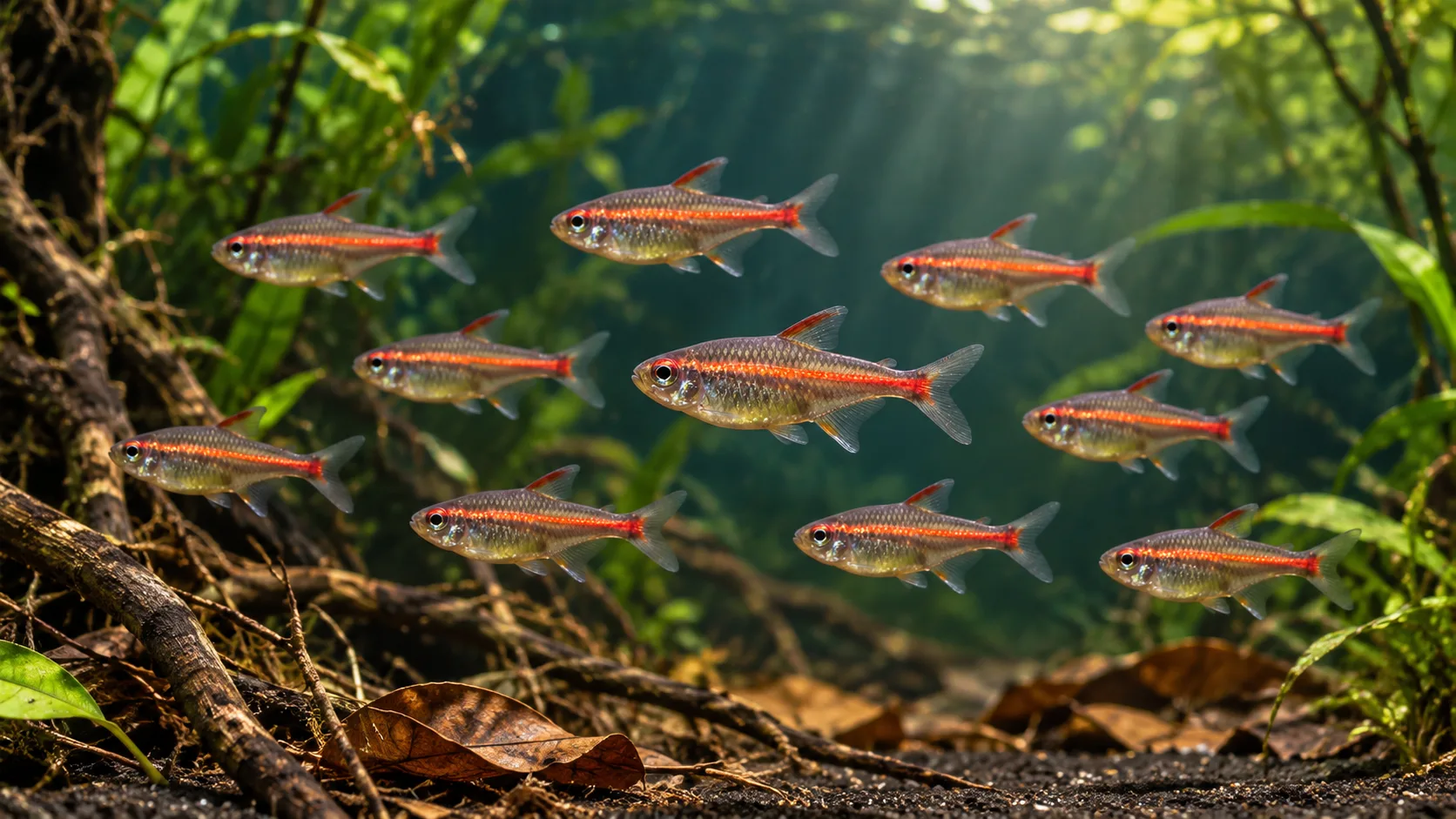
The glowlight tetra is a small, peaceful South American schooling fish identified by a warm orange-red line running from the eye toward the tail. Its 3 to 4 cm body is easy to fit into a tank, but a healthy group still needs a mature aquarium at least 60 cm long, stable warm water, planted cover, open midwater, and food distributed where every fish can reach it.
At a glance

- Adult size
- 4 cm
- Minimum footprint
- 60 x 30 cm or larger
- Minimum volume
- 54 litres
- Social structure
- Peaceful midwater shoal; FishBase documents at least five, while eight to ten is the practical starting group when the aquarium can support it.
- Minimum group
- 5
- Diet
- Omnivore
- Feeding
- Use a complete fine flake or micro-pellet with appropriately sized worm, crustacean, and insect foods for variety; divide the ration across more than one position and verify that every fish eats.
- Waste load
- low individually; moderate for a complete school
- Family
- Acestrorhamphidae
- Native range
- Essequibo River basin, Guyana
- Also sold as
- Fire neon, Glo-lite tetra. Trade and hobby names, not accepted species names.
- Conservation status
- Least Concern, assessed 12 November 2020 Source
A 60 x 30 x 30 cm aquarium is roughly 54 litres gross. The 60 cm swimming length and usable midwater footprint matter more than volume alone for a full school.
What is a glowlight tetra?
A glowlight tetra is Hemigrammus erythrozonus, a small freshwater characin native to the Essequibo River basin in Guyana. The current Catalog of Fishes record accepts that name and places it in Acestrorhamphidae, subfamily Pristellinae.
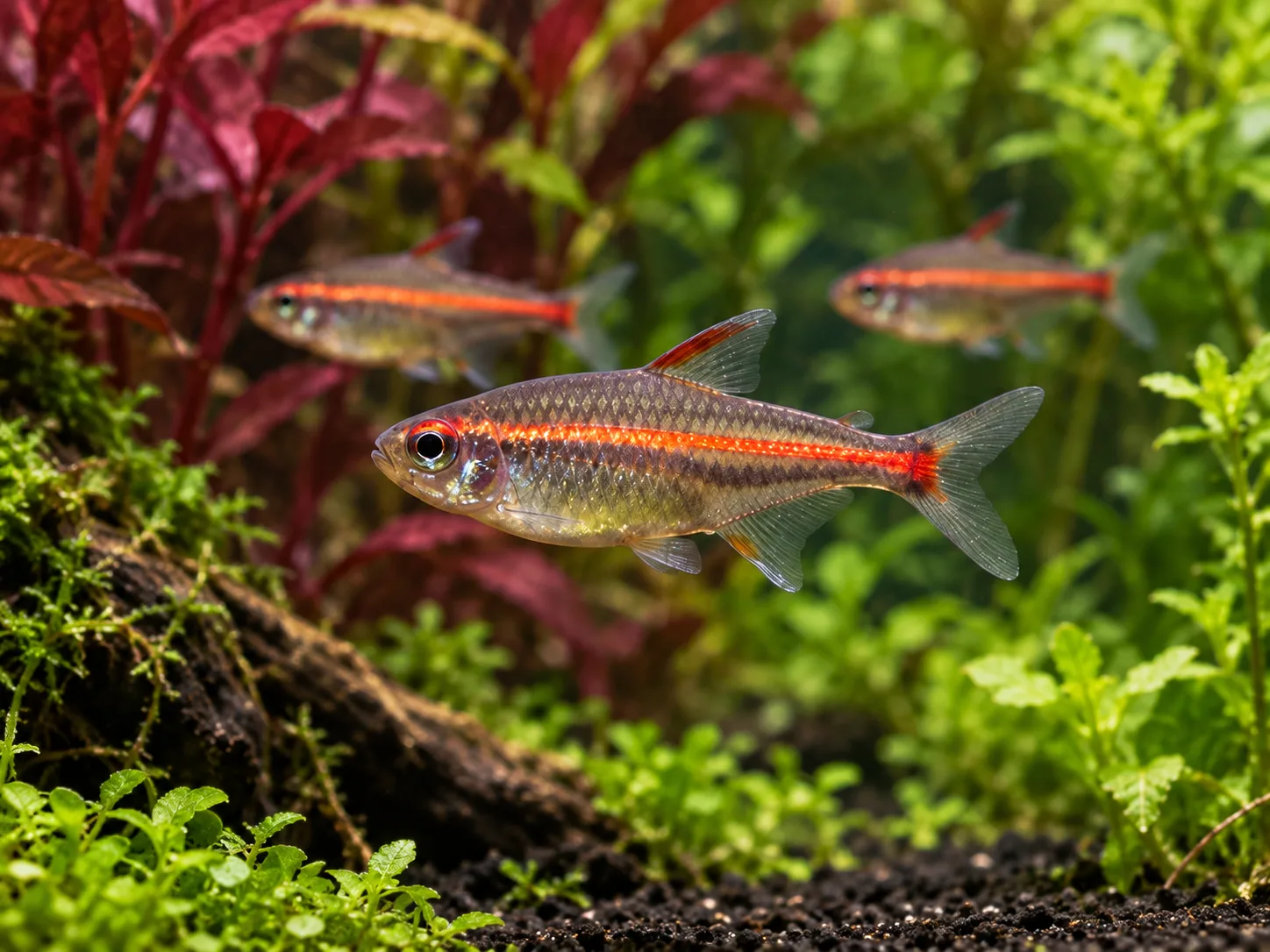
Its common name comes from the cherry-red to orange stripe that extends from the head along the side and into the middle of the tail. The body is otherwise translucent silver, so the stripe catches subdued aquarium light without the artificial fluorescent colours associated with GloFish.
- Accepted identity
- Hemigrammus erythrozonus Durbin, 1909
- Family
- Acestrorhamphidae
- Verified native range
- Essequibo River basin, Guyana
- Published adult size
- 3.3 cm total length, with 4 cm also reported
- Social structure
- Midwater shoal of at least five; more is better
- Published aquarium length
- At least 60 cm
- Published water range
- 24 to 28 °C, pH 6.0 to 8.0, 5 to 12 dH
- Recorded diet
- Worms, small crustaceans, and plant material
- Conservation
- Least Concern, assessed 12 November 2020
The US Fish and Wildlife Service assessment records the same basin and quotes the original colour description: no true humeral spot, a cherry-red stripe in life, and dusky markings below it. Those details help separate the ordinary glowlight tetra from a neon tetra or black neon tetra, whose bright lines and body markings follow different patterns.
A photograph can support a likely hobby identification, but it cannot confirm every scale count or specimen history. Keep the seller's scientific name and origin claim exactly as supplied if the fish will be bred, traded, or recorded as a known lineage.
How big do glowlight tetras get?
FishBase lists a maximum of 3.3 cm total length and notes another report of 4 cm. That small adult size lowers individual waste and turning demands, yet it does not remove the need to house a complete school.
FishBase also records a minimum aquarium length of 60 cm. A 60 by 30 cm footprint, roughly 54 litres before substrate and equipment at common proportions, is a practical starting point for a group of eight to ten when stocking stays restrained.
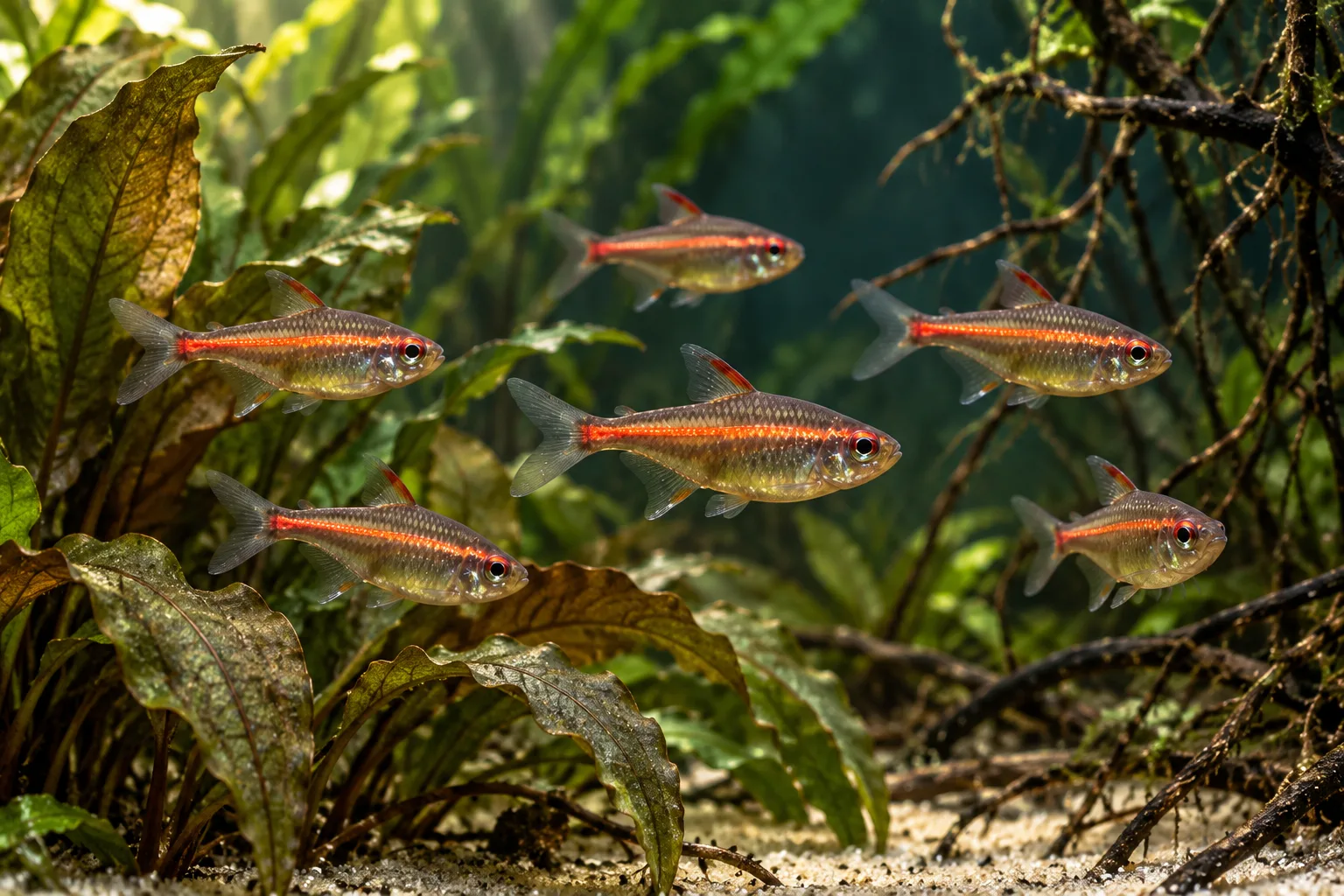
Litres cannot describe swimming length by themselves. A short cube may hold the same water but compress the school into repeated tight turns, while a central wall of wood can divide a nominally long tank into two cramped pockets.
Use the dedicated glowlight tetra tank size decision when planning a larger mixed community or a group above ten. Cover the aquarium with a fitted aquarium lid because a startled tetra can clear an open edge.
- Keep at least 60 cm of horizontal length for the first full group.
- Preserve an open route through the middle water.
- Place dense plants, fine roots, and leaf litter mainly at the back and ends.
- Cover filter cutouts and cable gaps without blocking gas exchange.
- Count the footprint occupied by wood, stones, filter sponges, and plant masses.
- Leave enough front access to remove settled food and debris.
The aquarium must fit the school, not one 4 cm fish. Add tank mates only after the complete glowlight group, its swimming lane, and the filter's biological capacity are accounted for.
How many glowlight tetras should live together?
FishBase and the OATA tetra care sheet both set five as a minimum group, and OATA states that more is better. In a suitable 60 cm or longer aquarium, eight to ten gives the fish more social choice and makes one individual less likely to carry all the pressure.
A school does not move as one rigid unit all day. Fish may spread through cover when calm, close ranks after a disturbance, or surge briefly toward food before separating again.
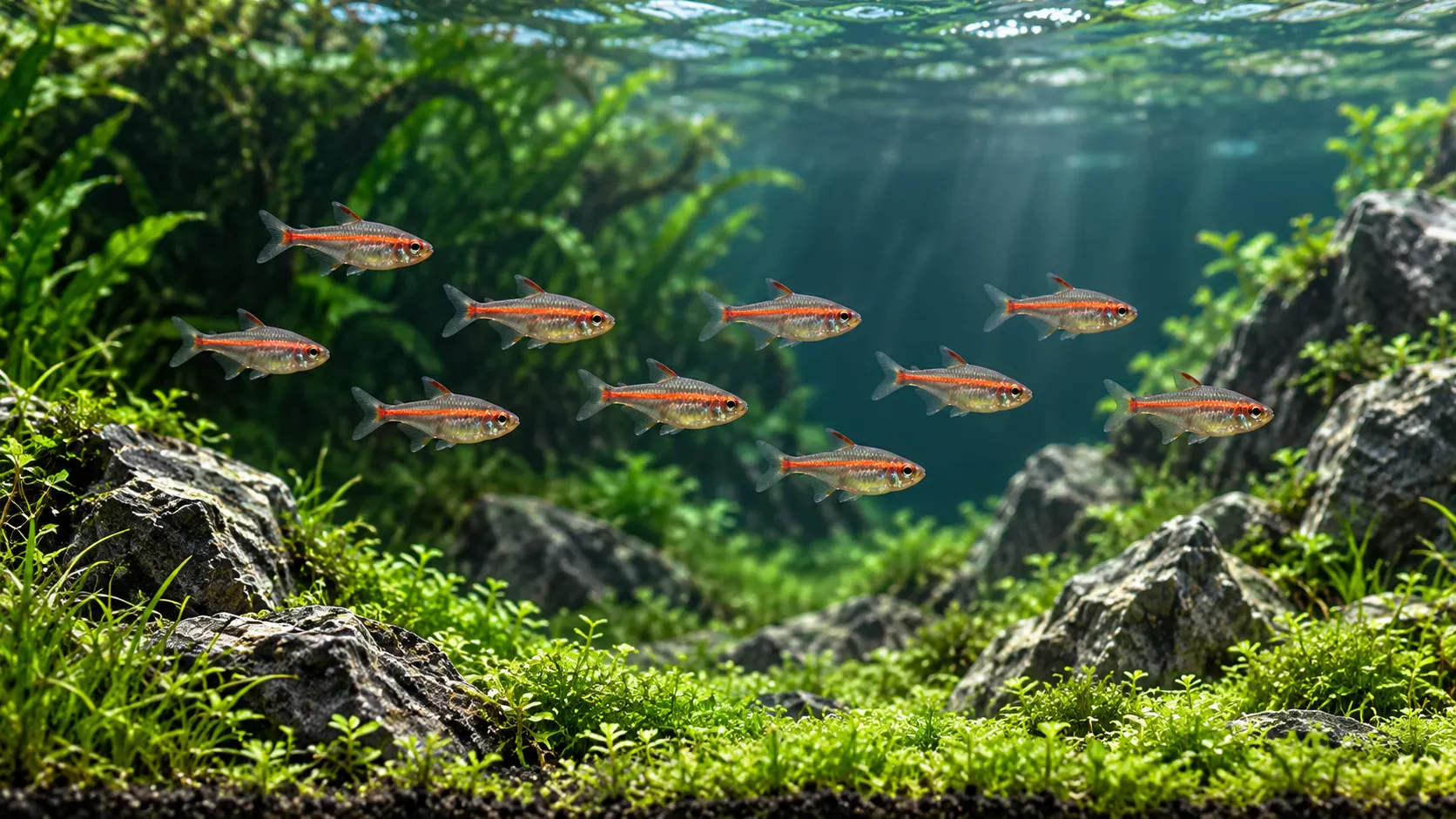
Glowlight tetras also perform a distinctive fin-flicking display. A controlled behaviour study found that fish increased fin flicking after detecting a chemical alarm cue and that nearby glowlight tetras responded with antipredator behaviour.
That finding does not make every fin movement an emergency. Look for the whole outcome: a normal group resumes feeding and open swimming, while chronic stress leaves the same fish isolated, pale, clamped, breathless, or unable to reach food.
Do not add more fish automatically when the group looks nervous. First confirm that the aquarium is mature, the existing school fits, and no predator-shaped or aggressive tank mate is keeping it compressed.
What water conditions suit glowlight tetras?
FishBase publishes 24 to 28 °C, pH 6.0 to 8.0, and 5 to 12 dH for aquarium keeping. These are broad compiled limits rather than instructions to move a settled aquarium toward the midpoint.
Published glowlight tetra water context
- Temperature24 to 28 °CSeparate aquarium thermometer away from the heater and filter return.
- pH6.0 to 8.0 pHCalibrated meter or a liquid test spanning the source-water value.
- General hardness5 to 12 dHDrop-count GH titration test reported in degrees of hardness.
Every range above applies to Hemigrammus erythrozonus compiled aquarium range in a freshwater system. Source: FishBase, checked 2026-09-15.
Measure the supplier's water and the receiving aquarium before moving a new group. A fish acclimated to one stable edge of the range may be harmed by a sudden correction that looks better on paper.
OATA recommends zero measurable ammonia and nitrite for tetras, with regular testing and a mature filter. Complete a fishless cycle before adding the school rather than asking small fish to absorb the cost of an immature aquarium.
<aside class="callout callout-warning" data-kna="callout"> <p class="callout-title">Stable warm water still needs oxygen</p> <p>Warmer water holds less dissolved oxygen. Keep gentle movement across the surface, verify actual filter flow, and investigate several fish breathing rapidly at once as a shared water or oxygen problem.</p> </aside>
The full glowlight tetra water parameters decision should account for source water, measurement method, acclimation history, and any tank mate that narrows the overlap. Never change pH or hardness rapidly just to match a single published number.
What tank setup brings out natural behaviour?
Glowlight tetras look most settled when they can choose between shaded cover and an open midwater route. Dark substrate, fine roots, leaf litter, and plants around the margins reduce glare, while a clear centre keeps the school visible and usable.
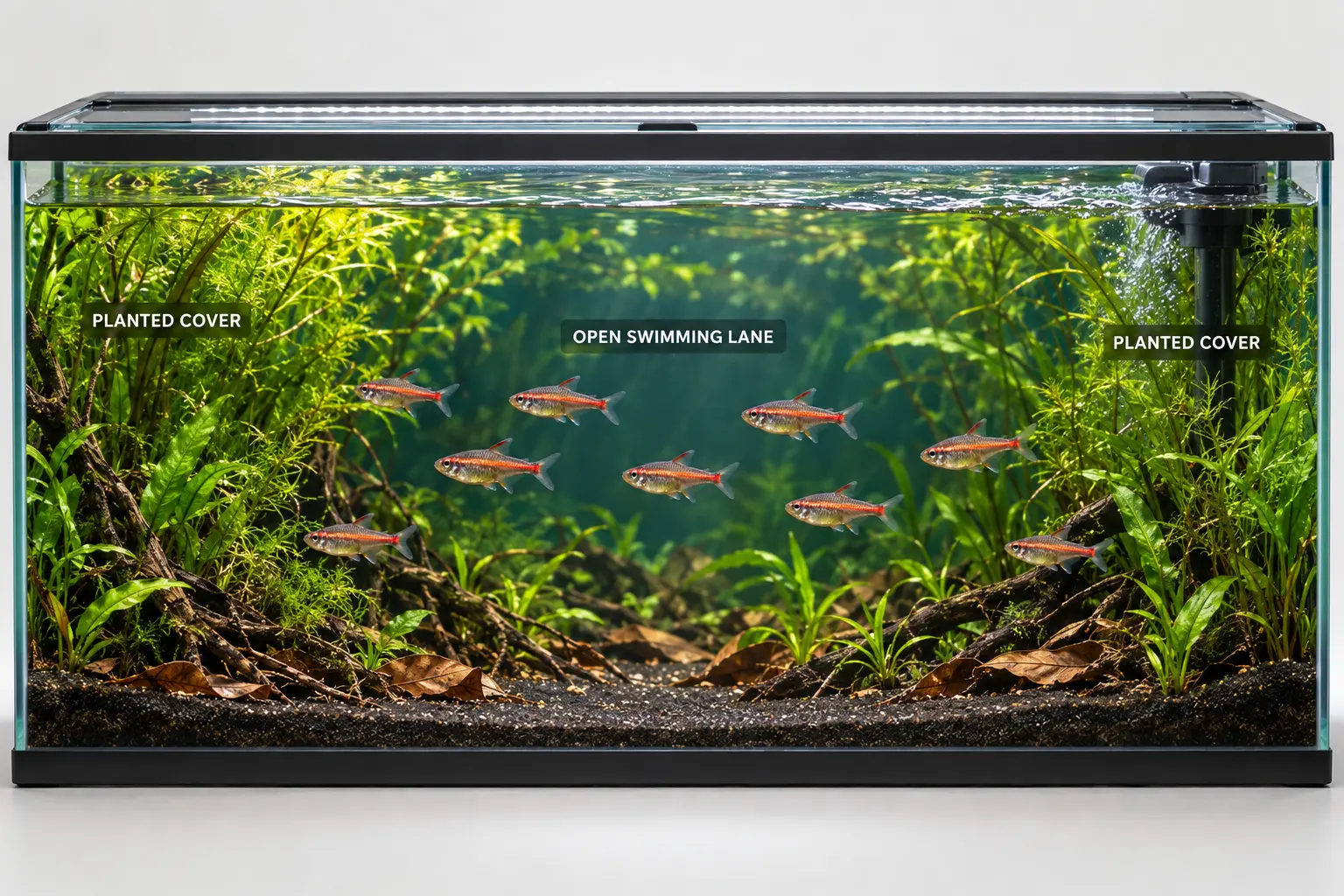
Open middle water
A continuous horizontal lane lets the school travel, spread, and regroup.
Shaded margins
Tall plants, roots, or floating cover give nervous fish somewhere to pause without leaving the group.
Gentle surface movement
A visible ripple supports gas exchange without turning the whole aquarium into fast current.
Dark lower ground
Fine dark sand and restrained leaf litter reduce glare and make settled waste easier to locate.
Mature filtration
Stable biological filtration processes the waste from the full school and every tank mate.
Predictable light
A timer prevents abrupt day length changes, while room light before the aquarium lamp softens the transition.
Avoid placing the tank beside a door that slams, a speaker, or a window that drives daily temperature swings. A calm location does more for normal schooling than adding decoration to an aquarium that is repeatedly startled.
The common glowlight tetra care mistakes are connected: a tiny group, exposed tank, abrupt chemistry change, immature filter, and one concentrated feeding point can all produce the same withdrawn appearance. Correct the confirmed cause instead of changing several variables together.
What do glowlight tetras eat?
FishBase records worms, small crustaceans, and plant material in the diet. In captivity, use a complete fine flake or micro-pellet as the staple, with safe frozen or live foods such as daphnia, Artemia, or small insect larvae for variety.
The particle must suit a small mouth. Crush oversized flakes before they enter the water and reject hard pieces that fish repeatedly take and spit out.
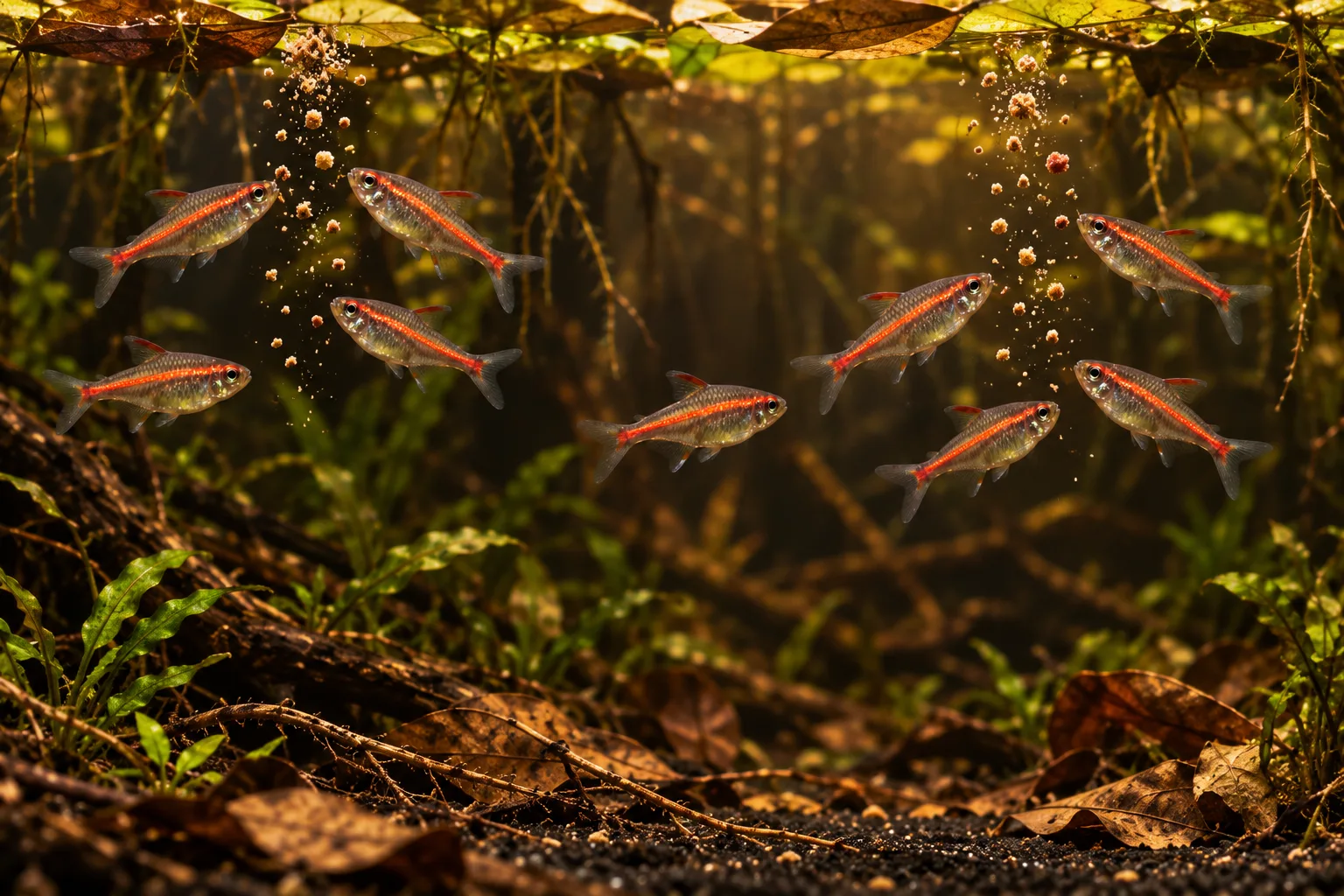
- Choose a fine staple Offer a complete food that can be swallowed promptly without repeated spitting.
- Divide the portion Release a small amount at two separated points rather than making one dense cloud.
- Watch the quiet fish Confirm that fish near cover take food before the boldest fish clear both areas.
- Stop while food is found quickly End the meal before particles settle into leaves or filter corners.
- Check the weekly trend Increase food only when body condition, waste, nitrate, and filter flow support the change.
A swollen abdomen after every meal points toward oversized portions or too much food at once, while a fish that remains thin despite reaching food needs closer observation. The narrower glowlight tetra diet question includes food form, ration checks, and feeding competition.
Which tankmates work with glowlight tetras?
The best tank mates are peaceful, too large to swallow, comfortable within the same stable temperature and chemistry, and unlikely to dominate the middle-water feeding zone. A name on a compatibility list cannot override the actual group sizes and footprint.
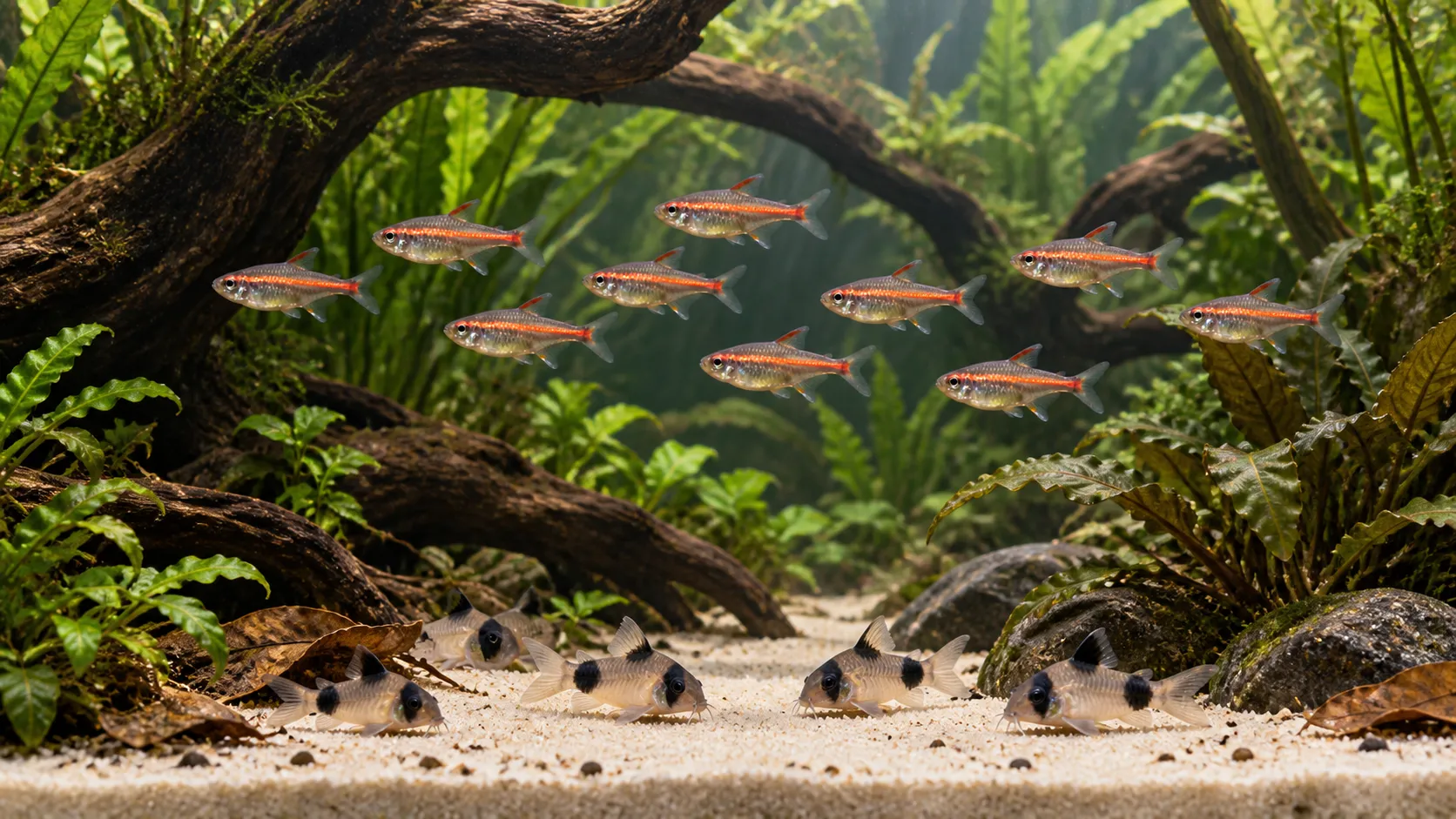
A small ember tetra group can share similar warm planted conditions, but it needs its own complete school and adds another midwater feeder. Cardinal tetras overlap in some softer warm-water systems, while panda corydoras use the lower zone only where the temperature overlap and sand area remain suitable.
| Decision | Better match | Poor match |
|---|---|---|
| Adult size | Cannot swallow a 3 to 4 cm tetra | Predatory mouth or large territorial fish |
| Temperament | Calm and able to disengage | Persistent chasing or ambush pressure |
| Temperature | Stable overlap within both species' ranges | One species held at an extreme |
| Feeding | Can eat at a separate position or level | Depends on food after the tetras finish |
| Space use | Full groups retain open routes and cover | Several schools forced into one narrow lane |
| Water quality | Filter and oxygen margin remain strong | Stocking leaves no capacity for a missed maintenance day |
Which similar community fish should you compare?
A similar body size does not guarantee the same behaviour, group structure, or tank footprint. Compare the complete adult group and its swimming zone before combining two shoals.
Black skirt tetra
A deeper-bodied, more forceful tetra whose group behaviour and fin interactions need separate assessment.
Bleeding heart tetra
A larger tetra that needs more room than its shop size suggests.
Bloodfin tetra
An active school with a different temperature question and strong open-water use.
Brilliant rasbora
Another streamlined schooling fish whose adult footprint and water overlap must be checked independently.
Celestial pearl danio
A much smaller fish with different cover, feeding, and social needs.
Cherry barb
A looser-moving group fish whose sex balance and planted cover shape the community decision.
Chili rasbora
A far smaller fish that needs tiny food and a calm community rather than simply sharing a warm temperature.
Emperor tetra
A tetra with more pronounced display behaviour, so sight lines and individual space matter.
A betta fish pairing depends on the individual betta, available escape routes, feeding access, and a ready separation plan. A giant danio is a poor size and pace match for this compact school despite sharing the danio and tetra aisles in many shops.
Long-finned or very slow fish may remain withdrawn around a quick feeding school even without obvious biting. Shrimp adults may coexist in dense planting, but shrimplets can be eaten, so a mixed display is not a breeding-safe colony.
Use the complete glowlight tetra tank mate assessment for a specific combination. Quarantine new fish in a separate mature setup, and follow a safe quarantine tank setup before equipment or water is shared with the display.
When does behaviour signal a problem?
Healthy glowlight tetras hold a level posture, respond quickly to food, and move between open water and cover without one fish being excluded. Colour may look softer after lights come on or during a brief disturbance, then recover as the group settles.
Check the shared aquarium first
- Temperature and oxygen Verify the thermometer, surface movement, filter return, and any recent warm spell.
- Ammonia and nitrite Test both after new stocking, filter cleaning, a power interruption, or group-wide rapid breathing.
- Recent water change Compare temperature, conditioner use, source-water chemistry, and anything that contacted the bucket or hose.
- Social access Watch whether one fish can leave a chase, reach both feeding points, and rest near the group.
- External contamination Review sprays, soaps, metals, untreated water, medications, and tools shared with another aquarium.
Several fish gasping, rolling, or losing balance at once requires immediate water and oxygen checks. Increase safe surface movement, verify toxic nitrogen, and make a temperature-matched conditioned water change when contaminated or toxic water is confirmed.
One fish hiding may reflect injury, exclusion, or illness. Move beyond general observation when sores, swelling, wasting, abnormal swimming, continuing respiratory distress, or rapid losses appear.
Do not clean all filter media, change chemistry, rearrange the tank, and medicate on the same day unless an emergency requires a specific action. Multiple simultaneous changes can add stress and hide the original cause.
How long do glowlight tetras live?
The strongest sources used here do not establish a dependable species-specific lifespan range. Popular figures of two to four years circulate widely, but the accessible claims do not provide enough underlying evidence for a firm promise.
Plan for multi-year care regardless. Stable warm water, full group size, consistent feeding access, low chronic stress, and a mature filter all matter more than treating one age as an expiry date.
<aside class="callout callout-note" data-kna="callout"> <p class="callout-title">Record the age you can actually know</p> <p>Keep the purchase date, supplier, approximate size, losses, and major aquarium changes with the group. The dedicated glowlight tetra lifespan record can be updated when stronger age evidence becomes available.</p> </aside>
A fish bought as an adult may already have an unknown history, so time in your aquarium is not the same as total age. Judge older fish by body condition, feeding, breathing, swimming, and social access rather than the calendar alone.
Can glowlight tetras breed in a community tank?
Glowlight tetras are egg-scattering fish without parental care. A peer-reviewed egg-envelope study found their fertilised eggs were spherical, transparent, adhesive, and settled to the bottom, which helps explain why eggs and newly hatched young are easily lost or eaten in a community aquarium.
<aside class="callout callout-note" data-kna="callout"> <p class="callout-title">Visible spawning does not guarantee surviving fry</p> <p>Adults and tank mates may consume eggs, while filters can trap eggs or fry. A controlled breeding aquarium needs separate planning for parent removal, egg protection, water conditions, and first foods.</p> </aside>
The complete glowlight tetra breeding decision belongs in a separate setup because breeding water and egg care should not be copied into the main display without context. Never move surplus fish, eggs, plants, or aquarium water into natural waterways.
Are glowlight tetras endangered?
FishBase displays the species as Least Concern, assessed on 12 November 2020, and lists CITES as Not Evaluated. Least Concern does not guarantee that every local population is secure or that every sale has a traceable origin.
The US Fish and Wildlife Service found no reported established introductions outside the native range in its 2018 assessment, but rated certainty about invasion risk as low because evidence was limited. Later occurrence aggregators should still be interpreted carefully because a record may represent trade, a preserved specimen, or an introduced observation rather than a native population.
A glowlight tetra group is a good fit when you can provide a mature covered aquarium at least 60 cm long, eight or more companions of its own kind, warm stable water, shaded cover, open midwater, and fine food at more than one position. The decisive test is whether every fish can swim, feed, and recover from a disturbance without persistent exclusion.