
How to Build a Biotope Aquarium From Habitat Data
A biotope aquarium represents a defined habitat and a biotope-inspired aquarium uses that evidence without claiming exact reconstruction. Start with a named place and habitat unit, then let water, substrate, structure and compatible native species shape the design.

What is a biotope aquarium?
A biotope aquarium represents a particular natural habitat through its layout, water conditions and suitable resident species. Its starting point is a documented place and habitat, rather than a mix chosen only for appearance.
It identifies a locality or reach, season where relevant, and a habitat unit such as a quiet leaf-litter margin, rocky run, flooded forest edge or sandy channel.
That precision prevents an attractive collection of "Amazon" materials from being described as one real community. Use biotope carefully and call the result biotope-inspired when evidence or livestock availability requires interpretation.
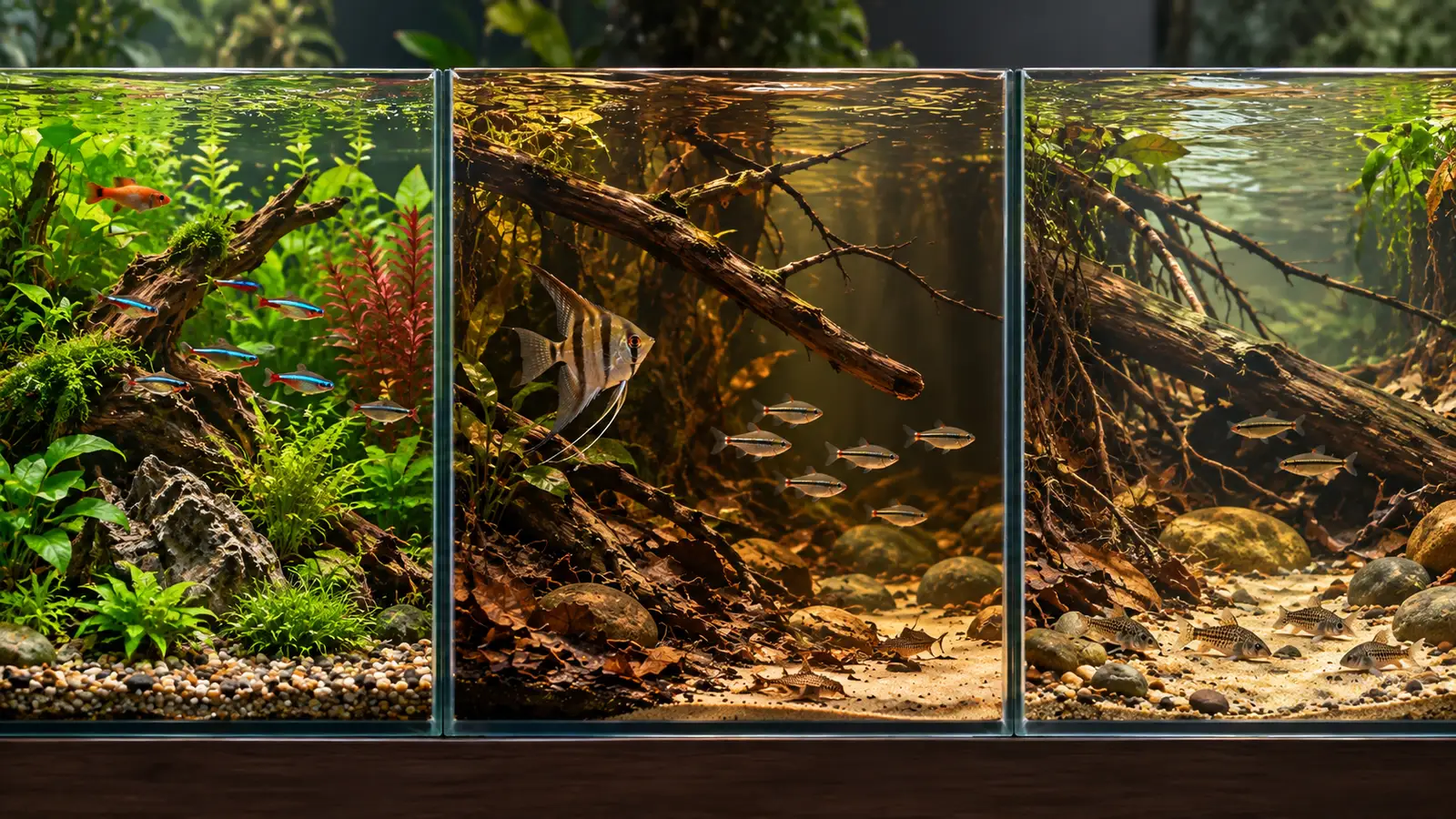
How narrow should the habitat be?
The useful scale is a habitat you can both document and maintain safely in the available tank.
A river basin may contain fast tributaries, muddy floodplain pools, clear headwaters and seasonally disconnected margins, so basin-level species lists can combine animals that never share one tank-sized patch.
A habitat unit gives practical boundaries: current, depth, bottom material, cover, light and seasonal change. Fisheries and Oceans Canada treats fish habitat as the places supporting life processes, a useful reminder that water and structure matter as much as a pin on a map.
Where can you find reliable evidence?
You can begin with government habitat surveys, museum collections, peer-reviewed field studies and biodiversity records. GBIF occurrence records can show where an organism was reported, but coordinates may be generalized, old, misidentified or collected from a broader area than the exact microhabitat.
Check accepted names, record dates, coordinate uncertainty and sampling methods, including any GBIF data-quality flags. One occurrence record proves neither permanent residence nor compatibility with every species recorded nearby.
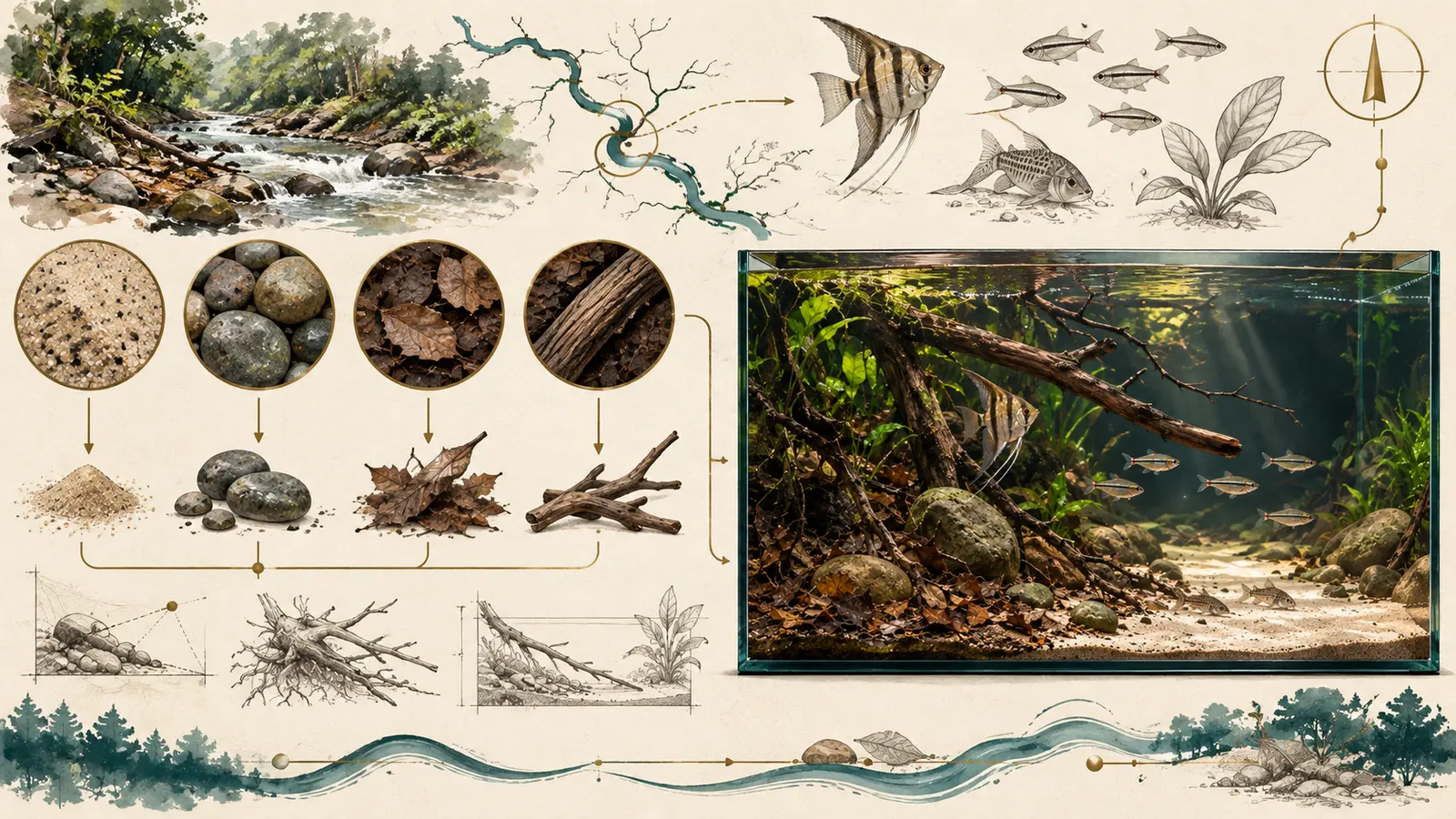
- Name the locality and habitat unit in one sentence.
- Record season, flow, depth and water measurements with their dates.
- Verify each species name and the precision of its occurrence record.
- List substrate, wood, rock, leaf litter and vegetation actually documented there.
- Separate observed facts from choices made for aquarium safety.
- Exclude species whose adult size, group or water needs exceed the system.
How do you turn habitat data into a layout?
Substrate and structural support determine what can safely sit above them.
Match substrate grain and stability first, place structural wood or stone to create the documented flow and refuge, then decide whether plants belong submerged, emergent or absent.
A photograph of a whole river cannot be copied into a glass box at the same scale. A tank-sized portion can preserve the relationship between open swimming space, bank cover, bottom refuge and current.
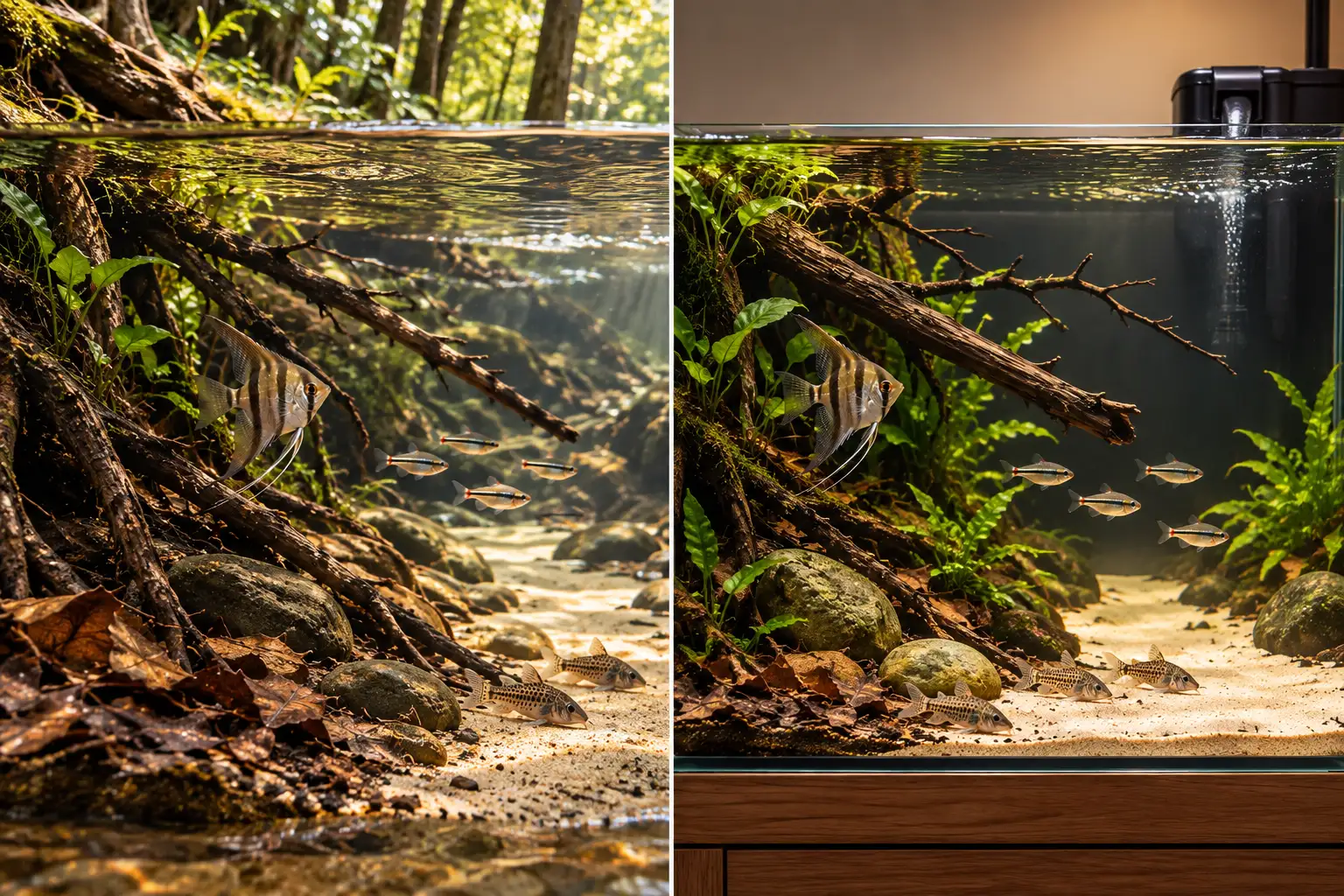
Must every material come from the wild locality?
No. Collecting substrate, wood, plants or animals may be illegal, environmentally harmful or unsafe, and untreated wild material can introduce pollutants, parasites and unwanted organisms.
You can use clean commercial substitutes that reproduce the material's function and appearance. Record that substitution honestly; authenticity does not require removing habitat from the place being represented.
How should you choose fish and plants?
You should start with species documented in the selected habitat unit, then apply aquarium welfare filters. Verify adult size, group size, temperature, water chemistry, current, diet and predation before treating geographic overlap as compatibility.
A smaller honest community is stronger than a crowded checklist. If one documented species needs a much larger footprint, describe the aquarium as representing its habitat without including that animal.
How exact should water chemistry be?
Field measurements are snapshots shaped by season, rainfall, time of day and method.
Keep source values with their context and choose conditions supported by the animals' long-term husbandry needs and acclimation history. Survival at a field reading does not make it a suitable aquarium target, and authenticity never warrants an abrupt correction.
Temperature, pH, hardness and conductivity measurements describe different parts of the habitat. Their usefulness depends on the test method and uncertainty, so a field reading cannot be treated as an exact aquarium target.
How do you keep the aquarium recognizable over time?
Leaf litter decomposes, wood shifts, plants alter flow and fish redistribute fine substrate. Photograph the same angles, record water and maintenance, and replace materials gradually so the system remains biologically stable.
Prune or remove growth when it erases the defining habitat zones, not simply when the layout loses symmetry. The create-depth guide, sloped substrate guide and prevent substrate flattening can help preserve form without changing the habitat claim.
How do season and disturbance change a habitat?
Many aquatic habitats expand, contract, clear or darken through the year.
A fish recorded on a flooded margin during high water may retreat to a channel later, and leaf input, temperature, conductivity and current can change at the same locality.
Choose the season your aquarium represents and keep that claim visible in your notes. You do not need to imitate a dangerous drought or sudden chemistry swing; reproduce the useful structural cues while keeping captive conditions stable.
Human alteration also matters. A field photograph may show silt, concrete or invasive plants that are present but do not describe the historical habitat.
An old species record may predate a dam or pollution event. You should date every source and distinguish current observation from restoration reference.
How do you resolve conflicting records?
First check whether the sources refer to the same taxon, coordinate precision, season and sampling gear.
A seine survey in a shallow margin and an electrofishing survey in the main channel can find different communities without either record being false.
Prefer the source that describes methods and habitat at the scale you are building. When uncertainty remains, narrow the public claim: "inspired by a sandy tributary margin in the basin" is more accurate than naming an exact creek that no source describes.
| Evidence | Supports | Does not prove |
|---|---|---|
| Georeferenced specimen | Species reported near a place | Exact microhabitat or permanent residence |
| Field water measurement | Condition at that time and method | A stable year-round aquarium target |
| Habitat photograph | Visible structure and water state | Full species community outside the frame |
| Survey report | Sampled animals and stated method | Absence of every unsampled species |
| Husbandry source | Captive welfare needs | Natural co-occurrence |
How can flow be recreated without exhausting fish?
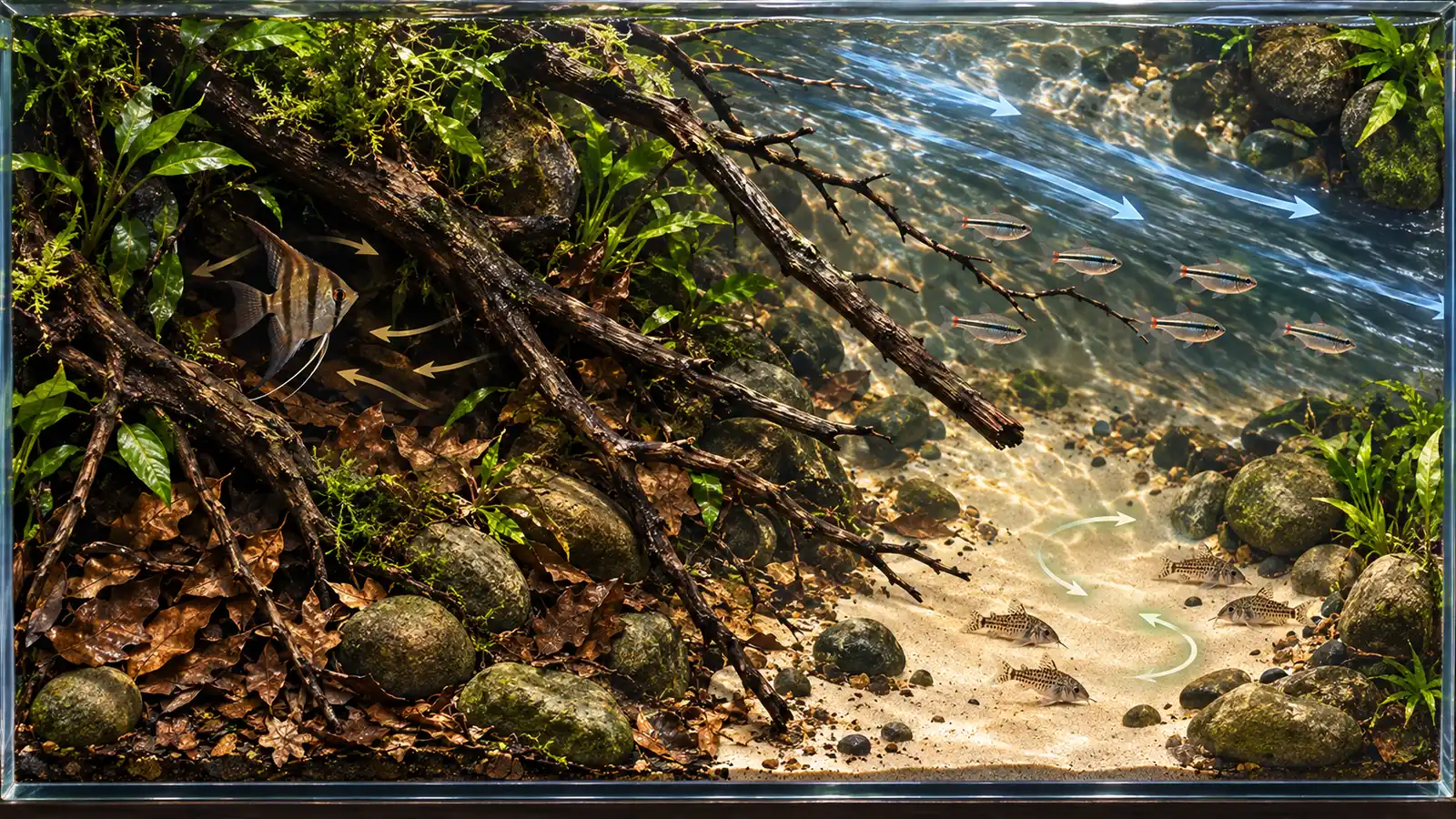
Use outlet direction, hardscape and open cross-section to create a faster route and sheltered pockets rather than pushing the entire tank at one speed. Confirm the fish can hold position, feed and rest without being pinned against the intake.
Place fine sediment where the designed flow will not keep it airborne. If the real habitat carries suspended sediment, visual authenticity still does not justify chronic gill irritation or a filter that cannot maintain safe water.
Observe lightweight particles during tank setup before animals arrive. They reveal short circuits, dead pockets and places where leaf litter will collect, letting you adjust structure without repeatedly disturbing livestock.
How do you document substitutions honestly?
You should keep a simple table with documented feature, aquarium substitute and reason. Aquarium-suitable leaves of known origin may represent unavailable litter, verified inert sand may replace contaminated sediment, and captive-bred fish can reduce reliance on wild collection.
- Exact evidence
- Locality, date, method and measured value
- Interpretation
- How several records were combined
- Substitution
- Material or species changed for legality or safety
- Exclusion
- Documented element omitted for welfare or tank size
- Uncertainty
- Claim that available sources cannot resolve
This record keeps the design coherent during maintenance and stops later additions from slowly turning a defined habitat into a general community tank. It also lets another aquarist understand which details are observed and which are responsible compromises.
How can you plan the aquarium before buying materials?
Draw the tank footprint and divide it into documented habitat zones.
Mark the filter intake, outlet, heater, maintenance route and the adult swimming area before placing a single stone; filtration equipment hidden after hardscape is built can create a dead pocket that the reference photograph never showed.
Create a material schedule with maximum quantities rather than buying an undirected pile. A small number of repeated stone types and one coherent wood form usually represent geology and flood action better than a display of unrelated hardscape pieces.
Dry-build heavy structure outside the aquarium or on a protected empty base. Test whether wood floats, whether stones can shift and whether the intended leaf layer blocks an intake; water and animals should not be the first load test.
- Write the locality, season and habitat unit in one precise sentence.
- Collect dated evidence for water, substrate, structure and resident species.
- Choose captive animals only after welfare and adult footprint checks.
- Draw flow, refuge, feeding and maintenance zones on the tank footprint.
- Select legal clean substitutes and record why each one was used.
- Run and measure the system without animals, then complete fishless cycling under the intended water conditions. Never use fish or other livestock to test whether the filter works.
- Stock only after ammonia processing is demonstrated and ammonia and nitrite are undetectable with appropriate tests. Follow species-specific quarantine and stocking plans, and pause additions if water quality or behaviour deteriorates.
What makes a biotope layout fail as an aquarium?
An accurate-looking leaf bed can trap food, a dense root wall can prevent cleaning, and tannin-dark water can hide declining fish. Keep access channels and observation points even when they are less dramatic than the reference scene.
The aquarium also fails when the label becomes more important than the residents. If a fish needs clearer water, more oxygen or a different group size than the chosen snapshot suggests, meet the animal's needs, verify compatibility and narrow the biotope claim.
Avoid using rare or sensitive species as decorative proof of authenticity. Captive-bred common animals with well-understood care can communicate a habitat more responsibly than a fragile wild import whose origin and collection impact are uncertain.
Sources
Fisheries and Oceans Canada on fish habitat GBIF occurrence-data quality requirements
Read next
Compare the biotope approach with a Dutch aquascape, Iwagumi aquascape or jungle aquascape before choosing the design boundary.