
How Many Schooling Fish Should You Keep Together?
Keep enough schooling fish for the species to express normal social behavior, but choose the number only after the adult group fits the aquarium. Six is a useful screening point for many small community fish, not a universal group size or a guarantee of good welfare.

Is six schooling fish enough?
Six is often quoted because it is easy to remember and better than keeping one or two social fish. There is no universal group size; treat six as a starting question: does this species settle at six, and can the tank support a larger adult group?
Saxby and colleagues compared four ornamental species in a 2010 study. Its behavioral analysis suggested better welfare in larger groups of neon tetras, white cloud mountain minnows and tiger barbs, but no clear group-size relationship for angelfish.
The results support species-specific decisions rather than a universal minimum. They do not establish that adding fish improves welfare when an aquarium lacks space or oxygen.
What is the difference between shoaling and schooling?
Shoaling fish choose to remain near one another, while schooling describes coordinated, polarized swimming in the same direction. The same fish may spread into a loose shoal while feeding and form a tight school after a disturbance.
That change is why a tight formation is not always proof that the fish are happy.
Persistent compression into one corner may point to a threatening tank mate, exposed layout, excessive current or repeated disturbance rather than an ideal group response.
How should species change the number you keep?
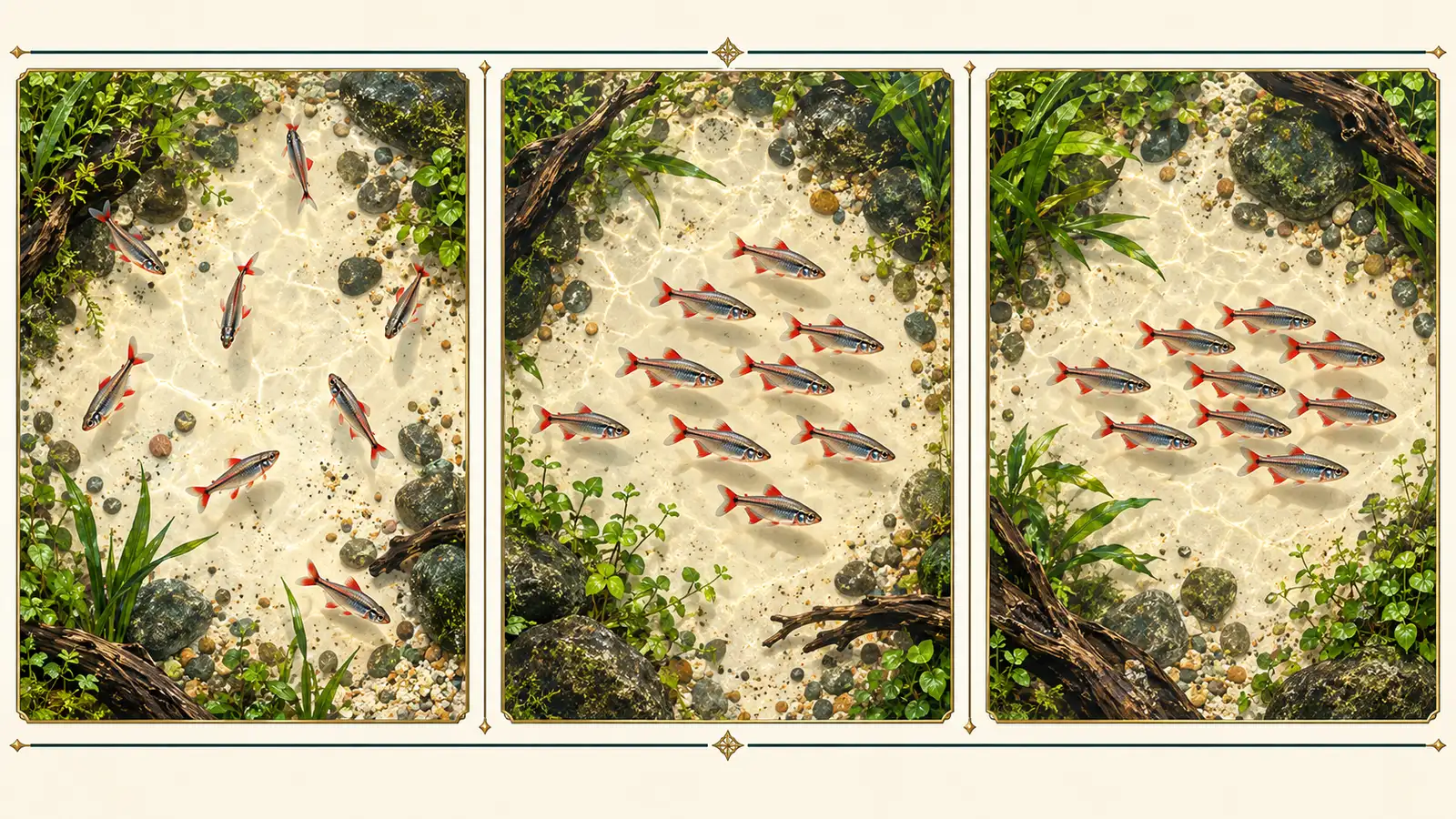
Small peaceful tetras and rasboras often benefit from adding more conspecifics once their adult footprint is secure. Fin-nipping or hierarchy-forming species may also direct more social attention toward their own group when numbers rise, but more fish cannot repair a cramped tank or an incompatible mix.
Research the exact animal rather than buying by the label "community fish." Compare its adult length, body depth, normal swimming zone, activity, aggression and whether sex ratio matters.
The cardinal tetra and black neon tetra profiles explain their species-specific group and space needs.
Does a larger group always need a larger tank?
Usually, because every added fish contributes waste and needs access to oxygen, food and usable space. The important measure is the adult group footprint, not the number of juvenile bodies that fit along the front glass on purchase day.
A longer tank often helps an active school more than a taller tank of similar volume.
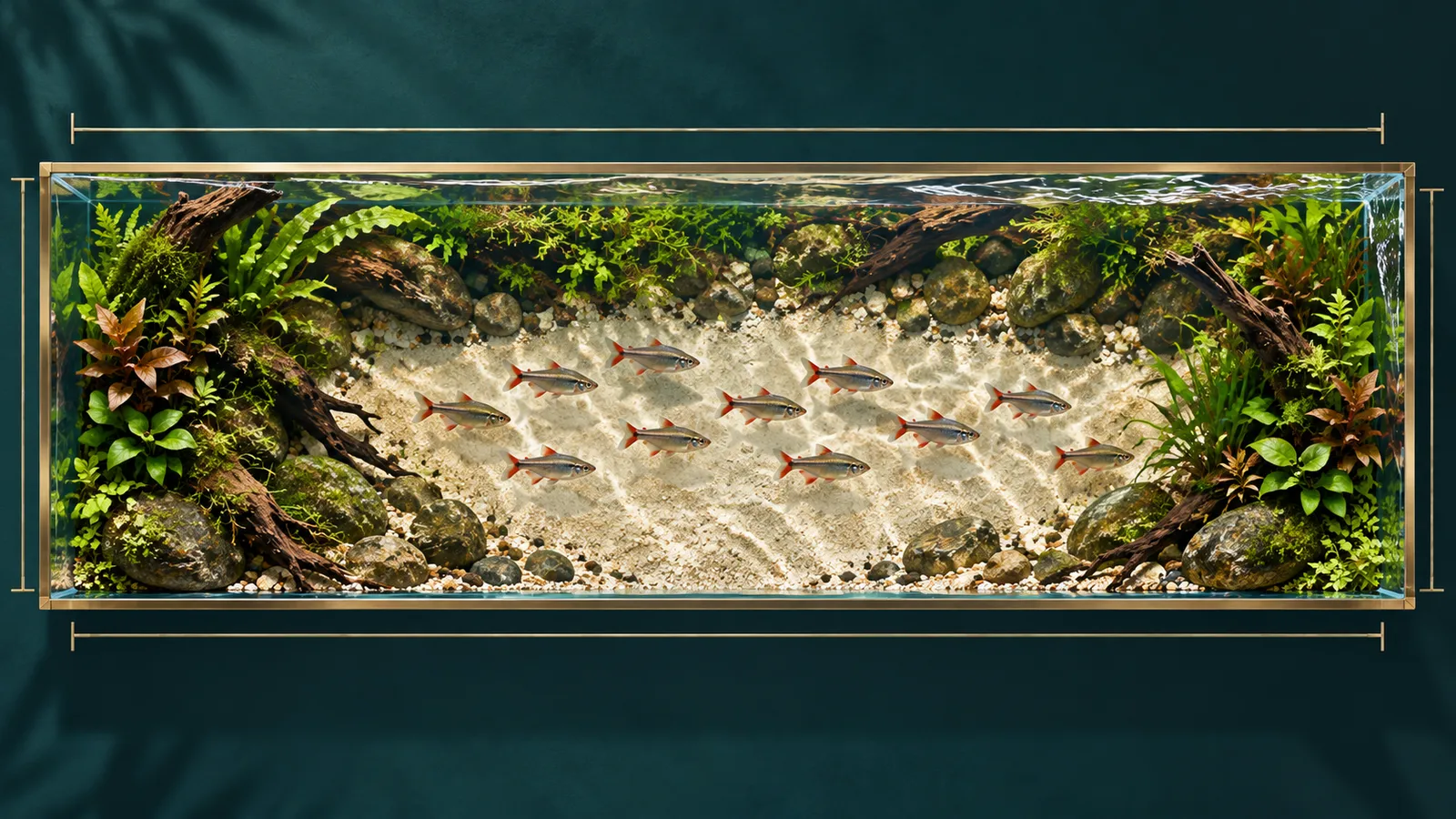
It provides a longer uninterrupted route, lets weaker fish change position and makes it easier to combine open water with planted or wooded refuge.
How do you balance several species in one aquarium?
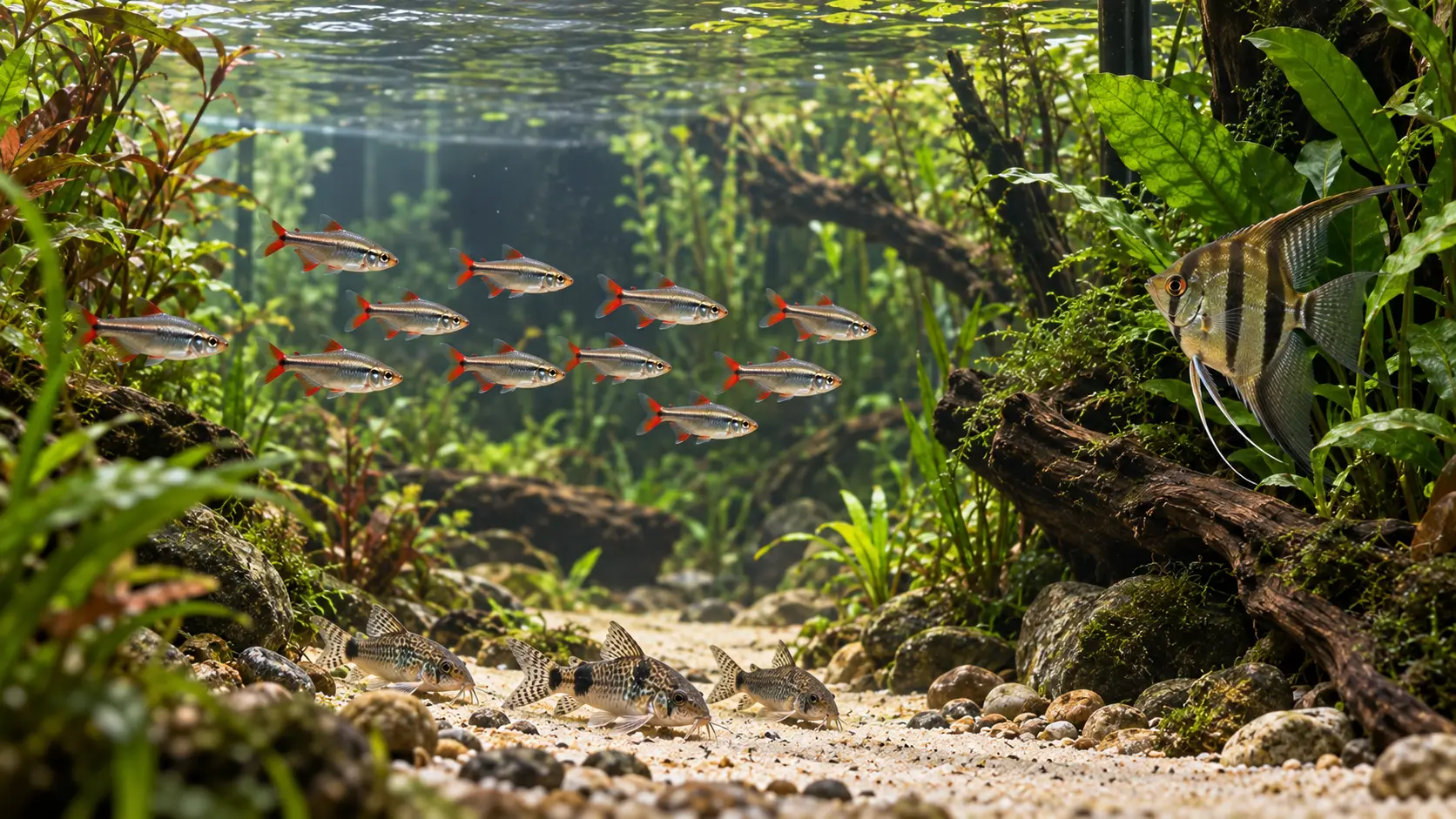
You can choose one visually and behaviorally dominant school first. Add bottom dwellers or a calm centerpiece only when their water, temperature, feeding and territorial needs overlap, using the full compatibility definition rather than color as the selection rule.
Three groups of five do not provide the same social opportunity as one group of fifteen.
Fewer species also makes it easier to notice weight loss, isolate a bully and deliver food to every swimming level.
| Decision factor | Stocking pattern | Likely consequence |
|---|---|---|
| One appropriately sized school | Stronger social choice and a clearer swimming route | Less species variety |
| Several minimum-sized groups | More colors and shapes | Greater competition and more social compromises |
| One very large school | Strong visual effect | Requires verified oxygen, filter and adult footprint capacity |
What signs suggest the group is too small?
You should look for persistent hiding, restless glass pacing, reluctance to cross open water, excessive attention from one dominant fish or a species that only emerges at feeding. These signs are nonspecific, so first test water, check temperature and review predators, glare, cover and current.
A fish that hides because ammonia is present does not need another five companions added to the same water. If the aquarium is stable and environmental causes are excluded, compare behavior after a careful increase rather than making several stocking changes together.
When should you stop adding fish?
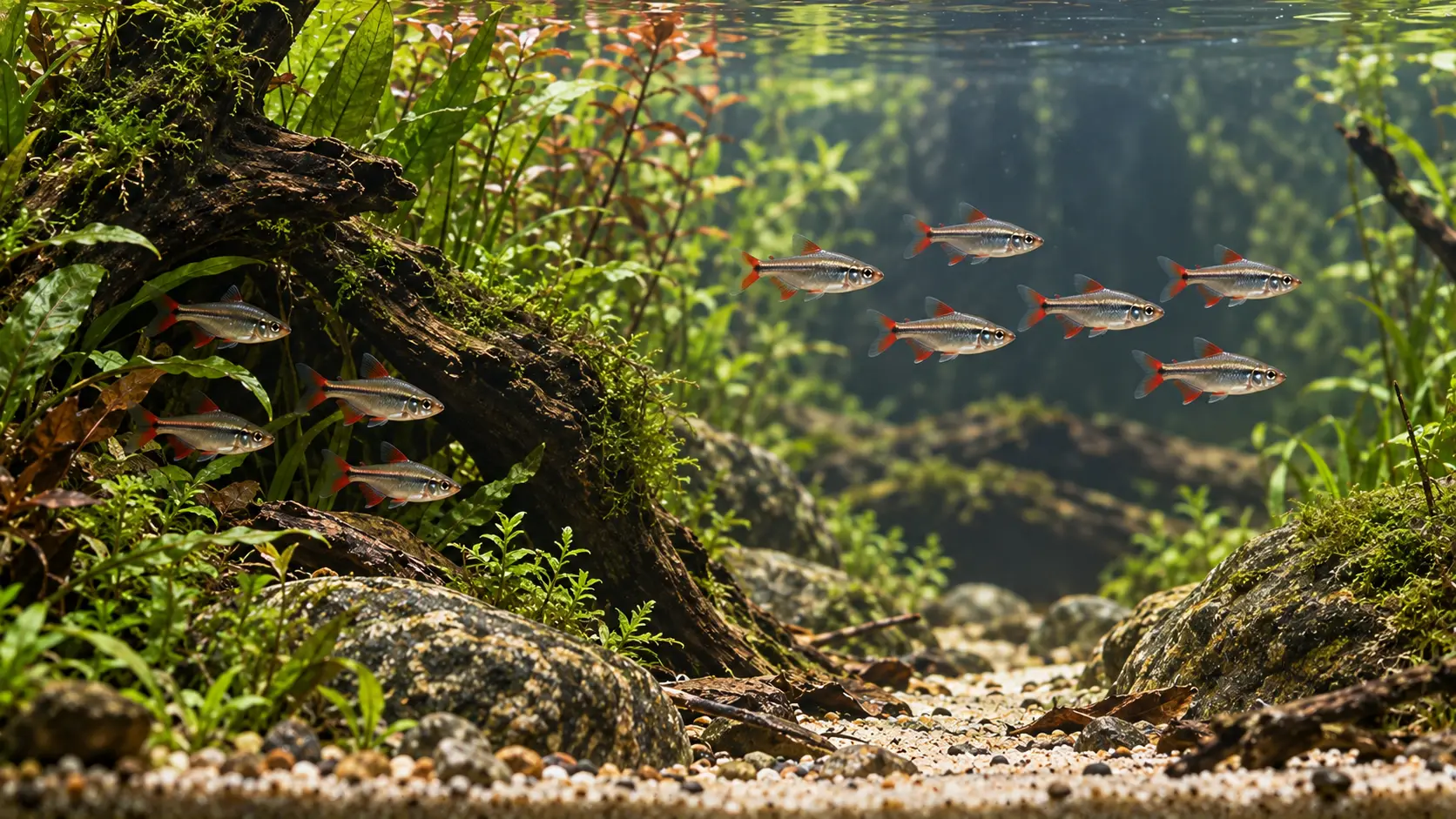
You should stop when the next addition would compromise adult swimming room, water quality, oxygen reserve, feeding access or quarantine capacity.
Stable nitrate does not prove that the social layout is spacious, and empty-looking upper water does not prove that filtration can accept more waste.
Quarantine additions before they join the established group, using a species-appropriate plan and separate equipment. Confirm that filtration and maintenance can support the intended adult load before buying more fish.
How do you build the group safely?
You should plan the final number before buying, quarantine compatible additions together when practical and avoid repeatedly adding single fish from uncertain sources. Match temperature and water context, dim harsh lighting during introduction and watch whether established fish exclude newcomers from food or refuge.
If the intended school cannot fit now, wait for the correct aquarium rather than treating an upgrade as guaranteed.
The most defensible number is the group you can house well at adult size today.
How do food, hierarchy and tank shape change the answer?
Group size determines how many social partners are available, but it does not guarantee equal access to food.
Feed across more than one point and watch the least assertive fish; a dominant cluster at the surface can leave smaller fish thin even when the total ration looks generous.
Tank shape changes encounters. In a short square aquarium, active fish turn frequently and cannot create distance from a persistent chaser, while a long footprint gives the group room to stretch, split briefly and regroup.
Dense planting can interrupt aggression, but an unbroken wall of plants can also remove the open lane that a midwater school needs.
Hierarchy deserves species-specific attention.
Some barbs and danios use repeated displays or short chases that remain within the group.
Relentless pursuit, torn fins, exclusion from food or a fish pinned behind equipment is a welfare problem. Increasing the group may spread attention only when the tank has spare capacity and the aggression is normal social behavior rather than incompatible sex ratio or territory.
How can you compare two possible group sizes?
Write down the adult body length, expected group number and normal swimming zone for both options. Then map the route each group would actually use after wood, plants, heater guards and filter intakes occupy space; nominal litres do not reveal that route.
| Question | Smaller group | Larger group |
|---|---|---|
| Social choice | Fewer partners and easier targeting | More partners if the species uses them |
| Swimming footprint | Less total body mass | Longer route and turning space usually needed |
| Waste and oxygen | Lower demand | Higher demand and less reserve during a failure |
| Feeding | Easier to count individuals | Needs wider distribution and closer observation |
| Quarantine | Smaller temporary system | More preparation and isolation capacity |
Run the comparison at adult size and at the warmest normal water temperature, when dissolved oxygen is less forgiving.
If the larger group only works while every filter, air line and maintenance routine performs perfectly, it has little safety margin.
What should change after the school is introduced?
For the first week, record appetite, spacing, respiration, hiding and any fish repeatedly separated from the group. Test ammonia and nitrite after the added load begins eating, and inspect the aquarium near lights-on as well as during the brighter, busier period.
Avoid redesigning the entire tank on the first evening. Transport and a new social order temporarily tighten a school; intervene promptly for water-quality problems or injury, but give harmless spacing behavior time to settle before interpreting it.
At the end of the observation period, ask whether fish choose open water, whether every individual feeds and whether resting fish can leave the current. Those outcomes are more informative than whether the group produces a perfect synchronized display for a few seconds.
Common group-size mistakes
- Buying the remembered minimum before checking the exact species.
- Counting juvenile size while planning an adult community.
- Adding several species in minimum groups because the tank looks empty.
- Treating tight schooling as automatic proof of comfort.
- Using filtration capacity as a substitute for swimming footprint.
- Adding fish to solve hiding before testing water and reviewing tank mates.
- Keeping one social fish because it survived alone at the store.
What if the current group is already too small?
Do not buy additions until you know why the group became undersized. If fish died, test water, inspect body condition and review disease or aggression and compatibility; adding newcomers before the cause is controlled exposes them to the same problem and can bring another pathogen into a weakened group.
When the remaining fish are healthy and the aquarium can support the intended adult number, find conspecifics of compatible size and quarantine them. A large size mismatch can change feeding access and predation risk even within a species, while one-at-a-time additions repeatedly reset hierarchy and quarantine exposure.
If the tank cannot hold a proper group, rehoming the remaining fish together or to an established compatible school may be kinder than preserving ownership of a token number. Check the recipient system, transport plan and acclimation rather than treating any advertised community tank as suitable.
How should a mixed community be observed after lights out?
Some daytime schooling fish settle close to plants, wood or the bottom after dark, while nocturnal tank mates begin feeding. Use a dim room light briefly to confirm that resting fish are not being displaced or hunted; avoid repeatedly startling the aquarium with a bright flashlight.
Check whether oxygenation and temperature remain stable near morning, especially in heavily planted tanks where photosynthesis has stopped overnight. A group that breathes rapidly only before lights-on may be revealing a system-capacity problem that daytime viewing misses.
Make any change from measured evidence. More surface movement, fewer animals or a different night-feeding strategy may solve the conflict, whereas increasing the school would add oxygen demand to the wrong problem.
Sources
Applied Animal Behaviour Science study on group size
Read next
Explore black skirt tetra tank size, bloodfin tetra tank size, brilliant rasbora tank size and aquarium filtration before fixing the final group.