
What Is African Water Fern, and How Should You Attach It?
Bolbitis heudelotii
African water fern is a slow-growing rhizome fern for wood and stone in flowing freshwater aquariums. Its central stem must stay exposed, while moderate light, clean movement and patient observation of new fronds matter more than repeatedly moving or dosing the plant.
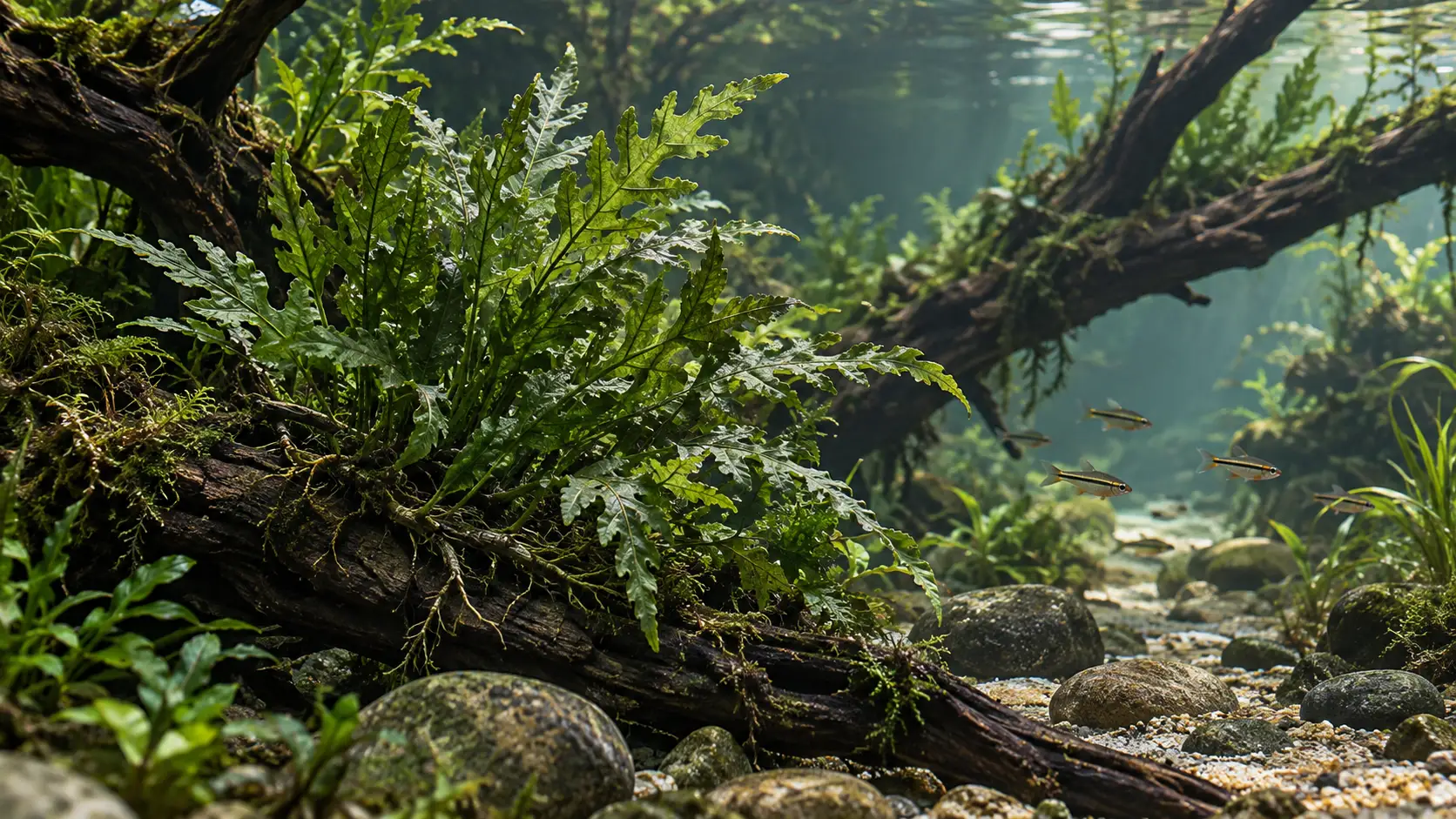
At a glance

- Light
- medium
- Injected CO2
- optional
- Substrate
- Do not bury the rhizome
- Nutrients
- Water-column nutrients supplied in measured balance
- Growth rate
- Slow
- Growth form
- Creeping aquatic rhizome fern
- Placement
- Attached to wood or stone in the middle or background
- Propagation
- Divide a healthy rhizome with leaves and roots on each section
- Family
- Dryopteridaceae
- Native range
- Tropical and southern Africa in perennial streams, waterfalls and seasonally flooded rock
- Grows emersed
- Yes. It can be grown above the waterline as well as submerged.
What is African water fern?
African water fern is Bolbitis heudelotii, an aquatic and stream-edge fern native to tropical and southern Africa. The Royal Botanic Gardens, Kew accepts that name, while a peer-reviewed botanical checklist describes it as a rheophyte associated with perennial streams, waterfalls and seasonally flooded rock.
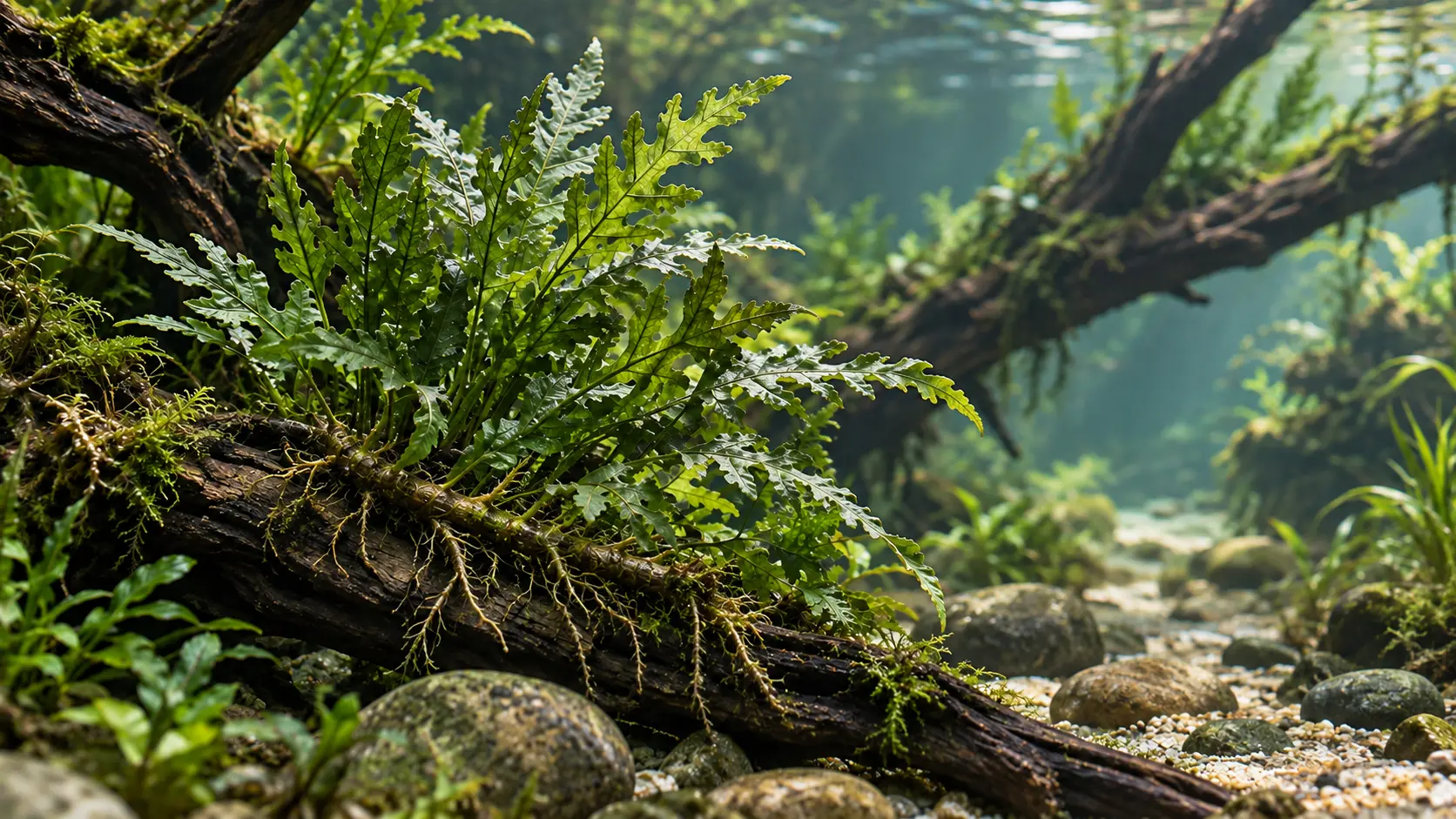
Its growth habit matters more than a decorative label. The fern belongs on wood or rock where water can pass its rhizome, not buried in substrate like a rooted stem plant.
- Accepted name
- Bolbitis heudelotii
- Growth form
- Creeping rhizome fern
- Best attachment
- Wood or stone with the rhizome exposed
- Natural clue
- Rheophytic growth around flowing water and rock
- Typical aquarium pace
- Slow, with establishment taking time
- Propagation
- Divide a healthy rhizome while keeping leaves and roots on each section
How do you recognize the rhizome?
The rhizome is the firm horizontal stem from which leaves and roots emerge. Fine roots may extend downward into cracks or substrate, but the rhizome itself should remain visible to circulating water.
This distinction prevents the most common planting error. Burying only the roots is harmless, while covering the rhizome can trap debris, reduce water movement and lead to softening or decay.
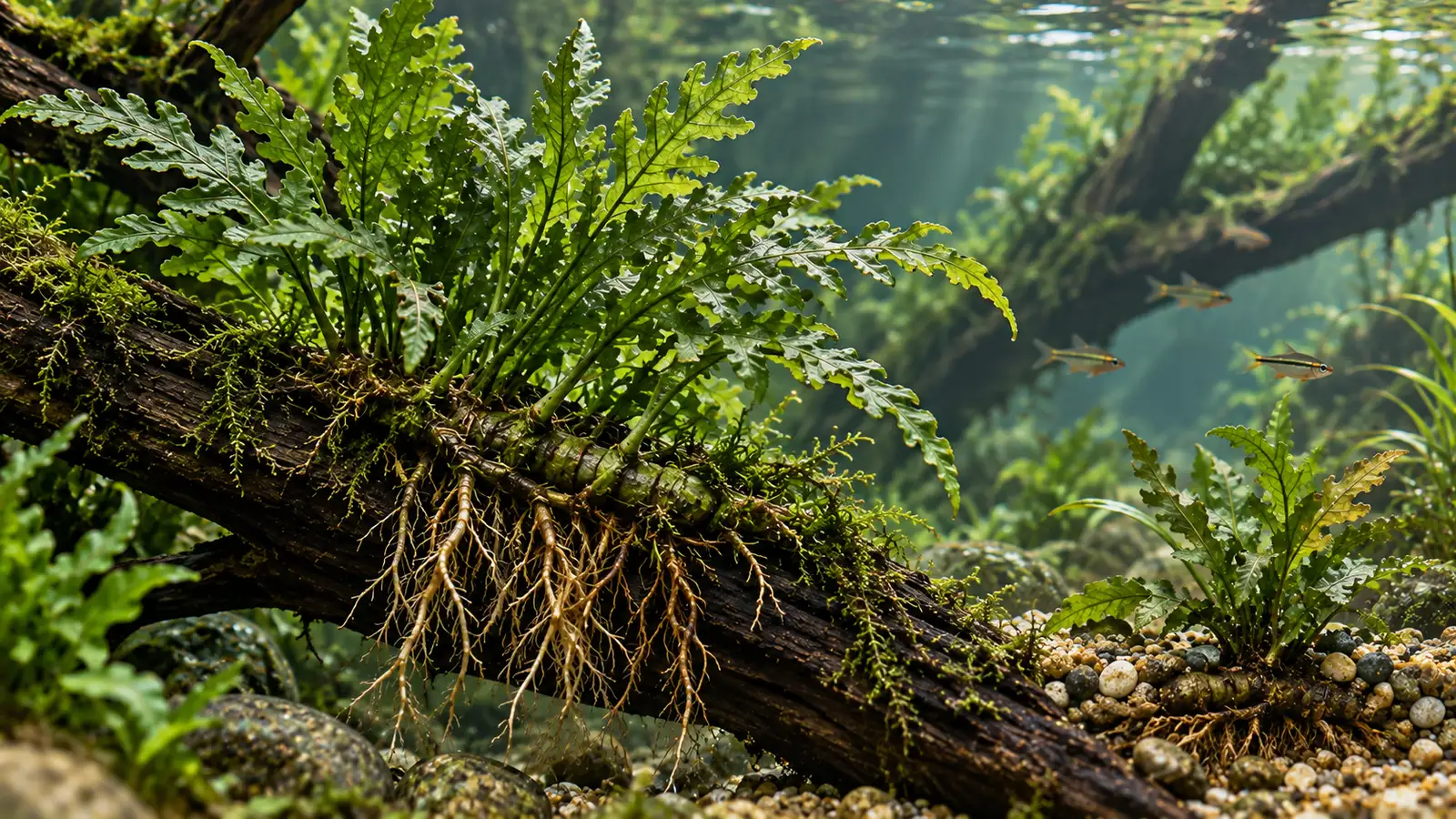
Dark dots or lines on mature leaf undersides may be spore-producing structures rather than pests. Compare several fronds and the plant's overall condition before removing a leaf solely because it carries regular markings.
How should you attach African water fern?
You should choose a shaded or moderately lit piece of wood or porous stone with space for the rhizome to extend. Set the plant against the surface and secure it with soft thread, a loose plant tie or a small amount of aquarium-safe adhesive applied away from active growth points.
- Rinse the plant in conditioned water and remove loose nursery material without scraping healthy roots.
- Identify the rhizome, roots and newest growth point before cutting or tying anything.
- Place the rhizome on wood or rock with roots touching a textured surface.
- Secure it lightly enough that water can pass around the stem and growth is not pinched.
- Position the hardscape, then verify that the plant does not flap violently in the actual flow.
- Inspect the attachment during maintenance and remove a tie once roots hold securely.
Do not wedge the rhizome into a deep anaerobic crack. A plant can look attached while its central stem is compressed between stones and slowly deteriorates out of sight.
What light and CO2 does it need?
Tropica's cultivation profile rates the plant for medium light and notes that added carbon dioxide can promote growth. Its product data lists a CO2 context of 6 to 14 mg/L, which describes that supplier's cultivation guidance rather than a universal requirement.
You can begin with moderate, consistent light and allow the plant time to establish. Increasing intensity to force faster growth can favour algae on the slow leaves before it materially speeds the fern.
| Input | Practical starting decision | What changes the decision |
|---|---|---|
| Light | Moderate and consistent, with some shade available | Pale new growth, algae pressure, plant placement and measured intensity |
| CO2 | Optional when the aquarium is otherwise balanced | Growth goal, gas stability, livestock safety and actual measured response |
| Nutrients | Supply through the water column without unmeasured excess | New-growth colour, water tests, plant mass and algae trend |
| Flow | Enough to move water past leaves without whipping them | Detritus accumulation, leaf damage and livestock needs |
Never raise injected CO2 without a measured delivery method, strong gas exchange and a stop condition based on livestock behavior.
Why does water movement matter?
The species' rheophytic habitat explains why clean movement around the rhizome is useful, but an aquarium should not imitate a waterfall across every leaf. Fish, shrimp, mosses and other plants still need usable flow and refuge.
You can aim the main circulation past the hardscape so water reaches the plant indirectly. Watch fine debris: if it settles continuously on the same fronds, alter the angle or clean gently rather than increasing pump power blindly.
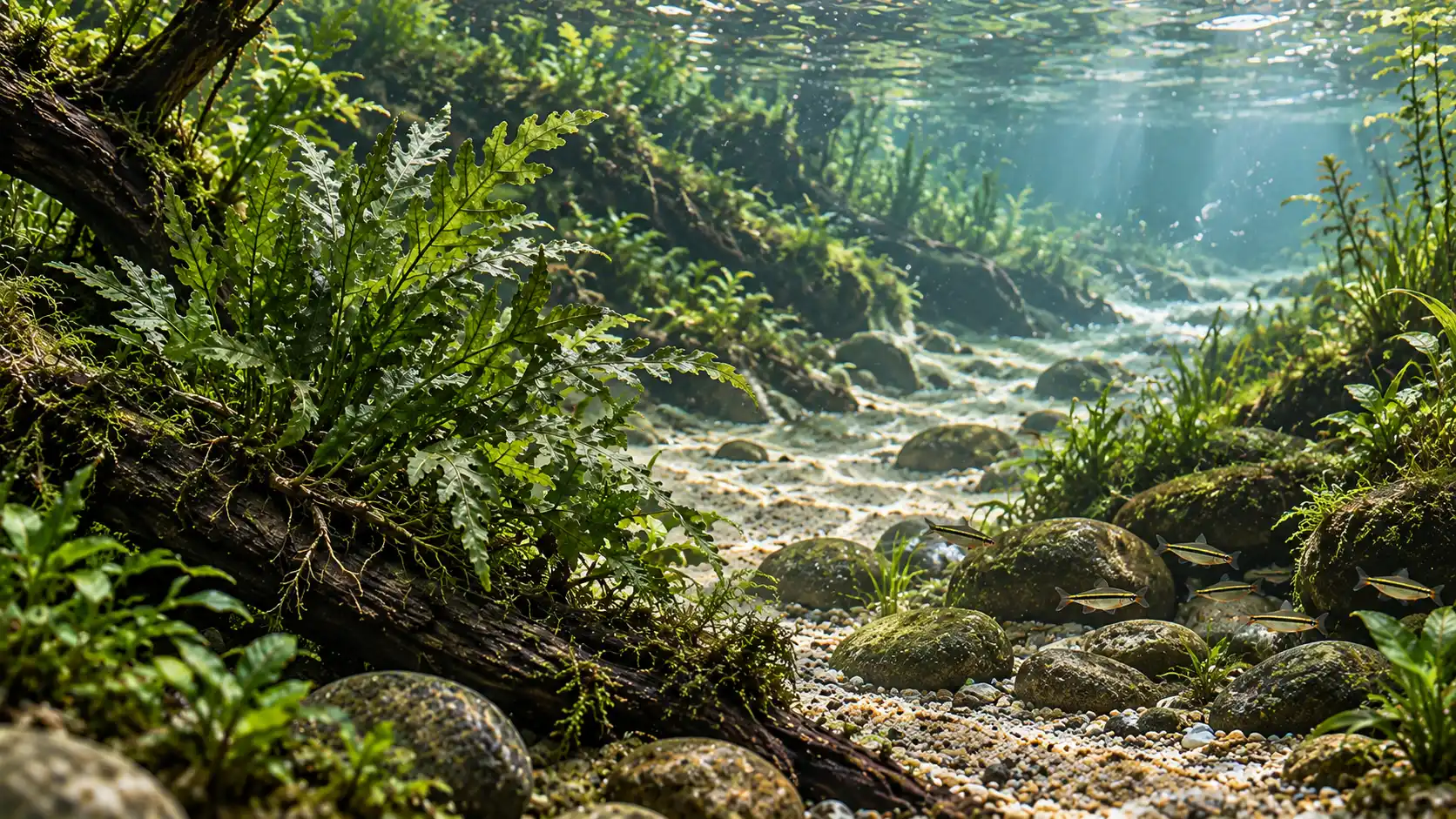
With suitable filtration and circulation, leaves should move gently, the rhizome should stay clear, and livestock should be able to rest and feed normally.
Which water conditions suit African water fern?
Tropica describes soft, slightly acidic water as favourable. The botanical literature confirms flowing freshwater habitat but does not provide one aquarium temperature, pH or hardness prescription that applies to every cultivated plant.
Keep temperature and chemistry stable within the requirements of the aquarium's animals, then judge the fern from healthy new growth. Do not lower pH or hardness simply to match a product description when the present water is stable and the plant is growing.
Any chemistry change must also stay safe for fish and invertebrates sharing the aquarium.
Why are leaves turning brown or transparent?
One old leaf declining after planting can be a transition, while several new leaves failing points to a continuing problem. Check whether the rhizome is buried, the attachment is crushing tissue, leaves are coated with debris, light changed abruptly, or the water column lacks a nutrient the rest of the planting is using.
Rule out the water first
- Expose and feel the rhizome; healthy tissue should not be soft or foul-smelling.
- Compare old leaves with the newest growth rather than judging one damaged frond.
- Check the light schedule and intensity for a recent increase.
- Look for detritus trapped where flow cannot reach the plant.
- Review fertiliser changes and measure relevant water conditions before adding more.
- Inspect for grazing, tearing and repeated contact with maintenance tools.
Remove a fully decayed leaf at its base with clean tools, but keep functioning green tissue while the plant establishes.
If several plant species lose tissue at once, follow the broader aquarium plants melting or aquarium plants not growing decision tree before changing this fern's placement alone.
How do you control algae on slow leaves?
Slow leaves give algae time to establish when light, nutrients, organic waste and plant demand are out of balance. Shading the fern modestly and keeping detritus moving can be more effective than scrubbing delicate fronds or adding an animal advertised as an algae eater.
Manually remove affected old leaves only when enough healthy growth remains. Review the whole aquarium's light duration, feeding, maintenance and plant mass before using an algaecide, because chemical treatments can harm plants and invertebrates without correcting the cause.
Use the dedicated guide when aquarium plants are covered in algae across several species. Widespread algae points to a system-level balance problem rather than a defect unique to this fern.
- Light duration is controlled by a timer and has not crept longer.
- The fern is not sitting directly under the brightest hotspot.
- Debris is siphoned without burying or tearing the rhizome.
- Fertiliser is measured rather than added in response to algae alone.
- Filter media and intake are maintained without destroying biological filtration.
- Any algae-control product is checked for livestock and plant safety before use.
How do you propagate African water fern?
You should divide only a firm, established rhizome with several healthy leaves and roots. Use a clean sharp blade, cut between growth points, and keep enough leaf and root mass on each section to resume growth.
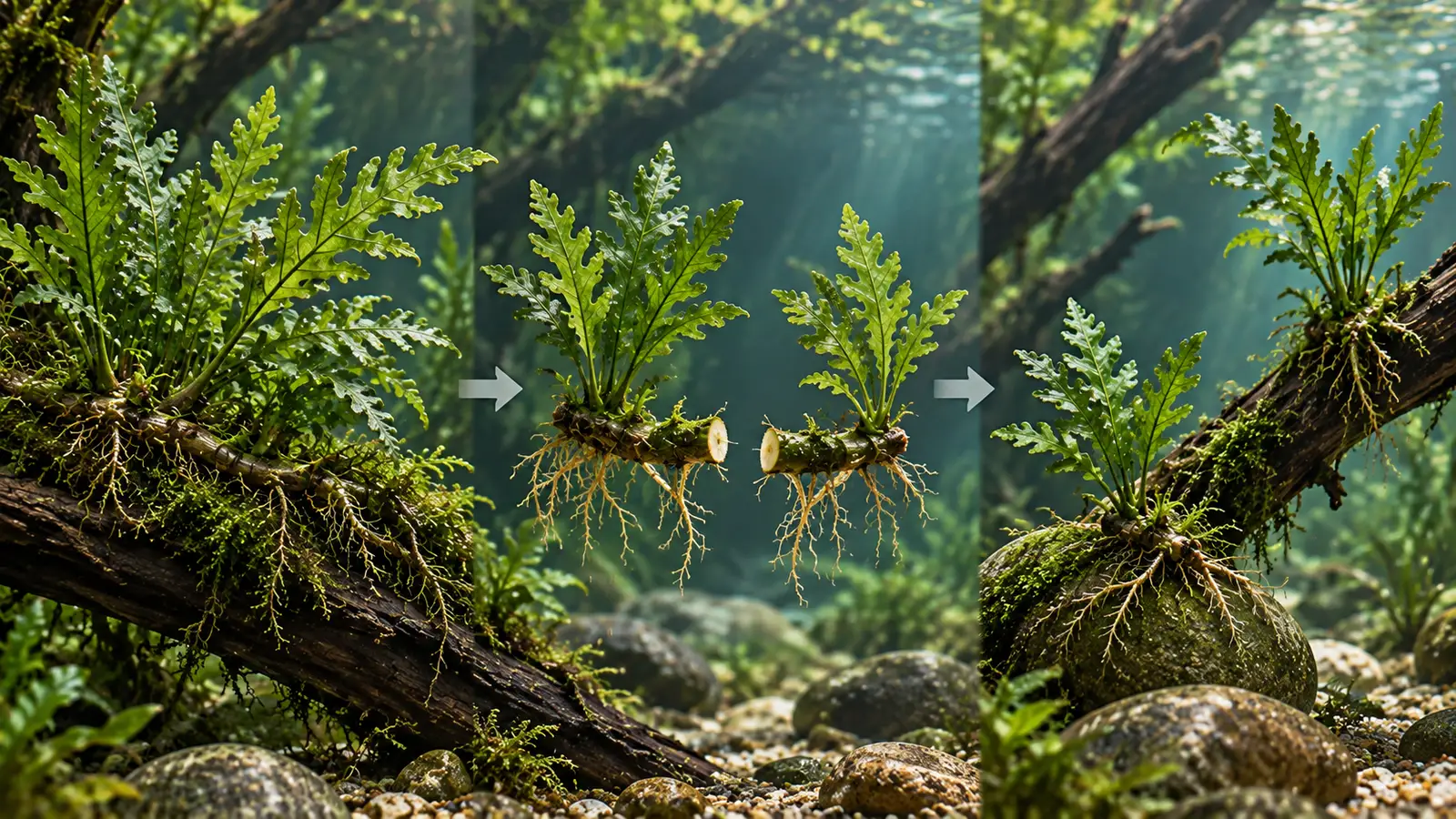
Attach the divisions separately and keep their light and flow stable while wounds recover.
Where does the fern fit in an aquascape?
Tropica gives an aquarium height around 15 to 40 cm, while wild fronds can be larger in botanical records. Place it in the middle or background where mature leaves will not cover the whole foreground or block a fish's surface route.
On branching wood, the plant can soften a tall vertical structure; on low stone, it can form a shaded riverbank mass. When comparing it with Anubias barteri, consider the space each mature plant needs rather than the size of the nursery pot.
Avoid repeating identical clumps across every rock. One larger anchor plant with smaller supporting divisions usually reads more naturally and leaves room for different textures, open water and animal territories.
Is African water fern right for your aquarium?
Choose it when you have wood or stone for an exposed rhizome, moderate stable light, clean water movement and patience for slow establishment. It is especially useful where a durable shaded plant must occupy hardscape without deep substrate.
Choose another plant if the design requires rapid carpeting, frequent uprooting or intense exposed light with no way to control algae. A healthy fern rewards stable placement; moving it repeatedly to search for instant growth often resets the very establishment you are waiting to see.