
What Is Anubias Barteri, and How Do You Keep Its Rhizome Healthy?
Anubias barteri
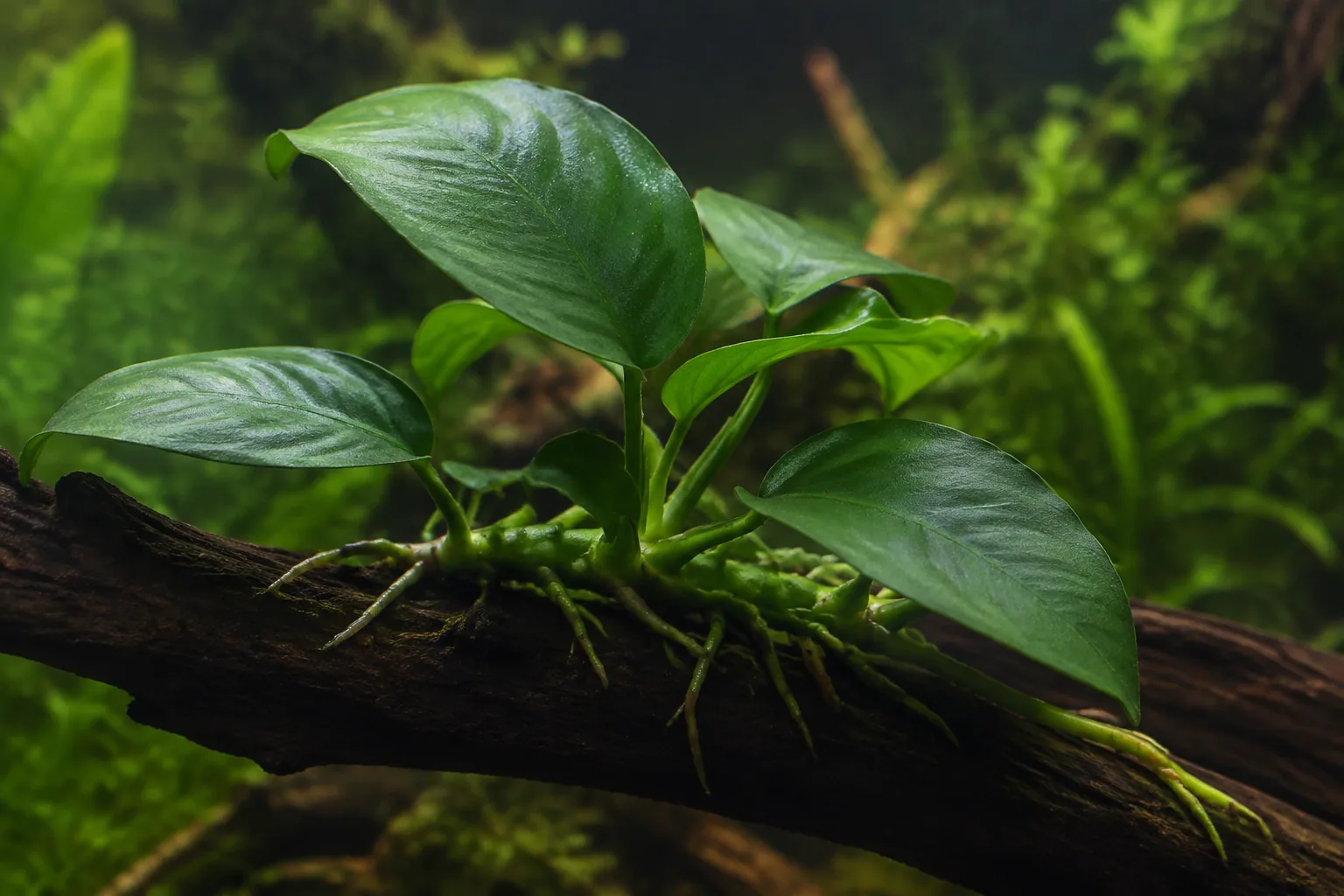
Anubias barteri is a slow-growing West African aroid that lives on a creeping rhizome, and it does best tied to wood or rock with that rhizome above the substrate. Given shade or moderate light it keeps the same tough leaves for years, while burial and strong light cause most of its failures.
At a glance

- Light
- low
- Injected CO2
- optional
- Substrate
- None; roots may enter gravel but the rhizome stays uncovered
- Nutrients
- Low, taken mainly from the water column
- Growth rate
- Slow
- Growth form
- Creeping rhizome aroid with leathery leaves on long stalks
- Placement
- Tied or glued to wood or stone; nana in the foreground, larger forms midground or background
- Propagation
- Cut a firm rhizome into sections that each keep leaves and roots
- Family
- Araceae
- Native range
- West and west-central tropical Africa, from Guinea and Liberia to Cameroon, Gabon, Congo and Bioko, on shaded stream banks
- Grows emersed
- Yes. It can be grown above the waterline as well as submerged.
What is Anubias barteri?
Anubias barteri is a slow-growing aroid from the forests of West and west-central Africa, and one of the most widely kept aquarium plants. Kew's Plants of the World Online accepts the name, published by Heinrich Schott in 1860, and records the species from Guinea and Liberia east through Nigeria and Cameroon to Gabon, Congo and the Gulf of Guinea islands.
In the wild it grows in shaded places along forest streams, on sand, on rocks or on old wood, often above the water or only partly submerged. That habit explains most of its aquarium behaviour: it copes with dim light because forest streams are shaded, and it expects its stem to sit on a surface with air or moving water around it.
The IUCN Red List assessed the species as Least Concern in 2020.
Aquarium stock comes from commercial nurseries, which multiply the plant from rhizome cuttings and tissue culture.
Import rules still differ by country. A 2013 weed risk assessment by the US Department of Agriculture rated the plant low risk, while noting that South Africa lists it as a prohibited import.
- Accepted name
- Anubias barteri Schott, family Araceae
- Native range
- West and west-central tropical Africa, Guinea to Congo
- Wild habitat
- Shaded stream banks, on sand, rock or old wood, emersed or partly submerged
- Growth form
- Creeping rhizome with leathery leaves on long stalks
- Growth rate
- Slow
- Light need
- Low to moderate
- Conservation
- Least Concern, IUCN Red List assessment of 2020
- Aquarium source
- Nursery grown from rhizome cuttings and tissue culture
The rhizome decides almost every outcome
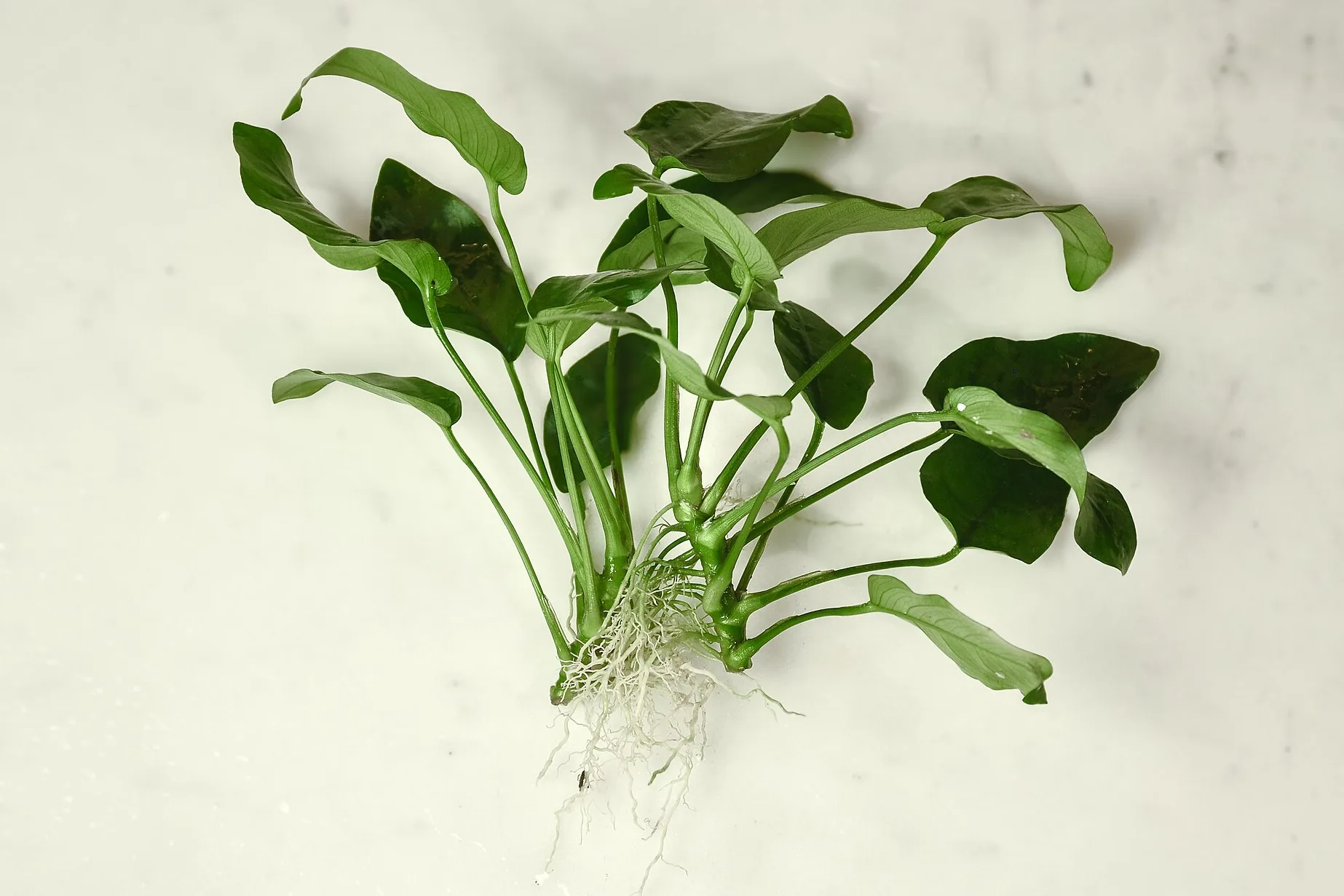
A rhizome is a horizontal stem, and in this species it is green, creeping and 0.2 to 1 cm thick, according to Crusio's 1979 revision of the genus. Every leaf, root and flower stalk grows from it, and new leaves unfold near its growing tip.
Because the leaves last for years and the rhizome lengthens slowly, the plant has very little spare growth to lose.
Three care outcomes follow from that one structure.
Burial comes first: gravel or sand packed over the rhizome stops water moving around it, and the nursery Tropica warns that a covered rhizome tends to rot.
Attachment follows from the same fact, since a rhizome tied or glued to wood stays in open water, while one left loose on the bottom drifts, gets pushed under the gravel by digging fish, or ends up trapped under debris.
Light is the third: Tropica notes that the leaves survive for several years, which gives slow-growing algae time to settle on them, so bright light leaves old leaves coated long before it produces new ones.
The same rules apply to other rhizome plants, such as Java fern and African water fern, which is why these plants are usually grown on hardscape rather than in the substrate.
How do you attach Anubias barteri to wood or rock?
A tie or a dot of glue only holds the plant until its own roots grip the wood or stone. Tropica suggests fishing line, and cotton thread or a gel cyanoacrylate glue sold for aquarium plants does the same job if it stays off the growing tip.
- Prepare the plant Rinse it in dechlorinated water and remove the pot, rock wool or tissue-culture gel without tearing the roots.
- Find the parts Locate the rhizome, the growing tip at its leafy end, and any soft or damaged section before tying anything.
- Trim only damage Cut broken or dead leaves off at the base of the stalk and keep every healthy leaf, because replacements come slowly.
- Choose the surface Pick wood or porous rock in shade or moderate light, where water moves past gently.
- Lay it flat Set the rhizome along the surface with the roots touching the wood or stone and the growing tip free.
- Secure it lightly Wrap fishing line or cotton thread around the rhizome between leaf stalks, or put a small dot of glue under it, firm enough to hold without cutting in.
- Check it in place Return the piece to the tank and confirm that no part of the rhizome touches the substrate and the leaves do not whip in the current.
- Remove the line later Cut fishing line away once roots hold the plant; cotton thread usually breaks down by itself.
Because the plant grows slowly, the tie often stays on for several weeks before new roots take hold.
Moving the piece around during that time breaks the young roots and restarts the wait.
Where should it go in the aquarium?
The right spot gives the rhizome open water, shade from the strongest light and a surface to hold.
Several positions in an ordinary tank meet all three conditions.
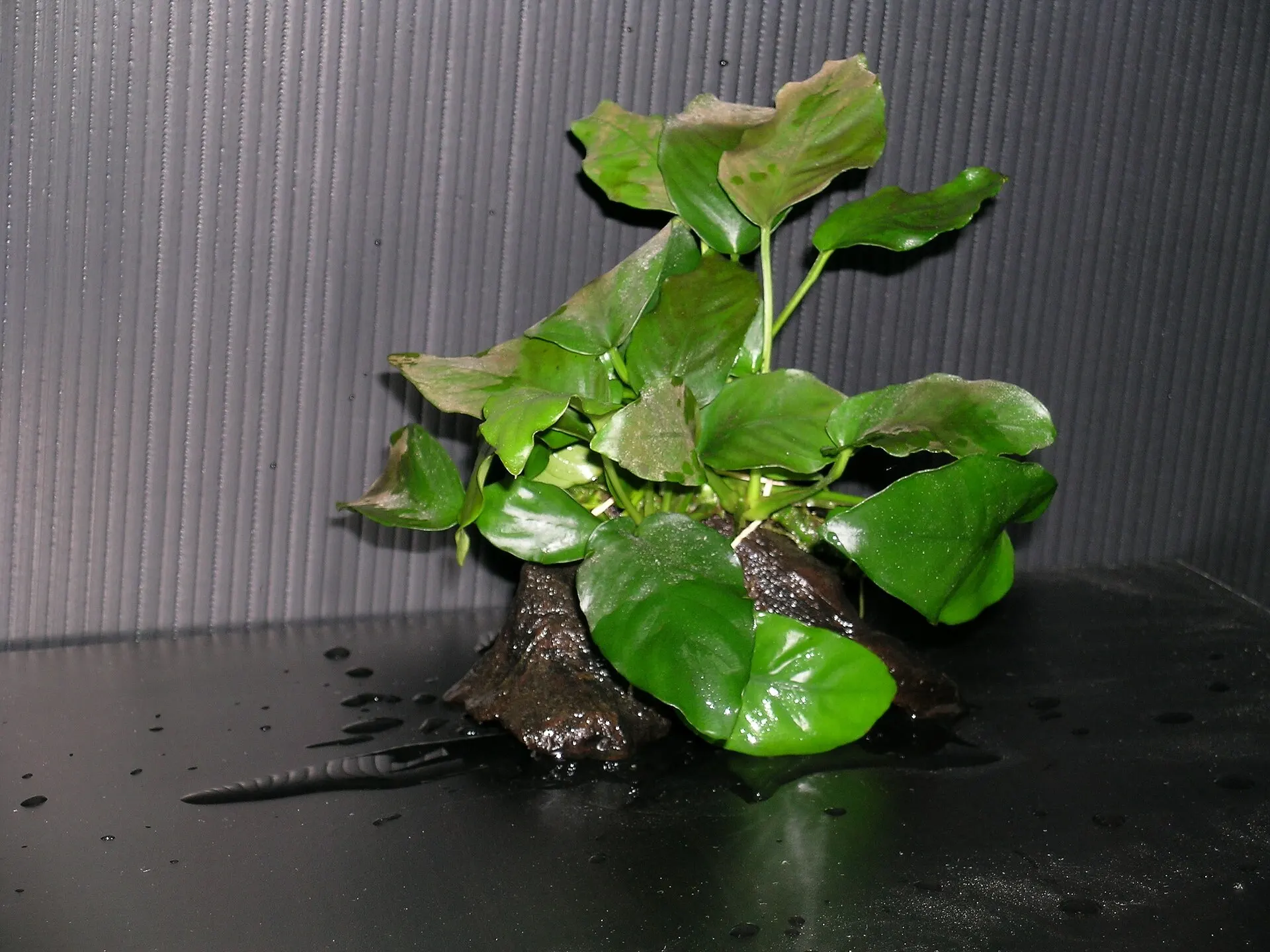
Driftwood in the midground
The usual choice. Soaked driftwood keeps the rhizome in moving water and lets taller plants shade the leaves.
Rock or stone
Porous stone gives roots a grip. Small nana plants suit foreground stones, while larger forms need room for long leaf stalks.
Gaps between stones
A rhizome set into a crack holds without ties, provided water still reaches it and the stone does not crush it.
On the substrate
Workable when only the roots enter the gravel and the rhizome rests on top, clear of fine sand and debris.
Under taller plants
Shade from stem plants, floating plants or overhanging wood slows algae on the oldest leaves.
Above the waterline
The plant grows emersed in paludariums and humid terrariums, much as it often does in the wild.
Size settles the rest. Tropica gives var. barteri a height of 25 to 45 cm and var. nana 5 to 10 cm, with a rhizome of 10 to 15 cm or more in both, so the larger form belongs in the midground or background.
Gentle movement from the filter outflow helps, because it keeps debris from settling on the rhizome and the leaves.
As an African species, it also fits a West African biotope aquarium, where most widely sold plants would be out of place.
How much light and CO2 does Anubias barteri need?
Low to moderate light is enough. Tropica rates var. barteri as a low-light, low-CO2 plant and describes var. nana as thriving in shady places where other plants will not, which fits a species from shaded forest streams.
Stronger light rarely buys faster growth, because the rhizome sets the pace.
What changes first is the condition of the old leaves.
| Decision factor | Shade or moderate light | Strong light or a long photoperiod |
|---|---|---|
| Leaf growth | Slow and steady, with new leaves at the growing tip | Still slow, since the rhizome limits new leaves |
| Old leaves | Usually stay clean for long periods | Collect green spot and other slow algae over the years they last |
| Added CO2 | Not needed | Can support growth, but only where light and nutrients are balanced too |
| Maintenance | Occasional removal of a damaged leaf | Regular cleaning or removal of coated leaves |
| Best use | Low-tech tanks, shaded corners, tanks with plant-eating fish | High-light tanks where faster plants shade it |
The plant is a staple of the low-tech planted tank for exactly this reason. In a brightly lit tank, placing it under taller growth and keeping the photoperiod steady does more than any change to the plant itself.
CO2 injection is optional. A tank that already runs it for other plants will not harm the anubias, but a gas system installed for this plant alone rarely pays off, because its growth rate stays slow.
When green spot algae or other growth coats the leaves, the cause usually sits in the whole tank's light and nutrient balance. The checks for aquarium plants covered in algae apply before any single leaf is scrubbed or removed.
Does Anubias barteri need special water?
No special water is needed: there is no single botanical water range for this species, and Tropica describes var. nana as thriving in all conditions, so the water that suits the fish usually suits the plant too.
What harms it is sudden change. A fast swing in temperature, pH or hardness stresses the animals first, and an adjustment made for the plant carries the same risk to them.
It is a tropical forest plant, and Crusio grew his material in a warm, very humid greenhouse.
A cold, unheated tank is therefore outside the conditions the species is known to handle.
Nutrient demand is low because growth is slow.
Measured liquid fertilizers reach it through the water, which suits a plant whose rhizome never sits in the substrate.
Which varieties are sold as Anubias barteri?
Crusio divided the species into five varieties by leaf shape and size, while noting that intermediates are common and the differences carry little taxonomic weight. Kew now lists every one of those variety names as a synonym of Anubias barteri, so on a label they describe a leaf form rather than a separate plant.
| Name on the label | Leaf in Crusio's key | Where it fits |
|---|---|---|
| var. barteri | Blade 7 to 23 cm long and 4 to 11 cm wide, usually shorter than its stalk | Midground or background wood |
| var. nana | Blade up to 6 cm long and 3 cm wide, longer than its stalk of up to 5 cm | Foreground stones and small tanks |
| var. glabra | Blade lanceolate to elliptic, less than five times as long as broad | Midground, similar in scale to var. barteri |
| var. angustifolia | Narrow blade more than five times as long as broad, up to 3.5 cm wide | Midground, as a slim leaf beside broad ones |
| var. caladiifolia | Arrow-shaped leaf base with a wide notch and palmate main veins | Larger tanks and paludariums |
| 'Coffeifolia' | Named by Kasselmann in 2010, now listed by Kew as a synonym | Sold as its own leaf form |
| 'Petite' or 'Bonsai' | Trade names for very small nana plants, with no botanical description | Nano tanks and tight foreground spots |
Crusio also found that each variety kept its leaf shape in cultivation. A plant bought as Anubias nana therefore stays small instead of growing into var. barteri, which matters when choosing between them in the barteri versus nana comparison.
Labels have drifted before: the USDA assessment records that var. angustifolia was once sold as Anubias afzelii, a different species, and the tiny Anubias petite is a trade name that no botanical description defines.
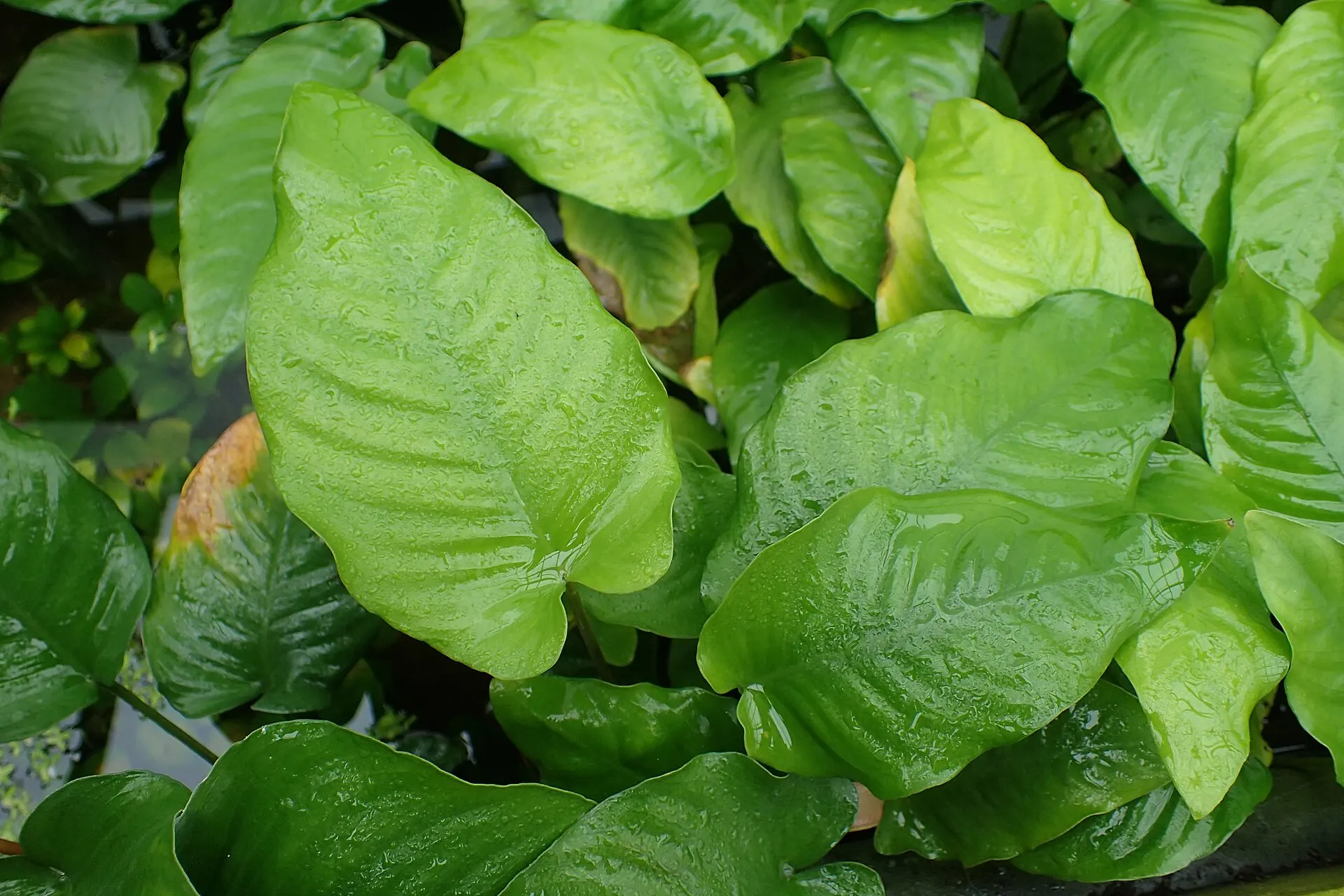
Var. nana is rare in nature, and Crusio knew of only a few wild collections, all from around Mount Cameroon, so nearly every nana plant in the trade is nursery stock.
Why is the rhizome rotting or the leaves melting?
An older leaf yellowing and dying now and then is normal on a plant that keeps its leaves for years. Several leaves failing together, or a rhizome going soft, means something in its position or in the tank has changed.
Check these before moving or treating the plant
- Rhizome buried Look for any part of the stem under gravel, sand or trapped debris, and lift it clear.
- Rhizome firmness Press it gently. Firm green tissue is healthy, while soft, brown or foul-smelling tissue has rotted and needs cutting back to firm growth with a clean blade.
- Tie or glue damage Check that line or glue is not cutting into the stem or covering the growing tip.
- Recent planting A plant grown out of water at a nursery can shed some older leaves after it goes under water, while new ones form.
- Light change A brighter lamp or longer photoperiod shows up as algae on old leaves rather than as melting.
- Whole-tank decline If other species are failing at the same time, the cause lies in the tank rather than in this plant's position.
- Pale new leaves Yellowing new growth across several plants points to a nutrient shortfall, which a water test and measured fertiliser address.
Cutting away rot usually leaves a healthy plant, as long as a firm section with leaves and the growing tip remains.
The cut piece then goes straight back onto wood or stone, never into the substrate that caused the problem.
When several species decline together, the checks for aquarium plants melting cover the whole tank. Pale new growth across many plants belongs with aquarium plants turning yellow, since the anubias is only one of the plants showing it.
Do fish and snails eat Anubias barteri?
Fish rarely touch it: Tropica describes the leaves as exceptionally tough and not eaten by herbivorous fish, which makes anubias a common choice for goldfish tanks and cichlid tanks where softer plants disappear.
In those tanks the real threat is digging, because a plant set in the substrate can be uprooted in a night.
| Animal | Effect on the plant | What helps |
|---|---|---|
| Plant-eating fish such as goldfish | Leaves are usually left alone because of their tough texture | Nothing beyond normal placement |
| Digging cichlids and large bottom fish | Uproot plants set in the substrate | Tie or glue it to heavy hardscape |
| Snails such as nerites | Graze the algae film on the leaf surface | Nothing; they clean slow leaves |
| Shrimp | Pick biofilm and algae from leaves and rhizome | Nothing; the plant gives them cover |
Grazers help more than they harm, and Amano shrimp and nerite snails work over the film that builds on old leaves, which matters on a plant whose leaves stay in place for years.
How fast does it grow, flower and spread?
Slowly on every count: Tropica rates it a slow grower whose leaves survive for several years, so a healthy plant changes shape over months rather than weeks.
No source gives a maximum age. The rhizome is perennial and keeps extending from its tip, and a divided piece carries on as a new plant, so a well placed anubias has no fixed lifespan in the way an animal does.
It flowers readily under water, and Tropica notes that var. nana flowers frequently when submerged, and Crusio recorded wild plants flowering and fruiting throughout the year.
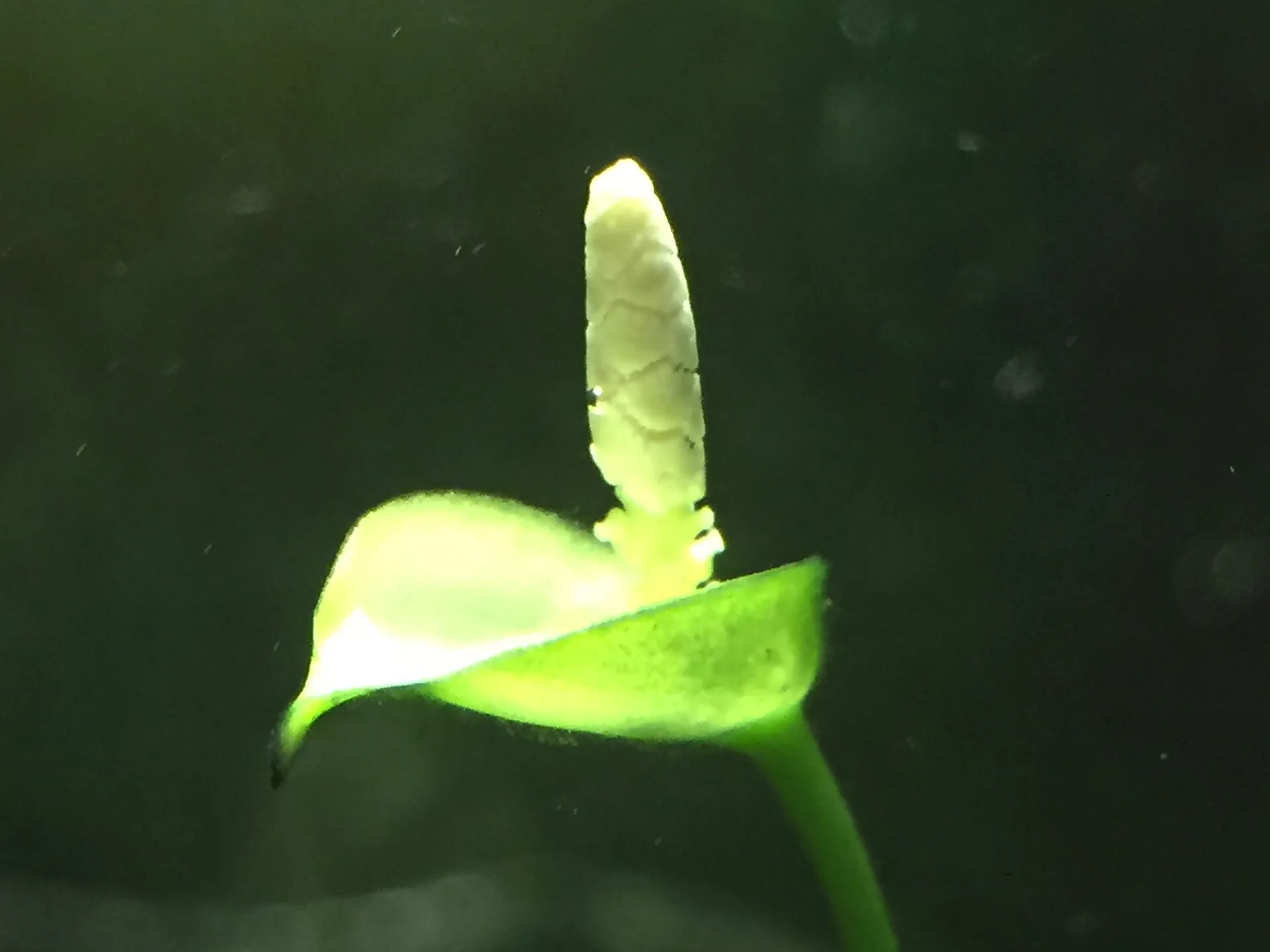
Each inflorescence is a spadix inside a spathe 1.5 to 6 cm long. Berries form inside the spathe, but the USDA assessment found no information on whether they produce viable seed.
Division is the practical way to propagate Anubias barteri. Cutting a long rhizome into sections gives each piece its own start, while nurseries rely on tissue culture for large numbers.
- The rhizome is firm and green along the length you plan to cut.
- Each section keeps several healthy leaves and some roots.
- The blade is clean and sharp, so it cuts rather than crushes.
- Each piece has a place to be attached straight away, off the substrate.
- The cut ends stay clear of gravel and sand while they seal.