
Acan Coral Water Parameters: Stable Reef Ranges
Acan corals do best in mature reef water whose salinity, temperature and alkalinity move very little. Use published ranges as operating boundaries, then judge the colony by tissue inflation, feeding response and the direction of your test results.

Which water parameters suit an acan coral?
For the coral commonly sold as an acan lord, Micromussa lordhowensis, a sound starting envelope is 24 to 26 C, specific gravity 1.023 to 1.026, pH 8.1 to 8.3, alkalinity 8 to 12 dKH, calcium 380 to 450 ppm and magnesium 1,250 to 1,350 ppm.
The OATA large-polyp stony coral guide publishes those group-level ranges, with ammonia and nitrite at zero, nitrate no higher than 20 mg/L and phosphate no higher than 0.05 mg/L.
These are group-level husbandry recommendations, not experimentally established tolerance limits for this species or a reason to chase the middle of every range. A mature system needs stable conditions, and acan coral identification and placement also affect how the colony responds.
Practical operating ranges
- Temperature24-26C system. Applies to Mature reef housing LPS coral. Calibrated aquarium thermometer.
- Specific gravity1.023-1.026SG system. Applies to Stable marine salinity. Temperature-compensated refractometer.
- pH8.1-8.3PH system. Applies to Read alongside alkalinity and daily timing. Calibrated meter or fresh marine test.
- Alkalinity8-12DKH system. Applies to Calcification support; avoid abrupt correction. Marine alkalinity titration.
- Calcium380-450Ppm system. Applies to Available calcium for skeleton growth. Marine calcium titration.
- Magnesium1250-1350Ppm system. Applies to Helps stabilize calcium and alkalinity chemistry. Marine magnesium titration.
- Ammonia and nitrite0Mg/L system. Applies to Established biofilter. Appropriate marine tests.
Every range above. Source: OATA LPS guide, checked 2026-09-22.
Calcium and magnesium retain the ppm units reported by OATA. Check the test manufacturer's reporting convention before comparing them with mg/L results; mass-based ppm and mg/L are not exactly interchangeable in seawater.
Specific gravity is a density ratio, not a salinity unit. OATA does not state its reference-temperature convention, so use the instrument's marine-water calibration and temperature instructions rather than converting this range to an exact salinity target.
Why does stability matter more than a perfect target?
An acan coral has living tissue stretched over a calcium-carbonate skeleton. Rapid salinity or temperature movement changes the water balance across that tissue, while an abrupt alkalinity correction changes the chemical environment in which the coral calcifies.
One isolated result tells you where the aquarium was at one moment. A dated log tells you whether salinity is rising through evaporation, alkalinity consumption is accelerating, or a test result is simply inconsistent with the surrounding trend.
How do alkalinity, calcium and magnesium affect one another?
Alkalinity, calcium and magnesium move as a system, even though each test reports a separate number. Reef-building corals use calcium and carbonate species to build skeleton, while magnesium can inhibit growth of calcite, one form of calcium carbonate.
Laboratory research on calcite supports that chemical role, but does not establish a magnesium dose for an aquarium. The practical implication is to check the combined chemistry before interpreting a falling calcium result as coral consumption.
Raising one result without checking the others can move material out of the water instead of making it available to the coral. A white crust on heater elements or pump impellers, a simultaneous decline in calcium and alkalinity, and cloudy water after dosing can all point toward precipitation rather than unusually rapid coral growth.
pH adds another layer because it responds to dissolved carbon dioxide as well as alkalinity. A closed room can produce a lower daily pH pattern even when alkalinity is steady, while photosynthesis during the light period removes carbon dioxide and commonly raises pH; changing the alkalinity dose does not correct every carbon-dioxide problem.
Salinity affects how concentrated major ions are in the sample. If specific gravity has drifted upward through evaporation, calcium and magnesium can appear elevated simply because water left while salts remained, so correct and verify salinity before interpreting smaller movements in the other tests.
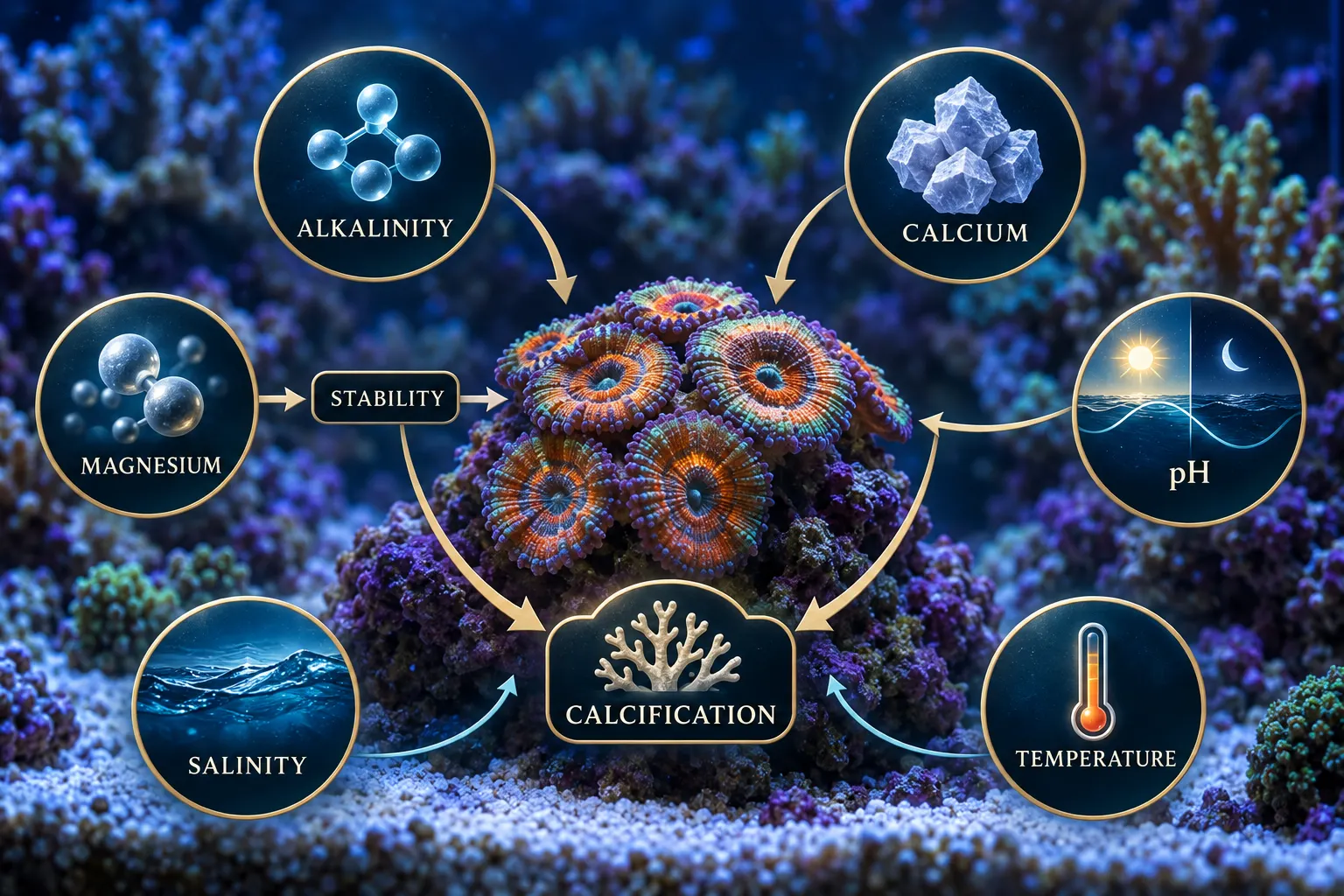
The most useful value is often daily consumption rather than a single result. Test at the same time on several ordinary days, divide the verified decline by elapsed time, and compare that demand after coral growth, a water change, a new salt mix or a dosing adjustment.
How should you test reef water accurately?
Measure salinity with a clean refractometer or conductivity instrument that has been calibrated with a suitable reference. Rinse sample cells with the water being tested, use the stated sample volume, observe the endpoint under neutral light and discard reagents that are expired or contaminated.
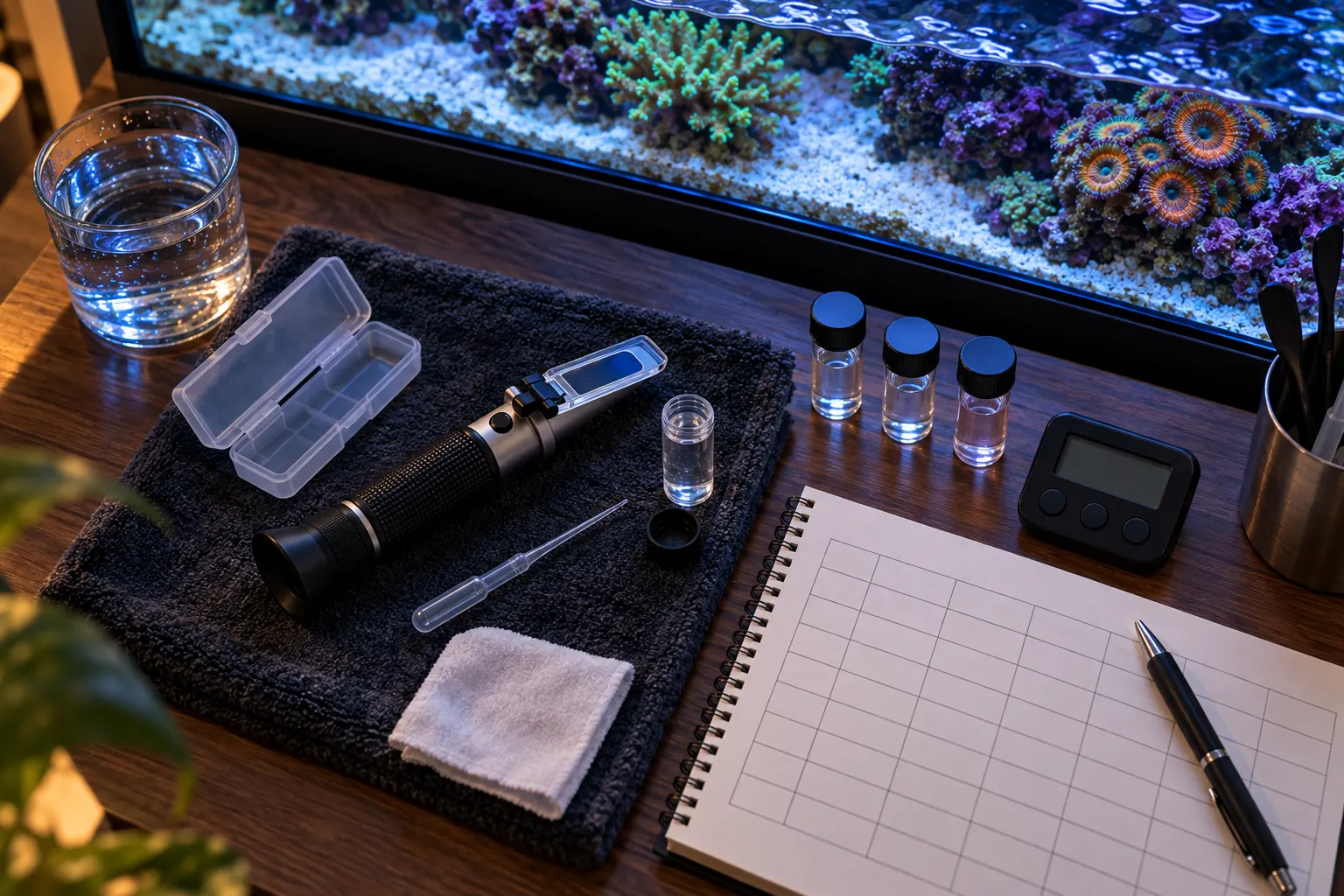
Test at a consistent time because pH commonly rises during the lit period and falls after lights out. Record the result, method, time and any recent water change or dose; a bare number without that context is much harder to interpret.
How much change can a test actually prove?
Every method has measurement uncertainty. A kit with broad color steps may show a useful trend without proving that alkalinity moved by a few tenths of a degree, and a digital display can show extra decimal places even when calibration or sampling error is larger than the displayed change.
Treat a small movement inside the method's repeatability as a prompt to retest, not as an automatic dose instruction. Run duplicate samples when a result will trigger a correction, use a reference solution at sensible intervals, and replace a method that cannot distinguish the change you need to manage.
Sampling technique can create false disagreements. Let freshly dosed water mix, avoid drawing a sample beside a dosing outlet, use the exact sample volume, hold droppers vertically where instructed, and compare color endpoints under the same neutral light.
When two methods disagree, the decision belongs to the method that has been checked against a known reference, not to the result with more digits. Record the kit lot or instrument, because a method change can look like an aquarium trend when the water itself never moved.
- Confirm the aquarium temperature before interpreting specific gravity.
- Calibrate the instrument with the correct reference, not an arbitrary household liquid.
- Repeat a surprising result with clean equipment before changing the aquarium.
- Compare alkalinity with the previous result and the elapsed time.
- Check freshly mixed saltwater separately when a water change caused the shift.
- Use one trusted unit consistently so dKH, meq/L and mg/L are not confused.
What do nitrate and phosphate mean for an acan?
Ammonia and nitrite should remain undetectable in an established reef. Nitrate and phosphate are different: they are nutrients, and a reading of zero does not automatically mean the system is clean because algae and microbes may be consuming them as quickly as they appear.
Excess nutrients can favor nuisance growth and reduce water quality, while aggressive nutrient removal can destabilize a coral that was acclimated to measurable availability. Follow the trend, feeding load, algae growth and coral response together instead of treating one color chart as the whole diagnosis.
How can you correct a drifting parameter safely?
First confirm what is moving and why. Rising salinity usually points to evaporation being replaced too slowly or with saltwater instead of fresh water; falling alkalinity may reflect coral and coralline growth, while a sudden jump often points to dosing or salt-mix error.
Routine evaporation top-off replaces lost water with fresh water, not saltwater. A large salinity error needs a correction plan based on the measured difference and the animals present, rather than an arbitrary daily rate.
For alkalinity, calcium or magnesium, the supplement instructions, verified concentration and actual water volume must all agree before dosing. Allow mixing and retest as instructed before another addition; stop dosing and seek advice if the result moves unexpectedly or tissue condition worsens.
| Observed change | Common cause | First verification |
|---|---|---|
| Specific gravity rising | Freshwater evaporation | Compare tank and top-off salinity; inspect top-off operation |
| Alkalinity falling steadily | Calcification and normal demand | Retest, then calculate daily consumption |
| Alkalinity jumping | Dose or new saltwater mismatch | Test the mixed water and review dose volume |
| pH low with steady alkalinity | Elevated indoor carbon dioxide or poor gas exchange | Compare fresh-air aeration and inspect surface movement |
| Nitrate rising | Feeding, trapped waste or insufficient export | Inspect flow, mechanical media and maintenance record |
What can the coral tell you that a test cannot?
A healthy colony usually inflates its tissue, keeps intact margins and responds to food without remaining tightly closed for days. Persistent recession, exposed skeleton, brown jelly-like material or rapid loss across neighboring polyps is not a cue to add a random supplement.
Check temperature, salinity, ammonia, recent additions, flow and physical damage immediately. Rapid or spreading tissue loss warrants prompt assessment by an aquatic veterinarian or coral-health professional, even when those readings look normal.
Brown material or exposed skeleton does not establish a diagnosis. Document the change and avoid unverified dips or supplements while seeking help.
When is the aquarium ready for an acan coral?
The system should have a working aquarium nitrogen cycle, consistent salinity control and enough testing history to show normal consumption between maintenance days. A newly mixed aquarium can display acceptable numbers before its microbial and nutrient behavior becomes predictable.
Add the coral only when you can explain how temperature, salinity and alkalinity behaved over several weeks. Keep the first placement accessible, avoid simultaneous equipment changes, and use a steady aquarium filtration plan so a small correction does not become a full-system disturbance.