
What Do Acan Corals Eat and How Should You Feed Them?
Acan corals obtain energy from their photosynthetic symbionts and can capture small animal-based foods with their polyps. Target feeding can support a healthy colony, but the useful portion is the amount the polyps capture without leaving food to decay or driving nitrate and phosphate upward.

What do acan corals eat?
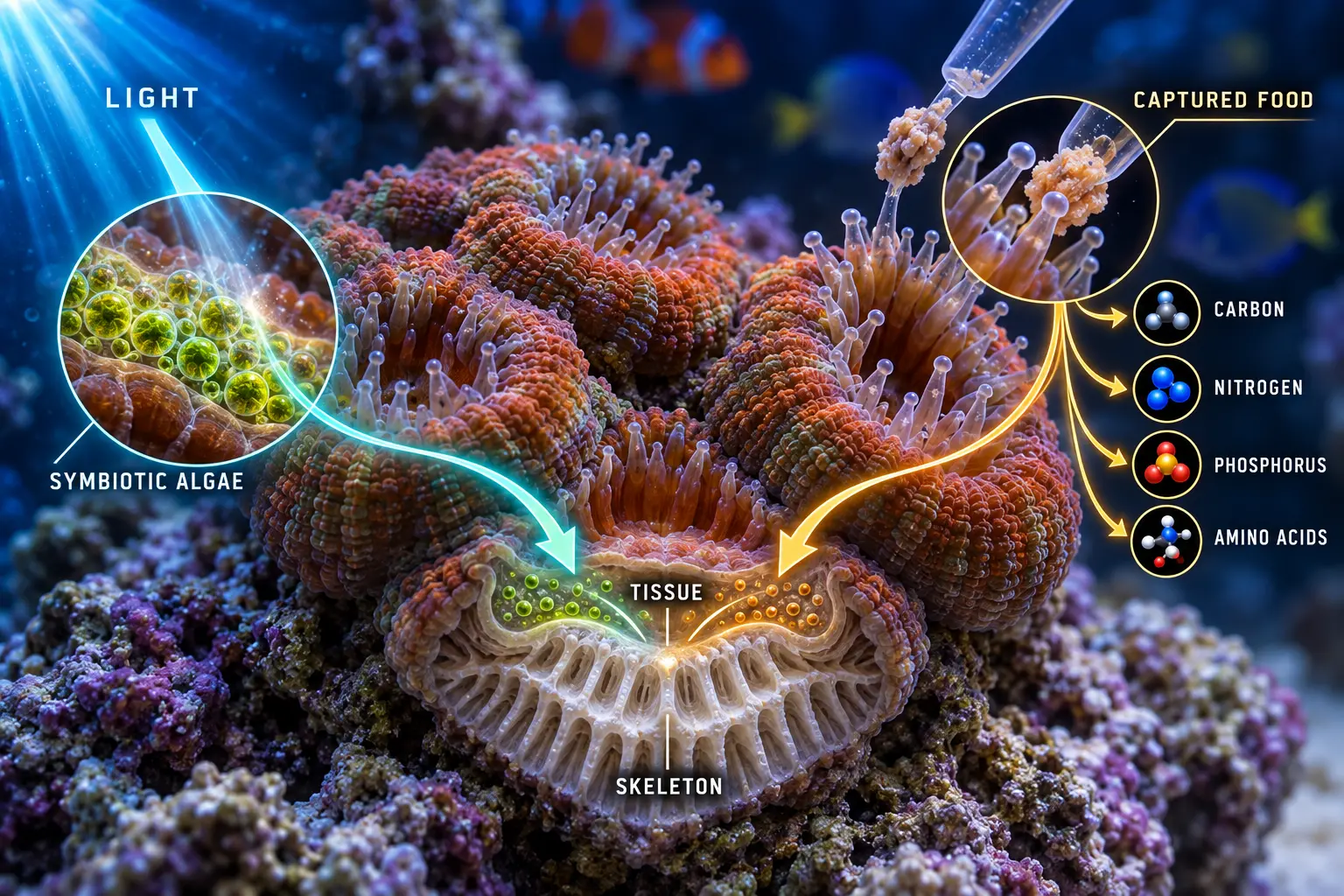
The coral commonly sold as an acan lord, Micromussa lordhowensis, is mixotrophic. Symbiotic algae in its tissue supply photosynthetic energy, while its mouths and tentacles capture suspended particles and small meaty foods.
NOAA explains the exchange between reef-building corals and their photosynthetic symbionts, which provide products of photosynthesis while receiving shelter and nutrients. Feeding therefore supplements a functioning light-and-water system; it does not replace suitable lighting or stable acan coral water parameters.
- Energy pathway
- Photosynthesis plus captured food
- Useful foods
- Appropriately sized marine zooplankton and finely cut meaty marine foods
- Delivery
- Gentle target feeding near open polyps
- Starting frequency
- Occasional small feeds, adjusted from response and nutrient trend
- Successful endpoint
- Food is captured and swallowed without leftovers collecting
- Main risk
- Excess food decomposes and raises the system nutrient load
What does food add that light does not?
Photosynthesis and captured food contribute different resources. Symbiotic algae transfer photosynthetic carbon to the coral host, while captured prey can supply carbon, nitrogen, phosphorus and amino acids directly to coral tissue.
That distinction explains why suitable light and occasional feeding can support the same colony without being interchangeable. More light cannot supply every prey-derived nutrient, and more food cannot compensate for unsuitable light, unstable salinity or tissue damage.
A controlled study of Stylophora pistillata found higher tissue protein, photosynthetic capacity and calcification in fed colonies, linking feeding with both tissue condition and skeletal growth. That experiment supports the biological role of heterotrophy in a reef-building coral, but it does not establish an exact ration for Micromussa lordhowensis in a home aquarium.
You can use the evidence at the correct scale by offering capturable marine food, then judging the individual colony and the whole system. A feeding schedule that produces clean capture and stable nutrients is more defensible than copying a laboratory frequency without its water volume, prey density and export controls.
Which foods are suitable?
You should choose marine foods small enough for the individual polyp to draw inward without remaining draped across tissue. Mysis-sized pieces may suit large mature polyps, while finely minced shrimp, copepod-sized foods or a reputable coral food can be easier for smaller mouths.
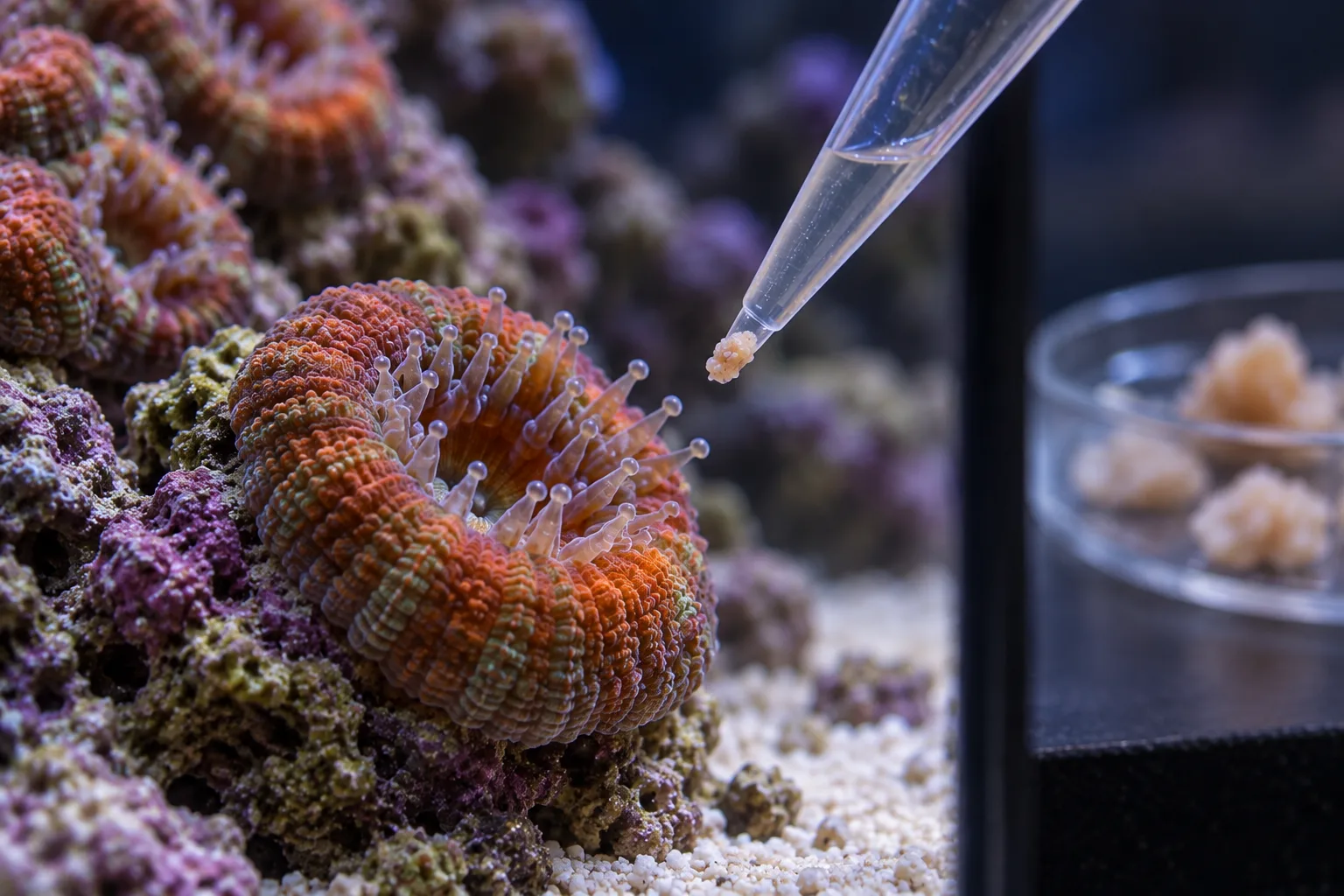
Large chunks are not automatically more nutritious. They can be dropped, stolen, regurgitated or left between polyps, and oily terrestrial meat is not an appropriate substitute for marine prey.
| Food form | Useful when | Watch for |
|---|---|---|
| Small marine zooplankton | Polyps are open and particles can be captured | Broadcast loss into filtration |
| Finely minced marine flesh | You can place one small portion per polyp | Pieces too large to swallow |
| Frozen mysis-sized food | Mature large polyps show a strong response | Rinse or portion to avoid excess liquid and fragments |
| Prepared coral food | Particle size and ingredients are clearly stated | Dense powder spreading beyond the colony |
| Liquid suspension | A specific product provides usable particles | Clouding water without visible capture |
When should you feed an acan coral?
Feed when the colony is expanded and shows a feeding response, often after the main lighting period begins to dim. Some colonies extend tentacles during the day after they learn a consistent feeding cue, while others respond more strongly at dusk.
If your colony is tightly closed or recently damaged, do not force food into a polyp. Check temperature, salinity, flow and nearby aggression first, including the placement and spacing of the coral.
How do you target-feed without making a mess?
- Thaw or prepare a very small portion in clean aquarium water.
- Reduce the return or strong circulation briefly while preserving oxygenation.
- Wait for feeding tentacles or a clear mouth response.
- Place one appropriately sized particle near each selected mouth with a pipette or baster.
- Allow the polyp to draw the food inward without touching or prodding the tissue.
- Restore normal circulation within a short controlled interval.
- Remove obvious leftovers and record the colony response.
The OATA LPS guide recommends suitable small foods and warns that overfeeding creates waste. Keep pumps off only as long as needed for capture; a feeding routine that depends on leaving circulation stopped creates a separate oxygen and temperature risk.
How much and how often should you feed?
You can begin conservatively, such as one small feeding once or twice a week, then adjust from polyp capture, growth, fish competition and nutrient trend. OATA uses twice weekly as a group-level starting point, not a requirement for every colony and system.
A controlled study of Pocillopora acuta found faster growth in fed fragments, but used a separate feeding tank to limit fouling. Its results do not establish a safe acan ration or justify moving a home colony for every feed.
Food that escapes capture still enters the aquarium's waste load. More frequent feeding is useful only if the coral benefits and the system can handle the additional input.
How do you decide whether to increase or reduce feeding?
Feeding response is evidence, not a ration calculator. A polyp that captures one particle quickly has shown that the food and timing were usable; it has not proved that every polyp needs another particle or that the same dose should be repeated daily.
Food offered to fish belongs in the same nutrient budget: missed particles and animal waste can affect the coral and the water. When comparing routines, record coral capture, next-day tissue condition, theft by tank mates, settled residue and nitrate and phosphate trends.
Change one variable only after several comparable observations, because changing food, frequency and flow together makes the result impossible to attribute.
| Observed pattern | Likely interpretation | Adjustment |
|---|---|---|
| Fast clean capture, stable nutrients | Current portion is usable | Keep the routine long enough to confirm the trend |
| Food remains on tissue | Particle too large, poor timing or stressed polyp | Remove it and offer a smaller test later |
| Food disappears into fish or shrimp | Delivery competition, not coral refusal | Feed competitors first or use a brief safe guard |
| Residue collects around the colony | Portion exceeds capture or flow cannot clear it | Reduce food and remove settled material |
| Nitrate or phosphate rises steadily | Total system input exceeds export | Reduce feeding input before adding new export media |
| Tissue remains closed or recedes | Husbandry or health problem may dominate | Pause feeding and check water, flow, damage and aggression |
Growth is a slow confirmation because skeletal extension and new tissue reflect weeks of combined light, chemistry and nutrition. Daily inflation is faster to observe but can change with lighting stage and flow, so compare photographs or notes at the same time under the same conditions.
What does a good feeding response look like?
Tentacles contact the particle, the mouth draws it inward and the tissue gradually returns to its ordinary shape. Temporary contraction around the food is expected; repeated gaping, mucus, tissue tearing or food sitting untouched is not a normal successful feed.
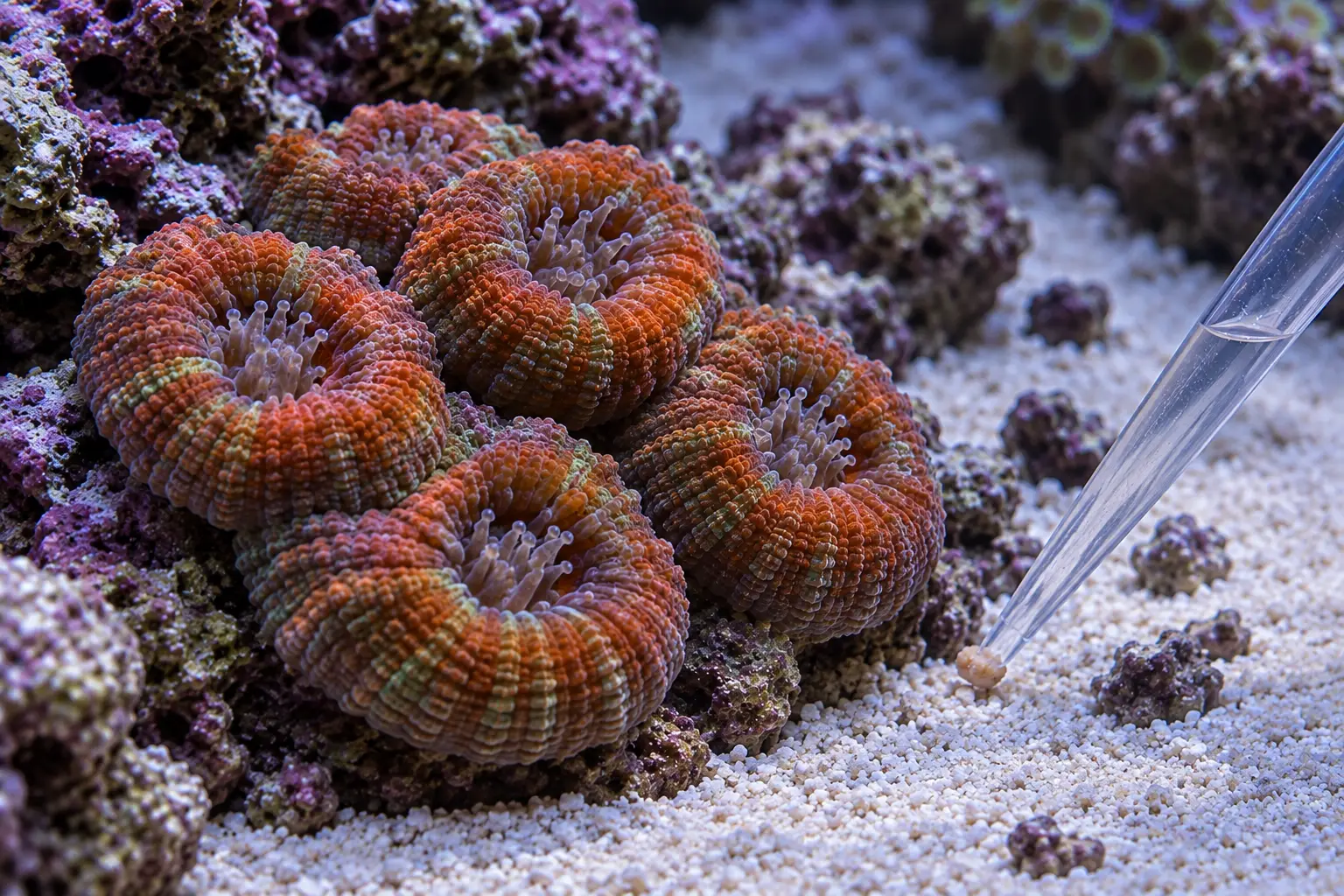
Compare the colony at the same lighting stage because normal inflation changes through the day. If several polyps stop responding, verify water chemistry and inspect for sediment, damage or competition before changing foods.
How do fish and tank mates change the feeding plan?
Fast fish and shrimp may remove food before the coral swallows it. Feed fish first, use a feeding guard when appropriate, or place the coral's portion after the most competitive animals settle.
If you use a feeding guard, keep it from burying the colony or leaving the tissue in stagnant water.
Can an acan survive without target feeding?
A healthy colony under appropriate light may persist and grow using photosynthesis and naturally available suspended food, especially in a mature reef. That does not prove every unfed colony is receiving enough energy, because light, dissolved nutrients, particle availability and species condition differ.
You should use target feeding as a controlled husbandry tool rather than as a rescue for poor light or unstable chemistry.
When should you stop feeding and investigate?
Pause target feeding when tissue is receding, mouths remain abnormally open, brown material develops, food is repeatedly rejected or ammonia becomes detectable. Remove leftovers, test the water and check whether a recent salinity, alkalinity, lighting or flow change preceded the response.
Rapid tissue loss across multiple polyps needs prompt expert assessment. Do not respond by pushing food into damaged tissue or adding unverified dips; preserve stable water, document the timeline and seek an aquatic veterinarian or experienced coral-health professional.