
Why Is Your Aquarium Air Pump Loud, and How Do You Fix It?
A loud aquarium air pump usually comes from transmitted vibration, contact with a cabinet or tubing, restricted airflow, a worn diaphragm or a pump working beyond its useful capacity. Isolate the sound first, then change one part of the air path at a time.
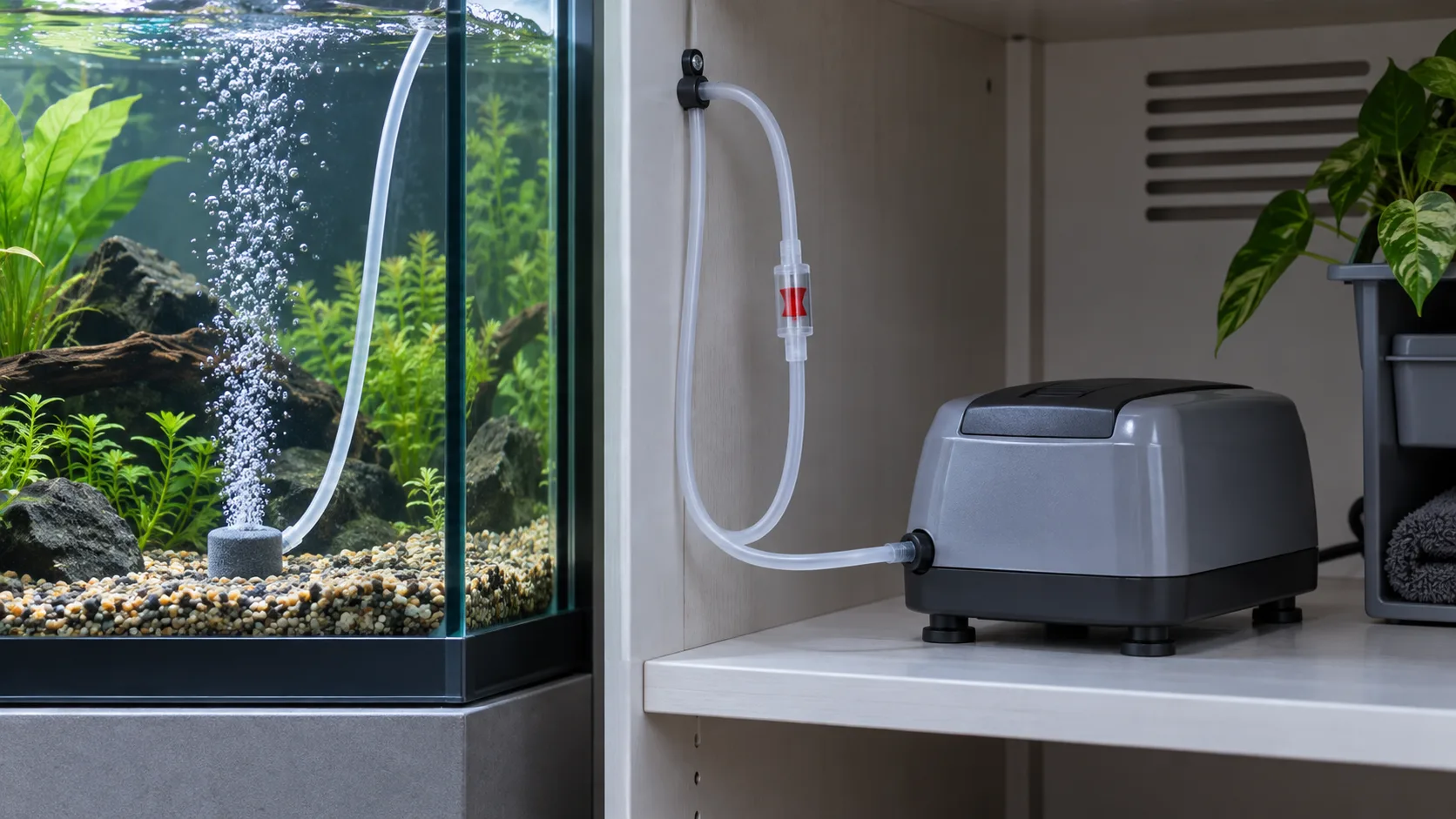
What kind of noise is the pump making?
A low hum amplified by furniture usually points to transmitted vibration.
Rattling suggests contact with a wall, lid, cable or loose case part; a strained buzz with weak bubbles points toward restriction, while clicking or irregular knocking can indicate internal wear.
You can listen from the pump, shelf, airline and aquarium rim without opening the case.
Disconnect power before moving or servicing the pump. If the plug or socket is wet, do not touch or unplug it: isolate the circuit from a safe, dry location and seek qualified help if that cannot be done safely.
- Hum grows when you touch the cabinet
- Structure is amplifying normal vibration
- Rattle stops when tubing moves
- Airline or valve is striking a hard surface
- Pitch rises while bubbles weaken
- Air path may be restricted
- Noise persists with approved known-good accessories
- Check placement and seek model-specific service advice
- Pump is unusually hot or smells burnt
- Stop use and disconnect power safely
How do you check restriction safely?
Check the model manual before testing: EHEIM air pump 100, 200 and 400 instructions prohibit running an air connection without its hose and outlet. Do not use a bare-outlet test on these pumps or assume it is permitted on another model.
With power disconnected, inspect tubing, valve direction and the diffuser, then replace a suspect part with a compatible known-good one. Reconnect every outlet as the maker specifies before restarting, and compare sound and delivered airflow.
Keep essential aeration or air-driven filtration running from a safe backup during servicing. Do not block an outlet with a finger, and stop testing if heat, burning smell, water ingress or damaged wiring suggests an electrical fault.
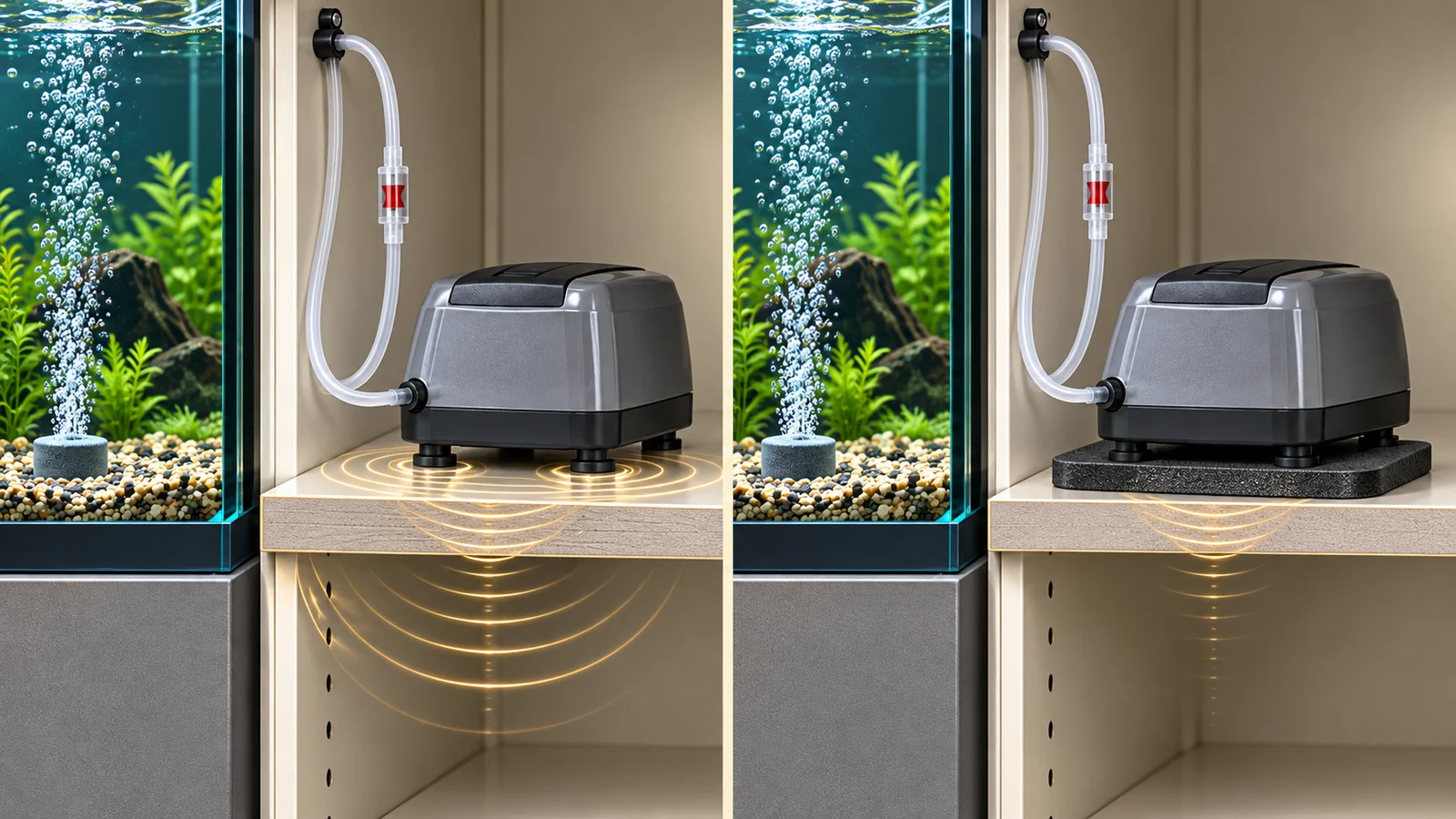
How do you stop transmitted vibration?
You should place the pump on its intact rubber feet over a dense, stable vibration pad. Keep it off hollow lids, thin cabinet shelves and resonant wood panels.
Leave ventilation openings clear.
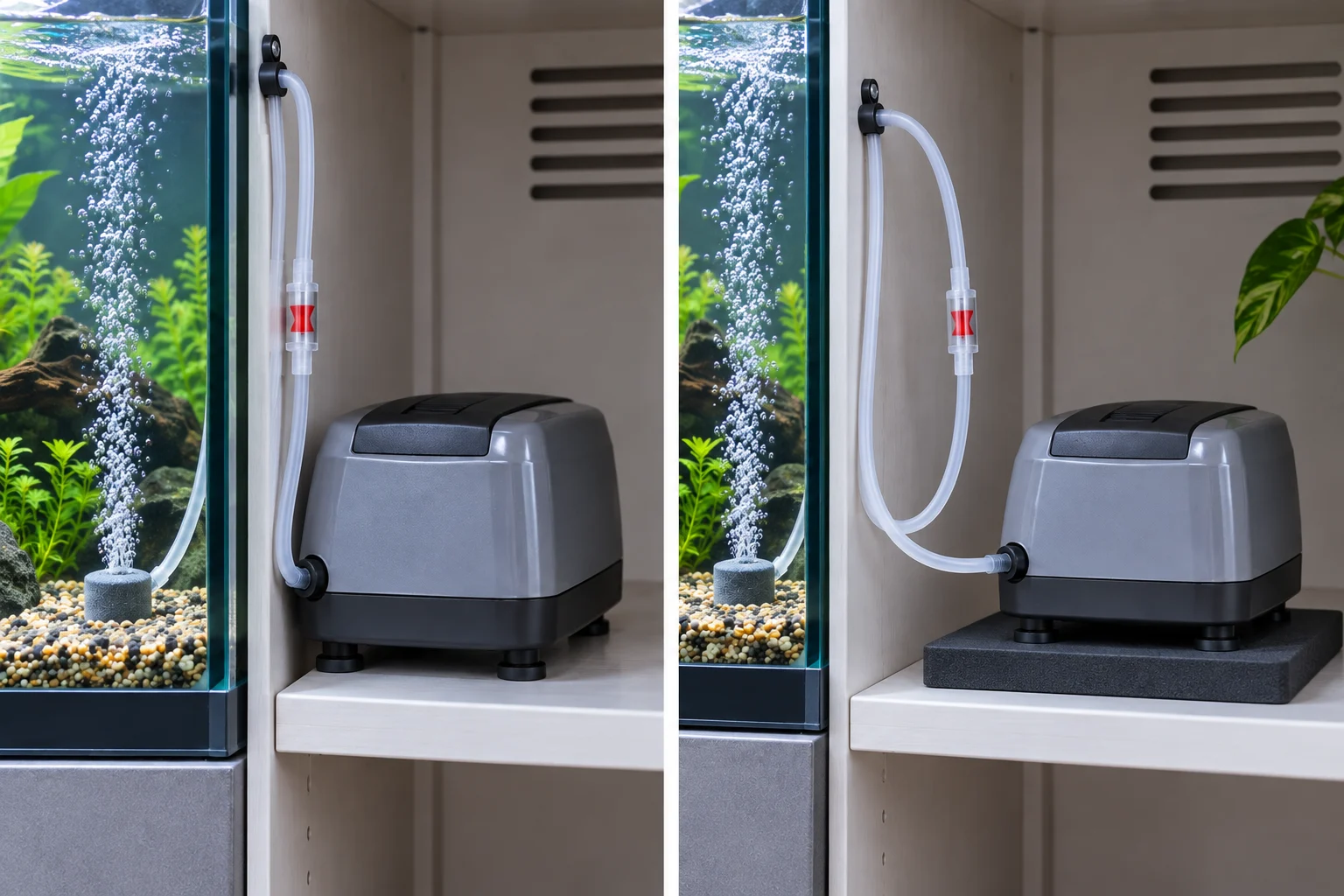
You should not wrap the pump in towels or foam. Trapping heat and blocking intake air can shorten component life and creates a worse failure than the original hum.
Can the airline make the pump louder?
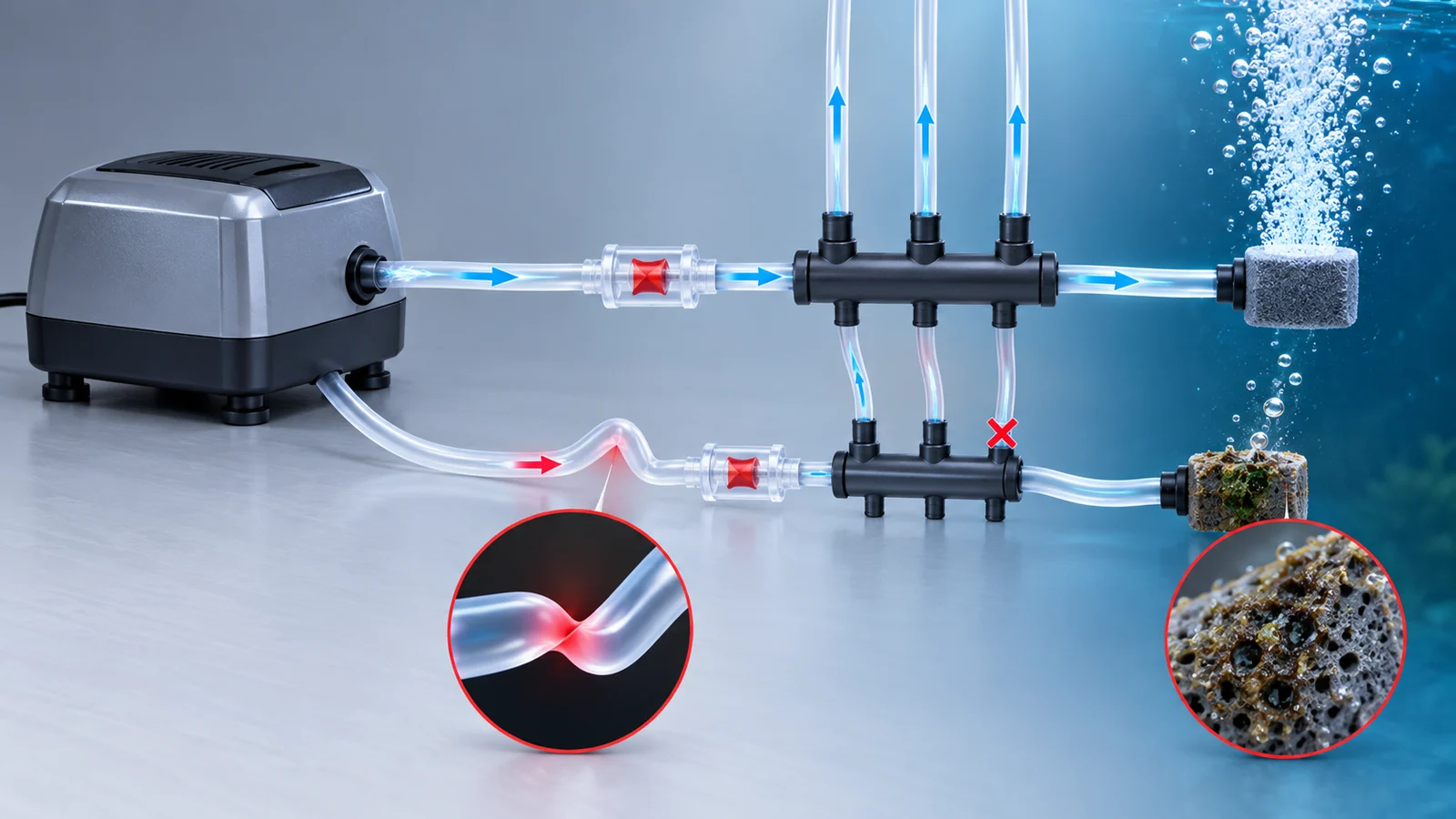
Yes. A kink, clogged air stone, reversed or undersized check valve, nearly closed manifold or excessively long narrow tube increases back pressure and changes the pump tone.
Straighten sharp bends and replace damaged tubing or a clogged diffuser with approved parts while power is disconnected. Change one suspect component at a time so the result identifies the restriction.
Where should the pump be installed?
Manufacturer instructions should own placement for the exact model.
For these EHEIM models, the manual requires installation outside the aquarium and above its water level, but not directly over the tank where the pump could fall in. A check valve does not cancel that placement requirement.
Other models may permit different arrangements; follow their own placement and backflow instructions rather than transferring an exception between pumps.
You should keep the unit dry, ventilated and accessible. Form the airline so condensation or a small spill cannot run toward electrical connections.
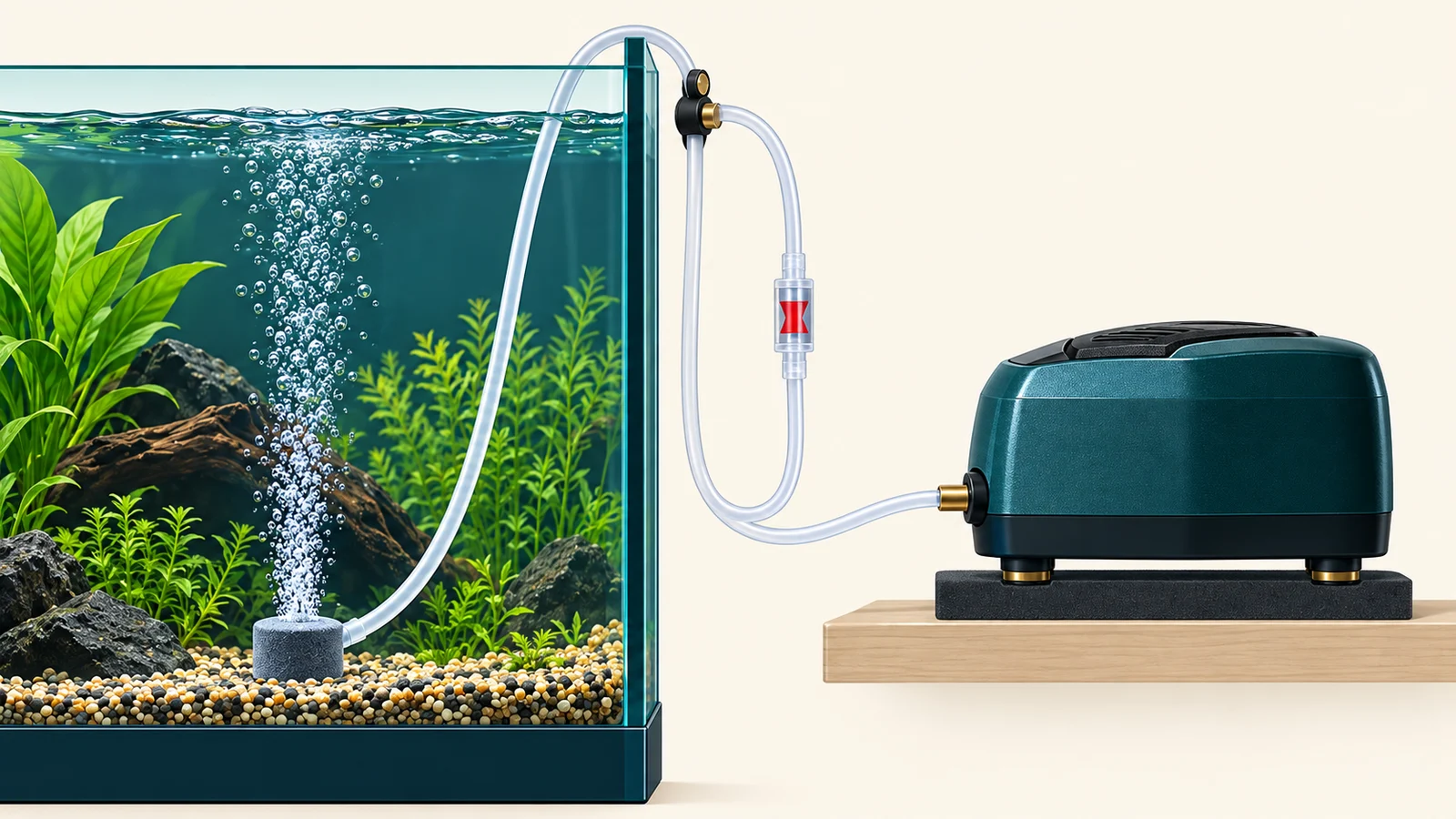
When is the pump too small or too large?
A small pump driving several deep tanks, fine diffusers or a restrictive manifold may run loudly near its limit. An oversized pump throttled almost closed can also create noise and wasted pressure.
You should match output to water depth, number of outlets and the resistance of the connected devices. Bleed excess air only through a safe arrangement approved for the system, not by creating a leak inside a closed cabinet.
Does bubble size tell you how much oxygen fish receive?
Fine bubbles provide water movement and surface exchange, but the bubble cloud alone does not measure dissolved oxygen.
Temperature, stocking, biological demand and surface circulation still matter.
Never silence essential aeration without an equivalent safe replacement. If the pump drives aquarium filtration, reducing its output also changes filter circulation; a quieter bubble stream does not prove adequate oxygen or filtration.
When should you replace the diaphragm or pump?
You should check whether the manufacturer sells a service kit and whether opening the housing is an intended user task. A hardened diaphragm can reduce output and increase noise, but cracked housings, damaged cords and water ingress call for replacement rather than improvised repair.
Compare the cost and remaining condition of the unit. New feet will not solve a worn mechanism, and a new pump will still sound loud on the same hollow shelf.
How can you locate the vibration path by touch?
With dry hands and no exposed electrical risk, rest one fingertip lightly on the shelf near the pump, then on the cabinet side and aquarium rim. A strongly vibrating surface may be acting as a sounding board; disconnect power before repositioning the pump, keep tubing relaxed, then restart to compare.
Do not press on the case to silence it for long periods. Pressure can mask a loose housing part without fixing it, obstruct ventilation or shift the unit until a foot hangs over the pad.
Move cables and tubing away from panels one item at a time. A stiff airline touching a cabinet wall can transmit a surprising amount of motor vibration even when the pump itself sits on a good mat.
What does back pressure do to an air pump?
The diaphragm must compress air against the resistance created by water depth, valves, narrow tubing and diffusers.
As resistance rises, delivered flow can fall while mechanical noise and heat increase, depending on the pump design.
| Test | Observation | Likely owner |
|---|---|---|
| Inspect with power disconnected | Kink or reversed valve found | Correct routing or orientation before restart |
| Approved known-good tube and diffuser | Flow improves after restart | Replaced component or routing was restrictive |
| Valve added | Pitch changes sharply | Valve direction or resistance |
| Known-good diffuser | Flow recovers | Old diffuser is clogged |
| Approved accessories connected, noise remains | No meaningful change | Pump, feet or support surface |
Use a known-good component rather than judging by appearance. A porous stone can look clean outside while mineral deposits or biofilm restrict its internal passages.
How should a multi-outlet manifold be balanced?
Begin with all intended outlets open, then adjust gradually while watching the weakest and deepest branch. Closing one valve sends more pressure elsewhere, so balancing by eye can make a shallow stone vigorous while a deeper sponge filter receives too little air.
Keep essential filtration distinguishable from decorative bubbles. If several tanks share one pump, label lines and ensure one accidental kink cannot remove aeration from an unseen aquarium.
Recheck after cleaning or replacing a diffuser because resistance changes. A manifold setting that worked with an old clogged stone may overdrive a new low-resistance one.
How can you tell normal sound from impending failure?
A steady low hum that has not changed and cannot be heard beyond the cabinet may be normal for the model.
A new rise in volume, falling output, intermittent start, internal knock, excess heat or electrical smell shows that conditions changed.
- Compare noise with compatible known-good tubing and diffuser connected as instructed.
- Confirm every rubber foot is present and level.
- Move tubing and cable clear of hard panels.
- Inspect kinks, valves, manifold and diffuser in order.
- Check output at the deepest or weakest branch.
- Review the manual before opening or servicing the housing.
- Replace the unit immediately if electrical safety is uncertain.
Record the normal sound after installation with the cabinet open and closed. The recording is not a calibrated measurement, but it gives you a useful baseline when deciding whether a later buzz is genuinely new.
What if the bubbles are loud but the pump is quiet?
Large bubbles breaking at the surface can splash a lid, resonate in a hood or create a sharp popping sound. Move the diffuser away from glass and equipment, confirm it remains upright, and compare a clean diffuser that produces the bubble size intended for the pump.
Do not reduce aeration blindly at night or during hot weather. If you throttle the line, confirm that fish respiration, surface movement and any air-driven filter remain safe at the lowest point in the daily oxygen cycle.
A lid can amplify splash noise when condensation trays, feeding doors or light covers sit loose. Secure only the parts designed to be secured and preserve ventilation; adhesive fixes near heat, water and electricity require material approval.
Can a pump be placed inside a closed cabinet?
Only when the manufacturer permits the orientation and the cabinet provides dry, clean ventilation. A closed compartment can reduce airborne sound but may increase heat, recirculate humid air and turn the cabinet panels into a larger resonator.
Keep the air intake away from aerosols, smoke, solvents and dusty maintenance supplies. An aquarium air pump moves room air into the water system, so hiding it beside household chemicals creates a risk unrelated to noise.
Route the airline without crushing it at the cabinet door and keep the pump accessible for inspection. A quiet installation that cannot be checked for heat, moisture or failing feet is poorly designed.
What should you record before replacing the pump?
You should note the model, age, water depth, number of outlets, connected devices and whether replacing a suspect accessory changed the sound. Record which surface it sat on and whether output weakened, because this separates an undersized installation from a defective unit.
Compare replacement performance using the same tubing and one known-good diffuser, then rebuild the manifold gradually. If the new pump becomes loud only after every old component is reconnected, the restriction remains downstream.
Retain proof of purchase and use the warranty path for a sealed unit. Opening a pump prematurely can compromise electrical safety and remove the manufacturer from a problem it should own.
If the pump still knocks, overheats or loses output after external restrictions are removed, stop using it and move essential aeration to a safe backup.
Sources
EHEIM air pump operating manual
Read next
Check mechanical filtration, biological filtration, cleaning a sponge filter and aquarium check valves for the connected system.